Feeds:
Posts
Comments

What we wish for

We all need money. Can’t live without it. And money is very unequally distributed which means some don’t have enough to live on and others have so much they don’t know what to spend it on.

My concern though is that our societies have become too money oriented. Money has become a god. It’s presented as the top priority over all else. We hear a lot these days about debt, both personal and national (although these two kinds of debt are really not alike!) and about “growth”, “wealth” and “profit”, without much detail behind these words. I even heard U.K. politicians talk about creating an “aspiration society” when they proposed reducing taxation for those earning over £150,000 a year.

Aspiration is not all about money. I worked all my life as a doctor and never aspired to earn over £150,000 a year. I don’t know any doctors, nurses, carers, teachers who do. In fact very few people in the world ever do aspire to, or expect to, earn over £150,000 a year. They have other, non-financial motives.

I’ve heard the U.K. described as “U.K. PLC” as if it’s a business. It isn’t. A country is people living together. It’s a community. We should aspire to creating a healthy community which enables individuals to flourish, to develop their talents, to thrive physically, mentally and spiritually.

Somehow we need to put money back in its rightful place – a good servant – because it’s a terrible master. Greed isn’t good. It’s destructive.

Here’s the poet, John Clare – “Poor greedy souls – what would they have/ beyond their plenty given?/ Will riches keep ‘em from the grave?/ or buy them rest in heaven?”
Moonlight

I’ve started a daily habit of reading some poetry. I’m doing this for two reasons. First, because I enjoy poetry, and, second, because poetry activates the right hemisphere of the brain, and I think we all need to do something to reset the imbalance between our cerebral hemispheres.

Since moving to rural France I’ve encountered the natural world close up much, much more frequently than at any other time of my life, so it seems obvious that I should start this new practice with some nature poets. I’ve chosen William Wordsworth and John Clare.

We were exposed to a little Wordsworth at school….well, daffodils, you know, as I suspect you were too. But it didn’t click. And John Clare? I don’t think we read any of his poems at school.

In my first few days of this practice I’m immediately struck by how often Wordsworth conjures up sounds and music in poetry. Here’s an example…

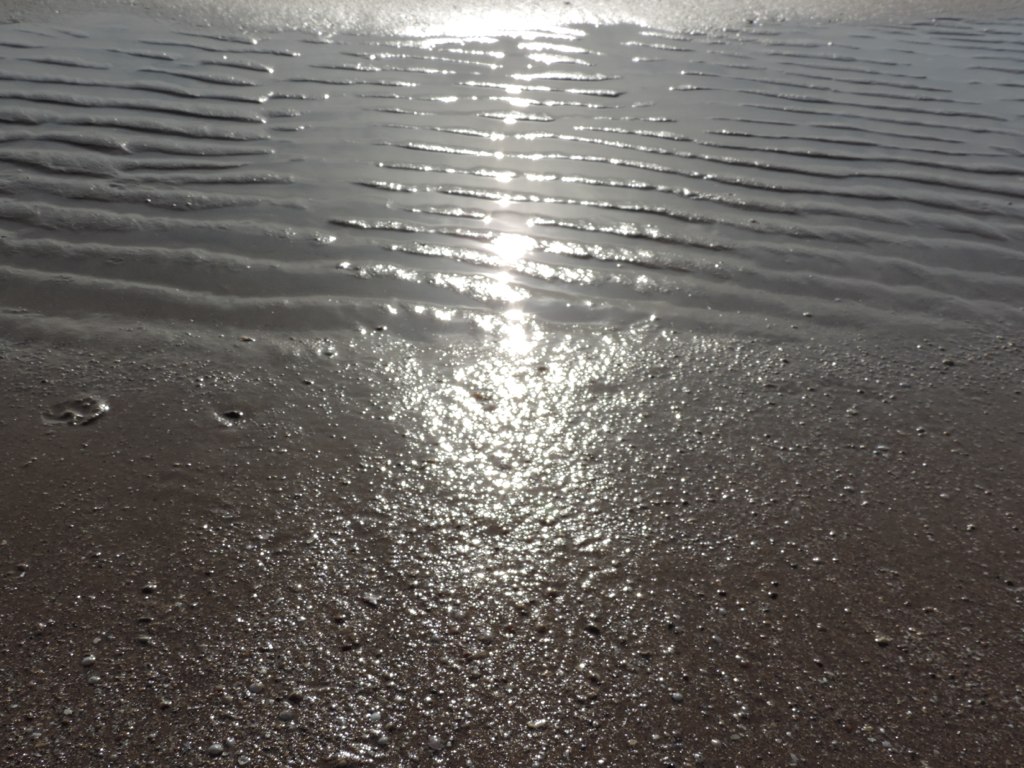
Or gaze upon the moon until its light/fell like a strain of music on his soul/and seemed to sink into his very heart.

Isn’t that lovely? It conjures up an image, music, and spiritual feelings all at once.

I’m happy to just read a verse like that a let it do its work, as it, like the strain of music he describes, sinks into my “very heart”.

But I’m also struck by how he uses both “soul” and “heart” in the same phrase. They aren’t completely interchangeable terms but they both refer to something deep, and invisible, and important, within us. Something which can’t be observed from outside, which can’t be measured, but which, I would argue, is essential for a good, full life.

Looking for meaning

Our brains are brilliant at spotting patterns. The psychiatrist and neuroscientist Dan Siegel, author of “Mindsight”, says our frontal lobes are responsible for creating three distinct types of map – “a you map, a me map, and a we map”. These maps are created from the patterns we spot, the shapes, events, habits, behaviours, feelings etc. They are how we recognise ourselves and others, how we know what to expect, and most importantly, how we make sense of life.

We are meaning seeking and meaning creating animals. We are driven to understand, to interpret our experiences and to classify and integrate them.

We weave our interpretations and understandings into the stories we tell others and ourselves.

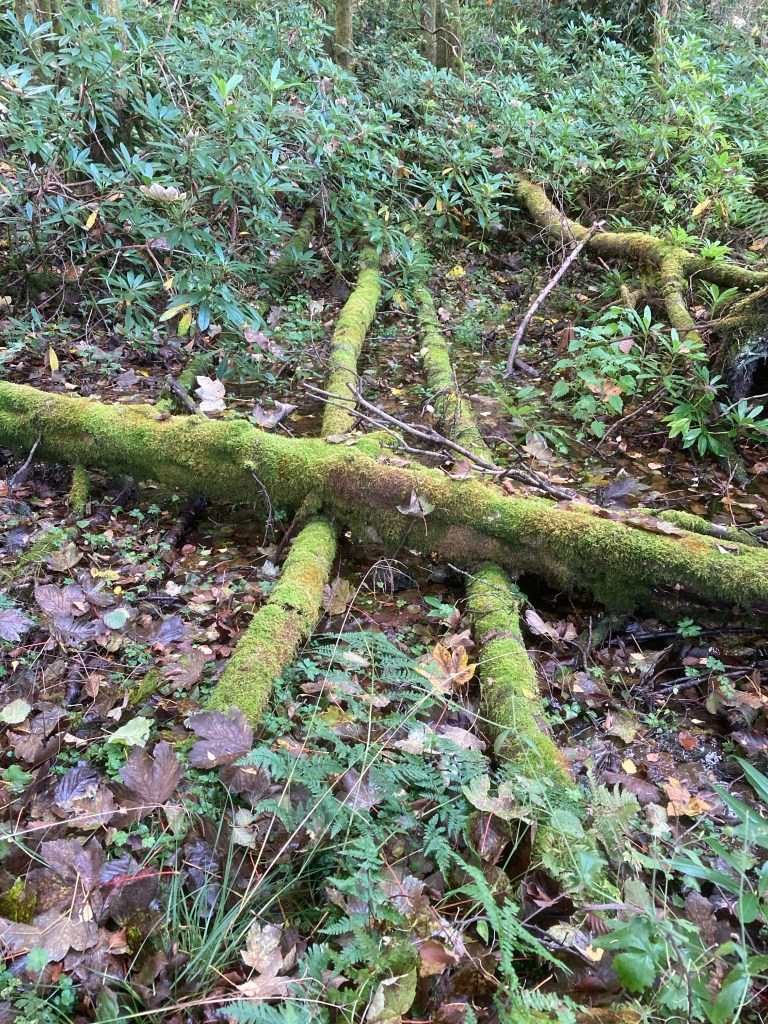
But we have to remain a bit sceptical. We have to retain the ability to doubt, because sometimes that giant letter “A” in the forest is just three logs which landed precisely there.

That’s the problem with discerning cause and effect. We are complex adaptive organisms, open systems embedded in multiple layered and interconnected environments.

To say that “this” caused “that” is, at best, only a partial truth. There’s always more to know, there are always more factors playing a part. We never know it all.

The light

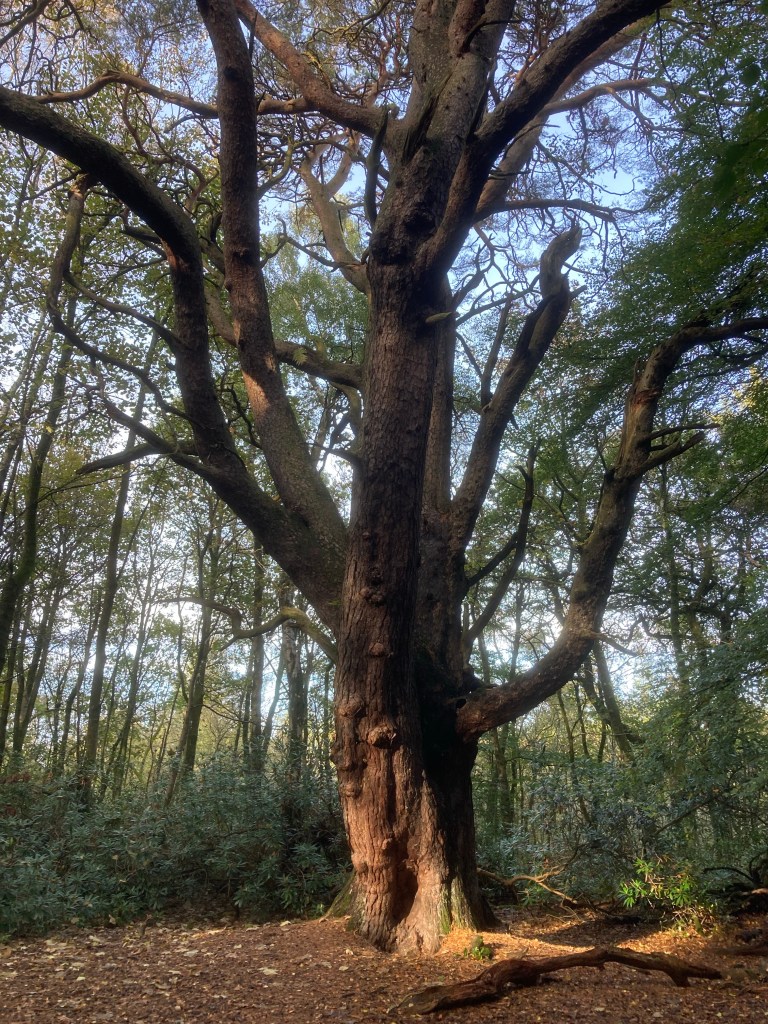
I was about to write “What strikes me most about this scene is the light”, then I suddenly had the thought “We can’t actually see light, can we? What strikes me here is the tree and the way it is lit”.

Light travels throughout the universe but the universe remains dark. It floods the Earth but we only see it when it is reflected, and even then what we see is whatever it is that’s being reflected – in this case, a tree.

Even when we look directly at a source of light (don’t look directly at the Sun!), for example when we see a car’s headlights at night, we see the source itself lit by the light – we see the headlights, not light itself.

How can light be so bright yet remain invisible?

C S Lewis wrote about a sunbeam in his shed and compared the two experiences of seeing the beam of light as it lit the millions of dust particles in the air, and of looking along the beam itself to where the light entered into the shed. But, here, I find myself simply delighting in the phenomena of reflection and illumination, how light makes everything we can see visible, but remains invisible itself.

Some say God is like this. They say we can’t see God directly but we see God reflected in the forest, the birds, our loved ones. God illuminates, reflects, brings into existence all that is.

I’ll leave you with that thought for a Sunday morning.

As above so below

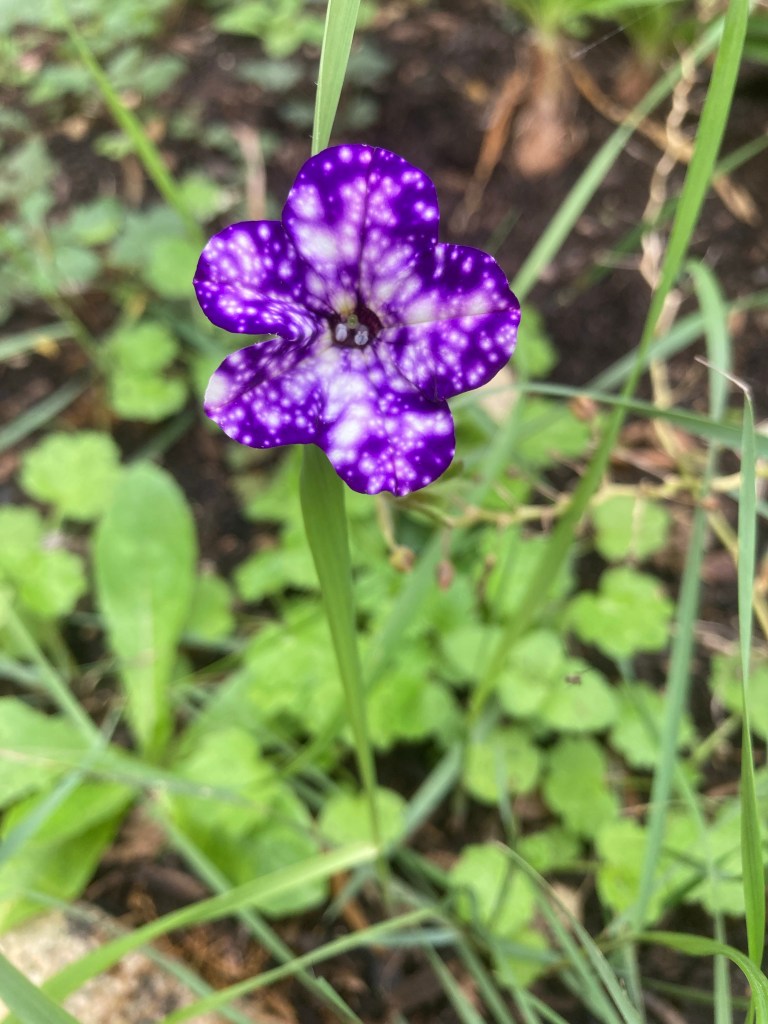
This is one of my most favourite flowers in our garden. It’s a Petunia and it looks like the night sky.

When I look at this I see the stars stretching across the sky above me at night and I think of the old saying, as above, so below, and I think of all the complex, fractal symmetries which exist in our universe.

I pause, I wonder, I am amazed.

One little flower can deepen the joy and awe of an everyday life. It sets my mind soaring up to the heavens, down into the soil of the Earth, flying through the vast web of connections and patterns I live in. It engages me, yet again, with what is greater than me, with The Other, The Divine, with the Life Force.

An autumn gathering

I noticed these autumn leaves when I was out on a walk recently. What caught my eye was their colour. Look at the variety of shades of brown, yellow and red. Aren’t they beautiful? Together they really capture the idea of autumn, don’t you think?

I love how they have gathered together in this little hollow in the tree. Of course, not a single leaf made it here under its own steam. Each was probably simply blown in the wind. I wonder, did they arrive separately or did they travel together through the air, a tiny handful of individuals lying together on the forest floor, whisked up as a group by a gust, and blown into this hollow?

It makes me wonder about randomness and chance. Nobody looking at these leaves still growing on a tree, could’ve predicted that they would have ended up here. There are just too many factors involved in creating this event, for anyone to calculate and predict. Yet we fool ourselves into thinking that’s possible, don’t we? We think that if all the “relevant data” were collected then we could invent a computer to make exactly this prediction.

It’s not true. We humans are not capable of knowing absolutely everything. So much about Life and the Universe is literally unknowable. Unknowable and unpredictable.

So maybe it’s time we changed direction and stopped pretending we can control Nature and use everything we encounter as a “resource”.

How might we live if we approach the world, not as a resource to be consumed, but as a living planet to be experienced? Each day filled with wonder, each day to be savoured……filled with experiences and events gathered together by forces and circumstances which will never be fully known.

Creativity

I love art in nature. It’s always a surprise and when it’s installed in a forest, an old quarry, along the banks of a river…..it just seems to more than double the pleasure for me. It’s as if the creativity of nature and the creativity of a human being multiply each other.

My understanding of the Christian teaching of a creator God who forms human beings “in His likeness”, is that we, too, are creators. But whatever your religious belief it isn’t difficult to see that this universe in which we live is a creative one. Creativity is at the heart and core of evolution. The trajectory of the universe is towards ever greater complexity and diversity….in other words creativity.

I think a lot of people think of creativity as synonymous with art, with music, sculpture, dance, literature and poetry. Well it does lead to all those wonderful activities but every one of us is creative every single day. Every one of us expresses our uniqueness moment by moment. We constantly adapt, we repeatedly solve problems, we never cease to be the heroes of our own stories.

Creativity – it’s what we do.

The invisible

I love to see a reflection like this. It’s beautiful. It also makes me think…..because when the reflection is as vivid as this we can’t see what lies beneath the water’s surface.

When I know there’s something there but I can’t see it I think of the invisible.

We are surrounded by, penetrated by, made of, three flows….material, energy and information. Only the materials are visible, and those only on their surfaces.

We can see the food we eat, the water we drink, but not the molecules from which they are made….at least not unless we use a microscope.

We can’t see the flows of energy which vibrate within us…the electromagnetic energies, the Life Force, the energies we call “vibes” which we can pick up when we walk into a room.

We can’t see information but our bodies detect it in several forms all the time, using our senses. We process all the information constantly, passing it through our bodies, our heart, our gut, our brain.

Most of what happens in our body and our brain, moment by moment, is invisible. We say it occurs unconsciously.

Crucially, and this is something we routinely forget, our entire experience of life is invisible. Only I know what life is like for me. Only you know what you are experiencing. We all live as subjects, and the subject never reveals itself as an object.

We know each other, subject to subject, only by getting in tune with each other, by resonating with each other. Saint Exupery put it best…It is only with the heart that one can see rightly; what is essential is invisible to the eye.

Long life

I came across this yew tree on my forest walk at the weekend. I understand it’s pretty difficult to know the age of a yew tree but I felt I was in the presence of an ancient being.

Yews are estimated to live 400 – 600 years but one is Scotland is thought to be 2,000 years old. These figures are simply astonishing. We humans have a life expectancy of around 80 years, a figure which has shrunk somewhat in the last few years. There are some famous billionaires who are investing heavily in “life extension technologies”, but it seems to me that whole ambition is poorly conceived and remains well in the domain of science fiction. I can’t see human beings living to an average 400 – 600 years any time soon!

What does it mean to live hundreds of years? Not as a human, but as a tree? What do you think? Can you imagine what it might be like….for a tree?

There’s something I find strange about evolution. Clearly it’s not all about selecting for survival. There are unicellular creatures which have lived way, way longer than trees. If survival and longevity was the essential principle of evolution why do we have more complex, multicellular organisms such as, say, trees, or human beings? The more complex the creature, the shorter the lifespan, apparently. Is that true? Correct me if I’ve misunderstood.

Clearly the direction of travel of evolution is towards complexity and more highly developed consciousness. It’s towards beauty, truth and goodness. We are on a path, it’s just not the narrow path of life expectancy.

Wood wide web

I took a walk in the woods today, up Gillies Hill, on the edge of Stirling. I went in search of autumn leaves to photograph but, actually, I ended up mostly taking photos of fungi.

The strange beauty of these fungi is utterly compelling. They draw you down onto the forest floor and pull you in the get as close as you can.

This is the time of year when a whole underground world becomes visible. These incredible fungi are only the above ground manifestation of the astonishing network of fungi which live among, along, and within the roots of the trees. We know now that this network of connections sends materials and information from tree to tree, turning the forest into one great organism, every element of which is in constant communication with the rest.

Welcome to the “wood wide web”.