We have the impression that we are separate. We have a model of reality which tells us that everything which exists can be broken down into smaller and smaller pieces. We used to think that atoms were the smallest indivisible pieces, and that everything was made up of them.
Then we split the atom and found even smaller particles inside….electrons, neutrons, protons….then it turned out that inside there were even smaller pieces which we’ve called quarks.
But, hey, guess what, when we get down that far and look even closer it turns out there are no indivisible separate fixed pieces at the bottom of everything.
Instead we’ve discovered that it’s better to think of “fields”….fields of energy flowing into, through and around each other. As these fields flow and interact there are “events”, “happenings”, where what we call particles flicker, briefly, into existence, then they’re gone again.
So it turns out that “all is one”, and “one is all”. It turns out there are no fixed “solids” at the foundation of the universe. Instead there are vast energy fields, inter-relating, constantly bringing into being everything we can see, constantly transforming everything we see into something else.
Actually, given our rather limited range of sensory organs and our finite brains it’s highly likely there’s a lot more in the universe than we are capable of becoming aware of, let alone knowing and understanding.
At this point in our human development there is an enormous tendency to objectify life, to fill our view of the world with objects, objects which we seek to grasp hold of, to own and/or to use. We treat Nature as one of those objects. It’s a place, somewhere to go to. It’s a resource to be used, even plundered. It’s where we humans landed, as if from elsewhere.
But Nature isn’t like that at all. Nature is our home. We emerged in Nature and we never leave. We are like the waves on the surface of the ocean, not like aliens who have landed.
How we think of Nature deeply affects how we behave. Are we consumers or gardeners? Are we conquerors seeking to control or inhabitants seeking to live?
It seems to me that treating Nature as an object to be controlled or consumed has brought us to this juncture….where we humans might make it impossible for our grandchildren and their grandchildren to live here.
It’s crucially time to change our relationship to this world in which we live.
This is a drainpipe. But it’s not like any other drainpipe I’ve ever seen. I mean, have you ever noticed a drainpipe and stopped to take a photo of it? Nope, me neither.
But this speaks to something important. Too often we allow utility to be the beginning and the end. As if as long as it does what it’s supposed to do then that is entirely sufficient. However look what happens when someone with imagination, someone with a creative, artistic tendency gets involved.
For me, the expansion of effort and vision beyond and below simple utility makes our lives more fully human. It’s not just that the drainpipe is more beautiful and unique, it’s that my day was different, enhanced, by it being this way. I didn’t just pass by. I stopped, I looked with greater awareness. I stepped out of zombie mode, slowed down, and entered more fully into the present moment. On top of that I felt delight, joy and wonder…all emotions and experiences which make for a better life.
We don’t have to choose superficiality. We can experience a life of greater depth, a re-enchanted life by our encounters with beauty, by encounters with the creativity and imaginations of others.
Here’s the most basic paradox I explored with patient after patient. We are social creatures, who need to belong, to be connected, to have healthy, living relationships, to share time, space and activities which other, to discover what we have in common. Yet we are also, every one of us, completely unique. No two of us share the same life story. We all have different habits, tastes, preferences, even values.
I think this photo which I took at a river side music festival in Nantes captures this paradox, people connected and sharing, whilst also doing their own thing. (Note the two women lying reading books on this near side river bank, for example)
Can you see that sort of whirlpool in the middle of this stream? It’s a vortex, created by the flow of water itself.
When we look at a stream, or a river, we can often see a disturbance, usually caused by stones or sticks or something interrupting the flow of the water. But that’s not what this is. A vortex is created by an asymmetry within the flow of water itself. A resistance is set up and a vortex appears.
A vortex can be very brief, lasting just a few seconds, but this one continued as long as I stood watching it. I tried to take several photos but it was tricky. There’s always something lost in the still image of whatever is moving, morphing before your very eyes.
A vortex is a good example of how objects are not things. We focus on only parts of the world around us and we separate out elements within the flow to see them as objects. But the underlying reality is that nothing exists outside of the flow. There are no separate fixed objects, just areas in the flow which change more slowly than others. It’s the rate of change which allows us to see them as things. Nothing lasts for ever. You just have to consider a larger timescale and even whole continents shift shape and location.
Is this important?
I think it is. Because the view we take of the world influences how we experience our everyday. If we see the world as a collection of separate disconnected objects, some kind of giant machine that we are not part of, then we will act in certain ways. However if we see the world as a whole and massively connected, ever changing flow, then “things” become more transient, and we realise that we, too, are vortices appearing in the flow.
Wherever I go I’m drawn to the bookshops. This photo is of one of the oldest, and best known, bookshops in Nantes. “Coiffard”. Look at the sculpture they have above the front door….a reader holding an open book and a broken chain.
Maybe this is a reference to the fact that this is an independent bookseller, not a chain store! But, I think the meaning is deeper than that….it’s that reading can set you free.
My blog, you’ll know, is called “heroes not zombies”. It’s a call to wake up, to break the habit of sleepwalking through life, driven by habit, manipulated by others. It’s a call to awareness, to appreciate the wonder of the everyday and to become more conscious authors of our own life stories.
Reading has always seemed like a path to liberation for me. I love to learn. I love to discover. I love to have my thinking and my preconceptions challenged. In other words reading opens up a larger and a deeper world for me.
I also love to have my imagination fired up, to be thrilled, to be moved, to laugh and to feel more deeply. I love to enhance my powers of empathy so I can understand and connect with others more deeply.
Reading is one of my main paths. One of my main ways to experience today as a good day, a special day.
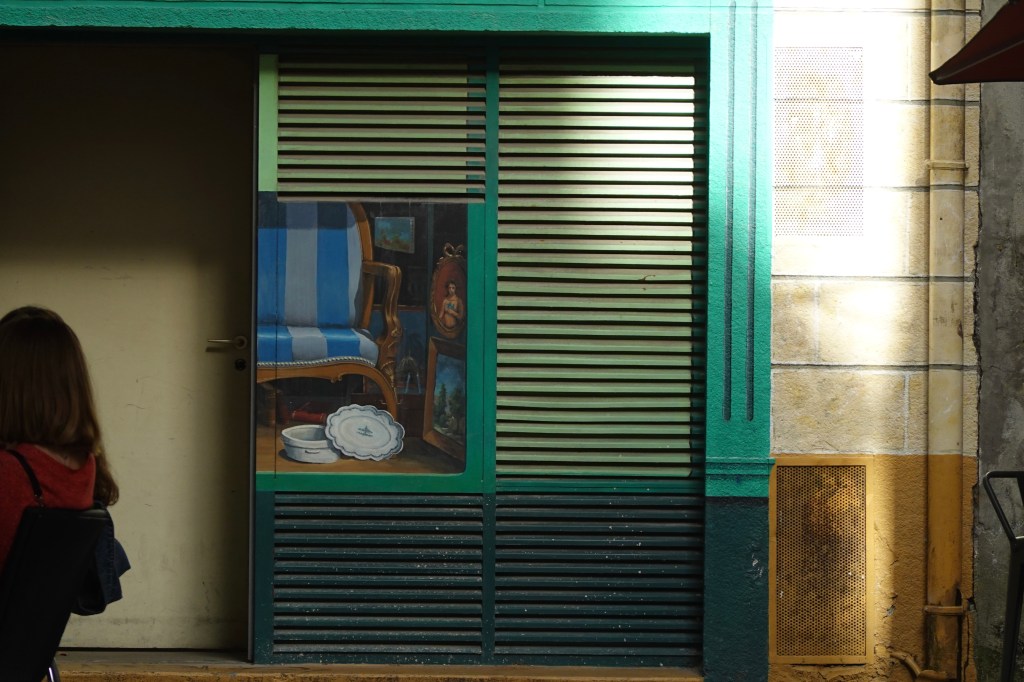
Colour, light, shadow, shape……I’m not sure exactly what caught my attention here. I was sitting sipping a cold beer outside a busy little bistro and I noticed the building opposite.
Maybe it was that bright shaft of sunlight which penetrated the trees which lined the square. I’m not sure, but I picked up my camera, zoomed in on this particular part of the building, and clicked.
When I look at it again now it reminds me of a Hopper painting. Something about the colours, the shadows, and the fact that it’s a street scene.
Whatever it was, the more I look at this the more beautiful I find it.
Isn’t there something important here? Isn’t this an example of how the universe draws us towards beauty?
Beauty is one of the three great classical values – good, true and beautiful. We find beauty everywhere, in the petals of a flower, a butterfly’s wing, the flight of a bird, a child’s laugh, a stranger’s smile, in music, paintings, poetry, sculptures, dance……
Beauty is an end in itself. The experience of beauty is the gift. In fact when we use beauty to achieve some other end….as advertisers do, then we lose something. It’s degraded by turning it towards utility.
Beauty attracts us. It captures our attention and stirs the soul. In fact, one of the greatest examples of beauty is the loving human heart.
What beauty did you encounter today? Or, better, why not set off today with the intention to encounter beauty? “There’s so much beauty in this world”, you can only miss it if you’re not paying attention.
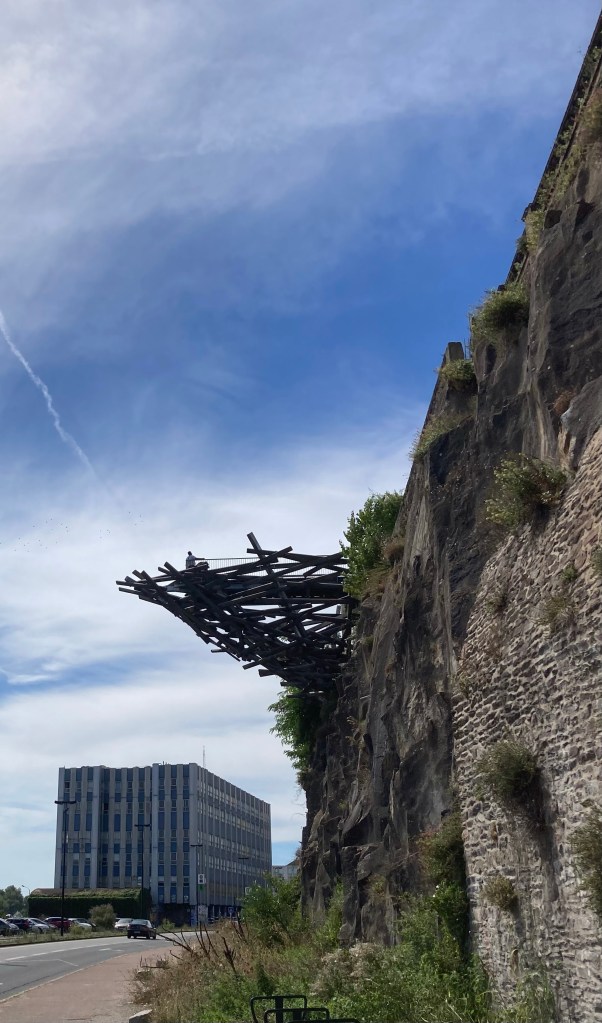
If you look very carefully you’ll be able to see a person in this photo. They are standing on that elaborate metal creation protruding from the top of the cliff. Can you see them?
This immediately made me think of one of the core paradoxes of life – significance and insignificance. This single human being looks so tiny, even from the perspective of this small part of the world. Think how tiny each of us are on this planet, Earth. Think how tiny we are in this vast universe.
Doesn’t that make you feel pretty insignificant in the whole scheme of things? It makes me feel that way. A single human being, a single life, lasting just a few years. In the vast scales of time and space it’s hard to see how any of us matter.
There are many people who think this way. They think the universe and all that exists came to be completely randomly. A series of utterly chance events producing all the stars, all the planets, all forms of life, consciousness. It’s all random and purposeless. Evolution proceeded by a series of spontaneous chance mutations which were “selected for” by the environment as more likely to promote survival. Any single organism in this view is both pointless and purposeless, apart from any usefulness they might temporarily provide.
Yuck!
Not convincing to me!
I spent my working life one to one with individual patients. I found every single one of them to be unique, every single one of them to be valuable and worthy of attention and care. So I start from the other end of the scale. The human one. And try to make sense of the universe from that perspective. Not by observing others as detached objects, but through compassionate engagement, subject to subject in relationship.
The figures don’t stack up for me. The chances of the stars coming into being completely by chance are infinitesimally small. So small some people have come up with the multiverse idea….that all that can happen does happen in an infinite number of parallel universes. But that strikes me as a cop out. It’s a mathematical trick to make the chance explanation feasible.
Then there’s evolution and life. The truth is that the most successful organisms in terms of survival are single celled ones. There are bacteria and amoebae millions of years old. But the direction of travel of evolution has been ever increasing complexity. We know of no more complex creatures than human beings. But we only survive around eighty years or so. Goodness, trees can live thousands of years, how come the direction of evolution has produced more and more complex creatures which can survive less and less years? Why didn’t it stop with amoebae?
And then how did consciousness come to be, and at what point? If it’s an end point in complex matter how does that work? How does consciousness “emerge” from matter?
Or did consciousness come first?
Has matter emerged from consciousness? Is the direction of evolution not survival as a quantitative phenomenon but the creation of ever greater complexity, difference, beauty and uniqueness?
I don’t buy the dominant materialist mechanical view. It doesn’t make sense to me and it appears to reduce human beings to cogs in a machine, flawed and replaceable. Life without purpose.
But I do buy a wholistic, connected, consciously value based view. That every single creature is a unique subject. That it’s relationships and experiences that we should focus on, over objects and parts. That each of us has a wholly unique role to play in existence. That the universe took 14 billion years to produce you, and that alone is pretty damn amazing.
I find wonder everywhere and everyday. The older I get the more I know I don’t know and that fills me with awe and respect. What a gift to be alive, to have this singular opportunity to contribute to the development of consciousness, to witness and create beauty, goodness and truth.
Do we matter? It depends on your world view. How does the universe appear to you?
There’s a lot of dock land development along the banks of the Loire in Nantes. The part which intrigued me most was the “Jardin Extraordinaire” – the extraordinary garden. It’s been created in an old quarry area known as the “Misery Quarry”, and, wow, has somebody transformed that land! There’s a 25 metre high waterfall, winding paths through bamboo and exotic plants. It feels like stepping into another world.
Look at this plant, for example. I have no idea what it’s called but it literally stopped me in my tracks. Isn’t it stunning? Isn’t it beautiful? Isn’t it utterly extraordinary?
The combination of colours and shapes make it appear like an explosion of life. I love it!
The whole garden has a feel of abundance and richness, although it’s obviously still pretty early days in terms of development with several signs indicating the plants are fragile so take care around them.
I’ve read up a little about this garden which was only created in September 2019. The old name of the “misery quarry” dates back to the 17th century before it became a quarry. It was said that the “miséreux”, the destitute, took shelter there. As a quarry it was a source of granite.
How wonderful to see this kind of reclamation. Well done, Nantes!
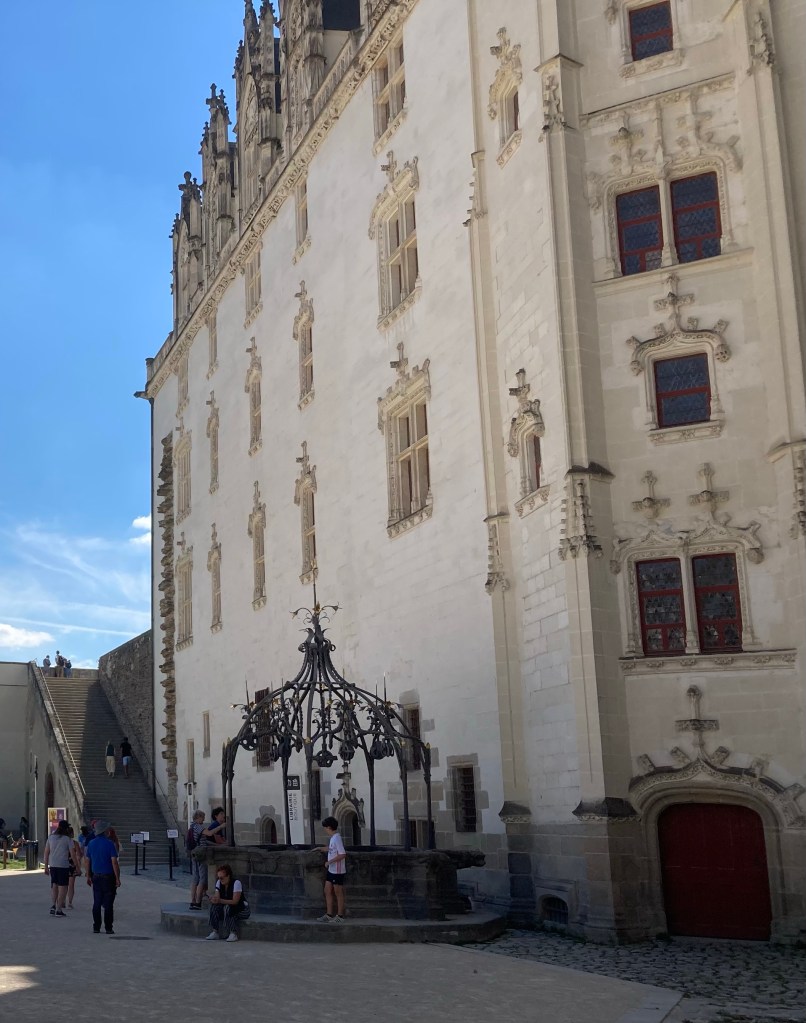
Inside the Chateau of the Ducs de Bretagne is this enormous old well. I don’t think I’ve ever seen a well with so many pulleys above it. It was obviously a very important resource.
I’m always impressed by creations which are beautiful as well as useful. Look at the ornate and elaborate iron work on this well. There’s an instinct in human beings to create, and an instinct towards beauty. Whoever built this well could have made a much more mundane (and ugly) structure to draw the water.
But with so called progress we’ve become a bit distanced from beauty. Time and again it’s sacrificed at the altar of utility, which in turn is constrained by profit making. So cheapness wins over beautiful all around us. Don’t you wonder as you stroll around an old city why, if we’ve progressed, if we’ve become richer as a society, it’s all the older buildings which look the most beautiful.
Ok I’m in danger of falling into a dualistic generalising trap here, because there are some stunningly beautiful modern buildings and some dreadfully ugly ancient ones! But my thought here is that beauty seems built in from the start in these old structures. Whereas often now it’s only an afterthought achieved poorly through decoration and trimmings.
If we don’t surround ourselves with beauty don’t we make our lives more superficial, and poorer?
I think we do.
It’s time to reconnect to our depths…..
It’s time to promote values and qualities instead of utility and profit. Good, true and beautiful stand the test of time.
I welcome constructive criticism and suggestions. I will not, however, tolerate abuse, rudeness or negativity, whether it is directed at me or other people. It has no place here. ANYONE making nasty comments will be banned.





 Heroes Not Zombies