Feeds:
Posts
Comments

This single distinct sunbeam pouring down from under the base of the cloud sitting atop Ben Ledi is beautiful. When I look at it I can’t help but see that it illuminates a particular area of the ground.

On a blue sky day the sunlight illuminates large areas of ground pretty equally but with weather like this where sunbeams drill down through gaps in the clouds we see certain parts, particular areas, more distinctly than the rest.

We do employ these two modes of attention all the time. We have a wide, open attention which takes in the whole scope with a broad brush. And we have narrow focused attention that emphasises certain parts.

I was taught the practice of Medicine in a particular sequence – the story, the physical examination, then the investigations.

Diagnosis begins by paying attention to the whole person, using both these modes to elicit particular aspects of the patient’s story whilst continuously contextualising every element.

I was taught that the bulk of diagnosis would emerge from the story. After that a “relevant” physical examination would allow the potential discovery of certain physical changes in the body. Finally, some tests might be needed to be more sure – blood tests, x rays, scans etc.

We were taught this process in a pretty linear manner. But the idea was that as you gained experience and skill you integrated the various approaches, no longer needing to stick to a rigid, linear sequence.

What I gradually came to realise was that this approach prioritised the subject, not the object. It shone the bright light of understanding on the unique person’s story, on the particulars of their experience and contexts. None of that could be measured.

The accessory elements were those which considered the person’s body as an object, to be examined, probed, observed and measured.

It was all important of course and not hierarchical….each aspect informed the whole, the understanding of the whole person.

The trouble, I think, emerges if we prioritise the object to the exclusion of the subject.

I’ve heard young doctors say they’ve learned “Don’t believe what the patient says. You can only trust the data” (by which they mean the measurements). This strikes me as seriously misguided. If the doctor doesn’t believe what the patient says how can they know them, how can they understand them, and how can they establish trust? In fact how can they even make a good diagnosis?

There’s a danger in putting too much attention onto the physical findings….especially when the physical findings don’t reveal the problem.

So much of what we experience can’t be observed and measured by another – pain, energy, nausea, dizziness, itch, hypersensitivity, emotions, thoughts, values and beliefs.

Only the unique human subject can express those experiences others. And they do that through their story, through their behaviour, and, ultimately through their body.

Funny how we need to pay attention to the invisible to know the human, huh?

Genie

You could say “It’s just a cloud”, but that word, “just”, sets up a whole series of limits. It limits the imagination, cutting it off before it gets going. It limits meaning, preferring only the superficial one, and choosing not to dive any deeper. It limits attention, because who is going to linger over anything that is “just” something? Who wouldn’t want to move on and try to find something which is “more”?

So, it’s not “just a cloud” when I look at it.

This cloud has shape and form. It seems to come from a narrow origin point down in the bottom left of the photo, and to swell out rapidly to fill the image’s entire top edge. It has a form like a cone. Or like a river expanding into an estuary. Or it is like a puff of smoke spreading out into the wide blue yonder.

Or it’s a genie……just escaped from a bottle.

I heard that phrase used the other day there, so that’s probably why my mind opened up the possibility of this being a genie. I heard an epidemiologist replying to the question, about covid, “When will this all be over?” (haven’t we all been asking this question again, and again, for many weeks now?) He replied “Once that genie got out of the bottle, there was no putting it back”.

So, that’s that then.

Covid is here to stay.

Or it’s not.

Because, if there is one thing I’ve become ever more sure of during this pandemic, it’s that nobody knows. Nobody is any good at predicting the future.

There’s something else I’ve become sure of during this pandemic. You can’t be sure of anything.

There have been, and continue to be, plenty of people claiming certainty. People claiming they know exactly what to do, what measures to enact, what advice to give. People claiming they know that they are making the best possible decisions based on the best possible science. But then things change again. And it turns out their certainty was misguided, or worse, a pretence.

Does all that sound a bit bleak?

Well, I think it probably does, and there are certainly times during this pandemic where each of us feels somewhat overwhelmed, a bit flattened, a bit done in by it all. Different people have had different challenges, different traumas, different problems to deal with. Some, on the other hand, have profited. Some have cashed in with lucrative contracts. The richest 0.1% have got a lot richer I believe. But that just goes to show, this genie doesn’t have the same effect on every one of us, does it?

But here’s the thing. This genie has made a few things a lot more clear.

It’s clearer now than ever that change is the only constant. The virus has changed, our responses have changed, the pandemic has changed. And that isn’t going to stop. So when the epidemiologist says covid is here to stay, it doesn’t mean life is going to stay this way……because that’s not what life does.

We change too. We adapt, we reflect and re-consider. We make new choices. We can make new choices.

What I see more clearly now than ever is that our societies are vulnerable, our way of life has become precarious, and that we should attend to those failings if we want a healthier, more sustainable, way of life. Just look at who has been hit the hardest by this bug. The elderly, the poor, the disadvantaged, the chronically sick. Is it beyond us to come up with better ways to look after the elderly, to reduce poverty, to address injustice and unfairness, to enable those with chronic ailments to live healthier, stronger lives? Surely not.

Actually a lot of light has been shed on many issues since this genie got out of its bottle.

We’ve learned the value of community, of living locally, of spending more time with family and less time commuting. We’ve discovered some of the joys in the everyday present, some of the wonders and delights of the here and now. We’ve realised how interconnected and interdependent we all are.

We’ve seen and heard countless stories of acts of care, compassion and commitment. Can we build on those? Can we nurture those?

We’ve learned that many of the poorest paid workers are actually “key workers” or “essential workers”. Will we remember that, as the pandemic wanes?

Perhaps more than anything we’ve learned that we human beings are social creatures. We need each other. Relationships and communication are important to us. We’ve learned that when we work together, when we collaborate, rather than competing with, or fighting with, each other, we can achieve some pretty amazing things. Can we build on that? Can we nurture that?

There will be other genies on the way, and we’ll need the same skills, talents and values……care, compassion and collaboration. It strikes me that if we build on those we can create a better, more resilient, more sustainable way of living. Is that possible? What do you think?

Inner flame

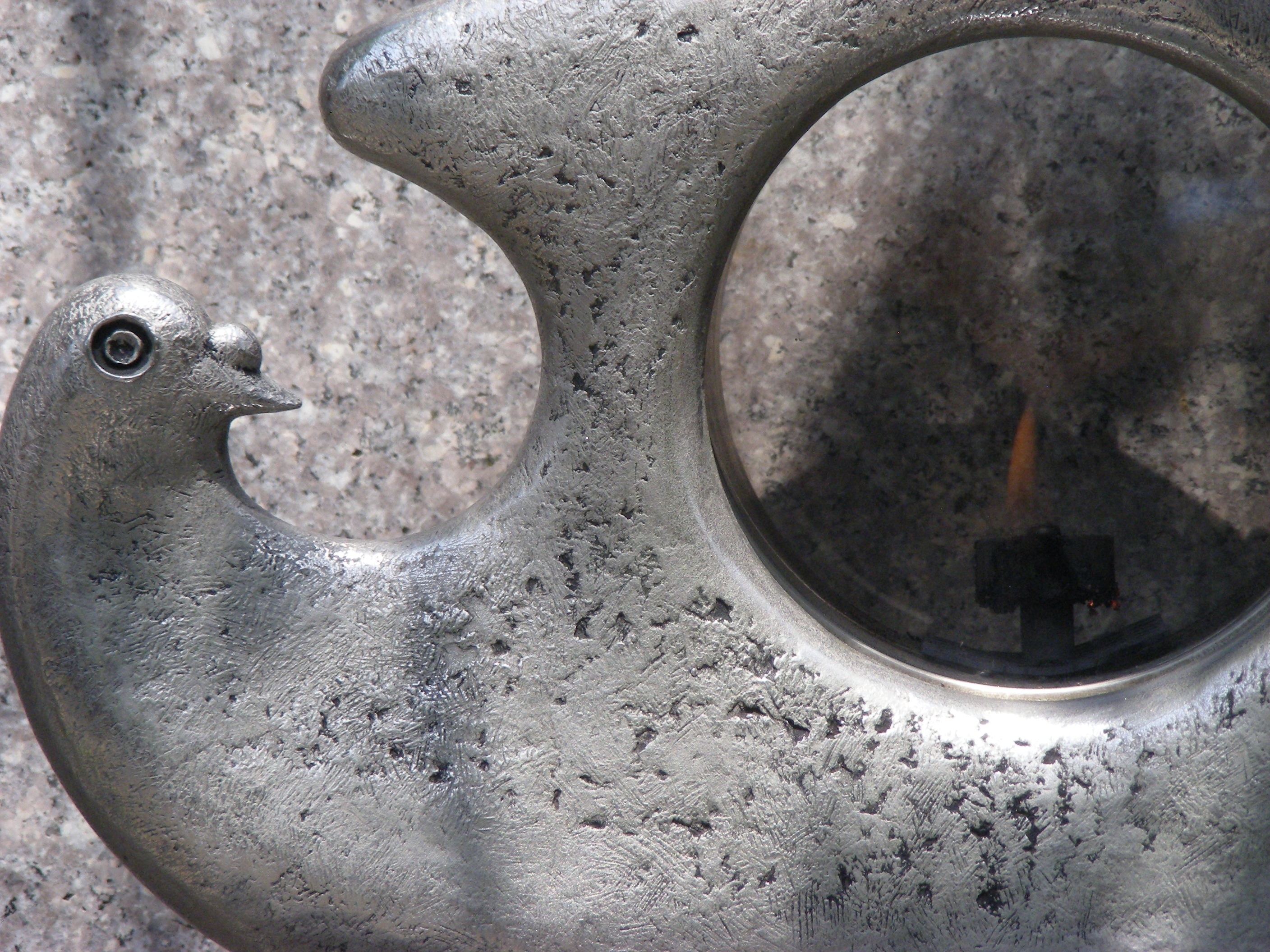
I took this photo in Ueno Gardens in Tokyo. It’s the centrepiece of a peace memorial and I think it’s utterly beautiful. I love the design of the dove whose curves suggest the flowing shapes of the yin yang symbol and the little flame flickering in its heart, or soul, is very moving. Isn’t it wonderful?

When I look at it, it stirs feelings of peace in me, but there’s more than that, which I think comes down to the nature of the little flame. It looks vulnerable. It’s not a raging fire. It’s a flickering light. It looks as if it could be blown out by not too strong a gust of wind. That moves me too.

That small, flickering flame, contains two polar opposites for me…….the energy which is at the heart of all Life, in other words the power of Life, and, on the other hand, the vulnerability and transient nature of every individual life.

When my daughter was small and had an illness which seemed to flatten her I told her to imagine a small candle flame inside her which would grow in brightness and strength as she paid it attention. That helped her to recover and it’s a practice we’ve used at other times as we’ve needed it.

There used to be a belief in an entity called “the Vital Force” which was an invisible spirit-like force which kept us healthy and restored us when we were ill. “Vitalism” fell out of favour a long time ago, even if it is kept alive in certain healing traditions. As far as I know there is no such entity, but the concept remains a good one. As I understand it now, human beings are “complex adaptive systems” which have the capacity to be “autopoietic” – what all that means is that biologically our systems and responses enable us to protect ourselves on a daily basis…..our immune systems are a part of this natural defence. And we have systems which enable us to repair any damage which occurs….our inflammatory systems are part of that. We also have the abilities to learn, change and adapt. Putting all that together, we have something which isn’t a “thing”, something which we can’t see, can’t measure and can’t pin down which is like an inner flame – it’s the flow of Life energy which pulses through our whole being from conception to death.

In short, we have the capacity to self-heal, and all “treatments”, in every stream of healing tradition, work, only if they support and/or stimulate that capacity. There is no artificial healing. There is only the ability of the living organism to heal itself. We can learn to nurture that, to support that and to stimulate that. That, for me, is what Medicine should be about.

Some philosophers have described human beings as “symbolic beings” – because we are only the creatures which seem to create and handle symbols. Symbols are a powerful tool for us. They help us to connect with each other, to communicate and to learn. They can help us to thrive. In fact, I believe, they can help us to survive.

So this work of art, in Ueno Gardens, works for me as a powerful combination of symbols – ones which activate the forces of both Peace and Life.

I hope this works for you too.

Human traces

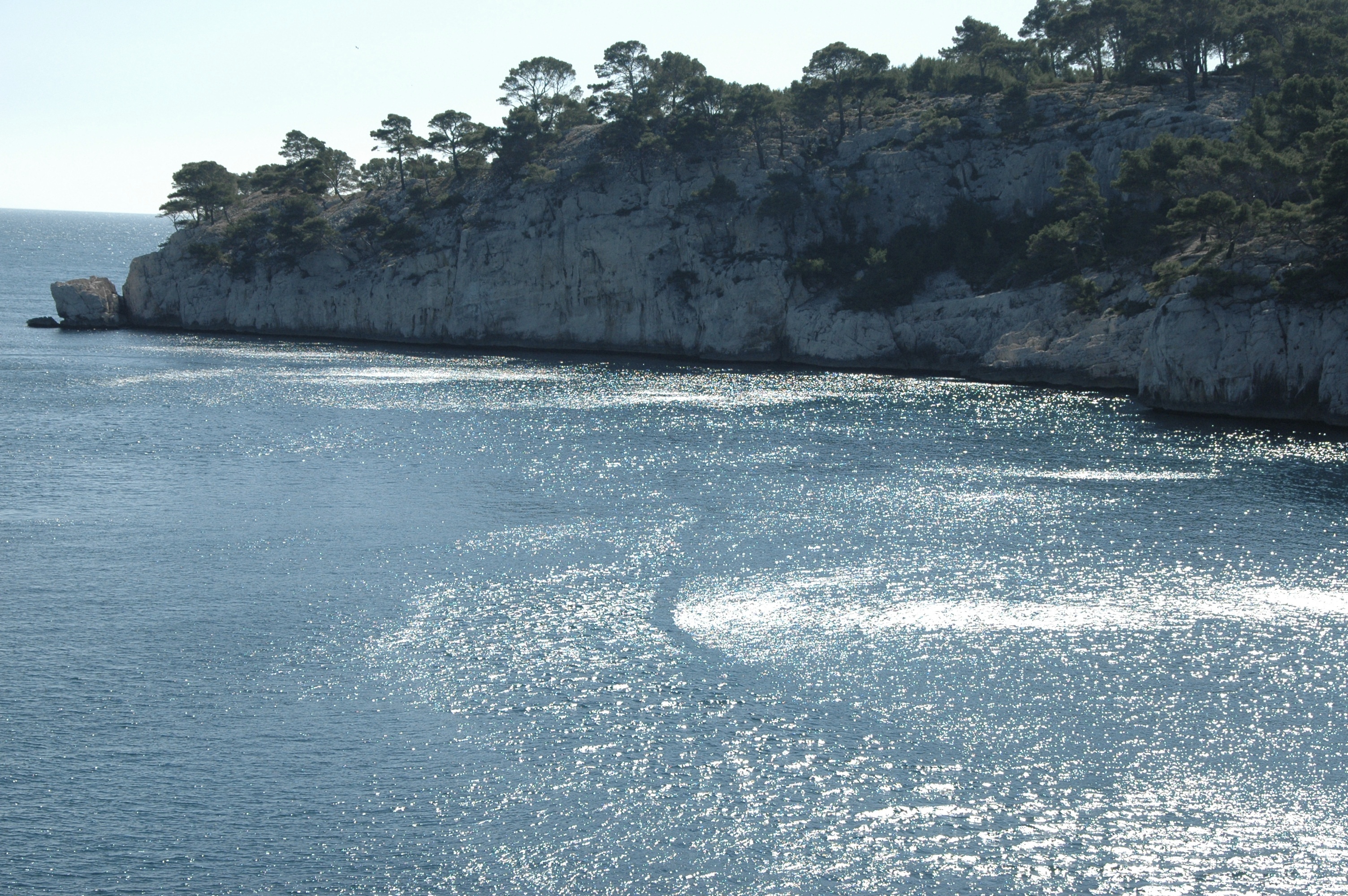
This photo has always fascinated me. At the time I took it the sunlight reflecting on the blue waters as they nestled at the foot of the wooded cliffs was what caught my attention. The whole scene is beautiful and it evokes a sense of peace and contentment in me. But from the first time I looked at it on my computer, what has struck me most has been that line on the surface of the water. Do you see it? It’s pretty much right in the middle of the image. It’s like a path, a blue path cut through the glistening white of the sunlit waters on either side of it. It is shaped like a bow, curving round from just over half way along its length to head towards the cliffs. The surface of the water in the path seems calmer than that on either side….it’s smoother somehow.

Clearly this is the trace left by a boat, but there is no sign of the boat. So when did the boat sail this way? A few minutes ago? An hour ago? Longer?

I suppose it could be caused by something which lies beneath the surface rather than by a boat, but what would run a length like that and have such straight parallel edges? No, I think it’s a trace, not something sitting below the surface.

I find that pretty amazing. If there was a boat at the leading edge of it I might not be so impressed, because all boats leave a wake, don’t they? But this is like a wake without a boat…..or a visible wake left by an invisible boat!

I always think of how we humans change the planet by living in it when I look at this photo. Just by moving from one place to another we change the surface, leaving a trail, leaving a trace. It reminds me of Robinson Crusoe finding a human footprint in the sand on what he thought was a deserted island. These traces say “you are not alone”, and that can be both a reassurance and somewhat unsettling.

Of course, this particular trace won’t last very long. It won’t be there tomorrow, or probably not even later today. But other traces we leave change the landscape for decades. Whether through deforestation, through mining, agriculture, or be the creation of living spaces, we change whole landscapes forever…..well, if not forever, then at least for generations. I’d argue it’s forever, because the changes don’t go away.

Changes don’t go away? Surely they do? Well, I’m not so sure. It seems to me that changes just change into something else. Time doesn’t reverse and we don’t return anything in the world to how it was before…….how it was before has gone, so the changes, if they do disappear, only do so by changing into something else. You know what I mean? Landscape changes produce biosphere changes, which cause further changes in the landscape. I see change as more a ripple than an event. I don’t see changes with definite beginnings and endings, but as emerging differences which cascade outwards through the infinite web of inter-connectedness.

Not all changes are as visible as the ones we see on surfaces, or in landscapes, of course. I know I change all the time. My consciousness changes all the time. My emotional state changes all the time. I think, I act, I communicate, I respond and react. Those waves of change ripple out through my connections. Like the one I have with you. When you stop by to read this today, some of what I’ve been thinking, some of what I’ve been feeling, or something that I’ve seen and shared with you today induces some change in you. Maybe a different thought, maybe the start of a different feeling, or the deepening of an existing one. Maybe this experience you are having reading this post, will ripple out into conversations you have today, or into what you choose to do, or, maybe even what you notice as you live your own life in the days ahead.

Of course, I don’t know.

But I’m aware of the possibility. And that awareness is at the heart of why I create these posts. My intention is to share some of my wonder, my amazement and my delight in daily living. To share from my heart with positivity. I hope this leaves a trace, or sets off some waves to ripple out into our shared and wonderful life together.

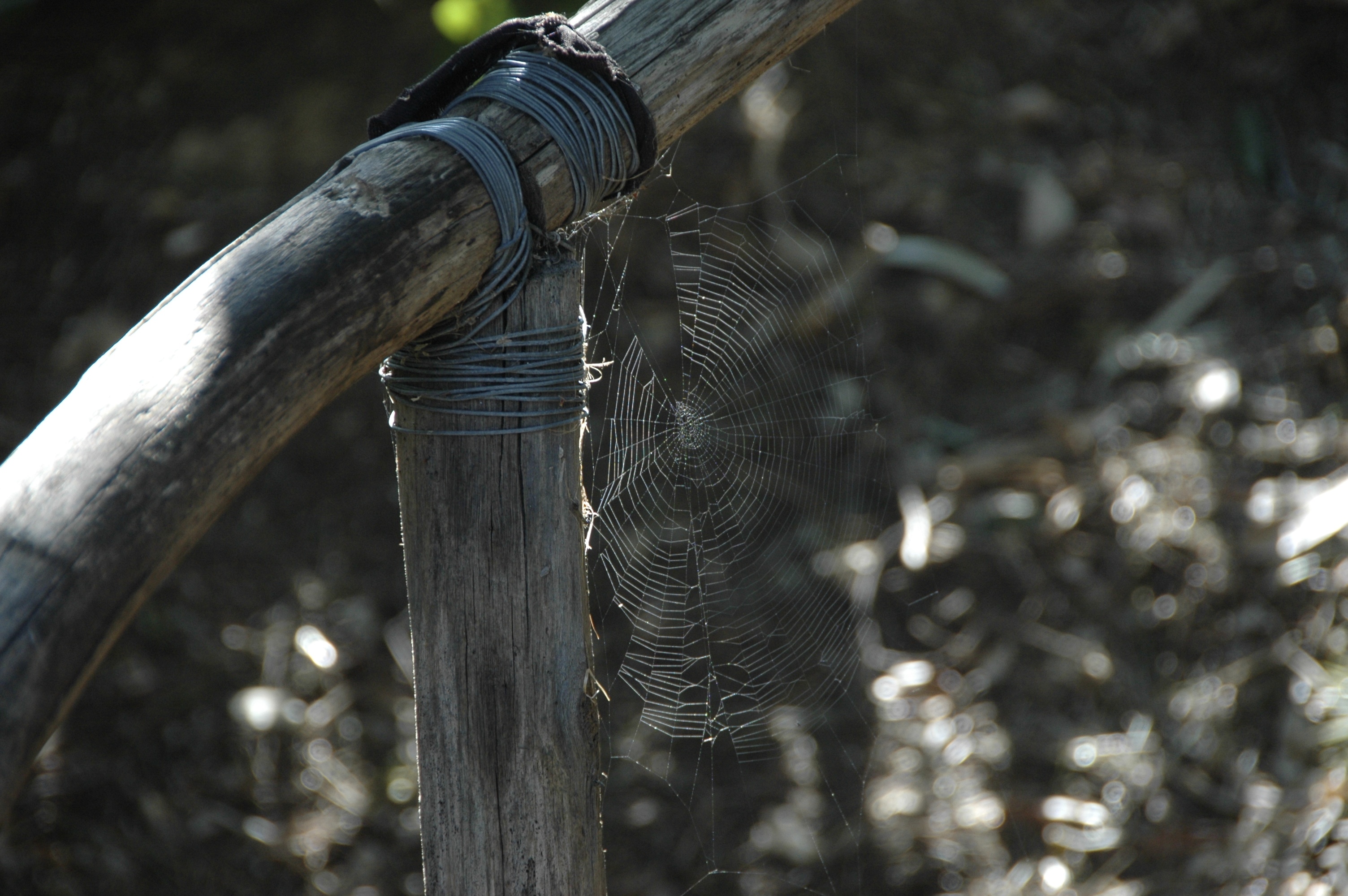
What strikes me about this photo is that I can see two completely different kinds of threads which bind. There is the wire wound round and round the wooden poles to create a fence, holding the cross posts tight to the upright. And there is the web.

I like the words entwined and entangled, because I think they highlight an often invisible aspect of reality. We are, all of us, inter-connected. We all exist in vast webs of relationships. You can’t really see a relationship. It isn’t measurable, but it is still the basis of reality. We are constantly exchanging materials, energy and information with others. Our relationships are between us and other humans, between us and other creatures, and between us and the planet.

Perhaps the most fundamental characteristic of our relationships is that they change us, and we change the others. It’s never one way. We absorb, are stimulated by, penetrated by, elements, molecules, and organisms. We exist in energy waves which penetrate us, changing our own energy patterns as they do so. We live in a continuous flow of information, picking up signals, responding to signs, symbols and stimuli, moment by moment. At the same time we send out molecules in our breath, in our body fluids, from our skin. We emit energies produced by the beating of our heart, by the activity of our brain, and by the rhythms of our cells. We send out information, signals, and signs all the time.

This reality of inter-connectedness underpins our inter-dependency. Not one of us could exist without the entangled webs and ecosystems in which we live. There’s a strange fantasy about space travel…..that you could take a human being, build them a house on the Moon, or on Mars, and start to create a new place to live. But human beings live as only one of hundreds of inter-dependent species on planet Earth, and take one species out (if such a thing were possible – it’s not – you exist with more micro-organisms than you do with ancestral cells), and then see how it can survive, let alone thrive. It’s a fantasy.

We don’t choose most of our entanglements. Not consciously. We are born into many of them, nurtured within them, and live within them. We are so unaware of the rest of Nature that we think of ourselves as outside, apart from, separate from, all of existence. We aren’t. We all exist inside, a part of, integrated within Nature, and Nature is a vast, complex, interconnected web of ties, of bonds, of connections and relationships. We are so unaware of Society that we think of ourselves as separate individuals, as if nothing others do could affect us, as if nothing we do could affect others. But we exist socially, culturally, economically, in one vast, interconnected system.

But we can choose some of our entanglements. We can become more aware of our day to day reality, and, then, when we pause to reflect, and observe, we can learn, see, hear and know more. Only then does conscious choice have a chance. Only then can we develop responses on top of all our reactions. (reactions being automatic)

There’s something to think about – what are my entanglements? How and with whom am I entwined? How do those connections and relationships change me, influence me, move me? And how do I change, influence and move them?

A sweet spot

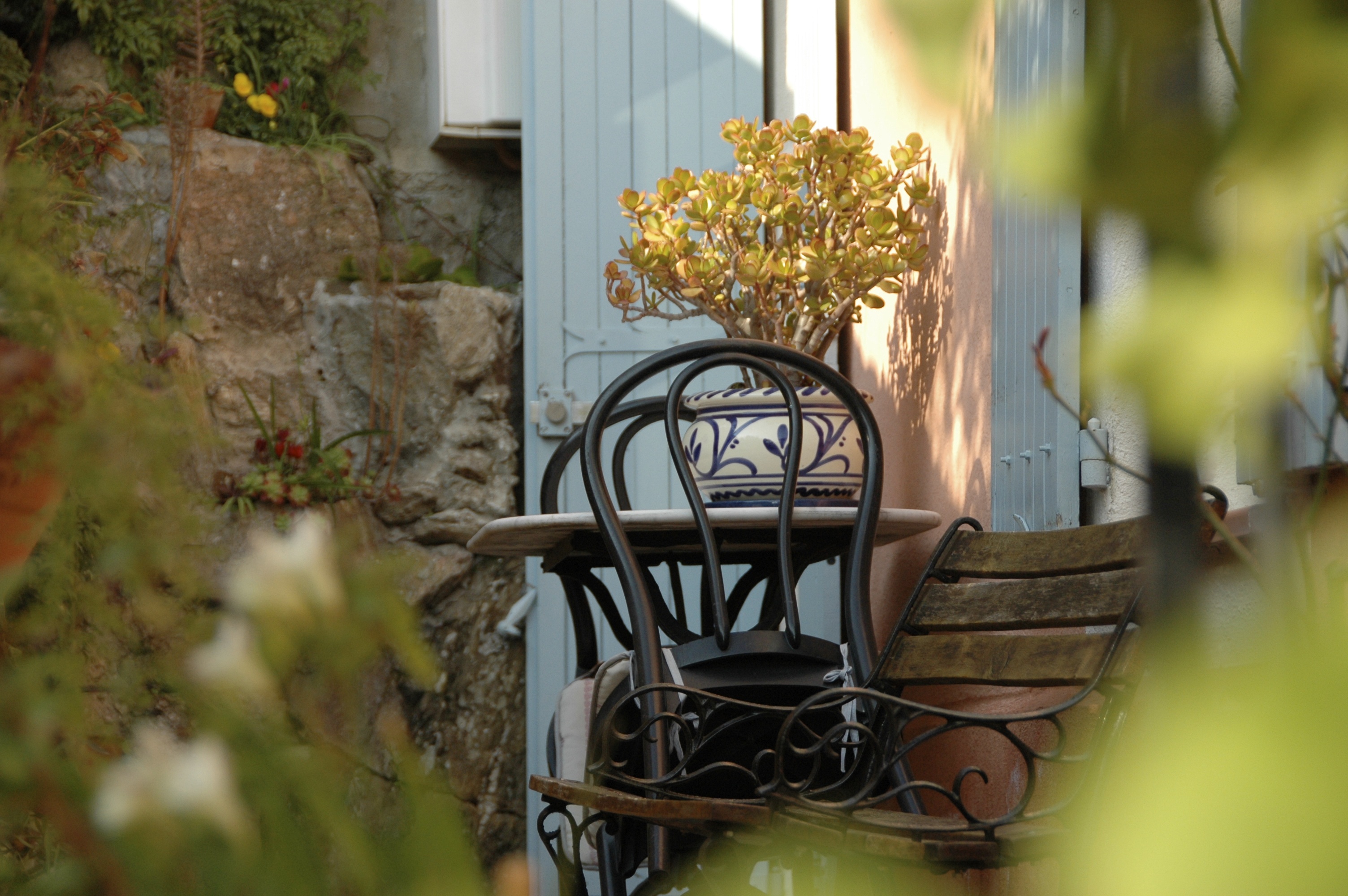
A few years ago I was walking through the Southern French town of Bormes les Mimosas and I noticed this little area just outside of a house at the end of a small pathway. It just appealed to me. As I look at it again today, I find it still appeals to me! It’s very simple. There is a small table with two chairs, a pot plant on the table and an old two seat bench just in front of it. The pale blue shutters of a window and a door are standing open and there’s an attractive, irregular, rock wall at the end of the passage. The whole scene is framed by plants giving the area a feeling of nook, hidden away in Nature.

What’s important to me here is the feeling that this scene induces….not the details really. I’m sure every one of us will find particular details appealing and others not so much. But I bet we all have favourite “sweet spots” – particular places we find comfortable, where we can feel content, happy and secure.

I think we all need such sweet spots in our lives.

Where are yours?

Or, if you were to create one, can you describe what it would look like?

Say I love you

Have you ever thought “What the world could do with is a bit more love in it?”

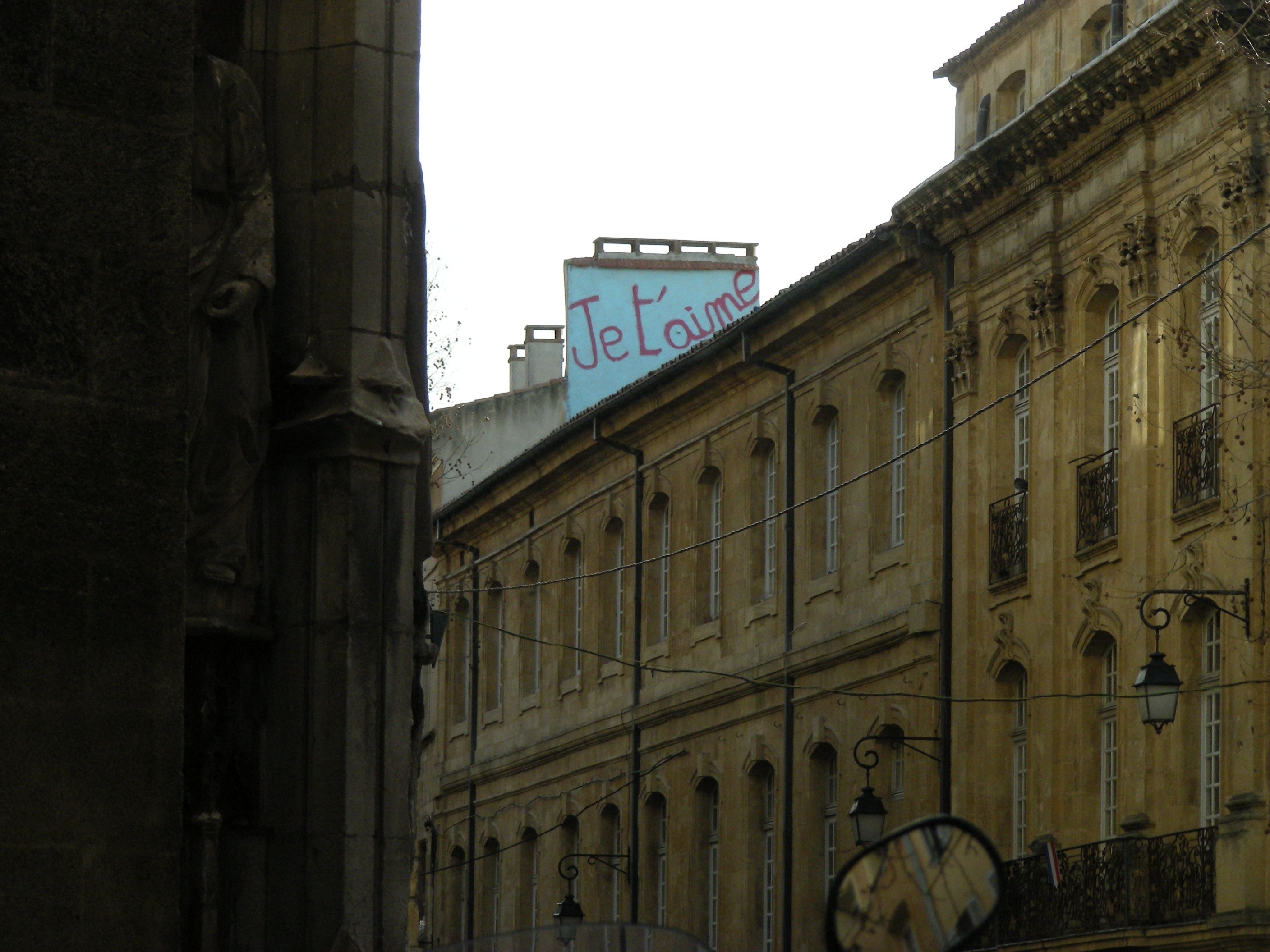
When I saw this graffiti a few years ago it reminded me of the late, great John Peel, whose radio show I used to listen to regularly in my teens. I remember him one year saying he enjoyed picking up autumn leaves, writing “Hello” on them, and dropping them back down on the ground, because he could imagine the joy and surprise it would bring people who came across them.

Well, how about, today, you say “I love you”?

Say it to someone you love. Or say it to your cat, your dog, or any other animal you love. Or say it to your favourite tree, or a beautiful flower which is blooming in your garden.

Or say I love you to the Earth or to the Universe.

You choose.

Whoever, or whatever, you choose to say “I love you” to, really mean it. Don’t just throw the words away. Feel the love in your heart, and visualise radiating that love outwards. Unconditionally.

Write it down if you want. This graffiti artist certainly wrote it big, but you can write it any size…..in an email, a message, on a leaf, a piece of paper…..you decide.

If we all do this today, there will be more love in the world. Not one day, not just sometime, but today.

And you know what? Nobody can stop you. Nobody can prevent it. It’s up to you to become aware of the love in your heart, and to choose to radiate that love outwards.

Waterfall/s

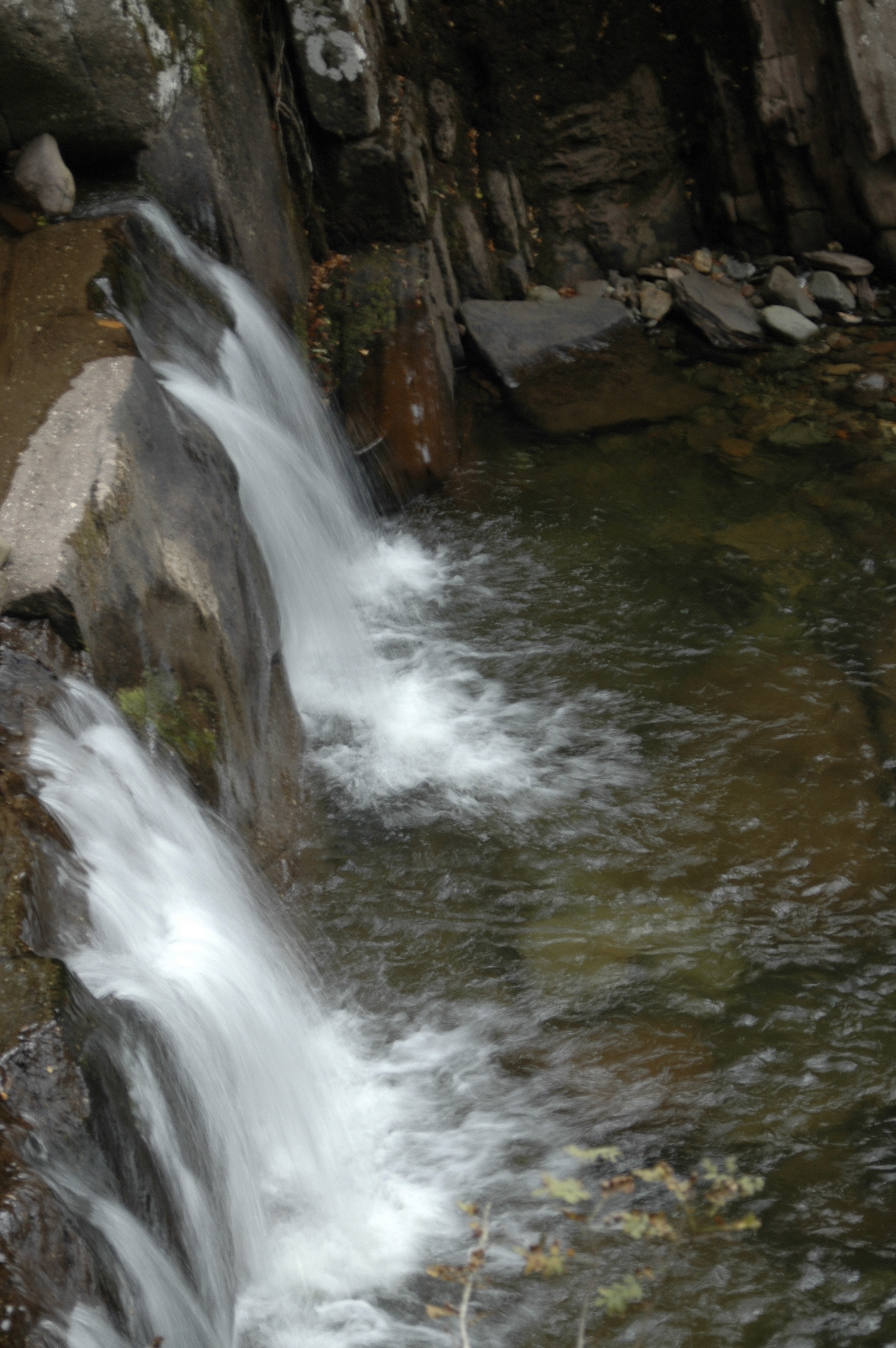
In my photo library I’ve named this “waterfalls”. Yep, plural. And when I looked at it again this morning I thought it seemed a great image to stimulate thought about working together…..in fact, “flowing together” was the phrase which popped into my mind. I slowed down the shutter speed for this photo so the water would blur like this. I think the whole sense of movement and flow is captured better that way. There’s a power in this scene, and that power lies in the water itself. Or, at least, that’s how it seems at first.

So I look at this and think, this is what we are like together…..when we flow together…..when our energies, our focus and our direction all align. Isn’t that beautiful?

I’d almost be happy to leave it at that. Just to put this image in front of you and hope that you’ll think of the power and the beauty of harmony, resonance and alignment.

But, then I wondered why I’d called the photo “waterfalls”, plural. Isn’t it just one waterfall? After all most waterfalls don’t have a single stream of water falling over a specific rock. Rather, most waterfalls are made up of multiple paths where different amounts of water channel through particular spaces, and tumble over specific rocks. We don’t look at a waterfall which has six streams of water falling and think, oh look at those six waterfalls, do we? Or maybe we do.

So that’s where my mind went next. It went off to reflect on our very human capacity to separate out whatever we are looking at. To break the whole down into parts. There are a number of words for that – abstraction is one. Abstraction is where we abstract, or remove, something from its context. Our left hemisphere is brilliant at doing that. Indeed it seems that’s the normal process……the whole flows into the right hemisphere which hands off some of that flow to the left so it can abstract the components, the parts, the pieces……abstract them, label them, categorise them. And, yes, what’s supposed to happen next is that the left passes the results of that analysis back to the right for it to re-contextualise it. It’s just, if Iain McGilchrist is right, that this process has broken down and we have developed the habit of giving priority to the work of the left hemisphere…….too often we see only the parts, and forget to re-contextualise them.

If we don’t allow ourselves to use our whole brain, then we see two waterfalls here, where, seeing the whole would mean we see just one.

I don’t know what works best for you, but I’ve had a lifetime of work refusing to rest with reductionist abstractions, and always striving to see and hear the unique whole person every time. Yes, I’ve had to focus down onto parts, perhaps listening to someone’s lungs or heart, perhaps measuring the level of a component in their blood, but, I’ve always preferred to re-contextualise whatever those abstractions reveal.

I think we need to do more of that.

I think we need to see the whole, to see the contexts, to seek the connections and relationships, and to realise that every experience we have changes us…..just as this beautiful waterfall constantly changes, moment by moment, month by month, year by year.

Gathering the gold

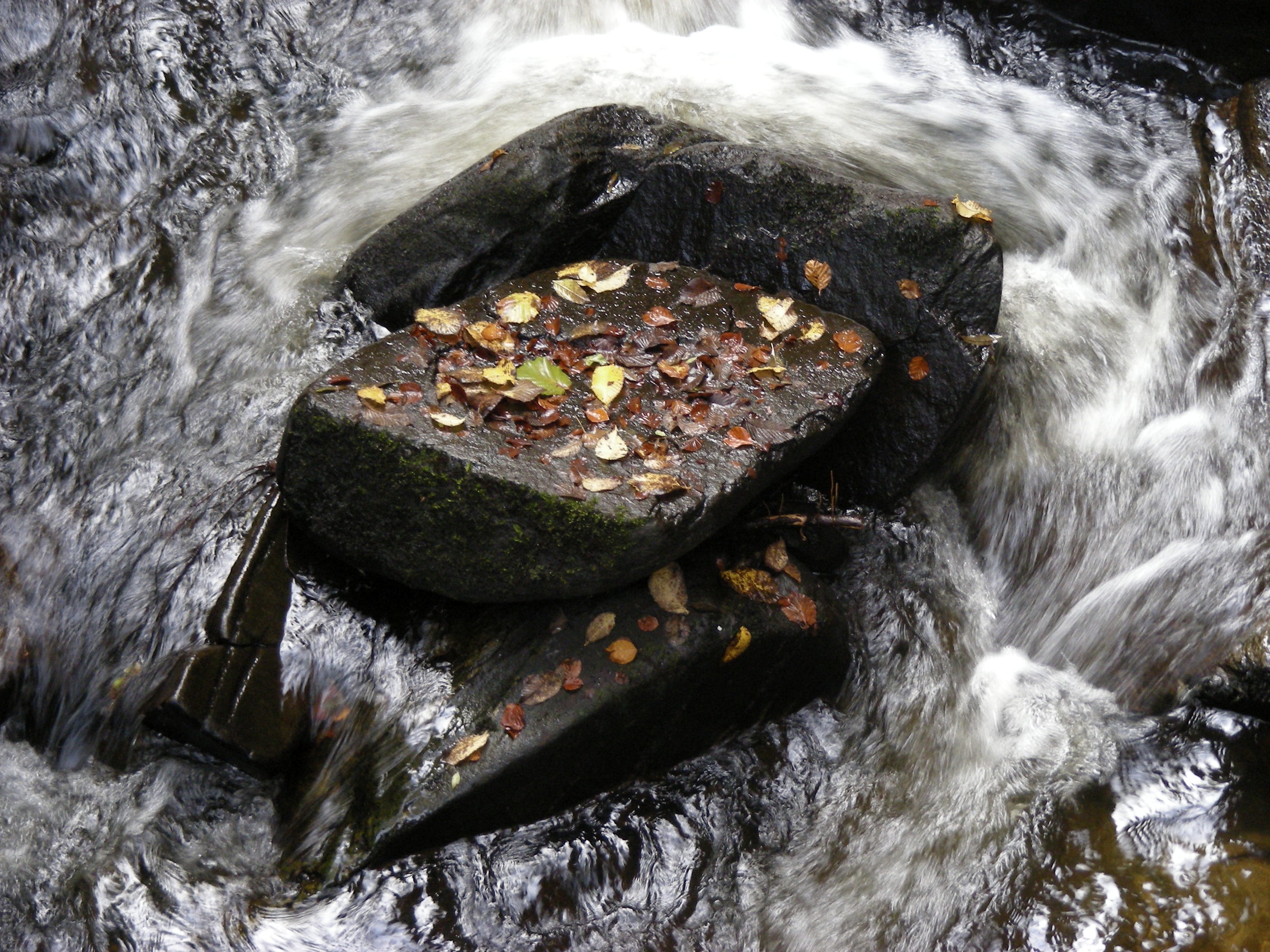
When I look at this photo the leaves seem like pieces of gold at first. Perhaps golden coins. But then I quickly see that they are fallen autumn leaves, with gold, brown, yellow and even green ones. The rock they have landed on, or stuck onto, seems like a collecting point, or a resting point. Maybe the leaves fell here from overhanging trees, but, in fact there weren’t any trees directly overhanging this rock, so maybe they were blown onto this rock. Alternatively, maybe they were swept downstream on the fast flowing water. Whatever their origin and mode of transport, they stuck to this wet rock.

Here’s what comes up for me as I reflect on this image……

Life flows past fast. It rushes by, moment by moment, day by day, even year by year. It never stops. Life is continuous and full of movement, just like this tumbling highland stream. There are places, however, where we can pause. Places or moments where we can step out of the rush and flow of things for a moment and take a breather. It’s important to do that.

When we do step onto the rock, which represents the time out moment, we find that there is some gold there. We find that stuck onto that place of rest there are some golden moments, and some of the gifts from golden moments, from the past. This reminds me of gratitude practice. Many people have demonstrated the benefits to our mental health and wellbeing of doing regular gratitude practice.

Quite simply, there is much to gain from taking a pause, a few moments, and either writing down some of the experiences, events, relationships, gifts for which we are grateful, or even calling them to mind, re-creating them in our imagination, and stirring the benefits of those special times all over again.

The rock, in these musings, becomes a place in the mind. A place where I rest, stand apart for a moment, create what Iain McGilchrist calls “the necessary distance” which allows us to reflect, to set new perspectives, and to see the whole. It’s a place of integration……where I reinforce the mutually beneficial bonds between me and “the other”.

Then I step off into the stream again, and flow off onto the next part of the journey.

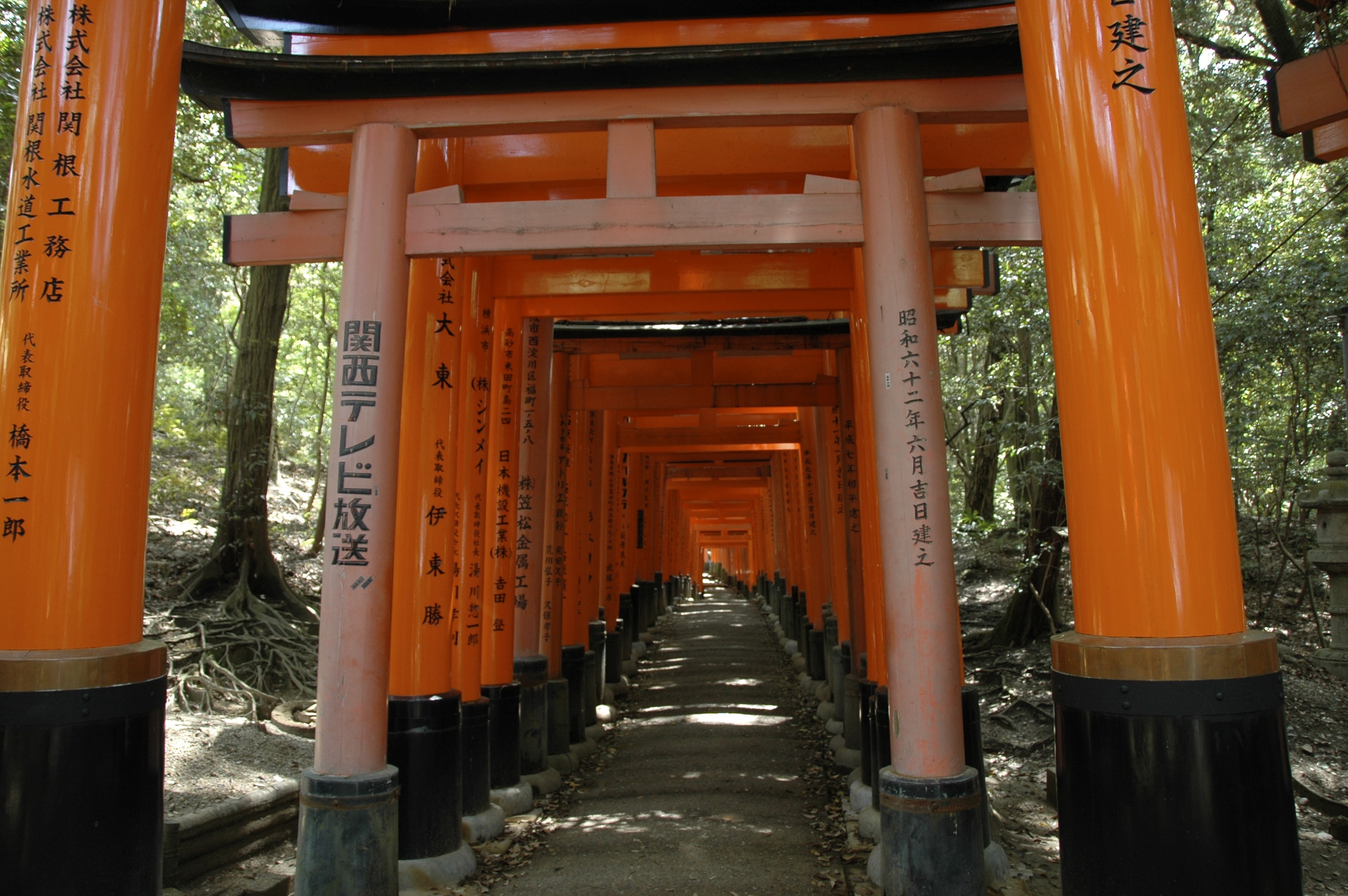
The Fushimi Inari temple just outside Kyoto is quite unlike any other place I’ve visited. It’s an experience which was unique and which remains vivid in my psyche many years later. You follow a path through a forest, up a hill until you get to the top. The path has hundreds of these “Torii” gates enclosing much of it.

You’ve probably seen photos of these types of brightly coloured gateways from Japan. I think they are amazing. They are simple, beautiful and magical.

As you walk up the path you pass under one gate after another, and it never becomes “same-y”. It seems that you can experience the uniqueness of each gate, one at a time, and, of course, if you stop, look ahead, turn round and look back, then you see these long snaking tunnels…..because although the gates are clearly separate from each other, as you look at a number of them extending into the distance, the spaces disappear and they seem to form a continuous arch.

Maybe the closest thing to this in Europe would be a cloister with multiple arches, but, even that is not quite the same.

If I stand here and look back, I see a trail of events and experiences represented by each of the gates. Each event was unique, every experience changed me. Some of them stand out in my memory and I can see them clearly, others have fused with the ones around them to create a longer period of my life which I remember with only some representative details.

If I stand here and look forward, I see a cascade of events and experiences lying before me. Not fully formed, and not realised until I reach that point in my path. The ones closer to me lie in my immediate future and I see them fairly clearly. The further out ones are hard to distinguish, hard to know in their details.

Both of those orientations seem right to me. Both of them influence and inform the point where I have reached, the present time and place, under this one torii gate we call this moment.

As I reflect on my life this way, I realise that every event has its unique context, every experience comes into being as I live it, and transforms me, and my life. I realise I can’t see very far into the future, that the future is not lying fully formed ahead of me, but that some aspects of the future are already in place, waiting to create my next, singular, and special experiences of what will become “now” when I reach them.

I can reflect on the larger scale this way too, looking back over the last 18 months of this pandemic, remembering some of the events which changed me, and straining to look ahead, having, yet again, that feeling of uncertainty, of doubt, and wonder……knowing that none of us know, but that we have a pretty good idea of how the near future will look, all the same.

Perhaps this is not the most creative way to think about the past and the future, but I like it. It brings together the connectedness of events and experiences. It reminds me how every one of them changes me. And it reinforces my understanding that I need to be humble, flexible, and adaptable, responding to each gate as I reach it.