There’s something magical about seeing the sky turn golden, red or pink, isn’t there? Whether it’s last thing at night or first thing in the morning.
I love those scenes in City of Angels where the angels gather on the beach in the morning to watch the sunrise.
I delight in the beauty of a subtly radiant Belt of Venus over the western horizon at dawn.
But I never tire of sunsets.
You’d think that because we’ve all seen so many of them that we’d be so used to them. You wouldn’t be surprised if we hardly noticed them because they were so “ordinary” but here’s the thing, sunsets never become ordinary. They draw me outside to look at the sky, or they stop me in my tracks time and time again.
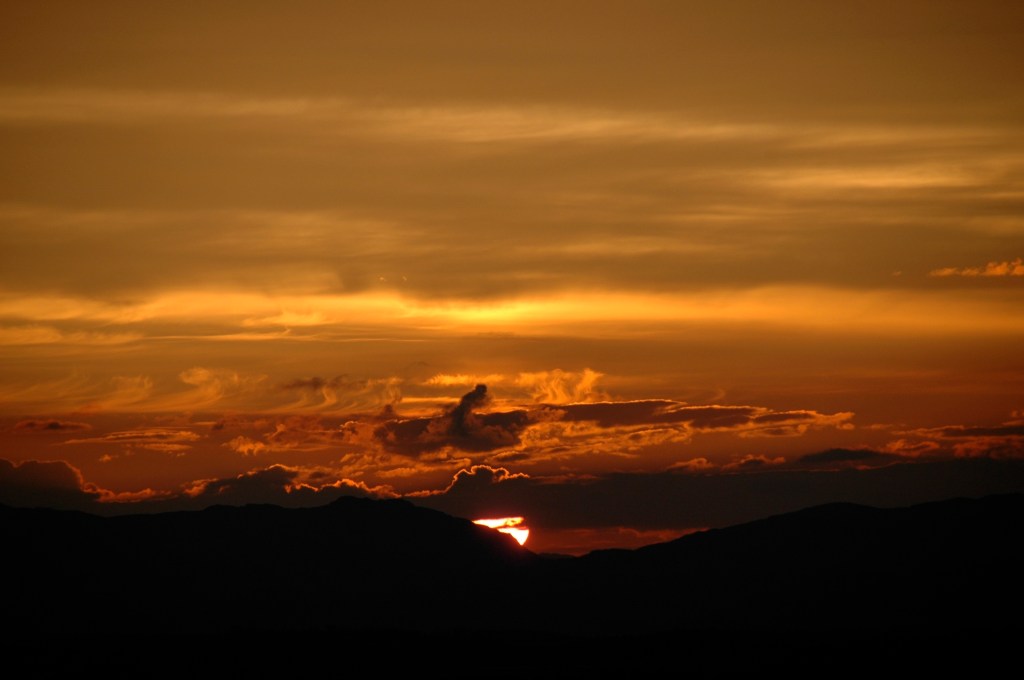
So I thought I’d share with you one of the many, many sunset photos I have. Like all the rest it stirs a mixture of joy, delight, wonder and awe in me. Sunsets are one of the most common ways to experience “l’émerveillement du quotidien” (the marvel of the everyday) which keeps that sense of specialness so alive in the here and now.
Just one final further comment – ever since I read the idea that a sunset is really an earthrise, because it’s the Earth turning and the horizon lifting towards the Sun, not really the Sun sinking below the edge of a static Earth, I find that word popping into my head every time I see this happen.
Remembering that this is an Earthrise is the best way I know to experience the sensation that this little planet is constantly turning in Space.
I have a life long love affair with books. My grandpa used to read to me when I was young, working his way through books like “Tales of a Grandfather” by Walter Scott, and collections of myths and fairy tales. I’ve always been intensely curious and had a fascination for both the local “reference library” and for story books from the “lending library”. Goodness knows how many books I’ve bought in my life, and I really don’t know how many I still have. I do know that most people who have come to my house seem surprised by just how many books there are, so I guess I have more than most people do.
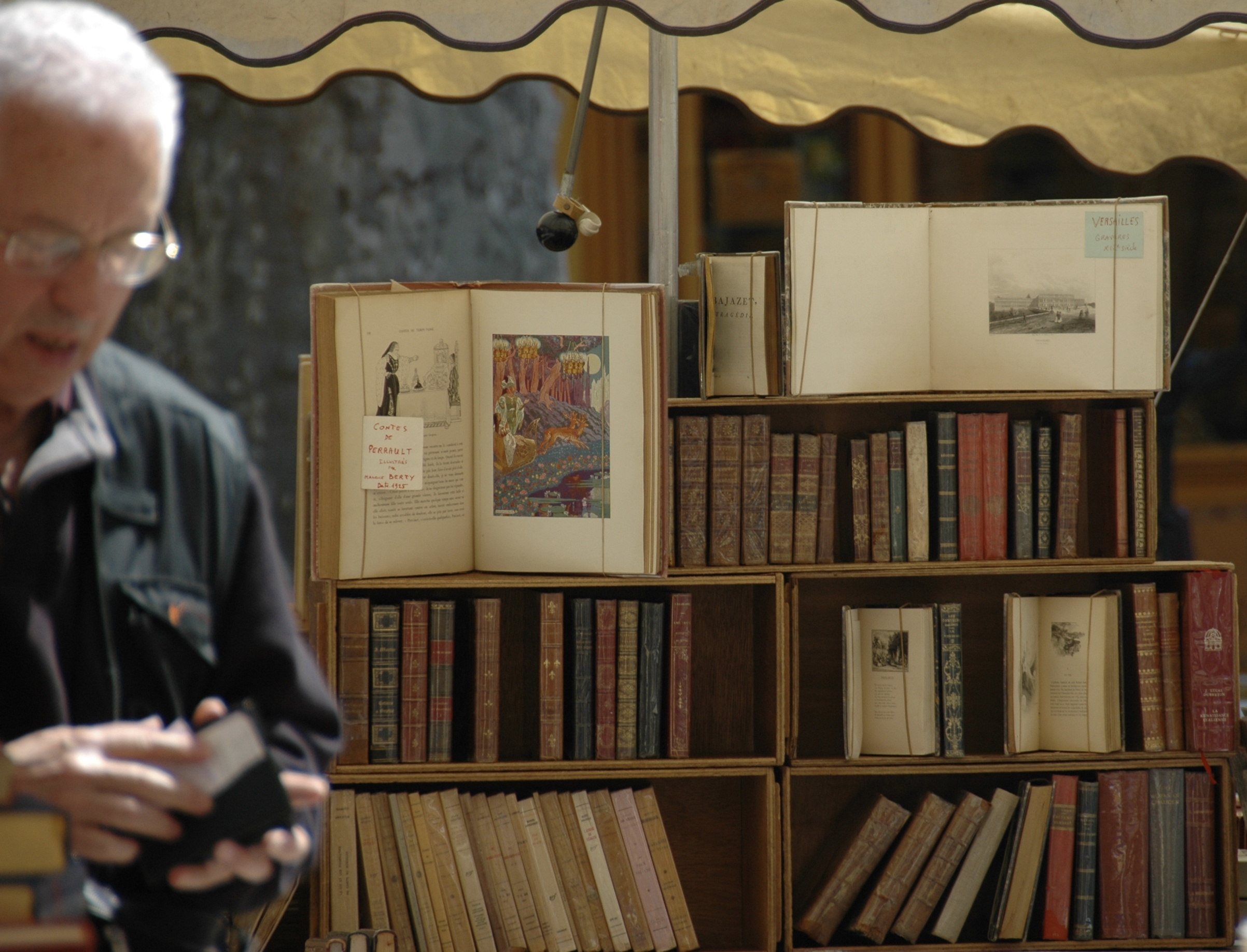
I love bookshops, old and new, and I adore browsing around the booksellers at fairs and markets. It was a market like the one in this photo which caught my imagination whilst on holiday in France many years ago, and probably seeded my idea to retire when I did, and come to live in France. I had decided I wanted to live part of my life not just in another physical part of the world with a different geography, climate and history, but I wanted to live in a different culture. In particular I wanted to immerse myself in the language and literature of France…..it seemed to offer both different ways of seeing and understanding the world, and to open up whole areas of thought and observation which was unknown to me.
But I didn’t switch away from English to French. I still read a lot more English than I do French. I’ve been here just over six years now and it’s fulfilling all I’d hoped for. Of course, with the pandemic even bookshops were closed, and certainly markets and fairs were cancelled, but that hasn’t slowed down my reading.
There are a couple of very famous French books I’d recommend to anyone – they are so famous that they’ve been translated into many languages so chances are you won’t need to learn French to be able to read them. They are “The Little Prince” by Saint Exupery. It’s a brilliant, thought provoking story, beautifully illustrated. Many, many years ago I found a book in a bookshop in Aix en Provence. It’s called “Donner un sens à l’existence” by Jean-Philippe Ravoux. He’s a professor of philosophy in Aix, and the subtitle is “ou pourquoi Le Petit Prince est le plus grand traité de métaphysique du XXe siècle” – so, it’s, roughly, “Making sense of existence” – “or why The Little Prince is the greatest work of metaphysics in the 20th century”. It’s a brilliant little book, which draws on Saint Exupery’s story to enable the reader to explore a philosophy of life. I love it. Sadly, I don’t think it’s ever been translated into any other languages. However, don’t despair, just read The Little Prince. I really, really recommend it.
The second very famous French book which I recommend is Montaigne’s Essays. OK, the full collection is HUGE, and the original in Old French, beyond me. But I have copies in both French and English. However, what I’d recommend to absolutely anyone is Sarah Bakewell’s “How to Live. A Life of Montaigne in one question and twenty attempts at an answer”. It’s brilliant. It’s really an easy read and I think it makes an utterly fabulous introduction to the life and work of Montaigne. The man was a genius and his essays have been translated into many languages and still stand the test of time.
If I really get into recommending books I’ll never stop! But I thought I’d just share these two works with you today – because they continue to be my favourites, I have never stopped re-reading them, and you are likely to be able to find translations into your own language.
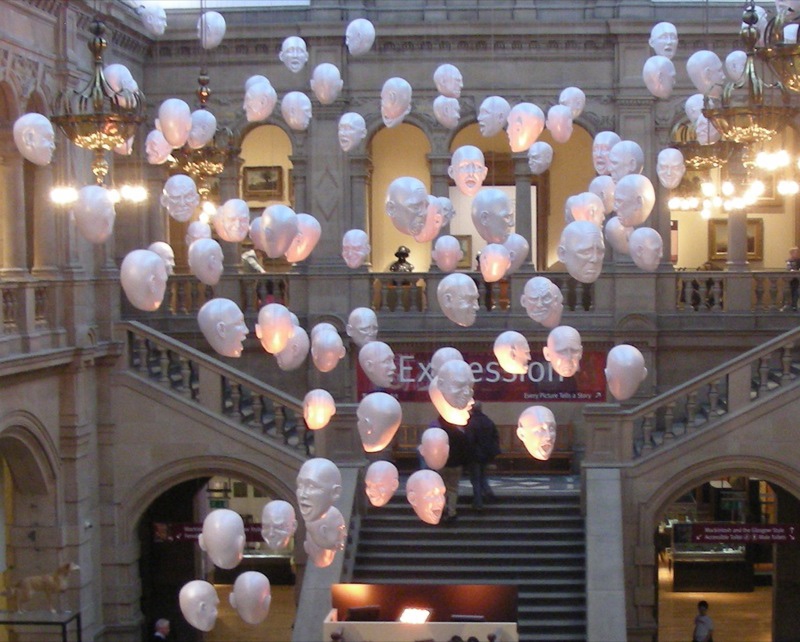
I took this photo many years ago in the Kelvingrove Gallery and Museum I’m Glasgow.
It’s one of those (many) art installations which have stayed in my mind forever. Every time I look at it, it feels fresh and inspiring.
I suppose a lot has changed in the years since I took this photo, and I find that the particular reflections, thoughts and ideas which are evoked by any image changes according to what I’ve experienced in the past, what I’m experiencing now, and what I’m concerned about in the future.
What I see now makes me think about the opposing world views of separateness and belonging.
I probably have way too many thoughts about this to put in a blog post, but let me just highlight some of the more prominent ones.
I could start by thinking about an economic structure like capitalism, which has become the dominant global model over the years. Or I could start by thinking about the political philosophy of neoliberalism which has been on the ascendant since the middle of the last century. Or I could begin with the way people interpreted Darwinism and turned it into slogans such as “survival of the fittest”. But maybe I could go all the way back to atomism, reductionism and the particular flavour of rationalism which emerges during the Enlightenment. Whichever of these starting points leads me to a seeing this as a collection of entirely separate heads. Probably all autonomous, probably all in competition with each other, where only the strongest, or most powerful, or richest will rise to the top.
Or I could start from seeing the vast web of connections between everything which exists. I could start from the place where the flows of energy, matter and information form relationships through encounters to create temporary, transient entities which continually change. Or perhaps I could start from the new findings of neuroscience which reveal how intensely social we humans are. Or from evolution and developmental science which shows us how no individual exists in isolation to others. Then I see in this image a vast web of interconnected people, each supporting the other, each forming integrated (mutually beneficial) bonds with each other.
In other words I can the representation of atomised alienated competing individuals, and I can see the representation of connected, collaborative societies.
I’ve never really thought of myself as someone who has a method but now I realise that I do.
What do I mean by a method? Well, simply that there are common behaviours that I have in life. Behaviours that developed day after day over many years.
My method has three elements, or three verbs if you like. They generally occur in sequence but it’s a continuous loop, not a straight line with a beginning and an end.
Observe, reflect, respond.
That’s it. Not more complicated than that.
Observe is more than look, of course. We notice most when we use a combination of our senses….sight, hearing, touch, maybe scent and taste.
I was taught to observe at medical school. We learned to listen to patients stories, to look at their bodies, to listen to their heart, and lungs, feel for swellings and organs, and so on. So when I say observe I mean paying attention, noticing, using all the relevant senses.
After observation I like to reflect, taking some time to make sense of what I’ve observed. To understand.
Only after that do I want to act. Action might mean saying something, making a suggestion or, especially when I was a working doctor I would prescribe something. Sometimes however the best action was to wait….to take some more time to learn more.
Well, that was my method at work. Observe, reflect, respond – and then continue on around that loop – observe again, reflect again, respond differently.
I realise this method has become my lifestyle. I think it suits me. It’s feels right.
I took this photo many years ago in Edinburgh city centre. I suppose I was becoming aware of the proliferation of security cameras that was occurring back then. From the perspective of today, there were hardly any!
Do you security cameras make you feel safer? I think I’m in two minds about them. I’d like to believe that they might deter some criminality but I don’t know if that’s true. On the other hand, it’s a bit like having lived in places where nobody locked their front door…..that’s just the opposite of having to live in a gated community with security guards and CCTV (although I should be clear….I’ve never lived in a place like that). When you think of those two extremes which one of them feels like it might be a safer place to live?
I live in a small village in South West France. I live in a cul de sac in the village, so the only passing traffic is the occasional tractor making its way onto the vineyards. My elderly neighbour appears out of his garden gate whenever a different vehicle turns up. He’s like a one man neighbourhood watch!
The other thing I wonder when I see a CCTV camera is who is looking at the footage? Is it just recording so it can be reviewed if a crime is committed, or is someone sitting somewhere watching the live feed.
The thing that makes this particular image interesting for me is the placing of the camera just next to the stone carved head. It kind of seems like the stone head is looking through the camera, which, of course, is impossible, but that gets me thinking about all the non-human surveillance we are now subject to.
Whether it’s Facebook, or Amazon, or Google’s algorithms we are under constant surveillance by computers and software. And like the CCTV I expect most of that all goes on with no human “live” involvement, but as best I know it’s all being recorded and someone can analyse all that whenever they want.
None of that makes me feel safer or more comfortable. And now we are moving into a new era of health surveillance. Here in France we’ll need to produce the QR code which shows we’ve been vaccinated before we can get into cinemas, theatres, restaurants and so on, and when it comes to travel across borders you have to subject yourself to testing and give a lot of information about your travel plans….all, apparently, for “public health reasons”.
I think I can see a lot of potential benefit from the more connected world, and I can understand the good intentions behind a lot of the surveillance, but, surely it would help us all to become a bit more at ease if we felt that the data about us was available to us, and that anyone who wanted to use or analyse that data had to get our permission and be open about what they do with that data.
I know, I know, it’s a complex, but, let’s face it, uncomfortable subject, but it’s one we are going to have to tackle sooner rather than later.
There are two phrases which come to mind when I look at this photo.
“We are all in the same boat” and “everyone is paddling their own canoe”. I know, I know, this isn’t a photo of a canoe, but bear with me, this is the way my mind works.
The last time I looked at this photo, nearer to the beginning of the pandemic what I saw was the possibility of escape. I guess “running away to sea” was the phrase which popped up. Well, it turns out there’s really not been anywhere to run away to (or if there was they slammed their borders shut to stop anyone joining them).
I reckon that on multiple occasions over the course of this pandemic I’ve felt pretty baffled and unsure, just not really knowing what way it’s going to go next, and what’s the best thing to do. Maybe, in that respect, that’s still where I am. Because the new combination of mass vaccination plus exploding case numbers due to variants takes us, yet again, into “which uncharted waters” (to keep my maritime metaphor going!). In fact, yet again, it feels like the authorities are “up sh*t creek without a paddle)
But back to my first thoughts looking at this image again today.
We ARE all in the same boat. This virus has left no population untouched. Our interconnectedness and interdependence has never been more clear. In good ways we’ve seen really brilliant scientific collaboration in both understanding this disease and coming up with the best ways to treat the sick. In not so good ways we’ve seen how international travel has accelerated the spread and made it really hard to manage it within a single political boundary.
It’s also shone a bright light on many of the vulnerabilities and weaknesses of our global economic/social model. Those who have been hardest have been the elderly, the long term sick and the poor. It’s highlighted the precarious nature of employment, inequality and injustice. It’s shown us some of the frailties of the health care systems, of the care systems and of a vast range of support systems. It’s even highlighted our poor nutrition, our poor relationship with the rest of Nature and poor education.
In the midst of all this we’ve seen countless acts of compassion, kindness and generosity. Countless acts of courage and sacrifice.
But we’ve seen way too much greed and selfishness too.
Which brings me to the second thought of each of us “paddling our own canoe”. Because we’ve been faced yet again with issues of personal responsibility and autonomy. We’ve been challenged by restrictions and controls which seem to wrest all autonomy from us and place the power in the hands of unknown others.
There’s the two sided coin of authoritarianism and conspiracy theories with established authorities seeking to impose their idea of The One Truth and hound and silence any alternative voices. Authorities which act in secret and issue false statements which undermines trust. It’s a powerful, disturbing cocktail which shows deep fractures in our societies.
At one level I believe we are all responsible for own decisions and that difference and variety are healthy. At another level it’s clear that a pandemic is a community disorder which cannot be solved by everyone acting as if only their personal choices matter.
It’s tricky isn’t it? Maybe the best thing to do is to stay humble and critical while doing what seems best for each of us, all living together. Keep the compassion and the kindness flowing and stay flexible enough to adapt.
I guess even if we are all sailing our own boats, we’re sailing them across the same sea.
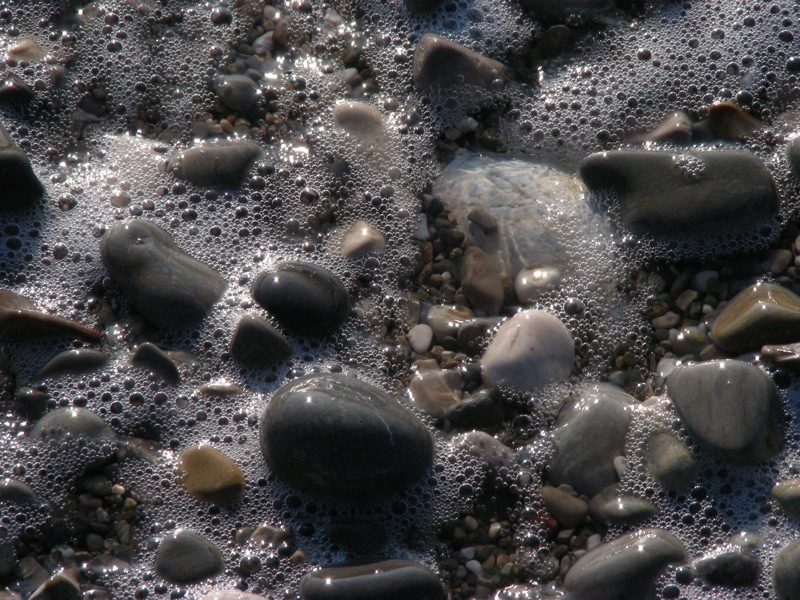
At the edge of the sea where the waves break onto the sad, sometimes you find an area like this, filled with pebbles and bubbling, foaming water. The hissing sound of the water as thousands of bubbles burst, and the clattering sound of the pebbles as they are tumbled back and forth by the waves is a beautiful sound.
When I look at this image I see the contrast between the foam and the stone. The foam lasts seconds, maybe a couple of minutes at most. The stones look permanent. They seem unchanging. But of course, they’re not. The reason that they are so smooth and rounded and glistening is due to the fact that they are undergoing constant transformation by the water. As they are washed and soaked by the water and rattled over each other by the waves, they change all the time, losing atoms to the sea, having their rough surfaces smoothed, and gradually, gradually, being reduced to sand.
The big difference between the foam and the stone is one of duration. Both are impermanent. Both are constantly changing. It’s just that the water does all that much more quickly than the stone does. In fact, the stone does it so slowly that we are mislead into thinking that the pebbles are permanent, eternal, unchanging. They’re not.
The other thing which strikes me when I look at this photo is how it reveals the fundamental truth that everything that exists is constantly being transformed by the encounters it makes with other things. We tend to think of the world as being made up of separate, easily identifiable, different objects – whether they are stones, trees, lakes or creatures.
But what about thinking about the world as made up of subjects, not objects? If everything (I really need to find another word for “thing” because just by using that I turn the world into a collection of objects!) which exists is in constant relationships with others….similar others, and totally different others…..and if those relationships change each of the partners through their encounters and experiences then maybe its better to think of the world as a community of subjects.
The world – not a collection of disconnected objects which can be standardised and replicated, but a community of subjects who co-inhabit the same planet and who resist standardisation through the perpetual transformations of being which emerge from their encounters.
Becoming, not being.
A finite, temporal world of encounters and experiences.
When I think of life this way I find a feeling of resistance arise in me – a resistance in the face of commodification, objectification, standardisation and control. It drives my desire for freedom, feeds my curiosity and opens me to the formation of new relationships and the experience of new encounters, every, single, day.
I took this photo a number of years during a trip to Italy. I’m often drawn to sculptures and this particular one is pretty unmissable I think you’ll agree. I’ve returned to look at this image many times and, particularly in the light of our new understanding of neurology and how the two cerebral hemispheres engage with the world differently, (thank you Iain McGilchrist) I find this a really powerful statement.
The first thing I think when I look at this is “Look at the size of that head!” It’s massive. See how small the people look in comparison. Every time I look at this it challenges me to consider how we over-represent the human head. How often do we think that “I” am what exists “in here” – in here being inside the skull we point to as we say that. But we know better now. We know that “I” is both an embodied concept – existing within a whole body – and an extended concept – existing within a network of ever-changing, co-influencing relationships with others and with the environment. You could say our more recent understandings have blown the head wide open and set the “I” free! Perhaps like this sculpture?
The second thing I think of that phrase “head over heart” which we use to set rational thinking and decision making against intuitive, feeling-based ways. In fact, we now know that the heart is more than a mere pump used to circulate blood around the body. There is a dense network of the specialised cells we call neurones around it, and the information processed in that network flows more from the heart to the head, than the other way. So we do actually make sense of our lives using our heart (physically and symbolically) as well as using our head. The fact this particular head is so over-sized reminds me of how we tend to give too much emphasis and attention to so called rational and cognitive ways of thinking, and not enough to our embodied, heart-focused, soulful, intuitive ways – which in many ways precede the work of the brain.
The third thing I think of is provoked by noticing that half the brain is missing in this sculpture – although we can’t see the cerebral cortex here, it seems that the right half is missing, even if the left half is still there behind the skull. That reminds me of the imbalance which is the basis of Iain McGilchrist’s thesis as described in such wonderful detail in his “The Master and the Emissary”. He argues that our left and right hemispheres have different world views and each half creates the kind of world it sees on a moment to moment, and historic basis. He claims that the right hemisphere is where all the information flows first (well, most of it does), that the right then hands off some of that information flow to the left, which processes it by analysing it, matching it to what we already know, categorising and labelling it. Then, it should hand the results back to the right, for it to set back into contexts and see it as a whole. As this sculpture suggests, things have gone wrong and we are using the left hemisphere way too much, and the right way too little.
Why don’t I just keep my photos in albums which I flip through from time to time?
Why don’t I just write my thoughts and ideas in a personal journal which nobody can read but me?
Because I’m driven to share.
We humans have developed as intensely social creatures. We haven’t evolved to survive as independent, isolated creatures. We have one of the longest dependent infancies on the planet. The little birds I see hatching in nests in the mulberry tree go from looking like small bald dinosaurs with open beaks, to feathered individuals which fly from the nest, successful on first flight, within days. It takes babies many months to walk, to speak and to be able to feed themselves with the food which they have no ability to find by themselves.
You know what I mean. We are created with the social means, the relationship-forming means, to survive and thrive.
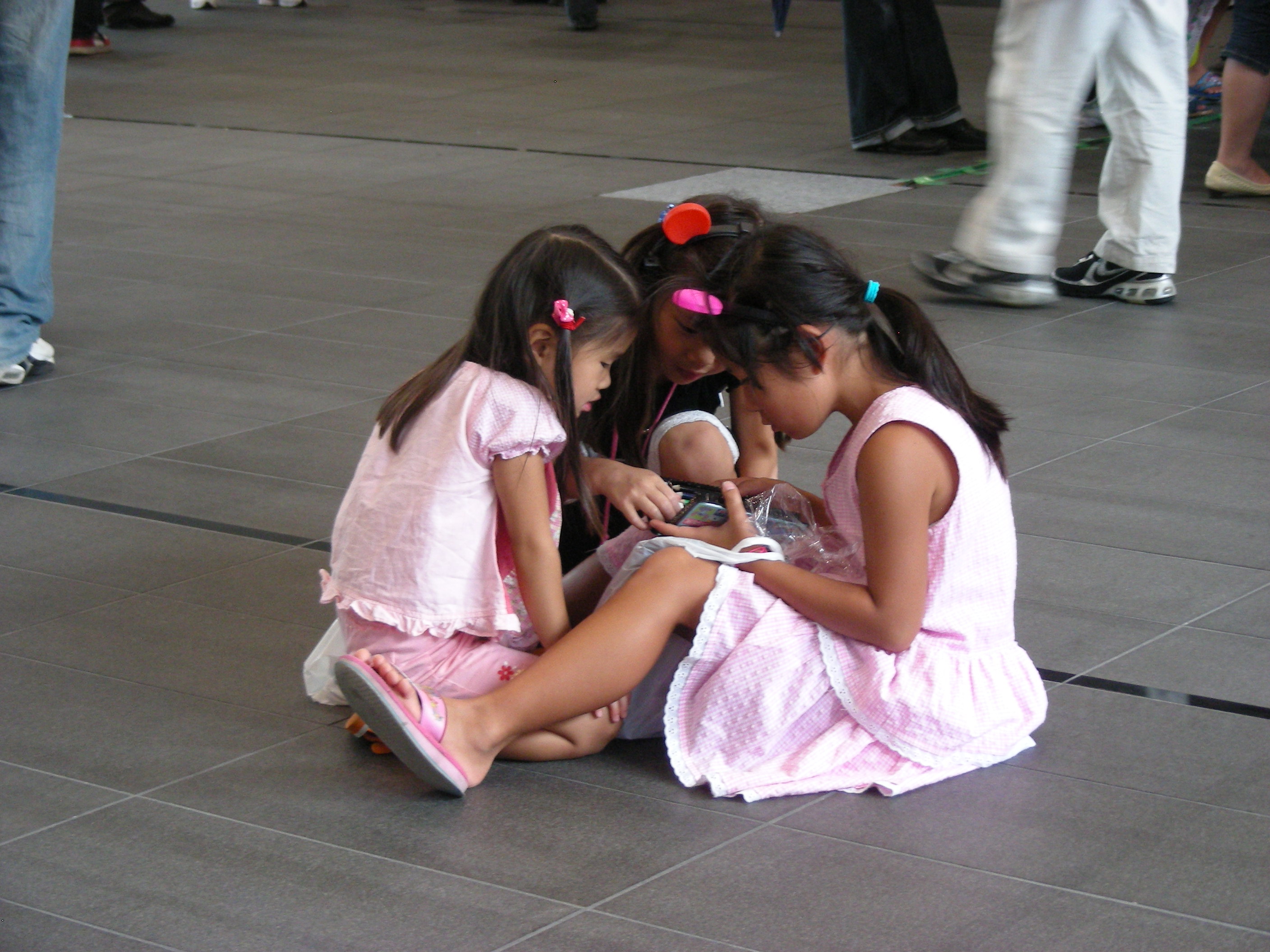
Look at these wee girls. I don’t know what they are sharing but you can tell just from their body language how enthusiastically they are sharing. This is a basic, fundamental, necessary drive in all humans.
OK, I know, some people prefer to be more private, to limit their sharing to one or two, or a small handful of, people. But if we have no-one to share with, then, over time, that becomes a problem. We feel alienated, separated, lonely or abandoned. Depression sets in as a kind of implosion obscuring our view of others and of the rest of the world. When I worked at the Centre for Integrative Care in Glasgow, we would sometimes take a patient into the garden and sit with them noticing…..seeing the flowers, the bushes and trees, hearing the birds, spotting the squirrels and the fox. Those times enabled people to safely take the first steps out of the dark hole of depression. Their attention was captured by the natural world and their energy and focus began to flow back into a positive form of connection.
I made a commitment to write a post every day when the first lockdown came in here in France. I suppose, like all of us, I had no idea how long this pandemic would last, and so, it’s something of a surprise to find I’m still creating these daily posts. My thinking was to share one of my photos and also some of the thoughts and feelings which came up within me when I looked at particular images. The main reason to do that was that I find these photos and the reflections they elicit, a source of joy, wonder, delight and positivity.
So, this was my original thought – what if I shared something positive every day? What ripples might that set off? Whose lives might they touch? Might the joys, the wonders and delights become magnified in the sharing? I think they do. Because that’s the really fascinating thing about sharing – it’s not giving away – it’s not losing something that somebody else gains – it magnifies its positive effects on both or us. My life feels better at least in part because of this daily sharing. And I hope yours does too.
There are many characteristics and features which seem to define what it is to be a human being. Language, storytelling, the use of symbols, pattern spotting, music, poetry, dance, rituals, problem solving abilities and creativity are amongst them.
But I think art has a very special place.
Deleuze described three ways of thinking – philosophy is our way of thinking concepts, science our way of describing functions and art as our way of dealing with “percepts and affects” – that is our sensations, what we perceive and what we feel.
The astonishing cave wall art found deep underground in several parts of France, and the intricate designs of the Picts and the Celts in Scotland are two of the more ancient examples I’m familiar with. But we find examples all around the world, going way, way back to the earliest traces of the human species.
There’s a creative drive in all of us, and we draw on it in very different ways……from day to day problem solving, to inventing, creating methods and technologies, to the creative expression of the varied art forms which exist.
Some of us are mainly drawn to music, others to dance, some to stories and writing, some to poems, others to the visual arts of drawing, painting, sculpture and photography. And, yes, I’ve left out several other alternatives from that list.
But whatever our preference and/or habit, I find that art attracts. We are drawn to it. We desire art. We desire and seek out the experience of art.
Art provides us with ways of engaging with, and understanding, the world which neither philosophy or science do. You know I’m a fan of “and not or” and I’m not seeking to establish a hierarchy here, but I have a feeling that we are slipping into a more utilitarian, materialistic and reduced way of living, and to restore a balance, to make life “more human” I think we need to give more time, energy, attention to art…..in education, in work and in leisure.
I welcome constructive criticism and suggestions. I will not, however, tolerate abuse, rudeness or negativity, whether it is directed at me or other people. It has no place here. ANYONE making nasty comments will be banned.





 Heroes Not Zombies