Feeds:
Posts
Comments

Archive for June, 2007

The Witch of Portobello by Paulo Coelho. ISBN 978-0-00-725184-1

If you enjoy the work of Paulo Coelho, and I am someone who does, then you will enjoy his latest book. He has created a very distinct style for himself. As a reader you know what to expect and you’re not disappointed. Mind you, having worked as a General Practitioner in Portobello, Edinburgh until I took up my current post, I was disappointed that the book wasn’t set there! There’s plenty to enjoy and lots to think about in this novel. Let me focus on the idea of the witch because that is fundamental to the whole work. On page 13 he describes four archetypes of women –

  • Virgin
  • Martyr
  • Saint
  • Witch

What really got me thinking here was his description of the path to enlightenment characteristic of each of these archetypes –

  • Virgin – Independence
  • Martyr – Suffering
  • Saint – Unconditional Love
  • Witch – Pleasure

Do you recognise these archetypes? I don’t think they are exclusive to women. As with all archetypes of the psyche I think each of us resonate with them to greater and lesser extents. It’s unusual to find someone who can be fully described by a single archetype. So which of these do you resonate with? And how can you play to your strengths then?

Like all Paulo Coelho’s books, this is a story of self-discovery and how to find your own way in life.

Read Full Post »

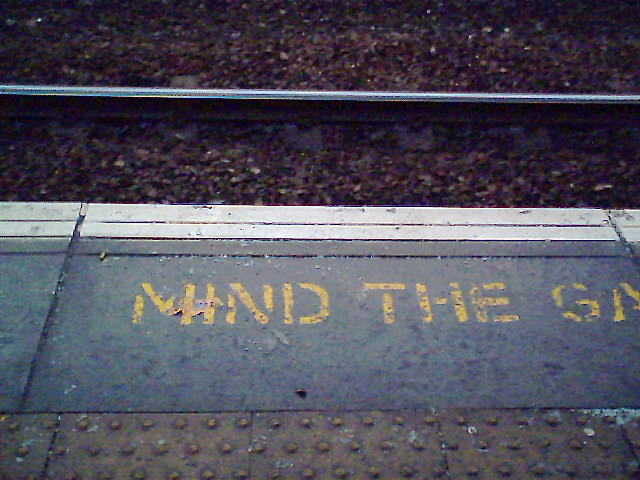
Mind the gap

mindthegap.jpg

It is in the spaces in between that things happen

.……..The Conqueror. Jan Kjaerstad

In a study of how we hear silences in music, Elizabeth Margulis has shown that not all silences are heard the same. In fact she has shown that both the music which precedes the gap and the music expected to follow the gap influence how long the listener experiences the gap to be and alters the quality of what they perceive.

A photo, a quotation from a novel, a scientific study…………they bring to my mind the Tibetan concept of a “bardo” as described in the Book of Living and Dying. I read it years ago but the idea of becoming aware of the gaps (bardos) has stayed with me. Spaces interest me. Shadows, the patches of light within and around shadows, the brief moments between breathing in and breathing out, between one thought and another. So here’s your challenge for today. Notice some spaces. What are they like? See how they are all different? How does life change when you start to notice the spaces in between?

Read Full Post »

….that might seem like a strange and obvious statement, but the reality is that health is experienced by individuals which is why we need a health service which is patient centred, taking a holistic focus to understand the differences between people as well as their similarities (what diseases they have). However, the other side of the partnership in healing is the health care professional – doctors, nurses and other professionals. There’s a strange distortion of “Evidence Based Medicine” which seeks to reduce the whole of health care to numbers, as if people don’t matter. We see this in the way that randomised controlled trials are conducted using methods which explicitly seek to exclude the individual people effects – you never see any mention in a research paper of who the individual health care professionals were who actually interacted with the nameless and faceless patients in the trial. It’s as if we can only rely on studies which exclude the effects and contexts of human beings. This has always struck me as strange.

In any GP partnership, patients quickly suss out which doctor is good for which approach. Those who want to be given time to talk about their problems seek out the doctor who listens. Those who want antibiotics seek out the one who is best known for prescribing them without lectures…….and so on.

Doctors are not clones. They are individuals too. In good health care each of us needs to find a doctor we can connect with, one who is on our wavelength. Yes, we want a surgeon, a physician, a GP who has good up to date technical knowledge and skill. That’s a given. But we need more than that. We need a good human relationship with him or her.

So, I wholeheartedly endorse Dr Everington of the BMA today who says

Doctors feel under attack, the government wants to turn everything into something that has just a monetary value. Vocation, dedication and lifetime commitment to patients and the NHS has little value in this new world – we are just financial commodities.

There’s a process going on in the NHS known as “Agenda for Change“. It’s central tenet seems to be that every job in the NHS can be described according to the knowledge and skills required to do that job, every person can have their knowledge and skill level assessed, then anyone with the requisite level for a particular job can do that job. The actual human beings become dispensible and interchangeable. The whole process is demoralising for thousands of NHS staff. People matter. Personal, individual qualities and characteristics matter. Two different people doing the same job will interact with people differently. In health care this matters. In a factory making widgets it maybe doesn’t. But GP surgeries and hospitals are not factories and people are not widgets.

Read Full Post »

purple day, originally uploaded by bobsee.

I decided to think of a colour each day for a week and take my camera with me everywhere.
Each day I’d have one particular colour in mind and if I noticed anything that was that colour I’d photograph it.
Here are the results. Five Days, Five Colours.
What do you think? Why not try it for yourself?

Read Full Post »

Interesting article on ScienceDaily today about a physicist postulating the existence of non-particles. It’s one of those mind-bending thoughts that physicists are so good at – maybe not everything is made of particles? Maybe there’s something else? “Non-particles”?

The line that really caught my attention was this –

a theorist who restricts their imagination to merely the likely possibilities probably isn’t trying hard enough.

I totally agree. This is true in life as well as physics. If you only think about the kinds of things you’ve already thought about you’re either stuck in a loop or you’re restricting your view.

The area of clinical practice in which I work is Homeopathic Medicine – as a doctor in the National Health Service, in Scotland’s only NHS Homeopathic Hospital. Some people ridicule homeopathy because they say there is “no plausible mechanism” to explain how it can work. But two thirds of the patients we see at the Homeopathic Hospital have already failed to have their pain, wheeze, depression, whatever, relieved by the best “Evidence based” treatments, but get relief after treatment with homeopathic medicines. It might be hard to accept that a treatment we can’t explain can have a useful place within the Health Service but the daily reality is that it does. So, I say to other doctors or “scientists” who dismiss this form of treatment, learn from the physicists…..

Try harder, imagine the unlikely as well as the likely.

Read Full Post »

A study published in The Archives of Internal Medicine looked at how doctors greet their patients. In particular they studied how often doctors used the patient’s name and how often they greeted the patient with a handshake. They claimed to show that most patients wanted to be greeted by name and with a handshake and that many times doctors failed to use the patient’s name. However, the statistics on the handshaking are fascinating –

Seventy-eight percent of patients surveyed wanted a doctor to shake their hands, while 18 percent did not. In the taped sessions, doctors and patients shook hands 83 percent of the time.

Read that carefully. 78% of patients said they wanted the doctor to shake their hands. 83% of time the doctor shook the patients hand. What does this mean? That doctors are shaking patients’ hands too readily? That more patients get their hands shaken than wish to do so? Funnily enough, there’s no comment about this strange anomaly.

Read Full Post »

rain on the mountain, originally uploaded by bobsee.

Here comes the rain! In the distance, over Ben Ledi, I can see the rainclouds, frayed at the edges, dropping the rain onto the earth below.
I love seeing the rain start to fall in the distance like this. It’s as if the clouds are showing they can have rays too, just like the sun.

Read Full Post »

Here’s a quote from The Conqueror by Jan Kjaerstad

Supposing one were a conqueror – what would one win? The world? A little peace of mind? A name? Immortality? Oneself? Power? Women? There were times in Jonas Wergeland’s life when he felt there was only one thing worth striving for: health. To be fit and well.

What do you think? Do you agree with Jonas? What do YOU think is worth striving for?

Read Full Post »

ISBN 1-905147-16-3. The Conqueror is the second in a trilogy by Norwegian author Jan Kjaerstad. The first volume, The Seducer, certainly seduced me. I read it when the English translation was published in 2003. That first volume hooked me before I even opened the book. On the back cover the blurb begins

So how do the pieces of a life fit together? Or, to put it another way: do they fit together at all?

Well, this is an idea which really intrigues me. I often think we have so many roles, so many aspects, so many threads running in our lives that it’s quite a challenge to see how it all fits together. Every time I sit with a new patient I’m doing the same thing – collecting the pieces of their lives, the fragments of their stories and trying to piece it all together, to make sense of it. The novel tells the story of one Jonas Wergeland, a famous Norwegian TV producer who arrives home to find his wife dead on the lounge floor. Shot. He is arrested and charged with her murder. The whole of the 600 pages of that first volume is made up of dozens of stories that try to explain how Jonas ended up at this juncture. By the end of the book we don’t know if he has been found guilty. The quality of the writing and the way he built up an understanding of Jonas by the telling of multiple stories of his life completely enthralled me. It’s taken four years to get volume two, The Conqueror, translated into English.

In The Conqueror we are made aware that Jonas has indeed been found guilty and Jan Kjaerstad uses the same technique to try to explain how a great TV producer, revered by a whole nation, could end up killing his wife. Here are a couple of lines from The Conqueror that will explain why this book so captures me as a reader

Maybe our existence is best understood as a story.

I don’t know any other way to understand either my existence or that of another. We construct ourselves and we communicate our private subjective unique experience of living through telling stories.

 For so it is: even though life is lived forward, it is always understood backward. You turn around and behold – in awe or fear – a pattern that you are not aware of having made.

Isn’t that so true? This man writes beautifully. I find his novels totally addictive. And how long will it be until the third and last part of this trilogy comes out in English? I suspect it’ll be around 2011! Well, you know what? I’ll content myself with a re-read or two of The Seducer AND The Conqueror while I wait!

There are many lines in The Conqueror that I’ve noted down and want to say something about. I’ll take them individually in separate posts (first of all over the next few days, then, probably, as I re-read these books, over the next few months). If you love stories, layers and layers of stories that develop an understanding of a person’s life, and you love good writing, I’d recommend you buy these novels and treat yourself.

This blog is titled “Heroes Not Zombies” because I have this belief that most of us sleepwalk through most of our lives, on automatic pilot, and that life can be better for any of us if we wake up, become more aware, more reflective and more creative. In short, the best kind of life is the one where we are the heroes of our own unique stories. Here’s Jan Kjaerstad again

Because most heroic tales can awaken forces which until then have lain fettered inside a person.

The BIG work of the main character of these novels, Jonas the TV producer, is his documentary series on Great Norwegians. As each episode is described, another Norwegian hero’s life and significance is manifested to the whole, hooked nation. Norwegians are described in the novels as a nation of spectators and the spectacle of this series on national heroes is what makes Jonas’ reputation. Every episode captured my imagination so much that I swung between wishing the series had been real so I could actually buy the DVD and watch it, and feeling I had seen and heard every detail in the author’s wonderful descriptions anyway.

This is a book which will make you think. It’ll make you think about stories and how we use them to understand ourselves and others. It’ll make you think this

But no occurrence, no day in a person’s life is so trivial that it might not be crucial. Important things happen all the time………all days are in a way, holy days.

Read Full Post »
anvil cloud, originally uploaded by bobsee.

I just looked out of my window and couldn’t resist snapping this.
What a wonderful anvil shape. You know there is a whole organisation and a book dedicated to noticing clouds. You can see why!
Sometimes the best place for my head is in the clouds…..

Read Full Post »

« Newer Posts - Older Posts »