
This is the sunset from the living room window of the place I rent in the South of France. Different from the sunsets I see over Ben Ledi.
I like the difference, and how the same sun setting in a different country can look so different. Of course the trees, as opposed to the great hills, background the sun, whereas the setting sun lighting the hills somehow lifts the sun out of the background.
Archive for March, 2008
sunset
Posted in from the dark room, photography on March 18, 2008| Leave a Comment »
The creative environment
Posted in creativity, from the dark room, photography on March 17, 2008| 3 Comments »

I was walking around the village of Lourmarin, in Provence, today, and it struck me that all around there were examples of peoples’ creativity. That creation above was quirky but really quite fun. It was hanging on the shutter of a first floor window. A little further down another set of shutters caught my eye.

I don’t know if the lady who lived in this house had this tile made especially, or if one of her relatives gave her it as a gift, but I did like it!

At the end of the next narrow street my eye was captured by this incredible blue –


Then round on the main street leading down to the main square I did some window shopping (that’s the only kind of shopping you can do on a Monday in French villages – everything is closed on Sundays and Mondays…..civilised! Maybe they use the time to paint!)


Blossom
Posted in from the dark room, photography on March 17, 2008| 1 Comment »
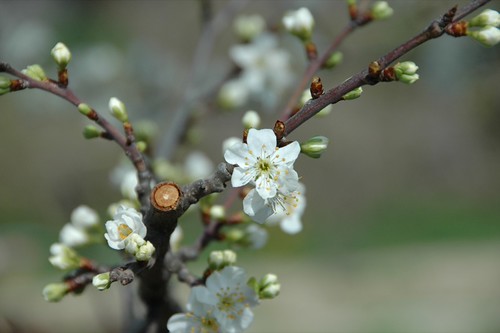
white blossom, originally uploaded by bobsee.
The fruit trees are further on in the South of France than they are in Scotland. Look at these lovely blossoms in the middle of March

Your whole self working in unison
Posted in from the reading room, life, personal growth on March 16, 2008| 5 Comments »
Now and again I read a book that significantly changes things for me. Sometimes, it’s because the author describes new concepts I had never previously encountered. Sometimes, it’s because the author makes something I wasn’t sure about suddenly very clear. And, yet other times, it’s because the author’s words or ideas take my understanding of something to another level.
Books like The Joy of Philosophy, Linked, and Why Do People Get Ill are all good examples.
Recently, I stumbled across the work of William Glasser. His idea of Reality Therapy and Choice Theory immediately appealed to me so I bought one of his books. Choice Theory: A New Psychology of Personal Freedom. I’ve just finished reading it and I’m going to share a few things with you in a number of posts.
One of his key ideas is captured with the term “total behaviour”. What he means is that all behaviour is “total behaviour”. All behaviour is made up of four elements –
- Acting
- Thinking
- Feeling
- Physiology
We can control our acts, and our thoughts, but we can’t directly control our feelings or our physiology. However, what we do and what we think affects our feelings and our bodies – for example, if you step into a dark empty house you might start to think about ghosts or people hiding in the darkness. Such a thought will make you feel scared and set your heart racing and quicken your breath. If you’re thought on entering the dark empty house is just “where’s the light switch” you won’t be feeling the fear and your heart and lungs won’t be speeding up. OK, that’s a very simplistic example, but I’m sure you get the idea. Everything in interconnected. The flows are two way. Just as a thought can influence your body or your feelings, so can a bodily change influence your feelings and your thoughts (and so your actions).
This holistic concept of whole being changes in different situations reminded me of the work of the General Semanticists of the mid 20th century. They too talked about these links between the body and the mind. They used a different term from “total behaviour” – they used “organismic changes or responses”. But it was a similar idea. In much more recent times we’ve begun to see emerging areas of scientific study termed “psychoneuroimmunology” and “psychoneuroendocrinology” which are helping us to understand the mechanisms of these two way influences between body and mind.
I think it’s a great concept to keep in mind – that these four aspects of behaviour are always present and connect the many diverse parts of ourselves so that our whole self always works in unison. When you’re feeling bad, or your body is playing up, this understanding will help you to realise all is not lost. You can work on your thoughts and you can choose different actions and your feelings and your body will respond.
first thing this morning
Posted in from the dark room, photography on March 14, 2008| 6 Comments »

first thing this morning, originally uploaded by bobsee.
this caught my eye when I stumbled out of bed this morning……
Healing or treating?
Posted in from the consulting room, health on March 14, 2008| 4 Comments »
Every time I see a patient for a first consultation I draw the following diagrams to explain what I’m trying to do and how it might fit with whatever other treatments they are receiving.
First I draw two simple shapes –

I say, “The circle on the left represents health and the disordered looking circle on the right represents ‘not health’. In acute diseases, it’s usually pretty easy to understand what’s caused the problem (represented by the red arrow). For example, along comes the flu virus and gives you flu, or along comes the number 6 bus and knocks you down and breaks your leg”. “The whole purpose of undergraduate training in medicine is to teach doctors how to recognise the disordered circles. It’s called ‘making a diagnosis’. This training focuses on the disease or the lesion. The doctor says ‘I know what this is. It’s the flu.’ or ‘You’ve got a broken leg’ or whatever. Whatever the problem, the body sets about its normal activity of trying to repair damage and restore health. This process is represented by the sweeping purple arrow –

“Interestingly, because doctors are trained to diagnose the problem in terms of the disease, all the treatments you are offered are intended to fight, suppress, or remove the disease. What the treatments are not designed to do is enhance the process represented by the purple arrow. Benjamin Frankin understood this. He said ‘God heals and the doctor takes the fee’. It seems strange to me that at medical school we only learn about pathology, about diseases and how to fight them, when, in reality, nobody, but nobody, gets better from any illness without the healing process working. It’s the body’s own capacity to self-repair, self-heal and self-restore which returns, or attempts to return you to health. Treatments directed against diseases might give the body a better chance to do that. In fact, with many diseases, the problem may be too serious for the body to manage to self-heal without the support of fighting the disease. Fighting the disease isn’t a bad thing. It’s just not enough. We need to see what we can do to support and promote your self-healing.”
I then add the following elements to the diagram –

What this shows is the addition of arrows, representing treatments, on the top right directed against the disease. The horizontal lines represent the kind of wall these treatments attempt to put between the disease and the outside world. Many, many treatments are called “anti-something” – anti-biotics, anti-inflammatories, anti-depressants, anti-hypertensives – that’s because most treatment is intended to act against the disease. I point out that, that may be important to do, but that what is missing are the treatments represented by the arrows added on top of the big purple arrow. These represent any treatments intended to support and stimulate the processes of self-repair and self-recovery. (I might then have a discussion with the patient about what factors influence these processes). The final element of this little diagram is the addition of the arrows around and within the circle which represents health. What I say about them is “In acute disease, as we already discussed, the cause is often obvious and single. In chronic diseases, however, the factors which have produced the problem are typically multiple. The aetiology, or origin, of chronic disease in a person is multifactorial. Some of these factors may be internal – genetic factors, hormonal and nutritional factors for example. Some of them will be external – impacts from the environment, viruses, bacteriae, physical trauma, emotional and psychological traumas and so on. Really anything which impacts on you as a person can impact on your health, and may be a factor involved in causing the illness.’
I find this introduction opens up a holistic, mind-body approach to any illness, empowers the patient, allows for their to be hope, and takes away any “either/or” thinking about dealing with illness from a biomedical perspective of fighting the disease or a biopsychosocial perspective of helping a person with an illness to recover better health.
What do you think? Tell me if this is clear and whether or not you think it is helpful. It’s easy for me to adjust the conversation with the patient at the time, but in a little post like this it might not be so clear?
Placebo stories
Posted in health on March 12, 2008| 10 Comments »
Here are three interesting placebo stories.
- This study shows the impact of the perceived cost a treatment on the outcome. 82 volunteers were given electric shocks to see how much pain they could stand. Half of them were then given a brochure about a new painkiller which cost $2.50 a pill. The other half were given a brochure about a new painkiller which cost 10 cents. They were all then given the painkiller they’d read about and given electric shocks again. In the $2.50-price group, 85 percent of subjects experienced a reduction in pain after taking the placebo. In the 10 cent group, 61 percent said the pain was less.
- Recently there was a report which analysed the trials conducted on four commonly prescribed anti-depressants. It came to the conclusion that these modern anti-depressants were actually no more effective than placebo. That’s not that they didn’t help anyone. It’s just that placebos helped people just as much. This is an important point. The anti-depressants helped most of the people who took them. The placebos did too.
- Here’s a third story. This one dates back to the 1950s and concerns a case published in the Journal of Projective Techniques and Personality Assessment. This patient was terminally ill with a cancer of the lymph nodes. He heard about a new drug called Krebiozen and managed to persuade his doctors to give him it. To everyone’s total amazement within 10 days all signs of the disease, including his massively swollen lymph nodes, had disappeared and he was discharged from hospital cured. However, reports of Krebiozen failing and actually being useless began to circulate and the patient, who kept up with the reports rapidly went downhill and was re-admitted two months later again in a terminal state. His doctors decided to carry out an experiment. They told him the newspaper reports were wrong and the problem was the drug wasn’t strong enough. More than that they told him they had ordered up a new “super strength” version of the drug but it would take a couple of days to arrive. His anticipation heightened his optimism. They then injected him with sterile water. Once again he experienced a miraculous recovery and stayed well until the American Medical Association announced “Nationwide tests show Krebiozen to be a worthless drug for the treatment of cancer”. Within days, he became dejected and died.
What do you think about these stories?
The placebo effect is not understood. Often placebos are seen as some kind of pretend medicine, probably because of the kinds of experiments mentioned in the first and third stories where the person taking the placebo is deliberately tricked. But the effects are not pretend. The volunteers receiving the more expensive placebo really did experience less pain. The patient with the lymphatic cancer even more tragically showed how the placebo effect reversed his pathology and how the loss of the belief (an essential component of the placebo effect) led to a rapid death. Nothing pretend about that. So that’s the first thing we should understand about the placebo effect – it’s real, and it’s significant. In fact some people say we should change the name of the placebo effect and call it the self-healing effect. That’s what placebo studies reveal – the capacity of the human body to self-heal.
The study of the anti-depressants reveals another important point. With belief in a treatment the treatment can be effective. It’s not just belief in placebos where we see this. It’s also true of pharmacological drugs and even of surgical operations. Without belief, any treatment is less likely to work. I’ve seen this frequently as a doctor. If a patient doesn’t believe in a particular pain killer or blood pressure pill or whatever, it doesn’t work for them. Similarly, if someone is convinced a drug will harm them, it’s highly likely it will.
I don’t think any doctor should use a treatment he or she does not believe in. No doctor should trick a patient. Trust is essential if belief in treatments is going to extend beyond the short term. And from the point of view of the patient, beware of agreeing to any treatment you believe will harm you, or which you don’t believe will help. If you’re in that position, ask the doctor, and others who you trust, for their advice and support to help you clarify your beliefs about the proposed treatment.
What do you think? Do these stories surprise you? Do they change what you think about medical treatments?
Out of Control
Posted in from the consulting room, from the viewing room, health, movies on March 12, 2008| 1 Comment »
I use movie clips a lot when teaching. I’ve posted a bit about some of the movies I use before (put “how we cope – learning from the movies” into the search box at the top right of this blog to see some examples). People now often suggest movies I might want to see because they show something about human character, about coping mechanisms or some of the ways in which things go wrong. Today, a colleague at work lent me “Control“.
It’s the movie based on the autobiography of Ian Curtis, the Joy Division singer’s widow. I was never really a Joy Division fan but I do still really like some of their songs. It’s no secret that this is a depressing movie. Ian Curtis hanged himself at just 23 years old. I found it a very powerful story, not least because it tells of a young man’s struggle with epilepsy. Convulsions are very scary to witness if you’ve never seen one before and the way they appear so suddenly and so completely take over a person’s life for a few seconds or minutes is always very dramatic. Ian Curtis couldn’t deal with having this complete loss of control and an experience of somebody he knew dying from an epileptic seizure probably magnified his fear of the disease and the terror that the next fit may well be his last. As the band begins to find success, his marriage begins to drift and he starts an affair he with a Romanian woman. In short, his life begins to unravel on all fronts at once. You might think success (selling more records, getting concert dates, becoming famous) would be a positive but to Ian it felt that he was being sucked empty by it. He gave his everything into his music and his performances but felt that success brought demands for more and more. He was losing control of his own life.
It was all too much and he committed suicide aged 23.
We all need to feel that we have some control in life. How much control varies between individuals and it alters at different points in life. But everyone I’ve ever met needs some sense of being in control of at least some important part of life. What a lot of people miss though is that we almost always have choices, and even though we find ourselves in circumstances outwith our control we can still choose how to respond. When it feels as if the choices have run out, it’s a very, very hard place.
I posted recently about change. Well in the face of too much change it can feel as if our choices have run out. But you know what? I don’t think they ever do. It’s just that sometimes it takes someone who loves us, or cares about us, to help us realise that.
It strikes me this is an important part of the practice of medicine – not just treating diseases, but helping people to see, and to make, more positive choices. A doctor can only do that if he or she understands the relationship between a patient’s illness and their life.
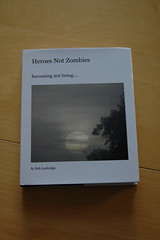
Heroes Not Zombies – the book of the blog
Posted in creativity, from the reading room, photography, writing, tagged blurb.com, book publishing on March 11, 2008| 9 Comments »
I’ve just taken delivery of my first attempt to use blurb.com to produce a book. It’s fabulous. It was so easy to do and the quality of the hardback book I’ve received is way beyond my expectations. And for any fellow bloggers, it’s a real treat to be able to page through a hard copy of your blog. I really do recommend it.
I am SO thrilled with the result. Click here to go and see for yourself.
What I wanted to do was produce a hardback copy of my first year of blogging. The blurb service has a program to download called “booksmart” and you use this to create your books. Included in the program is a great tool called “blogslurp” which downloads a complete copy of your blog into a template on your hard drive. You can then edit every single page, choosing different page layouts, upgrading low resolution photos for higher resolution copies from your photo library, and deleting or adding any text you choose. You then hit “upload” and that’s it. If you want you can preview the book as a pdf but I didn’t bother. I chose the largest format hardback book they do.
I am delighted with the quality of the printed copy and it got to Scotland in less than 10 days from the time I hit the upload button.
Here are some photos of the book to give you an idea what it looks like.


Striped crocus
Posted in from the dark room, photography on March 10, 2008| 5 Comments »

Striped crocus, originally uploaded by bobsee.
I like the purple crocus so much I took a photo of this one too
-

This work is licensed under a Creative Commons Attribution-Noncommercial-No Derivative Works 2.5 UK: Scotland License. -
Join 2,087 other subscribers
Top Posts
Categories
- art
- books
- creativity
- education
- from the consulting room
- from the dark room
- from the living room
- from the music room
- from the reading room
- from the viewing room
- health
- humour
- life
- movies
- music
- narrative
- neuroscience
- perception
- personal growth
- philosophy
- photography
- psychology
- science
- Uncategorized
- video
- writing
Pages
Meta
Category cloud
Commenting Policy
Archives
- April 2026
- March 2026
- February 2026
- December 2025
- November 2025
- October 2025
- September 2025
- July 2025
- June 2025
- May 2025
- April 2025
- March 2025
- February 2025
- January 2025
- December 2024
- November 2024
- October 2024
- September 2024
- August 2024
- July 2024
- June 2024
- May 2024
- April 2024
- March 2024
- February 2024
- January 2024
- May 2023
- April 2023
- March 2023
- February 2023
- January 2023
- December 2022
- November 2022
- October 2022
- September 2022
- August 2022
- July 2022
- June 2022
- May 2022
- April 2022
- March 2022
- February 2022
- January 2022
- December 2021
- November 2021
- October 2021
- September 2021
- August 2021
- July 2021
- June 2021
- May 2021
- April 2021
- March 2021
- February 2021
- January 2021
- December 2020
- November 2020
- October 2020
- September 2020
- August 2020
- July 2020
- June 2020
- May 2020
- April 2020
- March 2020
- February 2020
- January 2020
- December 2019
- November 2019
- October 2019
- September 2019
- August 2019
- July 2019
- June 2019
- May 2019
- April 2019
- March 2019
- February 2019
- January 2019
- January 2018
- June 2017
- May 2017
- April 2017
- March 2017
- February 2017
- January 2017
- December 2016
- November 2016
- October 2016
- September 2016
- August 2016
- July 2016
- June 2016
- May 2016
- April 2016
- March 2016
- February 2016
- January 2016
- December 2015
- November 2015
- October 2015
- September 2015
- August 2015
- July 2015
- June 2015
- May 2015
- April 2015
- March 2015
- February 2015
- January 2015
- December 2014
- November 2014
- October 2014
- September 2014
- August 2014
- July 2014
- June 2014
- May 2014
- April 2014
- March 2014
- February 2014
- January 2014
- December 2013
- November 2013
- October 2013
- September 2013
- August 2013
- July 2013
- June 2013
- May 2013
- April 2013
- March 2013
- February 2013
- January 2013
- December 2012
- November 2012
- October 2012
- September 2012
- August 2012
- July 2012
- June 2012
- May 2012
- April 2012
- March 2012
- February 2012
- January 2012
- December 2011
- November 2011
- October 2011
- September 2011
- August 2011
- July 2011
- June 2011
- May 2011
- April 2011
- March 2011
- February 2011
- January 2011
- December 2010
- November 2010
- October 2010
- September 2010
- August 2010
- July 2010
- June 2010
- May 2010
- April 2010
- March 2010
- February 2010
- January 2010
- December 2009
- November 2009
- October 2009
- September 2009
- August 2009
- July 2009
- June 2009
- May 2009
- April 2009
- March 2009
- February 2009
- January 2009
- December 2008
- November 2008
- October 2008
- September 2008
- August 2008
- July 2008
- June 2008
- May 2008
- April 2008
- March 2008
- February 2008
- January 2008
- December 2007
- November 2007
- October 2007
- September 2007
- August 2007
- July 2007
- June 2007
- May 2007
- April 2007
- March 2007
 Heroes Not Zombies