Feeds:
Posts
Comments

Archive for 2012

The Great Turning

Excellent post on the School of Life site about the three stories circulating at present – the first one is “business as usual” ie no need to change what we do or how we live; the second one is “the great unraveling” – it’s all falling to pieces. And the third?

The third story is held and embodied by those who know the first story is leading us to catastrophe and who refuse to let the second story have the last word. Involving the emergence of new and creative human responses, it is about the epochal transition from an industrial society committed to economic growth to a life-sustaining society committed to the healing and recovery of our world. We call this story the Great Turning. There is no point in arguing about which of these stories is “right.” All three are happening. The question is which one we want to put our energy behind.

I’m putting my energy behind The Great Turning – how about you?

Read Full Post »

On the Cambo Estate, at Kingsbarns in Fife, there’s a magical forest walk you can take at night time just now. Cambo is famous for its snowdrops at this time of year and they’ve lit up the forest and placed a number of art installations amongst the trees. Here’s a flavour of it.

snowdrops by starlight cambo house

snowdrops by starlight

snowdrops by starlight

snowdrops by starlight

snowdrops by starlight

snowdrops by starlight

Read Full Post »

Here’s an interesting idea from Okinawa. Apparently the people who live in Okinawa don’t trust banks (are you surprised?). However, in Okinawa, they have an interesting way of sharing money. It’s called a “tasukeai moai”.

Here’s an example. A group of 10 friends form one of these groups and they agree the following –

  1. To meet once a month for ten months.
  2. To each commit to put 50,000 yen (that’s around £400; or 500 dollars/euros) into the pot every month.
  3. Each month one person can opt to take the whole pot.
  4. Once 500,000 is taken, that person has to pay 2000 yen in “interest” each of the remaining months in addition to their monthly 50,000 contribution.
  5. The pot therefore rises by the amount of the addition payments each month (the 2000 yen from each “borrower” in addition to everyone’s monthly contribution), so the later you opt for the pot, the greater the amount you receive, and the earlier you take it, the greater the amount of interest you pay.
  6. If two or more people want the pot in any particular month, they draw lots.
  7. After the tenth month the club closes and a new club can commence. (you’ll have figured out that the group lasts for as many months as it has members….)

The group therefore support each other’s needs in a kind of informal savings and loan club. In addition to this support they are friends and increase their friendship through their commitment and sharing. These groups work on trust, friendship and everyone in the club knowing each other.

Different, huh?

Read Full Post »

ripples

We live with a view of ourselves as separate entities, made up of tiny, distinct, independent parts. This idea, this kind of atomism, has been around for centuries.

Now, however, we’re coming to understand that reality isn’t like that.

Lynne McTaggart writes in “The Bond”

The universe contains an indeterminate number of vibrating packets of energy that constantly pass energy back and forth as if in an endless game of basketball with a quantum sea of light. Indeed they aren’t even there all the time, but are constantly popping in and out of existence, making a brief appearance before disappearing back into the underlying energy field.

This is our emerging model of reality, one where there are no “things”, there is no “material” or “substance” distinct from energy. One where everything is constantly changing and nothing is separate.

Thomas Berry writes

We live immersed in a sea of energy beyond all comprehension. But this energy, in an ultimate sense, is ours not by domination but by invocation.

What a lovely phrase. This atomism has led us to believe that we are not only separate from each other but from Nature itself, and that has led to an unhealthy relationship with the Earth – one where we’ve been believing we can dominate and control. But we can’t. There is no separateness.

Read Full Post »

The Fourfold Wisdom

Thomas Berry, in “The Great Work” writes that we can draw on what he calls “the fourfold wisdom” as we face the future together in the world. These are “the wisdom of indigenous peoples; the wisdom of women; the wisdom of the classical traditions; and the wisdom of science”.

He captures the essence of the these wisdoms as follows –

Indigenous wisdom is distinguished by its intimacy with and participation in the functioning of the natural world.

The wisdom of women is to join the knowing of the body to that of the mind, to join soul to spirit, intuition to reasoning, feeling consciousness to intellectual analysis, intimacy to detachment, subjective presence to objective distance.

The wisdom of the classical traditions is based on revelatory experiences of a spiritual realm both transcendent to and imminent in the visible world about us and in the capacity of humans to participate in that world to achieve the fullness of their own mode of being.

The wisdom of science, as this exists in the Western world at the beginning of the twenty-first century, lies in its discovery that the universe has come into being by a sequence of evolutionary transformations over an immense period of time. Through these transformation episodes the universe has passed from a lesser to a greater complexity in structure and from a lesser to a greater mode of consciousness. We might say that the universe, in the phenomenal order, is self-emergent, self-sustaining, and self-fulfilling.

This is a beautiful model. We understand and experience the world through particular lenses. We experience life through the maps of reality which we create.

This idea of the four wisdoms gives us a fascinating map. Go explore.

Read Full Post »

cafe love

Yes, its Valentine’s Day, so a day for telling a romantic partner that you love them, but why not take today as an inspiration?
February is the month of love – not just romantic love – who do you feel love for? When did you last tell them?
Tell them today.

Oh, before I go……here’s a rose for YOU

passionate red

Read Full Post »

Read Full Post »

Have you ever thought of yourself as a celebration?

Thomas Berry, in his “The Great Work”, writes

While the universe celebrates itself in every mode of being, the human might be identified as that being in whom the universe celebrates itself and its numinous origins in a special mode of conscious self-awareness.

The theme of “The Great Work” is the amazing evolutionary story of the universe. Thomas Berry points out that we can discern three core principles, or characteristics, flowing through the evolution of the universe from its origins to the current day where human beings have populated the Earth. These themes are

differentiation, subjectivity, and communion

In other words, ever increasing complexity and diversity, the capacity to have inner experience, to respond spontaneously, and the ability to form connections and bonds.

This is a beautiful story. It’s dynamic, flowing and developing. As we follow through the story from the formation of stars like our sun, of the planets which orbit it, of the emergence of simple life forms, and onwards to the development of ever greater levels of consciousness, we see that in the human being the universe has achieved the ability to reflect on itself, to see itself, to celebrate itself.

You.

You are the universe celebrating itself.

What a lovely idea. See how it feels today to become aware of yourself as a celebration.

Read Full Post »

I’ve been collecting positive emotions recently. The Heartmath technique involves re-creating the heart felt, positive feelings you experienced in your life. So what are these heart felt, positive emotions? I’ve read a number of authors who write about positive emotions – from the perspectives of positive psychology, Heartmath itself, neurobiologists, mindfulness practitioners and so on.

What’s emerged is a short consensus list. Ten of these twelve feelings are mentioned by all the authors I read, all were mentioned by more than one author.

Contentment – pretty self-explanatory

Gratitude – it’s easy to establish a gratitude practice….worth doing at least once a day. What do I feel grateful for?

Hope – no life worth living without it?

Interest – I am insatiably curious. I’m never far away from interest!

Love – unconditional preferably

Pride – not what comes before a fall, but those moments when you know you’ve done well, when you are pleased with what you’ve achieved

Amusement – laughter is the best medicine

Compassion – it builds bonds

Sexual desire – again, pretty self-explanatory

Joy – just sheer pleasure and delight

Inspiration – those moments when you feel just, well, inspired!

Awe – or, as I prefer in French, émerveillment

What I really recommend is creating your own personal resource book of these feelings. Jot down in a few words, and/or gather photos, which capture your own personal experiences of these emotions. You can then draw on these feelings as you need them.

Read Full Post »

Last year I learned how to teach the Heartmath technique – find out more about Heartmath here.

Here’s a simple guide to the theory and the practice.

Here is a map called “the emotions map”
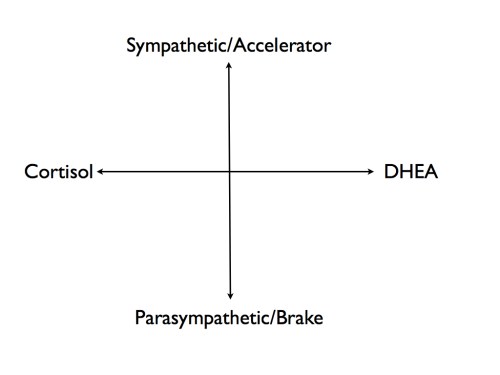
It has two axes – the vertical one shows the “autonomic nervous system” – this is the part of the nervous system which is responsible for the survival responses of “Fight of Flight OR Freeze” reactions. The autonomic nervous system is divided into two pathways – sympathetic and parasympathetic. Think of the sympathetic as being like the accelerator – when it is active there is a lot of adrenaline released into your system, your heart beats faster, your breathing is faster, and your body mobilises oxygen and energy to all your muscles ready to help you “fight or flee”.

The other path is the parasympathetic and can be thought of as a brake – through activation of the “vagus nerve” it slows down the heart, quietens and closes down your systems – the “freeze” reaction. We frequently oscillate wildly between these two extremes, flying from panic to collapse and back again!

The second axis, the horizontal one has one of the body’s main defence hormones at the left – cortisol. This is necessary for normal defence, but in excess cortisol can do a lot of harm. It’s sometimes called the “Stress hormone”. The right hand edge of this axis is “DHEA”, sometimes known as the “vitality hormone” – when there is a lot of this in the body, all the cells age more slowly and growth is stimulated.

What we want to achieve is a harmony of these systems – when we are in the top left quadrant our heart rhythm is chaotic. The heart rate varies all the time in a normal heart, but when the “heart rate variability” is chaotic, we’re not in a good place! Interestingly, when we are in the zone on the right of this chart, our heart slips into “coherence” – a kind of overlaid smooth, harmonious rhythm of the heart rate variability. In coherence we have harmony, we reduce the stress hormones and the excess autonomic activity, and we redress the balance between cortisol and DHEA.

Now here comes the fascinating bit – each of these zones or quadrants is associated with particular emotional states, with particular feelings.
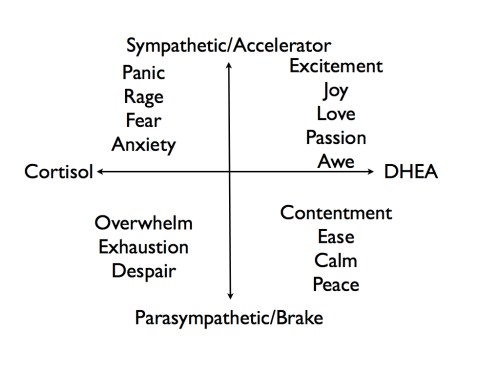
The Heartmath technique consists of re-experiencing one of the “positive” emotions on the right of this chart by recalling and reliving an episode or even where we felt such a feeling.

There are three steps to achieve “Quick Coherence” – a basic Heartmath technique.

Step 1. Heart focus. Bring your attention or your focus to the heart area of your body.

Step 2. Heart breathing. Take three, slow, deep, even breaths, filling the heart area of your body with oxygen, then emptying your lungs of all the carbon dioxide. Slowly in, slowly out, for three breaths.

Step 3. Heart feeling. Now recall an event where you experienced one of the positive, heart felt emotions. Here’s a couple of ones I use to give you an idea of the kind of event I mean. One is one of my grandchildren running up to me, shouting “grandpa!” and jumping up into my arms. That’s a great one! Another is looking out over Ben Ledi from my living room window when we have one of those gorgeous deep red sunsets – just amazing! Pick one of your own, and recollect it. Stay with that memory until you become aware that you are feeling that feeling again. This is about recreating a feeling. Once you have it, that’s it. You’re there.

Congratulations, you just managed “Quick coherence”.

Do check out the Heartmath Institute website – lots of great resources there to explore this technique in more detail!

Read Full Post »

« Newer Posts - Older Posts »