Feeds:
Posts
Comments

Archive for February, 2014

I’ve long been impressed by Don Berwick, whose “Crossing the Quality Chasm” introduced me to the concept of the Complex Adaptive System. So I was keen to listen to his keynote presentation at the Institute of Healthcare Improvement at the end of 2013. I urge you to take the time to watch this….ok, it’s 48 minutes long, but it is one of his very best talks.

His main point is that whilst we have improved disease management significantly, if we really want to increase the quality of health care, then it is time to apply attention and energy to “health creation”, and that do so, requires that we ask ourselves just what health is and what examples are there of health creation which might begin to help us build health creation into health care.

http://youtu.be/r5Tbikk44jY

I particularly like how Don Berwick refers to the work of Wayne Jonas, Dean Ornish, and the mindfulness movement initiated by Kabat-Zinn. But his reference to “blue zones” was new to me (those communities in the world where people live longer and in better health). What do all of these have in common?
IMG_0551


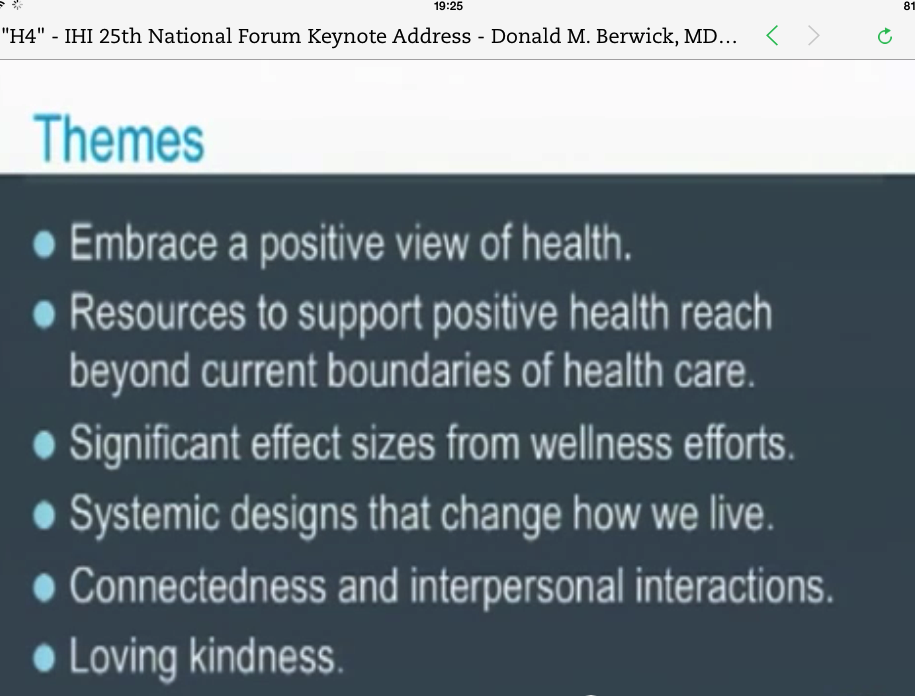
(this is the summary slide from Don Berwick’s keynote)

Health needs to be conceived of as a positive experience in itself – NOT the mere absence of disease. The ways to create health will probably be found outwith the current health care systems. A focus on wellness produces LARGE changes in health – in fact, much larger than the effect sizes of drugs on diseases. We need to use a systems approach to create health – not a focus on parts, but on the whole – body, mind and spirit.

The last two points are crucial –

  • Our connections in the world and our relationships are vitally important to good health.
  • The one key thing you can do to create better health is to practice loving kindness.


Read Full Post »

In the A to Z of Becoming, G is for GIVE.

Do you think giving is a satisfying experience?

I do. In fact, I think giving enriches your life.

Some people say life is a game of give and take, and that there are givers and takers. I’m sure you’ve come across that idea, and you can probably also identify individuals in your own world who are givers, and those who are takers. Not many people would be happy to accept the label of “taker”, and being known as a “giver” feels like being appreciated.

I’m not sure how useful labels are however, so I’m not thinking this week about who are the givers and who are the takers. What I want to be aware of this week are my opportunities to give.

What can I give?

My time, my attention, my compassion, my love, my effort, my full engagement with this present moment, my acts of kindness……

None of these are things, but I might have opportunities this week to give things too. What I find interesting is that we tend to think of gift giving as being about things, and I think physical gifts can be important. But, here’s something to experiment with this week….give every day, and make a note of what you give (in fact, even better, write an entry in your journal about it…..describe the circumstances of your giving, what your giving involved and why you decided to give) and then reflect next weekend on your week of giving.

How does it feel to give?

Let me give you this photograph (you can click through on any of my photos and download them for yourself, if you wish)

street games kyoto

I stumbled across this in Kyoto a while back. In fact, I saw it a few times because it was in a street near my hotel.

I love this. Here is a game of Go, with a tub of black stones, and a tub of white stones. Anyone is free to make a move. I don’t think I’ve seen anything like this in any other city. I wonder if the players know each other? It did strike me that every play was an act of giving, a gift of participation, a contributory gift, a gift of engagement.

Read Full Post »

clouds

clouds2

When you’re looking for something to photograph, just looking out of your window, or looking up to the sky, gives you enough inspiration.
I just love the multi-layered effects here….looks like range after range of mountains disappearing into the distance.
What you can’t see here is that the clouds were all moving very fast. This particular view changed before my very eyes…..as the Japanese culture emphasises – transience increases the beauty

Actually, when I look at clouds, I often hear Joni Mitchell singing in my head! If you’ve got a few minutes watch these two videos.

Firstly, this is Joni singing Both Sides Now in 1970

The, here she is singing the same song in 2000

What a difference! I know Heraclitus said you can’t step in the same river twice, so maybe it’s obvious that you can’t sing the same song twice

Read Full Post »

well, Valentine’s Day, so I strolled through my iPhoto library to find some kind of heart shaped image which wasn’t like all the other heart shaped images you’ll see today.

Here’s what I found

heart kiss

It’s a suggestion of heart shaped on the suggestion of lip shaped……so here’s my Valentine to you – hope you feel some love stirring in your heart today


Read Full Post »

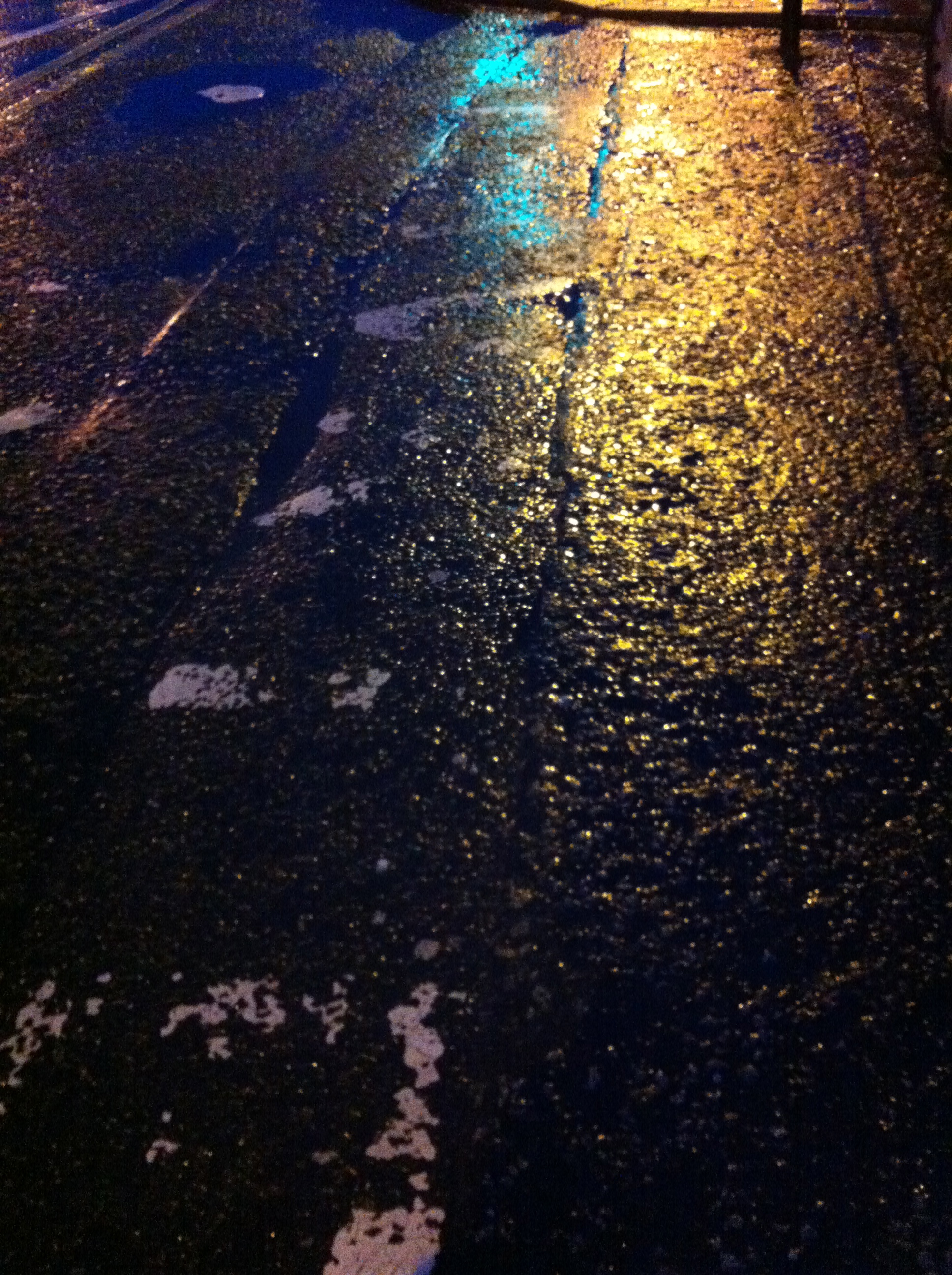
the road


Sometimes people are intimidated when they think about taking photos, so here are my two top tips –

1. The first is, don’t worry about what camera to get. The camera you have in your hand is the best camera to use today. In fact, lots of us now have a camera in our smartphone and you’re probably never without your phone. (I use my iPhone for quick shots, but I do carry a Nikon with me everywhere)

2. Photograph whatever catches your eye. Do you really think you can through a day without anything catching your eye?

The photo above is of the traffic lights reflected on the wet tarmac which caught my eye as I crossed the road from the station on a rainy night.

Read Full Post »

I’m convinced we are surrounded by beauty and wonder.

Here are three photos taken within minutes of each other in my kitchen the other day……what can you see without even leaving your house?


Kitchen peppers

Blue

image

Read Full Post »

I’m a bit of sceptic about putting collated data ahead of individual experience when it comes to finding what is best for this patient today.

So, I was very taken by this sentence from a Japanese doctor’s journal. This is a surgeon who has been the only doctor on a small Japanese island since 1978.

Initially, the locals were wary of this strange young doctor coming to their island. How would he win their trust? Show them some graphs of randomised controlled trials and run night classes on calculating odds ratios?

Nope.

I would have no choice but to wait and to rely on the power of positive results to build a relationship of trust here

This is what you call believing reality…..when time and again the lived experience steadily builds your confidence.

Read Full Post »

Fading roses

Faded roses, tossed behind a gravestone

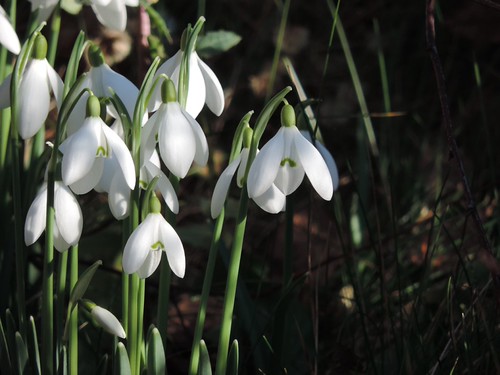
Snowdrops

First snowdrops of the year

Two images, a few metres apart, a few minutes apart, seasons and lifecycles apart

Read Full Post »

waterfall

Flow is one of my favourite verbs.

As with all words, there are various nuances, or aspects to it.

Maybe you see this word and think “Go with the flow” – as in, don’t resist, don’t fight, don’t challenge, just go along with everyone else. (but look what water can do, just by flowing over rock…..)

water and rock

Of maybe you hear it as a call to relax, take it easy, tune in to the effortless.

feather heart

But those aren’t what I think of when I think of flow – instead I think of Czikszentmihalyi, the positive psychology pioneer, who researched “flow experiences” and published them in his book of that name. He was referring to those times when it feels as if everything is flowing beautifully, everything is coherent….it’s a peak experience, and he found that it was most likely to occur when we are in the process of achieving some challenge we’ve set ourselves. So it often involves a lot of effort to develop the necessary skills, and then as we use those skills, in what can appear an almost effortless way, we have that feeling of complete harmony.

I also like the ideas of flow which emerge when you think about how water behaves. In fact, I like that so much I did a whole photographic project on it and turned it into a book and a website – come and see here.

Read Full Post »

There are three kinds of “attractors” described by complexity science. An attractor is a kind of local organiser, producing distinct forms from the patterning of energy flows.

Here are three photos of mine which will help you see these three common patterns. First up, the “point attractor” which creates spirals or whirlpools, organising the local region around a single point.

photo

Secondly, here’s a “loop attractor” pattern, where there are two points of organisation close to each other. This creates a pattern of alternating zones, or states, figures of 8, or “infinity loops”.

Bark marks

Thirdly, there are “strange” or “chaos” attractors where it is hard to see any distinct pattern but the region is being organised around multiple, interacting points.

amazing detail on stone


Similar patterns can be seen throughout the universe, from the microscopic to the cosmic level. Here are three astronomical photos showing large scale attractor patterns (I didn’t take these ones!).

A beautiful, point attractor, spiral.

images-1


A fascinating loop attractor….

images


And, finally, a strange attractor pattern….

images-2


I think we see these patterns in disease as well, from situations where everything gets stuck, going round and round the same restricted path, to those alternating, or flip-flopping states, like highs and lows, and, then thirdly, the chaos patterns where there is such a level of dis-integration that everything feels a mess, feels chaotic.

I wonder if you can see any of these fundamental patterns in your world?

Read Full Post »

« Newer Posts - Older Posts »