Feeds:
Posts
Comments

Archive for July, 2014

This way or that

I just can’t imagine how this tree grew in this particular shape, but it’s quite a metaphor for life.

Often something happens which means you have to change direction and go forward in a completely different way. This happens again and again and the events, their effects, and the changes you made stay embedded in the reality of you. They become the story you tell when someone asks you who you are.

Then you connect with someone, form a close bond, and your lives become entwined.

Read Full Post »

image

Two thoughts – firstly, isn’t this amazing? This little creature carefully checked out my fingers with its feelers, but decided to stay on the plant. Secondly, if evolution is a random process of mutations selected by their contribution to the chance of survival, then why did creatures become so complex? After all, single celled organisms have successfully adapted to every single physical environment on our planet.

Read Full Post »

Atlantic moon

Even the moon looks small over an Atlantic this big.

Read Full Post »

There are something like 100 billion neurons in your brain – a literally mind boggling figure.  Are you really able to imagine what a 100 billion of anything looks like?

As if that weren’t challenging enough, each neuron has up to 50,000 connections with other neurons, and each connection (a synapse) is an electro-chemical switch of a sort – passing information and energy across the gap between two neurons. This makes the total number of states of the brain (number of “on” or “off” neurons) a figure which is……well, unimaginably huge!

I was taught at university that a synapse was a pretty simple connection between two cells where on neuron released a chemical, which then crossed the gap and stimulated the next neuron. This, of course, is a huge oversimplification.

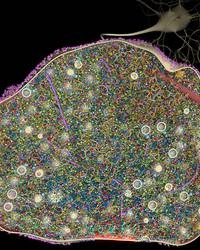
Researchers have recently managed to describe a single synapse much more accurately.

0f9996a3aecb308bd7182564925c857c


The researchers say


The new model shows, for the first time, that widely different numbers of proteins are needed for the different processes occurring in the synapse,” says Dr. Benjamin G. Wilhelm, first author of the publication. The new findings reveal: proteins involved in the release of messenger substances (neurotransmitters) from so called synaptic vesicles are present in up to 26,000 copies per synapse. Proteins involved in the opposite process, the recycling of synaptic vesicles, on the other hand, are present in only 1,000-4,000 copies per synapse. The most important insight the new model reveals, is however that the copy numbers of proteins involved in the same process scale to an astonishingly high degree. The building blocks of the cell are tightly coordinated to fit together in number, comparable to a highly efficient machinery. This is a very surprising finding and it remains entirely unclear how the cell manages to coordinate the copy numbers of proteins involved in the same process so closely.

It’s not just the numbers which are astonishing, its the complexity, and that last sentence particularly struck me – “it remains entirely unclear how the cell manages to coordinate the copy numbers of proteins involved in the same process so closely”

Just how much DO we know about how the human body works? How much DO we know about how it evolves to this level of complexity, both through an individual lifetime from the fertilisation of a single egg cell to a fully grown human being, and throughout history from single celled life forms to the multi celled human beings?

Humility. That’s what we need as scientists. Humility. Our ability to discover and understand is astonishing, but so far pales in comparison with the complexity of a single human being.

I’m amazed.

Read Full Post »

The A to Z of Becoming has been very popular over the last 26 Sundays (if you want to see any of the posts, search “a to z” using the search box on this blog homepage). A number of readers have asked me what will happen now that last Sunday was “z for zigzag”. The answer is Part 2 starts today.

Ready for another 26 verbs?

Well, let’s start again with A. This time, A is for Amaze.

The French concept of émerveillement is a core value for me in daily life, and one of the connotations of that word is amazement. So the verb for this week is “amaze”.

We can think of this from two different perspectives –

  1. what amazes you?
  2. what do you do to amaze someone else?

Here’s one of the many things which amazes me, and I hope it will amaze you too…..

pre-history

These are impressions left in the rocks by prehistoric people who were probably amongst the first inhabitants of Scotland. Look what happens when we flip this image up the other way

stand out


So, this amazes me in two ways.

First it I find these marks and indentations quite astonishing. To think how many thousands of years have passed since someone made them. And how did they make them? And why did they make them?

Second, I noticed that looking at these rain-filled indentations from one side of the rock made the water look concave, but from the other, they look convex. Luckily, I could capture that with my camera.

Isn’t that amazing?

It sure amazes me!

So, why not think about amazement this week and be prepared to both be amazed, and to amaze!

Read Full Post »

wide open

That’s what the world is like…..wide open.

Read Full Post »

NHSCIC garden

Henning Mankell, who you might have heard of as the author of the “Wallander” books, has been diagnosed with cancer and has written a series of articles about his experience of the diagnosis and the treatment.

That same evening my wife, Eva, told me about something she had heard on the radio. A doctor had been talking about the art of medical treatment. “Nobody talks about ‘the art of medical treatment’ nowadays,” she said. “But that’s what it all boils down to, even so.” She is right, of course. When you have lived for almost 70 years, as I have, you have quite a wide experience of doctors met over the years. Doctors in different situations, in different countries. I don’t think I’ve ever come across an absolute dud, somebody I’ve run a mile to get away from. Obviously, some have been more capable than others; some have been impatient or preoccupied; others have seemed to have unlimited time available. But the doctors I remember most clearly are those who have displayed what can be described, certainly by me, as the innermost subtleties of the art of medical treatment. Alleviation, consolation, perhaps even cure, always involves a dialogue in which the patient and doctor learn how to talk to one another, and if possible create a continuity. Medication and other treatments are never enough in themselves. If the patient doesn’t understand what the doctor is saying, or if the doctor is unwilling or unable to interpret the questions and worries of the patient, the dialogue that is at the very heart of medical treatment will never materialise.

So, what is this? This art of medical treatment? There are some clues in Henning’s words – a dialogue; continuity; the creation of a relationship; the need to understand each other; opening a space to allow the patient’s questions and worries to be expressed and the ability to interpret them.

Why use the term “art”? Well, it’s partly to differentiate this aspect of medical practice from the science which is also required, and partly to refer to the craft, or skill, of the therapeutic relationship. These are people skills, communication skills which require non-judgemental, empathic listening. But I think the “art of medical treatment” is even more than that. It invokes a consideration of what medical treatment is.

What is the purpose of medical treatment? What is a doctor seeking to do with each and every consultation? Surely, it’s an attempt to assist a person to a better life. It’s not just about prescribing, or surgical interventions…..as Henning says “Medication and other treatments are never enough in themselves” – not that treatments are unnecessary – they just aren’t enough.

I feel the same way about diagnosis. It’s one thing to diagnose a disease, but it’s quite another thing to understand a person and their illness. We need our scientific knowledge to diagnose diseases, but we need our art of medical treatment to understand a person and their illness.

I’m struck by the relevance of Henning Mankell’s reflections for me at this point, as I reflect on my medical career, and am blessed to have patients share with me just what it is that they valued about their care over the years – you can read about that here. To summarise, it seems to me, they are telling me what they valued was my “art of medical treatment”.


The wicker basket

Read Full Post »

DSCN1247

“Evidence Based Medicine” is a movement in crisis according to a recent BMJ article by doctors who want to improve it. Many of the responses to the article call for better statistics, more effectively communicated, and one in particular makes a plea for less but better protocols. One doctor talks about a friend who worked as a sailor in command of a nuclear submarine. He said the crew had to learn and consistently apply a small number of protocols and suggests that doctors should do the same.

There is a confusion at the heart of this comment, and in some of the assumptions behind statistics based medicine.

The confusion is that human beings are just complicated machines.

One way to clear up some of this confusion is to think about the differences between the terms complicated and complex.

Machines can be complicated. Technology can be complicated. Anything which is made up of many, many parts which are connected up can be complicated.

So, aren’t human beings complicated then? Aren’t human beings made up of many, many parts which are connected up?

Yes.

Any living organism has many, many parts which are connected up, but there’s a difference.

Living organisms are complex adaptive systems.

Complex adaptive systems have certain characteristics we don’t see in machines not matter how complicated they are. Here are four of them (there are more!)

  1. Non-linear connections
  2. Emergence
  3. Co-evolution
  4. Autopoeisis

Non-linear connections

You’ll have heard of the butterfly effect? Where a butterfly flapping its wings in the Amazon can cause a hurricane in another part of the world? What that illustration tells us is that very small changes in the starting condition of a system can cascade to rapidly produce very large changes in the outcome. This is the nature of most of the connections in living organisms

Emergence

Complex adaptive systems continuously behave in unpredictable, novel ways. Emergence is a term from biology which describes novel behaviours which could not have been predicted from an examination of the previous state.

Co-evolution

All living organisms exist within specific environments and because they are “open” ie constantly exchanging materials and energy with their environment, both the organism and the environment are constantly influencing each other, constantly responding to each other, and, in fact, even affecting each others evolution. You cannot fully understand a living organism by isolating it from the environment in which it exists.

Autopoesis

This is a term which means “self making capacity”. Not only can living organisms repair themselves, but they can grow, mature, develop and even replicate themselves.

Yes, all that is pretty complicated. But not in the same way a nuclear submarine is complicated. Advanced technologies might seem as if they are alive, but they aren’t.

If we forget this, we try to engage with living organisms as if they are just complicated machines which can be broken down into separate measurable parts, each of which can be managed by the application of protocols.

Living organisms need to be understood as complex, not complicated.
DSCN0930

Read Full Post »

IMG_0607


Over the first half of this year, I’ve written a post every Sunday under a series title of “The A to Z of Becoming”. I’ve picked 26 verbs and shared some thoughts about focusing on one verb a week as a way to consciously engage with the process of change in our lives.

We change all the time – as Henri Bergson says, in “Creative Evolution”

for a conscious being, to exist is to change, to change is to mature, to mature is to go on creating oneself endlessly

This process of “creating oneself endlessly” is largely an unconscious one, but we can engage with it consciously by making choices about what we DO. It’s our actions which create our selves and our world.

As Game of Thrones fans will know

Words are wind

Or to consider Bergson again….

we are, to a certain extent, what we do, and that we are creating ourselves continually

Our lives are creative processes of unceasing change, and consciousness gives us, uniquely in this universe (as far as we know!) the opportunity to escape from passivity and automaticity. We are not objects. We are not things. We are not zombies. Unless we choose to be……

Heroes, are the protagonists of the stories. Each of us is the hero, or protagonist of a unique story, a story untold by any other being in the history of the universe and a story which will never be told again by anyone else.

Heroes are “action heroes” – WE are these “action heroes” if we choose to become aware of the actions we take every day.

You can find a post on each of the verbs in that word cloud above by searching for the it using the search box on this page, or find the whole series by searching for “a to z” (use the quotation marks as well as the phrase)

Read Full Post »

july rest

In my twelve monthly themes, July has a theme of rest or of taking a pause.

Traditionally, these summer rest days, or rest weeks, are thought of as holidays. In Scotland there is a tradition of “Fair Fortnights” or “Trades Fortnights”, when all the businesses in a particular town would close for the same two weeks. In Glasgow, “The Glasgow Fair” is still a two week holiday period which starts with a Monday holiday. It’s a long time since all businesses shut down for the same two weeks, but a lot of Glasgow people will book an annual holiday for the two weeks of “The Fair”. In France, there is still a widespread tradition of taking a holiday in August, to the extent that the first day of the August holidays is known as “Le Grand Depart” (don’t think I have to translate that one for you, do I?)

If you do have a holiday coming up this month, what are you going to do during that time? Spend it alone, or with family, or friends? Stay at home, or go and live somewhere else for a few days (a tent, a caravan, a guest house or hotel)? Whatever your choices, I expect that your days will be quite different from your “usual” days, and I think that gives you a real opportunity.

Here’s your time to pause, to stand back, to see things from on high, to reflect. Yes, it’s a time for rest, or for exploration, or adventure, but it’s also something like what the Tibetan Buddhists call a “bardo“.

The term bardo can also be used metaphorically to describe times when our usual way of life becomes suspended….


The Med

Read Full Post »

« Newer Posts