Feeds:
Posts
Comments

Archive for March, 2015

opening

As this little plant opens up, it collects the morning dew.

Opening……I was recently reading an interview with Richard Sennett where he was talking about co-operation, and one of the things he was discussing was the difference between “dialogue” and “dialectics”.

Although that latter word might seem strange to you, it’s what we do a lot. As we converse with one another we each set out our views or beliefs and the idea of a dialectic discussion is to try to find “the truth”, or to achieve a shared view. (It’s not exactly that, but that’s probably close enough for this post!)

He proposed what we need to do if we want to live together, is dialogue.

In dialectic conversations, opposing positions (thesis and antithesis) confront one another with the goal of resolving conflicts (as a synthesis).  “In dialectic[s]…the verbal play of opposites should gradually build up a synthesis…the aim is to come eventually to a common understanding. Skill in practicing dialectic[s] lies in detecting what might establish that common ground.” Dialogical conversation, on the other hand, is much more open ended, not necessarily seeking the goal of resolution. “Though no shared agreements may be reached, through the process of exchange people may become more aware of their own views and expand their understanding of one another.” There is an openness of exchange in dialogics that is captured by idioms like ‘bouncing ideas off each other,’ ‘thinking out loud,’ or ‘brainstorming.’ Because the exchange is not structured as assertion, defend, assertion, etc. one has the space to be inventive, creative, and wrong. The value of dialogical conversation then is not the resolution of conflicts, but is to create a greater understanding, empathy, and sociability between parties; in other words, the goal is exposure

So, in dialogue, he says, we seek to understand the other. We don’t refute or challenge what they say in order to deny it, or modify it to suit our own views or purposes, but instead we ask more about why the person thinks that, or says that, and in so doing we might not achieve a “consensus” but we do achieve an understanding. Build that in with tolerance and you have a way of living with difference. (Dialectics, he says, seeks elimination of difference)

I found that in consultations with patients it was important to understand not just what they were experiencing but what sense they were making of that experience. And that sense might have a religious or a political/social basis which I personally didn’t share, but if I was to do my job well, I didn’t need to replace the sense they were making of things with my own personal beliefs and values. Rather I needed to understand, as best I could, what was different about this person – what beliefs and values were important to them in helping them to make sense of their experience.

That process is a process of opening up. It involves asking open questions, not ones where I have an answer or two up my sleeve, and I’m just waiting to produce the “right” one.

So, here’s what I’m thinking……when we talk to someone else, how do we open up the conversation, rather than close it down?

How can we be open to difference, instead of trying to eliminate it?
 

Read Full Post »

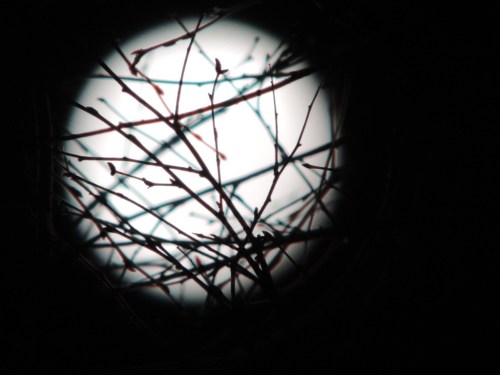
Last night with the moon just a night away from being full, it shone so very brightly in a clear sky.

Instead of taking a photo of the moon this time, I decided to take a photo of the silver birch tree in the garden which, just at that moment, had the moon shining through its branches.

But what I didn’t expect was the colour.

Look at it! Look at the colours produced by the moonlight!

I’ve never seen that before – it’s a magical, beautiful creative act by the moon and the silver birch tree (and me!) 

Read Full Post »

The Atlantic

People crave certainty.

We want to know, for sure, what the results will be of our actions. We want to be able to predict what is going to happen in the world, and in our lives.

Don’t we?

Two examples spring to my mind.

1. The daily weather forecast.

Every day millions of people listen to, watch or read the weather forecast. We want to predict what the weather will be like tomorrow, in a few days time, next week or the week after even……

2. The focus on “outcomes”.

Knowing for sure the results of our actions – in Medicine, we want to know for sure what will happen if we have treatment X, and we want to know for sure what diseases we will get and what effects they will have on us. In Economics, we want to know for sure that if we introduce this particular policy then it will have the results we desire. In engineering we want to know for sure that the machines we make will consistently and reliably do the job we design them to do.

That’s how it is for us humans. We’re afraid. We know that none of us live for ever but that’s a terrible knowledge to have. We want power over the unpredictable. We want to control the present in order to control the future.

But does the world work like that? Is Life like that?

I don’t believe those who predict futures, but I’ll listen to what they have to say, and make some choices all the same. If the weather forecast says it’s going to pour with rain tomorrow but has a good chance of being sunny in a couple of days time, I might choose to put off my trip to the beach tomorrow, and, instead, to plan to go in a couple of days time.

But do you know what I find most satisfying of all?

To “seize the day”.

If I wake up tomorrow and the forecast is wrong…..there’s bright sunshine and clear blue skies, then it’s great to set off to the coast, and not wait for a “better day” a couple of days ahead.

And what about control – of diseases, of economies, of machines and so on? We don’t control any of that.

Look at that lighthouse in the image above.

Does it control the Atlantic Ocean?

Does it ensure that shipping will not hit rocks?

No, neither of those things.

It gives us the opportunity to be aware, and so let’s us make adaptive choices. (In the case of the lighthouse, to be aware of the rocky coast and to change direction)

But if the opposite of control and prediction is “out of control” and unpredictable, then I don’t know any human beings who can manage to live that way.

So, for me, it’s not about trying to be out of control or to relish unpredictability. Despite the fact that the delusions of control and fallibility of predictability will always be unsatisfying, disappointing or frustrating.

I do think there is another way.

The other way has something to do with awareness, with resilience, and with living in the present moment, but I think I’ll take the time to explore that in more detail in future posts.

Read Full Post »

Dragon

A few years ago I wondered why the twelve months of the year have the names they do, and around the same time I was thinking, for many of us, there is a lack of awareness of rhythm and ritual in our lives, so I put the two ideas together and came up with a theme for each month of the year.

I use the theme as a touchstone of a kind. It’s a reminder, a meditation focus, a thought to return to each day….

March, the month which is named after Mars, has become, for me, the month to focus on strength.

There are two aspects of that which have come up for me this year as I reflect on this theme.

The first has been prompted by my reading of an article by Richard Sennett about “open cities”. He focuses on the issues which arise from us trying to live together – as we do as human beings, clustering together and building huge cities. That reminds me of T S Eliot’s Choruses from the Rock –

When the Stranger says: “What is the meaning of this city?

Do you huddle close together because you love each other?”

What will you answer? “We all dwell together

To make money from each other”? or “This is a community”?

And the Stranger will depart and return to the desert.

О my soul, be prepared for the coming of the Stranger,

Be prepared for him who knows how to ask questions.

Before I wander too far off topic, one of the key points Richard Sennett makes is about boundaries and borders. He says

The boundary is an edge where things end; the border is an edge where difference groups interact. At borders, organisms become more inter-active, due to the meeting of different species or physical conditions; for instance, where the shoreline of a lake meets solid land is an active zone of exchange where organisms find and feed off other organisms. Not surprisingly, it is also at the borderline where the work of natural selection is the most intense. Whereas the boundary is a guarded territory, as established by prides of lions or packs of wolves. No transgression at the boundary: Keep Out! Which means the edge itself is dead.

That’s a pretty new idea for me, but I’ve long since known the importance of healthy borders. In thinking about health, we need healthy boundaries which are maintained by our immune systems, but we also need healthy borders where we meet and interact with what is “other”.

So, here’s the first thing I’m going to reflect on this month, the month of strength – how are my boundaries and how are my borders? How healthy are they, and how might I make them healthier?

I think the answers to those questions are unique for each of us, but if you are inspired by this, why not reflect on boundaries and borders in your own life? See what you come up with?

The second aspect which has come up for me is Seligman’s idea of strengths. If you’ve never done it, or it’s some time since you did it, go and take the free questionnaire on his site and find out what your own core strengths are.

Just as I reflected on the difference between positive and negative hope, I think we can build our strengths by paying attention to them – not by beating ourselves up over our weaknesses!

So, there you are – March – the month of strength. What does that mean for you?

Read Full Post »

Plant feet

In the A to Z of Becoming, I’ve reached the letter “H” again, and one verb which begins with “H” is “hope”.

So I’ve been thinking about hope, but recently I’ve also been thinking a lot about negativity and how frequently we come across people who are against something. There are so many “anti-s” about and I often wonder what exactly an “anti” would say they are “pro”. What are they for, as opposed to what are they against.

When I bring those thoughts to the action of hoping I can see that on many occasions people are practising a kind of “negative hope” – “I hope I don’t fail at….” “I hope I don’t miss my train”, “I hope I don’t…..” – it’s about fear.

And fear is used a lot to control people so we are often sold messages on the basis of what might be avoided, rather than what might be achieved.

The positive psychology movement grew out of the understanding that whatever we focus on gets bigger. So if you try to treat someone’s fear by focusing on reducing that fear, you still end up focusing on the problem, not the solution.

It might seem there is a subtle difference between hoping for something and hoping that the opposite does not happen, but I think that difference is significant, because the focus of the hope has an influence on us.

If we spend our lives hoping that this or that does not happen, then we are living from a standpoint of fear, and our behaviours become avoidance behaviours.

If we spend our lives actively hoping for this or that, then we can live engaged with the creative efforts which can lead us to the fulfilment of those hopes.

Maybe the universe really does conspire to bring about what we focus on…..and if that is true, then ask yourself what you hope for, not what you hope you can avoid.

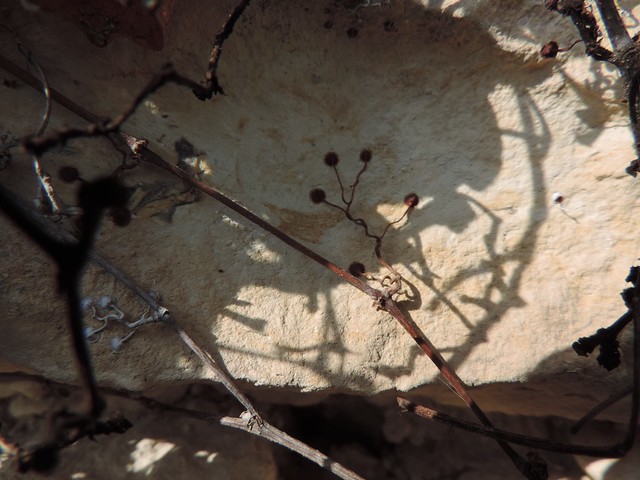
The vine in the photograph at the beginning of this post is actively seeking out and creating opportunities to grow. It is sending its out its tendrils to support itself in growing bigger, climbing higher, and spreading further. I like to see this as a positive behaviour focused on enriching and developing Life.


Read Full Post »

« Newer Posts