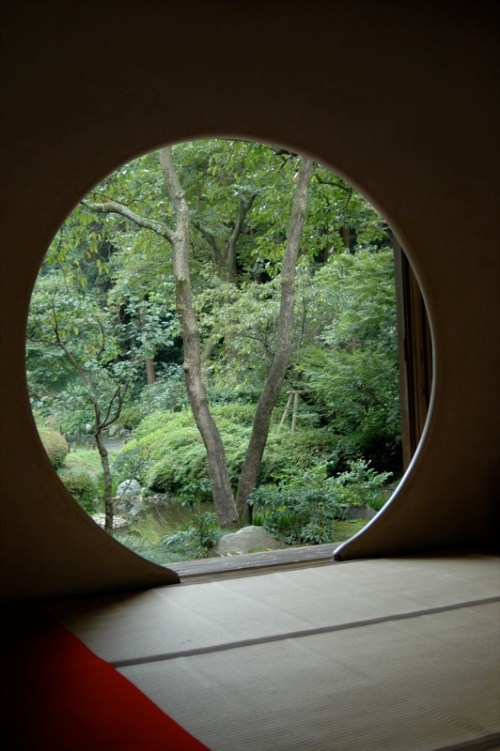
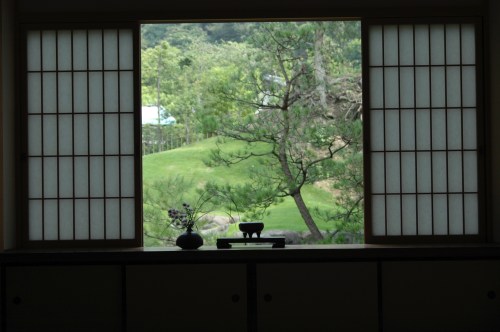
I was looking through old photos the other day and came across these ones of windows I’d seen in Japan. I thought I’d use one of them as the starting point for some writing and then found myself immediately unable to choose between them. I love them both.
However, they each present a totally different way of engaging with the world. Somehow, the round window invites the viewer to step through it into the garden. Maybe that’s partly because it goes all the way down to the floor, and, actually, the floor cuts through the circle which suggests that we are almost partly “in” it already. The square window, on the other hand, is like a frame. It looks complete in itself. There’s a symmetry to it which is very Japanese. The two bowls aren’t placed dead centre. The one nearer the middle is shifted to the left, and the other one is well to the left. Yet, somehow, the exact position I took up to make the shot resulted in the tree outside completing the distribution of objects in the frame in an incredibly pleasing way. It’s the symmetry of balance, rather than the symmetry of replication. You see that a lot in Japan. The Greco-Roman symmetries of Europe aren’t like that. In addition, the screens to each side of the square window act as powerful limiters. They substantially frame the view.
It struck me that the feelings associated with these two windows are very different. The circular window engages, opens up, invites. It feels like a moment of connection, not a static connection, but a dynamic connection which pulls you towards it. The square window doesn’t do that. It is somehow much more static. I feel content to stand here and gaze, feasting my eyes on the beauty of the image, frame and all.
But of course, why choose?
Why not prefer “and” to “or”?
So, I did. I chose them both and found that together they gave me a completely different starting point and a totally different flow of thought.
I feel there is an excess of binary thought these days. We are constantly being divided up, separated from each other, according to one simplistic duality. Natives or immigrants. Men or women. White people or People of Colour. “Leavers” or “Remainers”. I want to resist that. I refuse to be reduced to a single category. In fact, I refuse to be reduced to a collection of categories. I know that the data-minded think they can know us by harvesting our “likes” and preferences from Facebook but the uniqueness of a human being can’t be contained within a frame of data.
Maybe I see something of that in the square window. Maybe there’s something there of man-made straight lines and right angles, something which frames, contains, controls and boxes up.
Maybe I see something more natural in the round window. Maybe in that sweeping curve I’m pulled towards it, enticed to dive into it, to explore a world of connections and flow.
But maybe that just says something about me.
The truth is I like them both. If the straight lines and right angles represent science and the circle represents art, then I want both of them.
If the square window divides reality up into pieces, and the round window insists on a view of the whole which expands seamlessly as you step towards it, then I want both. I’m interested in the parts. I like the adventure into the body to discover the cells and their inner workings. And I’m insatiably curious because I know that all knowledge is incomplete. There will always be more to explore, more to discover, more to experience.
This afternoon, after pruning the vine which covers the old stone wall at the side of the garden, I sat down, felt the breeze on my cheeks, the sun on my skin, heard the songs of the little birds sitting amongst the plum blossom, and these thoughts of squares and circles came back to me. Here’s the thought that popped into my head. It surprised me, and it feels like a beginning rather than a conclusion.
Every camera I’ve ever seen has a circular lens. But the photographs it makes are rectangular.
Why is that?
Why do we capture the light with our round lenses, but only record what passes through them onto square, or rectangular sensors, or plates?
When I look out at the grass, the flowers, the fields and vineyards around me, the blue sky and clouds above me, there is no frame. Yes, I know, there are boundaries. I have what we call a “field of vision”. But that field isn’t at all like the field beyond the bottom of the garden. It isn’t bounded by four straight lines, and four right angles. It’s a circle. Or an ellipse.
That’s how we see the world. Through a circular lens and a sphere of sensors which are stimulated by the light which they encounter. There’s no hard edge. More a gradual loss of clarity towards the edges of the field. There’s no fixed frame, neither square nor circular. But there’s an impression of a circle nevertheless.
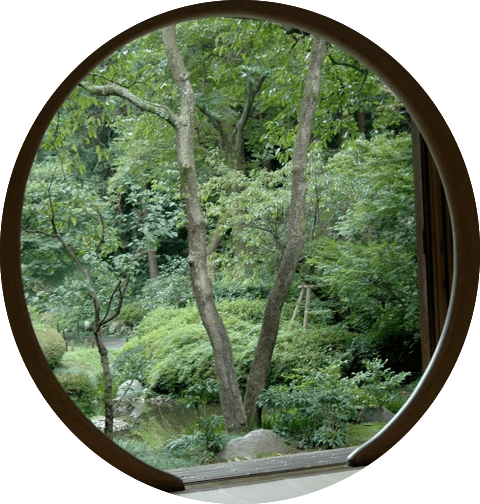
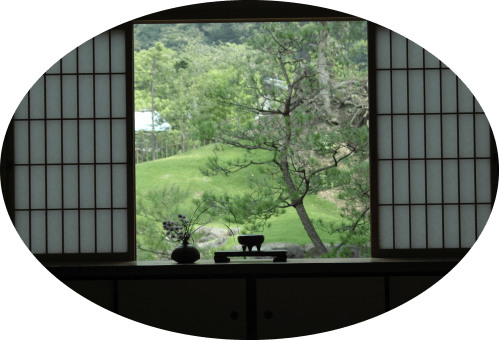
Before I go…..here are those two images again, but this time with circular or elliptical frames…….

 Heroes Not Zombies
I enjoyed reading this post Bob. Very insightful. Thanks.
Thank you Stepheh