Feeds:
Posts
Comments

Archive for March, 2021

Look at this guy! All alone, out there on the tip of the rocky outcrop. Not another soul in sight. Bliss!

Or is it?

There are times when life gets too busy. Times when we are packed onto trains, buses, planes. Times we are standing in queues surrounding by dozens of other people talking, shouting, pushing and shoving. And we just think – of, if only I could be all alone!

Well, it’s not been much like for many of us this last twelve months, has it? Gone are the commutes, the overcrowded bars and shops, the slow moving queues, the hustle and bustle, and now we are in our homes for way more of the time than we’ve been before.

In isolation, or “lockdown”, or “confinement”, we have been separated out. Socially distanced. Physically distanced. Is this bliss? Probably not.

We are social creatures, we humans. We have evolved a highly social brain which connects us to others. We have longings, desires, needs to be with others…..socially, physically, emotionally.

You’ve probably had the experience during this last year of contacting people you haven’t heard from in years. Or people you haven’t heard from in years have contacted you. You’re probably having more conversations on the phone, on video calls, and using messaging services like WhatsApp and Messenger. You’re maybe participating more on social media – which, strangely, is sometimes terribly anti-social!

The thing is we need both. We need time to ourselves, time we can relax, be at peace, perhaps meditate or exercise or just chill. With no interruptions, no demands and no stress. But we also need time to connect, to say “hello”, to ask how others are doing, to express ourselves, to be heard and to listen.

I know you might think it’s a matter of balance, but that’s a tricky concept isn’t it? Because a balance point isn’t likely to be found by scheduling in a set number of minutes for alone time and a set number for social time. That’s because the quality of life isn’t found in numbers of minutes. It’s found in the experiences….in the level of attention and awareness…..in the emotional landscape which emerges during an experience – love, joy, play, awe – all add quality to our lives. Whereas anxiety, fear and anger tend to feel not so good (even though these emotions are definitely an essential part of being human).

I wonder what comes next? Have we left behind the days of “over-tourism” in cities like Barcelona, Edinburgh and Prague? Have we become averse to crowds? If you’ve been working from home during this pandemic, are you looking forward to getting back into an office block? Are you looking forward to an hour or so of commuting to and fro again? Or are you longing to throw yourself into crowds of fans at a concert, or to pack a dance floor?

I don’t know, and the answer will be different for each of us. But, for a time anyway, I suspect we might be just a wee bit more aware than we’ve been for a long time. We might make more conscious decisions. And that, if it happens, will be one of the lessons we’ve learned from this pandemic.

Read Full Post »

I’ve only been sailing a couple times but I do think there are real life lessons we can learn from a photo like this.

First of all, life can seem full of threats like those rather scary, dangerous rocks. In this era of the pandemic that seems especially true and I wonder how our children are going to be as they grow up – they are having to wear masks, wash and/or gel their hands, get regular tests at school to see they are “germ free”, and are being taught that every physical contact is a potential threat – don’t hug! Don’t kiss! Don’t even stand too close!

Secondly, rocks are often much more of a hazard than they appear – we can see what’s above the water, but what lies hidden beneath? Which makes me think of viruses again – after all, we can never see them, and in fact the evidence for the effectiveness of things like wearing masks, social distancing, lockdowns and all such “non-pharmaceutical” interventions is disturbingly scant – by which I mean, not that they might be really helpful, but that we actually don’t know!

Thirdly, as a boat sails close to the rocks the pilot has to be aware of the currents and tides – because it’s not just the presence of the rocks which is a threat, but the potential for the water flows to push your boat onto them. Which reminds me that what we call threats are rarely fixed, often can’t be generalised and always need to be considered in their relevant contexts. Currents and tides change all the time…..and so does life.

Fourthly, I used this photo at the beginning of the pandemic to write about how it has always been a soothing image for me. Ever since I took it I look at it and I feel calm. It pleases me. But when I used it at the start of the pandemic, somehow I noticed the rocks as a threat for the first time. And here I am again, talking about how this image makes me think of potential threats. I guess this pandemic has changed us all. It’s certainly altered the lens through which we view the world.

Finally, I think sailing is a great metaphor for life. You can’t just plot your starting point and your destination and head off in a clear straight line from the one to the other. Nope, life will go much better if we stay aware and responsive. Sure, it’s good to have an idea of where you want to go….even to make preparations for the journey, hoping to anticipate what you’ll need and how you will deal with potential obstacles. But this is what life does – it throws up the unexpected. It surprises us again and again….which should be obvious really because the future is “emergent” – it comes into being from the combination of the past and the present – it’s not sitting there waiting for us to discover it. That’s a basic principle of complexity science – that the future is unpredictable in specific circumstances – that is, we can make broad generalised predictions – like about weather or climate – but we can’t predict accurately about specifics – the weather predictions get less accurate and reliable the further ahead you look.

So, if life isn’t fixed, then we can make certain preparations and plans but we always need to be awake and aware…..stumbling through life in zombie mode doesn’t strike me as the best option! And we need to be awake so that we can change direction, be flexible, adapt, depending on what we encounter. It turns out that improvisation and creative responsive solutions to problems and obstacles is what we need……every bit as much, if not more, than we need “goals”and “plans”!

Here’s the strange thing – at first this image was a calming image for me, then at the start of the pandemic it turned into a metaphor of threat, but, now I find it has become a positive image of improvisation and adaptation. Well, well, I wonder what kind of image it will be for me this time next year??

Read Full Post »

The truth is that every single flower is unique. There are no two flowers which share identical lives.

We have a tendency in our way of thinking which is dominated by how our left hemisphere engages with the world – it’s a tendency towards abstraction, labelling and categorisation. In other words we reduce whatever we encounter to a small range of characteristics or elements, consider them separately from their contexts and relationships to all else, label them and pop them into categories. So we can look at a meadow like this and identify, say, four different species of flowers. The trouble is, do we then just see only four species of flowers?

Maybe you think that doesn’t matter, and the thing is, most of the time, it doesn’t. We don’t need to know the life story of each individual flower. But the trouble is we extend that habit too widely. A good gardener tends their plants as individuals, noting how each one is growing, which ones are struggling, and so on, and dealing with any problems as they appear. We engage with domestic animals the same, naming them, learning their habits, characteristics and quirks. When a pet dies we feel grief which can’t be eased by “just buy another [cat] [dog] [rabbit] or whatever”.

In “The Little Prince” he talks about his rose which he says is not like all the other roses because he has spent so much time and attention looking after it….he’s developed a “bond” with it, a special and unique relationship. He’s right. When we create a meaningful relationship with an other, be that another person, another animal, another plant, then we appreciate their uniqueness, their irreplaceability.

Noticing diversity is a good way to remind ourselves that no two organisms are the same….no two trees, no two flowers, no two pets, no two people. When we become aware of diversity and see the individual as unique we can form a personal, meaningful, deeper, and richer relationship. That makes life richer.

Read Full Post »

I suspect “beauty is in the eye of the beholder” is not the last word on beauty, but I don’t deny that there is a subjective element to beauty. What I find beautiful, you might not, and vice versa. So here’s my invitation to you – tell me, or show me, what you find beautiful and I’ll share with you what I find beautiful.

Today, I came across this photo of a tiled roof in a village in Southern France. This is a very typical roof for this part of the world. I find it beautiful. I’m sure there are many reasons why, but I want to pick out and explore just one of them today – diversity.

What I see whenever I look at a roof like this is that the tiles are all different. As opposed, of course, to them all looking identical. I love how they are different colours and shades. I love how some of them have lichens growing on them, and some don’t. I love how they are not all the same size (they are pretty much the same size but it isn’t exact) and I love how they sort of fit in a higgley-piggedly way!

In other words the characteristic which I find so beautiful about these roofs is that the tiles are so diverse.

Diversity is beautiful.

Nature loves diversity. Left alone you don’t get permanent mono-cultures in Nature. Instead you get the display of vast networks of relationships between widely diverse elements, all of which contribute to the success, to the survival and the flourishing, of the whole.

I also love diversity even in tiles because it gives them more “character” – you can distinguish one individual from another. I like that more that factory produced, machine made, production line sameness – don’t “mono-culture” and “mono-tony” have the same root? Isn’t that maybe why I an averse to “mono-polies”?

I’m not a fan of imposed conformity, of the industrial, capitalist age of mass production and mass consumption. I love to see artisans at work here in France…..people with a lifetime of skill, learned by daily practice over years, taught by the most skilled ancestors and passed on to enthusiastic younger generations. I saw a great initiative in France recently where a small town invited two groups of people to a local building every Wednesday – retired people with a skill (an iron worker, a woman who used to sew for a fashion house, a stained glass worker, and others), and children aged about 12 years old. The children were learning these practical skills from these now retired skilled workers during their regular Wednesday time off from regular schooling. Both the retired skilled craftspeople and the children were loving it – it brought joy and meaning into their lives. It also connected the generations and gave both groups a different view of the other generation. Yes, it’s very small scale. There were only a handful of people in each group. But I don’t think that should put us off. Something doesn’t have to be “mass” and “standardised” to be successful. There’s nothing to stop any community taking this idea and fashioning it into their own practical project.

In my local town of Cognac there are several “Boulangeries” (Bakers) and they are ALL different. They might all include a core range of similar products, including baguettes and croissants, for example, but they all do it differently. Each baker has his or her own skill and experience, own strengths and weaknesses, and I know which one to go to for different types of bread, which make the croissants the way I enjoy them, and which make the best patisserie (like eclairs, and other cakes). Here’s the thing – I don’t buy all those different products in the same boulangerie. Yes, I know, you might prefer the “convenience” of a standardised, one stop shop, and that’s your right to enjoy that. But for me, acquiring this local knowledge then using it to find just what I want, when I want, enriches my life.

Diversity – it’s beautiful and enriching.

Read Full Post »

We change all the time. The world changes all the time. Nothing is fixed or, so called, “permanent”. I thought about that when I received my residency card here in France recently. I’ve been given what is called a “Carte de Sejour Permanente” – a permanent residency card. That’s me sorted, you might think. Then I notice that it expires in ten years time. Do they know something I don’t? Well, no, thank goodness, it’s just that permanent seems to last ten years in this instance.

That did get me thinking about the whole concept of permanent. Which isn’t something I’ve explored all that much. I have wondered for a long time about the concept of “now” – which is a period of time when we instantly recognise but is devilishly difficult to pin down or define. I mean the moment you think “this is now”, that moment has slipped away into the past and been replaced by an entirely new “now”! But back to “permanent” – I guess we just use this wonder to mean a fairly longish piece of time – in relation to geology we might be talking thousands of years, and in relation to the universe perhaps billions, but, in every single case, we discover that nothing is fixed, nothing really does retain the same, exact features and characteristics (cripes, even the same molecules!) for ever. It’s just the speed of change which alters.

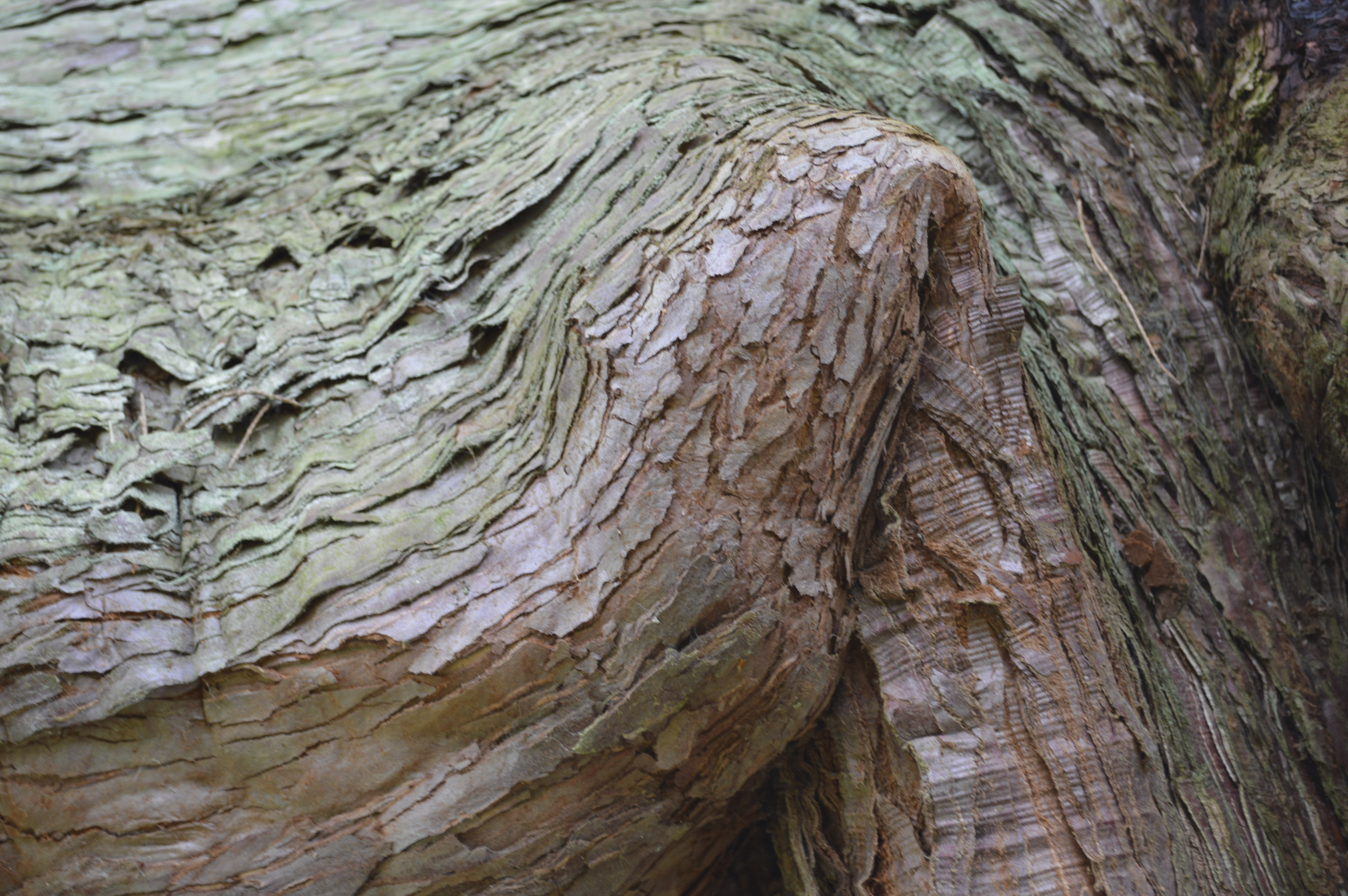
Yet, in our own lives, things happen, and after they’ve happened nothing ever seems the same again. Like you can see in this image of a tree that I’ve shared above. This tree has the most dramatic change of direction which has completely changed its shape forever….ok, for the rest of its life then. And when I see a “lesion” like this I immediately wonder “What happened?” I used to have the same approach with patients in the consulting room. They might come with a problem which had gone on for decades and I always asked them to think back to the time when they felt completely well, then to tell me about the appearance of the first symptoms. That naturally led on to a discussion about what was happening in their life around the time of the big change. I don’t think there’s any way to prove cause and effect in such a scenario but I found it helpful to take the position of “Let’s imagine that what was happening then was significant in bringing about what happened next” That seemed to open the way to a new understanding of illness, it’s significance and possible meaning, which gave a patient the opportunity to change their way of dealing with it to something more helpful, something which might even open the doors to growth and development.

In that sense I think that the events of our lives change us. The most significant events change us dramatically and for the rest of our lives. Death of a loved one, giving birth, serious trauma……you know the kind of thing. All of that, for the individual concerned leaves a permanent change – it can’t be erased. But the way forward with that is learning to create different responses from the ones which have trapped us in suffering. In other words, we can’t change the past, but we can change the way the past impacts on us by choosing to respond differently.

This pandemic is going to change us all……has already changed us all. There won’t be any “return to normal” even if many people desire that…..and nor should there be. Because this event is an opportunity for us, individually and collectively, to reflect, ask ourselves what we were doing that might have contributed to the particular experiences of the pandemic and what we might do differently now to not end up in the same place again.

We have a chance now to reassess our values, our beliefs and our behaviours. To change our priorities, to demand change in our economic, political and social systems. I hope we do that. We’ll all remember 2020. I hope we remember it as the year which led the world to take a different direction.

Read Full Post »

At Otagi Nenbutsu-ji outside of Kyoto, there is an extraordinary display of sculptures – read more about them here. They are all small figures, but the emphasis is on the faces. Each one was created by a different person, so each one is completely unique. You can see several of them if you click on the link in the first sentence of this post.

This particular one has a gorgeous expression. What does this convey to you? To me, it conveys delight, happiness, contentment, and a certain open hearted, loving sense of wonder. I know, I know, what we experience is an interplay that emerges from the connection between ourselves and whatever we have engaged with, so a lot of what this conveys to me comes from personal disposition and preferences. But that’s just how life is. You can’t take your subjective reality out of your daily experience!

What effect does this expression have one you? Because it does have an effect. It calms me. It soothes me. It stirs feelings of love and kindness in my heart. And as those emotions start to flow, they will change the complex balance of chemicals in my body, boosting my immune system and calming down my inflammatory system. Isn’t that amazing? I can change the chemical status of my “inner environment” and so my state of health by what I choose to engage with.

We do this all the time. Subconsciously for the most part, but we do it all the same. Our inner state, and our wellbeing, change constantly in response to the signals and triggers we encounter every day, and according to our own reaction and response patterns and habits. We can become more aware of them, and when we do, we can move more of our lives from react-mode to response-mode which frees us up from living in auto-pilot, or what I call “zombie living”. That lets us become more autonomous, more able to develop new patterns of response, and, yes, even reaction. More able to develop new behaviours, new habits, and new patterns of thought.

That’s the first thing I wanted to share with you when I looked at this image again today, but there’s something else too.

As we walk around our every day world there is one face we don’t see – our own. OK, we can see the mirror image of our face (which isn’t what other people see) and we can see photos of ourselves (look how many selfies people take nowadays!) so we do have opportunities to be able to see our faces. But we have to stop what we are doing and change our expressions to do both of those things. We can’t see the “live view” which other people have…..the expressions on our faces when we meet them, when we converse with them, when we engage with them.

Yet, look again at this image – it’s clear, isn’t it, that the facial expression has an effect on you? Well, that’s true of you as well. Your facial expression is having an effect on everyone who sees it. So, I wonder, what kind of effect do you want to have on other people? What kinds of responses and changes within them do you think might occur when they see the expression on your face?

I’ve said before that we can’t not influence the world we live in. We change it moment by moment by our breath, by our movement, by our actions and behaviours, whether we choose them consciously or not. But here’s another way we influence the world we live in – through our facial expressions.

Of course we can’t go about our lives consciously fashioning particular facial expressions all the time, but when we spend part of each day generating feelings of love, kindness, gratitude and wonder, then that will all play out in our faces, and we will literally radiate those vibes.

In contrast, when we spend a lot of our day in fear and anger then……guess what? That reminds me of the old story about the hungry wolves inside us.

Read Full Post »

I’ve been fortunate to have had the chance to visit Japan on a number of occasions. One of the things I always loved to do there was to visit temples and shrines (if I understand it correctly there are buddhist temples are shinto shrines). I’m not a Buddhist and I know only a bare amount about Shinto but I found these places to be what some would call “sacred” places. They feel sacred because they feel special, they stir something inside which surpasses wonder and appreciation of beauty. They are amongst those places in the world where the boundary between the material world and the spiritual world seems thin. I have had similar experiences in stone circles in Scotland, and in the cloisters of old monasteries in southern Europe.

What makes a place a sacred space? For you, I mean. What places in the world have you had experiences of stepping into somewhere enchanting, somewhere which stirs energies deep within you?

This photo is of a particular part of a particular place, but I want to focus on it today because every time I return to this image it calms me, it soothes me, it draws me out of myself and into a deeper connection with the whole. Let me just draw your attention to the elements (which I think are repeated in some form again and again in these Japanese temples and shrines).

There is running water. I do think this is a key element – not that you need running water to make a place sacred but in the context of these Japanese places it seems to be essential, and I love it. I love that the running water isn’t dramatic and showy like so many huge city centre fountains in France and Italy (although I must say I DO like those fountains too!). I like how it really demonstrates a continuous flow. It seems to me that this is the basis of all Life – continuous, always changing, but somehow also always constant, flow. We understand water so poorly, yet without it nothing of what we know would exist.

There are rocks and often one or more of them form a basin for the water to pour into. The rocks have age, they bring the past into the present, and they expand the range of time available to us as we stand in front of them. Have you ever stopped to wonder where rocks come from? Well, that’s a whole other story, but a truly fascinating one.

Lying on the rock are two strips of bamboo which are bound together to create a rest for the bamboo ladle. The ladle is used to scoop out some water and pour it over your hands…..a ritualised cleansing. I wonder if all religions have this element? This use of water to “cleanse” as part of a spiritual experience?

There is also a small sprig of flowers……Japanese flower arranging creates great beauty by simple and sparse combinations of plants. It inspires both wonder and delight. But the flower isn’t the only plant there…..there’s also moss. Now, moss has a particular special place in Japanese gardens and spiritual places. It’s revered in ways I haven’t encountered anywhere else in the world. Are there other cultures which revere moss? I would say it’s my encounters with moss in Japanese gardens and temples which completely changed my opinion of it. I love it now. I only saw its beauty once I had encountered it in places where it was revered. Isn’t that interesting?

This image still works for me, and I hope it brings you some delight and joy as well.

Here are my leaving thoughts – What places feel special this way for you? Do you have photographs of them? Did you paint them? Or write about them? How might you create such a special place for yourself? What elements would you like to include? And, don’t you think your life could be enriched by encounters with such places?

Read Full Post »

The first white asparagus of the season are arriving. The main lunchtime news had an item about the white asparagus from the “Landes” region yesterday, showing the first harvest. This is one of the most impressive differences for me about coming to live in South West France and it’s about food. Firstly, before I came here I don’t remember the annual seasonal arrival of any foodstuffs feeling like an “event”. I’m not even sure I could tell you what were the main seasons for anything in Scotland. But there are a number of distinct foods which appear seasonly here in France. Secondly, I don’t remember the seasonal arrival of any foodstuff being covered by the national news. Both of these phenomena are just normal here.

So, here we are in March and suddenly it’s the beginning of the asparagus season. First of all, the white asparagus. This season will only last until June so you’ve just over three months to enjoy it. In other words, it’s not just about the seasonal arrival of a particular fruit or vegetable, it’s that the season is exactly what you’d expect – about a quarter of a year – then you need to wait till this time next year until the local, fresh, harvest appears again.

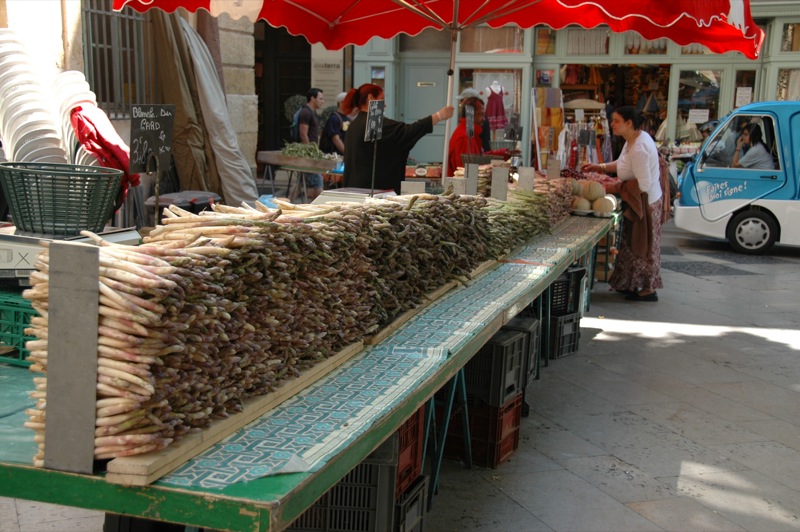
I took this photo a few years ago at one of the markets in Aix en Provence. I’d never seen that much asparagus before! Well, I’ve seen displays like this quite often in different parts of France since then (always, of course, at this time of year). In fact, in the weekly market in Rochefort, which isn’t too far from where I live, I heard a vendor behind a display like this shouting “Aspergez-vous!” – which would translate as “Asparagus yourself!” – nope, I don’t think you’d find that verb in a French dictionary. It was just his personal creativity and enthusiasm on display.

I don’t think I’d ever tasted asparagus before I came to live in France, and I certainly didn’t know there was both white asparagus and green asparagus. But I love it now – both kinds! I love it simply boiled with lemon juice drizzled onto it on the plate, and I love the white especially in a risotto. What a treat!

So here’s what I’ve learned from this experience – that when you eat food in its season, food which hasn’t travelled too many kilometres, food which hasn’t been processed, it tastes superb. Not only that, eating that food becomes something of an event. To eat it when it arrives in the market in season you experience a kind of excitement, a sort of thrill, which is added to the actual taste of that food. Applying this principle enhances my enjoyment of the food I eat, and when it comes to diets and “healthy eating”, enjoyment is not a supplementary option. It should be at the heart of the decision making. (This is a reverse to that old adage about the best diet being the one where “if it tastes good, spit it out!”)

I’m now more aware of variety in my diet. I’m more aware of how far the food has travelled. I’m more aware of wanting to choose what’s been produced locally where I can – and I’m happy to expand that concept of “local” depending on what the food is! (Corsican clementines are another of my all time favourite seasonal foods for example).

OK, so let me be clear. I don’t eat ONLY what is seasonal and local. But I have an awareness of those factors and I’ll deliberately choose them when I can. And yes, I know, not everyone has the same culture as the one I’m experiencing here. France has markets with local and seasonal produce really in every town….even quite small towns. That isn’t the case back in Scotland, and it might not be the case where you live. However, the culture of local small producer markets was always one of my favourite things about France when I used to come on holiday here and knowing that certainly influenced my decision to emigrate and to come and live here. (I emigrated to live in a different culture, a different language and a different climate)

How is it where you live? Are you able to access seasonal foods? If you are, I really recommend it. And, oh, yes, I’m pretty sure that a diet with plenty of seasonal and local plant based foods in it is a healthy diet. But I don’t think there is any one good diet which is best for everyone. I think it’s great we are different and we can make different choices.

Read Full Post »

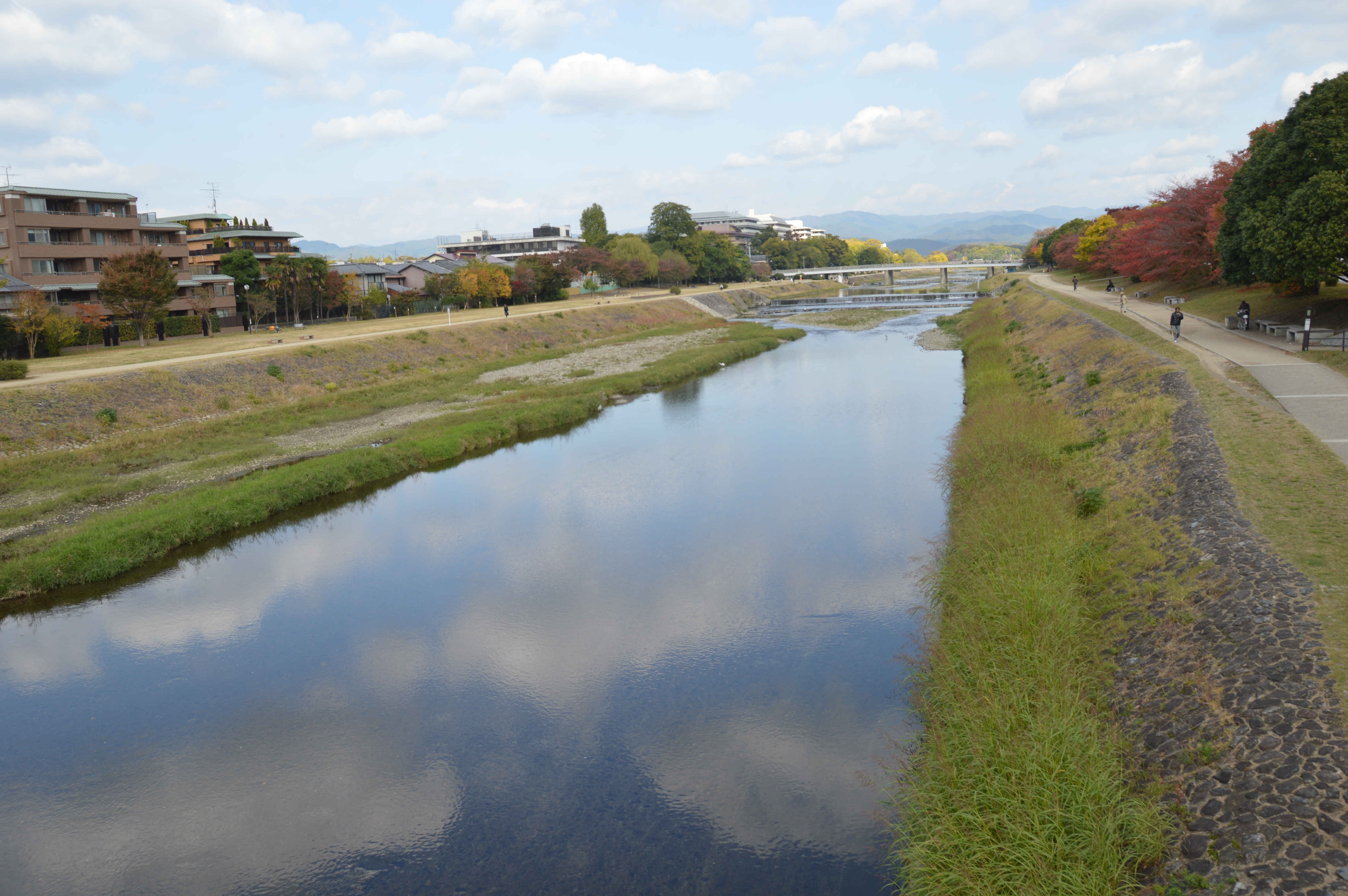
This is the Kamo River which flows through Kyoto. I took this shot because I liked the colours of the trees on the bank, and the reflection in the river of the clouds floating on a blue sky. I still like it for those reasons. However, I’ve found that, in the many years since I took this photo, that I’ve returned to it over and over again. I’ve used it to illustrate what I think are some of the most fundamental lessons of the universe.

On one bank you see trees, and a pathway running between the trees and the river. The trees are diverse. They are different species, different shapes, and different colours. For me they represent diversity and a “natural” habitat. You could argue they represent “wildness” – that universal force which continuously strives for growth, difference and diversity. It’s a “multiplicity”, not a “mono-culture”.

On the other bank you see houses, hotels and offices. This is the built environment. It is planned, constructed and ordered. Yes, I agree, the buildings are not all the same, and there is a saving grace in the Kyoto architecture. In some parts of other cities the buildings really are “cookie cutter” in their shape and construction. Let’s say this represents a second universal force – that which organises and builds.

Thomas Berry, in his “The Great Work”, describes these two forces beautifully and points out that an excess of “wildness” produces destruction, chaos and disorder….things can fall apart, whilst an excess of “discipline” produces too tight limits, narrow boundaries and a level of organisation which makes life impossible. I see this story represented in this photo.

Right down the middle of these two forces we see a calm, harmonious, “integrated”, flowing river. This is the “sweet spot”, that place where the interplay of these two great forces produces both Life and beauty. In this photo, there is even a bridge connecting the two. The bridge is a connector, and it’s through the creation of “mutually beneficial bonds between well differentiated parts” that we experience “integration”, harmony and growth.

You can think of a life journey sailing down this river, sometimes veering off towards more organisation, and sometimes off to the other bank to find diversity and wildness. As we navigate our way between these two opposites, we experience a full life, a rich life, a life of depth, meaning and purpose, a life of beauty and joy.

The final thing I’d say about the universal lesson I see in this photo is that it encourages us to appreciate the “whole”, not to judge one bank as “good” and the other as “bad”. After all, if we only had one bank, we wouldn’t have a river……we wouldn’t have a life.

Read Full Post »

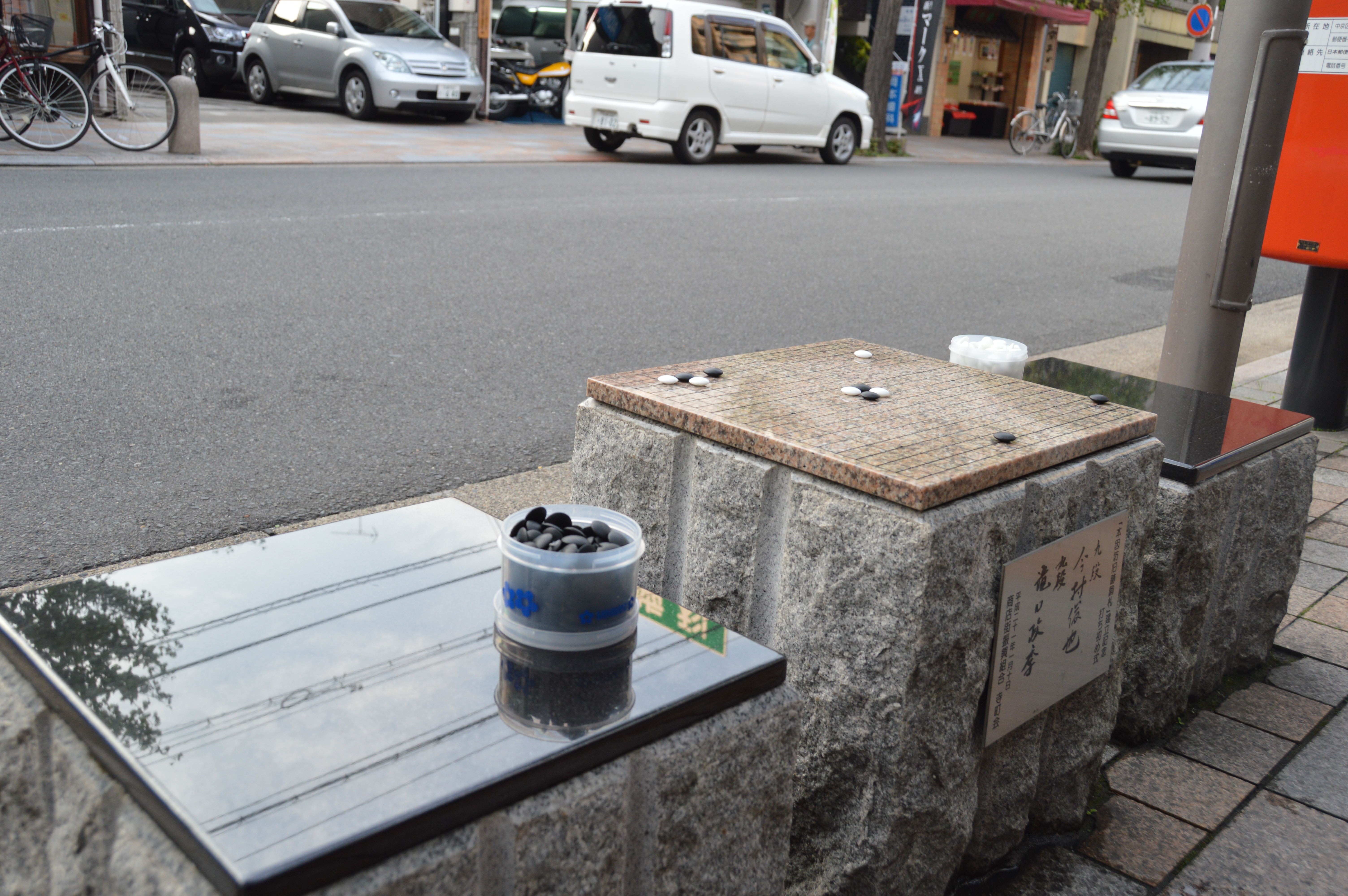
One day I was walking the streets of Kyoto and I saw this…….a game of Go, set up at the side of the road, for anyone to play. I don’t play Go but I thought it was amazing to see this. I suppose I’ve seen public chess boards and outsized chess pieces in other places, but this seemed a first to me.

Board games are very popular in France, where they are called “jeux de sociétié”(which would translate into “society games”) and sales of board games have apparently taken off spectacularly here. Card games are also very popular in France, although it’s a long time since I’ve seen a group of old men sitting at a cafe playing cards (I expect that will come back though)

There has also been a tremendous growth of interest in chess this last year, although, as I understand it, that is being put down, largely, to the extremely popular, fabulous, Netflix series, “The Queen’s Gambit” (if you haven’t seen that yet, I highly, highly, recommend it)

I also read recently that a study has shown that young boys who play video games are registering lower degrees of anxiety and psychological stress during the pandemic. Nice to read a more positive report about gaming.

So, maybe this pandemic has turned out to be an opportunity for us to rediscover the value of play in our lives – whether that be board games, card games, video games, or simply the unexpected benefit of young parents finding more time to play with their children. I know a lot of concern and emphasis has been on the difficulties associated with home schooling but I also know that many young parents now working from home are finding that their quality of relationships with their children has increased, at least in part due to the fact that commuting has diminished so much and spending that “found time” playing with the kids is such a delight to many.

So, how about you? Have you been playing more over the course of this last year? Did you take up chess? Are you enjoying your new “play times” with your children?

We shouldn’t underestimate the value of play.

Read Full Post »

« Newer Posts - Older Posts »