Feeds:
Posts
Comments

Archive for June, 2022

The second possible answer to How to Live is “pay attention”. Here’s an answer close to my heart. You could argue that “heroes not zombies” is about paying attention, because what we pay attention to creates what we experience on a day to day basis. Whatever we focus on is magnified by the attention we give.

Isn’t it interesting that we even talk of the “attention economy” nowadays? Whether on social media, tv, or other mainstream media, everyone is competing for our attention and is awarded for success by the advertising industry.

I’d argue that most modern politics is “attention politics” with its emphasis on focus groups, three word slogans and communications which stoke fear and anger and division.

If we’re not aware of where our attention is spending its time, we are in zombie mode, driven this way and that by those who seek to manipulate us.

Montaigne learned the importance of paying attention from the ancients.

Those traditions emphasise the benefits of paying attention to Nature and to everyday experiences. That makes a lot of sense to me. As you’ll find in many of my posts “l’émerveillement du quotidien” is a core principle for me – the wonder in the every day. I’m constantly fascinated by my daily encounters with birds, plants, trees, people, what I read in books, art, drama, music, poetry…..you name it.

Which brings me to another aspect of attention. Iain McGilchrist has shown that our two cerebral hemispheres pay attention in two very different ways. We need both and we experience life at its best when we integrate both halves. The left hemisphere has a narrow focus, honing in on particular details, abstracting them from the overall context and analysing them. It’s great for “grasping” things. The right, however, enables a broad, whole, engaged form of attention. It helps us to see the big picture, to discover and to create connections.

By using both we discover both the unique and the common. We see the context and in so doing better understand the parts.

I like the phrase “engaged attention”. It implies an investment in whatever it is we are paying attention to. It suggests a depth of experience greater than that which is achieved by flicking quickly through channels, “doom scrolling” social media, and purely reactive, unconscious ways of living.

This is one thing I feel quite certain of – it’s a good thing to pay attention !

Read Full Post »

The first of Montaigne’s twenty answers to the question of how to live (according to Sarah Bakewell) explores the issue of death. That might seem an odd place to start, because surely death is at the end of the story. However, it was an accident which gave Montaigne a near death experience and changed his whole way of thinking about life. It was this event which prompted him to begin exploring his own sensations, thoughts and emotions, and writing about them. In other words it was a near death experience which inspired Montaigne to create a whole new way of writing.

Prior to the accident he wrestled with the classical teaching of the Stoics who taught we should imagine our death, vividly, and in great detail, in order to prepare ourselves for dying when the time came. The trouble was he didn’t find thinking about and imagining his own death did anything other than increase his anxiety about it. He didn’t feel it was preparing him for it at all.

When I read that, I thought of the many Woody Allen films where his character constantly worries about death!

Montaigne processed his near death experience and concluded that the most striking thing was how dying felt a bit like falling asleep. It seemed like slipping from life into death was almost like floating effortlessly from the one to the other. Not a frightening process at all. Yet even as he was experiencing it, it seemed his unconscious body was writhing around, he’d been told. The inner experience didn’t seem to match the outward one.

As a doctor, you can imagine, I’ve witnessed many deaths over the years, and I’ve often wondered about those very final moments where, it seems, “the lights go out”. It’s always been a dramatic and emotional experience and I still don’t really understand exactly what happens at the final point of transition. In fact, “point” is the wrong word. It’s typically something that happens over a period of time greater than just a moment. But I’m not sure I ever imagined it was the way Montaigne described his near death experience.

Until one night on the island of Capri a couple of decades ago. As a young adult I ate oysters on two occasions and I was violently sick afterwards both times. As I grew up in central Scotland my family never ate seafood so I didn’t have any experience of mussels, clams, scallops and so on. One evening on Capri I was at a party and had spaghetti vongole. That was the night I discovered I had a shellfish allergy.

In the middle of the night I woke violently sick and rapidly got much worse. My wife went for help and I remember as a lay on the toilet floor realising I couldn’t move my legs any more and when I tried to speak no words came out. I knew in that moment I was really seriously ill and I still remember the floating feeling I had and the clear and distinct thought – “well, this is it. I’ve had a good life but I’ll be off now”.

Of course, I recovered. I wouldn’t be writing this today if I hadn’t. But that was my own personal near death experience. That all came back to me when I read Montaigne’s description. It did indeed feel from the inside a floating, slipping, easy transition. Not something to be afraid of.

Once Montaigne understood this he decided that, for him, at least, the old teachings about preparing for your death weren’t helpful. That, rather, death would come unexpectedly and naturally. He decided that instead of preparing to die, he’d put his efforts into living.

He shifted his focus from death to life. He decided to put his efforts, instead, into living a full, rich and fulfilling life. A good life. In the rest of his book he describes how he went about that. Each chapter is about his attempts to do that – “Essais”, translated as “Essays”, is the title of his book, but that French word actually means attempts, trials or tries. He describes what it was like to be Montaigne and as he does so uncovers many of the general issues we all share. So it’s common, even for contemporary readers, to wonder – “how did he know that’s what I experience?”

Well, that’s certainly my experience about this subject. For me, too, I’ve long since chosen to focus on living my life to the full.

Read Full Post »

How to live. Well, there’s a question which always feels fresh. There are whole sections of book shops dedicated to this question and an enormous diversity of ways of addressing it. You’ll find some advice in the Popular Psychology section, some in the Philosophy section, some in the Mind, Body, Spirit section, the Religion section, and on and on.

What’s the secret?

Probably there is no secret, and anyone who claims to have everything all worked out….well, what do you think?

Still, it’s a question which won’t go away so when Sarah Bakewell published “How to Live. A Life of Montaigne in one question and twenty attempts at an answer” back in 2010, I couldn’t resist. I really enjoyed it back in 2013 and this week I’ve started to re-read it.

Montaigne lived from 1533 to 1592 in the area around Bordeaux in the South West of France. I won’t tell the whole story here, but he was part of a wealthy family, and retired from Public duties as Mayor of Bordeaux at 39 years old. As the inscription hanging on the wall of his study says, he decided that after years of duties and responsibilities he was going to dedicate the rest of his life to freedom, tranquillity and leisure.


Montaigne’s chateau.

What he did for the next twenty years was enjoy life, have conversations, read and study, travel, and write. He decided to write to explore what it was like to be Michel Montaigne. He described his writings as attempts – that’s why they are called “essays” (from the French, essais, meaning to try). With great honesty and humility he set about reflecting on his past and present experiences. Sarah Bakewell, who spent years studying his writings highlighted the fact that this exploration was about trying to discover how to live, and in her book comes up with twenty “answers” to explore aspects of his thought and his life.

He didn’t write a self-help book. He didn’t write a manifesto. He didn’t write “the key to the secret of Life”. But what he did write has turned out to have much more staying power than it might have done had he done so. Over the next almost 500 years, reader after reader comes across Montaigne’s essays and recognises themselves. We think, goodness, how did he know that’s what I feel? Or how I deal with that? Or what I think? Because in exploring himself and sharing that, he helps us to understand what it is to be human.

I can’t think of a better introduction to this amazing man and his writings than “How to Live” [ISBN 978-0099485155]. I’ll share a few of the attempted answers in future blog posts, but let me just quote you a nice little summary of some of Montaigne’s personal principles which I found in Antoine Compagnon’s “Un été Avec Montaigne” which I picked up in bookshop near Montaigne’s chateau one summer.

Prenons le temps de vivre; suivons la nature; jouissons du moment présent; ne nous précipitons pas pour rien

My rough translation of this is to take your time to live; follow nature; enjoy the present moment and don’t rush into anything. (If you are a fluent French speaker, feel free to improve my translation!)

In other words, he predated the current “Slow movement” by almost 500 years, encouraged us to live in the now (which Eckhart Tolle has popularised), to live mindfully (and isn’t mindfulness everywhere just how? 12,200,000 hits on google today!), and to learn from Nature so that we can live according to natural principles instead of trying to fight against them (a lesson we are a long way from learning with our contemporary technology, economics, health care and relationship to the global environment)

Let us permit nature to take her own way; she better understands her own affairs than we.

Montaigne was classically educated and drew on the teachings of scepticism, stoicism and epicureanism. In fact he was the kind of sceptic I thoroughly identify with (not the modern, arrogant, sure of themselves and their own opinions variety!). He felt that knowledge was never complete so we could always learn more, and that no one person could have access to all knowledge so everyone’s opinions, experiences and views were interesting to discover. This approach made him humble and this comes through everything he wrote and did.

He didn’t tell people how to live.

Instead he reflected on his own life and shared it.

Read Full Post »

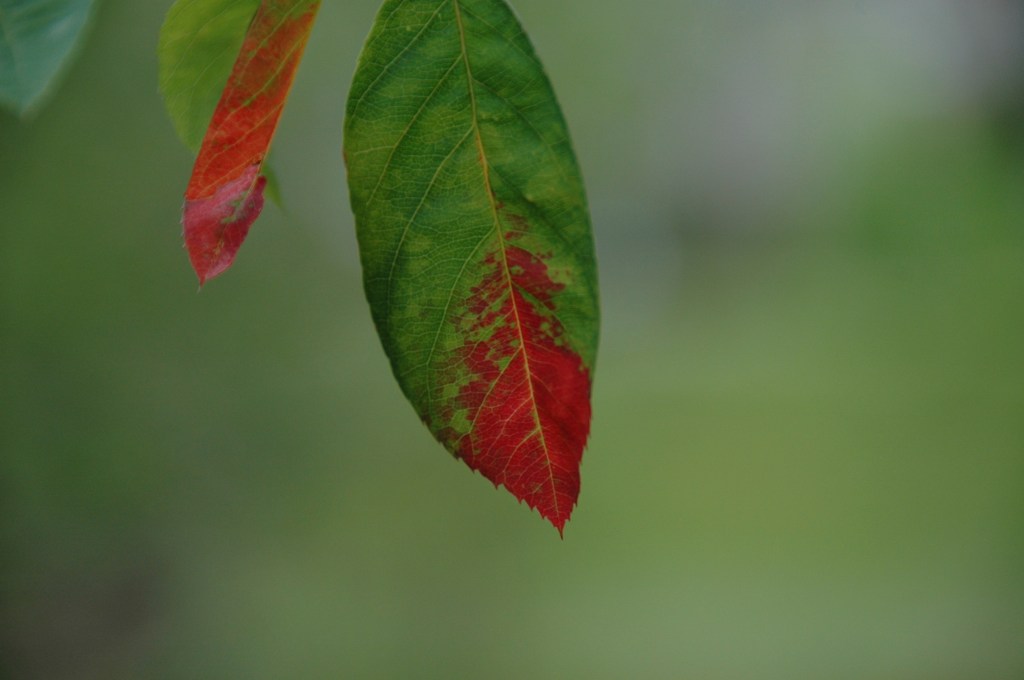
Is this a green leaf or a red one? If the colours represent two parties or choices in most modern democracies you’d have to say the greens won and the reds lost.

That kind of thinking does my head in! It produces everything from a tyranny of the biggest minority over all the other minorities to deepening divisions and resentment.

I understand that in a game, football, or tennis, for example, one team or player will score the most, be declared the winner and all the other contestants have to come to terms with their loser status. But that’s no way to run a society or a country.

Every population contains a diversity of individuals with different, probably evolving, or changing views and beliefs about everything. Democracy, if I understand the idea correctly, is a system designed to build consensus and promote social cohesion. But the current varieties of it don’t seem to work that way.

From first past the post voting, to us or them political groupings, to for or against votes where “winner takes all”, all of these practices deny the reality of complexity and diversity.

Does “we won” so “you” have to “shut up”, “suck it up”, or “move on” ever build understanding, improve relationships or build communities of people who want to work together? I don’t think so.

We need a better way to live together if we want to get off this divisive one track road to hatred, anger and resentment.

In politics, as in life, nothing is ever “finished”, “done” or “settled”. We need to be able to adapt, to make different choices as the world changes rather than digging deeper trenches and building bigger tribal walls.

I love this image of the green and red leaf, and I love it in this moment of its transition which speaks to me of Life, of dynamic cycles and seasons of change and difference. More than anything, in response to the question of its colour, I resort to “and not or”. It’s green AND red.

Would it be so hard to create a democratic system based on that reality? One that works for all of us, not just a minority?

Read Full Post »

Ways

I moved house six months ago. Since moving I’ve been very busy, every day. The house and garden haven’t been lived in for a few years so they’re needing to be brought back to life. They’re needing some care and attention. Some of that busyness is very satisfying. Some of it can be pretty frustrating. Much of it can be really exhausting. It’s certainly squeezed out other activities, blown away old habits.

My every day now feels quite different to my every day a few years ago. But then that’s pretty normal isn’t it?

Sometimes I think of my life as a book, so here I am in the next chapter. The title of my blog, heroes not zombies, reminds me that each of us is both the author and hero (main character) of our personal life story. So I’m busy writing this new chapter, and embracing fully every paragraph!

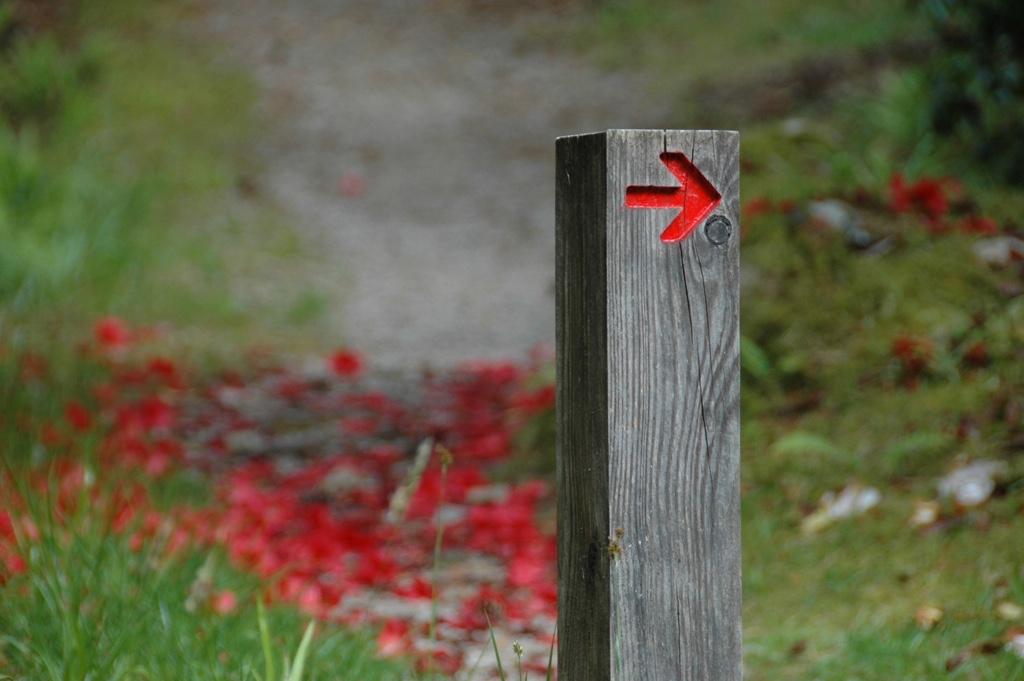
But this photo reminds me of another metaphor which I’ve always liked – the path, with it junctions, intersections and, occasionally, signposts.

My garden has a neglected overgrown area of trees in it and one of my main activities just now is opening it up and reclaiming it. I’m doing that, not by following any signposts, but by creating brand new paths.

It’s delightful, even when it’s tricky and hard work, to make your own new paths into the unknown, the unexplored, and to make new discoveries every day.

Sometimes there are helpful direction indicators in life, but they are always only suggestions, and the path we choose will always be unique, will always be our own.

Read Full Post »

Reality, which we can appreciate, and apprehend, directly in the natural, living world isn’t like the re-presentation, the model, or the map which is used most commonly in contemporary society.

What is that model or map? The machine.

A machine is constructed from parts, each of which is complete and independent from the others. It functions linearly, each movement or change leading to a predictable and exact outcome. The best machines are the ones which work most “efficiently”, producing the same outcomes time and again with the least amount of energy consumption.

The living world is not like that. Human beings are not like that. Reality is not like that. Machines and models are artificial. Complicated perhaps, useful perhaps, but not something we should try to emulate.

Reality is a constantly changing interactive flow of materials, energy and information. Everywhere we look in the natural world we see subjects, not objects…..living organisms which are born, grow and develop, flourish, reproduce, decline and die. We see unique creatures, every one with a different life story, living in a particular place over a particular period of time.

Living creatures are self-balancing, self-repairing, self-making individuals living in vast, intricate webs of relationships and connections, open to the flows of materials, energy and information from which they emerge, and into which they return.

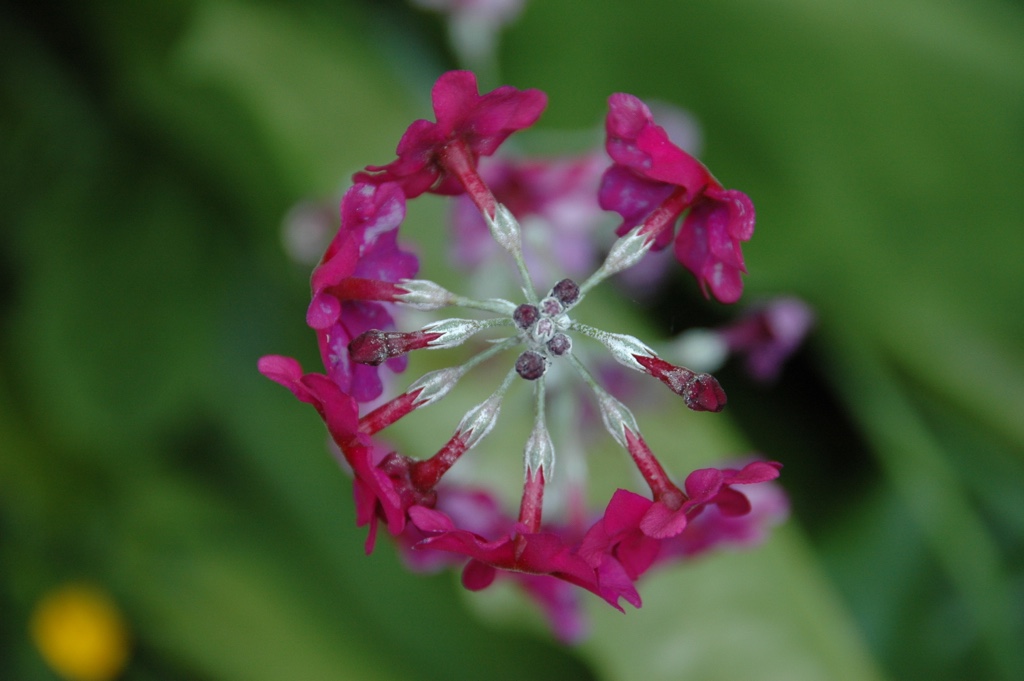
A plant like the one in this photo lives abundantly. It produces as many blossoms as it can, it produces as many seeds as it can. An excess, some might say. It isn’t parsimonious and it isn’t “efficient” like a machine.

There’s a characteristic in all complex adaptive systems known as “redundancy”…..it involves having more ways to do something than you “need”. When some is lost, or some part of the system is damaged, there’s always more to come on stream or take over.

We seem to be in a bit of a mess these days, with crises and shortages everywhere. From airports, to ports, to supply chains, hospitals, GP Practices, ambulance services, or food production, the pandemic, we are told, has made them all collapse.

Well the pandemic highlighted something and made it worse, but it’s not THE cause. It’s a factor.

We entered the pandemic in the midst of a time when we’ve been trying to organise ourselves as if we are machines. Economic and management theories based on machine models – of identical, predictable parts working efficiently to produce the greatest financial profits with the least human input.

It’s not working because reality isn’t a machine.

We can try something different, can’t we? By seeing that each of us are living, complex, adaptive creatures who exist and flourish in a living world wide web of relationships and interconnectedness. We can create organisations and societies, as diverse communities and families of unique, singular, particular, unpredictable, uncontrollable, glorious, amazing individual beings.

What might that look like?

Not a machine.

But then the main focus would have to shift – from making money and consuming “stuff” to nourishing and nurturing Life.

Might be worth a try….it works in the natural world.

Read Full Post »

I was never a gardener. I didn’t grow up in the tradition of gardening and for many years I lived in a top floor apartment with no garden. But since I retired and moved to rural France I’ve become a gardener.

It began with living in a house surrounded by vineyards and in a climate which drew me outside pretty much every day. I’d eat in the garden throughout the summer and I’d take a book outside to sit under the mulberry tree and read. I started to notice the birds which lived there or came to feed there and I’d notice the changes in all kinds of plants through the cycle of seasons.

I bought a battery operated lawnmower and found I’d enjoy listening to podcasts as I cut the grass. Cutting the grass would take between an hour and an hour and a half, an ideal podcast length of time!

We planted some vegetables in a “potager”, and I was amazed at the taste of fresh tomatoes, courgettes, lettuce, radishes and cucumbers. We planted a fig tree which quickly began to offer an abundance of fruit. Have you ever tasted figs just plucked from the tree? Amazing.

I don’t think I’ve ever felt more connected to Nature, never felt more in Nature at any other time in my life.

Now I’ve moved and bought a house in a small hamlet in the countryside. I’m no longer surrounded by vines, but by trees and fields. This house has a big garden and it’s needing to be reclaimed, to be re-inhabited. There’s still plenty of grass to cut, but no potager yet, and it has a significant area of overgrown trees – a little forest really. Most of the plants here have arrived without the assistance of human hands so there are surprise discoveries every week, different kinds of wild orchids, massive roses, sprawling ivy, wild clematis and honeysuckle.

This is not a garden which is ever going to be “finished”. Is any garden? It’s to be lived in, enjoyed, nurtured and cared for.

And there’s my greatest lesson I’ve learned from gardening. You can’t force it. You don’t fix it. It isn’t a giant machine with parts which need replaced or repaired.

To enable a garden to flourish you have to live with it, over time, get to know it and understand it. You have to “attend” to it, pay an engaged, committed attention to it. You have to care about, and for, it. You have to nurture it……especially the soil.

I think my work as a doctor was like that too. I knew that true healing only occurred when the individual patient was attended to, understood, cared for and nurtured. I knew that it wasn’t me who healed, nor was it any drug or procedure. It was the natural ability of a living organism to self-repair, self-heal and to grow and flourish. It was my job to support and facilitate that through long term healing relationships and by helping people to understand why they were suffering and what they might do to live differently, and thrive.

So there are threads in common here, between my work as a doctor, and my recent experiences as a gardener. Paying a particular kind of attention is perhaps the main one. Our left hemisphere facilitates a narrow, analytical focus on parts, helps us to grasp and manipulate the world. But left to itself, it produces a false sense of control and power, a false view of reality. Our right hemisphere enables us to have engaged attention. It helps us to find connections, to discover uniqueness, promotes a sense of wonder and wholeness. It helps us to “attend” to the real world directly.

Whether in gardening, or in Medicine, it turns out it’s best to use the whole brain, but to allow the right hemisphere to integrate all the activities of both sides. That allows us to realise life is not about fixing and controlling. It’s about the creation of caring relationships, attending and tending to, learning and growing together.

At least, that’s how it seems to me.

Read Full Post »

Leaf skeletons are beautiful and fascinating. You really don’t know they are there until the green substance of the living leaf has gone. It reminds me of the cyclical nature of the seasons and of the phases of our lives. From buds bursting with potential to full flourishing and on to dissolve back into the world from which the leaves emerged.

But there’s something else….this feels like a revelation….a glimpse at the underlying structure of the universe. Not a permanent, fixed structure of course, but a transient one based on a fundamental tendency to create nodes and links – the network or web-like nature of our universe which connects everything to everything else.

The Chinese concept of “li” captures this idea – it’s the multiplicity of patterns we see in all living forms which manifests itself in the beautiful patterns which we see.

However you think of it, I think this wonderful leaf skeleton opens a door to understanding that the universe is not totally random, and matter is not distributed smoothly and evenly everywhere. But that reality structures itself and the hidden structures create, or at least profoundly influence, the myriad of individual forms which we see around us, and within us.

Read Full Post »

illuminate

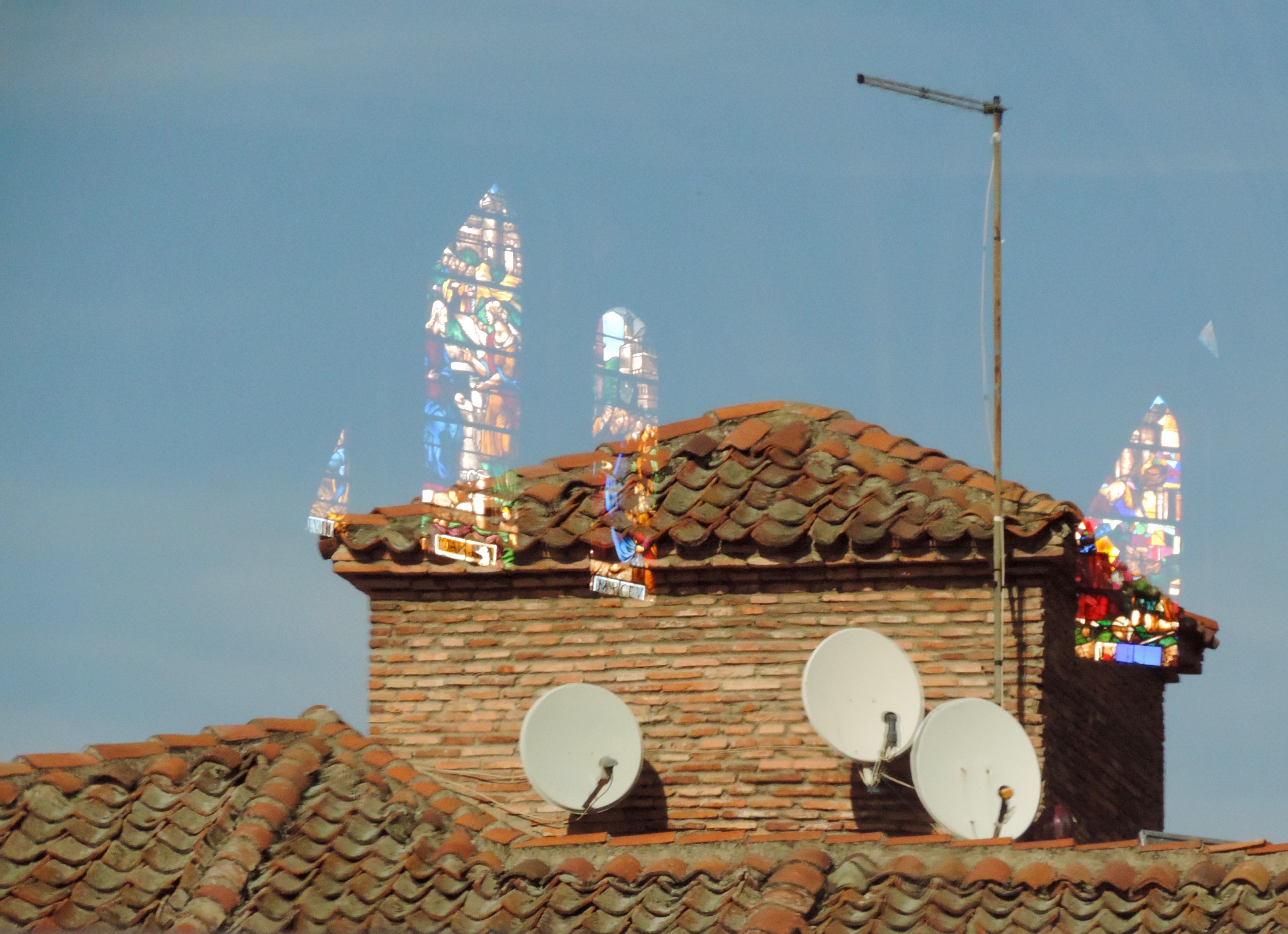
One day, I stepped out through the back door of the cathedral in Segovia and onto a large paved terrace surrounded by stone lions. When I turned to look back towards the tall arched doorway I noticed that the plain glass doors which hung in the doorway perfectly reflected the buildings across the street. I took a photo.

When I loaded up the photo later I noticed that there were some strange lights above and on the roofs and when I zoomed in I saw more clearly that behind the reflection of the tiles and the satellite dishes some of the cathedral’s stained glass windows shone through the glass door.

That got me thinking……

For centuries the church has created images and told stories to convince people what the world is like, what life is like, and how we should live. With captivating art and gripping stories it presented a particular view of the world. More than that, really, because in presenting that view and spreading it so widely, it created a reality for the people who lived in it.

But look at those satellite dishes.

Who is creating the images and the stories now? Who is telling people what the world is like? What life is like? And how they should live?

Who is presenting a view of the world and spreading it so widely, that it’s creating the reality for us who live in it?

With the rapid development in communications technology, with powerful mobile phones, connected computers, the internet, social media, memes, images and videos which “go viral”, some writers say we have created a whole new layer of the environment in which we live – the “noosphere” (the sphere of human thought).

The truth is we’ve always had a noosphere. We’ve always lived, we humans, within this environment of human thought.

There are image creators and story tellers who fashion the patterns of thought in this noosphere, and in so doing, they influence many others. They create the reality we experience.

But we have a choice. We can be the image creators and the story tellers, or we can be passive consumers. If we choose to be passive consumers, whose world, whose idea of the world, are we choosing to live in?

If we choose to be the image creators and the story tellers, what images shall we share? What stories shall we tell?

Are we going to live as zombies or heroes? Let’s co-create the world we want to live in. Let’s “be the change [we] want to be”.

I think it’s time to resist, to refuse to accept the world view which is responsible for massive inequality, injustice and suffering through the promotion of selfishness, division and greed.

We can make a better world than that. Can’t we? Let’s share our images of beauty, truth and goodness. Let’s share our daily delights and our experiences of awe and wonder. Let’s tell each other our stories of kindness, love and generosity. And let’s promote the world view that we are all connected and interdependent in this one, small planet we call Earth. Let’s share our attempts to adapt and live sustainability so we can co-create a better future for our children and grandchildren.

Shall we?

Read Full Post »

dscn7600

I read Barrie Condon’s, “Science for Heretics” a few years back and returned to it recently. The subtitle of the book is “Why so much of science is wrong” and his aim is to provoke the reader into questioning both the claims of science and its methods. He uses the device of three characters, The Believer, The Sceptic and The Heretic, throughout the book as he considers several fields of science including mathematics, physics, and medicine.

The Believer is one for whom science reveals the Truth and will one day enable us to understand everything in the universe. The Sceptic accepts the basic tenets of science but retains some doubts about whether of not we will ever be able to understand everything. The Heretic doesn’t buy the whole project. He thinks the universe is not completely knowable and that our scientific theories which shape our views of what we see are simply the projections of our human brains.

He particularly attacks the use of theory in science which tends to be translated into “laws”. He clarifies that no such “laws” exist and sets out the case for a return to observation and experimentation instead. I really enjoy his writing style and some passages particularly stood out for me.

For centuries we have been measuring all sorts of things but generally only recording the results we expected and ignoring the rest.

This captures two of my main objections to so much of medical practice – the reduction of human beings to measurements and the belief that the particular measurements which are made allow us to completely understand a patient and their illness. Although I have heard of a medical teacher say “Don’t listen to patients. They lie all the time. You can only trust the results.”, my own experience of doctoring couldn’t be more diametrically opposed from that view. ONLY the patient’s experience can be trusted. Measurements, sadly, frequently mislead, and ALWAYS need to be set in the context of this individual patient.

Life saving claims for medicines need careful examination. Drugs do certain things which are beneficial to the human body in disease, but they inevitably have other effects which can be deleterious or even fatal.

I wish more doctors made that more clear every time they write out a prescription.

He’s even better on physics and cosmology.

For me, the two most important things he has to say are, firstly –

Science gives us theories that purport to explain how the universe works. This breeds confidence in scientists who then go on to do things that carry certain risks. These risks are rationalised away on the basis of existing theory. Even if our Heretic is wrong in saying that all theory is actually erroneous, history shows us that most or perhaps all theories ultimately prove incorrect. Our perceptions and calculations of risk are therefore also likely to be erroneous. Science generally also assumes a high degree of control over experimental conditions and again this faith seems misplaced. While we may routinely underestimate risk, we also routinely overestimate our ability to control it.

This is SUCH an important point. He’s arguing for a greater use of the “precautionary principle”. Instead of assuming that everything we produce, all our chemicals, all our technologies are safe until proven otherwise, we should be more wary. What we need is a whole lot more humility and the ability to confess that we really don’t know very much at all. And we certainly way overestimate our ability to control things. It’s the arrogance of believers which frightens me most – people who are so sure that they, and only they are right – I’m on the side of the Heretics in Barrie’s terms. It’s likely that what we think we know at any point will be proven not to be quite right in a few years time (or, indeed, to be completely wrong).

The second important conclusion he reaches is that there are no fundamental laws of the universe…..apart from, maybe, two –

As well as a possible law for uniqueness, the Heretic is open to the possibility of a second law governing complexity, namely that it increases with time.

Well, there he puts his finger on what I’ve written about many times on this blog – that the most important characteristics of the universe are its tendency to create uniqueness and its trend of ever increasing complexity.

Take those two undeniable features on board and try and practice science or medicine by measuring, generalising and trying to control the future! Good luck with that.

Read Full Post »

« Newer Posts - Older Posts »