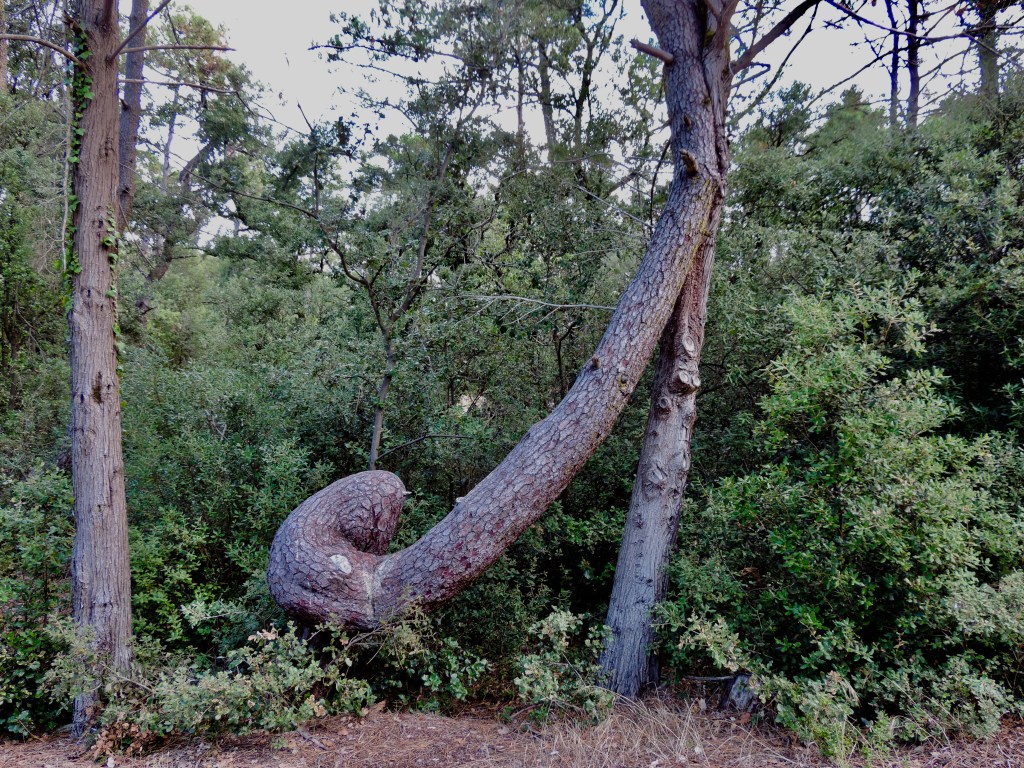
I took this photo because the shape of that tree is so strange. I’d never seen a tree grow in such a peculiar way. When I looked at the photo later I thought the two trees together looked like a pair of legs. It makes me smile every time I look at it now, imaging I caught an “Ent” running!
I return to this photo again and again. Look at the twists and turns taken by this tree! I wonder what the story is. What happened each time the trunk changed direction. Although it might not be so obvious our lives are like this. Every event we encounter, every experience we have, every choice we make, changes us, takes us off in a particular direction. The twists and turns of our everyday lives give our lives the distinct, unique shapes which develop as we grow.
But this photo makes me think of something else too….the dynamic uncertainty at the core of reality. Everything changes all the time. Living creatures change most of all. The changes are co-created by ourselves and the environments in which we live. And these changes are unpredictable in detail.
The more closely we consider an individual life, the more we understand them, but the more we realise we cannot predict the future.
Who could have described the shape of this tree we see now from its appearance as a young sapling? Who could have known which direction the trunk was going to take at each of those twists and turns?
I’m quite a fan of bridges. Many of them are beautiful constructions and I have lots of photos of bridges. I think I like them both as constructions in their own right, and what they facilitate – connections.
When we talk of building bridges between people or communities we are thinking of developing relationships. A bridge functions as a two way connector. It connects one bank of a river to another, an island to the mainland, or even one country to another.
It strikes me we need to do a lot more bridge building in this world. There is so much division. We’ve fractured into multiple groups of “us and them”, on the basis of gender, race, nationality, generation…you name it.
Each of us identifies with others with whom we share certain characteristics, and we gain a strength from that. But we need diversity in nature and in our lives. We need to “integrate” – to form mutually beneficial bonds.
Bridges enable that. Walls and fences separate and divide.
Whilst healthy boundaries and borders are good, we have to be aware of getting trapped into little worlds, narrow worlds, which constrain us and inhibit growth. So, we need the bridges, pathways and gates which let us venture further, to make new friends, discover new ideas, other ways of living.
One of the commonest forms of seed propagation is wind dispersal. You’ll know it best from dandelions but many plants use this method. I love the beauty of such seed heads. They look so soft and delicate.
When you look closely you see just how abundant they are. I’m sure someone has probably counted the average number of seeds on one stem like this but without taking the time to do that it’s pretty obvious there is an exceptionally large number.
Nature likes abundance. Whether it’s on one seed head or in a forest, a meadow, or in the sea.
I’ve read in several places that this Earth has an abundance of resources available to sustain life, no, not just sustain it, but to enable life to flourish. Yet we humans have created an economic system which seeks to convince us that what we need is scarce. Scarcity is a fundamental tenet of capitalism. And this same economic system encourages ever greater consumption, ever greater production of waste, and calls that “growth”.
We’re going to have to change tack if we want a sustainable way of life. We’re going to have to invent a different economic system. Not one which encourages grabbing and hoarding. Not one which measures success by the amount of resources gobbled up and destroyed.
Can we do that? I believe we can.
There are plenty of economists, scientists, creatives, and thinkers who have got practical ideas to take us forward but we still need more stories based on a vision of a different way of living together on this one little planet.
Have you read any stories, or come across any ideas, which have enabled to, not just to see reality differently, but which have inspired you to see other possible ways of living….personally and/or collectively?
Like this seed head, the more we can develop our potential and spread it far and wide, the more successful we will be at both surviving and flourishing.
I was struck by this passage in Gavin Francis’s “Recovery. The Lost Art of Convalescence”…….
This was my repeated experience both as a GP and as a Specialist at the Glasgow based NHS Centre for Integrative Care. The term “clinical encounter” is a much better one than “consultation” for this kind of experience. I used the term “consultation” a lot throughout my training and as a GP but it became increasingly clear that there was a lot more going on in these “encounters” than the word “consultation” could capture.
On multiple occasions patients told me they’d been able to tell their story for the first time in their lives, that they’d felt well heard and hadn’t been judged. Those encounters frequently led to profound changes in life…..certainly changes for the patients but also for me.
As I witnessed these changes over months and even years I was inspired. Time and again individuals broke through my limits of expectation and time and again I was amazed by and filled with admiration for their ability to recover, for their resilience and for their resurgent vitality.
I learned to expand my expectations. I learned to listen attentively and without judgement. I learned to be fully present. Again and again.
As I think about this passage again, I realise the same principle applies not only in clinical encounters but in every relationship we have.
Every meeting we have, every event we share with others, every conversation and interaction we have changes both of us – me and you. I think that applies when we meet physically but also when we meet “virtually” – through social media, email, or through connected screens.
I read Dr Gavin Francis’s “Recovery. The lost art of Convalescence” this week. I really enjoyed it and his approach to General Practice seems absolutely in line with what I was taught and tried to practice. His book is about convalescence as it says in the subtitle. The human capacity to self repair and self heal is at the core of my medical values and I agree with him, it’s a whole area which isn’t taught in medical school and is practiced only rarely.
It takes time to heal but it takes more than time. It takes care, personal support, good food and a good, natural environment.
The old model I grew up with still had convalescent hospitals, but they were already being closed down and sold off for housing developments. The hospitals I worked in still had traces of the “sanitarium” ideas of exposing patients to nature. For example, the respiratory department, which we called “the chest ward” had a covered terrace which enabled patients to spend time in fresh air, even if they were still bed bound.
However, I’m not of the opinion that everything was great in the past. It definitely wasn’t. That said, it seems to me that we’ve gone way too far down a road of “cost effectiveness”, “targets”, and so on which are more appropriate to the running of a factory which manufactures machines than to delivering care which promotes healing.
Gavin Francis mentions that the number of hospital beds in the U.K. has been reduced from 300,000 in the late 80s to 150,000 now. How’s that going?
All this in the face of every increasing numbers of elderly people in society and of people living with several concurrent chronic ailments. The numbers of GP consultations has sky rocketed, as have attendances at Accident and Emergency Departments, ambulance call outs, and hospital admissions.
Those who designed the NHS thought that over time demand would diminish as the health service made people healthier. Trouble is the health service was never designed to make people healthier. It was designed to deal with crises. And it’s done that brilliantly. Emergency care of acute conditions and trauma has developed tremendously in the last fifty years. But emergency care isn’t enough.
The economic and management philosophies which are dominating health care don’t seem able to cope with demand, reduce demand, or enable sufficient numbers of staff enough time and resources to stay healthy themselves while they deliver the best care they can.
All of the recommendations in Gavin’s book are very familiar to me. These are not new solutions, nor are they idealistic. They are achievable and reasonable but we need to shift the thinking from reductionist, mechanistic ones, to genuinely human centred holistic ones.
We won’t create healthier populations through health services but by addressing poverty, inadequate housing, job insecurity, inequality, poor nutrition, climate change, biodiversity loss and pollution.
We need the wisdom shared in “Recovery”, and we need to implement it. Maybe we should recommend it to health service managers and policy makers.
I looked up as I sat in the garden yesterday and this caught my eye. It’s just the remains of a jet-stream but from where I was looking it seemed to be related to the big tree. I thought it was almost like an eyebrow but then changed to seeing it as an edge.
I don’t know if you’ve seen any of the amazing photos from the International Space Station but the ones of Earth showing a long curving horizon with the blue and green of the planet coated by the thinnest white layer of atmosphere transfix me. I astonished at how narrow that band is. If it wasn’t for that delicate thin layer of gas we wouldn’t exist. Seeing it from the angle of the space station really highlights just how close to the edge we live.
It’s not a huge distance to the edge of our liveable world. One slim canopy, shared by us all, and here we are, changing it. Do we know what we are doing?
While I’m contemplating this idea of an edge I turn my mind to those other photos released by astronomers this week. The ones from the James Webb telescope which show us stars and even galaxies of stars well beyond our previous edge of seeing.
Isn’t there a metaphor in that too? How the edge of our knowledge is always pushed out a little further? How we never reach “the end”? How these edges are not fixed limits?
Then the focus of my mind returns from Outer Space to my garden and I let my gaze run along trees which grow along every boundary. There’s something deeply pleasing about that ever changing, dynamic, living edge. I’ve only experienced one winter, one spring and one summer so far. I wonder what it will look like in the autumn? However, I already feel deeply at home here, and this living edge around me seems to caress me, to wrap its arms around.
I feel welcome here….on Planet Earth. It’s special.
There is no law that completely fixes the outcomes of every physical interaction, every dynamic event….But much of the outcome is lawfully ordered and predictable. Nature is neither inevitably random nor completely lawful and predictable.
Physicist, David Oliver
This is a great observation. There are no laws which determine with certainty that particular outcomes will come about – not in health care, not in economics, not in biology, not in weather forecasting! We all have repeated experiences of life taking unexpected turns.
This is, in no small measure, due to the fact that complex systems are massively interconnected, both within themselves and within the contexts of their existence. And the kinds of complex systems which exist in Nature are open systems. They cannot be separated out from their environments. There are always active flows of materials, energies, signals of many kinds…impacting upon and entering complex systems. And complex systems are constantly changing the environment in which they exist. Just by breathing, you change the air in the room, for instance.
But that doesn’t mean just anything goes. If you plant a lettuce seed it’s not going to grow into a chestnut tree. No matter what you “visualise” or wish for.
So reality is not bound by strict laws, but neither is it totally random.
GPs are trained to work with this understanding, taking their knowledge, experience and skills to make a diagnosis, recommend a treatment and make a prognosis. But I remember being taught that those who make the best diagnoses are those who are prepared to let go of their initial ones in the face of the evidence and their observations. That’s why humility is so important in making diagnoses, and even more so in making prognoses. That’s why continuity of care, following up, not regarding health care as event based but, rather relationship based over time, are all so important.
Yesterday I listened to the ex Governor of the Bank of England, Mervyn King, being interviewed about his new book, “Radical Uncertainty”. He was counselling that we should be very wary of numbers and statistics, was highly sceptical about “super forecasters”, and suggested that, instead, we should rely more on stories. Interesting! I’m looking forward to reading it.
The stories we tell and the words we use shape the world we live in. We use stories to make sense of our lives and the world we live in. If we want to create a better future for our children and grandchildren perhaps we need some better stories. Stories of interconnection, stories of change, stories of uniqueness and diversity, stories about mutually beneficial relationships, stories which open our eyes to the lives of others and stories, above all, which inspire us to wonder.
Which stories inspire you to create a better future?
Even heaven is not complete; that is why when people are building a house they leave off the last three tiles, to correspond. And all things that are under the sky have degrees. It is precisely because creatures are incomplete that they are living.
Ssu-ma Ch’ien
This is one of those East/West things, but also, it’s a Right/Left Hemisphere thing.
Do we see the world as a collection of separate fixed objects or as a constant flow? In the former case there’s a focus on a sort of completeness. Each object is a finished article so it should look finished….nothing to change, nothing to add, inanimate and disconnected from everything else. In the later case, however, there are no separate objects….or at least separation is a kind of illusion because any object is a temporary manifestation of the constant flow of energy from which everything emerges.
It’s the “becoming not being” that I have as a subtitle to my blog. Reality is dynamic, flowing and massively interconnected.
The aesthetic which includes this idea of incompleteness seeks to make us aware of this dynamic flow, and by doing that it reminds us that everything is in fact unique. You can “see” the human hand in these creations and they reflect the reality of Nature as no living being is fixed, “finished”, or complete.
Knowledge, too, is always incomplete. Look at the new photos from the James Webb telescope compared to what Hubble could show us…..just amazing! We are never “done” knowing…..something which feeds my natural curiosity every single day.
I don’t see the world as a collection of finished objects and completed events. Reality is more dynamic than that, more lively, deeper, more soulful and more spirited.
Instead I feel I live in a continuously changing, ever evolving flux of multiple flows, where impermanence contributes to making every moment valuable, every experience unique.
Incompleteness keeps reminding me to be humble and I recall how Montaigne would write an essay, then throw in a “Mais que sais-je?” – “But what do I know?”
Hey, I could say a lot more about this, but isn’t that just another example of how nothing is ever complete?
It is part of the unifying disposition of the right hemisphere to see similarity within difference and part of its capacity for fine discrimination to see difference within similarity, whereas the isolating disposition of the left hemisphere sees similarity and difference as a simple opposition.
Iain McGilchrist. The Matter with Things
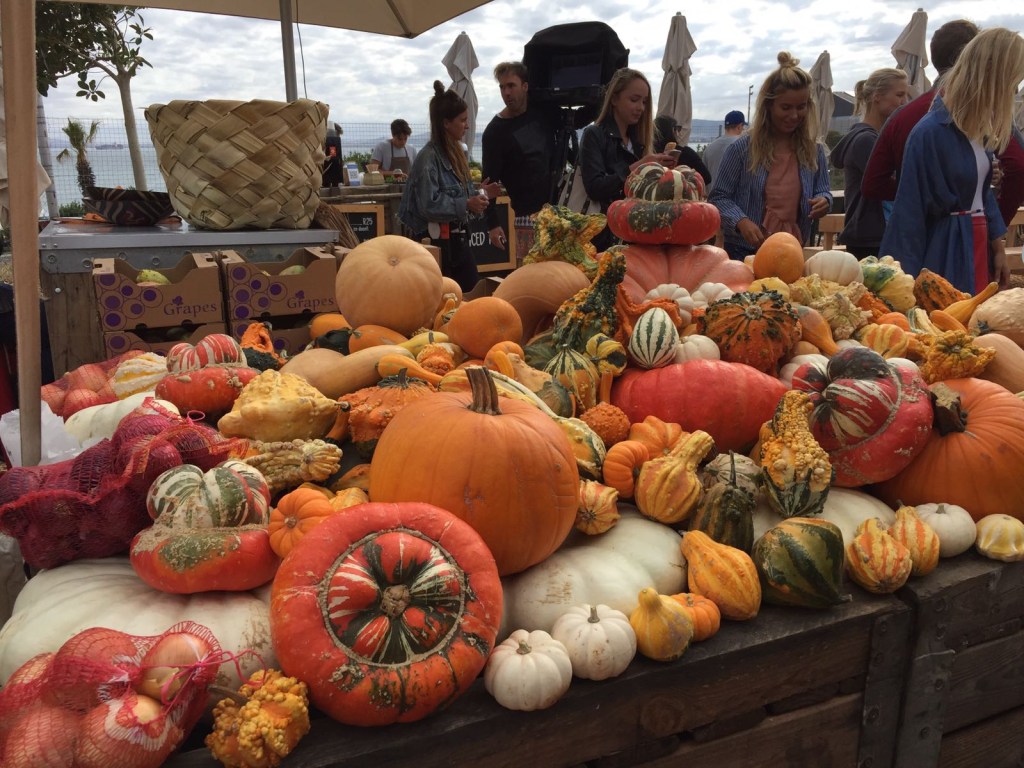
One year I visited my friends in Capetown and we went to the Saturday morning Farmers Market. I don’t think I’ve ever seen a bigger, more diverse, display of pumpkins. Aren’t they glorious?
This image is one which has stayed with me since then. It captures what Iain McGilchrist is referring to in this passage… the similarities in difference and the difference in similarity.
This was always a core issue for me as a doctor. With every single patient, at every single consultation, I had to understand what was familiar to me, what the similarities were between this patient and another, between this visit and the previous one. I’ve written many times about the importance of keeping a focus on uniqueness when it comes to making a good diagnosis, but the same thing applies to treatment. There’s a simplistic generalist form of thought which claims there are medicines which work and those which don’t, but you don’t have to work in general practice for long to realise that’s nonsense.
There’s only one way to find out the effects of particular treatment in a particular patient – follow up. I think this is why joined up practice based on continuity of care is so important. At follow up the doctor has to assess what’s familiar and what’s not…what’s similar and what’s different….by listening to the next chapter of the patient’s story. Only this unique person can tell you whether or not a particular treatment has benefited them.
I think the same principles apply in other areas of life. We meet new people, discover what we have in common, form connections on that basis and at the same time we are curious to discover each other’s differences, to find out what is unique in each other, and so to create another, unique relationship.
Similarities and differences aren’t in opposition to each other. They work together to create uniqueness.
If the great spirit had desired me to be a white man, he would have made me so in the first place. He put in your heart certain wishes and plans, in my heart he put other and different desires. Each man is good in his sight. It is not necessary for eagles to be crows.
Sitting Bull
When we recognise that everyone is unique then we create good, mutually beneficial relationships. That’s the essence of integration – it requires “well differentiated parts” to work together for mutual benefit. Just like how your heart works so well with your lungs, your liver, your brain, and so on. The development of a human from a fertilised egg involves wave after wave of differentiation, as cells develop into all the kinds of cells we need, building mutually beneficial relationships as they grow.
Pretty astonishing, right?
I often think of that when I dream of a better society because surely a well differentiated society, composed of very different human beings building mutually beneficial relationships would naturally produce healthier, more sustainable communities.
In other words, not by fighting each other, pressurising others to conform, pushing uniformity and competition. But the opposite…..by collaborating, seeking mutual benefit and promoting diversity.
I welcome constructive criticism and suggestions. I will not, however, tolerate abuse, rudeness or negativity, whether it is directed at me or other people. It has no place here. ANYONE making nasty comments will be banned.





 Heroes Not Zombies