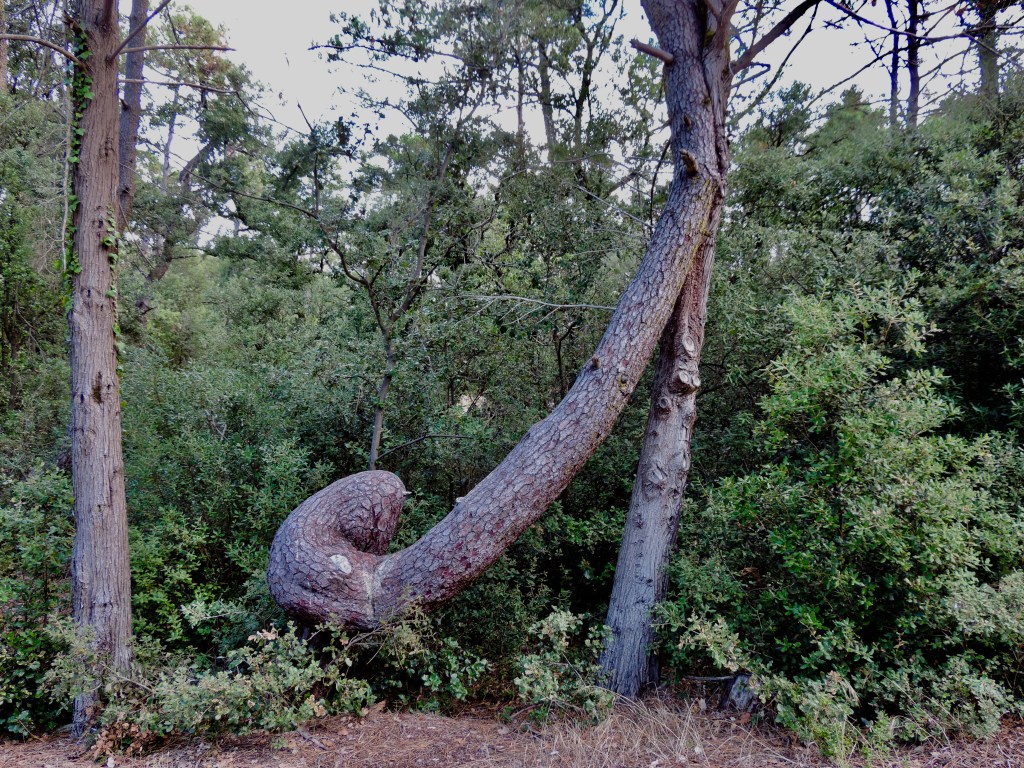
This photo is one of several I’ve taken where I’ve been really astonished by the shape of a tree. Actually it’s not just the shape that catches my eye, but the impression of movement which appears. It’s as if you can see the past, the present, and the future all at once.
For the first half of my medical career I worked as a GP, what we used to call a “family doctor”. My childhood role models for this work were our own family doctor, Dr Haig, and a fictional one, Dr Finlay. Initially I worked in a small rural town in south west Scotland, and then a city Practice, in Edinburgh. The organisation of our partnership privileged the idea of “personal lists”. People selected the particular doctor they wanted to see and would seek consultations with that individual in preference to the others. If their preferred (or “named”) doctor was on holiday, or not available today, they’d come and see one of the others. This system meant continuity of care was at the heart of our work. I’d get to know an individual through several life stages, sometimes from their birth until they became parents and even grandparents.
For the second half of my career I worked at Glasgow Homeopathic Hospital where we specialised in looking after people with long term conditions. Again, continuity of care was our core principle. From the first consultation onwards we would get to know an individual a little bit more at each subsequent consultation, over months, or even years.
So for my whole career I worked in contexts which privileged taking a whole of life perspective.
Yet, that is not how Medicine had developed. Following the dual influences of a reductive, often mechanistic, approach to illness, and a management methodology more suited to factories and shops than to Primary Care or hospitals. Illness is reduced to disease, to disorder or pathology in particular cells or organs.
Whilst the body can heal after physical trauma, and after most infections, most diseases do not go away. Yes, we can “manage” long term illness better….diabetes, asthma, hypertension etc…but only by using drugs for life. There are few genuine “cures” in modern Medicine.
One of my frustrations with medical research is not just that participants are studied for relatively short periods of time, but little, or no, attention is paid to any whole of life perspective.
If a particular treatment reduces the chances of dying from a specific disease, what do those patients die from instead? What experiences do they have of this disease, and others, months and years later?
Don’t we need a better knowledge of whole of life experiences to make good decisions….decisions only an individual can make with the best information and care?
I have a wish and a hope for the future – that we begin to shift our attention from short term to long term, that we seek out the connections, explore the contexts……in other words that we move towards more joined up, more holistic, more lifelong perspectives.

 Heroes Not Zombies
If space permits I would quite like to include your blog ‘Lifelong’ in the next Journal of the Laurence Society (which I am working on at the present’. Last year you kindly gave permission providing (of course) that you are properly acknowledged as author and photographer. Might I take this liberty again? Yours Allan Pollock
Certainly – I’d be delighted