Feeds:
Posts
Comments

Archive for the ‘books’ Category

I’ve seen a few different varieties of book sharing around – the most well known is probably “book crossing“.

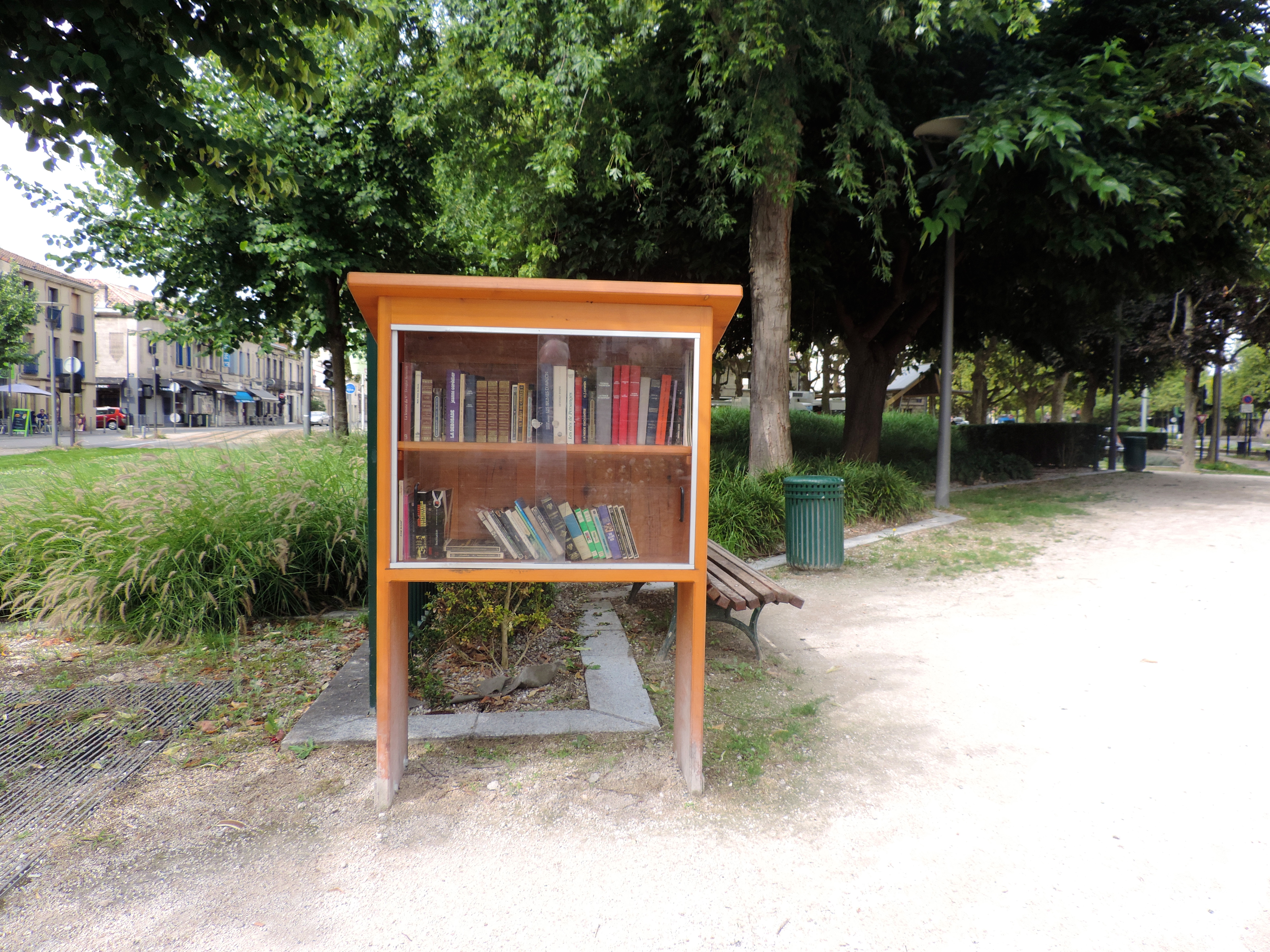
In Bordeaux, right next to one of the tram stops, I found this bookcase –

book sharing

….no instructions, no locks, just some books in a bookcase with sliding glass doors.

I wonder how long its been there. I’m amazed that such a piece of furniture can apparently sit quite happily in the middle of a city. And I wonder how often the books change hands?

Have you come across any interesting book sharing platforms or facilities?

By the way, in the hot e-books versus paper books debate, surely one of the best arguments for paper books is how you can pass them on to other people after you’ve read them (Did you realise that you only rent an e-book? You never own it the way you do a paper one)


Read Full Post »

Just read “The Fault in Our Stars” by John Green. A good read. As the endorsement from Markus Zusak said on the front “You laugh, you cry, and then you come back for more”.

I liked the humour and the constant determination of the main characters to say it like it is. It reminded me of some of the indie movies I’ve seen (I haven’t seen the movie version of this book). It’s a thought provoking book too.

I particularly enjoy it when a phrase or a paragraph in a novel leaps up and strikes me. Here’s one of the ones from “The Fault in Our Stars”. Hazel’s dad is talking about what he believes and recounts the story of his maths teacher talking about Fourier transforms, when she stops and says

‘Sometimes it seems the universe wants to be noticed.’
“That’s what I believe. I believe the universe wants to be noticed. I think the universe is improbably biased toward consciousness, that it rewards intelligence in part because the universe enjoys its elegance being observed.”

That works for me.

I have that belief too. It fits with Thomas Berry’s “moments of grace

Sometimes it seems the universe wants to be noticed.

Not controlled. Noticed.

(and I think we do too, but that’s another story)

Read Full Post »

OK, I’m going to take a guess….you love books, huh? I’m not going to ask you if you prefer e-books to physical books, or vice versa, but two things recently got me thinking about book buying.

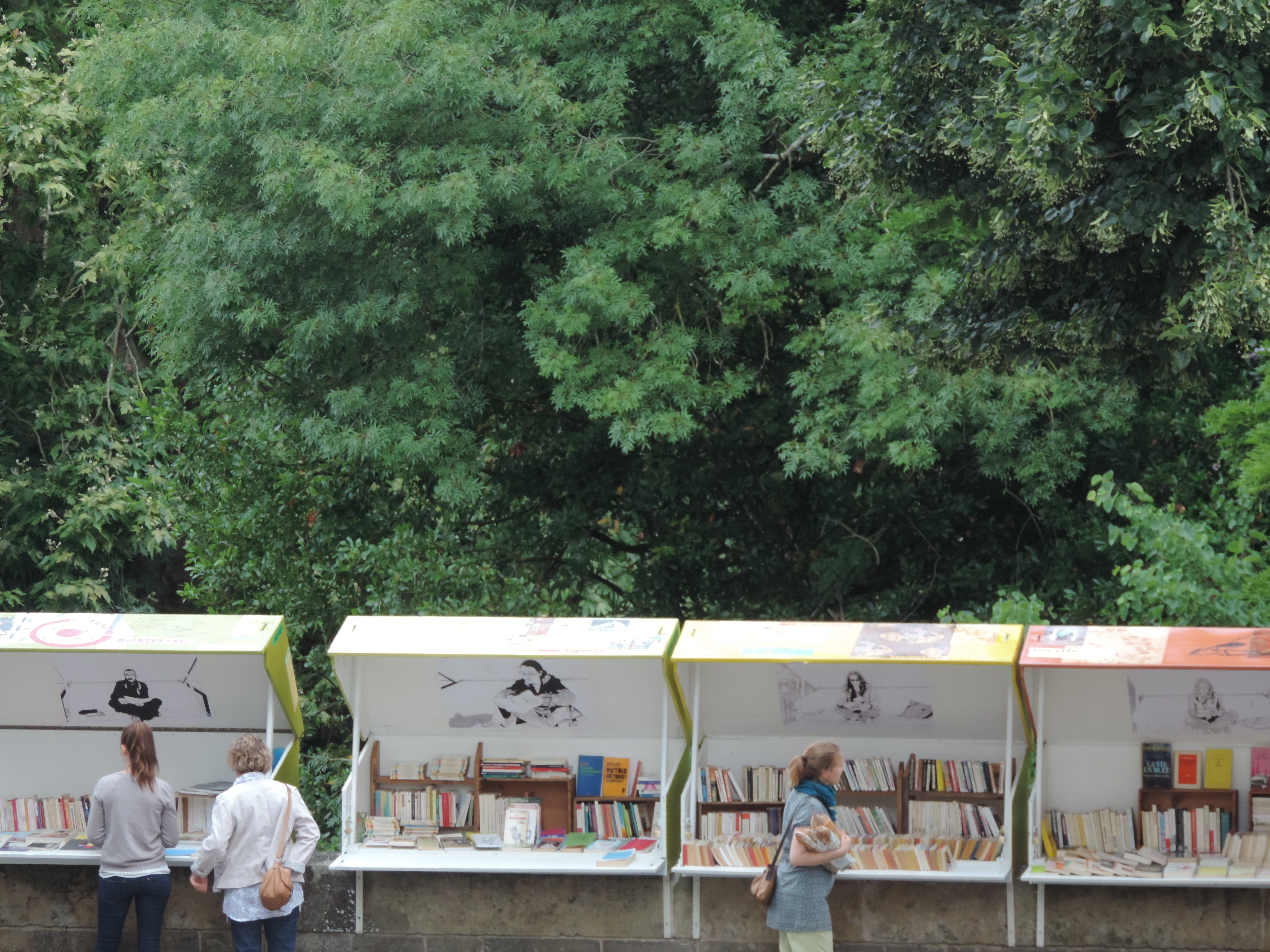
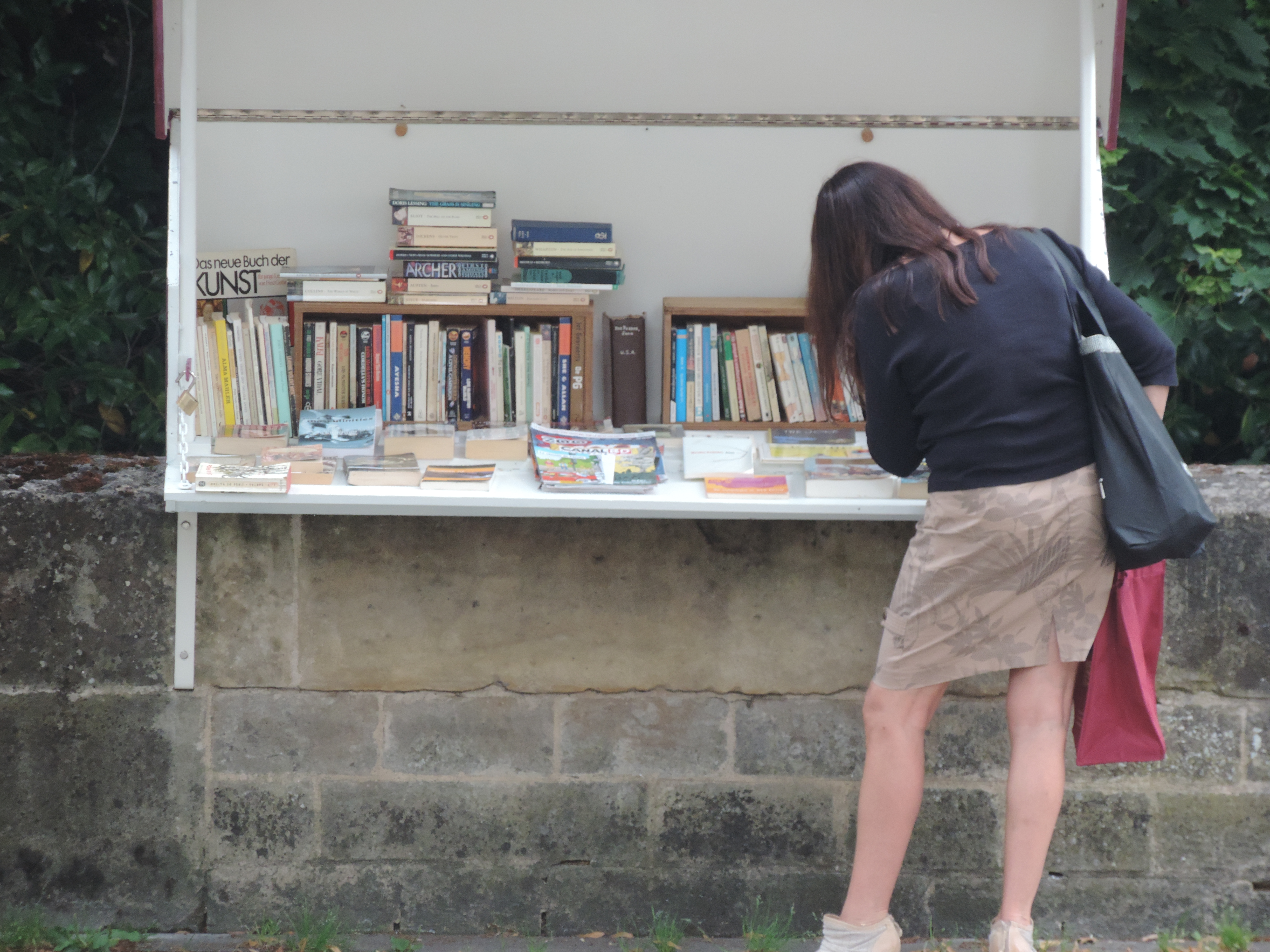
First up was the unexpected discovery of “bouquinistes” in Niort (I’ve only ever encountered this selling books from wooden boxes fastened to the wall at a the side of a river in Paris….didn’t know it happened anywhere else)

DSCN1741


DSCN1742


And the second was reading a fabulous essay by Gustavo Faverón Patriau about reading Borges and buying books. (Click through that link there, and read it, it is a treat)

He talks in that essay of buying books from a street of second hand booksellers in Lima and here’s the point he makes about buying the same books later in the US –

During these years, in Ithaca, New York and Brunswick, Maine, where I live now, I have bought once again many of the books I bought in those remote years, in different versions and editions, books that arrive by mail from unknown bookstores that I suspect do not exist, in parts of the country I have never been to, with yellow “used” stickers, impersonal, books that no human hand puts in mine, books without a context, that seem to materialize at my door. I read them and remember the first time I read them, how they impressed me, and I think of how, in my new copies, they seem to be different books, with different meanings. Now they tell me other things, or they do not tell me anything at all, certainly not what they told me then. The words seem weaker, immaterial, vague, powerless. What a contrast compared with the thrill they provoked in me when I saw those words in the yellow pages of the volumes I bought on Grau Avenue, in the second-hand copies I used to start reading while walking down the street or climbing on the bus, books that, later, when I placed them in my bookshelves at home, used to retain the smell of the street.

Have you ever had an experience like that?

Do you think that where you actually bought a book influences your reading experience of that book?

Read Full Post »

Big rock beach

I noticed this huge rock on a beach recently (OK, I agree, how could you NOT notice it!?)

I suppose I was a little surprised that some people had chosen to sit right in front of it……were they hoping to shelter from the wind? Or were they seeking some shade from the sun? Or, maybe, just maybe, they were working up to having a go at shoving it out of the way?

I’m guessing a LOT of people have wondered about moving that rock. I mean, there it is, sitting RIGHT in the middle of beach! So, why hasn’t anybody done it yet?

Then I got the answer – it’s down to “structured procrastination” –  as John Perry describes it –

All procrastinators put off things they have to do. Structured procrastination is the art of making this bad trait work for you. The key idea is that procrastinating does not mean doing absolutely nothing. Procrastinators seldom do absolutely nothing; they do marginally useful things, like gardening or sharpening pencils or making a diagram of how they will reorganize their files when they get around to it.

So maybe the people sitting on the beach there are doing some marginally useful things instead – like increasing their vitamin D levels by sitting in the sunshine, or measuring the temperature to check for global warming, or counting seagulls to for an RSPB environmental monitoring project, or……..

Or maybe this is not about procrastination at all, maybe it’s about being fully paid up members of the slow movement, like Christopher Richards, the founder of the International Institute for Not Doing Much (Christopher, thanks for sending me an email a few years back, I think my reply might be heading your way soon).

What an inspiration for slowness……..watching a rock change!

Hope you’re able to enjoy a nice slow holiday this summer (and if you haven’t figured out how to use structured procrastination to actually book that holiday up yet, check out John Perry’s book, “The Art of Procrastination” – just make sure you’ve got “Buy with 1-click” switched on)


Read Full Post »

According to a government report workers who retire early risk “boredom, loneliness and poverty“.

Well, that’s something to look forward to, huh? Strange report – probably part of a fear campaign to try and keep people in employment for longer. What are they suggesting, actually? It’s better to retire later? Or that if you are working, even on a minimum wage, zero hours contract in your 60s and 70s you will avoid “boredom, loneliness and poverty”?

I suspect this kind of thinking says more about how we live than it does about the respective benefits of employment and retirement.

Funnily enough, I just stumbled over this quote from Goethe –

“A man should hear a little music, read a little poetry, and see a fine picture every day of his life, in order that worldly cares may not obliterate the sense of the beautiful which God has implanted in the human soul.”
― Johann Wolfgang von Goethe

I’ll be continuing to do that once I start my early retirement next month! And much else besides. I’m anticipating that the post-employment years will include lots of discovery, creativity, personal development and fun.

Meantime, here’s a little music

and a little poetry

Tell me, what is it you plan to do
with your one wild and precious life?

– from Mary Oliver’s The Summer Day

and

Here’s a fine picture

glorious seedhead


Read Full Post »

I don’t understand synchronicity but when it happens its always striking and exciting.

About a week ago I bookmarked a transcript of an RSA talk by Guy Claxton, and yesterday I sat down and read it. It’s a fascinating talk about what he terms “glimpses” (what others have termed spiritual or enlightenment experiences). I’ll let you read the full talk yourself, but in that talk he referred to W B Yeats’ poem, “Vacillation”, where he describes just such an experience –

My fiftieth year had come and gone
I sat, a solitary man
In a crowded London shop
An open book, an empty cup
On the marble table-top
While on the shop and street I gazed
My body of a sudden blazed
And, twenty minutes, more or less
It seemed, so great my happiness
That I was blessed, and could bless

Then, later the same day, I was researching the lifespans of different organisms (I’ll tell you why another time) and picked my copy of Richard Fortey’s “Life” off my shelf. I have a beautiful Folio edition which is a complete joy to hold. Imagine my surprise when on page 22, in his first chapter, where he is describing his early experience of an expedition, he writes about having a dispute with his colleague, then waking to a beautiful, perfect day and he says “The joy of such moments healed any differences between us. Like W B Yeats –

My body of a sudden blazed
And, twenty minutes, more or less
It seemed, so great my happiness
That I was blessed, and could bless

I don’t know how that happens. Do you? How do I read the identical passage of poetry in two such different, totally unconnected places within a few hours of each other?


Read Full Post »

Remember Maslow’s hierarchy of needs?

Maslow identified what he called a hierarchy of needs which motivate human beings, starting with survival needs, such as food, drink and shelter, then moving upwards to social needs (relationship needs) of connecting and belonging, to esteem needs of being recognised and respected. Beyond that he postulated being needs, as opposed to these “deficiency needs”, which became evident as self-actualisation, something he thought wouldn’t happen until the lower needs were met.

This hierarchy has been criticised and its certainly not the case that human development follows any rigid, layer by layer, step-wise progression. (I think integral theory provides a more interesting way of looking at old hierarchies – from an integral viewpoint its not so much a hierarchy at all as layers which grow on top of each other with every layer continuing to exist)

Well, Gary Lachman, in his Secret History of Consciousness, mentions the writer, Colin Wilson, once researching the history of murder and finding something curious.

At first it seemed murders were mainly committed for gain – food for example. Then other types of murder appeared, which involved murderers protecting their lifestyle, their homes or their property. Towards the end of the nineteenth century the sex crime emerged (think of Jack the Ripper) where the murder was a kind of sex act in itself. In the twentieth century he noticed the emergence of murders for fame – to become known, and then towards the end of that century the appearance of the “motiveless murder”, the unpredictable, random killing sprees.

Wilson was struck that there was a parallel here with Maslow’s hierarchy – food, the home, sex, self-esteem –  and where did that lead to? Murder as a creative act? Murder as an act of self-actualisation? Wilson rejected this idea, rightly claiming that crime is not a means to self-actualisation. Criminals try to grab what they want, instead of putting in the time and effort to self-actualise. They will murder a celebrity to gain celebrity for example.

He posed the interesting question in relation to this discovery – was murder a kind of Jungian shadow, reflecting the level of development of human consciousness? If so, it might be further evidence that we are indeed moving as a species to a new stage of development, towards a focus on self-actualisation and creativity.

Wow! That’s quite a leap, huh? But certainly a thought provoking one!

Read Full Post »
One of Henri Bergson’s concepts is that evolution is a creative process.

Bergson saw life as an immense current of consciousness, a spiritual force, brimming with potentialities, penetrating matter and organizing it, “colonizing” it, as it were, in the service of increasing its own freedom. Matter, resistant to life’s impulses, impedes its advance and scatters its energies. Yet, as he argues in Creative Evolution, this current of consciousness seems to have been successful in at least three attempts to gain a foothold on matter: in the plant world; in the world of the insects; and in the vertebrates, who have so far culminated in ourselves.

He says

The vegetable world has fallen asleep in immobility…..In the world of the insects, specifically in the ants, what life gained in social organization and cooperation, it lost in initiative and independence; here instinct rules supreme…..the ant shows little in the way of intelligence, being completely dominated by instinct

Hermitage

beetle

flycatcher

If in plants and insects life has “stalled,” in the vertebrates there still remains the possibility of setting free “something which in the animal still remains imprisoned and is only finally released when we reach man.”8 For Bergson, humankind is the front line of evolution, the tip of the élan vital’s advance, the being in which the life force has most successfully organized matter to its own end of increasing its knowledge of itself and its freedom

Read Full Post »

Maya Angelou was wonderful with words. You’re probably coming across some of them just now as the internet spills over with memories and thoughts about her provoked by the news of her death.

Here is one of my favourites

My mission in life is not merely to survive, but to thrive; and to do so with some passion, some compassion, some humor, and some style.

I especially like this one because I just don’t accept the sole point of living is to make it to the end. Is a Life survived for a number of years something you’d aspire to? Isn’t the sole goal of survival ultimately 100% doomed? (Nobody makes it out of here alive!). You can spend a life like a robot, or, in terms of this blog, like a zombie, on some kind of autopilot, surviving, but there’s something else you can do. You can thrive. You can flourish. You can express the uniqueness you are in this universe, and become what only you could become. You can live with passion, fully engaged with the wonder of the everyday (l’émerveillement du quotidien), you can connect, feel, respond, use your imagination to put yourself in the shoes of others, you can laugh, live with a twinkle in your eye, and you can do it with beauty, grace and, yes, style.


Read Full Post »

Diving for silver?


It seems we didn’t evolve into human beings in a smooth, seamless way, but more with a pattern of great leaps and long, slow changes.

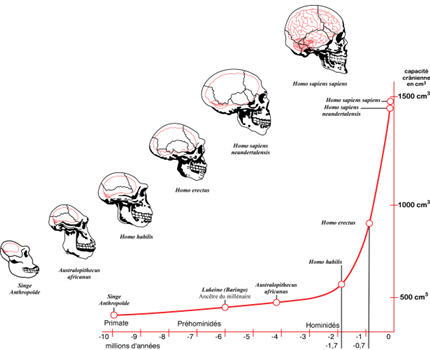
One of these great leaps was in the growth of the size of the brain. One of our pre-human ancestors, Homo erectus,  had much smaller brains than we do, but over the course of 200,000 generations (2 million years), their brain size roughly doubled in size, taking them up to about the same size as brain as we humans have (since about 500,000 years ago).

As Stephen Oppenheimer states, rapidly increasing brain size was a key feature that set humans apart from the walking apes that lived before 2.5 million years ago. Since then our brains have trebled in volume. This increase was not gradual and steady: most of it came as a doubling of volume in Homo erectus 2 million years ago. The greatest acceleration in relative brain size occurred before 1.5 million years ago – early in our genus. Modern humans – and Neandrathals – living before the last ice age 20,000 to 30,000 years ago had bigger brains than do people living today. (from)

Interestingly, brain size in humans hasn’t increased over the last half million years (indeed it’s shrunk a bit!), but what has happened is rapidly increasing asymmetries in the brain. It’s not just that our massive cerebral cortexes are asymmetrical, but within each area of the brain there are highly specialised areas. In other words, its a story not just of an increase in size, of adding more and more neurones, but of complexity.

Here’s one of the puzzles about evolution though – how on Earth did brains evolve so quickly? You might say 2 million years doesn’t seem that quick but look at the speed of change.

cerveau_evolution


This is why some people refer to the growth of the human brain as the second “Big Bang”…….although I do like the idea of a “Great Leap”!

Read Full Post »

« Newer Posts - Older Posts »