Feeds:
Posts
Comments

Archive for the ‘books’ Category

When I looked up and saw these black and white clouds I immediately thought of the yin yang symbol….that brilliant representation of wholeness, the union of opposites, and the permanency of change.

I think those are three of the most significant principles I return to again and again to make sense of the world, of life, of other people and of me.

Wholeness because all reduction, every move to separate and isolate, every attempt to disconnect, to abstract, to re-present, is fraught with the potential for delusion. There are no separate, isolated, disconnected phenomena in Nature. All our abstractions and re-presentations which we carry out with our left hemispheres are a step away from reality. Which is not to say they aren’t useful. They are. But you can’t rest there. You have to re-contextualise, to hand back the analysis to the right hemisphere to understand what you are looking at as only an aspect of the whole.

The union of opposites because we humans, Nature, Life and the Universe are full of opposites….dark and light, heat and cold, attraction and repulsion, organisation and disintegration. In fact it seems that there is no universe without opposites. We are tempted to construct the myths of competition and conflict from that fact, but we must not miss the deeper understanding – that all of existence emerges from the integration of opposites, not from the elimination of one pole by another, not from the unchallenged dominance of one over another.

The permanency of change because that’s the nature of reality. There is nothing fixed, nothing which is not in the process of growing, or adapting or degenerating, whether we see that as three Gods, or as the natural cycles of the biosphere and of the seasons.

So when I look again at these clouds, these beautiful black and white clouds, I am captured by their beauty and entranced by the teaching they can give me.
Read more about this in my book, “And not Or”. You can get it from Blurb at https://www.blurb.co.uk/b/10155078-and-not-or

There’s also a Kindle version – https://amzn.to/2UozjIw – if you are in the UK. If you are not in the UK, go to your local Amazon site and search for “Leckridge” – you’ll find it quickly that way (let me know if you don’t!)
Read Full Post »

I’ve long since been drawn to Romanticism. I feel they bring some extra, something deeper, something substantial to the dominant perspectives of the rationalist Enlightenment thinkers. It’s a funny thing, because in many ways I think I’ve lived with a foot in both camps. I trained in Medicine, practised as a General Practitioner for the first half of my career, then as a Specialist in what we came to call “Integrative Care” for the second half. That second half move was enabled by my training in Homeopathy which gave me a different framework to understand individual health and illness, as well as a set of therapeutic tools. We specialised in the care of people with long term conditions at the “NHS Centre for Integrative Care” in Glasgow, with the majority of our patients coming to us for help when they felt orthodox care wasn’t helping them enough. But we had a foot in both camps there, because our hospital was embedded within the Scottish NHS and we had access to all the tools, specialist help and advice of all that orthodox care could offer.

What does that have to do with Romanticism? I’m not sure, but I’ve recently been inspired to explore the Romantics in more depth, because I heard an interview with Eugene McCarraher about his new book, “The Enchantments of Mammon“. He talked a lot about the Romantics and I remembered that Iain McGilchrist had written about them too, so I picked “The Master and His Emissary” off my “most significant books bookshelf” (yes, I do really have such a shelf in my bookcase!), and yesterday sat down to re-read his chapter on Romanticism. One of the first lines in that chapter is

As always it was the clashes of theory with experience that showed up the cracks in the edifice of rationalism.

Well, that’s it in a nutshell……it was the “cracks in the edifice of rationalism” which opened the door to my enlarging my Practice to include a focus on the qualitative, and the “unmeasurable”. And, boy, was that a set of “clashes of theory with experience”!

Then this

Differences are as important as generalities

Now, this must be what became THE foundation stone of my Practice as a doctor. It still makes me a mixture of sad and annoyed when Medicine is conducted as if generalities trump differences every time. There continues to be a real struggle for individuals to have their stories heard and believed, especially when they don’t fit with either “generalities” or “theory”.

The idea of individual difference is central to romanticism

Well, if that is true, then I need to know more about romanticism, because the importance and the inescapable reality of individual difference lies at the heart of my life values.

What’s all this got to do with the photo I’m sharing today? Well, I just read this line

The Romantics perceived that one might learn more from half-light than light

OK, I’ve taken it out of the context of the rest of the chapter but Iain is arguing that a difference between the left and right hemispheres is that the left wants certainty, clarity and exactness, where the right is more interested in the whole, in the synthesis of opposites, in the distance between where we are and where we can almost see.

There’s real beauty here. There’s mystery and enchantment. There’s wonder and amazement. Well, I just love all of that.

Read Full Post »

I’ve just finished reading Madeline Miller’s superb “Circe”. I can’t tell you just how much I enjoyed it. I found it a great read. I am a bit familiar with some of the Greek myths and legends, including the story of Odysseus, but this way of telling Circe’s story let’s Madeline Miller tell you some of those myths from a new perspective. I just loved it.

Last night I read a passage which made me think “Yes! I must share this!” Here it is –

When I was young, I overheard our palace surgeon. He said that the medicines he gave out were only for show. Most hurts heal by themselves, he said, if you give them time. It was the kind of secret I loved to discover, for it made me feel cynical and wise.

I have long believed exactly that. I used to say to patients something like “If you break a leg, the surgeon will apply a plaster to your leg to hold it still. The plaster doesn’t repair the fracture. It just holds the ends together while your body gets on with doing what it does – healing – or, in this case, repairing the fracture.” Or I’d tell someone “This antibiotic isn’t going to cure your bladder infection. What antibiotics do is to kill bugs. That’s a good thing. But your bladder wall is all inflamed because of the infection, and it’s that inflammation which is causing your symptoms. The antibiotic will have no direct effect on your inflammation. But it will reduce the number of harmful bugs in your bladder to allow your body to get on with doing what it does – healing.”

Does that seem unnecessarily pedantic? I don’t think so. I think it reinforces the patient’s belief that their body can self-heal – which is exactly what all “Complex Adaptive Systems” do – all living creatures have these abilities to self-regulate, self-defend, and self-repair. It’s what they do.

That’s the wisdom part.

But in Circe’s telling this knowledge also brings a certain cynicism, and for me, that’s always been about the place of drugs in health care. There isn’t a drug on the market which is designed to directly promote and/or stimulate self-healing and self-repair. Each drug attempts to redress an imbalance, or to suppress some symptoms or pathologies. The business of the body doing what the body does – self-healing and self-repair is left to be a hopeful sort of side-benefit at best.

There are ways to work more in harmony with the body’s natural powers, but, in my opinion, those ways aren’t taken seriously enough. Targeting pathology/disease and/or symptoms remains the dominant model. But I do dream of a time when the balance tips towards targeting health/healing and/or powers of self-repair, and self-healing. The present types of drugs and treatments will then be seen as the potentially useful adjuvants that they really can be. They will no longer be seen as enough by themselves.

Oh, by the way, “Circe” isn’t a book about health or disease. It’s a telling of some of the Greek myths. It’s just that passage really resonated with me so I thought I’d share it. And, on reflection, don’t those myths have something to tell us about disease and illness, and how we cope, heal and grow?

Read Full Post »

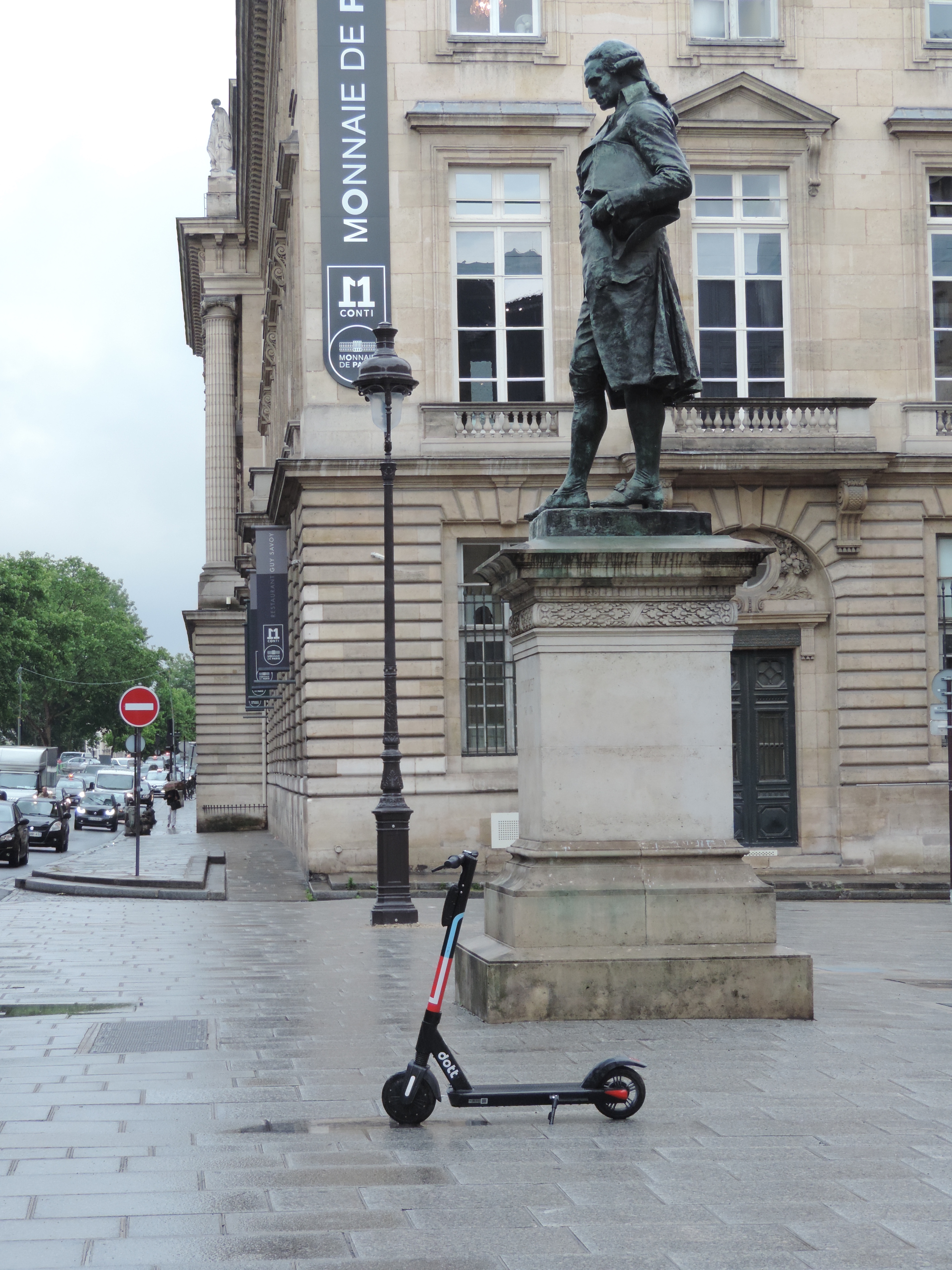
One day in Paris I came across this electric scooter sitting just beside this rather imposing statue of Condorcet. I had the notion that the serious thinker was looking down rather disdainfully at the scooter.

Even as I framed the shot I thought this was an interesting juxtaposition. Condorcet was a leading thinker of the Enlightenment, a champion of rational thought. That’s one large, heavy tome he has in his hand there and he has the air of someone who goes through life, eyes downcast, as he thinks seriously about everything.

For the Enlightenment thinkers rational thought was the way to liberate mankind, to free them up from the chains of superstition and enslavement by autocratic powers.

The electric scooter, on the other hand, is our right up to the moment symbol of autonomous freedom. In a city like Paris you can pick one up wherever it’s been left, pay your hire price using your smartphone, step on, and away you go whizzing along streets and passageways faster than pedestrians, weaving between static traffic jams of cars, pretty much as free as you’d like to be.

Yet a scooter, for many of us, is a sort of toy, isn’t it? I had a scooter as a child, as did my sister. In fact, just the other day there she found an old black and white photo of us both on our scooters, and sent it to me. Scooters back in the 1960s of course weren’t electric, but, apart from that is the modern version really that different?

I have a notion that one of the appeals of the electric scooter is something to do with play. Think back to childhood, or observe a child in your own family. From the very earliest of years children learn and develop through play. They explore, they discover, the try things out, pressing, pushing, bending, tasting, touching, looking and listening. They are like little sponges aren’t they? Absorbing every possible experience they can have minute by minute through the entirety of their waking hours.

Curiosity, then, that fundamental building block of learning, is expressed, first of all, through play. But there are three other qualities to play which come to my mind as I write this.

Play develops the imagination. Children create whole worlds to inhabit. Worlds of creatures, monsters, fairies, heroes. They dress up and assume roles. We even retain the phrase “role play” as an adult activity, don’t we?

Play encourages creativity. Children express themselves through drawing, singing, and making. Play is the medium through which creativity is released and nurtured.

Finally, play is social. Although a lot of play can be solitary, children adore games – games played with others. They are always asking to play games. Come and play this with me! Let’s play…..! They learn to connect, to interact and form relationships through play.

So, yes, the Enlightenment thinkers promoted liberation through rational thought, but are we missing a trick by reducing play to something less important, something somewhat trivial, even “childish”, to be left behind as we grow and mature into rational, thinking human beings?

Hey, you know me, and my “and not or” mantra – don’t we need BOTH? Don’t we need to inhabit, live, develop and grow both our “play” skills and our “rational” ones?

“All work and no play makes Jack a dull boy”

There’s such a push now, during this pandemic, for people to work from home, and already it’s easy to find a host of articles about the dangers this poses to work-life balance. Yet, “home-working” could be liberating. I had a telephone conversation with a government worker recently and I could tell from the background noise that he was at home, not in an office, so I asked him if that was the case. He replied yes and said how much he loved it. He no longer had to commute for 90 minutes to work and another 90 minutes back home every day – so he felt he had gained 3 hours. And, he said, when he wanted a coffee he didn’t have to stand in line and pay a hefty sum for a cup any more, he could just reach behind himself to where he’d placed his coffee machine.

I’m exploring a new way of organising my time, and I’ll share it with you once I’m happy with it, but today I realise I need to factor in something else, something a bit more liberated, something a bit more imaginative, something a bit more fun – play!

Why don’t you join me, and spend at least a little bit more of today in play?

Read Full Post »

We often look at the world this way….just a peek through a narrow gap. We can see a bit this way. It’s a way of being focused. If we narrow our gaze we can ignore everything except what’s in the target zone of our attention.

You know we have “two brains”, right? I mean the recognition that we have a cerebral cortex which is divided into two, non-symmetrical parts. Why do you think the brain is like this? Why not just have one, whole brain? Why did evolution prefer to develop the cortex in two significantly different hemispheres?

Well a lot of people have tried to claim that the right half does these things, and the left these other things….like the right is what we use to “do art” and the left is what we use to “do logic”. But we know that’s not true. The brain is not like a clock, a car, or a computer. It doesn’t function with one part doing “this” all by itself whilst other parts do “that”.

But Iain McGilchrist figured it out. In his “The Master and His Emissary” he lays out what I find to be a convincing thesis – each hemisphere engages with the world differently – in other words, each hemisphere gives us a different way of approaching, understanding and interacting with, the world.

What the left hemisphere allows us to do is like what you see in this image. We use it to narrow our gaze. We use it to focus in on “parts”, to analyse them, label them, categorise them, in order to try and “grasp” and manipulate them. The right hemisphere, on the other hand (see what I did there?), is used to enable a broad gaze. We use it to focus on the connections, to explore the bonds and relationships, to discover what’s new, and to see things in the broader view, or in “the whole”.

What amazes me about this is that we use both halves simultaneously pretty much all the time. They are in constant interaction, giving us the ability to “integrate” and “synthesise” what they focus on.

The trouble comes when we fail to pay enough attention to one of the halves – actually, in our modern world, it’s the right hemisphere we fail to attend to sufficiently. We get stuck in our world view of seeing reality as composed of separate parts which we can label, categorise and control. We get hooked on a mechanistic model. And, well, reality is not like that. That picture is incomplete and can lead us astray.

So, we do need these abilities to focus narrowly, to separate out elements, analyse them and organise that knowledge, but we ALSO need to be constantly aware of the big picture. We also need to see the contexts, the connections and the circumstances. It’s this that enables us to see uniqueness.

When it comes to this pandemic, we need to understand and analyse the COVID-19 virus. It will be a real boost to us to discover how to improve our treatment of people who are infected with it to try and reduce the potential damage they might suffer. But we need to use that other half of the brain too and see what the circumstances are in which this pandemic has arisen. We need to join up the dots. We need to see the connections and the contexts.

Isn’t it clear that one reason why this pandemic is so damaging is that we don’t have enough good health care? I think this issue is the same whether you live in the UK, France, the US, Spain, Belgium….you name it. It’s not the sheer number of people who are suffering from significant effects of this virus – after all, it seems about 80% of those who catch it don’t even get any symptoms. It’s that the small percentage of people who DO suffer serious effects from it still constitute numbers potentially too big for our health services to cope with.

Why do you think there is this constant message about “protect the NHS” in the UK? The NHS shouldn’t need “protecting” from sick people! It’s very purpose is to treat them. But the truth is there aren’t enough staff, there aren’t enough hospital beds, there isn’t enough equipment, there isn’t enough PPE, there aren’t enough testing materials, or laboratory resources.

There isn’t enough decent, safe social care available for the elderly. There isn’t sufficient support for people whose incomes are hit by forced closures of their workplaces. There isn’t enough decent housing. There isn’t enough decent nutrition because the current model of industrialised farming and processed food production is feeding both obesity and nutritional deficiencies of important vitamins and minerals which are needed for healthy immune systems.

And so on……

Unless we use our whole brains and address the underlying weaknesses, vulnerabilities, insufficiencies and injustices in our societies we will find not just this pandemic hard to handle, but we’ll set ourselves up for more of the same.

It’s time to change.

Read Full Post »

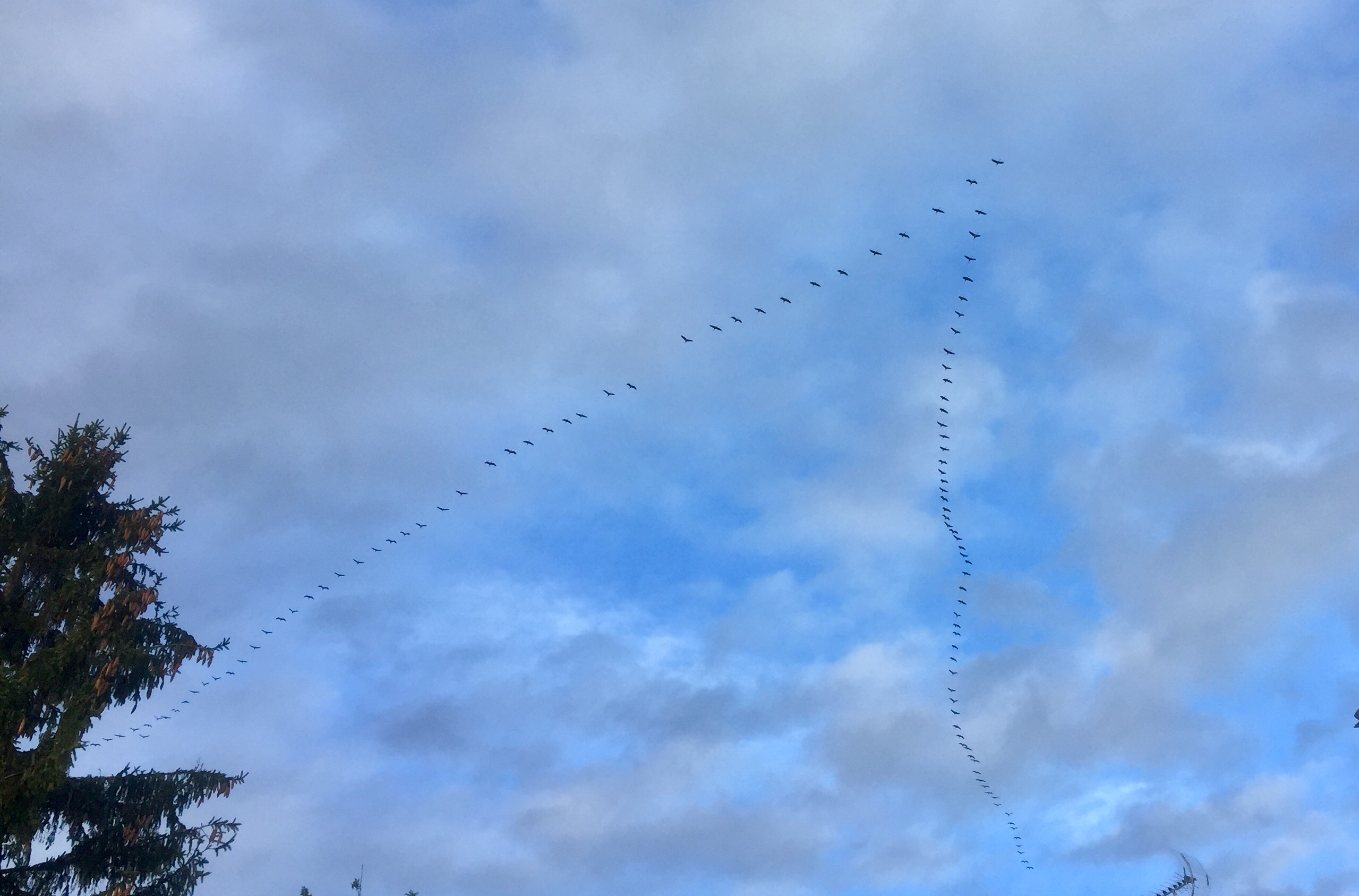
Here in Europe autumn is a season of great change where we move from summer to winter. One of the most astonishing phenomena of this season is migration. Look at this fabulous flying V of cranes heading south! I wish I could let you hear the incredible noise they make, but my little phone recording really doesn’t do them justice.

These are only one of the species of bird which migrates. The hoopoe and the redstart have already left my garden and I still have no idea where they go or how they manage to find their way back to exactly this small square of the Earth every Spring. The other birds I see around here flying in similar great V shapes are geese, but I haven’t seen any passing by yet.

Don’t you think it’s an astonishing phenomenon, this ability of these little creatures to navigate and fly across thousands of miles from one exact place to another? As far as I know nobody has managed to fully understand how they do that. But it’s also amazing to me that they have the energy and the determination to make the huge effort of flight over these enormous journeys.

Birds, of course, are not the only creatures to migrate. Many others do, from fish to butterflies. So it’s an important, significant natural phenomenon of Life. Many many more creatures migrate in the sense of moving from their original habitats to other ones, but don’t do this regular back and forth seasonal migration. In fact whilst millions of creatures live their entire lives in on physical location, or niche, millions of others either travel long distances within their lifetimes or over generations…….like humans, for example!

The BBC show, “Who do you think you are?” is often fascinating, tracing someone’s ancestors over centuries past. Normally, the stories take the subject to several countries, and as they tend to focus on only a small number of this person’s ancestors in a one hour show, we know that if they explored more fully they’d find origins in multiple and diverse locations.

The only living creatures to experience nation-state borders and barriers to this freedom of movement are human beings. Why do we do that? Why do we erect these utterly artificial and pretty arbitrary barriers to human movement, if it’s in our nature, as it is in so many other species, to migrate?

I find the rules and regulations around “citizenship” difficult, confusing and unjust. I don’t understand why two families living in the same street, with children in the same schools, adults working, shopping and enjoying life in the same offices, factories, stores, cinemas, theatres and sports halls, should have different rights and responsibilities. It sets up discrimination, prejudice and resentments.

Why don’t we change that? Change it to habitats. Why can’t we have the same rules, rights, obligations and responsibilities for all the inhabitants of the same habitats? Call that habitat a nation state if you must, but the important point is to treat all inhabitants equally under the same law.

I know that the whole issue of borders and migration is a difficult one, and I’ve read Rutger Bergman’s “Utopia for Realists” where he advocates no borders. Maybe that’s an aim worth having, but I think it will be a long and difficult road to get there. However, would it be so difficult to argue that all the inhabitants of the same habitat be given the same right and obligations?

This isn’t an issue of “nationality”, not even of an individual’s life story of several “homes”, or of ancestors from particular areas of planet Earth. It’s about how we live together in the present time, based on the present, not the past. It’s about developing fraternity, solidarity, equality, justice, fairness, and freedom. Can’t we learn this from Nature?

What do you think of this idea?

Read Full Post »

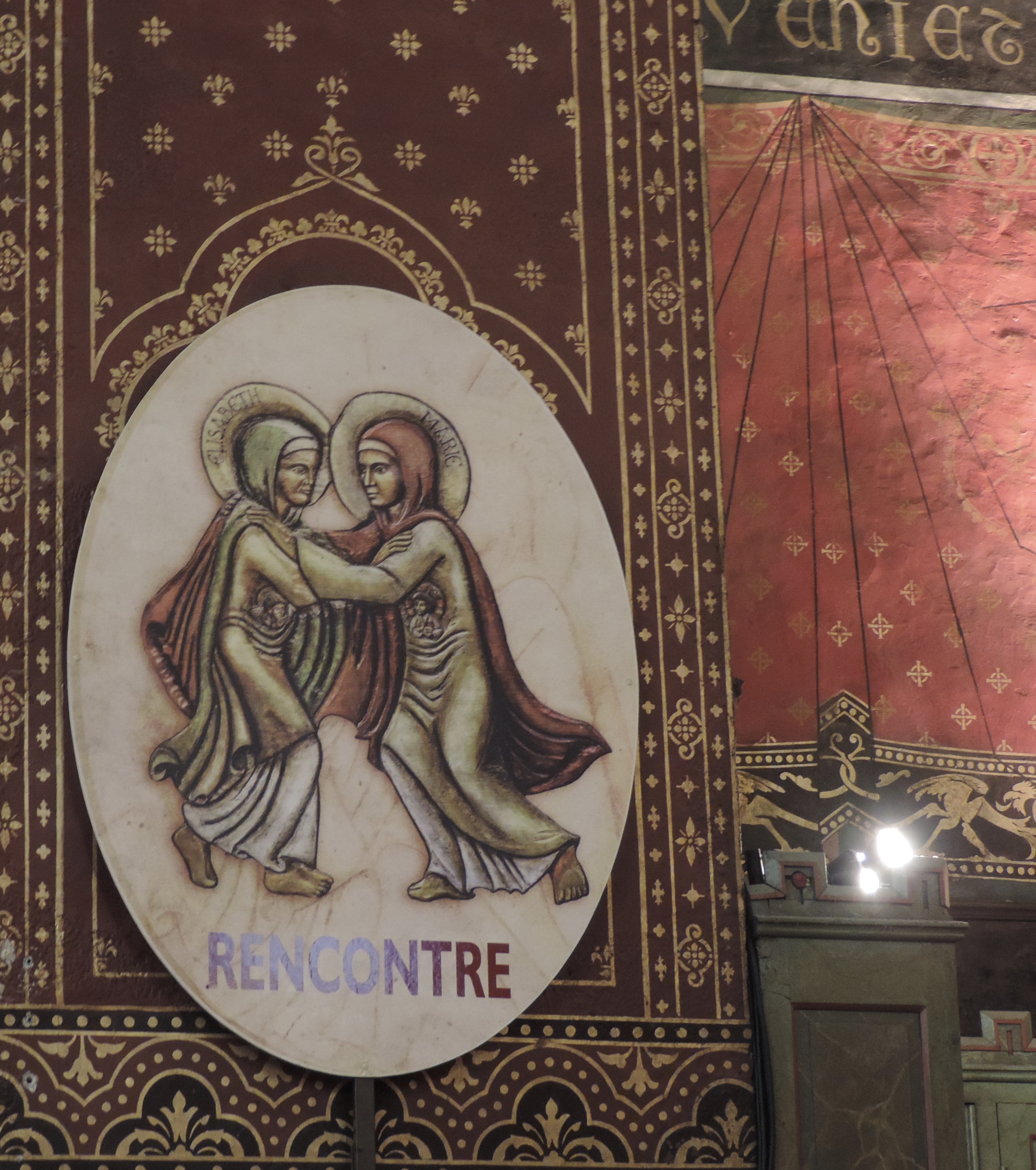
I saw this on the wall of a church in Saint-Jean-de-Luz in Southwest France. A “rencontre”, as you can probably tell from the drawing, is a meeting. I haven’t seen this portrayed in other churches but I really liked that it was displayed so prominently in this one.

For me, the key to understanding Life is revealed in connections, relationships, or bonds. In fact, it is revealed in a very special kind of connection – one which increases “integration”.

Integration is “the formation of mutually beneficial bonds between well differentiated parts”. I think this is easily understood when you think of the human body. We have several organs, from a heart, a liver, a pair of kidneys, a pair of lungs, a brain, and so on. All of these separate, distinct, structures have their own particular functions to carry out and they must carry them out in a way which is more than harmonious…..they must act to promote mutual benefit. The “integrative” connections exemplify collaboration and co-operation. Our organs do not compete with each other….not for energy, food, or protection. Not in a healthy state, anyway.

So, here is the basis of natural health – harmonious, well-integrated, collaborative relationships between distinctly different parts.

You can scale that up – so that a healthy society is a diverse one composed of unique individuals who relate to each other in mutually beneficial ways. You can scale it up further to consider whole ecosystems, or even the global biome, and see that this is the basis of Nature.

Much has been made of the role played by competition in Nature, and in particular in the story of evolution. But, competition has only ever been one part of the story. Without collaboration, without the creation of mutually beneficial bonds, Life would not exist, and it certainly wouldn’t evolve.

When I see this image of a “rencontre” I’m also reminded of the story of the Little Prince and the fox, as told by Saint-Exupery in his “The Little Prince”. In particular I remember the passage where the fox asks the Little Prince to “tame” him – by which he means to create a bond between them, and gives the example of rose which the Little Prince tended to in his home. The Little Prince claims that his rose, of all the roses in the world, is special to him. He cares for her, looks after her, and feels for her. What makes her special is the bond – the bond of care. The fox points out that if he and the Little Prince form such a bond, then they will be very upset when they have to part – because these bonds of care matter to us. They matter to us more than anything.

We can’t have too much of this type of connection in our world. In fact, we need a whole lot more of them – we need the bonds of “integration”, the “mutually beneficial” ones, the bonds of “care”.

Read Full Post »

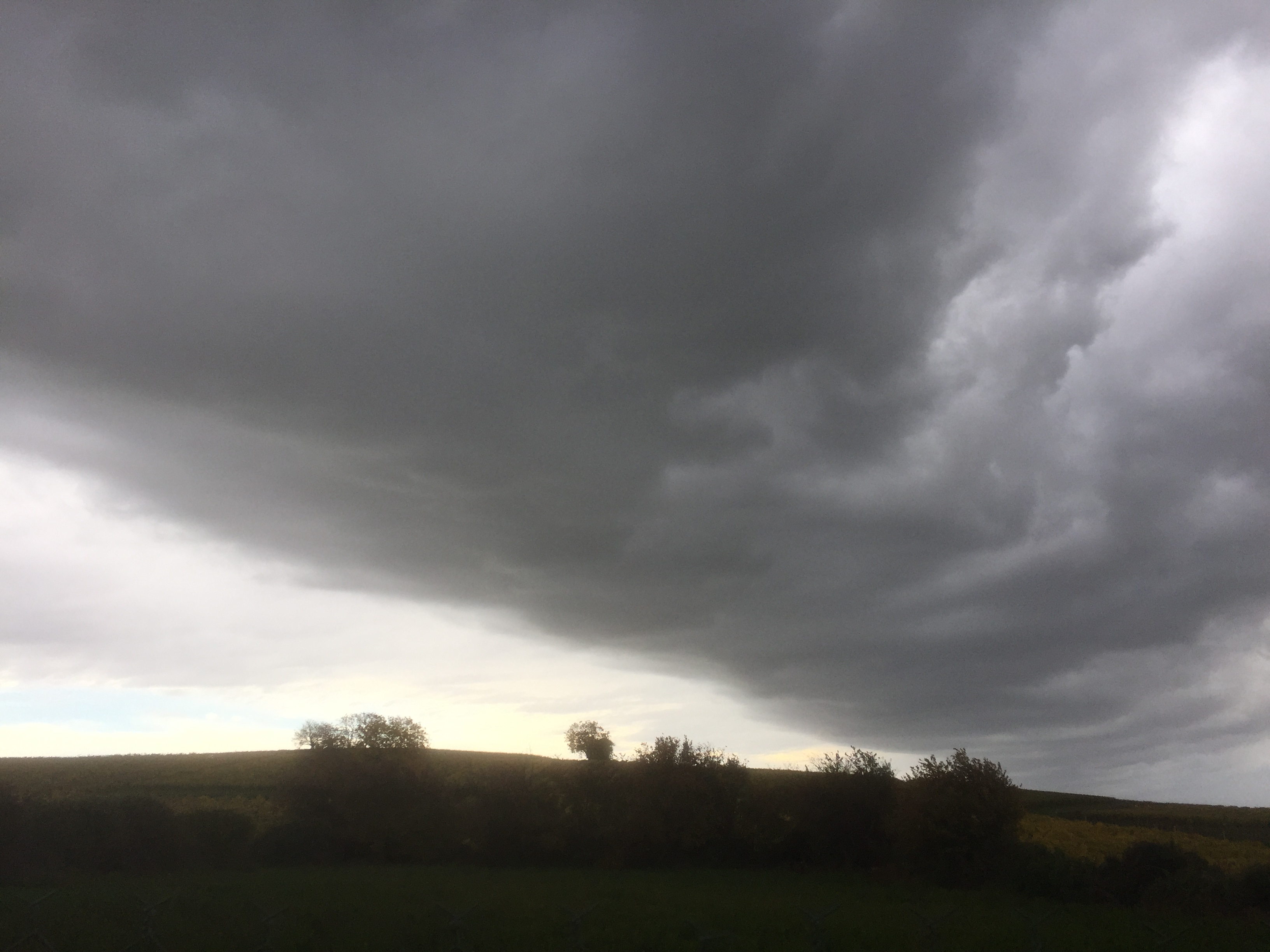
When you look at a sky like this you know a storm is coming. When it’s as dramatic as this it can be quite intimidating. At very least I know to prepare a little, unplugging my router and other equipment in case it gets fried by lightning (and, yes, it’s happened once since I came to live here). We also have an issue with heavy rain overwhelming the drains and then pouring down the driveway so another preparation is sandbags along the bottom of the garage door (and, yes, it’s happened more than once since I came to live here).

But sometimes, even a dramatic sky like this just passes over with hardly any rain, and no significant thunder and lightning. It seems impossible to predict at a local level. Even when the storm does come, it doesn’t last. Maybe just half an hour or so, or sometimes an hour or two, but usually it’s pretty brief.

I know that it’ll be different in different parts of the world, and I’m also aware of the absolutely catastrophic effects that dramatic, severe weather can have….most recently here down in the Valley of Roya just north of Nice where whole roads and parts of villages were washed away. Tragic.

I’ve also seen news coverage of the after effects of that storm, and as in other parts of the world when such calamities occur, what you see is dozens, if not hundreds, of people immediately appearing to do what they can to help….helping people to safety, cleaning up, making food, donating food, water and clothes. It is impressive. It is very impressive. You see it every time, no matter which country it happens in. You know some people don’t have a very good opinion of human beings and I know we can be an aggressive, exploitative species, but what impresses me so much more is this ordinary straightforward instinct to help and to work together to relieve the suffering of others.

Fundamentally, I believe that people are good. That’s my starting point. If things don’t turn out that way with an individual or a group then I adjust my attitude and behaviour to stay safe, to protect myself. But I start by believing in human goodness. In fact, I don’t know how I could have worked as a doctor for forty years without believing that. Everybody seems to be “worth saving”. Everybody who needs help “deserves” it. I know it’s complex and I’m not trying to be simplistic or naive here, but I really do believe that your experience of life changes when you start from a belief that people are fundamentally good.

I recently came across Rutger Bergman’s latest book, Human Kind, and he takes exactly this idea as his starting point….what if we believed that humans were basically good, instead of believing they are basically evil, or bad? I recommend it. It’s worth a read.

Read Full Post »

I saw this framed poster a couple of years ago in a shop in Copenhagen. I kinda wish I’d bought it! It’s a simple but elegant representation of something which has become my core model when I consider reality – networks.

When people say everything is connected to everything else they are right and the easiest way to both visualise and explore that is the network.

A picture of a network is simply some nodes connected by lines. The nodes might be people in your life, including you, with each line representing relationships. The nodes might be cells in your body, some more directly interconnected than others but all living in each other’s influences. The nodes might be neurones in your brain, each of which is connected to up to 50,000 other neurones! Can you imagine that? It’s literally mind boggling.

Networks can map thoughts, feelings and actions. They can help us trace the influences on any single moment cast by the past and the future if each node is an experience, real or imagined.

We have two halves to our cerebral cortex and it seems the left half is particularly good at noticing and exploring the nodes – the parts, the elements, the items, components or data. The right half, on the other hand, is particularly good at noticing the links, the bonds, connections and relationships.

Think of the constellations in the night sky, each twinkling star a node. When I look out now I see Orion has reappeared and makes his way each night across the winter sky from east to west. He’s been gone all summer and now he’s back I know winter is coming. But how do I see Orion? By tracing the invisible lines which connect the individual dots (stars).

When I first read about complexity science it was this model of networks which made it all clear to me, and, in particular, learning about the non-linear nature of the relationships between the nodes in living creatures helped me grasp the concept of the “complex adaptive system”…..which shone a bright light of understanding on everything from self-healing, to uniqueness.

If you’d like to explore this subject a bit more, here are some of the best books I’ve read about this concept of networks, connections and links.

Read Full Post »

I’ve got a shelf on one of my bookcases where I keep some of the books which have most significantly changed the way I think. OK, to be honest, there are too many books in that category to fit on one shelf but I do like the little collection I’ve gathered together there. I think of them as sources of light – they have all shone some light of illumination for me – and they still have the power to do that.

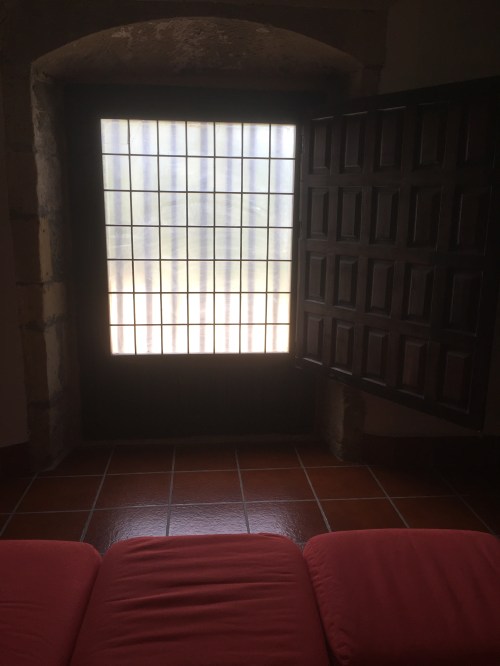
I thought of one of the insights I gained from those books when I looked at this photo I took in a museum in San Sebastian. It’s a photo of a window, but isn’t it a strange kind of window? I mean, you can’t see anything out of it…..you can’t see the outside world from inside the room. But then I thought, what it is doing is letting the light in. What it’s doing is illuminating the room, changing what and how you see the world around you as you stand inside this room. And it isn’t just any old window, is it? It’s not just a plain rectangle of clear glass. It’s filtering the light, softening it, changing it, before it enters the room. The window might be passive, but it’s still actively changing the experience of being in this room. Being in this room would be different if the window was different.

All that got me thinking about flow, because that’s one of the key insights I gleaned from some of the books on my special books shelf……that all that exists emerges from within a constant flow – a flow of material substances (atoms, molecules, compounds etc), a flow of energies (light waves, sound waves, heat, gravity, strong and weak forces of attraction etc), and flow of information (symbols, words, language etc) All three of those flows are modified by contexts, changed by the world around the perceiving, experiencing subject.

I find that becoming aware of these flows makes me appreciate the world more, makes me wonder more, makes me delight more. I love to look for the connections, for the relationships and bonds between each of us, and between us and the non-human world. I love to consider the directions of these flows – to visualise the flow of materials, energies and information which are surging through my being – and to consider how they are changed within me – how they are modified just because I exist – how they are modified by the choices I make.

That makes me aware of my role as a window in other people’s worlds too. How do I illuminate (or shade) the worlds of others? How do I modify these flows and send them onwards to enter the lives of others?

Because one thing is for sure – I don’t exist in isolation – I emerge from within these three genres of flow and I affect the lives of others as I modify and/or pass on these molecules, energies, words, stories, images and ideas. So maybe I should pay attention to how I am living and how I am interacting with all these currents, these waves, these whole rivers of flow.

Maybe I should be aware of what kind of window onto the world I am, and what kind of window you are too. How do we change the rooms/communities/worlds we each live in?

Read Full Post »

« Newer Posts - Older Posts »