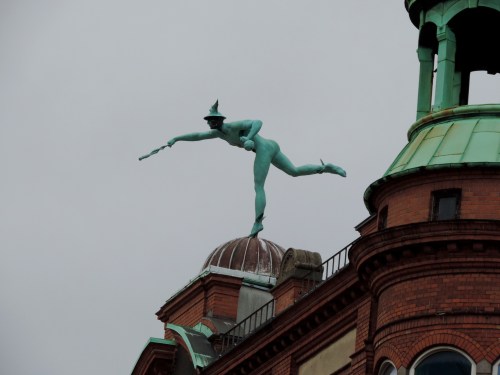
Here’s Hermes in Copenhagen. He gets around. I wonder if he is one of the most commonly represented gods from Greek mythology? Probably you’re more likely to encounter him in Europe! Hermes, the Greek god, was known as Mercury to the Romans, who also associated him with the Germanic god, Odin. He’s a complex god with layers and layers of meanings which human beings have attributed to him through their stories and myths.
He’s maybe best known as the Messenger God – able to cross boundaries and connect the conscious to the unconsciousness worlds, the living world and the underworld of the dead, the physical world to the spirit world.
But he’s also known as a God of Fertility, a Protector of shepherds, thieves and tricksters. A great orator or communicator, who helps to persuade people. But also a healing god.
The symbol of healing – the staff with the entwined snake, is doubled in Hermes hand, to have two snakes entwined with each other, but people often mix those two symbols up and use the “hermetic” one, the caduceus, when they mean the symbol of healing, “the rod of Asclepius“, which only had one snake, and no wings! But I think this just shows how fluid and changeable symbols can be.
I wonder what people intend when they place a statue of Hermes in the middle of a city like this? Is there a hope that the inhabitants will see it and think of communication, connections and healing? Is he there as a reminder that there is more to life than the physical, conscious world reveals?
Does he do anything for you? Would you like to have his image somewhere in your personal environment to help you make sense of the world?
I’ve just picked Hermes here as an example. If you look around I’m pretty sure you’ll come across other characters from stories in your environment and in your daily life……maybe characters from myths, religious texts, folklore….or maybe more modern characters from literature and art. Here’s my challenge – see how many you can spot in your own life this week. Note them down, find out about them, and see what comes up for you.
One of the unique ways we humans make sense of the world is through art, particularly through visual art. There are many examples of cave wall art in France, although, so far, the only one I’ve visited personally is Lascaux. Those prehistoric paintings are astonishing. Nobody really knows why the people who created them exerted such an immense amount of time and energy into painting them. Mostly, they are drawings of the animals which lived in that part of the world. But why spend hours underground painting the images of them, using only basic candle light to show them what they were doing?
There’s something about making images, making likenesses, which is a kind of magic. The images change our experience of time and place. They are a way for human beings to deepen their lives, to imbue them with more mystery, more beauty, more delight, more meaning….
Living with images, created works of art, changes our lives. That’s partly why we like them, why we enjoy them, why we support the activities of these artists.
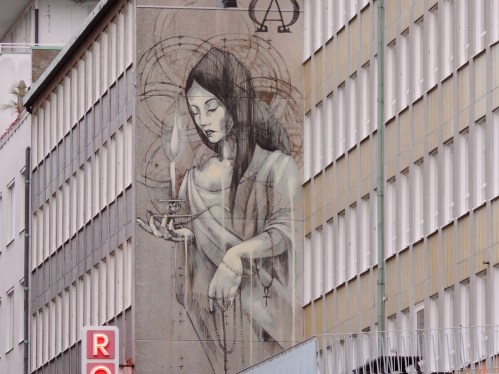
This photo is of a mural I spotted in Malmo three years ago. It’s by a South African street artist, “Faith 47”. I don’t know anything about this artist, or this particular work of art, and, probably, most people who see this haven’t read anything about it. It works as itself. It works as an image.
So, what do you see here? What I notice first, is the main subject, the woman with the long dark hair. She’s wearing robes, holding a lit candle on a candle stick, and she’s gazing down, as if in contemplation. This evokes a sense of Spirit, doesn’t it? In fact, the way she is holding the candle is quite unusual….open palmed, with the palm turned upwards….isn’t it just as we see in some statues of the Buddha? Well, it seems like that to me. It’s a gesture which is “not grasping”, not holding onto, not clinging….a gesture of non-attachment, of waiting to receive whatever is offered, of openness. In her other hand she has a string of beads. Strings of beads like this continue the theme of Spirit, with both Buddhist and Christian traditions containing the use of beads in relation to prayer. Maybe other religions do that too, I don’t know. But hanging around her left arm is also a chain with an “ankh” symbol attached to it….the ancient Egyptian symbol for “Life”.
Up above the main figure is the symbol of “Alpha and Omega”, a traditional symbol of God and Christ. Then behind the main subject there appears to be a kind of work in progress…..overlapping circles. The overlapping circles I know best are the ones used in the “Seed of Life”, and the “Flower of Life”. Overlapping circles like this have been used in a huge number of different cultures and traditions…if you’d like to read more about them, check out this article.
Two overlapping circles are often representative of a union of opposites, of the masculine and the feminine, of heaven and earth, of spirit and body. I like that this one isn’t complete. That evokes the Japanese preference for the “unfinished”, which is related to the issue of transience and beauty….leaving the observer to “complete” the image for themselves.
Well, there you have it. This single image evokes Spirit in human culture and tradition for me. It evokes the union of opposites, or, as I would prefer – integration…..the creation of mutually beneficial bonds between well-differentiated parts! It evokes the Spirit of the Divine Feminine for me too. It’s a peaceful, contemplative image which stops you in your tracks and takes you both deeper and higher at once, puts you in touch with meaning and purpose in the busy ordinary day.
How about you? How do you find this image? If you were to pass it as you walked through the city, don’t you think it could make your day a bit different?
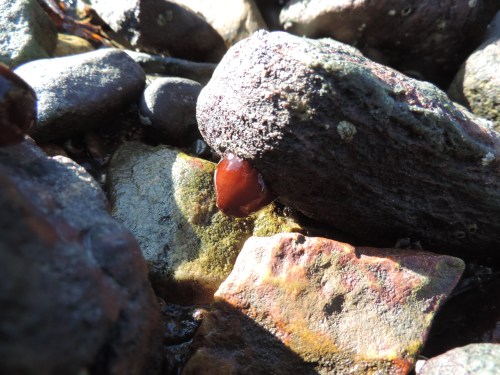
This looks like a bird, don’t you think? That’s interesting because in fact it is a stone on a beach with a little sea creature clinging to its undersurface, looking for all the world like a bright orange beak, and a tiny shell attached to the side just where you might expect to find an eye if this was a bird.
So, my mind has taken a combination of a stone and two completely different sea creatures and created a image for me which makes me think “This looks like a bird”.
We do that all the time. All the time. When we look at clouds we see patterns which make us think they look like faces, creatures, or other familiar shapes. We see people who look like people we know. We see likenesses in babies features which remind us of parents or grandparents.
This “looks like” ability isn’t unique to human beings of course. Flowers, insects and many other creatures are brilliant at developing shapes and forms of other life forms….either to attract what they want to attract, or to repel what they want to repel.
But we humans take this “looks like” ability to a completely different level. We use “representation” to become aware of, or to create, connections between things which we would otherwise miss. We use it to know, quickly, what we are looking at, or at least, to make a preliminary, perhaps “good enough” assessment.
But we also use it to connect to others. We look for similarities, symmetries echoes and reflections, to form bonds, attachments, relationships. We look for some aspect of a person or their life and say “I identify with that”, or “me too”, or “I sympathise with that”, “I understand that”.
Even in the circumstances where we look closer and realise that what we perceived at first wasn’t really what we thought it was…..this is not a bird….that ability of do the “looks like” thing turns something mundane into something just a bit more magical. It’s a way of “re-enchanting” the world.
I think we take this power to a whole new level when we start to employ symbols, art and language. I’ll say more about that tomorrow.
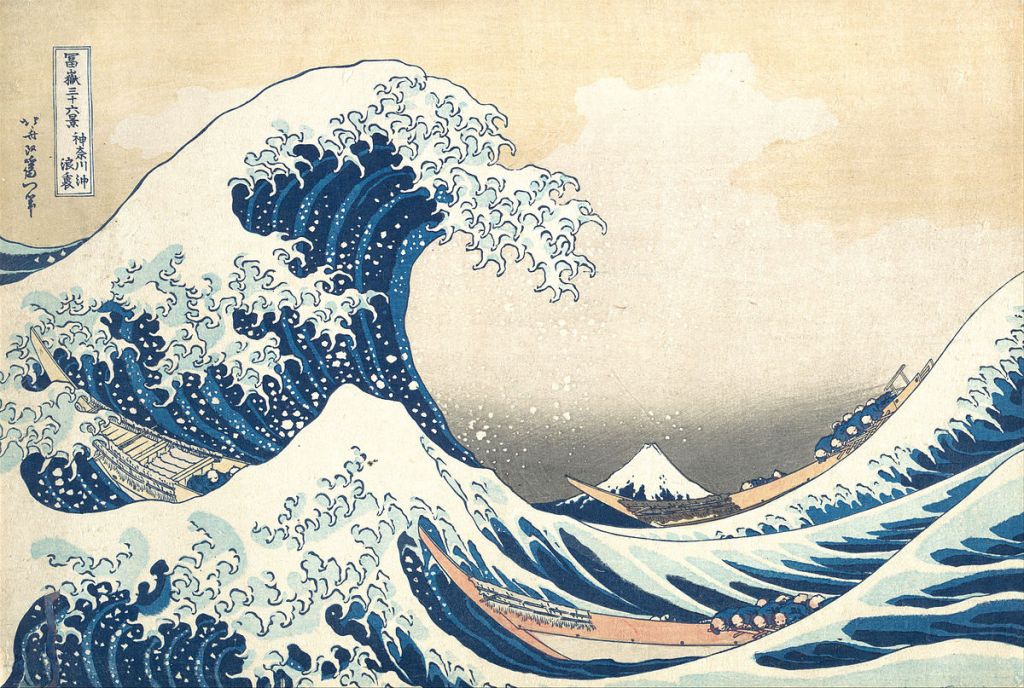
When I looked up at the sky and saw these clouds I thought of Hokusai’s famous work of art, “The Wave” …….
Of course, now that it’s 2020 and we’re still in the midst of this COVID-19 pandemic, that image has taken on a new significance I think.
There was always something both awe-inspiring and a bit frightening about “The Wave” (or is it called “The Great Wave”?). When I look at it I’m immediately struck by its beauty. What a fabulous form! And with Mount Fuji on the far horizon you get the impression that the wave is actually bigger than the mountain! Then you notice the people in the boats, and they are looking, to say the least, precarious! I mean if a wave the size of a mountain is about to come crashing down on you with its foam forming giant claws above your head, then, how could you be anything other than terrified? Well, maybe exhilarated too, responding to the challenge, the way a surfer would, but surely you’d be afraid?
This pandemic is a bit like this. I can’t help but feel awe in the face of the power of this tiny virus to spread over such enormous distances and affect so much of our tiny human lives. And I can’t help but feel a bit afraid of it too. Sure, we now seem to have reached a phase of frustration and don’t we all just wish the bloody thing would go away? But wishing isn’t going to get us there, is it? We have to face up to it, paddle like fury and try to ride it out.
What we’ll find on the other side of the Wave/Pandemic none of us know, but, one thing is for sure, we’ll be changed. This world will be different. Maybe we’d better face up to that too, and start to make the personal and collective changes which make sense in the light of what we’re learning from this experience……
Maybe that’s the big wave coming, actually…..not so much the tiny virus, but CHANGE…….change which washes away old and ingrained habits, routines, methods and ways of organising things. Change which inspires us to invent new ones.
I’ve had a couple of days thinking about beginnings, so it seemed kind of obvious to have one about endings!
This photo shows a number of berries, all part of the same plant, even the same part of the same plant, but each in a different stage of maturation. Some are still green, some have turned yellow, some red, and some are even beginning to get wrinkled (like me, ha! ha!) and so appear the most mature.
When I think about beginnings, I realise that they are all pretty arbitrary – a beginning is where we begin – if you pick a thread or two you’ll always find your way back to an earlier beginning.
I don’t think that means there are no beginnings. I think there are. All the time. Every day. Every moment of every day. There are beginnings. There are phenomena and experiences which have only this moment come into being for the first time ever. It’s pretty great to notice that.
Endings have exactly the same quality. It’s not that there aren’t any. There are endings all the time. Every day. Every moment of every day. There are endings. There are phenomena and experiences which have only this moment slipped into the past. You’ll never have them again. It’s pretty great to notice that.
Outcomes, targets and goals
In Medicine, there is a lot of focus on “outcomes”, sometimes called “clinical outcomes”, which, somehow are a bit different from “patient reported outcomes” (“PROMS”). These are all endings. They are points to be reached. Measurements to be attained, or ratings to be completed. But when your working life is that of a family doctor, (a “GP”), then you’re never done with outcomes. The patients don’t reach the intended outcomes then go away. Life, it turns out, goes on. What was an ending today, turns out to be just another chapter in an ongoing story, just another time and place sensitive reading in the midst of a flow of a whole life.
Oh, yes, you’ll say, but there is one outcome which isn’t like that isn’t there? Death. The final outcome. The ultimate ending. Except it’s not really, is it? Well, it is for the physical body of the person who has died, but we are more than physical bodies aren’t we? We are experiences, stories, events and memories, aren’t we? And those continue long after the physical body has gone. Are the people you loved who are no longer alive completely gone from your life? I don’t think so. Their life continues to influence our lives. The experiences we shared, the memories we made, whatever we created together, the stories told, the photographs taken, the objects held…….
Have you ever seen a BBC TV programme called “The Repair Shop”? I love it. People bring old objects to a workshop of artisans. The old objects are usually in a poor state of repair, but they mean something to the person who has them. Once restored by the craftsmen and women, the person comes back to reclaim the object, and time and time again, it is an immensely emotional experience. They are put in touch, deeply, and significantly with a loved one, long gone. It’s lovely to watch and it shows how a person, an individual, continues to influence others long after they’ve gone. How their “presence” I suppose you could say, is made more real through what they’ve touched, what they’ve handled, what they played with, or made.
Targets are a kind of outcome. They are useful as ways of getting you to somewhere you want to get. For example if you want to save up a certain amount of money then setting a target of that amount is a good aid to getting there. The trouble is that targets are used inappropriately. Whose targets are they? And are they the same, most important targets, which others want to achieve? Because the selection of targets is an individual, value-based, subjective, exercise of choice. But if they are set for others then they direct the efforts and lives of others towards those targets instead of others. I’m not a fan of targets. At least, not ones I don’t have a say in the creation of!
Goals are a bit like targets. I’d say the same about them. They can be helpful to get us to places we want to get to. But they are aspirations, not predictions. And they are not endings. Or at least, they are not final endings. Are they?
I think this unique and unpredicted pandemic is forcing us to face up to the reality of beginnings and endings. It’s making us more aware of connections, of webs of influence, of the non-linear, multifactorial, dynamic, ever flowing, ever changing nature of reality.
This morning I read an article in Le Monde about how management methods are already starting to change in the light of this experience. Here’s the main point I got in that article – management is having to move away from “control” to “coaching”. Three things have come to the fore – the need for individual autonomy, the need for good team working and relationships between workers, and the need for transparency.
Well that all seems pretty good to me! I look forward to seeing the end of de-humanising “Taylorism” and “command and control”, and the beginning of an emphasis of autonomy, relationships and transparency. Imagine if we governed countries according to those principles?!
Here in Europe the school year is starting and for most children they haven’t been to school since about March or April because of this pandemic. Although we know now that children under the age of 14 seem to be almost unaffected by COVID-19 there is a lot of anxiety about children spreading the virus through the community, and, perhaps more specifically, to the adults who work in the schools. So each country has been making cautious preparations for the re-opening of its schools, looking at everything from cleaning regimes, the use of hand gels and masks, and the way children spend their time in the school buildings.
Out of all this, at least in the UK, has emerged a concept of “bubbles”. The idea is to have children spend most of their school day with a small group of other children and teachers…..often much smaller than a regular class size. The same concept of “bubbles” has also been used for the wider community in the UK, with lockdown rules easing gradually to allow slightly more people to interact on a daily basis – two households meeting up, then three perhaps; limitations to the number of people who can gather in any one place but allowing particular groups or families to meet up and spend regular time together.
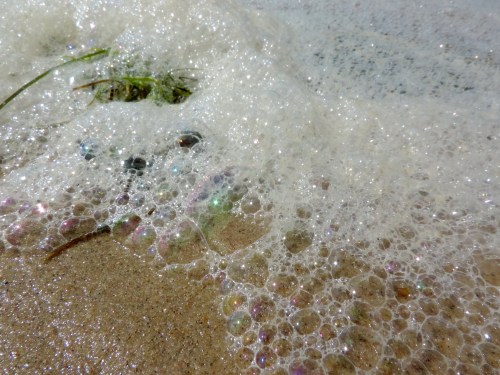
I think it’s an interesting idea. And, as this photo shows, a potentially beautiful one. This photo is of breaking waves on a beach in Western France where the land meets the Atlantic. The bubbles forming in the surf are just gorgeous, aren’t they?
It strikes me that this bubbles idea highlights a major issue for our societies and the way we organise our daily lives. It’s the issue of size. Mass gatherings, mass transport, mass tourism, have been shown to be amongst the most vulnerable points for us…..the circumstances which lead to most infections. The social distancing measures that each country has brought in have been based on the understanding that the more you keep people together in closed spaces the more the disease spreads.
So now we are seeing a huge increase in “home working”, and, it would seem, a large number of people find they actually prefer that to spending time every day packed onto buses or trains with hundreds of strangers, then working all day in the shared spaces of offices. People are learning to live locally, enjoying their local parks, shops, cafes etc now, instead of traveling long distances to share time with masses of strangers in huge workplaces, shopping centres and so on.
I’ve decided to re-read a book which made a huge impact on me when I young – “Small is Beautiful” by E F Schumacher. It’ll be interesting to revisit it in the light of what we’ve learned since it was written in 1974, and in the light of our experience of this pandemic. What I remember of the book is the key point that big is not best…..that we should try to create societies at human scales instead of around mass production and mass consumption.
Maybe the “new normal” will involve a lot less “mass” anything – maybe we will move towards a more human scale everywhere, overturning the industrialised principles of the last century to abandon so called “efficiencies of scale” (which have probably only ever been useful in the manufacture and delivery of products). Maybe we will start to create smaller schools, smaller classes, smaller hospitals, smaller communities. Maybe we will move towards more diversity and less uniformity.
We are more able to do that now. We now understand that complex systems are like vast interconnected networks of nodes and links. We know that the most robust and most resilient systems are diverse and adaptable. We know that distributed power and responsibility produces more sustainable systems and organisations than hierarchical, command and control, massively scaled ones.
Integration is the creation of mutually beneficial bonds between well differentiated parts. It’s how the body works. Not with a command centre, but with interconnected, responsive, open networks. It’s how Nature works, through inter-dependent, diverse elements within ecosystems.
Is this our model for a “new normal”?
Human scale. Small. Diverse, open and healthily inter-connected? Can we see a future way to live in this beautiful image of bubbles?
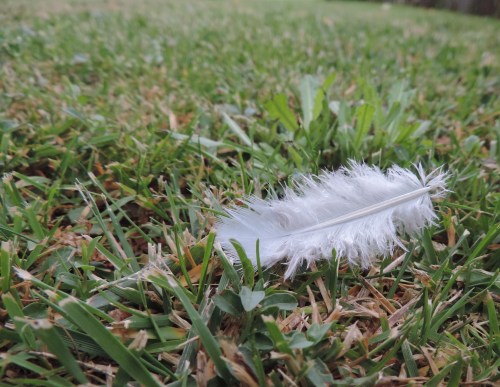
I remember reading that Paulo Coelho, the author, had a practice of starting a new book whenever he came across a white feather. I’m not sure if he still does that, or whether or not he always started a new book every time he came across a white feather……however, this has got me reflecting on the issue of beginnings.
Here I am, sitting in my studio office, near the French town of Cognac. It’s the second last day of August 2020 and we are now….how many months? into this COVID-19 pandemic.
I’ve had some recent experiences of thinking the pandemic was easier to cope with when we were in full lockdown than it is now. It seems that life was simpler because it was so constrained. Now there are an ever-changing host of regulations, laws and guidelines depending on where you are. Different in different places in the town, different in different towns, different in different countries. And the stats seem to be changing all the time as well now, as testing numbers increase, positive cases increase, hospital admissions and COVID deaths don’t increase…..just how widespread is this virus? Just how lethal is this virus? What are the best ways to minimise its impact? The answers to all these questions and more seems to change almost by the week now.
So this feels a particularly unsettled period. And, here’s a weird thing, so is the weather! I’ve never known a summer like this here. More wind, cooler mornings and evenings, high afternoon temperatures, unexpected showers, thunderstorms, and weather forecasts that are literally different between going to bed and waking up in the morning.
I find I can’t help wondering from time to time….”when is this all going to end?” Then, I realise, it might not end. The world might be changed by this. Life might be changed by this. We are not in a cycle of return where we will re-inhabit the past, pick up our “old ways” and carry on as if nothing had happened.
I think some people were thinking this way. Sure, a lot of people have talked about the “world after COVID” suggesting many things that could, and should, be changed. But others are more cynical and expect the predominant forces and power groups to steer things back to what suited them up till now.
The truth is none of us know. The truth is none of us can know. We haven’t lived through this particular event before and we haven’t even lived through an event which is “just like this”. We are still trying to understand what we are dealing with. And the future is never a place sitting like the next destination along the railway line just waiting for us to arrive. The future arrives as we live it. The future emerges from the present, from today’s choices and actions.
I got to thinking that maybe a bit like the “glass half full or empty” dilemma, maybe as life is lived it feels full of endings, but maybe it can also feel full of beginnings. Both are true. They are different perspectives. Isn’t there a saying somewhere about life being understood backwards but lived forwards? Something like that. How we make sense of things through reflection and memory, but how we live in a present which is constantly changing as possible futures come into being…..
So, maybe this as a good a time as any to concentrate on beginnings.
What shall I, what shall you, what shall we, start today? If the future really is like a path which emerges as we walk it, which path shall we take today? Which path will we start to create today?
This is my beginning. This is me just thinking of this. But over the next few days I’m going to devote some time and energy to this and ask myself, what shall I begin? How shall I begin to live now, in the light of this recent past, and this ongoing present?
Want to join me? Feel free. Share if you want, or just take some time this week to explore what you’d like to begin. Then begin.
Yesterday I shared a post about two forms of growth….unfurling (unfolding, opening, flourishing or blossoming) and connecting (reaching out to make bonds, relationships and links).
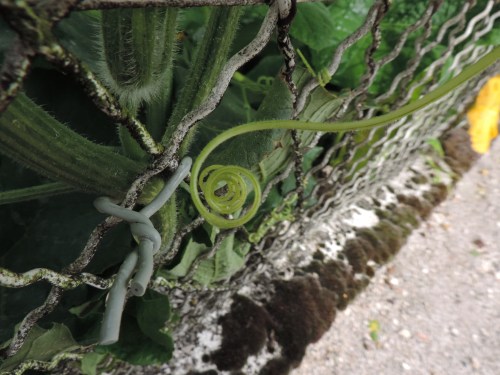
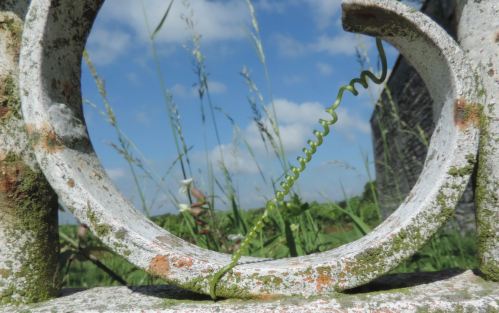
Today I came across a couple of photos from my garden which show both of these processes occurring at the same time. In this first photo you can see how the tendril or creeper which is reaching out is doing so in a kind of spiralling or un-spiralling way. It doesn’t consider that a straight line is the shortest distance between any two points! Perhaps there is something to learn from this – a sort of melange of meandering and spiralling around.
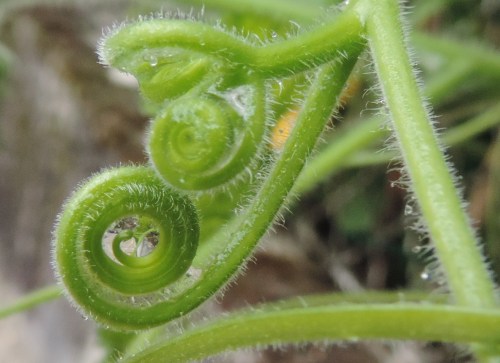
But what really struck me was this photo because I took a close up of these beautiful spirals and because I was focussing on the near distance the background has gone nicely blurred (something photographers call Bokeh I believe!) – but, wait! Look more closely! Look at the centre of the spiral which is in the bottom left corner of this image!
Through that spiral the distance suddenly becomes clear as crystal.
I don’t know what you think, but that reminded me of my favourite “And not or” theme – when you take BOTH of these processes of growth together suddenly you can see the world more clearly!
If you’re interested to read more about “And not or” check out my book.
Both of these images are beautiful and I think that in each of them we see a way of growing.
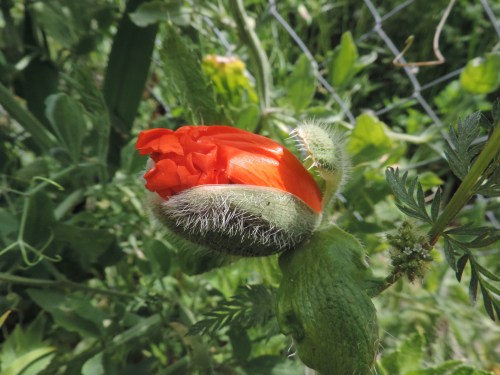
The image on the left is an unfurling. It’s an opening up, a revealing, a bursting out. The outer surface splits apart to allow the inner flower to come into the world. Buds are a powerful example of growth. We see them everywhere in the Spring. They start as small swellings, then their appearance becomes more complex as they grow, then they open up. This opening up, this “flourishing”, is one of the main ways of growing in the world. It’s a blooming, a blossoming. Beautiful. Isn’t this what we hope for in ourselves and our loved ones? That we are able to realise our potentials, that we are able to unfold and reveal our uniqueness, that we develop, grow and mature in a way which we could only call “blossoming”?
The image on the left is a connecting. This is a reaching out, a stretching out, a spiralling upwards, downwards, along until we find something else to catch on to, then investing power and energy is creating a strong, resilient bond. This is a second, equally important, way of growing. We grow by making connections, forming bonds, developing strong, resilient relationships. We grow by finding and connecting to “the other”…..to other beings, other parts of our environment, other parts of ourselves even.
So, in these two images I see two of the most fundamentally important ways of growing and developing – unfurling and connecting.
I’m pretty keen on creativity. I have an eye for what’s new. In fact, I’ve been pretty impressed with the old philosophy which says to treat every day as if it’s the first time you’ll have experienced it. Because it is. Each patient who came into my consulting room was coming in to tell me a new experience, a new story. Even if I already knew them quite well they’ll still come and tell me something I hadn’t heard them say before. Everyone had the capacity to surprise me.
I love the Spring time of the year because I love to see the new seeds pushing up the first green shoots, love to see the buds beginning to form and unfurl, love to see the first sight of the migratory birds returning from their winter travels.
But Autumn is sort of opposite to that. It’s a time of a certain paradox – a time of fruition and therefore harvest, but also a time when the world begins to wind down, go to sleep, or even die off. It’s a time you might call the “down cycle”. I love that too. I love to see the leaves turn yellow, red, brown, golden. I enjoy sweeping up the leaves that fall from the mulberry tree.
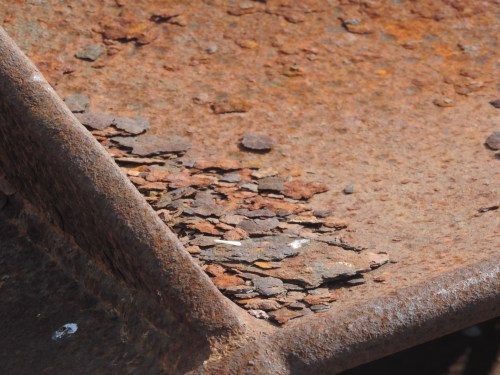
This photo reminds me of the down cycle. Here’s a piece of iron. Some large, once strong panel or plate which someone created. But it’s been cast aside for a long time, and Nature has begun to break it down. The once smooth and shiny surface is breaking up into these little chips and flakes. The chips and flakes will, finally, turn to dust.
Does that seem like a loss?
I suppose viewed from one perspective it is. But Nature has down phases as well as resting phases, waking, growing phases, and maturing phases too. Could anything exist if any of these phases didn’t exist?
I think we need to remember that sometimes, and not get too upset and anxious about change. Nothing stays the same. And because nothing stays the same we are able to start each day as if we had never lived it before….because we haven’t. Imagine! How much there will be to discover today. How many new experiences and sensations you will have. How many new thoughts and feelings you will experience.
Life is dynamic. As Carlo Rovelli, the physicist says
A stone is a prototypical “thing”: we can ask ourselves where it will be tomorrow. Conversely, a kiss is an “event.” It makes no sense to ask where the kiss will be tomorrow. The world is made up of networks of kisses, not of stones.
I think an awareness of the phases and cycles of life reminds us of that. There’s beauty in every phase.
I welcome constructive criticism and suggestions. I will not, however, tolerate abuse, rudeness or negativity, whether it is directed at me or other people. It has no place here. ANYONE making nasty comments will be banned.



 Heroes Not Zombies