Feeds:
Posts
Comments

Archive for the ‘creativity’ Category

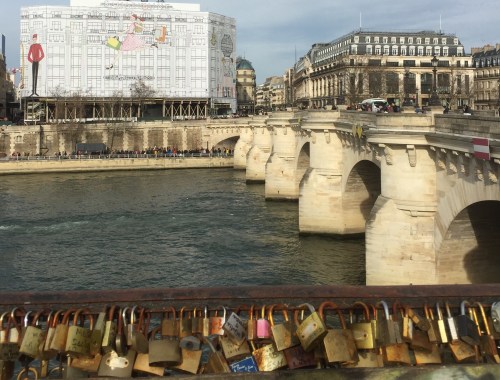
I came across this old photo the other day. I took it in Paris. In the foreground you can see some of the famous love locks. I’m not sure where this habit began but you can find it all over the world now. In this case these ones are along one of the banks of the Seine. On the opposite bank, the first thing you probably notice is the huge “Printemps” department store with its facade covered with scaffolding for building works. Rather than just cover the scaffolding with boring, bland material, they’ve made it look like a giant mural depicting a happy, carefree shopper swinging her bags of purchases as she almost flies over the ground. Right in front of the shop, but down a level on a promenade, you can see a gathering of people. Maybe if you zoom in you’ll make out that there are some musicians in this little crowd, because that’s what was going on. There was a jazz band playing by the side of the river. A kind of large busking event. They attracted people to gather around them and listen to the upbeat delightful music, but you can see a fair number of people also stopped on the bridge up above them to look and to listen.

Last night I watched a movie. A British rom-com called “Finding Your Feet“. I enjoyed it and had some real laugh out loud moments. For example, the character played by Joanna Lumley saying she had been married five times and the last time the marriage had ended “due to religious differences” – “He thought he was God and I disagreed”. But there are sad themes of loss and dying in the movie too. In one scene most of the cast go off to Rome to take part in a dance performance, and as they spend a day and an evening enjoying Rome together I was suddenly struck with a feeling of loss myself.

I realised I had the same feeling when I looked at this photo here. It’s a sort of nostalgia for what we used to call normal. There they are, all kinds of people, out in the city, no need for masks, no need for “social distancing”, as carefree as the character painted on the Printemps mural.

I have a longing for that normality again. I guess a lot of us are feeling pretty fed up with this pandemic by now. I guess many of us aren’t feeling that comfortable with all the measures introduced to “protect us” by making us wary of others, and constantly reminding us that we might catch this virus, get ill, and even die. It’s not getting much easier, is it?

So what are our options?

Mine is a mixture of acceptance and adaptation. The virus is present. It’s highly unlikely that I will catch it, and, apart from my age, I’m not in any of the groups likely to suffer the infection most severely. In fact, most people won’t catch it, and most of those who do won’t suffer much. But some will. Enough to overwhelm hospitals and carers….potentially. So, at the very least from a position of care and solidarity I need to change some of my habits. So I choose to go along with the increased physical distancing, the wearing of a mask to reduce the chance of spreading the virus, and to let go off some of the things which had become a normal part of my life – travel, day trips to cities, visits to museums and galleries, lunch in a seaside town during the holiday season. I’m sure you’ll have your own list.

So, I have this nostalgia for “normal” and I hope “normal”, at least as an experience will return soon.

Meanwhile I’m drawing my focus in to the everyday wonders of life here and now. Enjoying the glimpses of the “Little Owl”s, or the “Barn Owl” which flew over my head the other night in the dark. Gazing at the sparkling night sky wondering what I’m looking at. Sunset bathing…..basking in the glorious colours of the clouds as the last minutes of the day turn the world pink, and rose, and violet. Losing myself in wonder at the drunken stumbling movements of bees gathering nectar deep in the big yellow pumpkin flowers. I could go on.

I’ve started the practice of “morning pages” again (if you don’t know this practice, google it. Or check out this older post of mine). I’m writing these daily posts, compiling and editing photos and texts for my next book (remember to check out my last one – “And not Or“) I’m reading as avidly as I’ve ever read, and pretty much each day feels like a good one.

What are you doing?
Read Full Post »

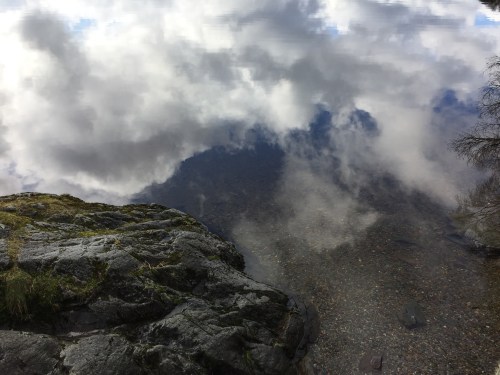
When you look at this photo I think it seems to be a mountain with clouds and sky just above it. But you immediately recognise that’s not quite right.

So then you see this and you think it’s trees with the sky above….maybe one of those forest pictures where the photographer directs the camera straight up to the sky and catches the topmost branches of several trees. But that’s not quite right.

In the first photo, the apparent mountain in the foreground is an odd shape. Mountains just don’t look like that, then, in the second photo, what’s that rock doing balanced on top of the trees?

The thing is, these are both photos of reflections on the still water of a loch. Once you know that, the whole image makes sense.

This inspires a train of thought in my mind…..about how we perceive and make sense of reality. It’s a complicated business but it involves context. It helps to know where you are when you are looking around and what you can see in the immediate environment. There is nobody standing at the edge of this loch wondering what they are looking at. They know where they are and how they got there.

We make sense of reality by spotting patterns, but we need to learn the patterns before we can spot them. A bit chicken and egg-ish isn’t it? In normal life these two aspects of the same thing are iterative…..we are constantly learning and spotting patterns, the more we learn, the more we spot, and the more we spot, the more we learn.

Medical Practice is like that. Doctors learn pathology and the natural history of diseases. In other words, they the patterns of illness. The better a doctor knows the patterns, the more easily they’ll be spotted – or diagnosed. And the more diagnoses a doctor makes, the better the knowledge of patterns. We call it experience. I always felt that a good diagnosis was crucial in good health care. If the diagnosis was wrong, the chances are the treatment would be wrong.

In my first Paediatric job, my mentor told me on the first day that his goal for my six months with him was to teach me how to recognise a sick child. When he said that I thought it was a pretty bizarre thing to say. I mean, wasn’t it obvious when a child was sick? Wasn’t the goal to diagnose ie name the sickness? Well, of course, he was right. I was wrong. What he wanted to teach me was that very first important step…..how to recognise, in an instant, that this child was ill and needed immediate attention. Working out exactly what the disease was and how to treat it came a close second, but if you didn’t recognise that the child was sick, all was lost. It turned out that learning was by experience, encountering sick children and healthy children of all ages, to become familiar with what was normal behaviour and demeanour at different developmental stages. That teaching was crucial for my practice as a GP. It let me walk into someone’s house and know instantly that this child needed close attention and help.

The clues, and the signs, were in the contexts, the environments and the relationships. Yes, some were in bodily or facial “signs”, but mostly they were in behaviours and responses.

I suppose it’s that kind of experience and learning which made me suspicious of reductionism and generalisations. Every individual is unique and can only be understood within their contexts, their environments and their relationships.

Diagnose, like pattern spotting, is like joining up the dots. It’s got a lot to do with connections and behaviours. It’s not all about “data” and “measurements”. Especially when considering the real, actual, unique individual here and now.

Read Full Post »

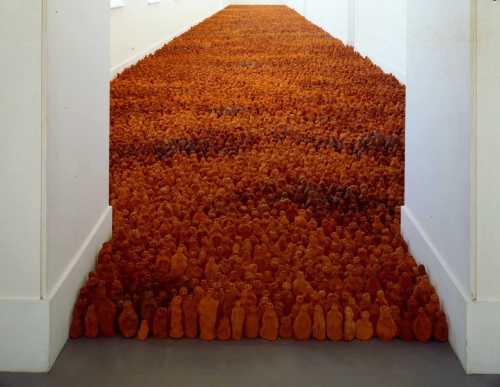
One of my most favourite sculptors is Antony Gormley, he who made “The Angel of the North” which stands beside the M1 in the North of England. His “The Field”, which I saw in Inverleith House in the Edinburgh Botanic Gardens years and years ago left an indelible mark on me. I recalled it in my mind time and time again as I wrestled with the paradox of what makes every patient unique and what they share with others.

But I was thinking again of his work the other day and I remember “Capacitor” which is what you see in this photo at the beginning of this post. This was one of the works he created from an outline shape of his body. In this case he made it with dozens of metal rods.

Maybe this came to mind because for the first time since I moved here almost six years ago I came across a hedgehog in the garden after dark, as I was out closing the shutters for the night.

I have such a clear memory of being in the same room as “Capacitor”….how awkward and dangerous it felt to be anywhere near this work. Like it could take your eye out, or pierce your body if you got too close.

So, you can see why that’s come back to me now. When I’m out and about now I sometimes think everyone has got on a suit that makes them look like “Capacitor”. Except all the spikes are invisible. Has this become the famous “new normal”? All of us increasing our stand-offishness (is that a word?). All of giving each other “a wide berth”. Everyone now regarded as a potential threat.

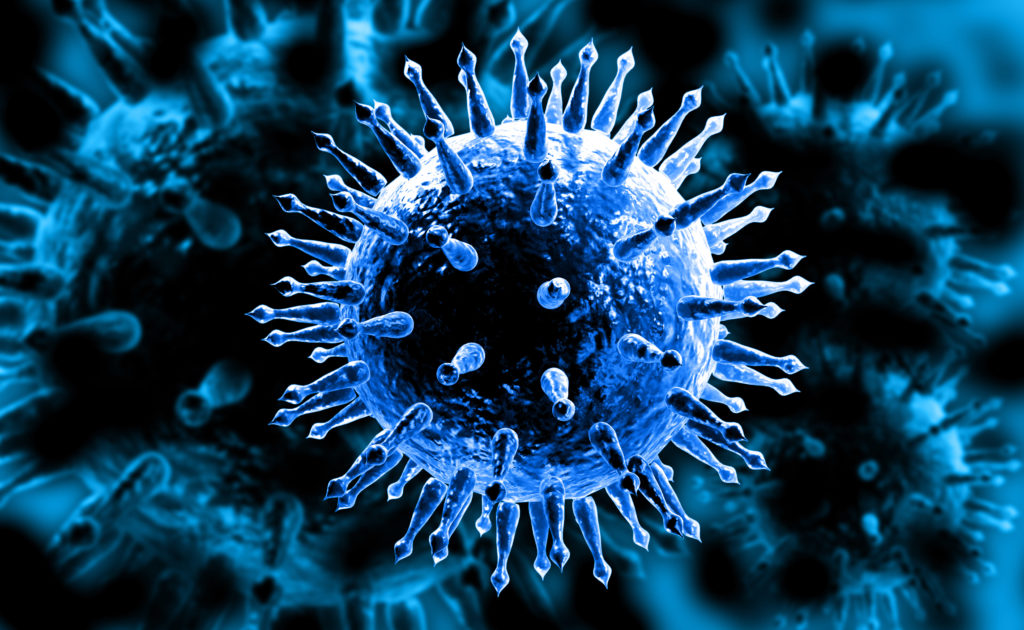
Then it struck me…have you seen the images of the coronavirus?

It’s a ball of spikes!

Yikes! It’s turning us all into images of itself!!

Read Full Post »

Plants send out creepers and tendrils which twist and turn and spiral on their way are always fascinating. For the last five years I’ve been composting grass cuttings and “garden waste” then spreading it on the veggie patch. It’s turned a stony, hard, bare piece of ground into something of a mini-jungle once each year’s vegetables start to grow. This year there must have been some viable pumpkin seeds in the compost because a couple of pumpkin plants started to grow in places where I definitely hadn’t planted them. Once they started to grow they took off, spreading all around the entire patch, weaving between other plants, sending spiralling tendrils out to grasp onto to anything it could touch, reaching each of the two boundary walls (the veggie patch is in a corner), climbing those walls, the fences above them and by now developing over half a dozen huge pumpkins. Every morning you could see how much further the plant had managed to grow since the previous morning. It’s astonishing.

This photo isn’t of a pumpkin plant. There are many, many varieties of plant which have this ability to send out these incredible tendrils. They reach out, touch and catch on. They connect, they bind, they tie together. Look at the size of these ones! You can sense how strong they are.

I was thinking this morning about how pretty much every single atom on the Earth has been here since the planet was formed. They arrived here from distant stars. I was contemplating how the Earth doesn’t make new copper atoms, gold atoms and so on. But what Nature does is create what’s unique and new every single day. She does that by making connections, reaching out, touching, drawing together, blending and binding. In other words, the world is full of newness every day….not new elements but new forms. Nature is like the most inventive creative artist you could imagine, fashioning brand new, individual, unique, forms every single day.

Making connections. Making new connections. That’s the essence of creation.

Read Full Post »

Sheer beauty.

What is it that I love so much about this world?

The wonders of the everyday. Or “L’émerveillement du quotidien”. It’s normal for me to find myself wondering about something I’ve just seen or heard.

I suppose for most of my working life my days were filled with patients. I never tired of that. I never got bored of that. Every day each patient would present to me a unique a story, a new, and singular problem, puzzle or conundrum to unravel. Each patient would be asking me to help them make sense of what they were experiencing and to support their abilities to heal, to cope, to adapt. Maybe they didn’t quite use that language but that’s always what I heard.

Before I became a doctor, way before, right back as early as I can remember I was driven by curiosity. I wanted to learn, discover and explore. It strikes me now that it isn’t a long way from curiosity to wonder.

People have always amazed me. They still do. Life has always amazed me. This Earth, this planet, the solar system, this universe which we all live in have always amazed me, filling me with an infinite supply of curiosity.

But there’s something else.

Beauty.

Look at this photo of a glorious, immersive sunset, where every single element of the sky and the Earth changes colour. Look at the palette! It is just breathtakingly gorgeous.

I see beauty everywhere. Which isn’t to say I find everything I see beautiful, I don’t. But there is “so much beauty in this world” (do you know what movie that comes from? Here’s the answer).

I am a very visual person. I think visually. I sketch and diagram as I think. I love photography and I think I “have an eye for it”. I see what I find amazing, curious or beautiful and I try to take a photo or two. Then I return to those images again and again, year after year, and I find that, like with this one, the delight, the pleasure, the amazement in beauty like this never fades.

Of course there are other senses and I don’t just experience beauty visually. I love music. I collected “records” long before people starting calling them “vinyl”. I still have them. I still play them. I spent hours and hours ripping CDs onto iTunes and I don’t even know where those libraries are any more! But I stream music now. Every day. Several times a day. I used to discover new music on the radio. I took the back off an old radio when I was a teenager, attached two wires to the speaker using clips, and fed the audio directly into a cassette recorder. I still have some of those recordings…..studio sessions on John Peel’s programme on Radio 1.

I’ve long had a love for movies. I love them for their stories and for their beauty, oh, and I often love them for their music. I compiled short clips of about a hundred movies to teach doctors and other health care workers about our unique human strategies for coping and adapting. I could have taught those strategies without movies but the beauty, wonder and emotional engagement which came with the movies made them much easier to learn and to remember. I probably have a whole vocabulary of coping and adapting based on movie characters, scenes and plots.

There is beauty all around us. I delight in images. I delight in music. I delight in movies.

Where do you find beauty? Where did you find beauty today?

Read Full Post »

Emanuele Coccia, the Italian philosopher who brings a new and refreshing perspective to the life by considering plant life says that what plants do so well is capture “extraterrestrial light” and turn it into energy and forms.

Two things struck me when I first heard him say that – “extraterrestrial light”? What’s that? Well it’s the light which comes from outside of the Earth isn’t it? Natural light. The light of the Sun, and the light of stars. The light of the moon is reflected light, so is just another dimension of the light of the Sun.

Without this “extraterrestrial light” from the Sun there would be no Life on Earth. Plants are THE way of transforming light into energy. We get all the energy we need by consuming other life forms at different stages on the food chain, but all of what we eat has plant life at its core. We fundamentally consume the light of the Sun through plants. Maybe through some animals we eat, but they do didn’t capture the energy directly from the Sun. All animals get all the energy they need AFTER the plants have captured it from the Sun.

The second thing which came to mind was Richard Feynman’s observation that trees make themselves “out of thin air“. That startling observation was based on the fact that trees capture carbon dioxide from the air, turn it into carbon based structures and emit oxygen as a “by product”. They also capture all the energy they need directly from the Sun using photosynthesis (a trick no animal ever managed to acquire!)

Then a third thing came to mind….the fact that we are all made from the atoms created in the stars. All the natural elements we find on Earth didn’t originate here. They originated in the great furnaces and explosions of distant stars millennia ago.

All of Life pursues this “extraterrestrial light” – all the plants, all the animals, all living creatures get the energy they need either directly from the Sun or indirectly through the consumption of other creatures which have already captured the sunlight.

Isn’t that a startling thought? That we are ALL light-seekers! All of us surviving and growing by finding and consuming the “extraterrestrial light”.

Read Full Post »

“Now, Life is living you”

This sign is on the wall of a buddhist temple smack in the middle of Kyoto city.

Just take a moment and contemplate it.

Ever since the moment I saw this phrase and it stopped me on the pavement outside this temple, I often think of it, and the more we learn about Life on Earth, the more true this statement seems to me.

As best we know, planet Earth was formed from atoms which were created in the great furnaces and explosions of distant stars. Every single one of us has been created from those atoms. Nature doesn’t create new atoms, it recycles and rearranges the existing ones. So the atoms which can be found in your body were once found in other bodies, other species, other members of other kingdoms on this Earth.

Our bodies are Star Bodies. We are the children of the Stars.

Emanuele Coccia, the Italian philosopher challenges us to think about the Plant Kingdom differently. He has a new book out, “Métamorphoses” (I’ve got it in French…..you’ll need to wait for an English translation if you don’t speak Italian or French). One of the central themes of this book is that we are One….that there is only One Life which never ceases to change forms whilst never changing its substance. In other words, there are only the atoms which made up the substance of the Earth at its creation, but Life turns these atoms, continuously into new forms – new species, new individuals within each species. The process of evolution is a kind of sculpting, produced by the vast complex web of all that exists, to create ever more adapted forms of Life.

We are each like the individual waves on one great ocean of water, every one of us unique and transitory, emerging for brief periods of time before dissolving back into the vast sea.

It’s Life which fashions each of us, and each of us, in turn, interacts with, metabolises and changes the other forms of Life. So, as Emanuele Coccia says, once we understand the one-ness of everything, all ownership and frontiers lose their significance.

Life is living you.

Read Full Post »

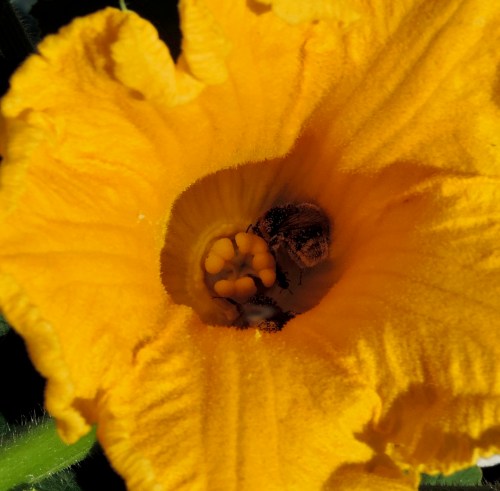
The other day the bees were going crazy for the pumpkin flowers. Each flower had two or three bees tumbling around in its depths, covering themselves with yellow pollen, and staggering as if they were drunk.

It was an amazing sight. Every single flower was filled with powdered bees. It was hard to photograph, but, I think you’ll agree, persistence paid off.

Strangely, (well, I never really understand how the universe does this), I had just read an interview in “Le Monde” with the Italian philosopher, Emanuele Coccia. He has a new book out, “Métamorphoses”, where he lays out his insights about the unity of Life, and the prime importance of plants. I read his earlier work, “La vie des plantes” some time ago and was hugely inspired by it – he gave me a whole new perspective on the world, teaching me to consider life from the perspective of the plant kingdom. In his interview he said a few things which came flooding back into my mind as I photographed these bees.

I’ll paraphrase what he said because the original is in French…..

Flowers contain the sexual organs of the plants but in order to reproduce they need the intervention of third parties – primarily insects or the atmosphere. So, what we learn from this observation is that flowers involve agents from other kingdoms in their individual sexual acts. This means that plants place their genetic and biological destiny into the hands of other species.

That’s quite a thought by itself, but he then goes on to ask “How do the insects choose which flower to pollinate?” The answer is, not by rational thought and logic, but by TASTE and AESTHETICS. So the evolution of plants is based on the tastes of other species.

Isn’t that a stunning idea? Or, rather, observation?

He has much more to say, but this is the part which I thought was most relevant to my experience of witnessing the crazy desire of the bees and the massive spread of pollen which was the result.

Life based on desire and taste……well, what do you know?

Read Full Post »

Summer has established itself here in the Charente, and the big heat has come with days of 30+ degrees. The grass is brown and feels crunchy when you walk across it. We managed a visit to family in Scotland so we’ve been away from here for a couple of weeks and several plants just haven’t made it.

This evening was a time for watering, harvesting some tomatoes, courgettes and radishes, and making a start on tidying away dead plants and leaves to put them into the compost bin.

At first glance the garden looks like it is suffering and it’s certainly the end of the road for some plants, but this photo from a forest floor in Scotland in the autumn reminds me…..new growth is never far away.

In fact, new growth is hugely unpredictable. We’ve got about seven large pumpkins swelling up on a giant pumpkin plant which has made its way to every wall it can reach, and we didn’t even plant it! There must have been viable pumpkin seeds in the compost I spread on the plot over the winter months. What a gift! What a surprise!

Nature teaches me this – there is no waste, no final ending, there is always new growth.

Read Full Post »

There was a craze hundreds of years ago for “chimera” – originally an idea from Greek mythology, medieval peoples took it a whole stage further and created all kinds of bizarre animals.

The chimera is an invented animal made up of the parts from other animals…so maybe a human head, a lion’s body, wings, a serpent tail etc. You can see lots of them carved onto the sides of old churches, and they illustrated old texts as well.

What do you think of them? Are they horrifying? (I think they were often intended to be so) or are they fun? Fascinating?

They just aren’t “natural” are they? You would never imagine that a creature like this existed anywhere. Maybe, once upon a time, some people did. Maybe they believed that they lived in unexplored regions…..remember the old maps with the unmapped areas labelled “Here Be Monsters”?

Probably the commonest reaction to them is a sort of disgust. We find them a bit repulsive….even the more beautiful ones!

I wonder if both chimera and genetically modified plants and animals touch that same core discomfort in us. There’s something a bit unsettling about cutting some DNA out of one creature and splicing it into another, don’t you think?

I think it’s no surprise that many people want GM foods labelled so they can choose not to buy them if they don’t want to. I think it’s not a surprise either that many people think there are complex ethical challenges to be addressed, and a need for intense oversight and control of the whole business of mixing DNA from creature into another……

Read Full Post »

« Newer Posts - Older Posts »