Feeds:
Posts
Comments

Archive for the ‘creativity’ Category

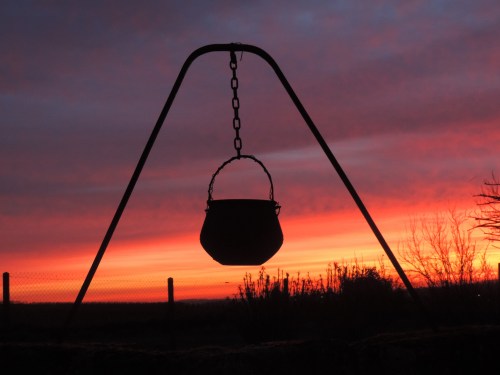
This is one of my most favourite photos. Here in the Charente we are blessed with incredible sunsets. There are, of course, all different kinds of sunsets, but one that I love most is the “immersive” kind. That’s where the entire sky changes colour. You know, watching a large disc of red sun sink below the horizon, is wonderful, but when the entire sky turns an infinite range of reds and purples it’s really something else.

When you are witnessing a scene like that, you are IN that scene. You are a part of it. You feel absorbed by it, entranced by it, enchanted by it. It’s a real world magical experience.

This particular evening I crouched down behind the old well in the garden and took this photo. I love the silhouette of the old iron bowl on its chain, suspended over the hidden depths of the water in the well, with the vibrant, glowing, fiery sky behind and above it.

That well has water in it. It’s over 20 metres down. We measured it using a ball of string with an old key tied on the end. 20 metres looks a long way down. When you peer into the well, (which is normally closed with a padlocked metal lid), you see a long dark vertical tunnel with a flicker of light in its very depths. Looking more closely you can make out shapes and colours which you know are the reflections of the sky, and of you. It’s a bit like looking into a kaleidoscope and recognising yourself.

This old iron bowl looks rather like a cauldron to me, which also inspires me to think of magic. It adds to the whole experience of being enchanted. So, maybe it’s not a surprise that what comes flooding into my mind when I look at this image are thoughts of alchemy…..of how we humans learned to work with both fire and water. Where would we be without either of these elements? Where would we be without having learned some of the secrets of fire and water?

Mind you, we’ve still got a LOT to learn! Do we really understand fire and heat and how to interact with it, how to live with it, how to thrive with it? Do we really understand water?

Of course there is a third element to consider when we experience a sunset like this……the observer, the one who is experiencing, the subject. It’s you, it’s me, it’s us. The truly astonishing alchemy of this is when we, as conscious, living, human beings, perceive and experience the fire and the water, and blend our memories and imagination to fashion an expression of those lived moments.

There is definitely a kind of alchemy in photography.

There is definitely a kind of alchemy in being human.
Read Full Post »

Unusually, I’ve decided to start my post today with two images, instead of one. I’m steadily working my way through my photo libraries of pictures I’ve taken over the last couple of decades. I have, literally, tens of thousands of them. In fact, I’ve always been utterly daunted by the size of my image libraries and haven’t made any attempt to edit or organise them. But then the lockdown kicked in and I decided to create and share a post every single day. I reckoned that was one of the best things I could do in this current situation. There is so much uncertainty, fear, and negativity about that I thought one of ways I could respond to that was create and publish positive, inspiring and encouraging posts. My thinking was, and is, that the deliberate dissemination of positive waves might contribute to others, might provide some support and reassurance in these difficult times.

Two of the things I do a lot is take photographs and write. It’s a long time now since my blog evolved to have this consistent structure – each post created around one of my photos, plus an associated written reflection.

My experience of doing this continues to delight me. These daily posts have become something of an addiction. I’d find it difficult to miss a day now! Every day I edit and organise some photos in one of my photo libraries, and I download one of two of them which inspire me to write something. Then, each day I choose one of those downloads, pop it into a new post, take a little time to contemplate and reflect, then I write. From time to time, I hear from one of you, sending me a message of gratitude for a post I’d published and that, too, delights me, because it confirms for me that positive ripples can, indeed, travel right around the world.

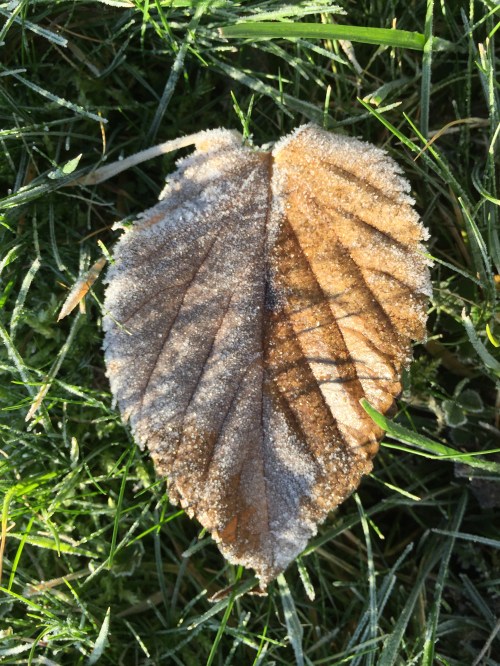
Today I was thinking of using one of these two photos but wasn’t sure which one, then……guess what? Yep, I decided “And not or“, and popped them both in, because together they make a small sentence. Ok, not quite a sentence, but a small phrase…..

Whole hearted.

The half frosted leaf struck me as a natural yin yang symbol when I saw it, and it still has that power over me. Because the left half is frosted and white, where the right half has warmed up, lost its frost, and revealed its brown colour again, it really does speak to me of contrasts, opposites, and polarities, and of how all such things exist only in connection with their partners. The yin yang symbol is such a great symbol of wholeness. Of dynamic wholeness. I love it.

The shape which has appeared on this tree is typical of the way we draw a symbolic heart. I know we humans are good at spotting, or seeing, faces everywhere, but I think we are equally good at spotting, or seeing, hearts. The heart is a symbol of love, of soul, of deep feeling and commitment for us, isn’t it? “Heart felt”, “heart to heart”, “broken hearted”, “the heart of the matter”, are all phrases which reflect the place of the heart in the human psyche.

But, perhaps my favourite heart-connected phrase is “whole hearted”. That idea of “going all in”, of “fully committing”, of generosity, of love, of passion, of enthusiasm and desire. I’ve long since thought “why do anything in a half-hearted way?”

This is how I want to live my life.

Whole hearted.

Read Full Post »

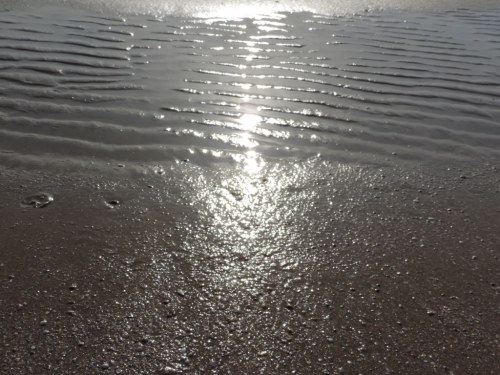
Look at the sand. Look at these lines. They look like waves, don’t they? Except sand doesn’t really do waves, does it? We know, when we look at this, that the sand has been shaped by some other force. We know that that force was water. Well, not really water, although water was involved. It’s been shaped by the forces which shaped the water.

Water often looks like this. Whether it’s the surface of a pond, a lake, or an ocean, the surface of the water breaks into long peaks and troughs which we call waves.

Nothing remarkable there?

Well, actually, it is. Because those waves in the water are movements of energy. You can’t capture a wave and examine it under a microscope.

A wave is more a verb, than a noun.

A wave is more a process, than an object.

The forces which create the wave are invisible to us. The shapes they make in the water are not.

So, when we look at the sand and see a pattern like this, we are seeing a kind of symmetry. We are looking at sand, fashioned into similar shapes to the water. But underlying both the sand and the water are these invisible forces which are doing the shaping.

Or, rather, the invisible forces are doing the shaping by interacting with the water and the sand. It’s a sort of collaboration.

I often wonder about the invisible forces which interact with the material world to produce the patterns, shapes and forms which we see around us.

I wonder about the invisible forces which interact with each of us to shape our experiences and our lives.

There is one particular quality in this kind of pattern which really captures my attention and imagination – transmission. When we see a wave move across the surface of a body of water, or we see how the sand has been shaped, then we realise we are witnessing something moving, something dynamic, something which is carrying particles, energy and information from one place to another.

That’s how I see the world now. A myriad of transient forms produced by continuous flows of materials, energies and information. Nothing exists in isolation. Nothing is fixed. Everything exerts influences which spread far and beyond the here and the now.

Everything, and everyone.

Read Full Post »

This is a photo I took many years ago, just using my phone. It’s taken in Edinburgh at night. The purple light of the underside of the bridge caught my attention. It was only once I’d uploaded the shot to my computer that I noticed the person walking along the pavement. At that moment I realised the scene was greatly enhanced by the human presence. It became a much, much more interesting image.

I believe this is a fundamental principle and value which I have. I don’t share the views of some people who think the human species is bad. I believe that we humans are not separate from Nature, we are a part of Nature. We are, in fact, an inextricable part of Nature. I can’t understand a human being without knowing them within their webs of connections, without exploring the flows of materials, energy and information through those networks, without considering them within their contexts and multiple environments, physical, social and cultural.

Yes, we humans have done, are doing, and will do, a wide range of harms to each other, to other creatures, and the one, small, blue marble, planet which we share with all other forms of life, and we need to learn how to live in greater harmony with each other and within this Nature that we are part of. But in four decades of face to face, person by person, patient by individual patient, work as a doctor, I never met a single human being I didn’t value.

I’ve found that as I get older, and in particular, since I retired and moved to live in the French countryside, that I value the rest of Nature, more and more. As I opened the shutters the other morning I looked out and saw two birds…..a Hoopoe drilling down into the grass for some breakfast, and Little Owl, sitting up on the highest point of the wall, spinning his head around surveying his territory. And I thought, well, how amazing is this? I’m more aware of the phases of the moon now, and the rhythm of the seasons. I’m more aware of sprouting seeds, the rate of growth of pumpkins, the cycles of leaves, flowers and fruits. As I garden, I feel in touch with a bond of care, attention and nurture, in this phenomenon we call Nature. But I sure wouldn’t want a world without human beings in it.

There’s something else this image does for me. It sparks the creative, story-telling part of me. Here’s something else which is uniquely human. The ability to perceive, interpret and invent. The ability to make sense of, to apply values to, and to create narratives from, our daily experiences. We are a creative species. We have a driving need to make sense of our lives. I can’t help but wonder about this solitary person, making their way through the streets of Edinburgh at night.

Maybe we just need to learn to shift the balance of our actions and efforts, away from harm, consumption and destruction, towards more harmony, more humanity, and more life-enhancing care. Maybe this pandemic has given us an opportunity to hit the reset button, and do just that.

Read Full Post »

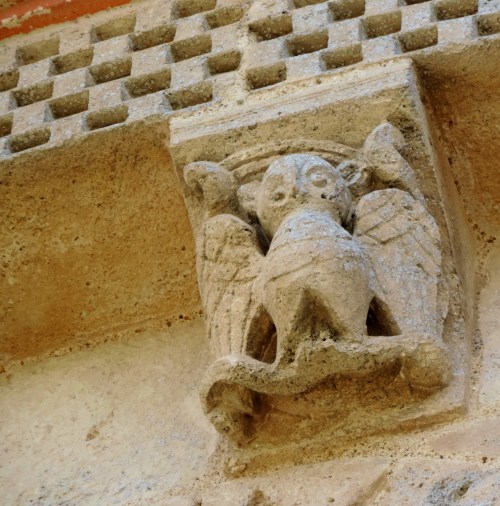
I’m fascinated by carved objects on buildings. Often they are above a door or a window. Other times they are under a roof overhang, or somewhere in a garden or building. Certain buildings, like churches, are often highly embellished with these works of art. This owl is on a church wall. I know most of the carvings on churches relate to saints and important people in the Christian faith, but many of them are really not so directly related (think of all the gargoyles!). Who chose them, and why?

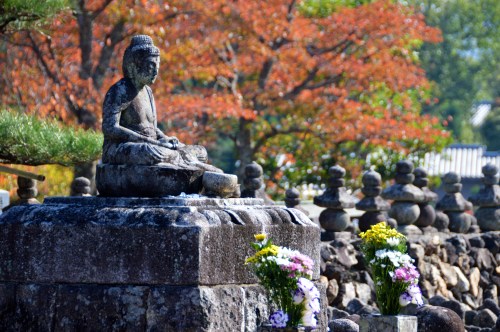
When I’ve traveled around Japan I’ve seen lots and lots of statues and statuettes….particularly buddhas.

However, it’s not at all uncommon to find figures like this for sale in Garden Centres here in France and I’ve noticed them a lot in French people’s gardens and houses.

There’s also quite a controversy raging just now about statues, with calls for the removal of statues of famous people whose actions and values communities no longer wish to celebrate (although maybe they were never celebrated, despite standing there for decades).

All this got me thinking about the symbolic power of objects. I wonder if you have any in your house? Or your garden? I wonder which ones you notice in your Public spaces?

Maybe we should assume that they are intended to exert some influence over us. For example, I think many people with the buddha statues often see them as objects to help them to remain calm. One of the first phrases I encountered here, in the Charente, was “Soyons zen” – “Let’s be “zen” – or calm”.

I have quite a lot of owls in my house. I feel an affinity with them and I think they help me access reflection, contemplation and wisdom.

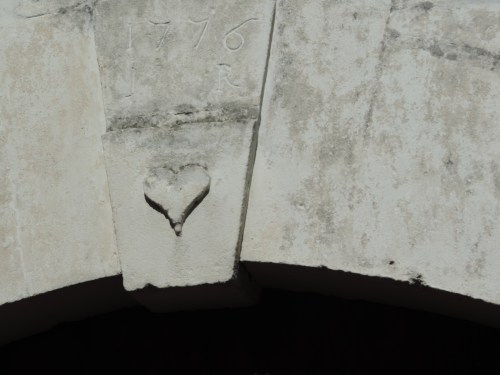
A common “device” over doorways is a heart.

I can certainly see the point of that! In fact, I think I’d quite like having a house where there was a heart over the doorway. Maybe it would help everyone who entered to remember the importance of “seeing with the heart”.

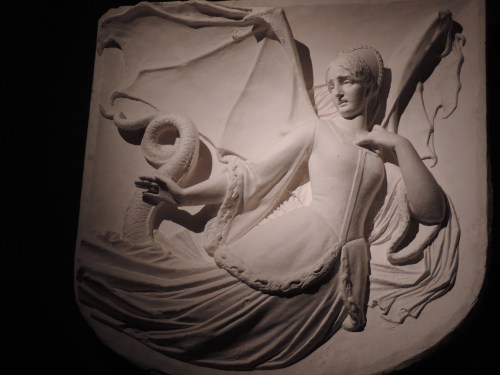
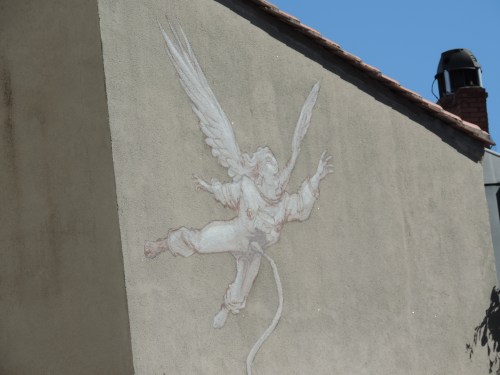
There’s a really interesting mythical one in this part of France (and I believe elsewhere in Europe too) – Melusine.

Half woman, half serpent (or dragon), with wings, there are a number of variations of the Melusine myth. Here’s a passage from wikipedia about her

One tale says Melusine herself was the daughter of the fairy Pressyne and king Elinas of Albany (now known as Scotland). Melusine’s mother leaves her husband, taking her daughters to the isle of Avalon after he breaks an oath never to look in at her and her daughter in their bath. The same pattern appears in stories where Melusine marries a nobleman only after he makes an oath to give her privacy in her bath; each time, she leaves the nobleman after he breaks that oath. Shapeshifting and flight on wings away from oath-breaking husbands also figure in stories about Melusine.

I wonder what influence her presence has on the people who live with her likeness on their walls?

One of the things which makes we human beings so unique is how we handle symbols and metaphors. We don’t just see objects as “things”. We attach value and meaning to them. They provoke emotions in us. They provoke our memories, stimulate our imaginations.

The objects to which we attach symbolic value, either individually, or as part of a culture, or society, have an influence on us. We often choose them exactly for that reason.

What symbolic objects are there around you in your daily life? And are you aware of the influence they have upon you?

Read Full Post »

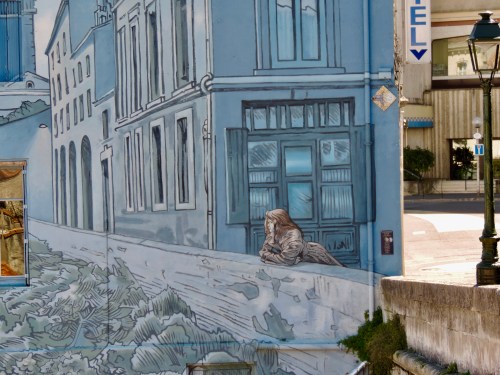
What’s this young woman doing? She looks relaxed, leaning both her forearms on the low wall as she gazes, or looks, (there is a difference) towards….who knows what? You can’t help but turn your head to see if you can see what she is seeing.

Deleuze and Guattari, in “What is Philosophy?” talk about three ways of thinking – concepts, functions and affects+percepts. Philosophy, they say, is our way of thinking concepts. Science describes functions. Art deals with sensations, affects and percepts.

In the city of Angouleme, about an hour from where I live, there are many, many examples of wall art. Angouleme is a major, maybe THE major centre, for graphic arts in France. Several of them are absolutely stunning. Many of them make you stop and think.

If art is a “bloc of sensations, that is to say, a compound of affects and percepts”, then what does that really mean in everyday life? I’m no philosopher and I wouldn’t be surprised if I misunderstand philosophical writings, but I am a “wonderer”. So, the two photos I’m sharing with you today, in this post, are just two examples of murals I’ve come across in Angouleme…….two murals which really stimulate my powers of perception and evoke emotions. They both make me wonder.

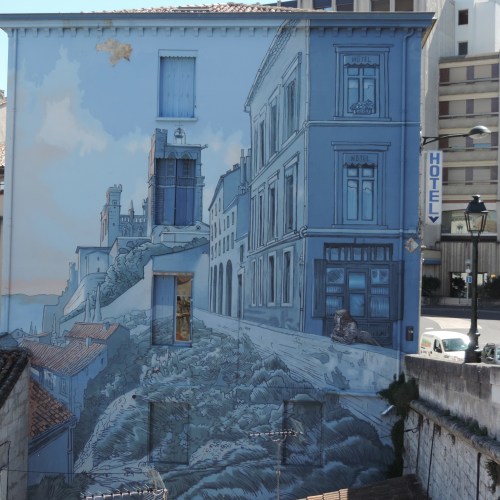
In this first one, everything in blue is the painting, but it’s been so cleverly painted that, at least at first, you have the impression you are looking at a real woman, leaning on a real wall, in front of a real hotel. Well, actually, it is painted on the gable end of real hotel, and the painted wall is an extension of one you can actually lean on. Maybe this graphic woman is looking into the window on the left? If so, she’s looking into a real window, not an imaginary one. Here’s the full picture…..

I love how the painted image blends with the physical world around it. It transforms reality. As I gaze at this in wonder, I slow down, feel calm and contemplative, and take my time to explore the whole painting. Isn’t it amazing that the woman, who is the artist’s creation, somehow induces in me, the viewer, these feelings of slow, calm contemplation?

What would this building look like unpainted? I’m not sure I’d even have noticed it. I certainly wouldn’t have stopped to gaze at it. And, here’s the other thing….I might not have followed the gaze of the woman beyond this low wall out over the valley below, towards the winding river, the boats, the houses and buildings at the edge of the city, and the farms and forests further out. I haven’t the slightest doubt that this work of art transformed my experience of Angouleme.

But, then, so did this one….

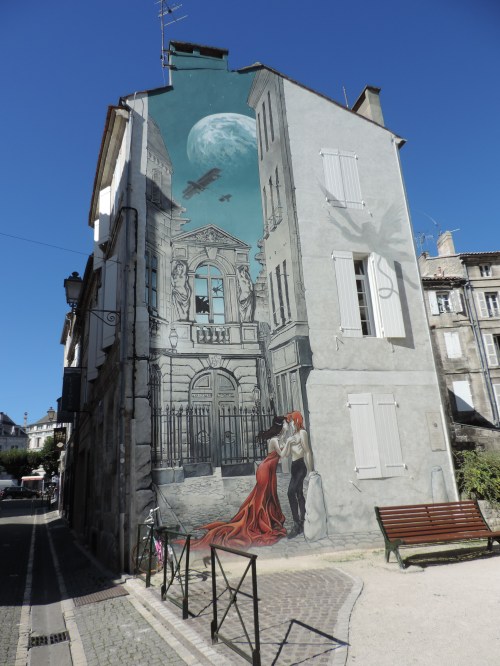
This is one of the most imaginative, evocative, narrative murals I’ve ever seen. It also stops you in your tracks. You can’t help but get drawn in, first to the woman and the man, who are kind of embracing, but there’s a mystery in this embrace. It doesn’t look entirely comfortable. What’s going on with these two? Then, above them, the glass in the window is broken. How did that happen? And above that, this enormous moon, which doesn’t really look like our Moon, but maybe some other planet? It always makes me think of the movie, “Another Earth“….But look at the biplane flying over the face of that planet? What era is this? Which makes us look at the couple again, and wonder what era they lived in as well…..they sure aren’t dressed the way we’d expect to see someone dressed in this day and age.

Then as I look again at this photo, I see the pink bike, parked against the railing, and I can’t help but think it’s her bike! So reality and fantasy blend and blur and lose their hard edges (do reality and fantasy really ever have hard edges?)

Finally, I look up and see what looks like the shadow of an angel with a trailing umbilical cord…..at least, that’s what it looks like to me, and I can’t help but turn around to see if I can see the actual angel behind me.

Oh, there’s the angel, over there, on the building opposite….

Isn’t that quite something? A drawing of a shadow which makes you turn around to see what’s casting the shadow? What a wonderful blending of perception and imagination!

Somewhere in the depths of my memory I seem to have a story of an ancient debate about whether or angels would have tummy buttons – because angels, allegedly, aren’t born, so don’t have umbilical cords. I remember thinking what an odd thing to have a debate about! But as I stand looking at this drawing, that old story comes rushing back to me, and in so doing, makes the artwork all the more interesting and engaging.

With both of these murals my experience of the day was transformed. They both challenged my perception of reality. They both stirred my feelings, stimulated my imagination and provoked memories. They both made me wonder.

As far as I know only human beings make art.

What kind of humanity would we be without it?

Read Full Post »

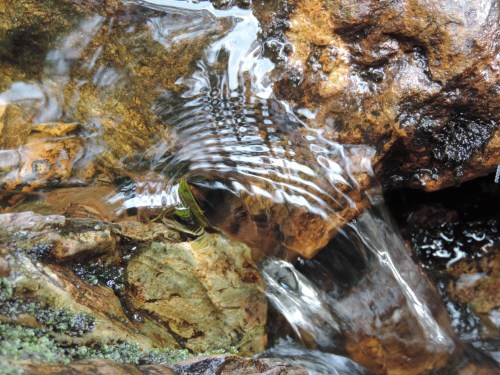
This photo of water flowing over rocks in a Highland stream transfixed me the first time I saw it, and it’s lost none of it power.

When you watch water pouring down over, around, and between rocks in a stream or a river, you can see how the water itself is shaped by the rocks and the earth which create its edges (the banks of the river). If you look carefully you can often see that there is an ongoing lengthy relationship between the water and the rocks. It’s not just that the rocks make obstacles which the water has to flow around. You can see that as the water flows over the rocks, it shapes them.

However, what you see in this photograph is an additional dimension. You don’t just see that the rocks are making the follow a particular path. You can see that the surface of the water itself is shaped. Those bands, or ridges, look waves spreading over the surface of the water, except you wouldn’t expect to see waves in a stream or river as it pours down a rocky hillside. Where do they come? Maybe it’s something to do with the rocks on the river bed, or the rocks within the river itself, but it looks like something different. It looks like this pattern, this shape, emerges from within the water itself. As if it looks this way because of some influence within the water.

So, this photo always makes me think of that. It makes me think of how each of us is shaped by external structures, and the environments in which we live – by which I mean the physical, social, and cultural environments at least. But how we are also shaped by our constantly evolving inner structures and environments……our memories, imaginings, thoughts and ideas, as well as our physical bodies and all the cells, tissues and organs which lie hidden inside.

Who we are, what we are like, what we look like to others, what our characteristics are, are all shaped, are all constantly being shaped, by an alchemical mix of the external and the internal, of the visible and the invisible.

Read Full Post »

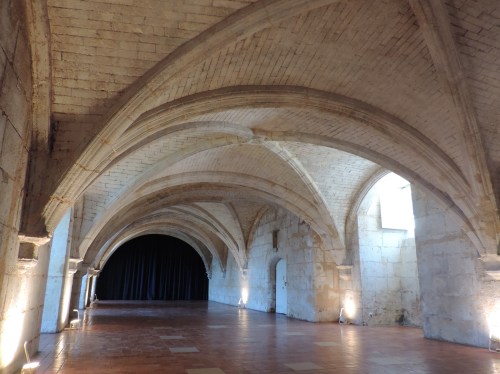
One of the cognac distilleries in the town of Cognac is in the old chateau. When you take a tour of the place you walk into this incredible room. What do you think this room would be used for?

Bet you didn’t say “for keeping prisoners in”. But that’s exactly what it was used for. Centuries ago it was very common practice to capture opposing army soldiers….especially knights, princes or kings….and hold them while you negotiated a ransom.

I’ve just finished reading a history of the “Black Prince”, Edward, who fought many campaigns for the English in Aquitaine, which in those days was controlled by England, not France. In many of the stories you read about knights or princes getting captured and the ransom money being used to fund more battles.

The proof that this grand room was used to hold some such prisoners is on the walls.

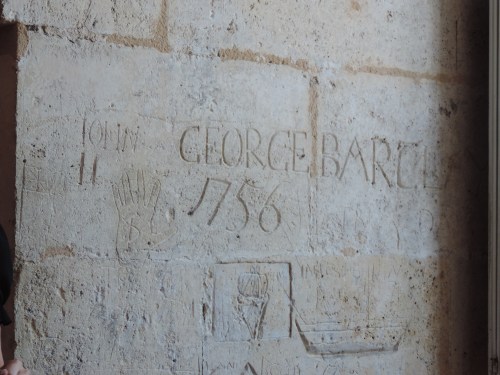
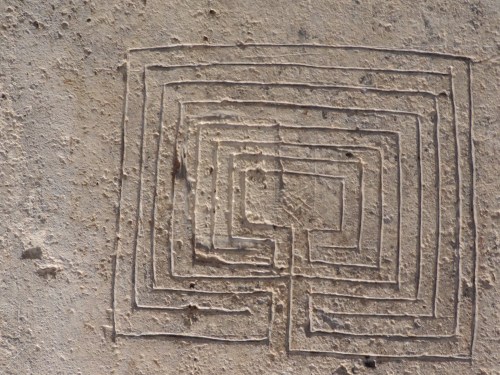
They are covered with carvings and scratchings such as these. And, yes, as you’d expect some are simple rows of lines, where someone has been marking off the days.

But look at this one….this is my favourite

This one has always got me wondering, what would I scratch on the wall of a prison like this, while I was awaiting my freedom?

So, how about you? What do you think you’d scratch onto the wall for people to see three hundred years later?

Read Full Post »

Have you ever noticed how we like to complete what we see?

This photo which I took turns a semi-circular bridge into a complete circle by including its reflection in the water. I like it better that way!

That makes me think of two things – how our vision works, and what kind of symmetry pleases us.

The simple way to think of the eye is that it is a kind of prism….that the light enters through the pupil and then casts an upside down image onto a screen – except where is the screen? At the back of the eye ie the retina? Or at the back of the skill ie in the brain? Whoa! Not so fast! Because that’s already NOT what happens.

Light enters the eye through the pupil and stimulates specialised cells embedded in the retina – rods and cones. When they are stimulated they send electrical signals along the “optic nerve” directly into the brain where different parts of the signal are processed in several different regions scattered across the back of the brain. The brain then merges all the processed information and, somehow, (we’re not quite sure how) turns it into a complete image. So we have the experience of seeing the world as if its a photo or a video.

Now, quite honestly, I think that is mind boggling. I think it is utterly incredible. But it’s even more weird than light being turned into electricity then split up, processed and merged, apparently instantly, to create whole images. Because for all the signals to travel from the retina to the brain they have to pass along the “optic nerve” and this “optic nerve” obviously doesn’t have the rods and cones which the rest of the retina has. It’s literally a blind spot. In other words, at no point does our eye, or our brain, “see” a whole image the way a prism, or a mirror would. We literally create what we see. Moment by moment, second by second. Astonishing huh?

Symmetry. In Western civilisations it’s common for people to prefer symmetry. By that I mean the typical “classical” symmetry of whole circles, balanced pillars and so on. But in Japan, for instance, such symmetry seems too static for most folk. They prefer things to be left a little “incomplete” or “asymmetrical” believing that such a view is more dynamic, and more TRUE because reality is never static or complete. You can read more about that if you explore “wabi sabi“.

I can find both pleasing. Lucky me, huh?!

But when I stop to think about it, the Japanese idea of leaving the mind (including the imagination) to “complete” an image is actually a more true representation of our vision functions.

How about you? What do you find most pleasing? The symmetry which looks balanced and “complete”, or the symmetry which encourages you to “complete” the vision with your own creative mind?

Read Full Post »

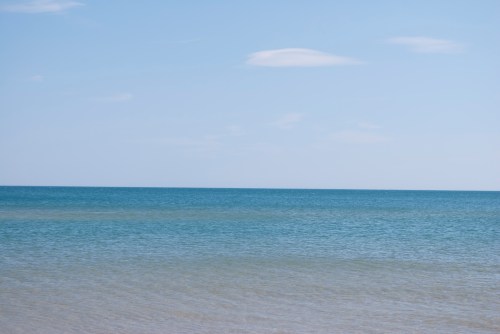
When I look out at a view like this I see the ancient teaching about the four elements – air, fire, water and stone.

I suppose the most obvious one is the water – just look at it! Look at the rich palette of colours! Look at the expanse of it! I heard someone the other day say we shouldn’t say “Planet Earth” we should say “Planet Ocean” because much more of the Earth’s surface is covered with water than with land. As best we know Life began in the sea and evolved from there.

Above the sea, the next most obvious element is air – well, we say sky really, because we can’t actually see “air”. Look at the colour palette there too, and the expanse. That unbroken horizon where the sky meets the sea with no land in-between has some kind of magical attraction for us, doesn’t it? Do you remember the story about “The Green Ray“? It’s based on the old belief that if you watch the sun setting on a horizon of sky and sea alone then for a brief moment before the sun disappears a bright green ray of light might appear. I don’t know if that’s true. I’ve never seen it. The story goes on to suggest that whoever you see next, after seeing the green ray, will be the love of your life. Romantic, huh? Eric Rohmer made it into a beautiful movie. Another thing we can’t see in the air is wind. We can only infer it from its effects on other elements. We can watch it blow the clouds (and what are clouds other than the temporary appearance of otherwise invisible water molecules which saturate the air?). We can watch it whip up waves.

The element of fire comes from the Sun. We can’t look at it directly without damaging our eyes. But we can close our eyes, turn our faces towards the Sun and feel the heat of the incredible furnaces and explosions which send out waves of energy to our Earth. Waves, without which there would be no Life. And in that air that we can’t see are gases we can’t see, including ozone, which, when it breaks down, allows way too much of the Sun’s fire through. We can’t see the carbon dioxide building up and trapping the energy of the Sun’s fire between the sky and the sea and earth, warming the oceans, the lands, and threatening the existence of all that lives.

Finally, there’s the earth, or stone. If you look carefully at the front of this image you can see the colour of the sand under the water. Isn’t it amazing that those un-countable grains of sand are created by the constant moving of the water? That they started out as rock and ended up almost too small to see. Well, of course, sand is more than little rocks. It’s got gazillions of tiny shells and pieces of shells in it too. Those protective homes created by billions of tiny sea creatures – all without the use of machines or technology!

I love to stand at the edge of the beach and harmonise my breathing with the rhythm of the breaking waves. Breathing out as the water breaks on the sand, and breathing in as the ocean draws its edges back in towards itself. When that harmony falls into place its one of the most calming, centring, but also expansive boundary-dissolving experience I know.

The four elements.

Always a rewarding contemplation.

Read Full Post »

« Newer Posts - Older Posts »