Feeds:
Posts
Comments

Archive for the ‘creativity’ Category

One of my most favourite phrases in French is “L’Emerveillement du quotidien” – which translates as something like “the wonder of the everyday”, but actually there are other layers of meaning which I find hard to capture in English.

I suppose the thing I love about the word “wonder” is that has several connotations. It suggests a certain curiosity, a “wondering” what something is, or how it came about. But it also suggests a kind of awe, something amazing, astonishing, or, at very least attention-catching. The sense of “everyday” also has a couple of nuances. It means something common, as in something you might encounter any day, and it means something ordinary. So you immediately find yourself dealing with a paradox – how can the “ordinary” seem “extraordinary”? How does something “common” become both “particular” and “special”?

I’ve come to believe that there is always something extra-ordinary in the ordinary, and, after working with thousands of patients over four decades of clinical work, I’m convinced that every human being is “special”. Special not in the sense of above or superior, but in the sense of particular and unique. In fact, I think it a dehumanising act to reduce any person to “ordinary” or “common”. It’s a failure to really meet and get to know the individual.

So, although these terms seem somewhat paradoxical I find no conflict in them. I find that every single day I can have my attention captured and feel a sense of wonder and amazement develop inside me, just by living my “ordinary”, “normal”, “everyday” life.

I think there are two important principles to bring to this idea and practice – attention and imagination.

We humans have remarkable powers of unconscious and subconscious functioning. We can easily slip into auto-pilot. Have you ever had that experience of driving somewhere with you head full of thoughts to such an extent that on your arrival you have virtually no memory of the actual journey? This happens especially if your trip is one you have taken many times before. You navigate, without much conscious thought, from one familiar landmark to the next, through one well known intersection to another, but you might be hard pushed to describe any of the details of the journey. We are equally great at acquiring habits, and once we set those routines off, unless anything interrupts the expected flow, then we cruise through those activities, “without a second thought”, or, maybe more accurately, without a first one!

These are great powers and they enable us to get on with living without having to stop and make sense of life in every lived moment. But it comes at a price. We miss a lot. In fact, it comes at another, perhaps even greater price. We open ourselves up to being controlled. There are vast industries of advertising, propaganda, and persuasion designed to hustle us along towards somebody else’s desired goals without stopping to consider them.

So, how do challenge that? By slowing down and paying attention. OK, maybe not all the time, but more than we are in the habit of doing. The more often we slow down and pay attention to what is here and now, the more we notice. And, my contention is, the more we notice, the more we wonder.

Repeated experiences of wondering undermine the belief that there is nothing interesting or different about any individual, that all flowers are the same, that nothing changes, or that generalisations are more true than specificities. In fact, repeated experiences of wondering create the exact opposite. They affirm, every single day, that every person is unique, that every plant is unique, that no experience is ever really repeated, and that the truth is always found deeper than in a surface generalisation.

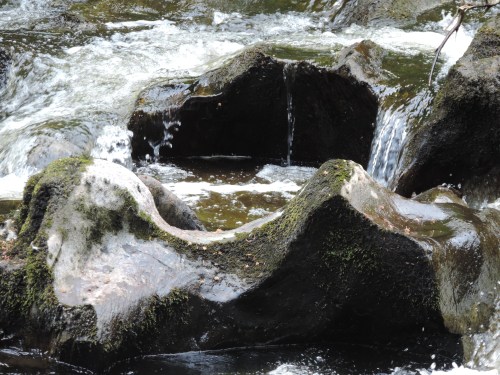
When I walked along the banks of this stream, which you can see in the photo at the start of this post, I noticed rocks and water. Everywhere I looked the rocks looked different, and I spent a long time mesmerised by the flow of the ever changing water.

Have another look at this particular shot. Don’t you find yourself starting to wonder? Starting to wonder about the shapes of the rocks? How smoothly they have been carved by the water. Don’t you start to wonder how each rock becomes this particular shape, and how the rock got to this position in the stream in the first place? It’s pretty easy to let a whole river of questions pour through your mind, and even without answers, those very questions start to stir a sense of amazement, of awe, of wonder.

The second element is imagination. We humans don’t just “see” the way a camera “sees”. We select, represent and interpret. We pick certain elements out of the immense flow of materials, energy and information which constantly course through our minds and bodies. We re-present those original flows and turn them into mental images, thoughts and ideas. And we interpret those representations, colouring and shading them with meanings which we draw from our memory banks and conjure up with our imagination.

I look at these particular rocks and I see a giant wide open mouth. I can imagine that some great monster fell, or was thrown or chased, into the water some time in the distant past. I can imagine that “once upon a time” something happened here, and there’s a story to be told to “explain” what we can see now. In Celtic traditions there is an abundance of such stories about the landscape. The mountains, rivers, forests, lochs, boulders, trees and ponds have stories attached to them, names given to them. Those stories and myths enrich the landscape, and add an extra, invisible layer to Life on Earth. Some people refer to this phenomenon as “enchantment” and I rather like that.

Here’s to a life of wonder and enchantment bursting up into our consciousness every single day.

Here’s to finding our inner heroes and discarding our inner zombies!

Read Full Post »

At the beginning of the year I received an invite to speak at a conference in Canada. The invitation was to talk about my experience of four decades of work as a doctor who used homeopathy. I was surprised, but it was a very kind invitation and I accepted.

The way I prepare for talks is to let some ideas and questions rattle around my brain for a bit, then start making notes. The kinds of notes I make are sort of mind maps. They aren’t as formal as those you’d find in books about the mind mapping. I just put down key words and phrases on a page, then draw circles, squares or diamond shapes around them and link them up. I’ll do a few versions of that, then I open up “Keynote” and I make a slide for each element in the mind map, pull in images from my photo library, write a few words (not many) on some of the slides, then arrange them to create a sequence which enables me to tell the story I want to tell. Well, I ended up with a set of three presentations, each of which would take about an hour to tell. I’d been told I’d be allocated two 90 minute slots in the schedule.

Then before the time arrived for the conference, along came COVID-19 and the event was cancelled. Maybe it will happen some other time, but maybe not. I’d enjoyed putting the presentations together so that gave me an idea. Why not write a book covering the same ground? I’d had an idea for a long time that I should tell my own story. I didn’t want to write a textbook, or a polemic, an argument for a way to live, a way to practice Medicine, or even make the case for the use of Homeopathy. I just wanted to make a record of my own life, my own experience.

I’m sure if any of us sat down to write our own story we’d immediately come up against the question, “But which story?”, because there are many stories of our lives. I didn’t want to write an autobiography which told the story of my family, my relationships, and my personal development. I wanted to tell the story of why I became a doctor, what kind of doctor I became, and how that came about. Not least because I thought it would help me to understand my own life better. I suppose it’s my “professional story”, but really, it’s the story of my “calling”.

I wanted to publish the book too, because I wanted others to be able to read it. Not to earn money from sales, nor to try to convince anyone of anything, but more to add to my over all project of sharing my personal experience of curiosity, wonder and joy – that’s what this blog is all about – and that’s what I committed to do daily from the day of lockdown. I’ve been writing a post based on one of my photos every day since the middle of March and I don’t feel like stopping any time soon. I already know, from feedback from some of you, how much you appreciate these posts and that completely delights me. Writing them adds to my life, so I’m very, very happy if reading them adds to yours!
Now, more than ever, I want to set off some positive, loving, inspiring waves. I’ve no idea where they will go, or what effect they will have, but it feels like a way to make a positive contribution to our times.

With lockdown, with the presentations already mapping out a story, and with the daily practice of writing for the blog, it all came together and I wrote this book – “And not or” – “A calling and a listening”.

This is how I did it, the tools I used, and what I had to learn.

I wrote the text using an A4 sized notebook and a pen. I wrote and wrote and wrote, till I thought I’d written all I wanted to write. Then I used that handwritten text to write the digital version using a program called “Ulysses“. Listen, before I go any further, I’m just laying out what I did, not saying you should do exactly what I did if you want to write your own book! But, on the other hand, I’ve always found it helpful to read what other writers have done. So, you could use any software you want. I started with Ulysses. I use this program on my desktop Mac, as well as on my iPad (for which I have a proper Bluetooth connected keyboard).

When I wrote the first digital version, I didn’t just copy out all the words I’d written in my notebook. Instead, I’d read a section, then start to transcribe the words into the wordprocessor, but I found I often decided to write it differently, to leave out whole sentences or passages, and to write brand new ones instead. By the time I’d done that I had what I called “draft 2” (the written text constituting “draft 1”). The way Ulysses works is that you write “sheets” – for me, each “sheet” was a chapter. I like the simple markdown language you can use with Ulysses. If you put a # sign at the start of a line it turns that line into a heading. If you put two ## signs it turns that line into a secondary heading. I only used those two levels of headings. The first level heading were the chapter titles, the second level to navigate sections within a chapter. The other main markdown tools I used were for inserting images (hey, you know how much I love my photos!), for marking a paragraph as a quotation, and for creating lists. That’s pretty much it. Ulysses presents you with a left hand column of your sheets, each one showing just the first line or two. I used that to get an overview of the whole book. That let me see what I thought was repetitive, and what I thought was missing.

Next step was “draft 3” – read through the whole digital text, correcting and editing as I went. Once I got to the end of that, I felt, well….dissatisfied! Something wasn’t right, and I couldn’t see what it was. So I put the whole project away for a week. Then when I came back to it I saw there were half a dozen chapters which seemed problematic. They were in two groups of three, and each group had overlap and repetition in it. I still couldn’t see the way ahead though. So, here’s the next neat thing about Ulysses, you can select whichever sheets you want to review and print them off. I printed off the six in question. Then I read through the printouts with pencil in hand, scoring out, adding in, and linking up different paragraphs. Once I’d done that I went back into the program and changed the text according to that latest “edit”. I also chopped out three other chapters that just didn’t seem to fit well at all. What do they call that? “killing your darlings” – dropping some of the sentences you love the most – because they just don’t fit. I guess I now I had gone through “draft 4”, to “draft 5”.

Time for another complete read through, correcting and editing as I went – “draft 6”. OK, this felt good now. Time to try and turn it into a published book. I decided I wanted a physical, paper version, and a digital version (and not or….get it?).

For the paper version I decided to use Blurb. This is a company I’ve used about once a year to make a photo album of my best, or most memorable photos of that year. I love their quality of print. And I’d already taught myself the basics of their software – “Bookwright“. Now, I’m sure with all the software I use that I’m no expert and there are probably easier ways to do things, but, hey, I only know what I know, so I don’t know any easy way to import all the text into “Bookwright”. Instead I created the pages, inserted either text or photo “layout boxes” onto each page, copied and pasted the text, chapter by chapter into Bookwright, imported all the photos I’d used, and dropped them into the right places, then ran the “preview” option, and the error checking, both of which identified things that needed fixed. Then I uploaded it to the Blurb site and ordered up my proof copy.

Meantime I had to think how to produce a digital version. Apple have something called “iBooks Author” which I’d used before, (I’ve since learned Apple are about to discontinue that software) and there were ebook creation tools I knew existed to produce “Kindle” or “ePub” versions.

Whoa! Too much to think about it! I then discovered that Amazon had produced new software called “Kindle Create“. I downloaded it, discovered you could import a “Word” file into it, make a cover, preview it, then upload it to Amazon. Ulysses makes it easy to export your sheets as a single “.docx” file so I did that, opened it up in “Pages”, then exported the document from there as a “Word” doc into Kindle Create. It was easy, and straightforward, just took time and care.

Now, I’m sure if you use Windows your workflow and the tools you can use will be different, and maybe some of you know a lot more about these programs and methods than I do – and if that’s true, please go ahead and share what you know in the comments here, or share links to your own articles if you’ve written them.

Well, this is where I’ve got to now – a paper version – you can get it from Blurb at https://www.blurb.co.uk/b/10155078-and-not-or

and a Kindle version – https://amzn.to/2UozjIw – if you are in the UK. If you are not in the UK, go to your local Amazon site and search for “Leckridge” – you’ll find it quickly that way (let me know if you don’t!)

Here’s my summary of the book –

Why become a doctor? This is one doctor’s response to that question. It begins with a calling, then continues through listening. Patient after patient, over four decades of Practice, tells their own unique story. Each one is an attempt to find healing. To find healing, the doctor and the patient embark on a relationship which allows them to uncover Nature’s pathways to health. 
Each pathway is a life of adaptive strategies revealed through the body, the emotions, and in patterns of behaviour, language and thought.
Two small words open different doors of understanding.
“Or” divides, separates and focuses attention on single parts.
“And” connects, integrates and focuses attention on the whole.
We need both approaches but if we are to heal, individually, together, and at the level of the planet, we need to shift the balance away from “or” to “and”. 
Through an exploration of narrative, psychoneuroimmunology, neuroscience, complexity and complementary medicine, this is one doctor’s experience of shifting the balance from “or” to “and”.

If you fancy reading it, go ahead, and if you’d like to give me feedback you can find me most places by searching for “bobleckridge” – I’m here on WordPress, but I’m also easily found on Facebook, Twitter, Flickr, and I use gmail.com (just put “bobleckridge” before the @ sign)

Read Full Post »

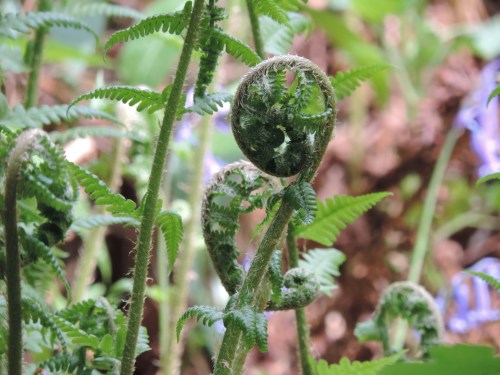
One of the most beautiful shapes in the universe is the spiral. From the spirals of galaxies to the double helix spiral of DNA, and so, from the largest scale to the smallest, there are spirals.

One of the commonest places to see them around you is where ferns grow. I love those spiral shapes you see as a fern unfurls.

Spirals make me think of the kind of path that life follows.

Clearly life does not follow a straight line. It doesn’t run directly and steadily from birth to death with no curves, pauses, deviations or ramblings.

And although there are many cycles in Nature and in our lives, the life story doesn’t follow a circular path either. Although sometimes it feels that way when you have one of those “How did I end up HERE again?” moments. When we don’t learn, when we try to solve our problems using the same solutions which brought those problems about in the first place, it often doesn’t go so well, or, at least, not so differently.

It seems to me that life is more spiral in character, and that, yes, we revisit unresolved issues, unhealed traumas, and unsolved problems repeatedly until we resolve them, solve them, until we heal. But each time around when we revisit something, when life throws up what seems like the same challenge yet again, it’s different. We are different. Because we change all the time. Every experience we have changes us, contributes to our memories, influences our choices and our actions, creates new behaviours, thoughts and habits. So when we hit that “How did I end up HERE again?” we are not exactly “HERE” again!

That always gives me hope.

We have a chance to respond differently this time, to make a different choice, and maybe set off along a brand new path…..another path with its own new spirals to come.

But here’s the thing about that fern in this photo – is it spiralling or un-spiralling? Is there even a word “un-spiralling”? I think instead of “unfurling” because that’s what it seems to be doing. It’s unfolding, opening up, stretching out, expanding. But, hey, I guess that’s a kind of un-spiralling…..something to learn from that I think!

Read Full Post »

This remains one of the strangest trees I ever saw in any forest. In fact, it seemed to me that there were two trees here. You could clearly see two trunks arising from the forest floor, then something odd happens, the one of the left sends out a substantial branch, so substantial I’m not even happy calling it a branch, which connects with the one on the right. They fuse. Then they continue upwards in parallel, each distinct but traveling in the same direction, until about a metre or so further up they fuse again, and from that point on, continue upwards as one.

I’m happy simply to contemplate them, to trace their separate and entwined paths as they reach up to the Sun…..but I seem unable to resist the thoughts they inspire in me.

This is such a beautiful representation of how all of Life seeks out more Life. We get close to certain others, connect with them, form relationships with them, bond with them, entwine and entangle our lives with them. We influence each other. Yeah, sure, we still know that we are individuals, that I am me and you are you, but our shared experiences change us. I am not the same since I met you.

Each of us emerges from, and lives in, a multiplicity of environments. We are embedded in certain times and places. We exist within certain cultures and societies. We become who we are becoming in vast interconnected webs of relationships which span across the face of the Earth and reach both back in history and forward into the futures we will create together.

Each of us lives, an embodied, unique, singular being, never completely separate, never completely alone, never completely independent. So let’s just embrace that shall we?

How might life be if we acknowledged our entwined, entangled, embedded, embodied nature? Could we begin to share our lives better, here and now, in this present time and place, as co-inhabitants, co-creators, and co-operators?

Wherever we are….in a particular street, town, city, region, country, hemisphere, planet…..we share our entangled, interconnected lives with everyone else who has ever lived, every other inhabitant of this time and place, and every other child we haven’t even dreamed of yet.

Read Full Post »

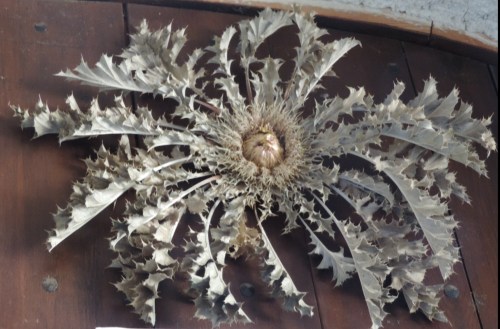
In one of my most favourite villages in France, Saint-Guilhem-le-Desert, there are two natural objects hanging on doors, above doors, and on walls, throughout the whole village. This is one of them. It’s a “cardabelle”.

A cardabelle is a kind of thistle which grows abundantly in this area.

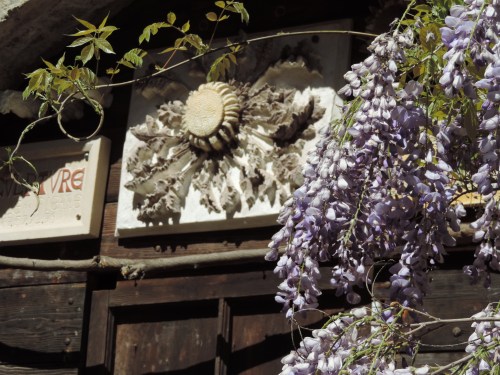
Mostly you see dried specimens pinned to doors, but in some places there are copies sculpted in stone.

The other natural object you find is…..

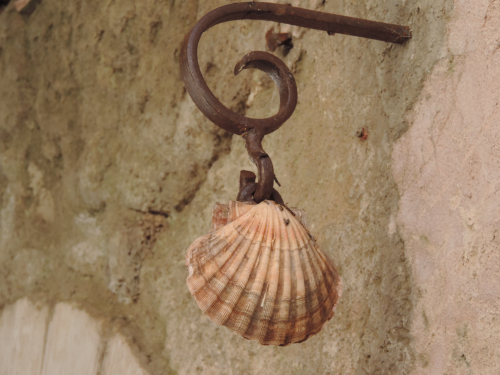
….the scallop shell.

Why these two objects?

Well, the cardabelle is thought to be a good luck token. I suppose in a similar way to the horseshoe you see in some other cultures. It’s also been used traditionally to make predictions……about the weather! That’s partly because it changes shape according to the humidity levels and atmospheric pressure, so it acts a bit like a natural barometer. I’m told it’s also eaten and tastes a bit like an artichoke (not my favourite vegetable!). But I think its utility is a lot less significant than its power to give meaning. It changes life through the power of symbol.

The scallop shell is the symbol of the pilgrim. Specifically, the pilgrim making his or her way along the “Camino de Santiago”, or, in French, “Chemin de Compostelle”. It is used along these paths to indicate some support for, or welcome to, any passing pilgrims. The photo above indicates drinking water (“eau potable” in French, which is worth remembering if you are thirsty while walking in France!). It is also hung outside certain inns and hostels for the pilgrims to find something to eat or somewhere to rest for the night. I hadn’t realised just what an extensive network of paths make up the “Camino de Santiago”.

What really interests me about the cardabelle and the scallop shell is that both are transformed from their original, natural purpose in the world by this distinctly human capacity to make one thing represent another.

They both become powerful symbols. Symbols of place, of belonging, of tradition, of belief, and of purpose. There are a million stories connected to them.

How are we to understand this? I think symbolic thought, metaphoric thought, represented by objects, artistic creations, words and stories, are a kind of invisible, global network connecting us all. They are part of Jung’s “collective unconscious” drawing from our archetypes and myths. They are part of Teilhard de Chardin’s “no-osphere”, that extra layer of atmosphere encompassing the Earth, composed of human reason and thought. They are a world wide web of deep, complex, living and growing sense-making and meaning-giving phenomena which we can draw on to make more sense of our individual lives.

I love this power we humans have – the power to create this vast uniquely “human layer” of existence which is embedded in, and emerges from, the natural world, deepening and widening our experiences and understanding. It’s a shared phenomenon, a collective effort stretching back over centuries and we are adding to it every day, drawing from it every day, living it every day.

Read Full Post »

Something which always catches my eye and makes me stop to lean in and look closer is the sparkle of light on water.

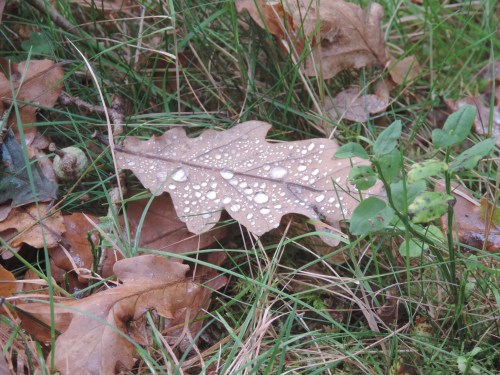
Look at these little water droplets on this leaf on the forest floor. They are absolutely like little jewels. Each one lying perfectly on this fallen oak leaf, presented to me as if on a platter. Each one looks like one of those glass paperweights which draw you in so that you can look closely and see if you can see a whole world inside.

How do they form?

I don’t really know. I suspect these particular ones may have come from the rain, but they could have appeared with the morning dew. How does each one make such a beautiful shape, yet every one unique in size and place? How do they form exactly where they form? What is it about the ground, or the leaf, or that part of a leaf, which lets the water molecules coalesce like this, to make these shining beads?

I remember learning about water tension and how water molecules hold together to form these perfect surfaces, but what determines the size? Why are some so much bigger than the others?

The other thing I immediately think of when I look at these images is how it takes the water, the sun, and the forest to create them. I might be drawn to the sparkling droplets on the leaf, but it takes all three of these forces, or presences, to make them. Nothing exists in isolation.

The one closest to you in this photo (I mean the one which is lowest down in the image), hints at a whole world. Click on it and look as closely as you can. There is a forest in there.

No wonder people have long since been intrigued by crystal balls.

But, for me, is the added quality of transience which makes these jewels so beautiful. You can’t pick them up and put them in a bag. You can’t sell them or horde them.

You can only enjoy them exactly where they are in this short but present moment.

Read Full Post »

We like to be close to the edge, don’t we?

I think that the “call of the sea” is real. We are pulled towards the oceans. Are houses with seaviews the most expensive houses in any country? Why is that? Is it that the sea represents both freedom and adventure? When we look out across the water towards the horizon it is somehow incredibly appealing when all we can see is water and sky. We don’t need to glimpse any distant coastlines to feel drawn to the edges of our land.

It does seem as if the sea, itself, stirs our souls.

But I think there is another factor. The edge.

I am naturally drawn towards the edges. I love to walk along a beach, gazing at the far horizon, breathing in tune to the rhythm of the breaking waves. That constantly changing, dynamic, irregular, line which marks where the water meets the sand, and the sand meets the water.

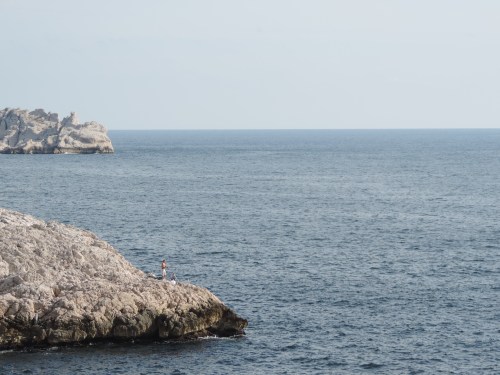
It’s the same with rocky outcrops. Just like the fisherman in the second photo there, we love to get to the edge (of course, he’s hoping to catch fish so if he doesn’t go to the edge, he’s not going to have much success!). But it’s not only the fishermen who like to stand, or sit, at the edge of a rock.

I wonder how much this instinctive attraction is due to a basic law of Nature – that all complex adaptive systems move towards “far from equilibrium” points? All living systems do. All ecosystems do. In fact, I think the concept of “steady state”, or “balance” misleads us. When I was taught about “homeostasis”, the idea that our “internal environment” has multiple checks and balances to maintain a constant inner state, I thought it made a lot of sense. I learned about all the feedback loops which kick in to ramp up or damp down activity in the body, to keep things ticking along in the “normal range”. But gradually I realised that was a bit simplistic.

The missing pieces included growth and adaptation, both of which are linked to creativity. That creativity manifests itself in “emergence” – the appearance of new behaviours and conditions which couldn’t have been predicted from the pre-existent ones. It manifests itself in novelty and difference. It manifests in growth, development, and maturity.

Once we start to understand that Life is based on a dynamic equilibrium – the kind of balance which never settles down – then we notice that everything tends to be drawn towards the edges.

It’s the same when we look at the activity of organs like the heart and the brain. The rhythm of the heart is constantly changing. You can measure the “heart rate variability”, and find that when there is next to none, the heart has become rigid, non-adaptive, and is about to fail. On the other hand, when you find that it’s chaotic, the heart is also about to fail. The sweet spot is the zone at the edge of both of those extremes. Same with the brain. When a seizure occurs the somewhat chaotic activity of the brain waves suddenly develop zones of constancy. It’s the imposition of rigid, regular wave patterns which seems to obliterate the underlying, normal, variable rhythms. The sweet spot, again, is in that zone at the edges of these two extremes – the zone between rigidity and chaos.

If we are going to learn from this pandemic we’re going to need new thinking, new ideas, different ways of living and organising ourselves. We aren’t going to learn if we try to “return to normal”.

The future is still to be invented, and we’re going to find it at the edge.

Read Full Post »

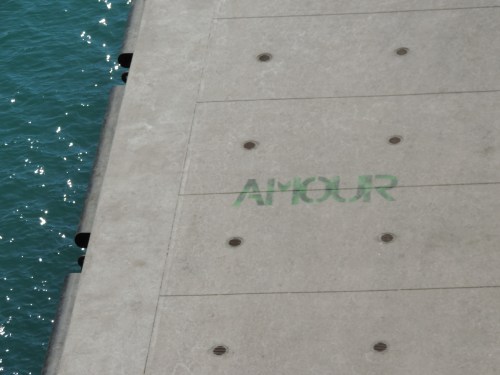
Many years ago I came across this stencilled graffiti on the ground in Marseilles. It struck me as very unusual.

First of all it’s stencilled, which gives it a kind of mass-produced appearance, and it’s been painted onto concrete slabs which people walk over.

Is it a declaration? Of somebody’s love for somebody else?

Is it an instruction? Telling us to love? (Probably not, because it’s a noun, not a command verb)

It is just a literal putting down a marker. Someone laying out an important value? Is it a prod? A stimulus to thought? A nudge?

It reminded me of the English DJ, John Peel, saying on the radio one autumn that he’d taken to carrying a marker pen with him when he went out walking, and from time to time he’d pick up a fallen leaf and write “Hello” on it, then put it back down on the ground. He liked to imagine that a stranger would be out walking, maybe feeling a little lonely, and they’d spot this leaf with the “Hello” on it and not feel so alone any more.

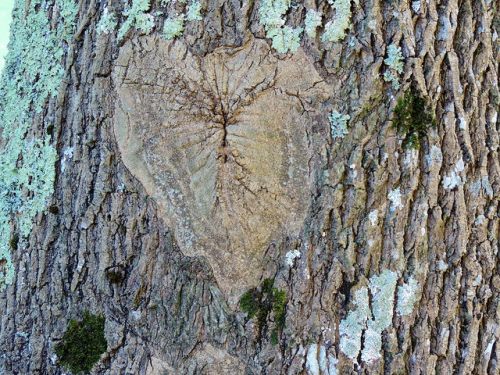
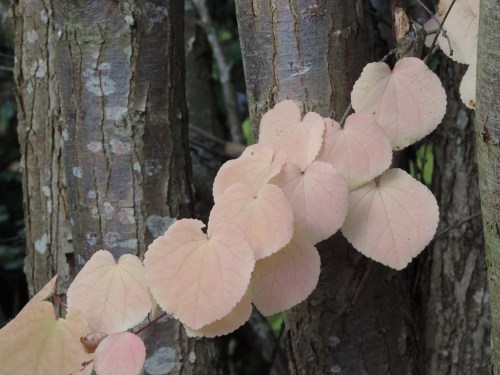
I’ve often noticed naturally occurring heart shapes, and they, too, make me think about love.

Whenever I see a heart shape I think of love, and I’m sure that activates the emotion of love inside me.

I wonder if I should take a leaf out of John Peel’s book, and the graffiti artist in Marseilles, and scatter prompts around the world.

Literally, spread those loving feelings.

Read Full Post »

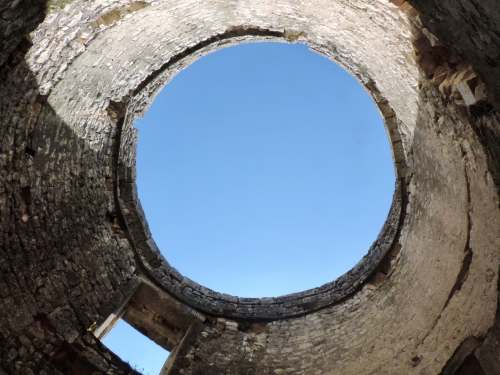
Continuing my little series of patterns to look for, today I’m going to share circles with you. I know, there’s probably a bit of overlap between spirals and circles, but I’m going to try and stick with the more obvious circles and not wander down the spiral path!

There’s an old tower near me, up in one of the neighbouring vineyards. I don’t know its history and I don’t know what it was used for, but it’s now just a circular stone tower with a doorway, a couple of spaces where windows used to be, and no roof. When I step inside it and look up, this is what I see! I’ve loved this photo from the day I took it. The circle itself is hugely appealing, and the blue sky sure adds something. I often look at this image (in fact I have it on the lock screen of my iPad) and it reminds me of my limits. I know I can only see within the parameters of my beliefs, values and personal experience. I know too, that I can never know EVERYTHING there is to know about ANYTHING – including about any of patient I ever saw, about any friend or relative I ever knew, and about myself. I like to remind myself of that. Isn’t it kind of odd that I use a circle to remind myself of that, because a circle, traditionally represents wholeness or completeness. Somehow I’ve done something quite different with it.

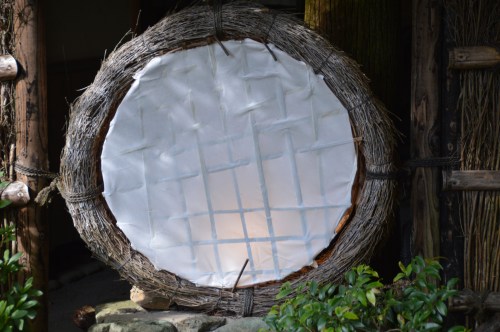
This is a round window in a little house in a village just outside of Kyoto. Well, is it a window? Or is it a lamp? It’s on the outside wall, but you can’t see through it. It’s also got a lamp, or a bulb, behind it, so that it is shining out onto the street. Why is it there? I’ve no idea. But, again, I’ve loved this image from the day I saw it. I satisfies me enormously.

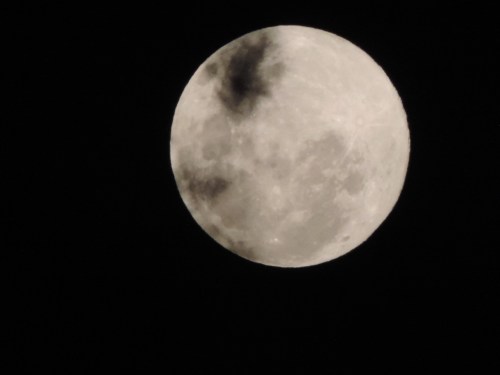
This particular circle is, of course, one I see every month. I am unceasingly fascinated with it. I love to follow the phases of the Moon over each 28 day cycle, but I especially love the full moon. The Moon stirs the energy of the Divine Feminine for me. It reminds me how we all have both of those universal energies coursing through our lives. Maybe it’s because I am a man, but I feel the Moon completes me somehow. It makes me feel more whole.

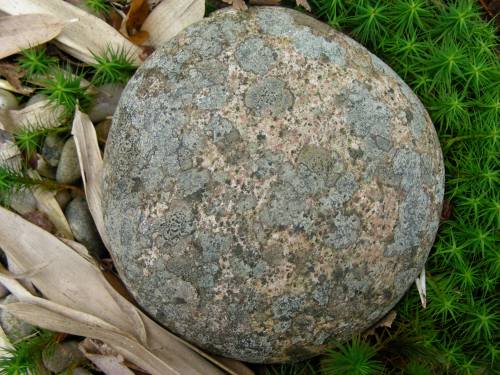
Most stones are not circular. They are not spheres. So when I come across one like this I am struck but how entrancing it seems to be. With the patterns of the lichen on its surface, this looks like a small planet to me. A whole world mapped out right before me.

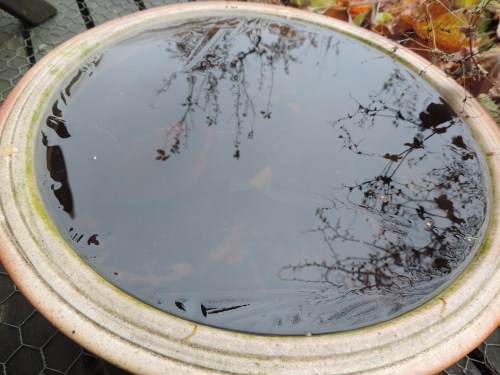
There’s something magical about a circular bowl filled with water, reflecting the sky, and the forest which surrounds it. This conjures up the image of Galadriel’s mirror (from Lord of the Rings) for me. I have an ancient well in my garden. It’s got a metal lid, locked with a padlock to keep it safe. But if you open the lid and peer down, more than twenty metres in the dark, you can glimpse lights and movement on the round surface of the deep water. I think of those things when I see this circle. It excites me, stirs my imagination, provokes thoughts about magic and divination.

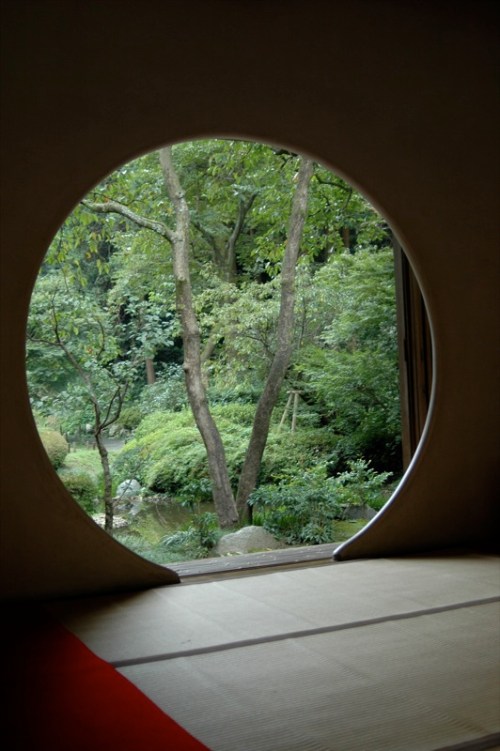
I saw this circular window at a temple in Japan. Of course, some of you will look at this and say, “It’s not whole. It’s got a piece cut off the bottom!” but that’s the typical Japanese aesthetic, never seeking to present “prefection” as something complete, but preferring the dynamism implied by asymmetry and “incompleteness”. Well I love it. And I’ve wondered ever since why we don’t have more circular windows in our buildings. Wouldn’t it be great to have a circular window in your house? (Maybe you’ve got one!)

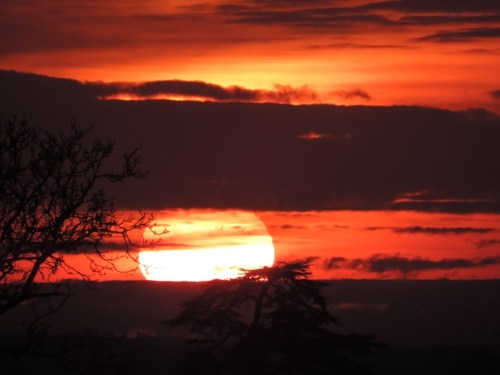
Finally, here’s the setting Sun. I have seen SO many spectacular sunsets in my life. I see LOTS of them here in the Charente. And I never, ever tire of them. I am entranced by the setting Sun. If the Moon is the Feminine Principle for me, the Sun is the Masculine one. I love to connect to both.

Once I read that the Sun doesn’t actually set. It’s we, on planet Earth who are moving, not the Sun moving in relation to us. So, a better term for this time of day would be “Earth Rising”, because that’s what is happening. The horizon of the Earth is lifting up into the sky as the Earth turns, giving us the sensation that the Sun is setting.

Well, whichever way you think of it. It is utterly entrancing, isn’t it?

Have you got any favourite circles to contemplate?

Read Full Post »

“There are no straight lines in Nature”

I don’t know where this teaching comes from, but it’s not true.

There are plenty of straight lines in Nature. OK, maybe they don’t cover great distances in the way manufactured lines do (I’m thinking railway lines and Roman roads) but they are everywhere, all the same.

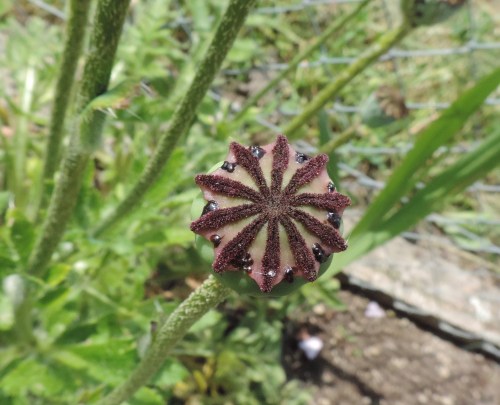
One typical expression of straight lines is “radial” – they start at a centre point and radiate out in many directions from there. This poppy bud in the image above is an example of that.

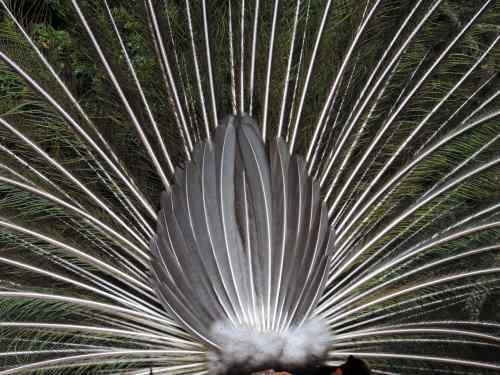
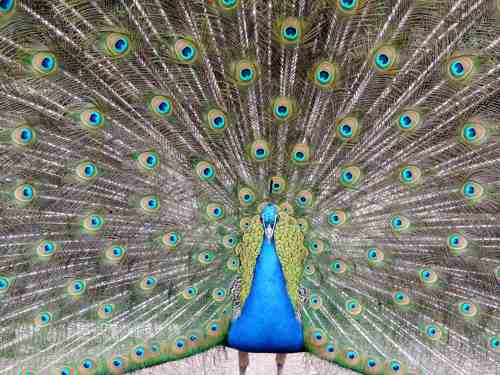
Not straight enough for you? Well, how about this?

Do you know what that is? Let’s look from the other side….

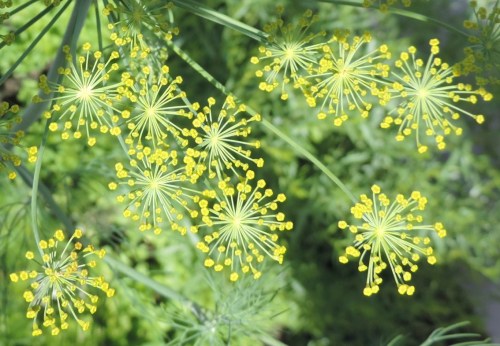
Plants show this “radial” spread of straight lines too.

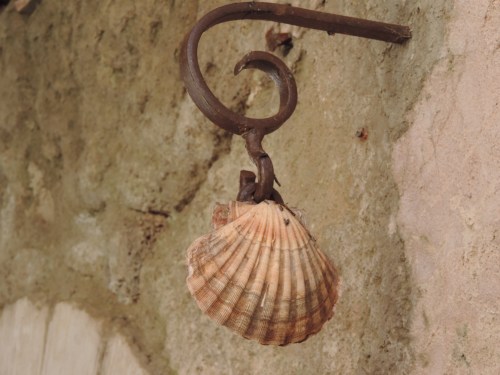
As do shells…

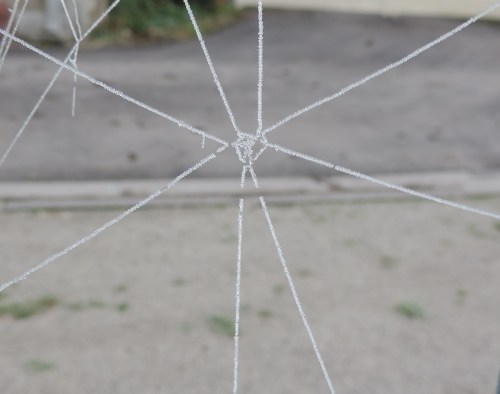
and spider webs

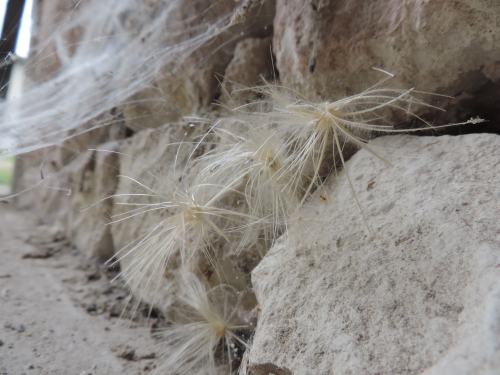
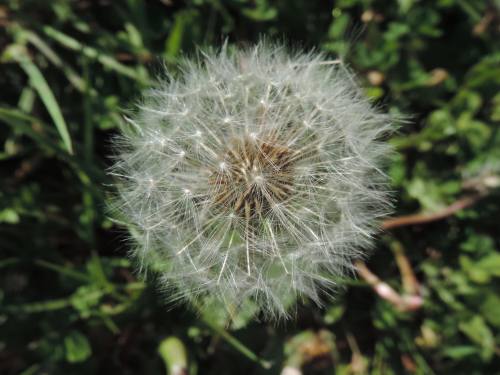
Seeds designed to be carried by the wind use this pattern of radiant straight lines from pointed origins too.

We pick up on these patterns and use them in our art and architecture.

Have a look around today and see where you can spot this pattern. When you do find it, do you think it is beautiful?

One of the things I really like about these “radiant” straight lines is that each line has a beginning and an end, just like a good story. You can see where it has come from and you can see where it is going. It reminds me of a concept from Deleuze and Guattari, which they named “lines of flight”. When I read about this I saw its relevance to complex systems. You might have read elsewhere on this site about “complex adaptive systems” (if not, why not pop that phrase into the search box on the top right of the page and see what comes up?). The complex systems model does more than explain living organisms, it reveals a lot about the underlying structure and function of the universe.

Complex adaptive systems tend to move towards “far from equilibrium” zones. This is what gives them their dynamism, their points of growth and their ability to change. But how do they get there, to those “far from equilibrium” zones? By following particular “lines of flight”.

One of the reasons I liked that so much was it helped me unravel the stories my patients told me. One of my most favourite questions to ask was “When did you last feel completely well?” It often took patience and time to get a clear answer to that question, but time and time again it revealed that the chronic ailment from which the patient was suffering, began either after a particularly severe trauma, or from a phase of life where the traumas piled up on each other, one by one. I wasn’t trying to prove causation, but following the narrative line from that time forwards to the present often revealed both the nature of the traumatic impacts, and, crucially, the adaptive strategies the person had employed (probably mostly sub-consciously) to cope.

Lines of flight, and radiant lines, are typically multiple, and they are also highly unlikely to exist in isolation. However, unravelling what they are, where they intersect, and how they influence each other, is, I believe, at the heart of understanding a person and their life.

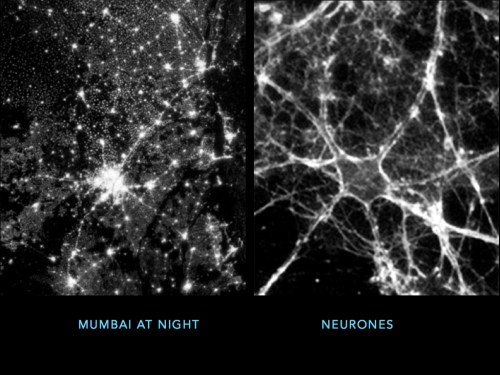
I’ll leave you today with another depiction of lines – well, two pictures actually, and neither taken by me –

On the left is the image of Mumbai at night, photographed from a satellite. On the right and image of neurones in a section of a brain. Interesting to think how this structure of intersections and nodes connected by straight lines scales up and down through the levels and dimensions. But I’m taking the original idea of straight lines a step further now, by seeing them in their context.

Read Full Post »

« Newer Posts - Older Posts »