Feeds:
Posts
Comments

Archive for the ‘creativity’ Category

Yesterday I was looking for spirals, one of my most favourite shapes in the universe. Today I’m looking for circles, or more specifically, concentric rings. They are another of my most favourite universal shapes.

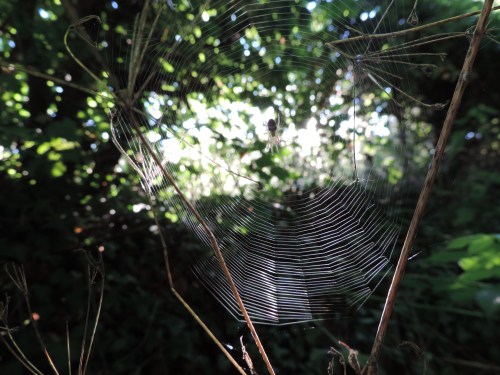
I’ve taken a lot of photos of spider webs over the years, and, believe me, they are very, very different. This one is a classic of type, though, isn’t it? You can see how ring after ring has been spun to create this fabulous pattern.
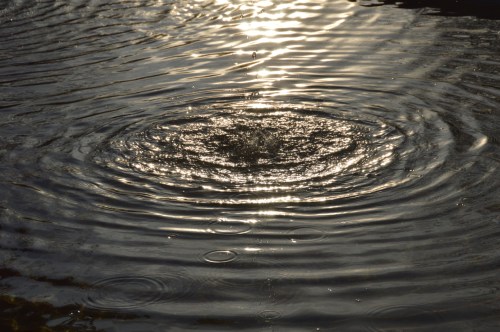
The commonest place to see this pattern is on the surface of a pond or a still lake. It always reminds me of the basic fact of influence – how whatever we do or say ripples out into the universe, connecting with, and influencing whatever the waves reach. That’s one of the main reasons I’m so particular about what I write and share. I always hope that whoever encounters these words and images is stimulated in some positive way.
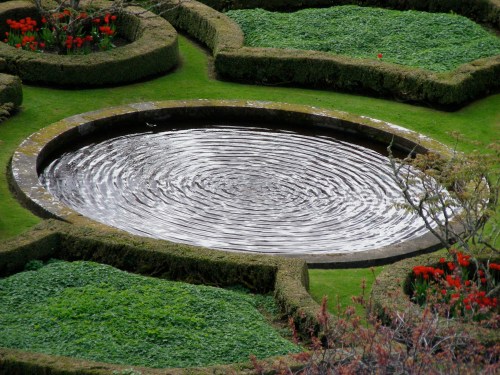
This is one of the most impressive examples I ever came across, in the gardens of Dunrobin Castle in the north of Scotland. What really grabbed my attention in this one was, firstly, the completeness of the pattern, the concentric circles filling the entire pond, and, secondly, unlike where there is a fountain setting off the waves by dripping water into the centre of the basin, in this one there is no fountain. What’s making the ripples?
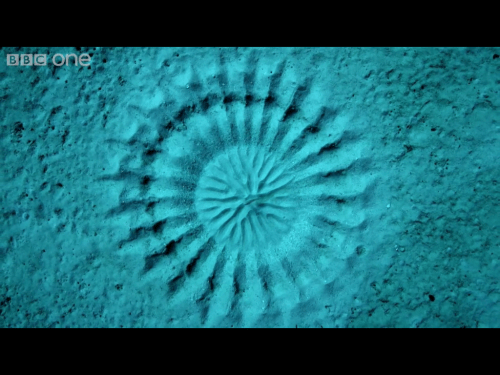
This is the pattern created on the sea bed by a little Puffer fish. It makes this beautiful pattern in the sand to attract a mate.

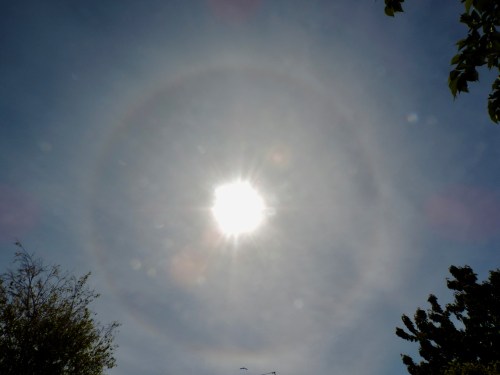
I recently saw a concentric circles pattern in the sky, when the Sun appeared with a corona – yes, a corona during the corona virus pandemic!
And, it’s not hard to find this type of pattern in wood, is it?
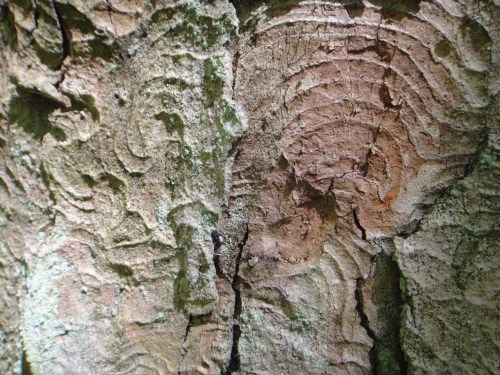
or even in rocks
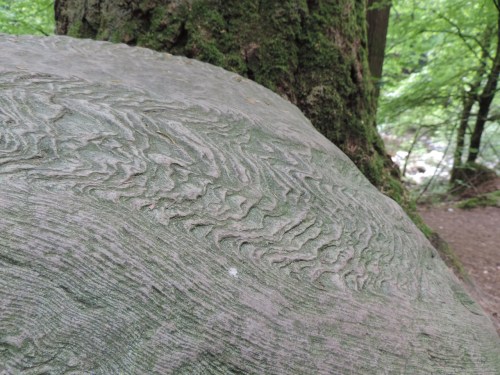
You can see that I’ve extended the symmetrical concentric ring idea to a much wider variety of irregular ripples, but I think those two patterns are really just different expressions of the same underlying force – the end result depends on the context, the borders and limits set by the environment.
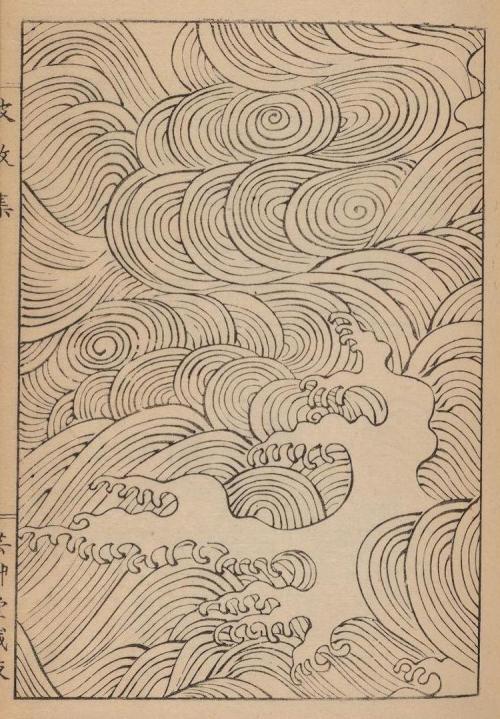
Japanese art combines spirals, concentric circles and ripples to create a beautiful and very distinct style.

It even influences what I can see on the surface of the Earth when I’m flying above it in a hot air balloon!
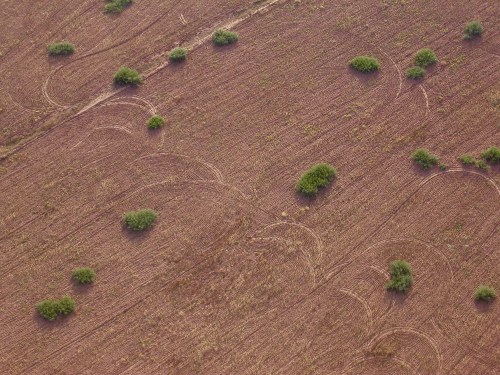
OLYMPUS DIGITAL CAMERA

How about you?

Have you seen any beautiful spirals, circles or ripples recently?
Read Full Post »

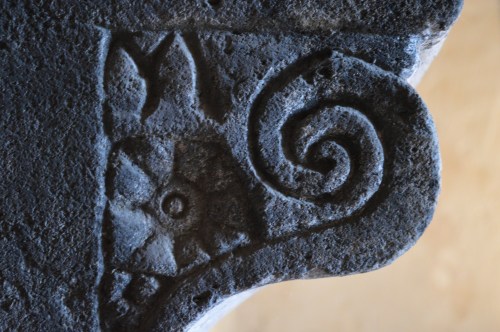
Sometimes I like to collect images of similar shapes or patterns. Today, I’d like to share some spirals.

The spiral is one of the most beautiful forms in nature and art. I think it is at the heart of our universe and tells us something interesting about the course of a life.

It seems to me that rather than running along a straight line, our lives often follow more of a spiral pattern, revisiting old issues and events time and time again, but each time from a different perspective. If we are growing those spirals drive forward movement and a deepening of our understanding. If we aren’t then we spin round and round the same issues until we learn from them.

That first image is on a window fitting in the chateau where Montaigne lived. Here’s one from a mantelpiece inside that same chateau.

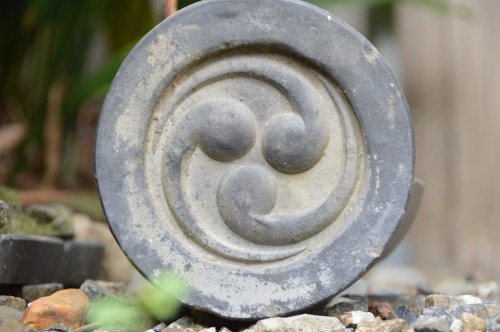
Some spirals you could draw with one line, but what appeals to me so much is how this enfolds two spirals into the one motif.

Here’s an example, found commonly in Japan, of three entwined spirals.

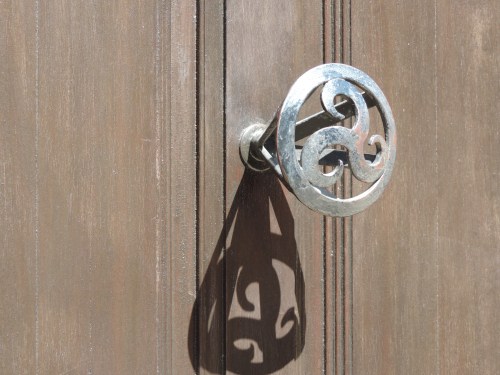
And, here’s a triple spiral where each one is spirally outwards, rather than in towards a central point. Although I completely agree you could see that in completely the other direction….as a gathering from three directions towards a single, common, point.

That’s a simple doorknob, but how beautiful is it? Especially with its triple spiral shadow cast onto the door.

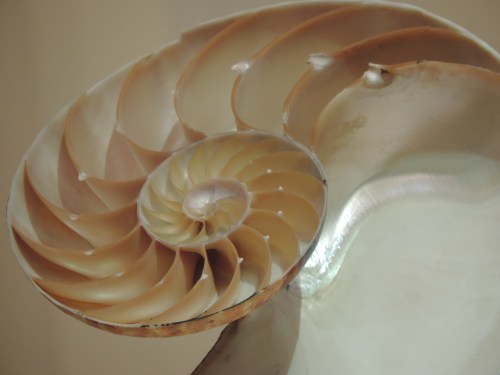
Nature loves spirals too. Here’s a section through a seashell – I found this particular one in the Museum of Scotland in Edinburgh.

At the opposite end of the scale, here’s a photo of a star being born….

I saw this while browsing the web this morning, and I think it’s what set me off in this spiral-gathering exercise!

Do you have any images of favourite spirals?

Read Full Post »

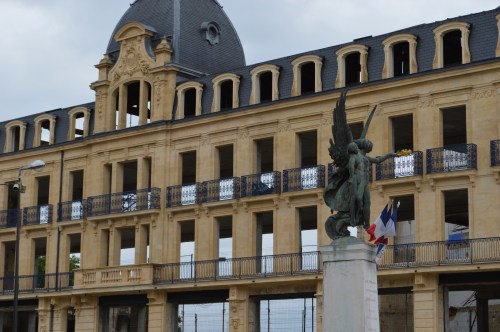
At first glance, this is a beautiful old building with its creamy, yellow stone all cleaned up and looking pretty glorious. But it doesn’t take long before you realise there’s something not right here. Something not whole. There’s no glass in any of the windows, which is the first clue, but when you look through the window frames you see…..the sky. When you walk around the building to the other side you see that there is nothing there. This isn’t a building any more. It’s a facade.

It’s not uncommon for towns to do this. The local authorities demand that the front of the old, beautiful building is preserved whilst the developers are free to demolish every other trace of it and replace it with a concrete, steel and glass box to put little offices or shops in.

It’s kind of sad. And yet, the front remains, and, when well preserved, it retains a lot of its initial beauty.

Have you ever visited a movie set? I don’t mean a movie theme park with rides and parades, but a set. I visited one once and it was the strangest experience to walk through a New York street, only to discover that every single building was a facade propped up from behind with great beams of wood and scaffolding. The building in this photo reminds me of that.

This sets my mind off down two quite different paths. The first is how we all present a certain face to the world. A certain look, style, a certain conformity really. Even when trying to be non-conformist, the “look” recreates conformity. I used to walk from Glasgow Central Station to Glasgow Queen Street Station on the way home from work. I’d pass the Gallery of Modern Art. On the steps of that gallery, goths would gather. Some evenings there would be a few dozen of them. Now, one goth in an office, or a shop, might stand out as really different, but several dozen of them together looked pretty much the same. (By the way, the pigeons used to hang about those same steps in large numbers too and I often wondered if there was some natural association between goths and pigeons!)

Our uniqueness is at its greatest on the inside. It’s not in our clothes, our “lifestyles”, our diets or our habits. We share all of those with many other people. (“Other customers who like X also like Y” – as the algorithms tell us)

So that’s the first thing I wonder about when I look at this photo. It’s uncomfortable because it isn’t “whole”, which, in my book, means it isn’t “healthy”. But, more than that it has no inside. So it’s lost its uniqueness.

The second line of thought is about imagination, because this image reminds me of the movie sets, and I know that whether it’s on TV, cinema or even in a theatre, “appearances” are manufactured to stimulate our imagination. So, I look again at this building and I wonder who built it and why. I wonder about the people who used to work there and how they related to the building they were working in. I wonder about the place this building had on this particular street, in this particular town. I wonder what stories these stones could tell, if only they could speak.

Here’s another photo which picks up that second thread.

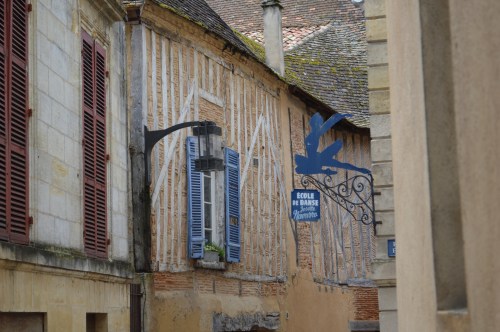
Josette Navarro’s Dance School. Isn’t that beautiful? Doesn’t it capture your attention and set your imagination running? What a name! Once I got home I looked up Josette Navarro and her “Ecole de Danse” and she was still giving lessons, but I couldn’t really find much detail about either her or her dance school.

However, I still find this an incredibly evocative image. I love the wind-vane style of the sign with the dancer in full flight. I love the name. “Josette Navarro”. And the fact she has a dance school. I love the blue of the sign and how it echoes the blue paint on the shutters opposite. I love the light hanging directly opposite, and wonder if it casts a spotlight on the dancer at night.

Even when we can’t see what’s inside, what we do see can really stimulate the imagination, and/or bring back memories, such that it’s easy to imagine stories, scenes from movies, drama, romance, or whatever your favourite genre, and just spend a while enjoying that. Following where it leads you.

Read Full Post »

Every now and then I’m stopped in my tracks by what seems to me to be “found art”.

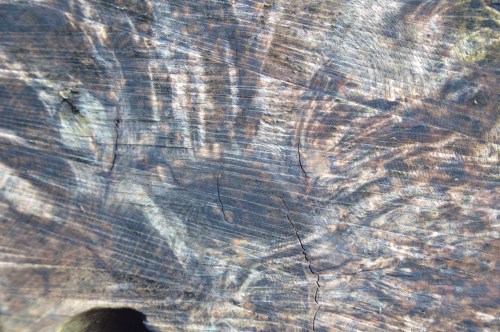
This image is of the end of a tree which has been cut down. There are often beautiful and intricate marks to be seen on the insides of these trees. Marks and patterns which are only revealed when the tree is cut open (which is a bit sad). You know the kind of thing. Concentric rings and swirls and knots. But something has been added here by human hand. The marks of the saw are very visible. What makes them obvious is how straight they are. I remember the first time I read that there are no straight lines in Nature and thinking, “really?” Well, it’s probably not absolutely true but they certainly aren’t common. The longer a straight line, the more likely it is to have been made by a human.

So I’m pretty certain that the patterns, (could I say the “design”?) on the end of this fallen tree, are the result of a combination of the life of the tree and the work of the woodsman.

But just look at it.

What does it seem like to you? What does it remind you of? Where does your mind go when you see this? I expect your mind will intermingle memories with imaginings and you might see……

….an eye – like the eye of Horus, the eye at the top of the pyramid, or some other eye you once saw.

…..a sunburst through the clouds, rays of white or pink or red light spreading across the sky.

….[or add your own images and sensations here]

I like this kind of “found art”, this apparently “accidental art”, partly created by forces of Nature, partly by forces of the human hand, partly by forces of memory and imagination.

Read Full Post »

I think I prefer bridges to walls. Bridges connect. Walls divide. Bridges cross the natural borders of rivers and valleys. Walls hide what lies behind them.

There’s a saying in the Charente, where I live, that to live “enclosed” is to live a happy life. That’s not not an exact translation from the French, but the meaning is that you need a basic level of privacy to be content. The classic country house in this region has a courtyard surrounded by extremely high walls, and the entrance is usually a huge arched wooden doorway. You’ve no idea what you will find until, and if, you are invited in. I don’t know if the style of property preceded the old saying, or vice versa, but they certainly fit well together.

This wall, the one in this photo, is, however, beautiful. At least, I find it so. It captures some of the essential features of beauty for me. Something not too regular. Something that doesn’t fit so neatly that you couldn’t move an inch. Something that doesn’t strive to achieve a mass produced, standardised, so-called perfection.

I like how all the bricks are different. Did they emerge from some machine? Or do they bear the traces of human hands? I think it’s the latter. I like that they don’t even lie on top of each other, but side by side, each row separated by a thick layer of mortar. I like that the mortar has pebbles embedded in it. It reminds me of the shore. And the shore reminds me of the sea.

These bricks, this mortar, these pebbles, all have a history. Every one of them. They came from somewhere and still carry traces of their origins and their adventures. They stimulate my imagination and my memories.

Most of all, I find this beautiful because it conveys the Human to me. The hands in the soil, in the sand, the individuals who honed their skills of building and assembling. I see beauty everywhere in Nature, but there’s a special kind of beauty which emerges when human beings create, when children, men and women turn what they find into something else without obliterating its origins.

Who knew? Even walls can be beautiful.

Read Full Post »

I reckon a lot of us have a fascination with water. Little children love to play with water, whether its in a sink, a pool, or at the beach. Pretty much all children can spend hours filling up brightly coloured plastic pails with sea water and pouring it into holes they’ve dug in the sand.

I’ve certainly always had a fascination for water. One of the few experiments I actually remember from schooldays is “a little goes a long way” where we put a few crystals of potassium permanganate into a big trough of water and watched with amazement how quickly the entirety of the water turned purple.

Learning about the “water cycle” of nature, where water evaporates from the sea, forms clouds in the sky, falls as rain on the mountains and runs down the rivers back to the sea, was probably my first encounter with the idea of cycles and ecosystems.

But ice – now isn’t ice just completely fascinating? Not simply because it expands in volume as the water freezes, which is counter to our instincts (which tell us that heat expands things and cold shrinks them). But because it is utterly beautiful.

The town of Aix-en-Provence is partly famous for all its fountains. I can’t remember how many it has, but there are a lot. These photos I’m sharing today are all taken one day in winter on the Cours Mirabeau in the centre of Aix. They remind me that just when I think I’ve seen all the shapes which frozen water can make, one day, I discover something new to me.

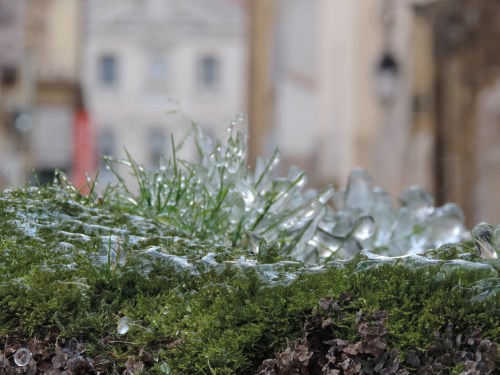
At first glance that image at the top of this post is typical of a frozen fountain. There are many long dangling pointy icicles. (Poetic, huh?).

But, look more closely and you’ll see something pretty weird.


On top of the moss the water has formed ice which looks more like jelly than anything else. It actually still looks liquid, but, you can see, it isn’t. It’s frozen. Not in a smooth level way, like you’d expect to see when water lies in a puddle or pond, but undulating, almost like frozen waves, but smooth waves, not spiky ones. It’s really not like anything else I’ve ever seen. When you imagine water lying on top of moss, you think it would have a level surface, just like a puddle would. So, it should freeze like that – level. But this didn’t.

Here’s another close up.

Look at the shape of this! These tiny stalagmites of ice are so rounded. Not at all spiky or pointy like the stalactite forms higher in the fountain. How does water form into shapes like that? And, if you look at the left hand side of this image, you’ll see that frozen flow appearance I showed you in the previous photo.

Wonder.

That’s what images like these provoke in me.

A sense of wonder…..that combination of curiosity and amazement tipping over into astonishment.

This is the “émerveillement du quotidien” which I love so much – that “everday wonder”. Makes life all the more special I find.

Read Full Post »

I’ve mentioned several times how much, in the years gone by, that I enjoyed looking out from my flat in Cambusbarron towards Ben Ledi. Here’s another one of many photos I have from that time.

What grabbed me about this view?

The beauty.

That’s the short answer. I find it utterly beautiful. The pale blue sky, the grey and pink clouds (“Caravan” reference in there for those of you who know 😉 . The shape of the mountain with its snowy peak, the surprisingly warm shades of the uncovered hillside. The low lying mist in the mid ground with just a row of trees appearing through it, and the familiar farm in the foreground.

But there’s more.

Yes, there are the birds flying past, which bring some life to the scene. But I mean the shape of the mist. Look at it! You’d expect mist just to fade out as it rose, but this mist, for some reason, has fashioned itself into a peak, that looks for all the world like an echo of Ben Ledi itself.

So what engages me about this image is every single element, plus how the whole adds up to a lot more than the sum of the parts.

I adore discovering these symmetries and they challenge my day to day perception that water changes quickly and that mountains never change. The most dynamic part of the scene is the birds in flight, creatures whose unceasing change (movement) keeps them flying through the invisible air. But the next most dynamic part is the water in three of its forms – mist, snow and clouds. Every one of those forms is changing moment by moment, but that’s not nearly so easy to spot as the movement of the birds. Then there is the mountain. The mountain which changes moment by moment in appearance as the Sun changes his angle and casts shadows from the ever-changing clouds. But the mountain changes too. In its substance, shape and form. Maybe it takes millennia to be able to spot that, but doesn’t everything have its own innate pace?

So, here’s the core paradox of this image – stillness and movement.

At first glance, this is an incredibly peaceful, quiet, static scene. But it doesn’t take much to see there is nothing static about it.

I love that.

Read Full Post »

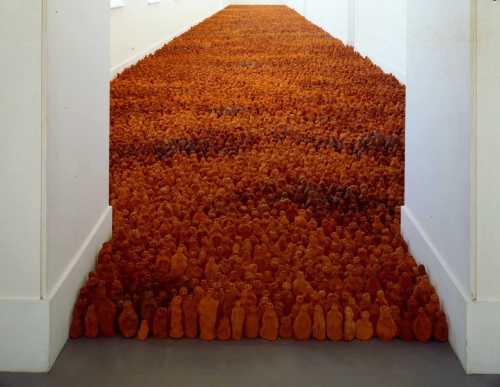
Anthony Gormley’s “The Field” is an installation which made a lasting impression on me. I saw it many, many years ago in Inverleith house in the Royal Botanic Gardens, Edinburgh.

When I first looked into the room and saw all these terracotta creatures I thought, how amazing, look at all these wee guys, all the same! Then I started to look more carefully and realised that they were not all the same. In fact, Gormley hadn’t made all these models himself. He’d invited hundreds of people to each make their own one. So every one of them was unique.

That image stayed with me because I thought this was an essence of the work of a doctor. Every patient would present me with features which they had in common with other patients who had the same diagnosis, but every one them was unique. I had to juggle with the opposites of sameness and difference every day.

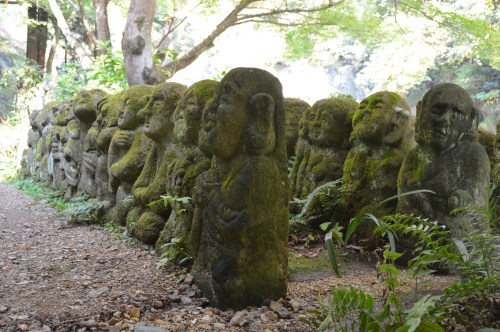
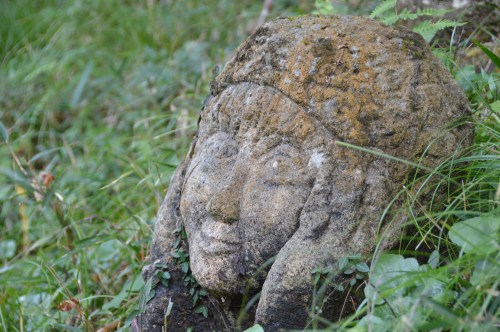
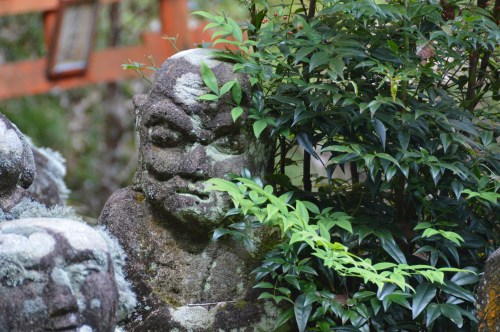
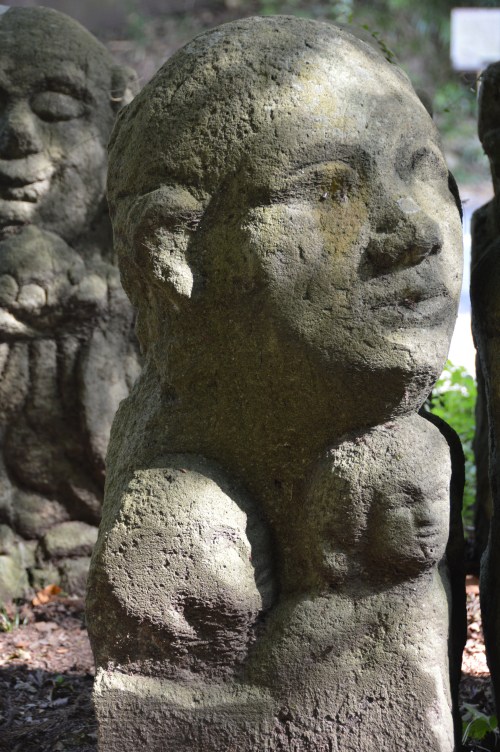
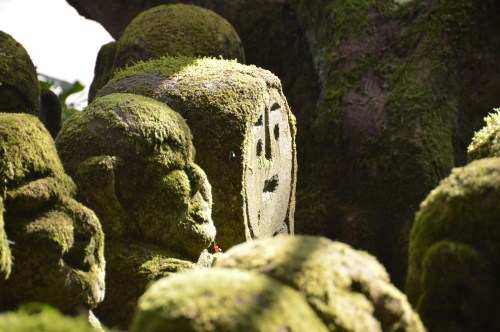
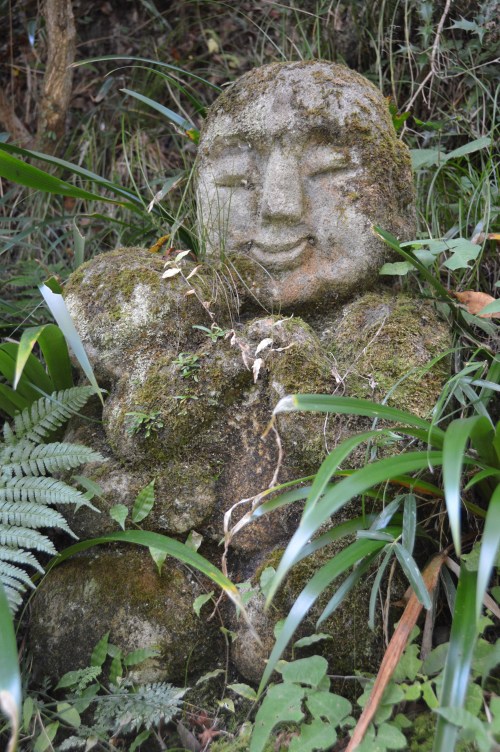
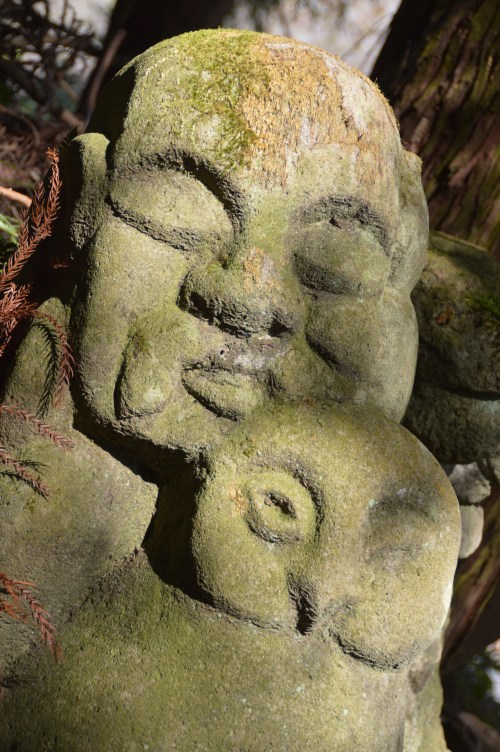
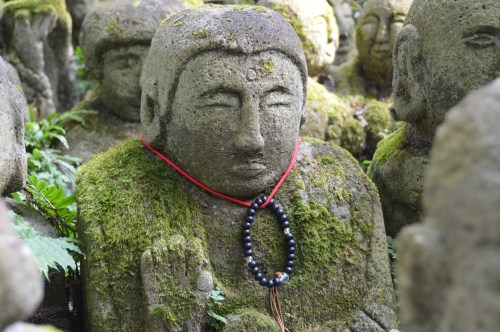
Years later I visited Otagi Nenbutsu-ji Temple on the edge of Kyoto. In the grounds there I found something similar to Anthony Gormley’s “The Field”. Under the direction of an artist dozens of people had created their own stone sculptures. Again, at first glance, they looked the same, but, quickly you can see that every single one of them is unique.


Look at some of them….I bet you find a favourite or two

Read Full Post »

This is a spider web, but doesn’t it look spooky?

It looks like the big hole in it is an eye socket and the central lower part looks like a beak, or a nose.

I see a mask when I look at this.

And a pretty disturbing mask at that!

I think this is a bit like one of those drawings you look at which at first glance might be an abstract pattern, but once you’ve seen a face or something in it, you just can’t unsee it ever again.

It really can be hard to see something “as if for the very first time” when you’ve already seen it and “made up your mind” what it is you can see.


Read Full Post »

I was so very fortunate to travel to Japan several times over the last decade or so of my working life. Every time I was inspired by the people I met and the places I saw. There’s an aesthetic which seems characteristically Japanese and I find it SO appealing.

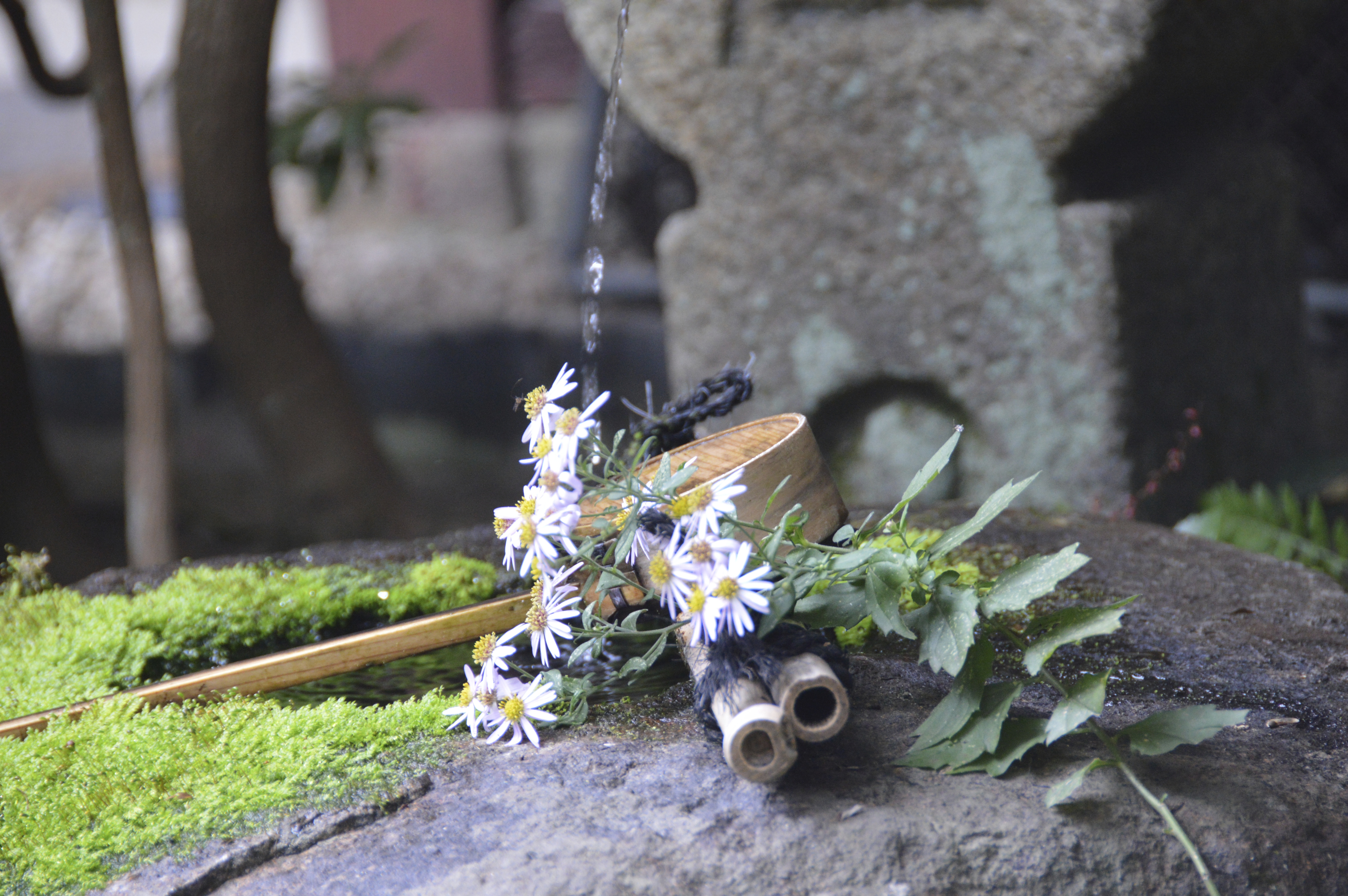
This photo is a good example, I think.

I don’t quite know how I’d capture what makes this so beautiful but I think its a simple, small combination of natural and hand-crafted elements.

Here you can see a rock, with some moss growing over part of it, a stone carving in the background and a simple stream of water pouring down into a stone basin (which you can’t see in this image). Laid on the stone is a bamboo ladle of the type you can find at any temple or shrine. It’s resting on two stalks of bamboo tied together with rough, black rope, over which lies a stem of flowers.

Everything looks as if it might have just fallen there accidentally, but you know everything has been carefully placed. I love that combination of natural elements, living and flowing elements, and hand crafted items fashioned from natural materials.

I have a notion that the principles of this aesthetic might become more widespread in other parts of the world if this current crisis inspires people to enjoy and savour the simple everyday pleasures, and maybe also begin to desire a better relationship to the natural world.

Some of the key principles of this Japanese aesthetic are described in wabi sabi – if you want to explore this further!

Read Full Post »

« Newer Posts - Older Posts »