Feeds:
Posts
Comments

Archive for the ‘creativity’ Category

quirky

I was walking around the village of Lourmarin, in Provence, today, and it struck me that all around there were examples of peoples’ creativity. That creation above was quirky but really quite fun. It was hanging on the shutter of a first floor window. A little further down another set of shutters caught my eye.

shuttered window

I don’t know if the lady who lived in this house had this tile made especially, or if one of her relatives gave her it as a gift, but I did like it!

granny's house

At the end of the next narrow street my eye was captured by this incredible blue –

blue villa

blue

Then round on the main street leading down to the main square I did some window shopping (that’s the only kind of shopping you can do on a Monday in French villages – everything is closed on Sundays and Mondays…..civilised! Maybe they use the time to paint!)

red cheeks
shining gate

paintings
paintings
paintings
paintings

Read Full Post »

I’ve just taken delivery of my first attempt to use blurb.com to produce a book. It’s fabulous. It was so easy to do and the quality of the hardback book I’ve received is way beyond my expectations. And for any fellow bloggers, it’s a real treat to be able to page through a hard copy of your blog. I really do recommend it.

I am SO thrilled with the result. Click here to go and see for yourself.

What I wanted to do was produce a hardback copy of my first year of blogging. The blurb service has a program to download called “booksmart” and you use this to create your books. Included in the program is a great tool called “blogslurp” which downloads a complete copy of your blog into a template on your hard drive. You can then edit every single page, choosing different page layouts, upgrading low resolution photos for higher resolution copies from your photo library, and deleting or adding any text you choose. You then hit “upload” and that’s it. If you want you can preview the book as a pdf but I didn’t bother. I chose the largest format hardback book they do.

I am delighted with the quality of the printed copy and it got to Scotland in less than 10 days from the time I hit the upload button.

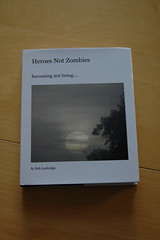
Here are some photos of the book to give you an idea what it looks like.
Heroes not Zombies The Book

Read Full Post »

Writing your self

Two of my best blog friends have posted interesting writing ideas yet. I’m going to point them out to you so you can go and check them out.

First of all, mrschili, across in her inner door blog, picked up an idea from a fellow blogger (wordlily), about writing a six word autobiography. The results are fascinating and enlightening. Try it for yourself. What would your six word autobiography be?

Secondly, Dr Tom Bibey, posted about writing a single paragraph entitled Where I Come From. His short paragraph about his origins and influences has gone on to inspire several others. Check them out. And, then……..yep, try it out for yourself. What would your write for “Where I Come From”?

Read Full Post »

Amy has nominated me for Best Health Blog – if you click on the badge top right it’ll take you to the Blogger’s Choice Awards to add your vote (if you’d like to!)

While you’re at it, Amy’s been nominated for three awards – photography, writing and parenting. Go visit her blog and see what you think.

Who’s Amy? She’s my amazing daughter of course! Am I biased ? You bet! But, seriously, don’t take my word for it, go and make up your own mind.

Read Full Post »

Here’s another study which shows the health benefits of writing about your experience. We all use narrative to make sense of our lives, so you’ll understand that writing about our experiences can help us to do just that – to makes sense of our experience. However, more than that, narrative is a creative, expressive act. It’s a way of affirming our existence, connecting to others and of growing. It helps us to develop.

In this study 71 patients with cancer were asked to write about “How has cancer changed you, and how do you feel about those changes?”

After the writing assignment, about half of the cancer patients said the exercise had changed their thinking about their illness, while 35 percent reported that writing changed the way they felt about their illness. Three weeks after the writing exercise, the effect had been maintained. Writing had the biggest impact on patients who were younger and recently diagnosed.

Changing how you think and how you feel changes your everyday experience so it’s no surprise these respondents reported improvements in the quality of their lives.

It’s interesting  to note how important it is to write about feelings to get the good effect –

“Thoughts and feelings, or the cognitive processing and emotions related to cancer, are key writing elements associated with health benefits,’’ said Nancy P. Morgan, director of the center’s Arts and Humanities Program. “Writing about only the facts has shown no benefit.”

One final point worth noting is that whilst, as you may have expected, many wrote that the experience of cancer had been life-changing, perhaps what is more surprising is that many made statements about the gains which they had obtained from the cancer experience.

One patient wrote: “Don’t get me wrong, cancer isn’t a gift, it just showed me what the gifts in my life are.”

Read Full Post »

The fairy house

My eldest grand-daughter showed me this the other day –
fairy house behind the pot
“It’s a fairy house”, she said
Come and look closer
fairy house entrance way

It reminded me of how rich the lives of children can be. What is it that makes such a difference?

Imagination.

What a shame that so many toys these days are manufactured right up to the finish point. Kids can get so much more fun out found objects and daily materials which with imagination become castles, boats, and, yes, fairy houses!  If you want to encourage your childrens’ growth and development then encourage their imaginative play.

In fact, I often think adults lead much poorer lives because they’ve lost both childlike wonder and the power of imagination.  When was the last time you let your imagination run loose and played?

Read Full Post »

flight, originally uploaded by bobsee.

From my living room window today I saw this little trail of snow on top of Ben Ledi so grabbed my camera (can’t tell you how long it’s been since Ben Ledi was visible from my window – we’ve had days of wild winds and rain or thick, heavy mists hiding the mountains).
What often catches me by surprise are the really obvious things in the picture which I only see when I put it up on the mac and just didn’t notice at all as I pointed my camera and clicked. First of all look at that huge, heavy, water-laden cloud up there! How didn’t I see that?! But look also at the bird in flight – isn’t that beautiful? You couldn’t manufacture a shot like that. I love that about photography – how it can raise our awareness and deepen our perception of the world. I swear I look at the world differently when I’ve been looking at photos and/or when I’ve got one of my cameras in my hand. It’s a kind of second sight…..you see it once, then you see it better!

Read Full Post »

Last night I went to see Aly Bain and Phil Cunningham in concert at Falkirk Town Hall and, oh, how I enjoyed it. What a great evening’s entertainment. To be quite honest I’ve always had a bit of a love/hate relationship with Scottish music which can be everything from twee to tear-jerkingly emotional but I can’t remember the last time I saw such masterly musicianship as I saw last night. The accordion is not my favourite instrument (I was amused that Celtic Connections put on a concert called “Accordion Hell” inspired by Larson’s cartoon where everyone going to heaven is given a harp, and everyone sent to hell is presented with an accordion) but in Phil Cunningham’s hands it is superb. (I’ve never seen anyone’s hands move so quickly over a keyboard of any kind actually!). He played a tune he wrote in memory of his deceased brother and it was profoundly moving. Here’s a video clip of him playing a bit of it and having it analysed to show how it works its power. I love how he says at the end that it’s music from the heart. The best of music is always music from the heart.

Read Full Post »

amaryllis

I took this photo of an amaryllis (ok, actually it’s probably not truly an amaryllis, but actually Hippeastrum) recently and when I looked at it once I’d uploaded it to my mac, it brought back to my mind a Hermann Hesse fairy tale I read back in my teens (yep, well over three decades ago!). Sometimes you read a novel, or a story, or a poem and it makes such an impression that it stays with you for life. I read a lot of Hesse when I was a teenager and one of my most favourite was (and still is) his collection of fairy stories – “Strange News from Another Star”. One of the stories in that collection is “Iris”. What I remember about that story is how the young boy imagines a whole world inside the Iris flower in the garden and later in life when he has lost touch with that whole way of experiencing life he falls for a woman named “Iris” who challenges him to go back and find what he had lost. I got my old copy off the bookshelf and the moment I started to read, the old magical feeling came back.

In the morning when he came out of the house, fresh from sleep and dreams and strange worlds, there stood the garden waiting for him, never lost yet always new, and where yesterday there had been the hard blue point of a blossom tightly rolled, staring out of its green sheath, now hung thin and blue as air a young petal with a tongue and a lip, tentatively searching for the curving form of which it had long dreamed. At the very bottom where it was still engaged in a noiseless struggle with its sheath, delicate yellow growth was already in preparation, the bright veined path and the far-off fragrant abyss of the soul. Perhaps as early as midday, perhaps by evening, it would open, the blue silk tent would unfold over the golden forest, and her first dreams, thoughts, and songs would be breathed silently out of the magical abyss.

I don’t think I ever looked at a flower the same way after reading that. Oh how I love those images – of the flower “tentatively searching for the curving form of which it had long dreamed” and of it “breathing silently out” its’ dreams, thoughts and songs.

When he stared into her chalice and in absorption allowed his thoughts to follow that bright dreamlike path between the marvellous yellow shrubbery towards the twilight interior of the flower, then his sole looked through the gate where appearance becomes a paradox and seeing a surmise. Sometimes at night too he dreamed of this flowery chalice, saw it opening gigantically in front of him, like the gate of a heavenly palace, and through it he would ride on horseback, would fly on swans, and with him flew and rode and glided gently the whole world drawn by magic into the lovely abyss, inward and downward, where every expectation had to find fulfilment and every intimation came true.

Each phenomenon on earth is an allegory, and each allegory is an open gate through which the soul, if it is ready, can pass into the interior of the world where you and I and day and night are all one. In the course of his life, every human being comes upon that open gate, here or there along the way; everyone is sometime assailed by the thought that everything visible is an allegory and that behind that allegory live spirit and eternal life. Few, to be sure, pass through the gate and give up the beautiful illusion for the surmised reality of what lies within.

Goodness, it is so many years since I last read those words but they feel as vibrant, stimulating and inspiring as they ever did. What a fabulous capacity we human beings have for imagination and creativity! How amazing is the tool of “allegory”? Isn’t it incredible how it turns what seems to be into something so much more? How it unlocks the potential that lies in everything. Wonderful! I’m off to re-read some more Hesse!

Meanwhile, here are a couple of other lily family photos I’ve taken – an iris I saw in Holland once, and a daylily from Rodin’s garden in Paris – hey, that should inspire your imagination a bit!

iris

daylily

Read Full Post »

The Medici Effect by Frans Johansson (ISBN 978-1-4221-0282-4) says on the front “If you can’t read it and come up with at least a minor Mona Lisa or two, you’re not trying”. Pretty enticing, huh? Well, so far, it hasn’t done that for me. Am I not trying? Well, actually, as Johansson shows, just reading about something isn’t enough. You have to turn your reading into actions.

The front cover quote is kind of misleading – this is an inspiring book but it certainly isn’t a “how to do it” kind of book.

The Medici Effect is an exploration of a single, simple concept – the intersection. The author’s claim is that innovation and creativity flourishes in the intersections. What intersections? Where different disciplines come together in the same team or project; where cultures meet; where languages meet. This concept reminds me strongly of the network science ideas which I read about in the fabulously inspiring “Linked“.

I think it’s very true. Some of my most creative times come around my visits to France and Japan. I spend most of my holiday leave in France and I love to go to the bookshops and the newsagents. The French publish utterly different magazines and books from the kind I find anywhere else in the world, and there is something about their perspective which I find so different from the one I find in the UK. In fact, for me, there’s something about reading French which is stimulating and exciting. I also visit Japan a couple of times a year and there the culture, the architecture, the contrasts of the spiritually ancient and the gaudy new sitting side by side, the design ethos focussed on transience and the constant dynamism of change, I find totally inspiring. When I go to Japan, I teach, with the aid of an interpreter which slows down my presentation style and gives me much more time to reflect. I come up with a new way to communicate something every time I go there.

The Medici Effect is what happens when you bring together diverse influences, and Johansson makes the claim that creativity and innovation is, in the final analysis, something that happens randomly. He gives the example of Edgar Allen Poe, who used to randomly choose three words from the dictionary and try to tie them together to make a new story.

As well as the valuing of difference and diversity which challenges and shifts our perspectives and stimulates our creative flow, Frans Johansson recommends abundance. He gives the example of Joyce Carol Oates, who published 45 novels, 39 collections of stories, 8 poetry collections, 5 dramas and 9 essay collections in four decades.

I especially liked his point that to be an innovative person you can’t just come up with ideas, you have to come up with ideas which are valuable and which are taken up by society or by other people. That seems so true to me. The truly creative people produce. They don’t just think. They do.

Read Full Post »

« Newer Posts - Older Posts »