Feeds:
Posts
Comments

Archive for the ‘from the consulting room’ Category

IMG_1529


I’m not sure if you can click on this photo and zoom in to see the text on the offers in the windows of this shop, but if not, let me say a little about it.

I was taking part in a superb community event about wellbeing at Finn’s Place in the Southside of Glasgow and as I walked to the station at the end of the day I saw this “Quality Pound Store” – the offers in the window on the right are virtually ALL sugar, fizzy drinks, or sweets (I think only three are not – can you spot them?)

I can’t make out the other window too well but I think it’s very similar.

What do you think?

What’s wrong with this picture as we try to increase the health and wellbeing of the people of Scotland?

(WHO and sugar, Action on Sugar and to bring a BIG smile to your face, the wonderful Mark Steel!)


Read Full Post »

How would you define fitness?

Take a moment to think of some answers for yourself then read this (I suspect rather different) definition….

“resilience during change”

or

“an adaptation to an environment whose complexity co-evolves with the complexity of the system”

I DO like these definitions – because it does seem to me that fitness is indeed about the ability to adapt to change. In a paper entitled “Technological integration and hyper-connectivity: tools for promoting extreme human lifespans”, Marios Kyriazis suggests that it is by becoming fit that an organism increases its chances of survival.

This question of fitness reminds me (for the second time today) of Hans Georg Gadamer’s essays on health, The Enigma of Health. In those essays he discusses the idea of fitness from the perspective of how well something fits – or, in this newer language, how well it develops, adapts and changes with environmental change. (I was thinking of Gadamer when preparing for a talk I gave this evening about how to make health…..it strikes me that he hit the nail on the head when he talked about the mysterious invisible, even disappearing, quality of health…..that it is a natural quality of all living organisms. He says that if we have a wound in our hand then we notice our hand…our attention is drawn to it by the pain, the heat, the redness…but when that wound heals and the pain, heat and redness disappear, so we become unaware again of our hand)

How do you think of fitness? Is it something to do with resilience, and of adaptability?

If Kyriazis is right then the way to increase fitness is to increase the number and quality of connections. And THAT also strikes me as spot on.

Read Full Post »

This is NOT a post about diets!

We use the metaphor of weight as a measure of value. If we “give more weight” to one side of an argument than another, then we are saying we value that side more. What weight do we give to a certain piece of evidence for example?

Well, here’s a fascinating study by psychologists who were studying the embodied nature of metaphors. Here’s what they did, and what they found…

  • In the first study, European participants were asked to guess the value of various foreign currency in euros. Some were given a heavy clipboard on which to mark their estimates, and others a light clipboard. Those who held the light clipboard estimated, on average, lesser values.
  • In a second study, subjects were asked to estimate the importance of college students having a voice in a decision-making process involving grants to study abroad. Participants with the heavy clipboard felt that it was more important for students to have a voice.
  • In a third, subjects were asked to report whether they liked their city after reading a biography of the mayor and indicating how they felt about him. If they carried the heavy clipboard, there was a relationship between their estimation of the mayor and that of the city, but not if they carried a light clipboard. In this case, the importance of their feelings about the mayor weighed heavier on their evaluation of the city if the clipboard was heavy


Interesting, huh? Reminds me of a study I read years ago where the researcher gave the study subject a drink to hold while they went up in an elevator. The subjects were asked to give their opinion of the researcher at the end of the “test”. Those who had held a warm drink, rated the researchers as more friendly and warmer, than those who held a cold drink.

Still think the body and the mind are separate?

Read Full Post »

Blue zones” are communities around the world where the life expectancy and quality of life is higher – in these communities more people live to be 100, and more people are still healthy when they are 80. (In fact, it turns out that most people who live to 100 were healthy when they were 80)

Researchers have found that there are common themes amongst these communities. David Buettner, who published these findings, identifies nine of them, which he calls the “Power 9

In summary, the first common theme is movement – and not vigorous exercise or actually using a gym membership! They mention “natural movement”….you know, the opposite of sitting all day.

(Oh, of you’ve got a minute, check out this video about how to move more…watch out for the brilliant suggestion about where to part at the supermarket)

Three are about food and drink – the 80% rule, which is about stopping eating before you are full ie when your stomach is 80% full; the “plant slant”, which is the same as Pollan’s “mainly plants”

(see Michael Pollan’s Food Rules)

….and drinking a glass or two of wine a day!

Then there is one about “time out” or “down time” – taking a pause in the day to relax or nap.

Two left……one is having a sense of purpose. Do you know that having a sense of purpose can be worth an extra seven years of life!? By sense of purpose they mean everything from having a reason to get up today, to still having important things to fulfil in your life.

And, finally….and last, but not least, I’d say….THREE that are about our relationships with others –

“Loved ones first” – having children, parents, partners, siblings who you really care for.

“Belong” – almost ALL the centenarians interviewed belonged to a faith-based group

“Right tribes” – this is an interesting one….it’s about being part of social circles where the others are also healthy and long living. I think that’s fascinating, because I remember reading that if your friend’s friend becomes obese, then you are more likely to become obese. So, there is a common phenomenon of social networks where people influence each other through apparently indirect ways – goes both ways apparently – healthy or unhealthy – I wonder what tips the scales from the one to the other given that most networks will have both…..careful who you hang around with!


Read Full Post »

I’ve long been impressed by Don Berwick, whose “Crossing the Quality Chasm” introduced me to the concept of the Complex Adaptive System. So I was keen to listen to his keynote presentation at the Institute of Healthcare Improvement at the end of 2013. I urge you to take the time to watch this….ok, it’s 48 minutes long, but it is one of his very best talks.

His main point is that whilst we have improved disease management significantly, if we really want to increase the quality of health care, then it is time to apply attention and energy to “health creation”, and that do so, requires that we ask ourselves just what health is and what examples are there of health creation which might begin to help us build health creation into health care.

I particularly like how Don Berwick refers to the work of Wayne Jonas, Dean Ornish, and the mindfulness movement initiated by Kabat-Zinn. But his reference to “blue zones” was new to me (those communities in the world where people live longer and in better health). What do all of these have in common?

IMG_0551


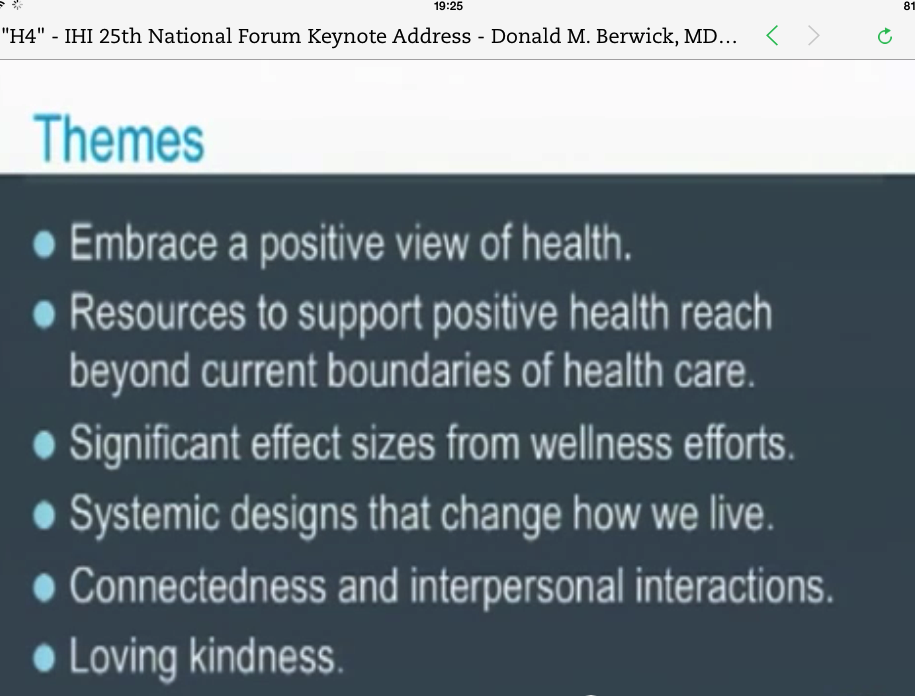
(this is the summary slide from Don Berwick’s keynote)

Health needs to be conceived of as a positive experience in itself – NOT the mere absence of disease. The ways to create health will probably be found outwith the current health care systems. A focus on wellness produces LARGE changes in health – in fact, much larger than the effect sizes of drugs on diseases. We need to use a systems approach to create health – not a focus on parts, but on the whole – body, mind and spirit.

The last two points are crucial –

  • Our connections in the world and our relationships are vitally important to good health.
  • The one key thing you can do to create better health is to practice loving kindness.


Read Full Post »

I’m a bit of sceptic about putting collated data ahead of individual experience when it comes to finding what is best for this patient today.

So, I was very taken by this sentence from a Japanese doctor’s journal. This is a surgeon who has been the only doctor on a small Japanese island since 1978.

Initially, the locals were wary of this strange young doctor coming to their island. How would he win their trust? Show them some graphs of randomised controlled trials and run night classes on calculating odds ratios?

Nope.

I would have no choice but to wait and to rely on the power of positive results to build a relationship of trust here

This is what you call believing reality…..when time and again the lived experience steadily builds your confidence.

Read Full Post »


So, here’s a study which makes you go…..duh!? Is anybody surprised?? The conclusion is this –

When physicians spend too much time looking at the computer screen in the exam room, nonverbal cues may get overlooked and affect doctors’ ability to pay attention and communicate with patients

Using video cameras to follow eye gaze the researchers found that physicians using electronic health records were likely to spend a third of their time in the consultation looking at the computer screen (I’m surprised it was only a third!) and, more surprisingly, that the patient too gazed at the screen, even if they couldn’t see, or read, the details on the screen.

When doctors spend that much time looking at the computer, it can be difficult for patients to get their attention,” said Enid Montague, first author of the study. “It’s likely that the ability to listen, problem-solve and think creatively is not optimal when physicians’ eyes are glued to the screen.”

Can’t disagree with that….it’d be surprising if a doctor could pick up the non-verbal clues when they are looking at a screen.

What do the researchers recommend?

Nope, not putting a bag over the screen the way people used to put a bag over bird cages to get noisy parrots to go to sleep. Instead they say their findings could contribute towards

more effective training guidelines and better-designed technology. Future systems, for example, could include more interactive screen sharing between physicians and patients

Pssst! Researchers! I’m over here! How about getting Humphrey Bogart to teach doctors? If the norm was “here’s looking at you, kid”…..well, what do you think??

Read Full Post »

paris park

Sometimes I think there are two kinds of people (that’s nonsense of course because there are as many “kinds” as there are people!). The two kinds I’d like to consider here are those who value stories, and those who value data.

I am still astonished when I remember the conversation I had with a young junior doctor who told me they were being taught “Don’t listen to the patient, they lie all the time. Only the results tell the truth” That is a data teacher talking, and, frankly, I think it’s scary to think such an attitude exists in doctors, especially doctors who are teaching young doctors. (by the way, do you remember a character called “Data“?)

What I love is the story. Every person I meet tells me a new story. It’s in the narrative that I can make sense of their suffering. It’s in the narrative that I can see the connections between the mind, the body and the spirit.

We all use narrative, not only to understand each other, but to make sense of our own lives.

When I first started to explore the use of narrative in medicine, I think the very first article I read was by Rita Charon. Here’s a passage from her book, Narrative Medicine.

What I am trying to convey is the kind of listening that will not only register facts and information but will, between the lines of listening, recognize what the teller is revealing about the self. Conventional medical care has not considered this kind of listening to be its responsibility. Except for some psychiatrists and psychoanalysts, health care professionals cannot give the time or get the training needed to listen for stories. Without knowing what is salient to an illness and what is not, many doctors and nurses fear that such listening will trap them for hours hearing information that is unrelated to disease. Listening to it, they think, will only distract them from the task at hand— to deal with the insomnia or to treat the abdominal pain. Unfortunately, sickness does not travel in straight lines, and we who care for sick people have to be equipped for circuitous journeys if we want to be of help. Although many health care professionals worry that they do not have the time to listen for stories, many of us who have incorporated listening into practice find that time invested early is recouped quickly. Indeed, the first few visits with a patient may take more time than in conventional practice, but time is saved shortly down the road by having developed a more robust clinical alliance from the start. The serious consequences of not being able to do this kind of narratively sophisticated listening is that patients’ symptoms get dismissed, their non-medical concerns get ignored, and treatable disease gets missed. More compellingly, only this kind of narrative listening will hear the connections among body, mind, and self, and disease recognition and treatment cannot proceed, we are beginning to believe, without simultaneous attention to all three.

I think that’s so right. The shame and weakness of the UK NHS is how it is constructed around routine encounters between doctors and patients which last less than ten minutes. What on earth can you understand about a patient in ten minutes? How do you make a diagnosis? No wonder doctors send patients off for X Rays, scans of this, scans of that, and blood tests so much nowadays. But what worries me most about our current model of care, is how prioritising data, results in just what Rita Charon says “patients’ symptoms get dismissed, their non-medical concerns get ignored, and treatable disease gets missed.”

Jennifer Percy, writing in The Atlantic, says

The language of science was unsatisfying to me. “The most incomprehensible thing about the universe is that it’s comprehensible,” Einstein said. But I don’t think human relationships are ever fully comprehensible. They can clarify for small, beautiful moments, but then they change. Unlike a scientific experiment with rigorous, controlled parameters, our lives are boundless and shifting. And there’s never an end to the story. We need more than science—we need storytelling to capture that kind of complexity, that kind of incomprehensibility.

It’s not just human relationships which are never fully comprehensible, it’s human beings. Can we really apply “rigorous, controlled parameters”, to lives which are “boundless and shifting”?

We do need storytelling to capture the complexity. And we do need to understand that these stories never end.

Read Full Post »

mitsudomo

So, I was told this week I was the most calm person someone had ever met, and asked how did I manage that?

This isn’t the first time. Not by a long way. So the truth is there is something about who I am which allows me to emit a sense of calm. When I was a young hospital doctor (25 years old) and in charge of a Cardiac Arrest Team, the other team members would commonly say that once I arrived on the scene, everyone felt their anxiety level dropped and everyone felt more calm. I never understood how that happened, because my heart would be banging away in my chest and I would feel that bucket loads of adrenaline were storming around my body. But somehow, what I emitted was calm.

However, what occurred to me in response to the question this time was, I’ve learned that calm and ease occur more naturally when we focus on the present. I sometimes say to people that suffering occurs in the gap between fantasy and reality, by which I mean, when we are wishing how things were, instead of experiencing how they are, then we suffer…..regrets, relived hurts, anxieties or fears. The way I practice, and have practiced now for many, many years (this is the year I turn 60), is to fully focus on the person who is consulting me right now. Whether it is for 90 minutes, 20 minutes, or, when I was a GP, only 10 minutes, that piece of time is always fully for this person who is with me. I will listen attentively, engage with them fully, and be completely present. My mind doesn’t wander off to the patient before, or the one about to come next. But whenever that person leaves the room, I let go. And the next patient walks in, and again, I’m fully present with this new person.

What struck me as I thought about that was “what a great meditation practice!” “what great mindfulness practice!” Repeatedly, gently, returning to the present. So maybe that is at least one of the reasons I still absolutely love daily clinical practice. If I’m ever feeling not so great, then a busy clinic gives me a lift. If I’m feeling a bit weary, then the clinic boosts my energy.

I owe a debt of gratitude to my patients over all these years. See what a lot of good they’ve done me!

(And I’m sure it’s a two way benefit. I’m told that all the time.)

Read Full Post »

The Resilience Alliance give this description of resilience, using forests as an example of a complex adaptive system which exhibit resilience.

Natural systems are inherently resilient but just as their capacity to cope with disturbance can be degraded, so can it be enhanced. The key to resilience in social-ecological systems is diversity. Biodiversity plays a crucial role by providing functional redundancy. For example, in a grassland ecosystem, several different species will commonly perform nitrogen fixation, but each species may respond differently to climatic events, thus ensuring that even though some species may be lost, the process of nitrogen fixation within the grassland ecosystem will continue. Similarly, when the management of a resource is shared by a diverse group of stakeholders (e.g., local resource users, research scientists, community members with traditional knowledge, government representatives, etc.), decision-making is better informed and more options exist for testing policies.Active adaptive management whereby management actions are designed as experiments encourages learning and novelty, thus increasing resilience in social-ecological systems.

The main point made here is the importance of diversity. They mention “socio-ecological” systems, but in fact organisations can also be considered as complex systems. This is one of the ways we are going wrong with the way we deliver health are these days. Due to the vast diversity of human beings, and the reality that large organisations behave as complex systems, we need diversity in our organisations and in our practices.

There just is no one size fits all when it comes to health care and a health service managed by protocols, rules and tight controls, will ultimately fail.

Read Full Post »

« Newer Posts - Older Posts »