Feeds:
Posts
Comments

Archive for the ‘from the consulting room’ Category

Take 20 minutes to watch this brilliant TED talk by Iain McGilchrist.


I agree with everything he says in this, but I was especially struck by his mention of the gene which codes for eyes. It’s the same gene which codes for a fly’s eye, a frog’s eye and a human eye. What makes the difference? The context of the other cells in the separate creatures. We are not just our genes, and our genes only express themselves in the contexts of the cells in which they exist.

I also really like what he says towards the end of the talk about protocols and the practice of medicine. How on earth can a protocol devised by a committee somewhere tell a doctor how to treat this particular, unique, individual patient today? It’s nonsense.

Read Full Post »

Rain lenses


Look carefully at these raindrops and see what you can see within them.

There are all kinds of theories about reality and how we experience it, but in this Age of Modernity, the object, what’s “outside”, what can be measured, what is “physical” has gained almost a monopoly over what is accepted as “real”.

What a patient’s tests or scans show are believed to represent what’s really wrong or right. What a patient reports, relates or describes of their experience – their symptoms, their personal narrative, is often dismissed by researchers as anecdote, or by clinicians as unimportant – “I’m happy to tell you your results are all normal” (“now go away and stop bothering me with your complaints!”). Somehow the lived experience of reality has become less relevant than the measurement of reality. The object trumps the subject.

Yet that objective, physical reality can only be experienced by, can only be measured by, the human subject.

So, in this dialectic, is there some way to grasp reality, to know what is REAL?

I’m not about to solve this one here, but one way of approaching this which appeals to me a lot, is to ask the question “what are these the two poles of?” “Inside and outside of what?” Or to put it another way……If the subject and the object are two sides of the coin, what’s the coin?

Is it the continuous process of becoming which we see everywhere in the universe? Is it the vital force, the Life force, the universal spirit from which all form emerges?

Can we take a perspective on reality which sees BOTH the inside and the outside as valid and important?

That’s why I don’t accept the proposed duality of mind and body, and any understanding of a patient is incomplete without exploring both.

Read Full Post »

Steven Charlap tells the story of the failure of his MDPrevent business which he had to close down last month. It’s an honest and thought provoking reflective piece. His idea was to have a medical practice which focused on health instead of disease, which advised patients and supported them in making lifestyle changes instead of prescribing for them. It didn’t work out. For a number of reasons……he didn’t get enough referrals from other health care providers, had many problems with health insurance companies, and, he says, the patients weren’t really up for it.

Based on our review of the credible research, our model mostly excluded dietary supplements and multivitamins because the science mostly did not support their use. When it came to pharmaceuticals, we didn’t rush to prescribe if there were a non-drug alternative. This approach was a turn-off to many patients who expected a prescription or emphatically clung to beliefs in supplements. And the no-cost, no-deductible, no co-payment provisions in Medicare’s preventive benefits may have had an adverse effect on people’s sense of its value. How much would you appreciate something that has no cost to you? For many patients, it seemed easier to take supplements than to be more attentive to food labels and exercise habits.

I have a lot of sympathy for this doctor. I think the present system of health care is not about health, and is not sustainable. I’m not so sure about the emphasis on prevention however…..let me explain – to prevent something has a negative tone for me, and I think health is a positive attribute. I prefer a focus on positively creating health, rather than negatively trying to prevent, or avoid disease.

His conclusion is particularly striking –

Patients loved my practice because I was willing to spend up to two full hours with them, most of it not reimbursed by insurance. The extra time often meant successfully making a diagnosis that had eluded other doctors for many years. It takes a very long time to get a thorough history and do a good exam and almost no time to prescribe a medication for a presumed illness. I chose the former. Insurance pays for the latter. Unfortunately, we still have a healthcare system that makes money by treating disease, rather than by preventing it.

and that last sentence is the real indictment in this story “we still have a healthcare system that makes money by treating disease, rather than by preventing it.”

What do you think? Do you think we need health care which helps people to create health? Would you like a service like that?

Read Full Post »

Mostly we react, but its better when we respond.

What’s the difference?

Reacting is automatic and rapid. Somebody presses one of our buttons and BUZZ out comes the response – anger, indignation, anxiety, hurt, sadness…..you name it. One of the problems with this reaction mode is that we get the feeling other people are constantly pulling all our strings.

It would be great if we felt more in the driving seat, wouldn’t it? To do that, we need to practice responding instead of reacting. What happens in response mode is that somebody presses one of our buttons, we notice it and think, ‘oh, there’s that button getting pressed again’, then in the short pause, we get to choose. What am I going to do about it?

It’s a bit like when the telephone rings. You don’t HAVE to answer it. You have a choice. The experience of exercising that choice, in fact, even the experience of having time to choose, is hugely empowering.

Here’s a simple little technique which lets you begin to change from reactive mode to responsive mode. It’s called “getting neutral” by the “Heartmath” people.

First deliberately move your attention to your heart area. Say, for example, you are speaking to someone on the phone, maybe someone who repeatedly winds you up. They hit one of your buttons but instead of automatically reacting, you say ‘hold on a moment’, put your hand over the receiver, turn your attention to your heart area, and now, take three deep, diaphragmatic breaths. One, two, three. Now return to the conversation.

This is called ‘getting neutral’ because its like when you are driving a car and the brakes fail. You can slip the gear into neutral, breaking the connection between the engine and the car’s wheels, stopping it from speeding out of control.

I’ve taught this method to people who experience panic attacks. Instead of spinning out of control, they turn their attention to their heart area, take three diaphragmatic breaths, and the panic stops.

It might not work every time, but one of the great things about it, apart from its simplicity and easiness, is that it gets more powerful and useful the more it is practised.


Read Full Post »

I’m often asked what I and my colleagues actually do at the NHS Centre for Integrative Care.

Here’s a 20 minute video where I explain what Integrative Medicine is. This is based on a talk I’m giving to GPs next week so the intended audience is health care professionals but I thought anybody might find it interesting or thought provoking…..I hope it is!

In essence I think Integrative Medicine is a holistic approach to health making, and my understanding of health and illness is framed by the lens of complexity science, or, specifically, through the lens of the Complex Adaptive System.


Read Full Post »

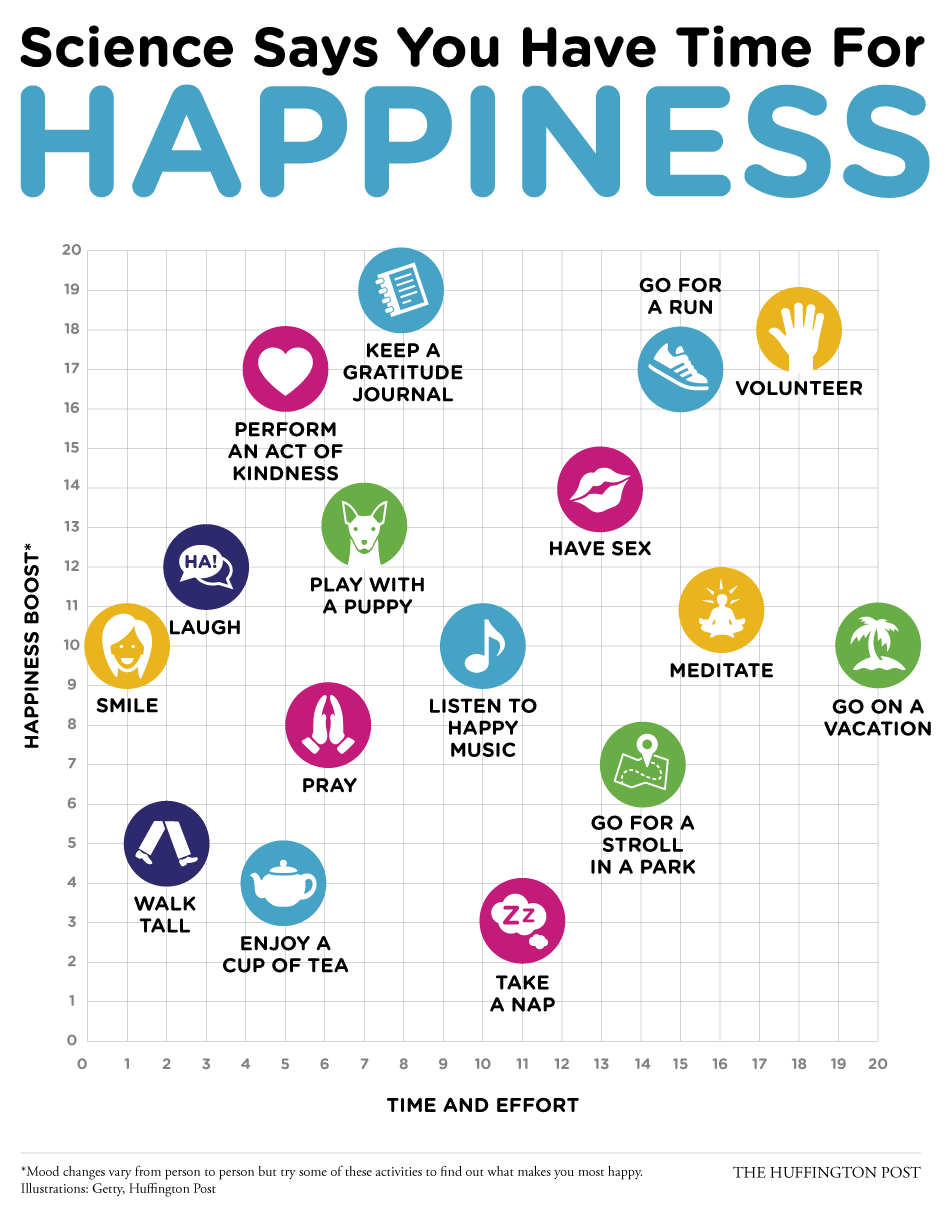
I’ve read a lot of books about happiness, but this little article on the Huffington Post really caught my attention with this simple and useful infographic. Click through on the link to the Huffington Post in that sentence to find the links to the studies backing the creation of this image.

2013_HappinessMatrix

Nice, huh?

Good to see how you can easily boost happiness simply by smiling (warning: the smiles have to be authentic – artificial smiles don’t work!) And I am really struck by the power of gratitude, and by performing acts of kindness.

So, how about just taking those three, and trying them out for the next few days. Start a gratitude journal and write in once a day, maybe preferably at night before bedtime……just list, and write a sentence or two about, whatever you experienced today that you feel grateful for, or write about who you are grateful to, and why. Set out each day to perform at least one act of kindness, or, even better, see if you can speak kindly and act kindly all day long. Finally, play some music which makes you smile, or look at some photos which make you smile, or delve into your memory banks for moments in your life which made you smile.

Read Full Post »

Here’s an interesting article about patients with dementia.

It focuses on interaction. This particular piece gives examples from America where Catholic and other Christian care homes introduced regular services of prayers and hymns, and showed how these old traditions connected with the patients when other forms of care didn’t. I don’t think this means that Catholic or other religious people have, or can have, a better experience of dementia than others, but I do think it highlights yet again the need for carers to be non-judgemental. Where a person has strong religious beliefs, engaging with them through their lens of understanding can really bring about surprising changes.

But what I especially like about this article is how it highlights three things – the need for compassion, the need to remember that all human beings are individuals, and the need to enter into active engaged relationships.

Like anything else in medicine, helping someone suffering from dementia requires understanding, compassion, and dedication. Care needs to be tailored to each patient’s personality, life history, and stage in the development of the disease. When this is done well, new possibilities open up. What might have been an atmosphere of regret and hopelessness centered on the disease’s relentless progress can be transformed into an upbeat outlook that celebrates abilities, rejoices in moments of recognition, and looks to the future with hope.

and

We simply do not know what is transpiring in the mind of another person. It is all too easy to place all the blame on the dementia patient, lamenting and even despising their disability. But were we to do so, we would be letting ourselves off the hook a bit too soon. Awareness, understanding, and affection are not merely the outputs of some inner dynamo. They also emerge in response to what others do, say, and feel. In some cases, unresponsiveness may say less about a patient’s disability than a failure on our part to offer something worth responding to.


Read Full Post »

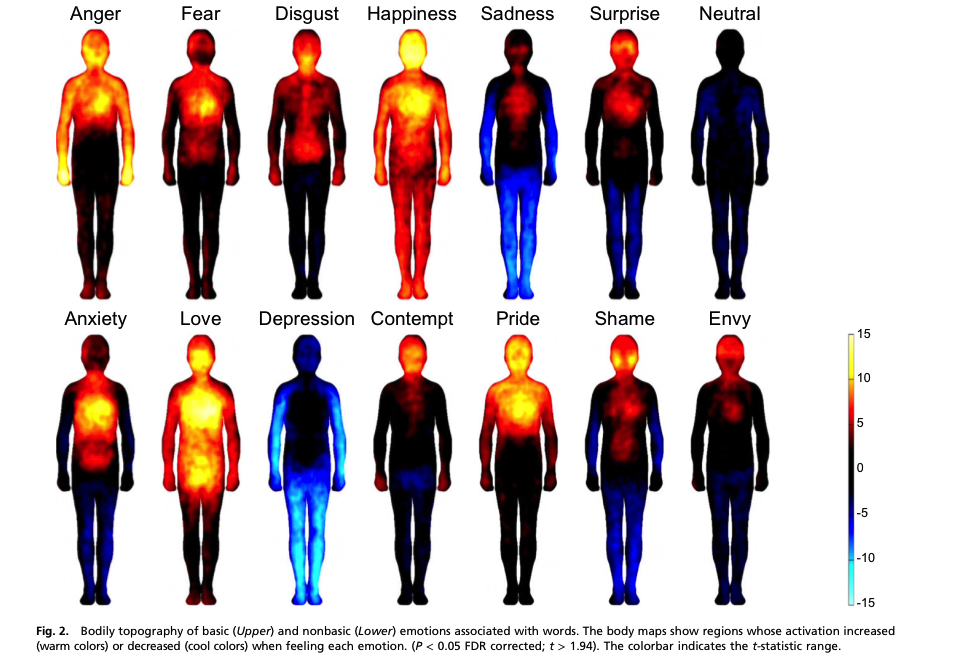
Here’s a fascinating study of 700 people asked to record what happened in different parts of their bodies when they experienced different emotions.

You’ve probably come across the idea of embodied cognition and embodied metaphors (briefly, we now know there are neural networks around the hollow organs of the body, especially the heart and the intestines, revealing that we don’t do all our cognitive work inside our skulls! and that metaphors like “heart broken”, “heart to heart”, “gut feeling” and so on, demonstrate how we experience the whole world through our whole being – body and mind)

This particular study is a self-reported one – it does not show physiological body changes, rather a representation of what people say they experience subjectively. Look at the beautiful summary image they produced –

embodied


How well does this show the shutdown experience of depression, the fist clenching of anger, the whole body experience of happiness, the links between anxiety and fear, or between shame and disgust, or between envy and contempt?

Another thing that strikes me about this is the degree to which the shutting down in depression is focused in the limbs – which makes me wonder about the links we are discovering about the healing power of exercise.

Interesting, huh?

Read Full Post »

(Part 1)

I was taught that bad medical practice was to prescribe a pill for every ill.

I especially remember sessions where we had to reflect on our use of the prescribing pad, asking ourselves exactly why we were choosing to prescribe at all, not just why we chose a particular drug.

That teaching may be long since gone. Prescribing rates grow exponentially. I read the other day about the number of prescription drugs found in waste water in cities, and how around 70% of adult Americans now take at least one prescription drug every day.

I wonder why that is. Why are more and more people being prescribed more and more drugs? Are we, as a species, becoming sicker and sicker? Is it because the drug companies “don’t sell drugs. They sell lies about drugs“? Is it because of the distortion of “evidence” by drug companies?

I think it is at least in part due to the fact that modern medicine is practised on the basis of a delusion that human beings are complicated machines. They are not. They are complex organisms.There is a huge difference. When you see a person as a machine with a part which doesn’t work, the idea that you can sort that part with a drug makes some kind of sense. What’s lost in this way of thinking is a very, very important truth.

The only healing which occurs is natural healing. It is the person’s own healing system which gets the results. Drugs, if they do anything useful, act as adjuncts to steady things up whilst the body gets on with sorting itself out. There is not a drug on the market which directly cures anything. Benjamin Franklin said “God heals and the doctor takes the fee” – same observation, framed in a particular way.

So, given that the truth is we don’t have any drugs which cure, and its only the natural self-healing capacities of the human being which actually repair tissue, and restore health, then why don’t we FIRST of all seek to stimulate and support self-healing, self-care and self-repair, and ONLY when necessary, support the process with a carefully prescribed drug?

The problem with the data, algorithm, drug model of medical practice is that all roads lead to drugs.

We need new maps. We need to be able to understand how to set the conditions for recovery, for resilience and for health. We need to understand how to live differently to have sustainable health, and to maximise health when we have a chronic condition.

Read Full Post »

The NHS in England is trying out an approach to Primary Care where the patient accesses the GP Practice website, completes an online questionnaire about their symptoms, has their identity checked by a member of staff on the phone, then receives a prescription for a drug.
This is pretty much what happened during the great swine flu epidemic, except I think they skipped the ID check – answer 4 questions online correctly and win a box of Tamiflu. Honestly, I thought Medicine had reached a new low at that point.

Here’s what I was taught at Edinburgh University then subsequently in GP training –
Start with the patient’s history. By the time you’ve taken the history you should have a diagnosis, or a differential diagnosis (a list of possibilities).
Next do a physical exam as needed to confirm the diagnosis
If you still haven’t confirmed the diagnosis, then ask for any investigation which potentially will confirm the diagnosis.
The next stage is treatment options (I’ll come to that later)

I was taught the history is not a data set. It is a narrative. Patients come and tell a story. They don’t come to share data.
Data can be collected on examination and investigation which can help inform the doctor and the patient but data is NOT “the truth, the whole truth, and nothing but the truth”
Human beings cannot be reduced to data sets. Mary Midgely, the philosopher, said

One cannot claim to know somebody merely because one has collected a pile of printed information about them

As a GP I learned that some people present with “minor” ailments as a “ticket” to access the doctor. There is actually a bigger issue they want to address (often emotional, psychological or related to a more chronic symptom) and the “minor” ailment is what precipitates the appointment request – it is neither the sole reason, nor even the main reason for the consultation.

As a GP I learned that noticing the patient’s body language, their speech pattern, their hesitancies and word choices opened up the potential to explore what they were really experiencing and concerned about – and so allowed a fuller, “better” diagnosis – and so a more appropriate treatment.

As a GP I learned that eye contact, my body language, the way I formed a question all either opened up, or closed down, possible other avenues to explore with a patient.

How often has a patient told me something important only to add they had never before told that to anyone?

What about patient centred care and compassion? Human beings don’t fit algorithms. Human beings, as complex adaptive systems (CAS), are open, emergent, dynamic, changing, contextually embedded creatures. What algorithms have been invented which can cope with the complexity of individuality? The complexity of everyday living?

We can squeeze people into algorithms, but we can’t make algorithms which fit the breadth and depth of natural variety.

And this is the heart of my concern.

Is the practice of Human Medicine about the health of human beings? If it is, we have to work with the reality of what a human being is. A complex, conscious living being who communicates and makes sense of the world through narrative, and who is embedded in a web of interconnections which inform their values and their choices. If it is, we have to work with the reality of diversity and uniqueness.

Please, please, let’s emphasise the need for a scientific approach to human health – one which is based on the science of living creatures, not one based on a delusional reductionist, materialistic science of complicated machines.

We are heroes, not zombies.

Read Full Post »

« Newer Posts - Older Posts »