Feeds:
Posts
Comments

Archive for the ‘from the consulting room’ Category

We are a pattern-spotting, and pattern-creating species. This is a brilliant quality to possess. It allows us to make sense of very complex systems, to engage with Life and phenomena holistically and to see (or create) the meaning behind our daily perceptions and experiences.

eye of the tree

Margaret Wheatley, in her Leadership and the New Science, says

Wholeness is revealed only as shapes, not facts. Systems reveal themselves as patterns, not as isolated incidents or data points.

Further, she says,

It is the nature of life to organise into patterns

morse moss


What patterns do you see today?

What patterns touch you, capture your attention, or help you make sense of things?

Every consultation I do, I sit with a patient and we have a conversation. It’s best if I do most of the listening, and stimulate the odd reflection when I begin to discern patterns. At the simplest of levels I was taught diagnosis at Medical School. I still think we make the best diagnoses by quickly spotting the patterns – the connections and inter-connections between the elements of a story, the symptoms expressed, the signs and changes manifested, and recognising the pattern which holds this all together.

At the deepest level there are a multiple of patterns in every person’s life, each interacting and interweaving to create ever more beautiful and amazing spiralling narratives. This is how we get to know each other. This is how we get to know ourselves.

Let’s make some new patterns together……how about it?


zen garden

Read Full Post »

What’s with all the war language these days? The War on Terror. The War on Drugs. The War against Cancer. Winning the battles against bacteria and viruses. And all the disease-focused charities – “beating cancer”, a recent one in Scotland “let’s take this outside, cancer”, “help win the war against heart disease”, “beat obesity” and on and on and on……

What are these wars exactly? And what would winning them look like? A world which eliminated these “enemies”? When it comes to bacteria, have a read at the chapter in Howard Bloom’s “Global Brain” about bacteria – is there any other life form on the planet which has been able to adapt to, and colonise such an incredible diversity of environments? Some live in us. Some live in the mouths of volcanoes which are erupting miles under the oceans! They demonstrate fabulous adaptive powers…..we see that in how they “learn” to resist toxic drugs which we throw into the environment and they can spread that knowledge around the globe with fantastic speed. Anyway, we don’t want a world without bacteria. We’d die. Did you know that apparently there is ten times as much bacterial DNA in YOU than there is your own DNA? Pretty mind boggling.

I enjoyed Howard Bloom’s “Global Brain” but he did emphasise the competitive element of Life too much for me.

But wait, I hear you say, surely competition is the ESSENCE of Life! At least, isn’t that what we learned from Darwin and from his followers? “Nature red in tooth and claw” and all that?

I think that’s partly where we’ve gone wrong. Yes competition is a strong part of Life. To deny that would be to deny reality. But that is not the same as doing battle or waging war. Think about sports like athletics, cycling or ice skating for example. The winner of those competitions is the person who performs the best. Usually the person who does the best and wins the medals is achieving their “personal best” too. They win by being the best they can be. They don’t win by waging war on the other competitors. Competition, in other words, can bring out the absolute best in people by being focused on the self – by trying to achieve one’s personal best. Yes, I know other sports are not like that. There are sports where you have to harm your competitors to win – boxing being the obvious example. But most sports, it seems to me are not like boxing. Maybe we should award “personal best medals” at competitions as well as “best competition performance medals”?

But the other big thing that is missing in this focus on war and battle is co-operation and collaboration. No, I’ll go further, it neglects the importance of the inextricable links between us, about our co-evolution, our co-dependence. Read books like, The Bond, Connected, Linked and you might start to see things differently. What matters in the evolution of complex adaptive systems is the connections, the relationships between the parts.

We won’t win these so called wars. What we should be doing is trying our best to be the best us we can be. We should be encouraging diversity, flexibility, autonomy, the building of mutually enhancing bonds between us and between ourselves and other aspects of Nature. Only down that road will we adapt, grow and thrive…….

Read Full Post »

The GMC has recently revised its guidance on prescribing. Here’s the relevant paragraphs related to what a doctor is expected to do before they issue a prescription –

3. For a relationship between doctor and patient to be effective, it should be a partnership based on openness, trust and good communication.  Each person has a role to play in making decisions about treatment or care.
4. No single approach to discussions about treatment or care will suit every patient, or apply in all circumstances. Individual patients may want more or less information or involvement in making decisions depending on their circumstances or wishes. And some patients may need additional support to understand information and express their views and preferences
5. If patients have capacity to make decisions for themselves, a basic model applies:
a. The doctor and patient make an assessment of the patient’s condition, taking into account the patient’s medical history, views, experience and knowledge.
b. The doctor uses specialist knowledge and experience and clinical judgement, and the patient’s views and understanding of their condition, to identify which investigations or treatments are likely to result in overall benefit for the patient. The doctor explains the options to the patient, setting out the potential benefits, risks, burdens and side effects of each option, including the option to have no treatment. The doctor may recommend a particular option which they believe to be best for the patient, but they must not put pressure on the patient to accept their advice.
c. The patient weighs up the potential benefits, risks and burdens of the various options as well as any non-clinical issues that are relevant to them. The patient decides whether to accept any of the options and, if so, which one. They also have the right to accept or refuse an option for a reason that may seem irrational to the doctor, or for no reason at all.
d. If the patient asks for a treatment that the doctor considers would not be of overall benefit to them, the doctor should discuss the issues with the patient and explore the reasons for their request. If, after discussion, the doctor still considers that the treatment would not be of overall benefit to the patient, they do not have to provide the treatment. But they should explain their reasons to the patient, and explain any other options that are available, including the option to seek a second opinion.
What interests me most about this is that the GMC is absolutely clear that health care is a partnership. We often seem to deliver health care as if the expert knows everything and the patient knows nothing. But, in fact, the GMC expects that doctors will act more as expert advisors to enable patients to make their own choices, and that whilst the doctor does not need to defer to the patient’s choice, neither does the patient have to defer to this particular doctor’s choice.

Read Full Post »

There is a big difference between what is complicated and what is complex.
A machine can be very complicated. As cars have become ever more sophisticated they have become more complicated. It’s not easy to see what’s wrong when your car breaks down, unless you have learned how it works.
Machines are made up of different parts, and there may be hundreds or thousands of parts in a machine but we can still learn exactly how it works and how to fix it by learning bit by bit just how each part works and how it affects any other part.
People on the other hand are complex. We also are made up of many many parts, billions and billions of cells, each of which is an agent acting on many other cells, and each of which, in turn is acted upon by many other cells. In fact, through the multiplicity of interactive connections which exist, it becomes impossible to deal with any single part in isolation, or, indeed, to be able to accurately predict the over all effects of any single change. It’s parts don’t necessarily function the same way in isolation as they do when under the influence of their multiple connections.
This structure makes the organism a complex one, not a complicated one.
Here is the key difference –
A complicated structure can be understood by understanding its individual parts.
A complex one can only be understood as a whole.

Read Full Post »

Health is not a THING.

Health is not an entity or a product.

Health is more than the sum of the set of “normal” measurements.

Health is a lived experience.

As an experience, health is a characteristic described by the experiencing person, by the subject. Without a person to experience health, there is no health.

So, why do we deliver health care by treating diseases and people as objects, or by processing people to reach pre-determined targets, which might have precious little to do with the experience of health?

The shocking report on Stafford Hospital, suggesting between 400 and 1200 patients might have died due to the way they were treated in the hospital concludes that

“There was a lack of care, compassion, humanity and leadership,” he said. “The most basic standards of care were not observed and fundamental rights to dignity were not respected.”

Chris Ham of the Kings fund says

The priority must be to shift from a culture in which the behaviour of staff is driven by compliance with targets to one in which there is a real commitment to patient-centred care in every hospital and surgery

But so far the government’s response seems to be to drive towards greater compliance with tougher regulation and inspections.

The problem isn’t one of control, it’s one of “care, compassion and humanity”. How did the Health Service come to this?

Increasingly we treat health care delivery in the same way we treat a business or a factory, by measuring, standardising, and enforcing compliance. None of that seems to be improving the experience of health care because none of that is based on the fact that health is a lived experience, not a product.

Every single human being is unique.

Every life is unpredictable.

A truly patient-centred care will consider the uniqueness of the individual at all stages in the health care journey, and will require imagination – the imagination needed to enable health care workers and managers to imagine what it would be like to experience what the patients are experiencing.It will also take a lot of non-judgemental listening. Without really hearing a person’s story, we fail to know their uniqueness, fail to comprehend or consider their beliefs, values or wishes.

The Stafford story is not the end of the story. It’s probably the tip of an iceberg. Maybe now is a wake up call for all of health care. Maybe now is the time to reconsider the commodified, reductionist, materialistic basis of the current model which pushes more and more drugs into more and more people every single year, and processes more and more people through hospital beds ever more quickly.

After all, if health is an experience, we should design health care around making personal experiences better.

Check out the manifesto for slow medicine.

Read Full Post »

Each of us lives out a story, a dynamic narrative whose only consistency is that we somehow show up in each of the scenes. While the plots line may be unknown to us, there is one. Creating a Life. James Hollis

We know ourselves and others through the stories we tell. We create meaning and gain an understanding of the events and experiences of our lives by creating a narrative. And isn’t that quote so true? Doesn’t it sometimes seem as if the only constant in our life story is that we show up in each of the scenes. All of life, the world we live in and experience, is woven into these stories, which always, in some way, contain ourselves.

But what about this idea of a plot? Because doesn’t it happen to all of us that from time to time we lost the plot? In fact, don’t many people never seem to have a grasp of the plot? Well, an interesting factor in the creation of the plot comes from thinking about Fate.

What is fate?

The narrower the frame of consciousness, the greater the personal chronicle plays out as fate…what is denied inwardly, will come to us as Fate. Creating a Life. James Hollis

Of course, we have the hand we are dealt too, as part of Fate. Sir Harry Burns, the Chief Medical Officer of Scotland, in discussing the problems of ill health in Scotland points the discovery that a grandfather’s experience can alter his genes and so pass on influences that way through his children and even their children too. We can’t understand a person, or their plot, without seeing who they are within more than their own personal lifetime. We have to consider their genetic, familial, cultural and societal contexts and influences, most of which may shape the unconscious more than they shape the conscious. Living a zombie life, on automatic pilot, will be experienced as a life dominated by Fate, but waking up, becoming conscious, examining our own lives, gives us the chance to become the heroes of our own personal stories.

Plot is partly unearthed, and partly created.

Read Full Post »

As Howard Bloom points out in The Global Brain, there are a couple of opposite but essential drivers at the heart of complex systems – conformity enforcers and diversity generators.

We need both. But we need both to work together in an integrated way. If there’s too much of either growth, development and evolution is impeded.

Diversity generators don’t just tolerate difference but give highest value to uniqueness. Conformity enforcers, on the other hand, operate by eliminating difference, setting standards and rules and making sure the whole system is compliant.

In health care, it seems to me, we have an excess of conformity enforcement. The “evidence based” enforcers seek to “eliminate variation” by developing flow chart style protocols where every single patient is entered into the same pathway and is treated according to the same, limited range of interventions. There is a belief that the raw material of patients can be entered into the same machine and will come out the other end with the same product or “outcome”.

But life isn’t like that. Every single human being is unique. There isn’t a single health care intervention in the world which produces the same outcome for every patient who receives it. There’s something essentially dehumanising about the enforcement of conformity on the rich diversity of individuals.

I’m a champion for diversity and tolerance. I think it’s richer than uniformity and conformity. I don’t deny that we need some level of conformity (without it we’d have disintegration and chaos), but I think we’ve gone too far. Not just in health care but in many, many areas of modern society – education, politics, economics…….

Where do you put your energies? Are you throwing your weight behind diversity generation or conformity enforcement?


Read Full Post »

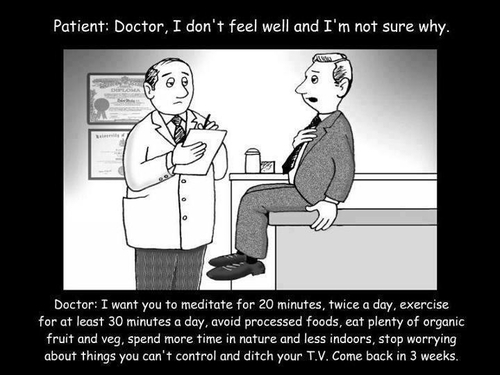
I saw this cartoon the other day and there was immediately something about it that bothered me….
IMG_0354

……what was it?

The advice from the doctor….well, I say all of those things. Not exactly as said here, but pretty close. I suspect any doctor giving advice about health probably covers a selection of these points nowadays. Maybe some would talk about “5 a day” instead of “plenty of organic fruit and veg”, and some would mention stopping smoking and drinking in moderation, but it really covers the common advice.

So, what’s the problem?

Well, the problem is you can imagine from this cartoon that this advice has become like a standard prescription. A modern panacea. Doesn’t matter who the person is, or what they are complaining about, here’s the same advice.

Who is this man in the grey suit? When he says he doesn’t feel well, what exactly does he feel? And what really are his concerns? Why has he come to the doctor as this particular point? In other words, who is he, what kind of life does he lead, and how does his illness experience fit into his life story? (There’s a clue that he is seeking a meaning when he says “I’m not sure why”

What’s missing?

The person – because we aren’t hearing the story.

Here’s the text of a post I wrote on this blog four years ago about the importance of story (the importance of story, you’ll see, is a main theme of this blog)

The people who come to see us bring us their stories. They hope they tell them well enough so that we understand the truth of their lives. They hope we know how to interpret their stories correctly. We have to remember that what we hear is their story.

Robert Coles in “The Call of Stories”.

Stories have always fascinated me. I love them. Every day when I sit in my consulting room patients tell me the most amazing, fascinating and unique stories. As a medical student I was taught how to “take a history” – I hate that phrase actually – who’s doing the “taking” and what exactly are they “taking” and from whom? Doesn’t seem right to me at all. Instead I prefer teaching medical students how to listen to patients’ stories. However, the point is that this is the beginning of all diagnosis. To a certain extent listening to the patient’s story is a diminished art. There’s an over-reliance on technology and a lot of doctors just don’t seem to be able to make a diagnosis without a test these days. Diagnosis is a form of understanding. It’s a process of trying to make sense of somebody’s experience.

If stories are so important in clinical practice, then how can I learn to handle them better I wondered? There is a developing area of medicine known as “narrative-based practice”, with associated “narrative-based research” methodologies, but materially-orientated, reductionist scientists look down on narrative. They prefer data. So, when I started to study narrative (which, technically is the story AND the way that story is told), I couldn’t find much work from a scientific perspective. I had to turn to the humanities.

One of the books which I really love in this area of study is “On Stories” by Richard Kearney (ISBN 9-780415-247986). Not only is it a fabulous exploration of the place of story in human life, but it’s written completely beautifully. Richard Kearney is a philosopher but he’s also a magnificent writer. This one book taught me more about the importance of story than any other.

Telling stories is as basic to human beings as eating. More so, in fact, for while food makes us live, stories are what make our lives worth living.

This sets stories at the heart of human existence – not optional, but essential.

Aristotle says in “Poetics” that storytelling is what gives us a shareable world.

The key word there is “shareable”. It’s through the use of story that we communicate our subjective experience and its through the sharing of subjective experience that we connect, and identify with others.

Without this transition from nature to narrative, from time suffered to time enacted and enunciated, it is debatable whether a merely biological life could ever be considered a truly human one.

Beautifully expressed. Sets narrative at the heart of what it means to be human and stands it against those who would take a materialistic view of life which they claim can be reduced to data sets and DNA.

Every life is in search of a narrative. We all seek, willy-nilly, to introduce some kind of concord into the everyday discord.

This is one of my favourite lines in the whole book. This is exactly the power of story – it enables us to “get a handle on” life, to bring some kind of order out of chaos.

What does Richard Kearney mean by story then? Well, I’ll finish this post with two more quotes from his book which make it very clear and very simple.

When someone asks you who you are, you tell your story. That is, you recount your present condition in the light of past memories and future anticipations.

This shows that story collapses time, bringing the past and the future into the present. Story telling requires memory, imagination and expression.

Every story requires –

a teller, a tale, something told about, and a recipient of the tale.

Nice and simple, but what profundity lies in there. For every story, there is a unique human being doing the telling, there is the story itself and its subject matter, and, very importantly there’s the recipient – the listener or the reader. Story is, as Aristotle said, a way of creating a shareable world. That’s the greatest potential of blogs, I reckon. By sharing our stories we create a shared world. Yes, sure, stories can divide as well as connect, but without stories, there is no potential for connection, no potential for compassion and no potential for the creation of a meaning-full, and better world.

Read Full Post »

The self is relatedness. The self doesn’t exist without relationship. The self appears in your deeds, and deeds always mean relationship.

James Hollis wrote that. It stopped me. You find there are books like that, don’t you? Books which you can’t read all the way through without stopping. I don’t mean the stopping for tea, or to answer the phone. I mean that stopping in the middle of the page, or anywhere in the page actually, because what you just read provokes such a mental reaction. This was one of the many places where I stopped when reading Creating a Life by James Hollis.
My first thought was, “how true”. I see connections everywhere, and I see the constancy of change. In fact, that is so important to me that I put the phrase, “becoming not being….” as the sub-head of this blog.
We are constantly becoming, ever interacting, exchanging, adapting and changing.
So, it’s true. The self doesn’t exist without relationship. I’ve thought many times that you could never know a person by observing them, through a one way glass,in an empty room. You have to see how a person interacts, with you, or with others, to have any sense of who they are.
Reminds me too, of “Ubuntu” – “I am because you are”
But then it seemed to me he’d gone too far when he added “deeds always mean relationship”.
Surely there must be deeds we commit alone?
But hold on, am I narrowing the definition of relationship too far here? Am I assuming a relationship is between two PEOPLE?
What about how I relate to Nature, to the built environment, to music and images and art? To this very book I am reading in fact!
It’s true what he says – the self really does appear in our actions, our reactions, and our interactions. It’s not a phenomenon which emerges in total isolation (even our memories and our imaginings are the creation of relationships aren’t they?)
So here’s something to consider today – what sense of self do I notice emerging from my deeds? my choices? my interactions?

Read Full Post »

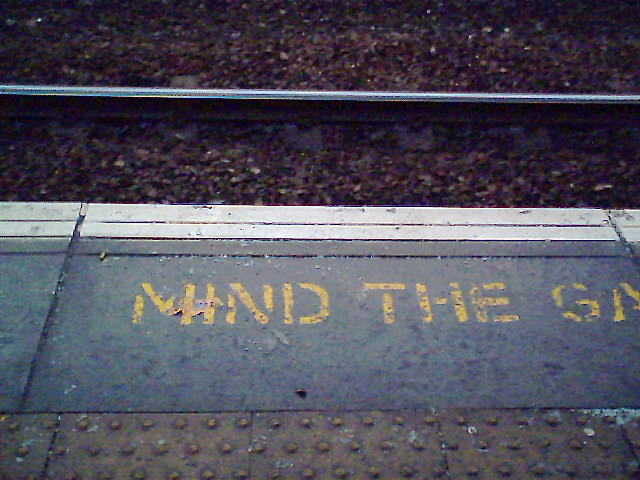
mindthegap.jpg


I come across this issue all the time – there is a gap between reality and fantasy, and that’s where suffering occurs.

By fantasy, I really mean imagination, but that includes hopes, dreams, and idealised wishes for how things could be. It includes memories too, because I don’t believe memories are like objects tucked into some cerebral drawer – we recreate them, imagine them anew, every time we bring them into the present.

Some terrible things happen to people. Things that will never go away. And those things keep jumping into the present. We wish those memories weren’t there. We wish those things had never happened, those words had never been said, those choices had never been made. But they did and they were. And in that gap, in that space or difference between how we wish things had been and how they actually were, there’s where suffering lies – hurt, pain, anger, sadness, regret…..

Some people imagine how things might turn out, and those imaginings might either be terrible and they live them now in the fears and paralysing anxieties which emerge in the space between the awful future and the actual present. Or they imagine how things would be so much better than they are and in that gap they find frustration, dissatisfaction and discontent.

What do we can we do with this gap? Can we narrow it a bit, even if we can’t make it go away?

Partly. But, wait a minute. Should our first thought be “let’s get rid of this suffering”? Because if it is, we might reach for the painkillers and the sedatives, or hit the escape routes, before we understand what this pain is about. Might it not be better to see if we can see what the roots of this pain are? Where is it coming from? Why is it here? What sense do I make of it? We are meaning seeking creatures and we want to make sense of lives. What sense do we make of this particular suffering? What it is telling us?

Sometimes, when we understand the suffering better, we understand that something needs to change, that we need to make different choices. And sometimes when we understand it better, we realise that right now, right here, in the present moment, we are actually ok. Better than that, we discover that the everyday, so called ordinary world, right here, right now, is extraordinary and amazing, and that our suffering is fear or anxiety about what might be, overwhelming the present moment and hiding from us the fact that life, here and now, is not just welcome, but something to be grateful for.

There’s another role for suffering of course – creative energy. In the gap between how things are and how we imagine they could be, dissatisfaction or discontent can drive creative solutions, generate new ways of thinking or inspirational art. (I’m not saying you have to suffer to create great art – I’m just saying that sometimes great artists turn their alchemical skills to their suffering and their struggles and create gold)

Anyway, however you handle it, whatever choices you make, next time you feel you are suffering…..Mind the Gap – and reflect on why it’s there. Then you might be able to make a different choice.

Read Full Post »

« Newer Posts - Older Posts »