Feeds:
Posts
Comments

Archive for the ‘from the consulting room’ Category

Stumbled across a fabulous extract from Marilynne Robinson’s new book. Here’s just one of the paragraphs which hooked me –

There is a great difference, in fiction and in life, between knowing someone and knowing aboutsomeone. When a writer knows about his character, he is writing for plot. When he knows his character, he is writing to explore, to feel reality on a set of nerves somehow not quite his own. Words like “sympathy,” “empathy,” and “compassion” are overworked and overcharged—there is no word for the experience of seeing an embrace at a subway stop or hearing an argument at the next table in a restaurant. Every such instant has its own emotional coloration, which memory retains or heightens, and so the most sidelong, unintended moment becomes a part of what we have seen of the world. Then, I suppose, these moments, as they have seemed to us, constellate themselves into something a little like a spirit, a little like a human presence in its mystery and distinctiveness.

She’s writing about writing fiction of course, but the insight is applicable to life too, don’t you think? I recall Dan Siegel’s great line about the importance of “feeling felt”. I think that, as a doctor, it’s these little moments which are all around us every day, if we can only be sufficiently present and aware to notice them, which embed their constellations of human emotion into our psyches. I do believe, it’s these, and all the others I encounter in the everyday clinic, which create the conditions for understanding – for my understanding of those who come to me to be heard and to be felt.

This is the essence of “healing”.

Read Full Post »

The French do seem to have a different way of viewing Life from the British. That’s one of the reasons I really enjoy reading French publications, and one of my regulars is a magazine called “Cles“. In the most recent issue they have a thought provoking and different article about dieting. In “Cles” there is a regular section dedicated to articles which promote a “Slow movement” approach to Life, and in this month’s issue they take on dieting. (“Slow minceur, le corps tranquille”).

Essentially, the article advocates this approach to diet.

1. Don’t go on a diet.

2. Instead, slow down and really enjoy your food. For the French enjoying your food is about more than just the taste, the colour and smell of the food. It’s about the whole experience of enjoying a meal….the environment, the aesthetics, the company you share. The article doesn’t use the word “mindful” but such a concept would be consistent with this message – eat mindfully – slowly, really savouring and appreciating what you are eating, and the experience of the meal.

3. Stop when you’ve had enough. Sound straightforward? Maybe not so easy because we tend to have bad habits related to eating way too large portions, either because we were taught to clear our plates, or because we think more food for less money is a bargain. However, if you are eating mindfully, you’ll become aware when your body has had enough. And at that point, you can stop!

4. Learn to handle your emotions without reverting to food. In fact, the article quotes a David O’Hare whose book is entitled “Maigrir par la cohérence cardiaque” (which sounds like Heartmath to me, but see here).

5. Finally, they recommend not cutting out anything, but instead steadily eating a little less, moving a little more, and accepting that it will take a long time to lose a significant amount of weight ie take away any performance or fear of failure anxiety induced by setting short term targets.

What do you think? Maybe this way isn’t for you, but it’s sure different, and as we are all different, it’s good to have a range of possible strategies available, isn’t it?

Read Full Post »

“seeing the person in the patient” caught my eye as I read this letter in last week’s BMJ –

The key to the successful management of comorbidities (and all illness) is to “see the person in the patient.” That is not easy for doctors who see patients only briefly and tend to use that time to focus on their patients’ illnesses. At 68 years of age and with a fine collection of comorbidities of my own, I speak from experience. The key to success in treating comorbidities is to discover what motivates patients, what their ambitions and aspirations are, what they would like to be able to do, and then to agree with patients an individual care plan that accommodates all of their conditions, is practicable from their point of view, and which will—as far as possible—enable the fulfilment of those aspirations. Kamerow is right that dealing with such patients is logically a primary care issue but, in the UK at least, that is not simple. In my GP practice, I rarely see the same GP twice in succession, so continuity of care has something of a hollow ring to it. Perhaps there is a case for a GP with a special interest in comorbidities, or are there so many of us with comorbidities that no GPs would be left to treat acute illnesses?

The letter is written by Peter Lapsley, who is described as the BMJ’s “patient editor” (not sure what that is, but I really agree with his comments). He was writing in response to a piece by Kamerow about the difficulties in dealing with patients who have more than one thing wrong with them – “comorbidities”. The problem is that the reductionist approach to illness compartmentalises people into bits, trying to find and define the wonky bits (my term!) and fix them. This approach uses guidelines and algorithms created from reviews of research into treatments for individual diseases – pretty much always conducted on patients with just one thing wrong with them.

Actually, as Peter Lapsley points out, the problem is resolved by focusing on the person instead of the individual diseases.

The trouble is that takes time, a holistic, patient-centred approach, and a real effort to understand what’s important to the patient and responding to their aspirations and values. It absolutely is not a one-size-fits-all approach to health care. It’s time to stop trying to squeeze everyone into protocols and rediscover the value of both continuity of care and the importance of focusing on the human, or the “person”. This is especially true when dealing with people who have long term conditions.

(I’ll declare an interest here – where I work we deliver 100% continuity of care, and we completely focus on the individual and help them find a way to better health according to their aspirations and values)

Read Full Post »

More of us are living more years than our ancestors did. That’s often presented as a problem. How will we afford all the pensions? How will we afford to pay for the extra care these millions of additional frail people will need? How will we afford to pay for the extra years of drugs they’ll be prescribed?

And what about respect for the elderly? Do we see this increase in the numbers of older people as providing us with unique resources of knowledge, wisdom, care, love, support?

How refreshing to read the words of Herman Hesse on this subject –

Aging is far from being only a process of reducing, wilting and fading. Old age, like every other stage of life has its own merits, its own magic, its own wisdom, its own sorrow.
Whoever becomes old consciously, can observe that in spite of diminishing powers and potencies, every ear brings an increase and an enhancement in the infinite web of relations and connections.

Oh, I so understand that last point in particular. With my now five grandchildren my web of relations and connections has been enhanced amazingly. And over the last few years, with teaching in different countries, and writing this blog, I’ve made many, many new friends and connections, meeting such different people who so often shift my perspectives and make my world a bigger, yet smaller place!

Here’s more from Hesse on the benefits of aging –

…increased independence from the judgement of others, less vulnerability to compulsion and more undisturbed reverence before the eternal

You should have been with me this morning when one of my very sprightly, beautifully dressed, 86 year old patients told me as I asked her if she was ok to climb the staircase with me to my consulting room, “that’s a beautiful, straight bannister on this staircase. Maybe I’ll slide down it on my way out!” ……made my day!

Read Full Post »

Thomas Berry, in “The Great Work” describes a creative tension which exists in the universe. He uses the terms “wildness” and “discipline”

Wildness we might consider as the root of authentic spontaneities of any being. It is that wellspring of creativity whence come the instinctive activities which enable all living beings to obtain their food, to find shelter, to bring forth their young; to sing and dance and fly through the air and swim through the depths of the sea. This is the same inner tendency that evokes the insight of the poet, the skill of the artist, and the power of the shaman. Something in the wild depths of the human soul finds its fulfilment in the experience of nature’s violent moments.

Throughout the entire world there exists a discipline that holds the energies of the universe in the creative pattern of their activities, although this discipline may not be immediately evident to human perception.

..[the] mutual attraction and mutual limitation of gravitation is, perhaps, the first expression of the primordial model of artistic discipline.

We might consider then, that the wild and the disciplined are the two constituent forces of the universe, the expansive force and the containing force bound into a single universe and expressed in every being in the universe.

This is a beautiful description. Creativity requires both the freedom of play and the discipline of practice (the routine of “showing up every day”). He goes on to relate these ideas to our own solar system.

When first the solar system gathered itself together with the sun as the center surrounded by the nine fragments of matter shaped into planets, the planets that we observe in the sky each night, these were all composed of the same matter; yet Mars turned into rock so firm that nothing fluid can exist there, and Jupiter remained a fiery mass of gases so fluid that nothing firm can exist there. Only the Earth became a living planet filled with those innumerable forms of geological structure and biological expression that we observe throughout the natural world……….The excess of discipline suppressed the wildness of Mars. The excess of wildness overcame the discipline of Jupiter. Their creativity was lost by an excess of one over the other.

Wow! Beautiful story, fabulous imagery, and really a great insight. One thought which comes to mind when reading it is how the brain functions best in what is termed a “near chaos zone”. When thoughts and brain function become completely chaotic we are lost. When the brain function becomes absolutely rigid and fixed we can have seizures. Another thought is about the healthy heart. The intervals between every beat are not exact. The heart is not like a metronome or a machine-like pump. If it does become so rigid in its rhythm then begins to fail. However, if it becomes completely chaotic, it fails too. What we really need is a state of coherence, where the heart rate variability is high but rhythmically so.

Read Full Post »

I often say to patients that there is no healing other than natural healing. What I mean by that is that all the drugs, and all the surgical techniques used in modern medicine, act directly against pathology. None of them actually stimulate or directly support self-healing. Yet that’s the only kind of true healing to exist. An antibiotic might kill a bug, but its the natural self-healing which repairs the tissue damaged by the infection. A broken bone can be held in place, but it’s the natural self-healing which knits the bone back together. I think it was Benjamin Franklin who said “God heals and the doctor takes the fees” – a rather cynical view of the same concept!

Then I came across this passage in Rupert Sheldrake’s The Science Delusion

…it is important to remember that animals and plants have been regenerating after damage, healing themselves and defending themselves against infections throughout the entire history of life on earth. All of us are descended from animal and human forebears that survived and reproduced for hundreds of millions of years before the advent of doctors. We would not be here if it were not for our ancestors’ innate capacities to heal and resist diseases. Medicine can help and enhance these capacities, but it builds on foundations that have evolved over vast aeons of time, continually subject to natural selection.

Actually he’s being quite generous about Medicine here – it can help and enhance – but only in complementary ways. I don’t know of any treatments marketed by drug companies which directly stimulate healing. Rather, they, at best, reduce pathology whilst we hope that the body will get on with healing itself.

Amazing thought though, huh? Every single one of your direct ancestors survived to an age where they could procreate – or you wouldn’t be here today!

Isn’t it time we made available, researched and developed the ways of directly supporting and stimulating self-healing?

Read Full Post »

Read Full Post »

Last year I learned how to teach the Heartmath technique – find out more about Heartmath here.

Here’s a simple guide to the theory and the practice.

Here is a map called “the emotions map”
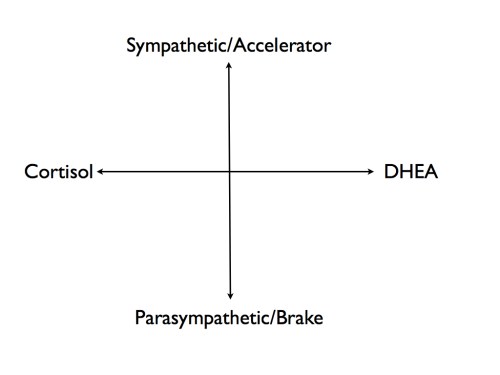
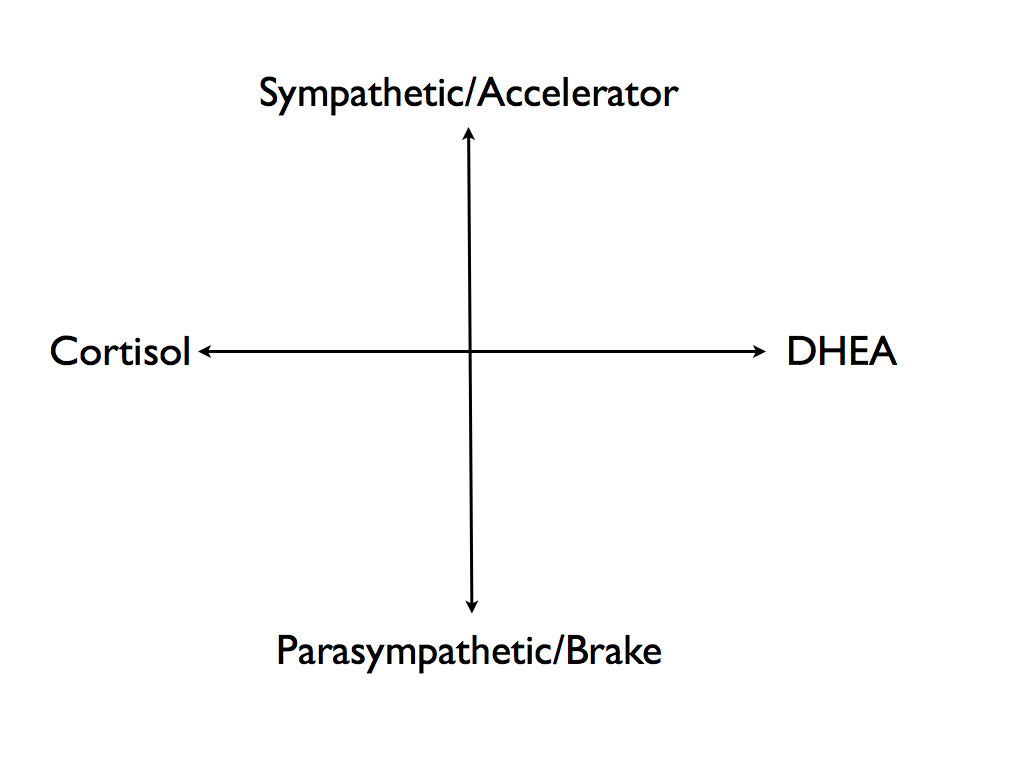
It has two axes – the vertical one shows the “autonomic nervous system” – this is the part of the nervous system which is responsible for the survival responses of “Fight of Flight OR Freeze” reactions. The autonomic nervous system is divided into two pathways – sympathetic and parasympathetic. Think of the sympathetic as being like the accelerator – when it is active there is a lot of adrenaline released into your system, your heart beats faster, your breathing is faster, and your body mobilises oxygen and energy to all your muscles ready to help you “fight or flee”.

The other path is the parasympathetic and can be thought of as a brake – through activation of the “vagus nerve” it slows down the heart, quietens and closes down your systems – the “freeze” reaction. We frequently oscillate wildly between these two extremes, flying from panic to collapse and back again!

The second axis, the horizontal one has one of the body’s main defence hormones at the left – cortisol. This is necessary for normal defence, but in excess cortisol can do a lot of harm. It’s sometimes called the “Stress hormone”. The right hand edge of this axis is “DHEA”, sometimes known as the “vitality hormone” – when there is a lot of this in the body, all the cells age more slowly and growth is stimulated.

What we want to achieve is a harmony of these systems – when we are in the top left quadrant our heart rhythm is chaotic. The heart rate varies all the time in a normal heart, but when the “heart rate variability” is chaotic, we’re not in a good place! Interestingly, when we are in the zone on the right of this chart, our heart slips into “coherence” – a kind of overlaid smooth, harmonious rhythm of the heart rate variability. In coherence we have harmony, we reduce the stress hormones and the excess autonomic activity, and we redress the balance between cortisol and DHEA.

Now here comes the fascinating bit – each of these zones or quadrants is associated with particular emotional states, with particular feelings.
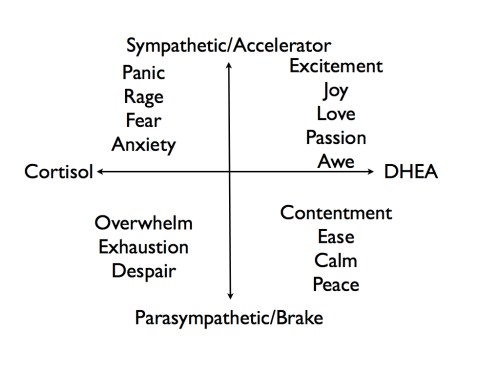
The Heartmath technique consists of re-experiencing one of the “positive” emotions on the right of this chart by recalling and reliving an episode or even where we felt such a feeling.

There are three steps to achieve “Quick Coherence” – a basic Heartmath technique.

Step 1. Heart focus. Bring your attention or your focus to the heart area of your body.

Step 2. Heart breathing. Take three, slow, deep, even breaths, filling the heart area of your body with oxygen, then emptying your lungs of all the carbon dioxide. Slowly in, slowly out, for three breaths.

Step 3. Heart feeling. Now recall an event where you experienced one of the positive, heart felt emotions. Here’s a couple of ones I use to give you an idea of the kind of event I mean. One is one of my grandchildren running up to me, shouting “grandpa!” and jumping up into my arms. That’s a great one! Another is looking out over Ben Ledi from my living room window when we have one of those gorgeous deep red sunsets – just amazing! Pick one of your own, and recollect it. Stay with that memory until you become aware that you are feeling that feeling again. This is about recreating a feeling. Once you have it, that’s it. You’re there.

Congratulations, you just managed “Quick coherence”.

Do check out the Heartmath Institute website – lots of great resources there to explore this technique in more detail!

Read Full Post »
A recent edition of the BMJ took a big focus on the issue of “surrogate outcomes” – in other words, changes in some lab tests instead of changes which matter to the patient.

Does this comment surprise you?

“In order to fully engage our patients in treatment decisions, we must understand how therapies affect outcomes that are important to them,”

It shouldn’t really, but in recent years, certain flavours of “evidence based” enthusiasts have completely dismissed patients reports of differences in their health experience. Often the patients reports are dismissed as either “anecdotes”, as “soft evidence”, or as “just feeling better” (ie not REALLY better – whatever that means!)

I think health is a subjective experience as well as a state of potential change in objective signs or measures. I’m delighted, therefore, to see these calls for a PRIORITY to be given to “outcomes which matter to patients”. After all, whose life is it?

Here are a couple of examples from the BMJ articles –

Citing the 2010 report from the US Institute of Medicine, which urged much greater caution in how we use surrogates, Moynihan called for a shift “from numbers to people” so that patients and doctors stop mistaking “a numerical benefit for a genuine one.”

and

From their perspective within the world of diabetes they warn that surrogates like HbA1c generally show much larger responses to treatment than “hard” outcomes that matter to patients, such as renal and visual impairment or quality of life.

Why are they arguing for this?

What’s the problem with surrogates?

Why have doctors become so invested in surrogate markers? The main reason is that the evidence base is built from trials that focus on the effect on surrogates. Since they respond sooner than outcomes that are important to patients, surrogates are better suited as end points in clinical trials that need to be completed quickly and at low cost. Evidence that builds in this way shapes practice and policy. Consequently, clinicians see this evidence converted into guidelines, quality of care measures, and pay for performance targets. We could speculate that the short term goals of the drug industry contribute to the predominance of surrogates in clinical practice. But this is an oversimplistic analysis. A historical view points more broadly to an alliance of public health advocates, scientists and clinicians, professional societies, and test and treatment companies who see their interests coincide. Idolisation of the surrogate end point has turned doctors away from the focal point of patient centred therapy based on hard end points. (Yudkin)


We need to change this primarily to reduce the potential harms caused by promoting drugs which don’t actually make patients lives better, but where the side effects can be fatal (think flecainide or rosiglitazone), but also….

Focusing on outcomes that matter to patients should improve decision making and patient engagement. It should also stop us spending money on treatments that deliver minimal or no benefit.

Nobody can define “benefit” better than the patient whose life is being affected by the disease and by the treatment.

Read Full Post »

Have you come across the slow movement yet? It started with “slow food”. Slow food, of course, is the opposite of fast food. It’s pretty easy to figure out what a “slow food” movement would be about. Fresh, locally sourced ingredients, individually prepared, and savoured as its eaten. Taking the time to really appreciate each and every mouthful. A bit like “mindful eating” really. 

Next came the “slow city”. The mayor of San Miniato in Italy, with local support declared his town a “slow city”, banning the opening of fast food restaurants and chain stores, encouraging walking, cycling and the nurturing of green public spaces. Several other towns have signed up to these principles creating the “slow city movement”.
There’s a lovely blog named “slow love life“. Read this phrase from its front page….SLOW LOVE means engaging with the world in a considered, compassionate way, appreciating the miraculous beauty of everyday moments, and celebrating the interconnected nature of life”
Then, recently some scientists have called for the formation of a “slow science” movement, posting this manifesto online  and asking for scientists to freed from the perpetual pressures to produce publishable results, to be less outcomes driven, and more exploration driven.
So, how about a “slow medicine” movement? Where doctors, nurses and other health carers take the time to fully understand a person’s illness, and are able to establish therapeutic, compassionate relationships. Where there isn’t a reflex to jump into a “quick fix” by prescribing a drug which will only mask the disease or temporarily modify it. Where it’s a fundamental value to discover what is unique about every individual and to help to stimulate and support every patient’s ability to self heal and self repair. In other words where the focus shifts from short term, outcomes driven goals, to improving quality of life and enabling people to actually develop and grow through the process of being ill.

Acute, fast Medicine
Acute, fast medicine has its place, and that place is at the edge of life. When your illness is sudden and severe I think the advances made in medical technology make a HUGE difference. Quick decisions, and rapid, precise actions bring the ultimate results – the difference between living and dying today.
Acute, fast medicine involves a sharp focus on only what is important to achieve a well defined outcome (not dying for example) in a short period of time (minutes or hours usually).
This model is just not appropriate either for trying to help someone to have a healthy life, or to live a good life in the presence of a chronic disease.
If someone has a condition like diabetes, multiple sclerosis, asthma etc, then using the fast, acute methods to rapidly change a very small part of the whole person is not enough. The timescale of a chronic complaint is weeks, months or even a lifetime. The outcomes which make a difference over that timescale can’t be so easily defined and measured. They are about qualitative rather than quantitative change.
The crucial shift from acute problems to chronic ones involves a broadening of the focus, a deepening of understanding to encompass the whole person inextricably embedded in the multiple contexts of their life.
This takes time, and it takes the establishment and maintenance of a relationship.


Manifesto for Slow Medicine

  • Every person is unique. It takes time to get to know a person. Appointment times should be long enough to discover a person’s uniqueness.
  • Good health care is developed from an understanding of the person who is ill or who wants to stay healthy. Understanding should take place before acting.
  • More than a knowledge of disease is required to deliver good health care. There also needs to be a knowledge of the person. Diagnosis should not be limited to knowledge of disease. It should encompass a knowledge of the person.
  • Doctors, nurses and other healthcare professionals  are people too. Every health care worker is unique. Recognising and nurturing this uniqueness is as important as defining knowledge, skills and attitudes required to carry out tasks.
  • Delivering good health care requires self awareness and understanding on the part of the person who is caring. Reflective practice should include working on personal growth.
  • The core of health care is the relationship between individual people – patients and carers. Priority should be given to the relationship.
  • Good health care is relationship based, not event based.
  • Continuity of care should therefore be given priority in order to support and develop healing relationships.
  • Health care is for life. Defined, time-limited outcomes are arbitrary and are not a substitute for life long care.
  • Health carers should work in supportive, understanding environments which enhance the delivery of healing relationships. These environments are co-created by the leaders, managers and health care professionals working in accord with compassionate, person centred values.

Read Full Post »

« Newer Posts - Older Posts »