Feeds:
Posts
Comments

Archive for the ‘from the dark room’ Category

Water patterns

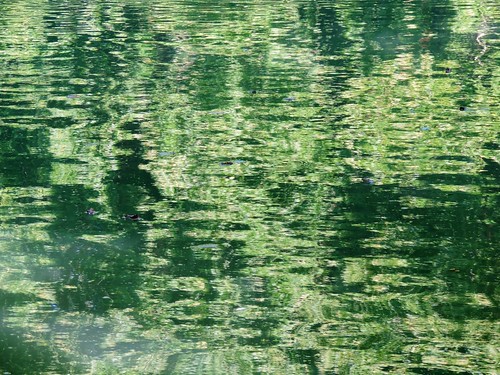
It’s quite hard to capture the sense of flow in flowing water – but I really, really like this photo I took yesterday.

It reminds me of the class in school where we learned about “interference patterns” where two wave forms would meet – you can almost see here the same kind of “cross-hatching” which occurs when that happens.

So, as well as being a beautiful image, this stimulates a lot of my thoughts about flow, about patterns, about connections, about transience…….oh, I could go on!

How great it is that a single moment can stimulate such rich trains of thought……..

Read Full Post »

Hugs

In the second part of the A to Z of Becoming, H is for Hug.

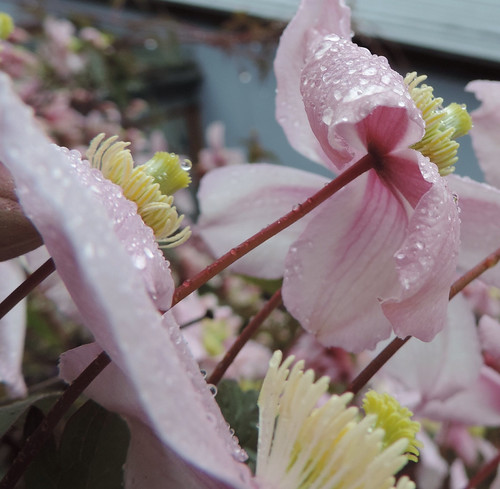
How good does it feel to give, and to receive, a big hug…..whether the person you are hugging is one of your children, someone you love, or just someone your heart goes out to.

Is it too much to suggest you should hug at least once EVERY day?


Read Full Post »

Bay of Biscay

I did a search the other day to see if I could find the origin of the French phrase “l’émerveillement du quotidien” (the amazing everyday) because its a concept which I’ve taken to heart so passionately that if anyone asks me for advice about how to live a good life, how to be happy and healthy, I’ll pretty much always begin by saying they should approach every single day with an attitude of wonder and joy – “l’émerveillement du quotidien” (one good way to do that is to use the “first and last” method)

Well, I haven’t managed to track down the origins yet, but if you put the phrase into a google image search, guess what? MANY of the photos which come are mine!

So, whatever the origins, I guess I’m one of the world’s leading protagonists of “l’émerveillement du quotidien”!

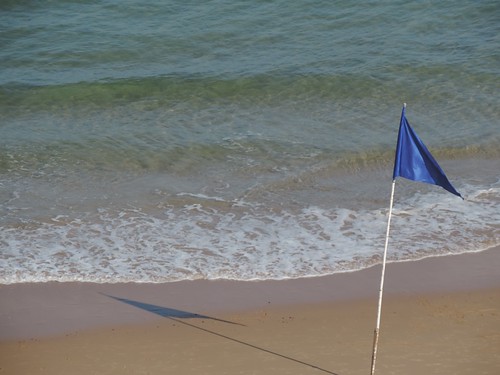
This photo is one I took while on holiday on the West coast of France – it’s a great example of how amazing an everyday view of the sea is. Look at the range of colours! It’s gorgeous, and remarkable!

Read Full Post »

eau potable

The earliest form of photography was the daguerreotype (named after its inventor, Monsieur Daguerre). It was a process which captured images onto silver coated copper plates. It didn’t involve using negatives and every single “print” was a one off. They couldn’t be duplicated or transferred onto paper.

The daguerreotype was remarkable for the accuracy of the image produced. It was sharp and detailed (you could use a 50x magnification lens to look at part of the daguerreotype and see crisp details). Partly because of its accuracy it was initially used as a “scientific instrument” and found in laboratories, but as the technology became more portable the taking of portraits, landscapes and cityscapes soon proliferated.

As photography developed, an artistic intention was soon brought to it. The newer processes of making negatives and printing onto paper, were quickly taken up by artists.

I’m a keen photographer, as I’m sure you can tell if you browse through this site. I’m also very curious about how we experience the world and how we communicate our experiences to other people. Recently I’ve been wondering about the differences between “representation” and “manifestation”.

Just as the daguerreotypes were great for re-presenting what could be seen, I think we often believe that is what we are doing when communicate our observations and experiences to others. Certainly in scientific publication, the scientists are trying to “re-present” what they have observed as “objectively” as possible.

However, as it’s not possible to experience any “out there” from anywhere other than “in here”, there is always an aspect of “manifestation” to the “representations”. Every “re-presentation” involves some “manifestation” of the subjective experience of the person who is making the image (or writing the document).

Maybe in all Art we can see these two aspects – there is some re-presentation of what the artist experiences (including what he or she observes) – but there is always some degree of manifestation too. I wonder to what extent Art could even be said to be primarily a way of manifesting the subjective – a way of a human being making manifest the otherwise invisible, unique, personal experience of the world.

Look at the image I’ve placed at the top of this post. It’s a photo I took in a “beau village” in France. It’s a sign to show that the water here is drinkable. But it isn’t just a sign. Even the way the words “eau potable” (which means drinkable water) are carved reveals something of the creator of the piece. And what about the shell? Why is that there? The shell is the symbol of the pilgrims heading to Compostella. So this is a drinking fountain to help quench the thirst of the pilgrims. That manifests something of the artist’s world view doesn’t it?

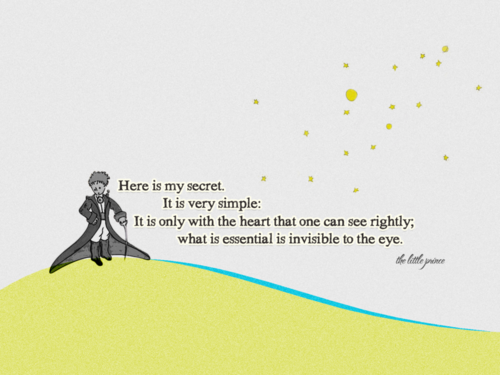
Saint-Exupéry said

saint exupery invisible

So how are you going to manifest YOUR unique, invisible, essential experience of reality?

Read Full Post »

“Everybody needs beauty as well as bread, places to play in and pray in where nature may heal and cheer and give strength to the body and soul.” – John Muir

Just as we are constantly influenced by what’s inside us, so we are constantly influenced by what’s around us.

One of those influences is beauty.


Bay of Biscay

Monet like reflections

Moonrise over the Atlantic

Clematis

spiral

restaurant

A recent article in The Atlantic looks at the influence of beauty on happiness.

Beauty tends to feel like something that must be found in special places—parks and museums, galleries and exotic cities. Lunch is not a place one would normally think to look. But finding beauty in normal activities can bring deep happiness to life, studies show.

“In a paper titled, “Untangling What Makes Cities Livable: Happiness in Five Cities,” Abraham Goldberg, a professor at University of South Carolina Upstate, and his team conducted a statistical analysis of happiness in New York City, London, Paris, Toronto, and Berlin.”

In addition to the usual “Big Seven” influences (wealth, family relationships, career, friends, health, freedom, and personal values), Goldberg found that what makes people happiest is the beauty around them.

It seems part of humans’ appreciation of beauty is because it is able to conjure the feelings we tend to associate with happiness: calmness, a connection to history or the divine, wealth, time for reflection and appreciation, and, perhaps surprisingly, hope.

Beauty, famously, is “in the eye of the beholder” and maybe some of the images I’ve included here are not what you might find beautiful (but I do!), but what interested me about this article was not just that beauty can be found in big works eg architecture, great paintings etc, but also in everyday small objects and scenes.

I also especially liked the quotations towards the end which highlight a very interesting aspect of beauty – it’s connection to anticipation, or hope…..

“So long as we find anything beautiful, we feel that we have not yet exhausted what [life] has to offer,” writes Nehamas. “That forward-looking element is … inseparable from the judgment of beauty.”………… As the 18th-century French writer Stendhal wrote, “Beauty is the promise of happiness.”


Read Full Post »

Blue flag

In the A to Z of Becoming, Part 2, G is for “Go”.

I’ve got three different contexts of the verb “go” for you to consider this week.

Firstly, as this is the month travel in the 12 monthly themes (the month of “Le Grand Depart”), where might you go? Are you planning any holidays, any weekends away, any day trips? Or maybe you could just break a routine and go somewhere different this week…..a different route to work, a different park for the children to explore, a different cafe, restaurant or even supermarket! Yep, just GO! Go somewhere different!

Secondly, “Go!” is a command. We shout it at the start of a competition or a race, but we can can use this ourselves to just start something. You’ve probably got a list of goals somewhere, either written down in a notebook, or rattling around in your head, so why not pick one and make a start? Take your first lesson in that foreign language you want to learn, or pick up that instrument you’ve been meaning to play, go out a buy a notebook to start your writing practice, sign up for exercise class…….whatever it is, just pick one and “GO!” Make a start!

Thirdly, we use the verb go in the phrase “have a go”, which means to try something. So why not give some thought to what you’d like to try and take the opportunity to do it? What would you like to “have a go at”? Baking? Cooking? Fishing? Tennis? Photography? Again, why not pick one and “have a go”?


Read Full Post »

rock weathering

sparkling water

stained glass light

tree ripples

It seems the way are brains are made we are predisposed to notice patterns.

The scientific method is based on noticing patterns, describing them, and, in particular spotting patterns which repeat. Patterns which repeat give us the ability to predict – not just what might happen next, but what might happen if we take a particular action. In other words we can use what we learn from pattern spotting to manipulate objects. But there are no patterns which ALWAYS repeat and none apply in ALL contexts of time and place. The danger of pattern spotting is to generalise and turn repeating patterns into “laws” or “rules”.

Science can easily go wrong when it hardens into arrogance…….the arrogance which often arises out of conviction.

A good doctor recognises a pattern of symptoms and signs, makes a diagnosis, takes an action known to be likely to produce a particular desired outcome, but retains their awareness and curiosity to seek new patterns, to reconsider their assessment of the patterns and tries different actions when the first one fails to achieve what the doctor was trying to achieve.

After all, even weather patterns are unpredictable…..


barometer

Read Full Post »

left or right?

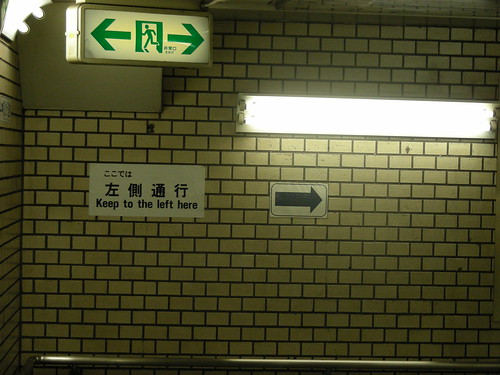
Rules, rules, rules……..

When I look at people, animals, plants, when I think about experiences and events, one thing is clear.

Uniqueness.

Not only is every person unique, but every experience is unique. As Heroditus said, you can’t step into the same river twice.

Today has never happened before. This moment, here and now, is unique.

Yet we create systems in society which ignore this reality. We create schools, health services, whole economies on the basis of imposing uniformity and conformity.

Uniformity and conformity might work well when you are running a factory to produce a product. Mass production and mass consumption seem to fit well with uniformity and conformity. You don’t want an individual factory worker to bring their uniqueness and creativity to the manufacture of the computer component your factory produces.

But in situations where the focus of activity is human – for example, education or health care – then uniformity and conformity don’t make sense.

But what about standards you ask? Doesn’t every patient deserve to have the best care?

Ah, yes, but is the best care that which denies the individual’s uniqueness?

Throughout my working life as a doctor I believed the way to deliver the best care was firstly to give a damn…….to genuinely care about the patient, to put aside personal preferences in order to empathically understand what was important to this person. Secondly, to deliver the best care you need to be constantly reflective.

How was that? How did it go? Why did things go the way they went?

The counter to uniqueness and freedom is uniformity and conformity.

Sadly, these are the values we see increasingly in management and society. There are massive attempts to deny individuality and to impose conformity.

We’ve always had these competing forces. Thomas Berry refers to them as discipline and wildness. Iain McGilchrist describes them in the context of the distinct approaches to reality delivered by the left and right hemispheres of the brain.

What I especially like about Berry and McGichrist is their understanding of the inevitability of these opposing forces, and of how they work together to produce the whole.

We do need to use both halves of our brains.

We do need both discipline and wildness.

And we need to be able to stand back and reflect and see when and where we need to focus on the one rather than the other.

Right now, it feels to me, we’re concentrating too much on uniformity and conformity. We could do with increasing diversity, supporting uniqueness, and freedom.

If human beings really are unique then we might do well to create our systems around that core fact of reality.


Read Full Post »

Just seeing – vision – amazes me. We know so little about how it happens.

At university I learned about the visual cortex – the area of the brain which processes the signals from our eyes and created the images we “see”. I remember being strangely surprised to think through what it meant that light waves hit the backs of our eyeballs and then that energy was transformed into electro-chemical signals which sent information back along the “optic nerve” and how the exit point from the eyeball where the nerve goes off to the brain received no light information at all so should always be present a gap in the image we see. But there is no gap to see! Our brains seamlessly, instantaneously and constantly process all the information from our eyeballs and creates this experience of moving images which never have any holes in them!

We now know that there is a lot more of the brain involved in creating images for us than we previously thought. Read this wikipedia article for starters.

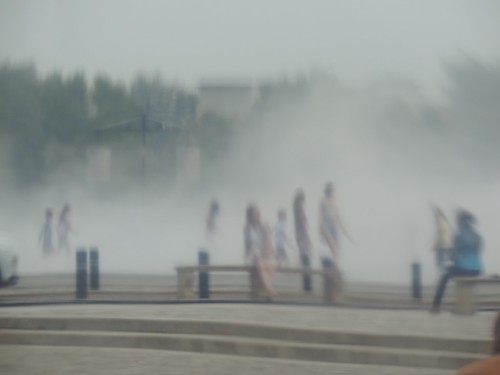
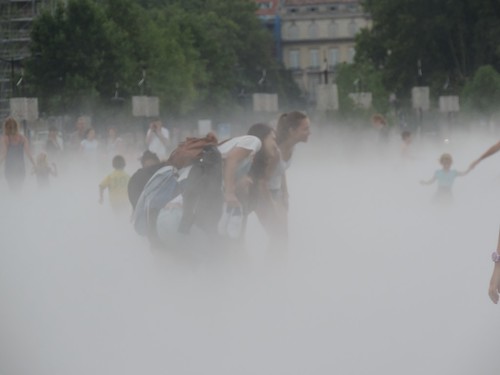
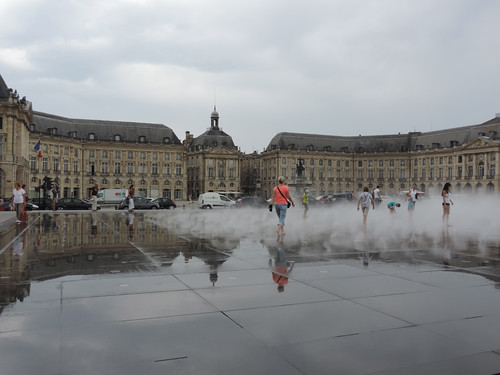
So, what amazes me is not just how we experience this seamless visual image, but how we instantly know what we are looking at. Take a look at these photos I took of people on the Miroir D’eau in Bordeaux. The first one is taken pointing the camera at a mirror which is reflecting the image from outside the building I’m in. People are in the mist created by the water spray. The second is outside with me actually on the Miroir and the people in the mist. The third is a shot taken after the mist has settled.


Through the window

Lost in the mist

miroir d'eau Bordeaux

In all three shots we know we are looking at people. Sure, as the images become more clear we can see more detail, but isn’t it interesting that we have a pretty good idea of what we are looking at right from the first image?

Wow! Isn’t the ability to SEE just amazing? And how wonderful that we continue to learn how we do that. We often forget that our level of understanding is just our current level. It’s never complete. It’s never the “full story”. What more will we learn even in my lifetime?

Read Full Post »

From small, delicate, beginnings…..

forest floor

…..to a life really lived……

a tree story

Amazing!

How such small seedlings grow to become such old and experienced trees…….!

What stories could they tell?

Who could have predicted the twists and turns, the traumas, the wounds, the opportunities, the new directions, the crises of survival, the creative responses to challenges, the relationships with the others in the forest?

How much more so for a human being?

Read Full Post »

« Newer Posts - Older Posts »