Feeds:
Posts
Comments

Archive for the ‘from the living room’ Category

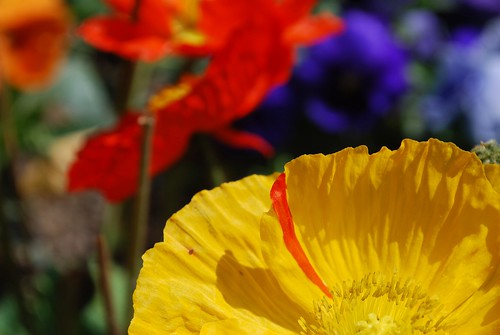
Poppy petals

In the A to Z of Becoming, O is for “open”.

One of the most beautiful sights in Nature is the opening up of a flower (just like these poppies I photographed yesterday). So, in what ways can we “open” this week?

Open your mind. Many, many years ago I noticed graffiti on a wall in San Francisco, which said “Minds are like parachutes, they work best when they are open”. The General Semanticists say that “judgement stops thought”. When we “make up our minds” we often close them. I’m not saying you shouldn’t decide anything but it might be a good experiment now and again to keep an open mind, instead of coming down with certainty one way or another. We can also open our minds by opening ourselves up to new opportunities, new sights, new music, new tastes….in other words why not try something different this week, and see what it opens up for you?

Open your hands. Don’t grasp. Don’t cling. Can you let go? Accept? Just try this little experiment – make a fist with your hand, scrunch it up tightly. What feelings come with that gesture? Now, relax your fingers, and turn your hand palm upwards. What feelings arise now?

Open your heart. Approach people this week with an open heart, prepared to be kind, to be loving and accepting. What flows when you open your heart? (Another take on opening your heart to someone is to express your true feelings to them)

Let me tell you a strange story. I’m having a short holiday in Pézenas in the South of France. As the weekend approached I started to think about my Sunday blog post, the one about the A to Z of Becoming. This week it was to be “O for open” so I got to wondering about opening minds, opening hands and opening hearts. I wandered into the bookshop in Pézenas and browsed. The bookshop here is mainly a newsagent and stationers. They don’t have a lot of books, but there was a pile on a table. One caught my eye “L’Âme du monde” by Frédéric Lenoir. I’d never seen or heard of this book before but the “soul of the world” title caught my fancy. I picked it up and flicked it open to a random place, which turned out to be the start of a chapter. The chapter title? “Ouvre ton coeur” – “open your heart”.

I don’t know. You explain it!
Read Full Post »

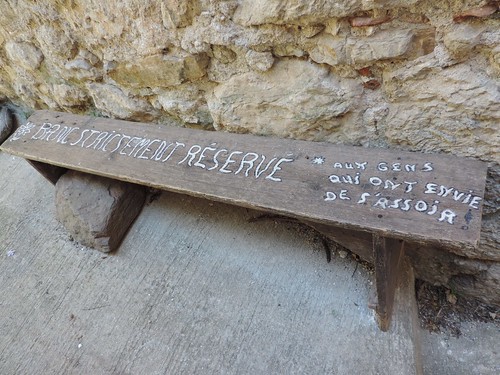
Strictly reserved

Translated, the message is “This bench is strictly reserved…..for people who really need to sit down”

I like it!

Read Full Post »

Door restore

This restored door in Pézenas reminded me of the story the ship whose planks were gradually replaced one by one until none of the original planks were left. Was it still the same ship?
And what about our ever changing bodies with new cells replacing old ones every day so that very few cells remain after a few years…..yet we are still ourselves. Aren’t we?

This miracle of perpetual change which allows a sense of continuity and consistency.

Read Full Post »

Pézenas

Relaxing in Pézenas for a few days. Tell me, look at this environment, don’t you think our physical environment, natural and built, influences the way we feel, the way we think, the way we are?

If you still aren’t sure, look at St-Guilhem-le-désert (one of the most beautiful villages in France).

St Guilhem-le-désert

Today I walked around these old streets, had lunch under the 150 year “King of the Platânes” in the main square, and felt, this is a sacred place, a place of beauty, of spirit, of wholeness.

I love the experience of “sacred places” – those places where you feel something extraordinary. Which places are sacred places for you?

Read Full Post »

Lewis Hyde, in the excellent, “The Gift” writes about the origins of the word “dose”

The French etymologist Benveniste writes: ‘There is a … medical usage in which [the Greek word] dósis denotes the act of giving, whence develops the sense of the amount of medicine given, a “dose” … This sense passed by loan translation into German, where Gift, like Gr.-Lat. dósis, was used as a substitute for venēnum, “poison.”

How fascinating that it began as a gift, and how sad that it turned into poison!

Read Full Post »

Nourish.

Franschhoek

What about making this your verb of the week? What about asking yourself about your choices and your actions every day…..is this nourishing me? What, or who am I nourishing?

I imagine when you think of nourishing, first of all you think of food and feeding…..which makes me instantly think about two stories – the one from Native American tradition of the hungry wolves –

One evening an old Cherokee warrior told his grandson about a battle that goes on inside all people. He said, ‘My son, the battle is between two ‘wolves’ inside us all. One is Evil. It is anger, envy, jealousy, sorrow, regret, greed, arrogance, self-pity, guilt, resentment, inferiority, lies, false pride, superiority, and ego. The other is Good. It is joy, peace, love, hope, serenity, humility, kindness, benevolence, empathy, generosity, truth, compassion and faith.’ The grandson thought about it for a minute and then asked his grandfather: ‘Which wolf wins?’ The old Cherokee simply replied. The one you feed.’

and the one from Thich Nhat Hahn about watering seeds –

Your mind is like a piece of land planted with many different kinds of seeds: seeds of joy, peace, mindfulness, understanding, and love; seeds of craving, anger, fear, hate, and forgetfulness. These wholesome and unwholesome seeds are always there, sleeping in the soil of your mind. The quality of your life depends on the seeds you water. If you plant tomato seeds in your gardens, tomatoes will grow. Just so, if you water a seed of peace in your mind, peace will grow. When the seeds of happiness in you are watered, you will become happy. When the seed of anger in you is watered, you will become angry. The seeds that are watered frequently are those that will grow strong.

So, let’s think about nourishing the body, the mind and the spirit.

Main course

I’ve often been asked about dietary advice and my response is to say we are all different and what is good for one person at one time, might not be so good for another or at another time. I like Michael Pollan’s Food Rules – especially….”eat food”, “mainly plants”, “not too much”! But have a think when you eat this week, “is this nourishing for me?”

meditation

When if comes to the mind, are you aware of certain thoughts or feelings being more nourishing than others? When you worry, does that feeling nourishing? When you ruminate, does that feel nourishing? When you make goals, think positively, focus on the present, does that nourish you?

flourish

And when it comes to the spirit, I’d take a little while to explore what nourishes your soul – your soul as Thomas Moore describes it – think how we use the word “soul” – soul food, soul music, soul mate – what are those for you? What is your soul food, which music stirs your soul, who are your soul mates? Are there special places you can go to nourish your soul? How might you nourish your soul?

So, why not take a focus on nourishing this week? Nourish your body, nourish your mind, nourish your spirit, nourish those others who you encounter this week, nourish your world……

Read Full Post »

In the wonderful “The Republic of Tea” Mel says

The whole problem with Western civilisation is that ever since the Greeks we’ve been trying to squeeze the mind into the brain and it won’t fit.

Wonderful!

My first thought was Alva Nöe’s point in “Out of our Heads” – “Brains don’t have minds, people do

Then I recalled Dan Seigel’s definition of mind as being an “embodied inter-relational process of regulation of energy and information flow” – which certainly doesn’t fit the mind into the brain!

Andy Clark talks about the “extended mind” in his “Supersizing the Mind” –

According to BRAINBOUND, the (nonneural) body is just the sensor and effector system of the brain, and the rest of the world is just the arena in which adaptive problems get posed and in which the brain-body system must sense and act.
Maximally opposed to BRAINBOUND is a view according to which thinking and cognizing may (at times) depend directly and noninstrumentally upon the ongoing work of the body and/or the extraorganismic environment. Call this model EXTENDED. According to EXTENDED, the actual local operations that realise certain forms of human cognizing include inextricable tangles of feedback, feed-forward, and feed-around loops; loops that promiscuously criss-cross the boundaries of brain, body and world. The local mechanisms of mind, if this is correct, are not all in the head. Cognition leaks out into body and world.

And then there was that recent map of body emotions which showed where we locate different emotions (certainly not just in our brains!)

But the mention of the brain-based focus of Western civilisation since the time of the Greeks producing such limits to our understanding, I couldn’t help thinking again of Iain McGilchrist and how I’m sure he’d say it’s not just that we’ve been trying to squeeze the mind into the brain, but that we’ve been tried to squeeze it into the left hemisphere!

Read Full Post »

inequality

You’re familiar with this, aren’t you? It shows how the top 1% of the population have increased their share of wealth fantastically since 2003 while the 99% (that’s probably you and me!) have seen their income stay the same or decline over the same period.

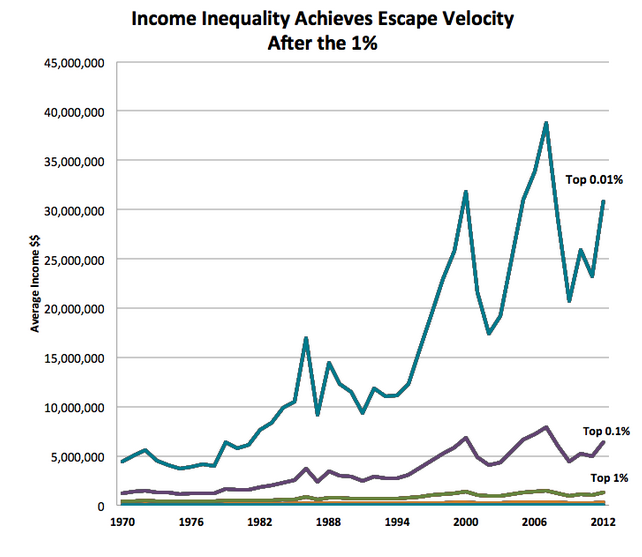
However, check out this interesting graph from an article in The Atlantic this week.

0.01%

It shows, amazingly, that within that top 1%, 99% of them have NOT increased their wealth, but 1% of them have enormously increased their wealth. That means the only ones to gain in this period of austerity are the top 0.01% of society and they have MASSIVELY increased their share. This unprecedented centralisation of wealth sucks the life blood out of society. This small elite hoards the world’s wealth to themselves. And if we can say anything about healthy economies, they need circulation and movement. Remember the credit crunch? What happened? The money stopped circulating.

There are a mass of other problems which are linked to huge socio-economic inequality. Have a look here if you’re unfamiliar with the work of Prof Wilkinson.

Hamish Mcrae, writing in the Independent, reflects on this finding. He says

Once the majority of people in a democracy feel it is not working to their advantage, they will seek a remedy.

He then goes on to say that taxing the rich won’t work, and that we can only hope they will learn to “change their ways”. Really? That’s your big solution, Hamish? Karl Marx said

Accumulation of wealth at one pole is, therefore, at the same time accumulation of misery at the opposite pole.

Bloomberg Business Week published an article noting the reemergence of Marxist economics last June. And Pope Francis said

Just as the commandment “Thou shalt not kill” sets a clear limit in order to safeguard the value of human life, today we also have to say “Thou shalt not” to an economy of exclusion and inequality. Such an economy kills. How can it be that it is not a news item when an elderly homeless person dies of exposure, but it is news when the stock market loses two points? This is a case of exclusion. Can we continue to stand by when food is thrown away while people are starving? This is a case of inequality.

and goes on

While the earnings of the minority are growing exponentially, so, too, is the gap separating the majority from the prosperity enjoyed by those happy few. The imbalance is the result of ideologies which defend the absolute autonomy of the marketplace and financial speculation…. A new tyranny is thus born, invisible and often virtual, which relentlessly imposes its own laws and rules…. The thirst for power and possessions knows no limits. In this system, which tends to devour everything that stands in the way of increased profits, whatever is fragile, like the environment, is defenseless before the interests of a deified market, which become the only rule.

What does he suggest?

I exhort you to a generous solidarity and to the return of economics and finance to an ethical approach which favors human beings.

It’s a long time since Schumacher published “Small is Beautiful” but maybe we are beginning to see a clamour for the development of economics, politics, science and humanities which enrich not just the 0.01%, but the 99.99% too.

Any ideas?


Read Full Post »

DSCN0914

This is cherry blossom time and in Japan the coming of the cherry blossom is a cause for celebration and of great interest.

Follow through this link here and you’ll see a map showing when the blossom comes out in different parts of Japan (over March and April – we’re a bit later with our blossom here in Scotland)

Why is it such a celebration? Well, not just because it is beautiful (which it is) but because it makes us so much more aware of transience. The blossom comes, the blossom goes. It’s not here for long. Everything is like that. Our lives are like that. We are here with these bodies for a while, and then we are gone.

This is a transition time for me in my life. I’ll be retiring from medical practice this summer, which is a huge life change. So I’m acutely aware of the beauty and the power of transience right now. There is celebration of the life lived so far, of how much it has changed, and an intensity to the everyday experience which comes with the awareness of change.

This is a good month to notice the daffodils coming out, or the cherry blossom briefly flourishing on the trees. Nature is showing off the wonderful beauty of transience.

I know we have a human tendency to cling, to want to keep the status quo, holding onto not just what is good but what is familiar. But we also have this deep human capacity to know that we are mortal, to know that change is the inescapable reality of Life, and somehow, that makes today even more precious, even more important, even more beautiful.

Read Full Post »

DSCN0872

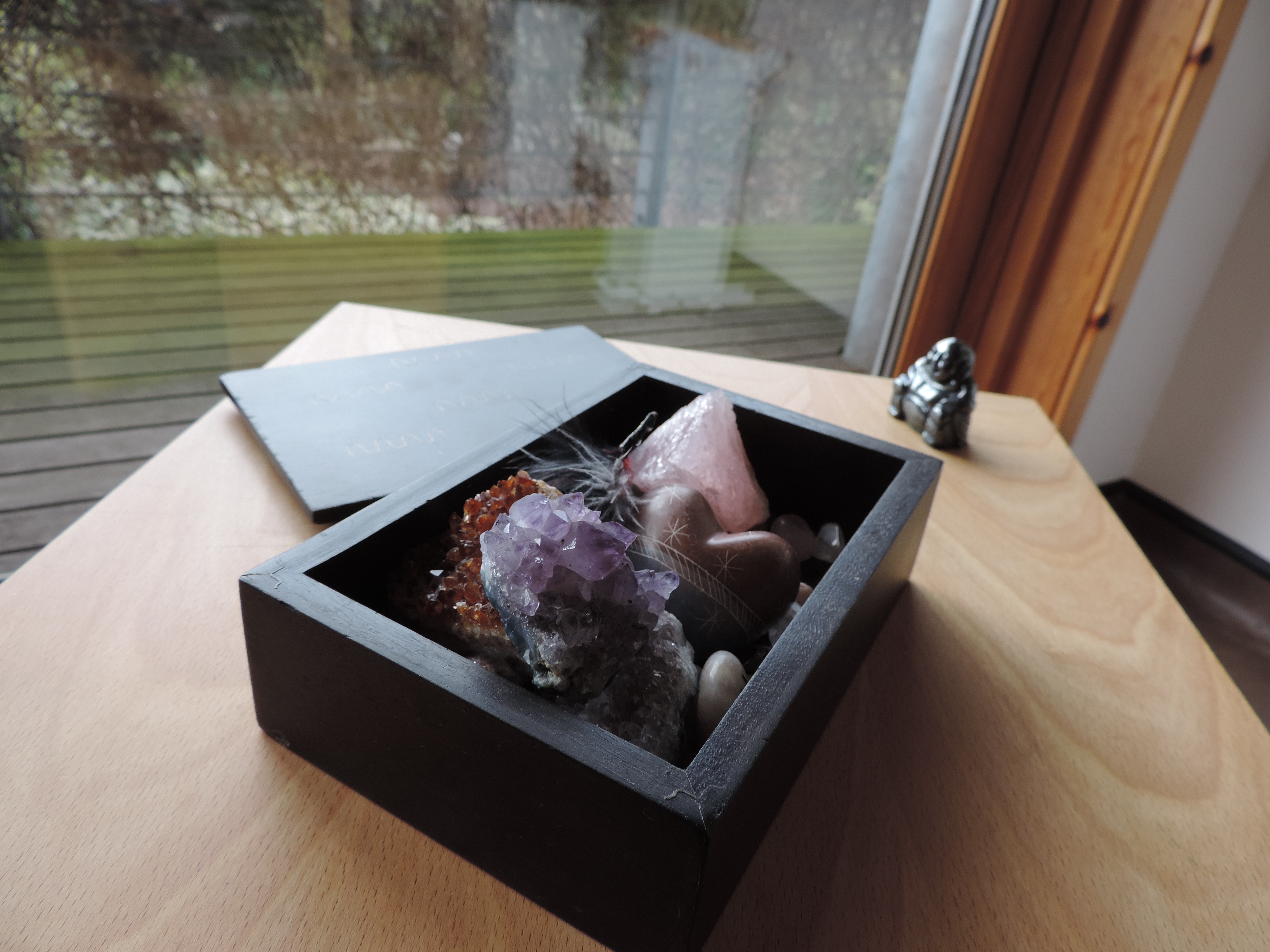
Over the years patients and colleagues have given me little gifts which I’ve collected in this box which sits next to my chair in my consulting room. In some ways I’ve thought of it as my little “cabinet of curiosities“.

It’s often a talking point, but the recently one five year old girl came into my room, made a bee line for the box and squealed “Ooh! Treasure!”

I hadn’t thought of it as a treasure box until then, but that’s what it is.

Have you a treasure box? If not, why not start one? What would you put in it?

Read Full Post »

« Newer Posts - Older Posts »