Feeds:
Posts
Comments

Archive for the ‘from the living room’ Category

Continuing on the theme of sense making…….I’m endlessly curious about how we human beings do three things – perceive the world, make sense of life, and influence our day to day experiences of reality. Each one of those contributes to the richness of our unique daily lives. No two of us have the exact same experience at the exact same time and place. Never. We will all bring our previous experience, our memories, habits and distinct patterns of being to the present moment.

I think that perhaps one of the most powerful, and certainly most magical, qualities we have is the power of imagination. Some people seem to think we can separate imagination from the perception of reality very easily, that there is a permanent and impermeable barrier between the two. Sometimes I wonder if there’s a connection between that thinking and what doctors used to describe as “the blood brain barrier”, an invisible border between the body and the brain which drugs couldn’t cross. We know it’s not that simple now. But is there a big stretch between that thinking and the idea that some illnesses are “all in your head”? I mean, whatever did that really mean? I remember hearing someone claiming that for a certain patient “her pain is all in her head”. What did that mean? That it didn’t really exist? That she was either lying or deluded? What a way to dismiss a person’s lived experience. What a way to undermine a relationship of trust. What a way to fail to understand.

I think our power of imagination doesn’t switch itself off and on. Blimey, it even keeps going while we are sound asleep!

Perception is a creative act. It involves memory, signals from the environment, signals from within our own bodies, as well as our creative powers of imagination which enable us to make connections, see patterns and create images which we hope provide us with good representations of the world.

Sense making is also a creative act. Whether we draw on numbers, words, stories, images or similarities, making sense of the world is an act of imagination, a creative act of imagination.

Our daily lives are creative acts. We are much more the active agents of our experience than we realise. We are not blank slates for someone else to draw on. We are not data to be fed into an algorithm. Algorithms, statistics and data do not KNOW us better than ourselves. We are creating ourselves every moment of every day.

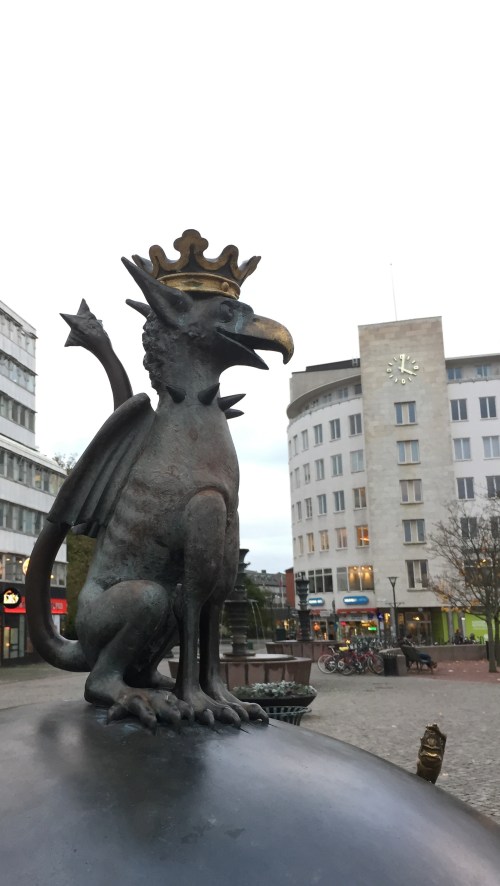
This photo is of a public work of art, placed in a square in Malmo. It’s a griffin with a crown. A griffin? An imaginary creature. There are no griffins in Nature. But we respond to this, don’t we? We react to it. It influences us. Part of the genius of this sculpture, I think, is the crown. Placing the crown on this creature’s head increases its impact and magnifies its significance and importance.

I’m well used to living with imaginary creatures. I come from Scotland. And, no, I’m not thinking of the Loch Ness Monster. I’m thinking of the imaginary creature which adorns castles, flags and buildings throughout Scotland.

The unicorn.

A magical, mythical creature of incredible power.

I’m not going to describe my own responses to the unicorn today. Instead I’d like you to notice what your own responses are. When you look at an image of a unicorn, what do you experience? What images spring to mind, what thoughts enter your head, what feelings emerge within you? What do you imagine?

Read Full Post »

We humans have invented incredible cultural tools which help us to make sense of the world, to bring about changes, to create connections, and to express ourselves. Alphabets, language, words, symbols and art are some of the ones I’ve written about over the last few days, but there is another class of cultural tool entirely – numbers.

We love to make measurements. Well, some of us love it more than others I suspect, but how often do you hear questions such as “How big is it?” “How heavy is it?” “How long is it?” and so on…..?

I can see the point of favouring measurements when it comes to building and maintaining houses and machines, but I find them partial, or even distracting once we try to apply them to non-physical, invisible phenomena…..like subjective experience, qualities and time.

This photo is of an astonishingly beautiful, elaborate clock. Have you ever stopped to wonder about this idea of measuring time? It’s a complete invention because time isn’t a phenomenon which can be measured. We arbitrarily agreed to divide the day into small pieces, 24 hours, each of 60 minutes, which each has 60 seconds. But why those figures? Why those “units of time”? Other creatures deal with time without making measurements which produce figures. They deal with the natural periods of time, from sunrise to sunset, sunset to sunrise, from one solstice to another, from one equinox to another. They live according to the rhythms of Nature’s cycles and the rotations of the Earth, both on its own axis, and in its orbit around the Sun. They live according to the rhythms of the Life in each of their cells. We do too, but we stand apart from all that, or at least we try to, and we impose a human invention instead – measured time.

The thing about measured time is it can’t tell you anything about the quality of the time. It can’t tell you the difference between a “good time” and a “bad time”. It can’t tell you about the “best time of my life” or the “worst time of my life”. It can’t tell you about the experience of “passing the time”, “wasting time”, or “saving time”. It’s not enough to measure the number of minutes a consultation lasts, you have to know what the doctor and patient are doing and experiencing during that consultation.

I heard a story once. It was told to me by a dentist who was running a Facial Pain Clinic. He said he’d taken the clinic over from the colleague who had created it, once that colleague retired. He told me about his first day in the clinic. When the first patient came in, he introduced himself, asked the patient how they were and they replied “14”. He was a bit puzzled but let it pass and carried on with the rest of the consultation. The next patient did the same strange thing, telling him “9” before telling him anything else. When it happened with the third patient he asked the nursing staff if they knew what was going on. Oh, yes, he was told, the previous colleague had invented a numerical scale of pain severity, from 0 to 20. He trained all the patients to tell him what number they were applying to their level of pain each time they came for a check up. He was a pretty intimidating and demanding man and the nurse said that if a patient started by telling them what had been happening in their life since the last visit, he’d say “Stop! I want the next thing to come out of your mouth to be a number!” They all learned to comply!

Well there’s a whole movement within Medicine to try to quantify qualitative phenomena – ie symptoms, like pain, dizziness, nausea and so on, symptoms which can’t be “seen” or “measured” in any other way.

What do you think of that?

Both of these examples, the measurement of time, and the measurement of pain, highlight an important division in our values – do we pay more attention to numbers, to what can be measured, or to which we can invent and apply artificial measures? Or do we pay more attention to the lived experience? That is, do we favour the quantitative over the qualitative or vice versa?

I find some people fall into the former camp, whilst others fall into the latter. You know what I’m going to say, don’t you? “And not or”! I think both can be helpful. It depends on context. If we are dealing with machines, I can see that the quantitative approach is really helpful…..if we are dealing with human beings…..not so much! By that, I don’t mean there is no point in measuring somebody’s blood pressure, checking their haemoglobin levels, etc. I just mean the numbers are never enough. They always, and, yes, I believe that’s the right word, always, need to be put into the context of this individual, unique human being’s life……and we do that by paying attention to the qualitative.

Read Full Post »

“Words were originally magic”

Have you ever read that sentence before? It was coined by Freud in 1915, and used by Steve de Shazer as the title of his book about his “solution focussed approach” to brief psychotherapy.

Do you think writing “freedom” repeatedly over the front of this office block works some magic? Who decided to write this in this particular place? Were they being ironic? Pointing to the fact that offices are actually soul-less, regimented places of control….the antithesis of freedom? Or were they trying to cast a spell….to make people feel more free by presenting the word to them?

I don’t know. I don’t know the history of this office block in Malmo.

We are told we now live in a world of “post truth” where words are used to confuse, misdirect, obscure, lie and evade…..where words are used to persuade and manipulate……where words are propaganda….ways to influence and control whole populations one three word slogan at a time. “Take back control”, “Get Brexit done”, “Build, build, build”………

Well it seems that words are losing their magical power when they are used so cynically and when they aren’t backed up with actions. But still, they work a magic over millions of people who voluntarily give up their freedoms and quality of life for the sake of a privileged few (just as Montaigne’s friend, Étienne de La Boétie, described in “Discourse on Voluntary Servitude” back in 1577)….inequalities are increasing massively, wealth and power is becoming ever more concentrated while “strong men” narcissists bewitch large numbers of people into supporting them.

Ok, political rant over! Back to health care….my specialist subject! As a doctor you have to be really careful about the words you use. Telling someone they have X months to live can become a self-fulfilling spell. People give up, or gain hope, depending on the words the doctor uses….and how they use them (by which I mean the contexts in which they use them, and whether or not they are used within already established relationships of trust). In a good consultation the doctor is on the alert for specific words which the patients might use, words which might hold the key to both diagnosis and prognosis. Which words does the doctor pick up on, and ask you to say more about?

We have to be especially careful of using words as labels…..such labels can put people into boxes. It’s a danger in health care, but also in wider society….the fast track path to prejudice and injustice.

Words are still magic. They still have enormous power. It’s worthwhile staying aware of that……

Be a hero, not a zombie!

Read Full Post »

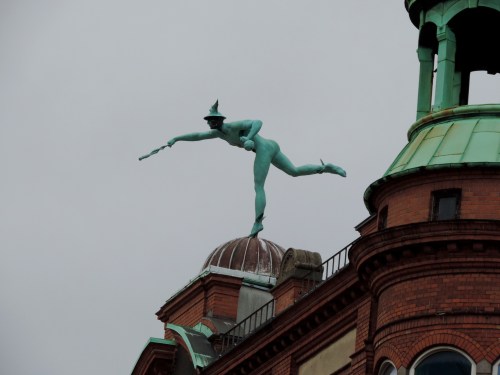
Here’s Hermes in Copenhagen. He gets around. I wonder if he is one of the most commonly represented gods from Greek mythology? Probably you’re more likely to encounter him in Europe! Hermes, the Greek god, was known as Mercury to the Romans, who also associated him with the Germanic god, Odin. He’s a complex god with layers and layers of meanings which human beings have attributed to him through their stories and myths.

He’s maybe best known as the Messenger God – able to cross boundaries and connect the conscious to the unconsciousness worlds, the living world and the underworld of the dead, the physical world to the spirit world.

But he’s also known as a God of Fertility, a Protector of shepherds, thieves and tricksters. A great orator or communicator, who helps to persuade people. But also a healing god.

The symbol of healing – the staff with the entwined snake, is doubled in Hermes hand, to have two snakes entwined with each other, but people often mix those two symbols up and use the “hermetic” one, the caduceus, when they mean the symbol of healing, “the rod of Asclepius“, which only had one snake, and no wings! But I think this just shows how fluid and changeable symbols can be.

I wonder what people intend when they place a statue of Hermes in the middle of a city like this? Is there a hope that the inhabitants will see it and think of communication, connections and healing? Is he there as a reminder that there is more to life than the physical, conscious world reveals?

Does he do anything for you? Would you like to have his image somewhere in your personal environment to help you make sense of the world?

I’ve just picked Hermes here as an example. If you look around I’m pretty sure you’ll come across other characters from stories in your environment and in your daily life……maybe characters from myths, religious texts, folklore….or maybe more modern characters from literature and art. Here’s my challenge – see how many you can spot in your own life this week. Note them down, find out about them, and see what comes up for you.

Read Full Post »

One of the unique ways we humans make sense of the world is through art, particularly through visual art. There are many examples of cave wall art in France, although, so far, the only one I’ve visited personally is Lascaux. Those prehistoric paintings are astonishing. Nobody really knows why the people who created them exerted such an immense amount of time and energy into painting them. Mostly, they are drawings of the animals which lived in that part of the world. But why spend hours underground painting the images of them, using only basic candle light to show them what they were doing?

There’s something about making images, making likenesses, which is a kind of magic. The images change our experience of time and place. They are a way for human beings to deepen their lives, to imbue them with more mystery, more beauty, more delight, more meaning….

Living with images, created works of art, changes our lives. That’s partly why we like them, why we enjoy them, why we support the activities of these artists.

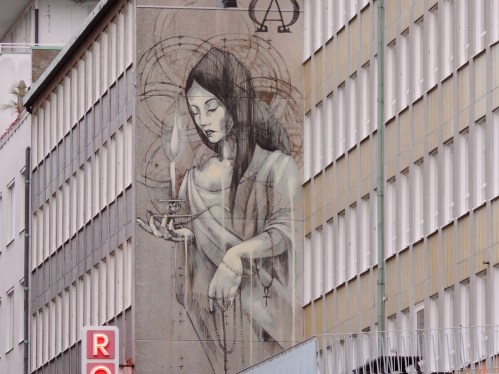
This photo is of a mural I spotted in Malmo three years ago. It’s by a South African street artist, “Faith 47”. I don’t know anything about this artist, or this particular work of art, and, probably, most people who see this haven’t read anything about it. It works as itself. It works as an image.

So, what do you see here? What I notice first, is the main subject, the woman with the long dark hair. She’s wearing robes, holding a lit candle on a candle stick, and she’s gazing down, as if in contemplation. This evokes a sense of Spirit, doesn’t it? In fact, the way she is holding the candle is quite unusual….open palmed, with the palm turned upwards….isn’t it just as we see in some statues of the Buddha? Well, it seems like that to me. It’s a gesture which is “not grasping”, not holding onto, not clinging….a gesture of non-attachment, of waiting to receive whatever is offered, of openness. In her other hand she has a string of beads. Strings of beads like this continue the theme of Spirit, with both Buddhist and Christian traditions containing the use of beads in relation to prayer. Maybe other religions do that too, I don’t know. But hanging around her left arm is also a chain with an “ankh” symbol attached to it….the ancient Egyptian symbol for “Life”.

Up above the main figure is the symbol of “Alpha and Omega”, a traditional symbol of God and Christ. Then behind the main subject there appears to be a kind of work in progress…..overlapping circles. The overlapping circles I know best are the ones used in the “Seed of Life”, and the “Flower of Life”. Overlapping circles like this have been used in a huge number of different cultures and traditions…if you’d like to read more about them, check out this article.

Two overlapping circles are often representative of a union of opposites, of the masculine and the feminine, of heaven and earth, of spirit and body. I like that this one isn’t complete. That evokes the Japanese preference for the “unfinished”, which is related to the issue of transience and beauty….leaving the observer to “complete” the image for themselves.

Well, there you have it. This single image evokes Spirit in human culture and tradition for me. It evokes the union of opposites, or, as I would prefer – integration…..the creation of mutually beneficial bonds between well-differentiated parts! It evokes the Spirit of the Divine Feminine for me too. It’s a peaceful, contemplative image which stops you in your tracks and takes you both deeper and higher at once, puts you in touch with meaning and purpose in the busy ordinary day.

How about you? How do you find this image? If you were to pass it as you walked through the city, don’t you think it could make your day a bit different?

Read Full Post »

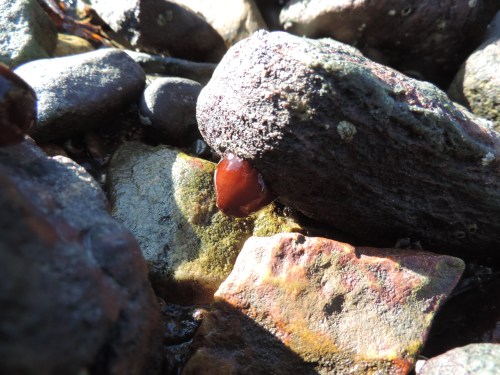
This looks like a bird, don’t you think? That’s interesting because in fact it is a stone on a beach with a little sea creature clinging to its undersurface, looking for all the world like a bright orange beak, and a tiny shell attached to the side just where you might expect to find an eye if this was a bird.

So, my mind has taken a combination of a stone and two completely different sea creatures and created a image for me which makes me think “This looks like a bird”.

We do that all the time. All the time. When we look at clouds we see patterns which make us think they look like faces, creatures, or other familiar shapes. We see people who look like people we know. We see likenesses in babies features which remind us of parents or grandparents.

This “looks like” ability isn’t unique to human beings of course. Flowers, insects and many other creatures are brilliant at developing shapes and forms of other life forms….either to attract what they want to attract, or to repel what they want to repel.

But we humans take this “looks like” ability to a completely different level. We use “representation” to become aware of, or to create, connections between things which we would otherwise miss. We use it to know, quickly, what we are looking at, or at least, to make a preliminary, perhaps “good enough” assessment.

But we also use it to connect to others. We look for similarities, symmetries echoes and reflections, to form bonds, attachments, relationships. We look for some aspect of a person or their life and say “I identify with that”, or “me too”, or “I sympathise with that”, “I understand that”.

Even in the circumstances where we look closer and realise that what we perceived at first wasn’t really what we thought it was…..this is not a bird….that ability of do the “looks like” thing turns something mundane into something just a bit more magical. It’s a way of “re-enchanting” the world.

I think we take this power to a whole new level when we start to employ symbols, art and language. I’ll say more about that tomorrow.

Read Full Post »

I took this photo of an office block in Malmo about three years ago. I liked the green colour of the office reflected in front of this one, and the green exit sign in the bottom left hand corner just seemed so right for the whole image.

When I look at it again now, in the light of the pandemic, it’s got a whole other level of meaning.

One of the things which happened in many countries as authorities tried to control the spread of the virus was not simply asking people to stay at home as much as possible, but to work from home if they could. Millions did so. Possibly millions are still doing so as I write this at the beginning of September. In the UK the Tory government, is applying an increasing amount of pressure on people to stop working from home and get back to the office. They are concerned about the economic impacts of less workers travelling, buying their lunch in the city and town centres, using taxis and so on. In other words, it’s not just offices which are pretty empty, it’s the streets and businesses in the environments of those offices. Turns out everything is connected after all!

But a lot of workers are finding they are much happier without a couple of hours of commuting on overcrowded Public transport, or sitting in long queues of traffic on the roads. They are happier sharing their meals with their families and they are discovering that the localities around their homes have lots of small businesses, shops, cafes and so on where they can spend their time and money instead of in the big city. They are enjoying cleaner air to breathe, enjoying the sound of birds which have replaced the sounds of traffic and building works. In other words, they are finding that their quality of life is just better.

Many are now thinking of moving out of cities altogether and finding somewhere to live in smaller towns a little further away, looking for homes with some outside space or a small garden, and a fast internet connection so they can continue to tele-work.

The world is changing. Funny how we don’t control as much as we think we do. Funny how life will get on and adapt even without any central planning from politicians and managers.

Well, folks, you know my favourite phrase “And not or” …….. At one point in this pandemic it looked like the big new thing would be “blended education” with some delivered face to face as before, but more delivered online. That’s faded a bit since schools started to re-open but I think we are a long way from seeing the full changes in that area. Maybe what there wasn’t so much talk about was “blended working” but that seems to be what a lot of businesses are moving towards – having their staff work from home as much as possible, and getting them together for face to face meetings, or events which are better face to face, only as they need to. There are more and more stories of companies reassessing their need for large amounts of expensive city centre office spaces.

Change is happening already.

It seems the question of “to office or not to office” is already being answered with “and not or”!

Read Full Post »

When I discovered complexity theory and science suddenly everything started to make sense. It gave me an entirely new, consistent, clear lens through which to view and interpret life.

Sadly though, I think the word “complexity” puts people off. They think “complex = difficult” and that’s not quite true. They also confuse “complicated” with “complex”. They aren’t the same thing.

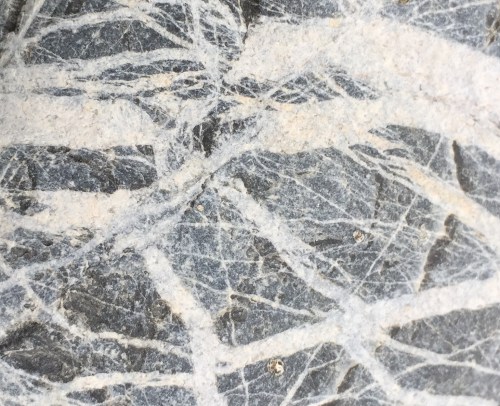
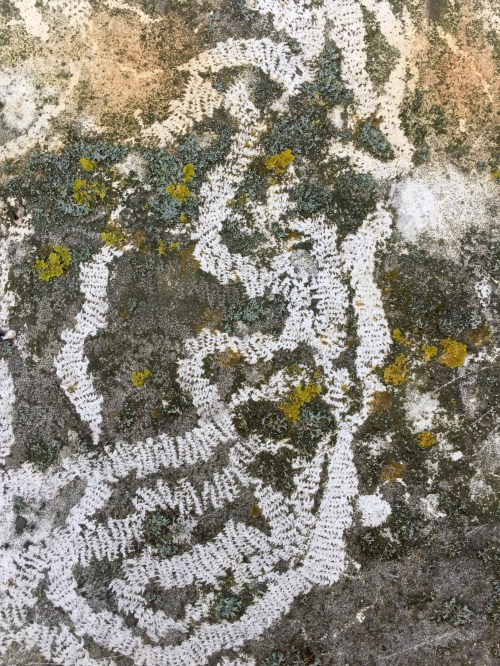
So I thought I’d just share one way into this beautiful way of understanding reality – by focusing on lines. Look at the lines on this stone. You can look at this as a drawing made up of lines and junctions. In network and complexity theory these junctions, those meeting points, are known as “nodes”. Seriously, that’s a good place to start.

All complex systems can be seen as a number of nodes joined together – lines and junctions – or in the case of the human brain, long spindly nerve cells and synapses. If you were to pick a starting point somewhere on this stone and mark a finish point, you could trace an enormous number of ways between those two points, just by following the lines with your finger.

All complex systems are so massively interconnected this way that there are a countless number of alternative ways to trace the relationships and pathways between the nodes. There are always a massive number of alternatives available. And you can never know exactly which of the alternatives is going to be taken.

Complex systems are NOT predictable in detail. That applies more in human beings than perhaps anywhere else because human beings are probably the most complex systems in the universe. The paths a living creature takes are highly unlikely to be straight. Creatures meander and wander and change direction all the time. Have you ever watched a butterfly flying from flower to flower? Have you ever tried predicting which flower it will go to next, and how it will get there? Good luck with that!

Complex systems are not only massively interconnected on the inside, they are massively connected to everything else as well. Complex systems adapt and change according to the environment. They cannot be understood outside of their unique and particular contexts – by the way, I read yesterday that the word “context” has Latin roots in the words for “connection” and “weaving” – nice, huh?

One more thing about complex systems…..see all those lines that indicate the connections and bonds between the nodes and parts? Well they carry influence – in the form or molecules, energy or information – and as they carry whatever it is they are carrying they might multiply them or diminish them. Connections in complex systems make feedback loops of influence – “positive feedback loops” which increase a signal, or “negative feedback loops” which put the brakes on.

All this adds up to “non-linear” function – perhaps the absolute key to understanding a complex system. There is no simple A + B = C. There are a host of factors and influences in play, there are multiple routes through the connections, and there are accelerators and brakes. And all of this is “adaptive” – it responds to, and changes according to, the contexts.

Machines can be complicated. But they aren’t complex. They are made of individual isolated parts which have direct one to one effects on only the parts they are connected to. They are not non-linear. They don’t learn to adapt and grow.

For many years I was a fan of the word “holistic” and would say I practised Medicine holistically. But in the latter part of my career I changed that to saying I practiced the Medicine of “Complex Adaptive Systems” – I know, maybe it isn’t as catchy but I maintain it’s more understandable – after all, just what is “holistic” anyway? Dealing with “everything” at the same time? Seeing “everything there is to see”? I understand the aspiration but…….well, what do you think? I’m not out to attack “Holistic Medicine” here, I’m just sharing with you how I think about human beings, Nature, Life, the Universe, health, healing and disease now – it’s through this lens of the “complexity”.

I know, some of you will be thinking there is more to this “complexity science” than this, and, yes, of course, you are right. There are whole books on the subject, whole multidisciplinary research projects, there is always more. Maybe this will whet your appetite.

Read Full Post »

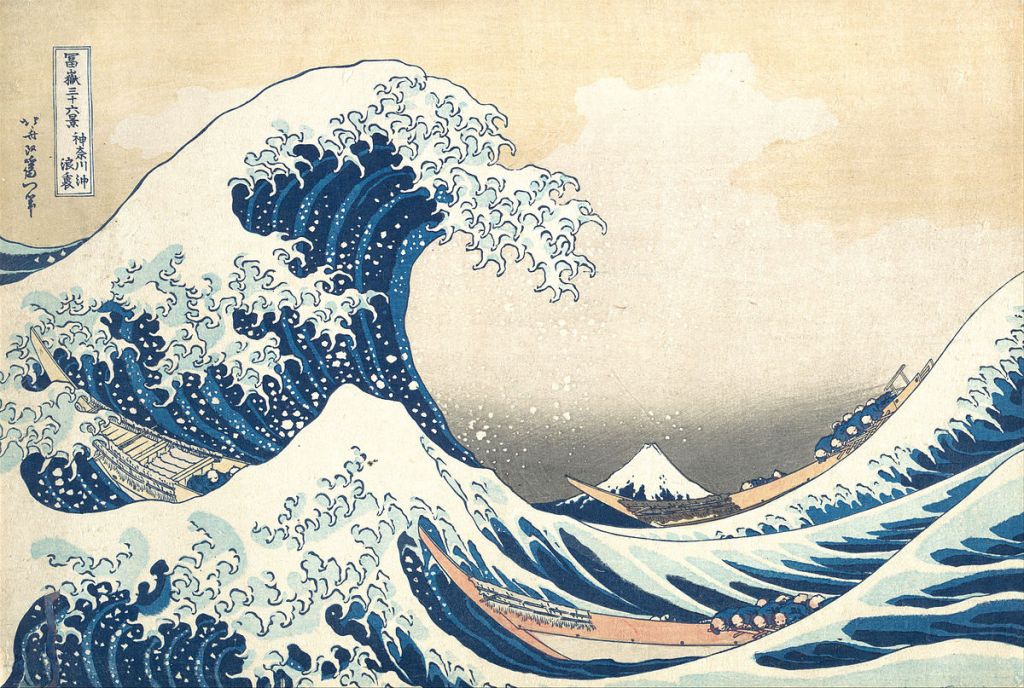
When I looked up at the sky and saw these clouds I thought of Hokusai’s famous work of art, “The Wave” …….

Of course, now that it’s 2020 and we’re still in the midst of this COVID-19 pandemic, that image has taken on a new significance I think.

There was always something both awe-inspiring and a bit frightening about “The Wave” (or is it called “The Great Wave”?). When I look at it I’m immediately struck by its beauty. What a fabulous form! And with Mount Fuji on the far horizon you get the impression that the wave is actually bigger than the mountain! Then you notice the people in the boats, and they are looking, to say the least, precarious! I mean if a wave the size of a mountain is about to come crashing down on you with its foam forming giant claws above your head, then, how could you be anything other than terrified? Well, maybe exhilarated too, responding to the challenge, the way a surfer would, but surely you’d be afraid?

This pandemic is a bit like this. I can’t help but feel awe in the face of the power of this tiny virus to spread over such enormous distances and affect so much of our tiny human lives. And I can’t help but feel a bit afraid of it too. Sure, we now seem to have reached a phase of frustration and don’t we all just wish the bloody thing would go away? But wishing isn’t going to get us there, is it? We have to face up to it, paddle like fury and try to ride it out.

What we’ll find on the other side of the Wave/Pandemic none of us know, but, one thing is for sure, we’ll be changed. This world will be different. Maybe we’d better face up to that too, and start to make the personal and collective changes which make sense in the light of what we’re learning from this experience……

Maybe that’s the big wave coming, actually…..not so much the tiny virus, but CHANGE…….change which washes away old and ingrained habits, routines, methods and ways of organising things. Change which inspires us to invent new ones.

Read Full Post »

I’ve had a couple of days thinking about beginnings, so it seemed kind of obvious to have one about endings!

This photo shows a number of berries, all part of the same plant, even the same part of the same plant, but each in a different stage of maturation. Some are still green, some have turned yellow, some red, and some are even beginning to get wrinkled (like me, ha! ha!) and so appear the most mature.

When I think about beginnings, I realise that they are all pretty arbitrary – a beginning is where we begin – if you pick a thread or two you’ll always find your way back to an earlier beginning.

I don’t think that means there are no beginnings. I think there are. All the time. Every day. Every moment of every day. There are beginnings. There are phenomena and experiences which have only this moment come into being for the first time ever. It’s pretty great to notice that.

Endings have exactly the same quality. It’s not that there aren’t any. There are endings all the time. Every day. Every moment of every day. There are endings. There are phenomena and experiences which have only this moment slipped into the past. You’ll never have them again. It’s pretty great to notice that.

Outcomes, targets and goals

In Medicine, there is a lot of focus on “outcomes”, sometimes called “clinical outcomes”, which, somehow are a bit different from “patient reported outcomes” (“PROMS”). These are all endings. They are points to be reached. Measurements to be attained, or ratings to be completed. But when your working life is that of a family doctor, (a “GP”), then you’re never done with outcomes. The patients don’t reach the intended outcomes then go away. Life, it turns out, goes on. What was an ending today, turns out to be just another chapter in an ongoing story, just another time and place sensitive reading in the midst of a flow of a whole life.

Oh, yes, you’ll say, but there is one outcome which isn’t like that isn’t there? Death. The final outcome. The ultimate ending. Except it’s not really, is it? Well, it is for the physical body of the person who has died, but we are more than physical bodies aren’t we? We are experiences, stories, events and memories, aren’t we? And those continue long after the physical body has gone. Are the people you loved who are no longer alive completely gone from your life? I don’t think so. Their life continues to influence our lives. The experiences we shared, the memories we made, whatever we created together, the stories told, the photographs taken, the objects held…….

Have you ever seen a BBC TV programme called “The Repair Shop”? I love it. People bring old objects to a workshop of artisans. The old objects are usually in a poor state of repair, but they mean something to the person who has them. Once restored by the craftsmen and women, the person comes back to reclaim the object, and time and time again, it is an immensely emotional experience. They are put in touch, deeply, and significantly with a loved one, long gone. It’s lovely to watch and it shows how a person, an individual, continues to influence others long after they’ve gone. How their “presence” I suppose you could say, is made more real through what they’ve touched, what they’ve handled, what they played with, or made.

Targets are a kind of outcome. They are useful as ways of getting you to somewhere you want to get. For example if you want to save up a certain amount of money then setting a target of that amount is a good aid to getting there. The trouble is that targets are used inappropriately. Whose targets are they? And are they the same, most important targets, which others want to achieve? Because the selection of targets is an individual, value-based, subjective, exercise of choice. But if they are set for others then they direct the efforts and lives of others towards those targets instead of others. I’m not a fan of targets. At least, not ones I don’t have a say in the creation of!

Goals are a bit like targets. I’d say the same about them. They can be helpful to get us to places we want to get to. But they are aspirations, not predictions. And they are not endings. Or at least, they are not final endings. Are they?

I think this unique and unpredicted pandemic is forcing us to face up to the reality of beginnings and endings. It’s making us more aware of connections, of webs of influence, of the non-linear, multifactorial, dynamic, ever flowing, ever changing nature of reality.

This morning I read an article in Le Monde about how management methods are already starting to change in the light of this experience. Here’s the main point I got in that article – management is having to move away from “control” to “coaching”. Three things have come to the fore – the need for individual autonomy, the need for good team working and relationships between workers, and the need for transparency.

Well that all seems pretty good to me! I look forward to seeing the end of de-humanising “Taylorism” and “command and control”, and the beginning of an emphasis of autonomy, relationships and transparency. Imagine if we governed countries according to those principles?!

Read Full Post »

« Newer Posts - Older Posts »