Feeds:
Posts
Comments

Archive for the ‘from the living room’ Category

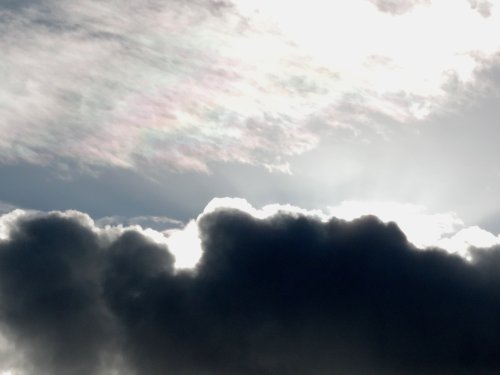
I see two symbols of hope in this one image – a cloud with a silver lining, and the beginnings of a rainbow (or, if you prefer, the emergence of colour out of monochrome)

We human beings need hope. I’m not sure if it’s possible to live without it. That might sound dramatic but I expect you’ve heard tales of seriously ill people “turning their face to the wall”, and dying. Or, maybe the opposite, maybe you’ve heard those who recover from serious illness described as “fighters”, which doesn’t mean they have defeated an enemy, it means they have dug deep, found wells of hope and belief, and have healed.

Whenever I saw a patient with a serious disease I knew there were roughly three possible future paths – improvement, deterioration and something inbetween (a kind of continuation of the present). You can see that with common, acute infections, such as a cold or flu, and you can see it with this COVID-19 virus too. Some people make a complete recovery, some go downhill quickly and die, others recover well enough to leave hospital but continue to have disabling symptoms (people are calling them “long haulers”).

Perhaps one of the silver linings from this latter group is the growing recognition in Medicine that some viral infections can produce seriously disabling chronic states. Sadly, in my own work, I saw patients with diagnoses from “Post Viral Syndrome”, to “ME”, to “Chronic Fatigue Syndrome” who had been dismissed and/or not believed by other doctors. These patients were hit by a double whammy – illness and disbelief. That was always hard. I hope this pandemic might have changed the mindsets of some physicians who have dismissed such chronic states as “psychological”, “depression”, or “fraud”.

But to return to the issue of hope. What makes the difference? What influences which of these three paths lie ahead for you when you get sick? The improvement path, the decline path, or the chronic illness path? The truth is we don’t know. But I sure hope there are people invested in research projects to try to shed a light on this issue. The other truth is that nobody can accurately predict which of these paths lie ahead for any single patient.

Yes, of course, we can use statistics and probabilities, but when it comes to an individual, those generalities don’t determine the outcomes. I’d be explicit about that with patients, and I’d say, the truth is that for this individual, their path may well be the improvement path, so why not take on board that truth? Taking that on board is a kind of hope.

A little further down the road things might look very different. Someone who was getting better might decline. Someone who looked as if they had no chance might make a stunning, and unexpected recovery….and so on. But as the story proceeded, so did the three options. At every point, every day, those three paths lie ahead – improvement, decline or staying much the same. Is it ever helpful, then, to give up hope? If we hope, then don’t we try our best? Don’t we put in our greatest efforts? If we don’t hope, the danger is that we give up.

Because, here’s the other piece – the self-fulfilling prophecy. How often does it seem that what we anticipate, what we expect, comes to pass? Is it possible that hope can contribute to improvement and that despair and hopelessness can contribute to decline?

What do you think?

I think we human beings need hope. And I think hope contributes towards improvements. And even when things don’t improve, we can always change what we are hoping for. Changing what we hope for keeps us realistic, but being realistic doesn’t mean we have to give up all hope.

What’s your experience?

Read Full Post »

“Now, Life is living you”

This sign is on the wall of a buddhist temple smack in the middle of Kyoto city.

Just take a moment and contemplate it.

Ever since the moment I saw this phrase and it stopped me on the pavement outside this temple, I often think of it, and the more we learn about Life on Earth, the more true this statement seems to me.

As best we know, planet Earth was formed from atoms which were created in the great furnaces and explosions of distant stars. Every single one of us has been created from those atoms. Nature doesn’t create new atoms, it recycles and rearranges the existing ones. So the atoms which can be found in your body were once found in other bodies, other species, other members of other kingdoms on this Earth.

Our bodies are Star Bodies. We are the children of the Stars.

Emanuele Coccia, the Italian philosopher challenges us to think about the Plant Kingdom differently. He has a new book out, “Métamorphoses” (I’ve got it in French…..you’ll need to wait for an English translation if you don’t speak Italian or French). One of the central themes of this book is that we are One….that there is only One Life which never ceases to change forms whilst never changing its substance. In other words, there are only the atoms which made up the substance of the Earth at its creation, but Life turns these atoms, continuously into new forms – new species, new individuals within each species. The process of evolution is a kind of sculpting, produced by the vast complex web of all that exists, to create ever more adapted forms of Life.

We are each like the individual waves on one great ocean of water, every one of us unique and transitory, emerging for brief periods of time before dissolving back into the vast sea.

It’s Life which fashions each of us, and each of us, in turn, interacts with, metabolises and changes the other forms of Life. So, as Emanuele Coccia says, once we understand the one-ness of everything, all ownership and frontiers lose their significance.

Life is living you.

Read Full Post »

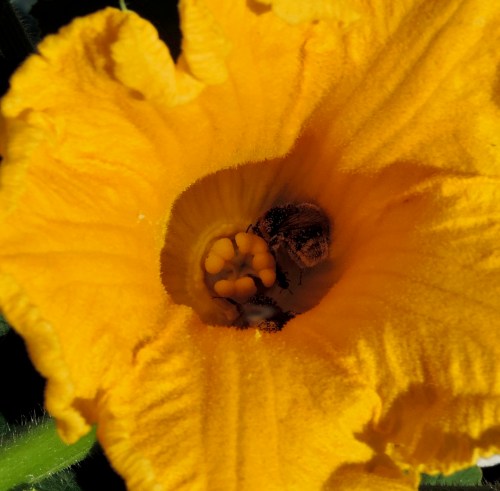
The other day the bees were going crazy for the pumpkin flowers. Each flower had two or three bees tumbling around in its depths, covering themselves with yellow pollen, and staggering as if they were drunk.

It was an amazing sight. Every single flower was filled with powdered bees. It was hard to photograph, but, I think you’ll agree, persistence paid off.

Strangely, (well, I never really understand how the universe does this), I had just read an interview in “Le Monde” with the Italian philosopher, Emanuele Coccia. He has a new book out, “Métamorphoses”, where he lays out his insights about the unity of Life, and the prime importance of plants. I read his earlier work, “La vie des plantes” some time ago and was hugely inspired by it – he gave me a whole new perspective on the world, teaching me to consider life from the perspective of the plant kingdom. In his interview he said a few things which came flooding back into my mind as I photographed these bees.

I’ll paraphrase what he said because the original is in French…..

Flowers contain the sexual organs of the plants but in order to reproduce they need the intervention of third parties – primarily insects or the atmosphere. So, what we learn from this observation is that flowers involve agents from other kingdoms in their individual sexual acts. This means that plants place their genetic and biological destiny into the hands of other species.

That’s quite a thought by itself, but he then goes on to ask “How do the insects choose which flower to pollinate?” The answer is, not by rational thought and logic, but by TASTE and AESTHETICS. So the evolution of plants is based on the tastes of other species.

Isn’t that a stunning idea? Or, rather, observation?

He has much more to say, but this is the part which I thought was most relevant to my experience of witnessing the crazy desire of the bees and the massive spread of pollen which was the result.

Life based on desire and taste……well, what do you know?

Read Full Post »

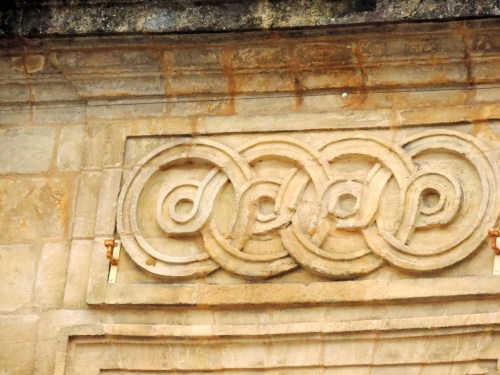
When you look at these two photos, how do you respond?

Do you find you prefer one to the other? Or do you like both, equally?

The design on the left is all straight lines and right angles, whereas the one on the right is of interlocking circles and loops.

Some people find straight lines and right angles somewhat aggressive. I seem to remember reading that the architecture of Waldorf Schools and other Steiner inspired buildings seeks to avoid these “harsher” lines and angles. The hospital where I worked for the last two decades of my career, “The NHS Centre for Integrative Care” (formerly, “Glasgow Homeopathic Hospital”) was designed to have as many curves, and as few right angles, as possible. The main reception desk was curved and open, and even the walls of the inpatient unit were a series of curves which evoked the image of gentle waves. I liked that.

As I was born and grew up in Scotland, the typical Celtic designs of knots and loops were familiar to me from an early age. Although the image on the left is also of intertwining lines, it isn’t typical of the Celtic drawings I know.

But maybe the straight lines and right angles are more appealing to you? If they are, why don’t you tell me about them? I’d be interested to hear what your preference is, and why.

Read Full Post »

I’m convinced that the Self isn’t a thing. There is no entity, or measurable, directly observable object, called “the Self”.

Some say the Self is an illusion, but I was always impressed by the philosopher, Mary Midgely’s response to that…..which was to ask if the Self is an illusion who, or what, is having this illusion? I’m not convinced that the Self is an illusion.

Some say the Self is multiple, that there is a “community of selves”, or that the Self is multidimensional. Different dimensions, or aspects, of the Self are activated and expressed in different relationships, and different contexts. I’m convinced that the Self is multiple.

Some say the Self is a narrative, a story. I’ve got a lot of time for that idea. I’m pretty sure we weave together the events and experiences of our lives into our personal story both to make sense of life, but also to have a sense of Self, a sense of identity.

But that isn’t enough.

There’s more to who I am than my story. There’s my body. There’s my unconscious and subconscious reality, all the breathing and heart beating, and organ and cell and tissue function that is vital to me but of which I normally have zero awareness so can’t weave into a story.

I’m convinced of a Life Principle, a Life Force, or a “Vital Force”, not as an entity, not as an object, not as something “outside” of the body and the Self, but as something manifest AS the body and the Self and probably more besides….

There’s a red thread runs through life…..the thread of the Self as more than a construct, a narrative, an illusion, a force…..isn’t it just wonderful to experience that, to savour that, to enjoy that, to get to know that?

Read Full Post »

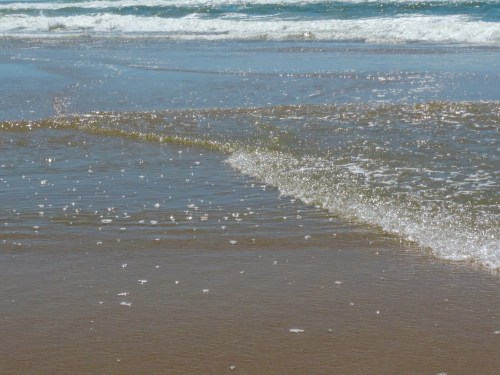
There’s a stretch of coastline about an hour directly west of here. It’s known as “La côte sauvage” – the wild coast. It’s beautiful but a bit dangerous. There are rip tides and ever changing flows within the Atlantic Ocean which can trap and carry off a swimmer.

This photo captures something of that unpredictability. If you look at the lines of the breaking waves you can see the water is arriving from at least three different directions at once, and there are layers of water running in several directions.

Actually, I think life is like this. There are forces, attractions, repulsions, triggers and stimuli influencing us from multiple origins in every waking moment. We are complex creatures, we humans. And the world we live in is complex too. That’s why I doubt simplistic analyses and confident predictions.

Human life cannot be reduced to “cause and effect”, to “rationalism”, to “measurements”, “categories” and “data”. Life is full of surprises and every single experience emerges within multiple contexts with us responding, mostly unconsciously, to an almost infinite number of factors.

Somehow, that makes life all the more beautiful, all the more mysterious, all the more engaging……

Read Full Post »

Summer has established itself here in the Charente, and the big heat has come with days of 30+ degrees. The grass is brown and feels crunchy when you walk across it. We managed a visit to family in Scotland so we’ve been away from here for a couple of weeks and several plants just haven’t made it.

This evening was a time for watering, harvesting some tomatoes, courgettes and radishes, and making a start on tidying away dead plants and leaves to put them into the compost bin.

At first glance the garden looks like it is suffering and it’s certainly the end of the road for some plants, but this photo from a forest floor in Scotland in the autumn reminds me…..new growth is never far away.

In fact, new growth is hugely unpredictable. We’ve got about seven large pumpkins swelling up on a giant pumpkin plant which has made its way to every wall it can reach, and we didn’t even plant it! There must have been viable pumpkin seeds in the compost I spread on the plot over the winter months. What a gift! What a surprise!

Nature teaches me this – there is no waste, no final ending, there is always new growth.

Read Full Post »

There was a craze hundreds of years ago for “chimera” – originally an idea from Greek mythology, medieval peoples took it a whole stage further and created all kinds of bizarre animals.

The chimera is an invented animal made up of the parts from other animals…so maybe a human head, a lion’s body, wings, a serpent tail etc. You can see lots of them carved onto the sides of old churches, and they illustrated old texts as well.

What do you think of them? Are they horrifying? (I think they were often intended to be so) or are they fun? Fascinating?

They just aren’t “natural” are they? You would never imagine that a creature like this existed anywhere. Maybe, once upon a time, some people did. Maybe they believed that they lived in unexplored regions…..remember the old maps with the unmapped areas labelled “Here Be Monsters”?

Probably the commonest reaction to them is a sort of disgust. We find them a bit repulsive….even the more beautiful ones!

I wonder if both chimera and genetically modified plants and animals touch that same core discomfort in us. There’s something a bit unsettling about cutting some DNA out of one creature and splicing it into another, don’t you think?

I think it’s no surprise that many people want GM foods labelled so they can choose not to buy them if they don’t want to. I think it’s not a surprise either that many people think there are complex ethical challenges to be addressed, and a need for intense oversight and control of the whole business of mixing DNA from creature into another……

Read Full Post »

There’s something which really bothers me about modern management theory and practice – “efficiency”.

“Why should that bother you?” you ask.

Well, because it seems to me that it usually means getting the greatest return from the least input or effort. And I’m not sure that’s always a good idea. I’m coming from the perspective of health care. I despaired of the annual cuts after cuts after cuts in the NHS. Every year I saw colleagues who retired or moved away, not replaced. Every single time someone left the remaining staff were asked to “absorb” the missing colleague’s workload. Every year there were more budget restrictions, more closures of beds and services, all in the name of “efficiency”.

So what has happened now that a pandemic has hit? Not enough beds, not enough equipment, not enough staff. Even now, weeks into the crisis, frontline staff lack adequate amounts of PPE (Personal Protective Equipment). All the pressure to “protect the NHS” was due to the fact it had been pared down to the bone over at least a decade. There was, and there is, no, or little, resiliency in the system. Yes, they redirected staff and reallocated beds to deal with the COVID-19 patients, but did so at the expense of the care and services which those staff and beds were normally employed for.

Is it really a good idea to have “just in time” ordering and delivery systems for something like the NHS? It doesn’t look like it. Is it really a good idea to have as few beds as possible, as few hospitals as possible and as few staff as possible? It doesn’t look like it.

Nature doesn’t do it this way.

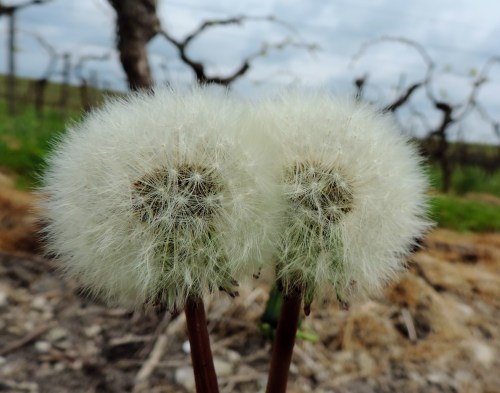
Nature goes for abundance. Look at the seedhead in the photo at the start of this post. How many seeds are there from that single plant? Way more than you’d “need” for reproduction and spread you might think. Would it not be more “efficient” for the plant to produce, say, half that number of seeds? Or maybe only ten percent? It doesn’t look like it.

Complex adaptive systems are Nature’s way of enabling adaptability and resilience. All such systems have what scientists call “redundancy” – by which they mean there are “belt and braces” approaches, there are several pathways to achieve the same thing. It’s by drawing on those “extra” resources and methods that Natural living organisms survive and thrive.

I think we need to learn that from Nature. There’s been way too much paring back, stripping down, and minimising going on. If we want resilient services, and resilient societies we aren’t going to get there by “efficiently” going for the least, the cheapest, the quickest and the meanest.

Here’s what Nature does –

It goes for more……

Read Full Post »

What happens as new technologies, new designs and new fashions appear? Do they replace the existing and past ones? Do we throw away the ones we have and replace them with the new ones we just bought?

Well, I suspect that happens a lot. What do we do with the old “stuff’? Stick it in a drawer, or in the attic? I read that most of us have old phones, old cameras, old laptops etc stuck in the house somewhere….no longer used, out of sight, out of mind, just occupying space (although, to be fair, it’s usually dark space……somewhere hidden where nobody can see it)

Dark space, huh? There’s an interesting idea! Sounds a bit like “dark matter” or “dark energy” which between them are apparently mainly what the universe is “made of”. I wonder how much the “dark space” in our houses affects the way we live? Or do you think all that stuff has no effect because you don’t see it on an everyday basis?

If we don’t stick the old stuff into dark space, then maybe what we do is throw it away, give it away, or sell it. There are increasingly good reasons to do the latter two, rather than the former one.

Nature doesn’t do waste. There is no waste in Nature. So why don’t we try to be more natural?

Be more like Nature!

How are we going to do that? Well, reducing waste would be a good idea. Longevity of products would help that. In other words making things which last. We used to call that quality. Wouldn’t it be good to have better quality in our lives?

But longevity isn’t enough. Our lives change, our needs change, there is just a lot that we don’t need any more, don’t use any more, don’t wear any more. What to do with that?

Share it – “toy banks”, “clothes banks”, “community swaps” etc.

Give it away – donations to charities, to relatives, to friends etc

Sell it – in France there are lots of “vide grenier” – which translates as “attic emptying” – in other countries you might call them “garage sales” or “car boot sales”. There are lots of online options too.

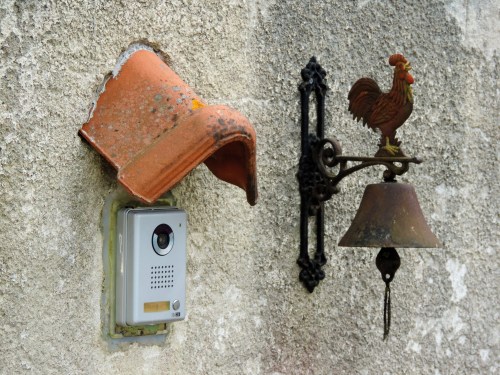
Or, in the case in the photo above, it seems to me, they’ve gone for “and not or”. They had a way of visitors letting them know they were there. It’s pretty attractive actually……a handbell with a cockerel on top. But, maybe because it’s not so easy to get to the door any more, they’ve added a smart video-doorbell, so they can see who is there, and, maybe, I don’t know, press a button to open the door. So why not just take the bell and cockerel down and throw it away, give it away, or sell it? Maybe it means something to this homeowner. Maybe their grandfather made it, or it was a wedding gift, or….well, use your imagination. We humans relate to objects in more than mere utilitarian ways. Sometimes we want to have a particular object because it inspires memories, symbolically conveys meaning to us, or to others…..and that’s absolutely fine.

(Mind you, it’s unlikely all that stuff in your “dark space” has got real, valued meaning for you…..because if it did, why would you keep it where you can’t see it??)

Read Full Post »

« Newer Posts - Older Posts »