Feeds:
Posts
Comments

Archive for the ‘from the reading room’ Category

Sheer beauty.

What is it that I love so much about this world?

The wonders of the everyday. Or “L’émerveillement du quotidien”. It’s normal for me to find myself wondering about something I’ve just seen or heard.

I suppose for most of my working life my days were filled with patients. I never tired of that. I never got bored of that. Every day each patient would present to me a unique a story, a new, and singular problem, puzzle or conundrum to unravel. Each patient would be asking me to help them make sense of what they were experiencing and to support their abilities to heal, to cope, to adapt. Maybe they didn’t quite use that language but that’s always what I heard.

Before I became a doctor, way before, right back as early as I can remember I was driven by curiosity. I wanted to learn, discover and explore. It strikes me now that it isn’t a long way from curiosity to wonder.

People have always amazed me. They still do. Life has always amazed me. This Earth, this planet, the solar system, this universe which we all live in have always amazed me, filling me with an infinite supply of curiosity.

But there’s something else.

Beauty.

Look at this photo of a glorious, immersive sunset, where every single element of the sky and the Earth changes colour. Look at the palette! It is just breathtakingly gorgeous.

I see beauty everywhere. Which isn’t to say I find everything I see beautiful, I don’t. But there is “so much beauty in this world” (do you know what movie that comes from? Here’s the answer).

I am a very visual person. I think visually. I sketch and diagram as I think. I love photography and I think I “have an eye for it”. I see what I find amazing, curious or beautiful and I try to take a photo or two. Then I return to those images again and again, year after year, and I find that, like with this one, the delight, the pleasure, the amazement in beauty like this never fades.

Of course there are other senses and I don’t just experience beauty visually. I love music. I collected “records” long before people starting calling them “vinyl”. I still have them. I still play them. I spent hours and hours ripping CDs onto iTunes and I don’t even know where those libraries are any more! But I stream music now. Every day. Several times a day. I used to discover new music on the radio. I took the back off an old radio when I was a teenager, attached two wires to the speaker using clips, and fed the audio directly into a cassette recorder. I still have some of those recordings…..studio sessions on John Peel’s programme on Radio 1.

I’ve long had a love for movies. I love them for their stories and for their beauty, oh, and I often love them for their music. I compiled short clips of about a hundred movies to teach doctors and other health care workers about our unique human strategies for coping and adapting. I could have taught those strategies without movies but the beauty, wonder and emotional engagement which came with the movies made them much easier to learn and to remember. I probably have a whole vocabulary of coping and adapting based on movie characters, scenes and plots.

There is beauty all around us. I delight in images. I delight in music. I delight in movies.

Where do you find beauty? Where did you find beauty today?
Read Full Post »

Emanuele Coccia, the Italian philosopher who brings a new and refreshing perspective to the life by considering plant life says that what plants do so well is capture “extraterrestrial light” and turn it into energy and forms.

Two things struck me when I first heard him say that – “extraterrestrial light”? What’s that? Well it’s the light which comes from outside of the Earth isn’t it? Natural light. The light of the Sun, and the light of stars. The light of the moon is reflected light, so is just another dimension of the light of the Sun.

Without this “extraterrestrial light” from the Sun there would be no Life on Earth. Plants are THE way of transforming light into energy. We get all the energy we need by consuming other life forms at different stages on the food chain, but all of what we eat has plant life at its core. We fundamentally consume the light of the Sun through plants. Maybe through some animals we eat, but they do didn’t capture the energy directly from the Sun. All animals get all the energy they need AFTER the plants have captured it from the Sun.

The second thing which came to mind was Richard Feynman’s observation that trees make themselves “out of thin air“. That startling observation was based on the fact that trees capture carbon dioxide from the air, turn it into carbon based structures and emit oxygen as a “by product”. They also capture all the energy they need directly from the Sun using photosynthesis (a trick no animal ever managed to acquire!)

Then a third thing came to mind….the fact that we are all made from the atoms created in the stars. All the natural elements we find on Earth didn’t originate here. They originated in the great furnaces and explosions of distant stars millennia ago.

All of Life pursues this “extraterrestrial light” – all the plants, all the animals, all living creatures get the energy they need either directly from the Sun or indirectly through the consumption of other creatures which have already captured the sunlight.

Isn’t that a startling thought? That we are ALL light-seekers! All of us surviving and growing by finding and consuming the “extraterrestrial light”.

Read Full Post »

“Now, Life is living you”

This sign is on the wall of a buddhist temple smack in the middle of Kyoto city.

Just take a moment and contemplate it.

Ever since the moment I saw this phrase and it stopped me on the pavement outside this temple, I often think of it, and the more we learn about Life on Earth, the more true this statement seems to me.

As best we know, planet Earth was formed from atoms which were created in the great furnaces and explosions of distant stars. Every single one of us has been created from those atoms. Nature doesn’t create new atoms, it recycles and rearranges the existing ones. So the atoms which can be found in your body were once found in other bodies, other species, other members of other kingdoms on this Earth.

Our bodies are Star Bodies. We are the children of the Stars.

Emanuele Coccia, the Italian philosopher challenges us to think about the Plant Kingdom differently. He has a new book out, “Métamorphoses” (I’ve got it in French…..you’ll need to wait for an English translation if you don’t speak Italian or French). One of the central themes of this book is that we are One….that there is only One Life which never ceases to change forms whilst never changing its substance. In other words, there are only the atoms which made up the substance of the Earth at its creation, but Life turns these atoms, continuously into new forms – new species, new individuals within each species. The process of evolution is a kind of sculpting, produced by the vast complex web of all that exists, to create ever more adapted forms of Life.

We are each like the individual waves on one great ocean of water, every one of us unique and transitory, emerging for brief periods of time before dissolving back into the vast sea.

It’s Life which fashions each of us, and each of us, in turn, interacts with, metabolises and changes the other forms of Life. So, as Emanuele Coccia says, once we understand the one-ness of everything, all ownership and frontiers lose their significance.

Life is living you.

Read Full Post »

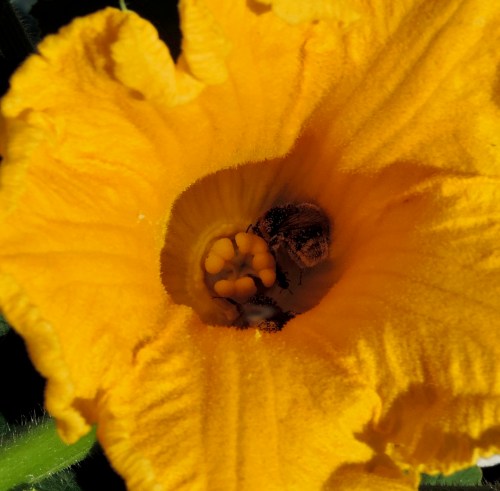
The other day the bees were going crazy for the pumpkin flowers. Each flower had two or three bees tumbling around in its depths, covering themselves with yellow pollen, and staggering as if they were drunk.

It was an amazing sight. Every single flower was filled with powdered bees. It was hard to photograph, but, I think you’ll agree, persistence paid off.

Strangely, (well, I never really understand how the universe does this), I had just read an interview in “Le Monde” with the Italian philosopher, Emanuele Coccia. He has a new book out, “Métamorphoses”, where he lays out his insights about the unity of Life, and the prime importance of plants. I read his earlier work, “La vie des plantes” some time ago and was hugely inspired by it – he gave me a whole new perspective on the world, teaching me to consider life from the perspective of the plant kingdom. In his interview he said a few things which came flooding back into my mind as I photographed these bees.

I’ll paraphrase what he said because the original is in French…..

Flowers contain the sexual organs of the plants but in order to reproduce they need the intervention of third parties – primarily insects or the atmosphere. So, what we learn from this observation is that flowers involve agents from other kingdoms in their individual sexual acts. This means that plants place their genetic and biological destiny into the hands of other species.

That’s quite a thought by itself, but he then goes on to ask “How do the insects choose which flower to pollinate?” The answer is, not by rational thought and logic, but by TASTE and AESTHETICS. So the evolution of plants is based on the tastes of other species.

Isn’t that a stunning idea? Or, rather, observation?

He has much more to say, but this is the part which I thought was most relevant to my experience of witnessing the crazy desire of the bees and the massive spread of pollen which was the result.

Life based on desire and taste……well, what do you know?

Read Full Post »

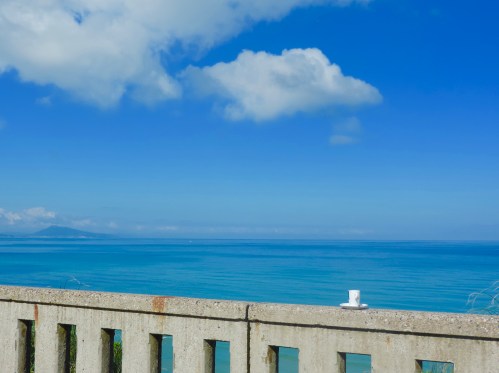
This is one of my all time favourite photos. I took it while having breakfast at a little cabin at the top of the hill on the edge of Biarritz. I realise that the concrete fence is not bonny! But that doesn’t take anything away from the picture for me. The rich, deep hues of blue in the sea, sky and even distant mountain are just gorgeous and I like the fluffy summer style of clouds floating by.

Hey, you might be saying, you’re going on about the fence, the sea, the sky, the mountain, even the clouds, but isn’t this a photo of a coffee cup?

Well, yes. You could say that. But, then you know my tendency to explore the contexts, the connections and the environment….how I am drawn to the “whole”. But, yes, it is a photo of an expresso, and that’s what I want to talk about today.

Even though these short coffees in Europe are called “expressos” they don’t necessarily imply a brief, speedy period of time. I noticed that when I first stopped for a coffee in Italy that the cafe had tall tables and no chairs. That was a surprise. Maybe that’s when I thought that an “expresso” wasn’t just fast to make, it was fast to drink. But that was a misunderstanding. When I went for breakfast with a group of Italian friends, they stood around the tables chatting, drinking their coffees, eating pastries or biscuits, and there was absolutely no sense of urgency or hurry.

Coffee time is a pause.

It’s often an in-between time….between waking up and engaging with the tasks of the day, for example. When I worked in Glasgow, I lived in Stirling, and traveled in the train for about an hour each way each day. I’d stop and enjoy a coffee once I arrived in Glasgow and before I caught my second train to the hospital, and, often, I’d stop and enjoy another one on the return journey. Those were times of pausing. Of stepping off the busy flow and slowing down to reflect, to read, to ponder. Coffee times were also times of sharing, of enjoying the company and chat. Not all coffee times are social times, but many of them are, and that’s important.

There’s a term in buddhism – “bardo” – it means a space. For example, there is a bardo between each in breath and each out breath, and another between each out breath and each in breath. There is even a bardo between each thought, but good luck catching any of those! I think a pause is a kind of bardo. A life bardo, breaking up a busy day, and helping us to re-centre, to re-focus, to re-connect and to re-store.

I was reading in an article in “Philosophie” magazine this morning. It was about rituals and one philosopher described his coffee ritual. He said he wakes up, drags his heavy feet and thick head through to the kitchen, pops a “dosette” into the coffee machine, presses the on button, and listens to the familiar sounds of the machine. That first coffee begins to re-connect his disconnected brain cells, but it also makes him cough. He has a second coffee, which settles his cough, then, the third coffee, he says, is “for pleasure”. Then he is ready to get on with the rest of the day. Wow! I think if I started every day with THREE expressos I’d FLY through the day!!

We all have our own rituals, our own habits, our own routines. This little coffee cup resting on the fence reminds me of that. It’s good to pause now and again, and in that bardo to take stock, to reflect, and to become aware of rituals, habits and routines. What are they, and what part do they play in my life?

How about you?

What comes to mind when you think of a pause, a bardo or a ritual?

Read Full Post »

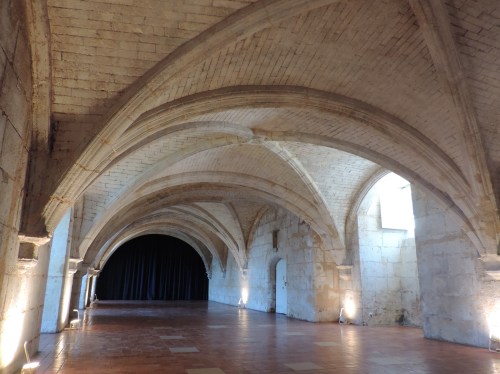
One of the cognac distilleries in the town of Cognac is in the old chateau. When you take a tour of the place you walk into this incredible room. What do you think this room would be used for?

Bet you didn’t say “for keeping prisoners in”. But that’s exactly what it was used for. Centuries ago it was very common practice to capture opposing army soldiers….especially knights, princes or kings….and hold them while you negotiated a ransom.

I’ve just finished reading a history of the “Black Prince”, Edward, who fought many campaigns for the English in Aquitaine, which in those days was controlled by England, not France. In many of the stories you read about knights or princes getting captured and the ransom money being used to fund more battles.

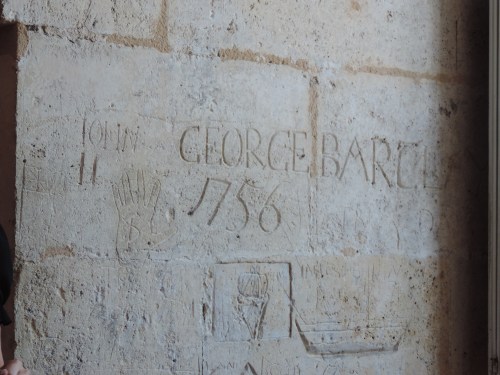
The proof that this grand room was used to hold some such prisoners is on the walls.

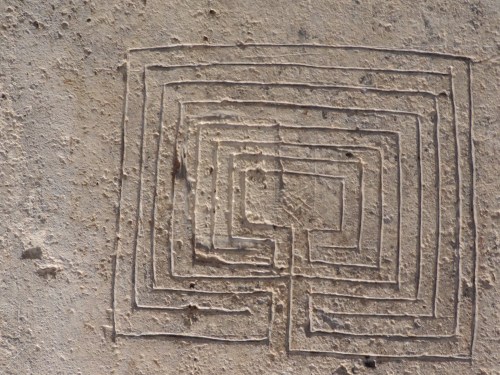
They are covered with carvings and scratchings such as these. And, yes, as you’d expect some are simple rows of lines, where someone has been marking off the days.

But look at this one….this is my favourite

This one has always got me wondering, what would I scratch on the wall of a prison like this, while I was awaiting my freedom?

So, how about you? What do you think you’d scratch onto the wall for people to see three hundred years later?

Read Full Post »

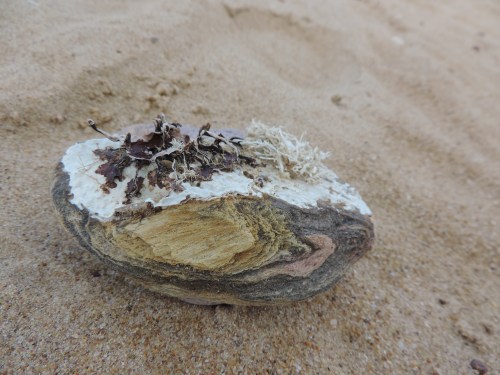
When I noticed this stone on the beach I was entranced. It looks like a whole small world. Look at the layers of minerals, their colours, their extent and shape. Look at the top of the stone with several species of lichen and/or seaweeds living there.

It makes me think of illustrations I saw when I was a child. Colour drawings of the Earth with a segment removed to show you the multiple layers all the way down to the core.

It also makes me think of the concept of the ecosystem, or even a biosphere….a complex of elements, some living, some non-living (which reminds me….I came across a quotation yesterday which said the opposite of “life” is not “death”, it’s “non-living”……must look that up!)

The idea of networks of connections and relationships between minerals, uni-cellular and multi-cellular organisms, air, water and sunlight co-creating the reality we live in…..I just love that.

It makes me think of the idea of viewing whatever we are looking at from different scales, because everything which exists, exists in nested layers of everything else……remember the old funny story about the teaching that the world floats on the back of a turtle? How the enquirer asked “And what does the turtle sit on?” The answer “Another turtle”. To which the enquirer asks “What does THAT turtle sit on?” The answer “Another turtle”. After a few minutes of this exchange continuing along the exact same question and response, the teacher finally responds to one of the “What does THAT turtle sit on?” with “It’s turtles all the way down, son. It’s turtles all the way down.”

On a more serious note, I found Lynn Margulis’s theory of “endo-symbiosis” hugely convincing. Briefly, she claimed that all multi-cellular organisms (that includes you and me) are made up an incredibly complex co-operating network of single cells, and that inside each of our cells are individual elements, like mitochondria, for example, which, way back in history were single celled creatures in their own right. She hypothesised that the evolutionary path of development was driven by collaboration and co-operation, with single celled organisms combining to live together at new levels. In other words all the different elements of a single cell came from smaller single “celled” creatures merging. Maybe that idea was a bit too challenging for some people, but it’s pretty undeniable that multi-cellular organisms like humans can actually be understood as whole worlds of vastly networked individual cells. It’s reckoned that only a tenth of the cells of your body are genetically “you”, the other ninety percent being bacteria and other unicellular organisms. Pretty mind boggling isn’t it? But it seems to be true all the same.

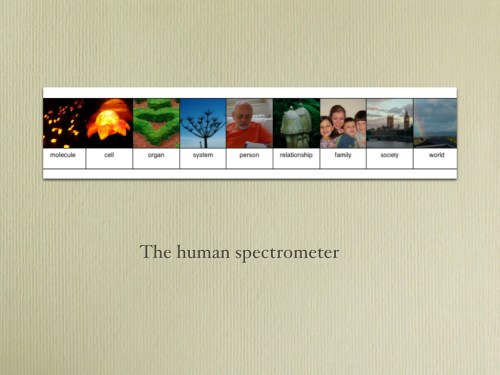
This idea of scale…..a long time ago I created a “human spectrometer” to help me discuss a patient’s issues with them at different levels of scale. Here it is

I’d start in the middle with the “person” because that’s where we met, person to person. Then I could move left zooming in on smaller and smaller parts of the person to consider the problems and their effects….perhaps in the “nervous system”, or the “digestive system”, then further “in” to disturbances in particular organs, “the heart”, or the “liver”, then further in yet to consider the role of cells, like white blood cells, or the cells of a specific organ, or, at an even smaller level the circulating levels of individual molecules, like hormones, antibodies, chemical messengers and so on.

I’d then return to the “person” and start moving right to consider the person within their significant relationships, within their family, within society, considering cultural, economic and work issues, or, finally within the “world”, by which I meant the environment.

I didn’t usually work through this whole thing methodically, step by step, but used it as an illustration to consider everything from pathology, to pathogenesis, to the impacts from and on the vast networks of life in which an individual lived.

I created a post about it back in 2007, so patients could explore the idea a bit more in their own homes.

It’s only now, many years later, after reading Iain McGilchrist’s “The Master and His Emissary“, that the left hemisphere zooms in to consider the parts, while the right zooms out to consider the connections, the relationships, the whole! Funny, how the universe works!

This notion of nested scales was also explored by Arthur Koestler who coined the term “holon” to describe the idea of multi-level hierarchies. You can read a bit more about that here.

Read Full Post »

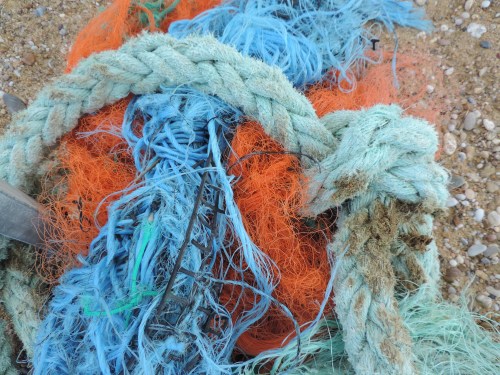
Life is tangled.

Every one of us is a multitude. Check out Bob Dylan’s new release “I contain multitudes” for a very recent expression of this idea. In fact, as he sings it, maybe we are multitudes, plural.

The Scottish psychologist, Miller Mair, coined the term “community of selves” back in the 1970s. It remains a powerful metaphor for the complexity of an individual personality. That idea made a lot of sense to me, and helped me to understand not only my patients but also myself. We all have that experience of at very least tapping into different strands of our lives when we act within our different roles – parent, child, friend, neighbour, employee, professional, artist, consumer etc etc. We know all those roles are just a part of who we are but it can be very hard to untangle them, to see how they inter-connect.

The French philosopher, Deleuze, wrote about “multiplicities” as a way of understanding the complex universe, and described any particular instance as a “singularity of multiplicities”. I liked that idea the moment I read it. I happened upon his writings at the same time that I was exploring the new “complexity science”, and in particular the concept of the “complex adaptive system“, which fundamentally changed how I saw our lives and our world.

I once spoke to a “Chef de Service” at a Parisian Homeopathic Hospital and he described to me that he saw each patient as like a diamond, with multiple facets shining, each one different, but together all part of the same individual. He saw his therapeutic strategy as being based on addressing several of the most prominent of a patient’s “facets”. A rather poetic way to think of the same underlying issue.

What is the underlying issue?

Life is messy.

On the “inside” and the “outside”. I put those words in quote marks because I’m pretty sure that frequently there is no clear boundary between the two. I think wherever we look we can find multiple threads to follow. We can identify particular paths, storylines, themes, chains of cause and effect, which run through a lifetime.

And, here’s the important point, brought back to the front of my mind by this photo today, all those paths, storylines, threads or whatever, are entangled. They are connected. They are inextricably interconnected, astonishingly woven together to create a unique, beautiful tapestry of a single life.

I’m not a fan of labelling a patient with several different concurrent diagnoses then sending them off to separate specialists to have each disease treated as if it exists in isolation. In Medicine this is referred to as “silo-ing“, a strange word which means separating out someone’s problems into separate baskets, boxes, or “silos”, then treating each one separately. Most of the evidence used in “Evidence Based Medicine” comes from trials where patients have been selected on the basis that they have only the single disease which is under study, and that they are receiving only the single drug which is being trialled. But the real world isn’t much like that. Much more common is the finding that an individual patient will have several different diagnoses active at the same time and that they will already be on a cocktail of drugs. Medicine is more messy than some people would have you believe.

So what? Is this a counsel of despair? Am I saying life is too complex and entangled to make any sense of it? No. Absolutely not.

What I find is that this complex entangled life is beautiful. That it manifests in the most unique, most varied, most astonishing individual narratives you could imagine.

What I find is that when you look for the connections between the parts, you get insights and understanding which you’d miss if you kept your attention only on single parts.

What I find is that it’s best to use your whole brain, not just half of it, as Iain McGilchrist, author of “The Master and His Emissary“, would say. It’s not enough to separate out the threads and elements and study them. You have to weave them back together to see the contexts, the contingencies and the connections. In other words, you need both your left hemisphere ability to see the threads, and your right hemisphere ability to weave them together into a whole.

What I find is that when you look at life this way, then you encounter the “émerveillement du quotidien” – that you find yourself wondering and marvelling every single day. You find diversity and uniqueness. You find infinite trails of connections. You find that curiosity is constantly stimulated and never ends. You find that you are humbled by how little you actually know. You find that you doubt predictions and develop a distaste for judging people.

You find that Life is astonishingly, endlessly, fascinating.

What a delight!

Read Full Post »

In several parts of France, usually along a river bank, you might find “bouquinistes”….second hand, and antiquarian booksellers, each with a wooden box, or a number of wooden boxes, which contain their books for sale. They close these up and lock them when they aren’t there, and open them up for browsing and sales while, usually, they sit nearby on a camp chair, or in small clusters with other bouquinistes, until somebody appears to want to buy something.

The most famous are in Paris, and the Seine has even been described as “the only river in the world which runs between two bookshelves”. The Parisian ones are the first ones I saw but these photos of mine are from another town, in the West of France. The term applies a lot more widely than just to the ones with the boxes along the river banks, however. You’ll often see a “bouquiniste” advertised and usually it’s a second hand, and/or antiquarian bookseller’s shop in a town centre.

I think their highly visible presence says something about French culture though. Books remain hugely popular in France. So are magazines and graphic novels. In fact, pretty much every town has a “Maison de la Presse” or something similar with a huge range of weekly and monthly magazines covering an incredible range of subjects, from hobbies, politics, design and art, to science, philosophy, history and geography. I just love those shops. There is something special for me about the way French magazines are produced. The graphic art, use of photography, diagrams and images are just superb. And there are plenty to choose from if you want to learn about something. I delight in the fact that so many aren’t “dumbed down” but assume readers with some intelligence and education.

I know there’s an ongoing debate about the subject of e-books. Some people love them, others hate them. I’m in neither camp but I certainly have my issues with e-books – number one being that they tend to be tied to specific “platforms” and you can neither give them away nor sell them second hand once you’ve read them. I don’t like that the only model for most e-books is rental, not ownership. However, I do read a fair number of non-fiction books as e-books. I love being able to highlight passages with my finger then use the references later when I am writing. In fact, that’s probably my favourite feature. I very rarely read fiction as an e-book, but I’m not really sure why!

Well, you know me, my favourite phrase is “and not or”. That’s exactly my position with books. I have LOADS of hardback and paperback books. I buy new, and I buy second hand. But I have also read a lot of “Kindle” books, and enjoy listening to audiobooks using “Audible” (especially when cutting the grass, or travelling in my car).

I retired from the NHS in Scotland where I’d lived and worked my whole life up until I was 60, then I sold up and emigrated to here, Nouvelle Aquitaine, in South West France. One of the many reasons I had for moving here was language and reading. I wanted to live part of my life in another language, and French was the one I was at least a bit familiar with. But I was also attracted to the French cultural tradition of books and learning. In fact, I often find I learn something in a French article which refers to a writer, thinker, scientist or whoever who is English speaking, Italian, Spanish, German or African (to name a few!). I then go exploring, perhaps reading further works by that author in their native English, or translated into English. However, I frequently seem to be able to find French translations of non-English speaking authors who have never been translated into English.

Books, magazines, and newspapers, in a second language have opened doors for me, widened and deepened my knowledge and understanding in ways I don’t think would have happened if I’d spent my whole life in a single-language culture.

How about you?

Do you read and/or speak more than one language? What’s been your experience of that? Have you found that it opens up whole vistas of knowledge and thought? Have you found that it’s brought you experiences you think would have been impossible if you’d remained with only your Mother Tongue?

Read Full Post »

I have a shelf in my bookcase where I collect some of the books which have made the biggest impact on my thinking and understanding. On that shelf sits a first edition of Iain McGilchrist’s “The Master and His Emissary”. If you’ve been reading these posts for a while you’re bound to have come across my references to his description of how our two cerebral hemispheres engage with the world in different ways.

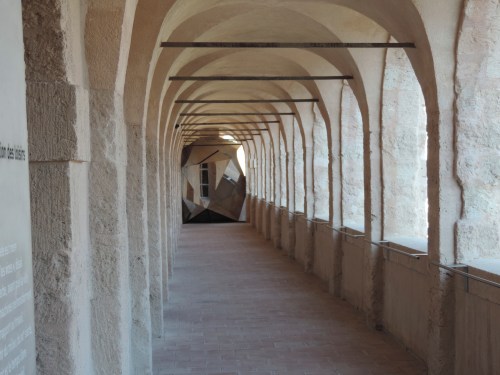
When I came across this old photo from Marseilles the other day I immediately thought of the “left brain” view of the world. The left cerebral hemisphere is utterly brilliant at focusing in on whatever we are considering. It helps us to see the trees in the wood. It picks out elements, features, characteristics or parts. Then it helps us to analyse, label and categorise whatever it is that can be recognised.

It needs to have a narrow focus to be able to do that. It zooms in. It hones our attention. It separates and abstracts by blanking out the connections, the contexts and the environment.

This long corridor of arches looks very much like that kind of focused attention to me.

But there’s more. At the end of this passageway what do we see? It’s kind of hard to make out, isn’t it? What you are looking at here is an installation of irregular, angled mirrors. So you aren’t seeing a complete picture. Rather you are seeing a number of disconnected views or parts.

Our left brain is pretty good at doing that too. Its preference is for the parts, not their connections.

How the brain is supposed to work is that the after the left side does this focusing, separating, labelling and categorising, it’s supposed to pass this information back to the right side to have it contextualised. In other words, after seeing and recognising the pieces, the left passes over to the right to recreate the whole picture, to help us to understand whatever it is we’ve “grasped” by seeing how it connects to everything else.

Iain McGilchrist’s thesis is that this natural flow has become rather disrupted. The left brain has a tendency to hang on to what it grasps, and to convince us that whatever it has analysed is “correct”. Over the centuries we’ve evolved a complex society and civilisation which has encouraged us to prioritise the left brain over the right.

That’s a big mistake. That’s only using half a brain. To rectify this we have to learn how to use the whole brain again, and to practice doing that as often as we can. That’s going to involve deliberately returning again and again to the right brain functions – seeing the connections, discovering the particular, appreciating the whole, and weaving together the multiple threads to enjoy the entire tapestry of the world.

I don’t know about you, but that excites me!

I love that this idea is not about abandoning our left brain functions but re-integrating them into the right brain ones. How satisfying!

Read Full Post »

« Newer Posts - Older Posts »