Feeds:
Posts
Comments

Archive for the ‘from the reading room’ Category

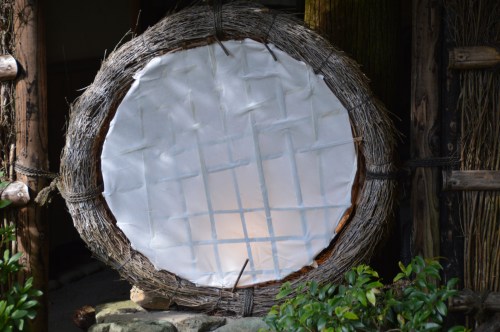
The light filtered through the paper caught my eye.

It’s soft and pleasing. It drew me to it. Then when I looked more carefully I saw the matrix of stalks criss-crossing behind the paper, and that changed my perception of it again. Then I noticed the woven circular frame. From first glance, to detailed inspection, I find this utterly beautiful.

I was thinking about it today as I contemplated it again and I remembered a book I read decades ago – The Lens of Perception, by Hal Bennett. I must say I don’t remember the details of the book all these years on, but the central metaphor did stick with me. The author proposed that we don’t see the world directly. We see it through a series of lenses, or filters, each of which is coloured by certain values and beliefs. It was quite an imaginative way of exploring how culture and social conditioning profoundly influences our perception and experience of the world.

Using a different metaphor, in these days of social media we read about “echo chambers” where we only read the messages and information put out by people who closely share our pre-existing beliefs and our prejudices. As the world divides into separate echo chambers people lose the ability to communicate with each other. Differing views are described as, at best, dissent, and, at worst, as betrayal. This is a powerful way of enforcing conformity. Divide and rule. Hardly a new idea is it?

However, it isn’t easy to see what filters or lenses we are using. Well, it seems easier to see which ones other people are using than our own ones anyway. (And what was that old Bible teaching about taking the plank out of your own eye before trying to remove the splinter from someone else’s?)

It’s not impossible though, and I suspect there are at least two very different ways to do it. One is to take the time to reflect on our pre-occupations. Have you ever done the “Morning pages” exercise promoted by Julia Cameron? Quite simply it is writing continuously without stopping until you’ve filled three A4 pages. It’s a stream of consciousness form of writing. You do it every morning for thirty days. Whenever I have done it I don’t read what I’ve written until the end of the thirty days. Each time it’s been a revelation. I find themes, phrases, and issues recurring over and over again. I find preoccupations I either didn’t know I had, or which I, at very least, didn’t know I held so strongly.

There are other ways to explore your values and beliefs but they all involve a conscious effort to describe them.

The other major way is to “phone a friend” as they say in the famous game show.

Robert Burns, my national poet, said –

“O, wad some Power the giftie gie us
To see oursels as others see us!
It wad frae monie a blunder free us,
An’ foolish notion.”

A wish to be able to see ourselves as others see us.

Well, there’s only one way to do that – other people.

This is where it gets tricky. Because to do this you need a friend or colleague who you trust. You need someone who won’t judge you. There’s no point jumping into somebody else’s echo chamber and challenging everyone there to find out what they think about your views! I suspect you know the answer to that before you even begin.

No, I think you have to start by sharing at a very personal level. But the trouble with that is, those others who you trust are likely to be seeing the world through the same filters and lenses as you do in the first place. I know they say “opposites attract” but I’ve always found that applies more to magnets than it does to people. However, there is no substitute for dialogue when it comes to clarifying what beliefs, values and world views you hold most dear.

Can we promote dialogue? Surely we can.

How do we escape the echo chambers, but criticise and challenge our views safely? I don’t know any way to do that which doesn’t involve non-judgemental engagement. It’s the key that opens the door.

Is there a non-judgement lens or filter?

What would the world look like when viewed it through that one?


Read Full Post »

When I noticed this tree in the forest I thought it had a long deep groove running the whole length of its trunk. It was as if it folded in on itself. But then I looked more closely and I saw that a better explanation was that there were two trees growing together. You could trace two distinct trunks all the way up, each spreading its own branches high above the forest floor.

I was even more taken with this when I saw it as two entwined, two organisms, two life forms, living, surviving and growing together. It reminded me of the myths of the soul….that each of us is in search of the other half….each of us longing for our soul mate.

But maybe I’m wrong. Maybe this is one tree which has partially divided itself…..partially, but not completely, so that now it appears as almost two trees instead of one. But does it really matter? Do I care whether these are two trees living intimately together, or one tree manifesting two clearly visible aspects of itself?

The first idea stimulates my thoughts about how important relationships are. It makes me think about how I can’t fully understand anyone, or any thing, in exclusion from its relationships. We are all embedded in vast networks of other people, other creatures, plants, micro-organisms, elements and molecules. We all come into being through a process of emergence within those networks. We all survive and thrive only because of those relationships and networks.

The second idea stimulate my thoughts about our multiple selves. I’ve never been able to understand anyone, including myself, by reducing them to a single, solitary self. Miller Mair’s “Community of Self” really impressed me. It struck me as true. I know a distinct self as a doctor, which is quite different from, yet completely connected to, my self as a parent for example.

A homeopathic doctor in Paris once told me he saw every patient as like a diamond, with different facets glinting in the sunlight. Each facet represented an aspect of that person. That impressed me too.

Then, much later, I read the works of the French philosopher, Gilles Deleuze, and his focus on “a multiplicity of singularities” seemed to me to be saying the same thing, just in a different language.

We are all multiple.

We are all a complex of multiple, distinct, unique “singularities” – both within ourselves, and within our world.

We are all One.

Read Full Post »

Last night as I was sleeping,

I dreamt – marvellous error! –

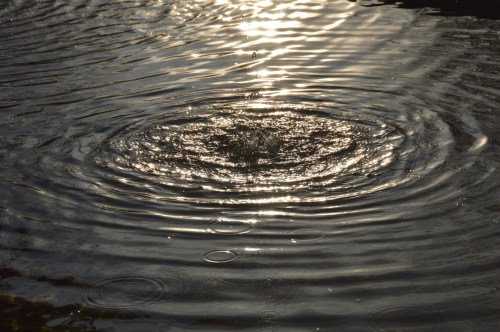
that a spring was breaking

out in my heart.

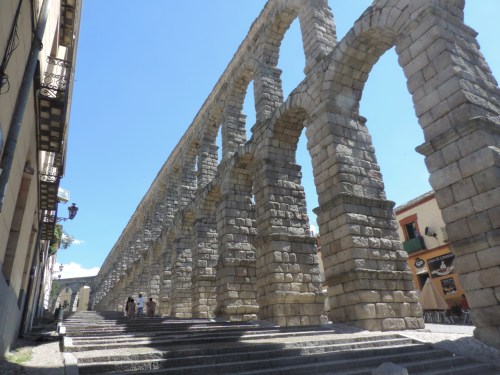
I said: Along which secret aqueduct,

Oh water, are you coming to me,

water of a new life

that I have never drunk?

Last night as I was sleeping,

I dreamt – marvellous error! –

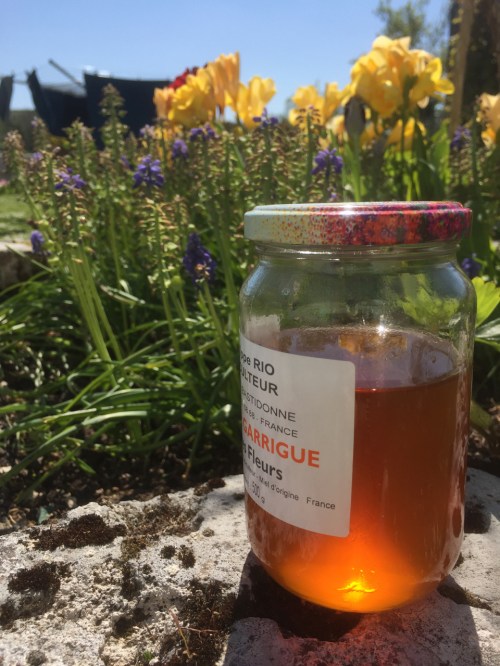
that I had a beehive

here inside my heart.

And the golden bees

were making white combs

and sweet honey

from my old failures.

Last night as I was sleeping,

I dreamt – marvellous error! –

that a fiery sun was giving

light inside my heart.

It was fiery because I felt

warmth as from a hearth,

and sun because it gave light

and brought tears to my eyes.

Last night as I slept,

I dreamt – marvellous error! –

that is was God I had

here inside my heart.


Last Night As I Was Sleeping, is a poem by Antonio Machado (this translation from the original Spanish is by the poet, Robert Bly). I’ve decided to return to an exploration of poetry during this strange time in our world, and have started by reading “Ten poems to change your life”, by Roger Housden. The first poem in the book is The Journey, by Mary Oliver, and the second one is this one by Antonio Machado.

Roger Housden, who says, of Antonio Machado, “He lived a plain and simple existence, much of it as a country schoolteacher. What mattered to him was the deep current that joins the human soul to the world. What mattered above all to him was to be awake to that deeper life.”

I love the images in this poem, starting with the spring of fresh water breaking out in the heart. “The origin of the spring is not in your own heart; its waters are carried there by some secret aqueduct from a source beyond all your knowing”.

Then in the next verse he talks of making sweet honey from our old failures. What a nice variation on the “when life gives you lemons make lemonade”!

The next image is of the sun shining in his heart. Roger Housden says “Machado becomes the source of his own warmth and light”.

In the final stanza where Machado dreams of God in his heart, Housden says “He dares to leap over metaphor altogether and say directly what he has been inferring all along: you are own source, drink from your own well, live by your own undying light……..the light of the world that streams through your life….”

I found that as I read it various of my own photos came to my mind so I thought I’d collect them together here with the poem. What I really love about this poem is that idea of the flow of Life pouring through the depths of our being and found by looking at what we have in our heart.

Read Full Post »

One day you finally knew

what you had to do, and began


One day I was walking in a forest and I came across this signpost. Clearly, this was the way to go….

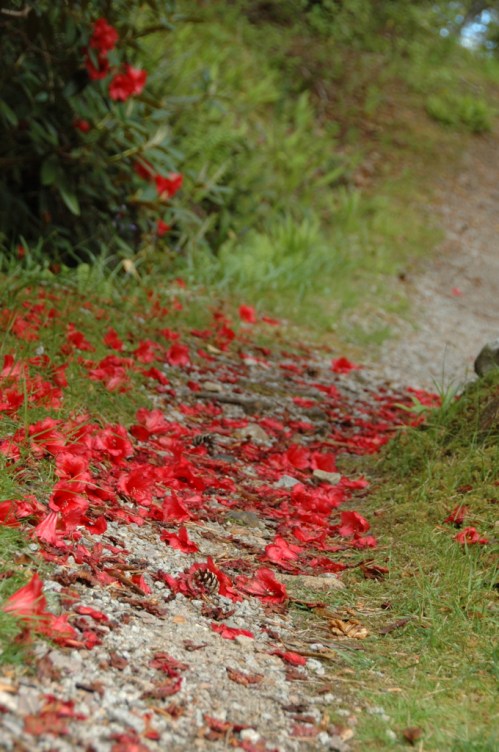
I followed the path strewn with blood red petals, but I didn’t know where it would take me.

Mary Oliver, in The Journey, the beginning of which I quoted above, continued her journey…

It was already late

enough, and a wild night,

and the road full of fallen

branches and stones.

I turned a corner, and there before me I saw…..

…red petals cascading down a slope, and rising high up into the canopy of the trees. Maybe this is what I came to see? But I carried on….

as you strode deeper and deeper

into the world,

determined to do

the only thing you could do –

determined to save

the only life that you could save.


Eventually, I found this….

…the heart of the wood.

So, this is how it is, isn’t it?

We don’t need a “goal”, or an “outcome”. We don’t need to “get” or “consume” anything in particular.

What we need to do, is find our heart.

This is as good a time as any to listen, and find out if you can hear what your heart is telling you.

We have access to more than one kind of intelligence. Not just the rational intelligence of the analytic left cerebral hemisphere in the brain, but the emotional intelligence of the heart.

You think that’s fanciful? Or just a nice metaphor?

I don’t think so.

It turns out we have a network of neurones, yes, neurones, the specialist kind of cell you find in a human brain, around the heart. There is a neural network around the heart. Apparently, the nerve connections between the brain and the heart are not just about the brain regulating the heart, they are two way. Our heart informs our brain.

And emotions? Those deep, intense embodied rivers of information and activity which course through the depths of our very being…..are they something supplementary? Are they something inferior in some way to our thoughts?

I don’t think so.

Our emotions are the organising, adaptive strategies which have evolved to enable us to survive and to thrive.

As the fox said to the Little Prince – “what is essential is invisible to the eye”.

Here’s Mary Oliver’s poem, The Journey, in full –

One day you finally knew
what you had to do, and began,
though the voices around you
kept shouting
their bad advice–
though the whole house
began to tremble
and you felt the old tug
at your ankles.
“Mend my life!”
each voice cried.
But you didn’t stop.
You knew what you had to do,
though the wind pried
with its stiff fingers
at the very foundations,
though their melancholy
was terrible.
It was already late
enough, and a wild night,
and the road full of fallen
branches and stones.
But little by little,
as you left their voices behind,
the stars began to burn
through the sheets of clouds,
and there was a new voice
which you slowly
recognized as your own,
that kept you company
as you strode deeper and deeper
into the world,
determined to do
the only thing you could do–
determined to save
the only life you could save.

Read Full Post »

One of the strongest characteristics which human beings have is our ability to make links.

We connect what we see to what we have already seen and to what we imagine we might be able to see.

There’s a lot in that sentence, but I’m not going to unpick it right now….suffice to say we blend the perceptions of the present with memory and imagination.

That is an incredible power.

It helps us to discern patterns which we use to recognise what we are perceiving and to be able to make reasonable assumptions about the future.

For example, as a doctor I learned how to diagnose. Diagnosing involves listening to a person’s description of their experience and to their telling of their story, examining them physically if needed, then conducting certain tests if still not in a position to make a good diagnosis. A diagnosis enabled me to do two things – firstly, to recognise both the likely disease or pathology underlying the patient’s experience, and secondly, to gain an understanding what that meant in this person’s life. Yep, diagnosis is more than naming a disease. It’s about arriving at a level of understanding – an understanding of this illness in this person’s life.

Once I had a diagnosis I could then decide how to act. I could decide what to do and how quickly I had to do it. At that moment I’d be imagining certain futures. If I do this, then what might happen, and if I do that instead, what might happen? How quickly might those possible futures become real? To answer those questions I needed a knowledge of the patterns of disease – how is this disease likely to develop based on what we have all seen so far?


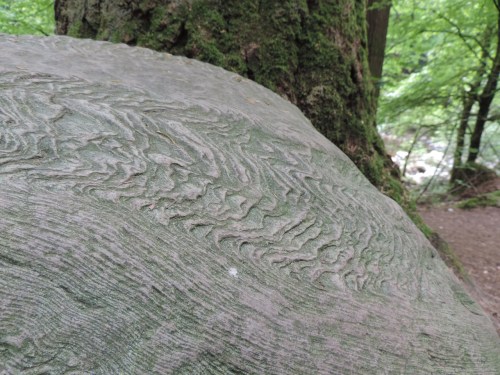
I picked this image today to reflect on our ability to recognise patterns around us, AND to apply those patterns widely. When we look at something, we don’t just “see it as it is”, because everything we see, hear, smell, taste, touch, sets off chains of memory and imagination.

So when I look at this particular tree I see these three enormous swirls. They look like whirlpools and water eddying around hidden rocks. A while ago I learned about complexity science and it really opened up my understanding of the world.

There are certain characteristic features of complex systems and one of them is the existence of “attractors”. “Attractors” are kind of organising points. They are part of what creates the differences within any given system or object. I’ve seen some scientists describe reality as “lumpy” rather than “smooth” and although I don’t really like that language I understand what they mean.

The universe is not uniform.

The phenomena of the universe are not distributed uniformly.

There are three common kinds of attractor –

Point attractors – these organise the surrounds around a single point. These three knots in this wood look a bit like three point attractors.

Loop attractors – this is where there are two centres of attraction acting together as one. They produce what looks like an infinity loop, or a figure or 8. They are a way of seeing polar opposites as part of the same system.

Strange attractors – also called complex attractors. This is where there are a number of centres of attraction all interacting within the same system. It can be hard to see any patterns here but we can recognise them when we seem the whole system. In other words, if we zoom in too close and focus only on certain parts we can’t see the way this system as a whole behaves. But when we stand back, zoom out, climb the hill, “take the view from on high”, or however else you want to describe it, we see that all the apparently separate parts are actually interconnected and working together.

I think as you encounter the world, you’ll see examples of these three kinds of attractor everywhere. See how many you can spot this week.

Ok, so, let me be clear. This is MY interpretation of these things. I’m not a complexity scientist. I just wanted to share how I make sense of my life and the world I live in.

I hope that there might be something here which sheds a light on things for you too.

Read Full Post »

What are the energies which run through us? The ones we interact with and which influence us?

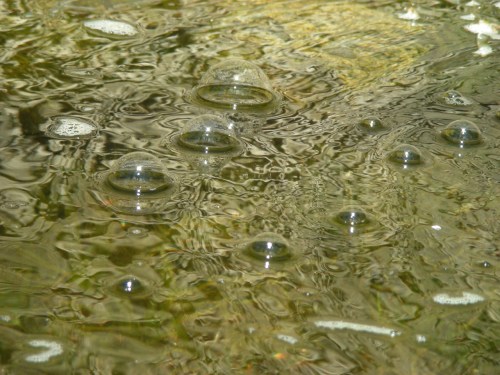
When I look at this photo of water in a fountain I get lost in it. The first thing I see is the bubbles. I mean, look at them! Some of them are pretty damn big. Each of them like a perfect little dome catching a spark of sunlight. I remember sitting by this fountain watching it for awhile.

It seemed to me there was no way to predict where a bubble would form, where it would move to, or how long it would last. I guess there’s no way to predict what size each particular bubble would be either, but are there people in the world who could do that? I suspect there aren’t. Yeah, there are probably people who can tell you about the physics of water and explain how bubbles form, but I bet they couldn’t sit by the fountain and predict where the next bubble would form and how long it would exist.

I was thinking about that again while listening to some officials pontificate on the future course of this pandemic.

I guess it’s hard to describe the future when the future doesn’t exist yet.

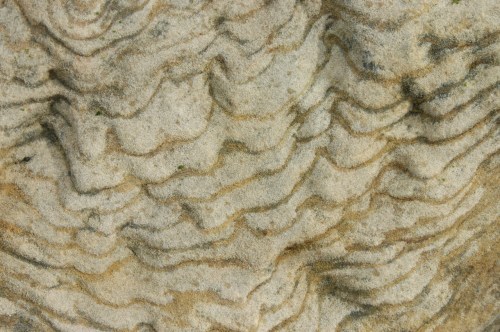
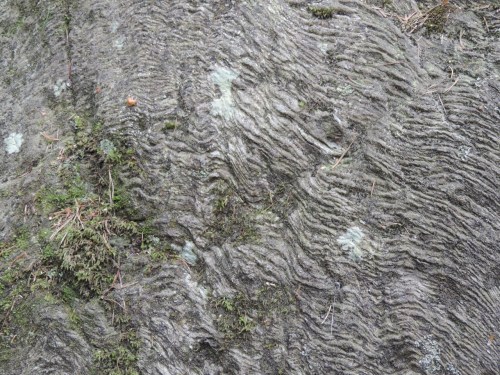
The next thing I noticed were the ripples and currents in the water. They remind me of those old books you used to find with their fancy papers inside…..what did they call them again? Oh yes, marbled papers. Funny how we can see such similar patterns on the surface of water and on the surface of stone. I’m sure I’ve lots of photos of stone and rock which look patterned in just the same way as water does.

There’s one! And here’s another two…

This phenomenon of similar patterns occurring in different natural materials is described in Confucianism as “li” – a kind of organising force which patterns flows.

I realise as I look at images like these ones that there are two strong forces which attract me, flow through me and shape my thoughts, my behaviour and my life.

Beauty and curiosity.

I love dwelling on phenomena like these because I find them beautiful.

They don’t have to be useful to me. I just love them for what they are. They are beautiful.

I love them too because they pique my curiosity. They set my mind off running down through memories, thoughts and wonderings. Question after question start to flow through my brain. I’ve always been a curious person. As a child my parents subscribed to two “part works” for me. I’d get one of each every week and add them into the binders you could buy to keep them organised. Each was a full colour magazine full of fascinating facts and phenomena. One was called “Knowledge” and the other, “Look and Learn”. Did you have anything like that when you were young? Do you have anything like that now?

Then when I qualified as a doctor, with my first month’s salary I bought a complete set of Encyclopaedia Britannica. I still have it. Can’t bring myself to throw it out even though it’s been long since surpassed by wikipedia and google.

Curiosity.

I’d say that is one of the strongest life forces in my life.

Beauty.

That’s another one. I love to take photographs. I love the beauty of Nature, of landscapes, of buildings, of Art, of people. In fact I think I appreciate beauty every single day of my life.

I’m sure these are not the only two life forces in my life, but they are certainly two of the most dominant ones.

What life forces are you aware of in your life?

Read Full Post »

Quite a lot of people, me included, are saying this pandemic is throwing a light on certain things – how fragile our systems of health care and social care, how poor the safety nets are, how interconnected the world is, how the instincts to collaborate and connect are so strong in human beings, how much we humans move around the Earth……[add you own here]

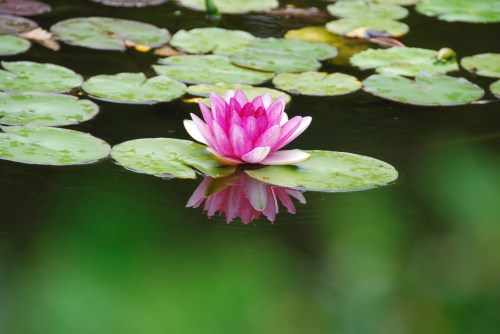
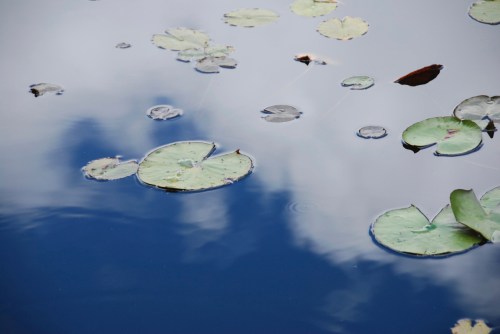
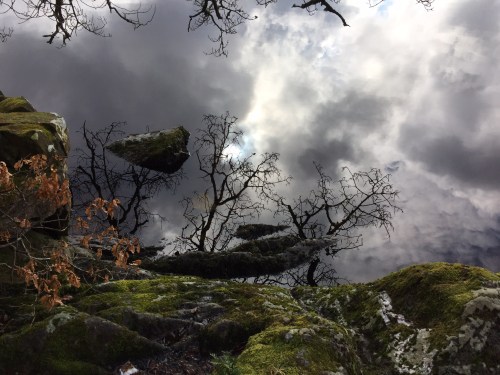
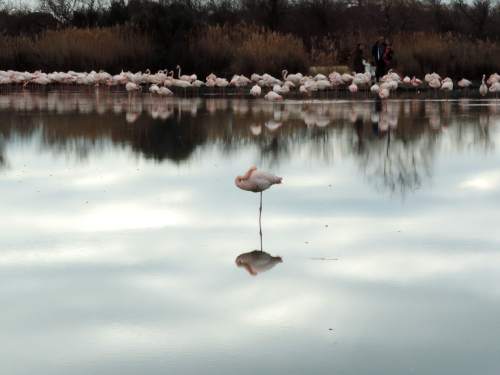
But today I stumbled across some old photos of reflections and I realised that the reflections are a different sort of light.

A direct light brightens and maybe even makes more clear the object it is shining on. That’s useful. Though it immediately brings to my mind that question I have about Scandi-noir crime drama – why does the (usually female) detective always go down into the basement or the abandoned warehouse at night, all alone, with just a torch to light up little bits of the room? Well, I suspect I know the answer to that one already.

Reflections are different.

They turn things upside down.

They give us an unusual and different take on reality, which lets us see beyond what the light is illuminating.

Look at this one, for example –

lily leaves on a still pond which is reflecting the blue sky and some clouds.

Or this one –

the edge of a Scottish loch where the still water is reflecting the clouds

Or, this one –

the solitary flamingo doubled by the water’s surface

In all these cases the reflection does something special I think.

It literally turns something upside down which immediately makes us look more carefully.

It changes our perspective whilst keeping our default one. In other words, it increases our perception and understanding by doubling our perspectives.

It shows us connections we were happy to ignore as long as we focused solely on the central subject. It connects the sky to the water, the water in the clouds to the water in the loch, for example, reminding us of these cycles and links and interconnections which are the most fundamental characteristic of Nature.

It increases our experience of beauty. Each of these photos could have been beautiful without the reflections, but I think that including the reflections make them exponentially more beautiful.

All of which brings me to my main thought today – shining a light on something helps us to understand it, promotes analysis and clarifies what has been obscure or forgotten. Reflecting adds in something completely different – it promotes our perception and understanding by changing our perspective, highlighting the connections, and increasing our senses of wonder and delight.

“And not or” is my moto – analyse and reflect. Actually, as I write that sentence I’m reminded of Iain McGilchrist’s Divided Brain thesis and how the left cerebral hemisphere is great for zooming in, analysing and cataloguing, while the right seeks out the connections, the specific and the unique.


Read Full Post »

The phrase “everything is connected” immediately appeals to me and strikes me as true.

The first thing I think of is the human being.

Although I was taught Medicine in parts, learning about cells, tissues, organs and even systems separately, it was an almost unspoken given that all the parts were connected. In Second Year of Medicine at the University of Edinburgh, one of the main subjects was Anatomy and we were put into groups of six to spend a year dissecting a human body. Our guide was a three volume textbook, “Cunnigham’s Manual of Practical Anatomy”, along with “Gray’s Anatomy” (probably the most beautiful textbook I ever possessed). I was a bit overwhelmed with the sheer number of pages in these texts and asked one of the tutors “Which bits of this book do we need to learn?” He replied, “Which bits of human beings do you think patients will ask you about once you’re qualified?” “Ah, you mean we have to learn it ALL?” He smiled and walked away.

It would be a full two years after that before I met an actual live patient, but, hey, they don’t teach Medicine that way any more do they?

I don’t remember a single lecture about holism, but somehow it was a core value for me right from the start. However it was over a decade after graduation before I came across “Psychoneuroimmunology” and “Psychoneuroendrocrinology” which were fields of study looking at the connections between the Mind, the Nervous System, the Endocrine System and the Immune System. I think that’s where I first encountered a more holistic science, one focused on “systems” not “parts”.

It was much, much later when I encountered “Complex Adaptive Systems” and both “Chaos Theory” and “Complexity Science”. Somehow I think we are still in pretty early days of developing the sciences of the connections. But it sure still excites me!

As a GP I also had to be aware of the individual patient’s connections between themselves and the rest of the world….their relationships, their work, their housing, their family and so on. Those are threads you never quite get to the end of. I think that makes us humble, that knowing that we will never know all there is to know.

Sometimes it seems to me that our minds are like fractals, vast webs of mirrors reflecting similar patterns of reality to each other. Actually, as I write this I remember “Indra’s Net” – where every drop reflects every other drop. I think we humans are great at spotting patterns, and regularities, and that, combined with our ability to use metaphors and symbols enables us to appreciate the incredibly rich, dense nature of reality.

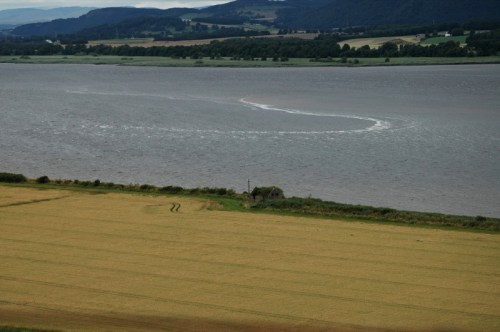
When I saw this shape on the surface of the water I wondered if it had been caused by a boat, or was it something lying on the river bed? But look at the shape drawn by the farmer who has been working this field. What a gorgeous echo of the shape on the river. One of the things that happens when we appreciate these connections is an experience of beauty and wonder intimately entwined.

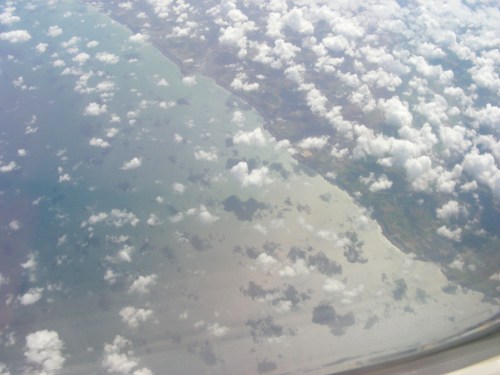
One time when flying over the English Channel, I looked down and saw the shadows of the clouds on the water’s surface just before the coast. Ooh, that still pleases me so much to contemplate this image! I love the fragility and impermanency of the little clouds. I love the even more ephemeral nature of their shadows on the Channel. And I love that transition of density of the clouds from the area above the water to the area above the land, how you can see in that the dynamic, ever moving dance of the land and the water and the air. Magic!

What connections have you spotted today?


Read Full Post »

Do you do that “word of the year” thing? Where you choose a word at the beginning of each year, a word which will be some kind of touchstone, theme or “north star” for you?

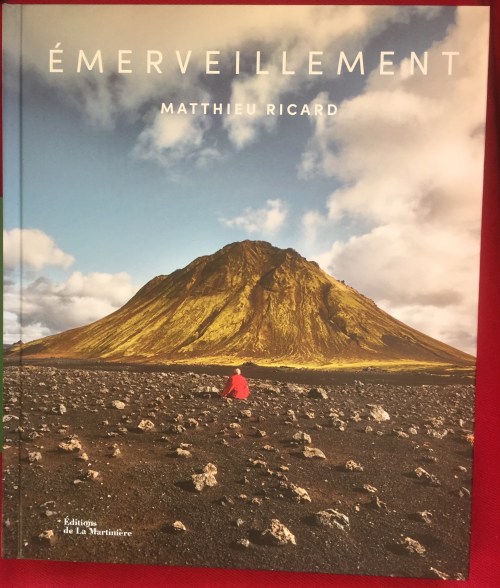
This year, I’ve decided to choose two…….because I received two books as presents for Christmas and it immediately struck me that between them they lay a foundation for a way of living I highly value.

These are French books, so here’s another innovation for me…..up until now my Word of the Year has been an English word, but, hey, I’ve been living in France for the last five years and I’ve read a LOT of French, so, I reckon it’s high time I choose a couple of French words.

Here’s where things start to get interesting, because I can’t find direct, single word translations of these two words into English. Perhaps, more accurately, I should say I can’t find any direct translations into English which I find satisfying. I think that’s a great example of how learning a second language can both widen and deepen your world.

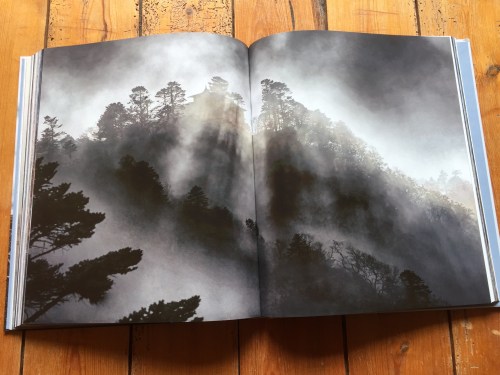
If you’ve read other posts on my site here you’ll have come across my use of the term “émerveillement” already. The first time I read the phrase “l’émerveillement du quotidien” I was entranced by it. It sort of means “the wonder of the every day”. The word “émerveillement” captures my core value of curiosity, of amazement, of awe and of wonder. I adore those moments when you notice something and it stops you in your tracks, where you pause, savour, and reflect. The more that happens in my life, the better my life seems to me. To really experience “émerveillement” you have to be open minded. You have to be curious, aware and non-judgemental. So the pursuit of “émerveillement” every day brings along with it a whole set of other attitudes and behaviours which I value.

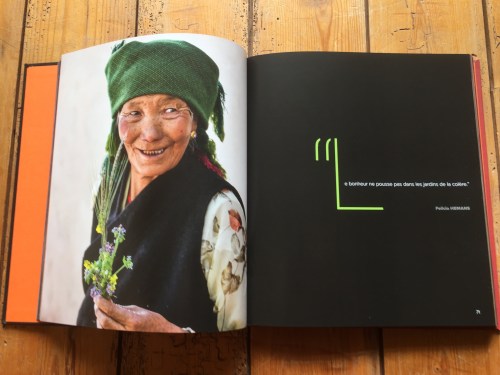
Here are a couple of pages from the book which give you a flavour of why it entrances me –

The second word is “bienveillance” which could be translated as “well-meaning” but again, that direct translation doesn’t quite cut it for me. It is used to cover well-meaning and well-wishing, but also kindness, gentleness and care. So, another set of values and behaviours I really rate and aspire to every day.

Here a couple of pages from that book which might stir the same feelings in you. If they do, then, yet again, a picture will have proven to be worth a thousand words.

That quote in the middle image is from the poet Felicia Herman and it translates as “Happiness doesn’t grow in the gardens of anger”, which is an interesting line to consider in these days of conflict and polarisation.

Read Full Post »

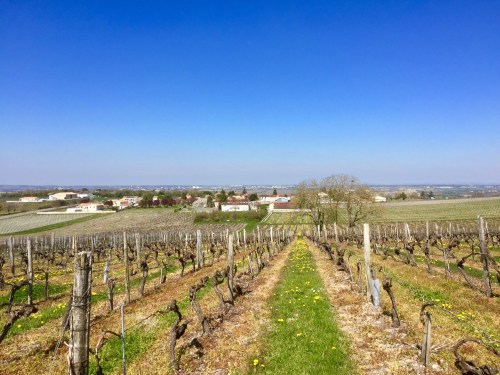
For the last five years I’ve lived just south of the town of Cognac (that’s Cognac in the distance in this photo).

I’m on the edge of a village surrounded by vineyards.

If you look closely at this photo you’ll see there are actually multiple vineyards covering the landscape. Here’s another view

Here you see at least three distinct vineyards in the foreground to the mid-ground, with several others stretching as far as the eye can see.

One of the things which struck me straight away when I went for my first stroll through the vineyards was that there are no fences, no walls, no hedges between them. Yet, from what I’ve learned, these different vineyards belong to different people. Another thing which struck me was that anyone can wander freely amongst them. There’s even a map of different trails posted up on a large panel outside the village church, and wayfarer wooden signposts with coloured markers to guide you along the different routes.

I’ve made a number of road trips to Spain and Italy since moving here, and every time I’m amazed how I can just drive over the border into, and back from, those countries without showing a single document, or even speaking to a border guard.

Last month I flew to Copenhagen, spent a few days there, then flew on to Edinburgh to visit family. Although I had my passport our of my bag and ready to join the queue for Passport Control when I got off the plane at Copenhagen airport from Bordeaux, I was struck by the fact there was no Passport Control. Instead I just picked up my bags from the conveyor belt and walked out of the airport to the taxi rank. Needless to say, it wasn’t the same flying to Scotland where I had to join a queue and use the automated passport check gate to be allowed in.

I am definitely no expert on the pros and cons of borders and border controls but these experiences get me wondering about both what such procedures and laws are supposed to do, and, whose life is made better and/or safer by imposing them?

Rutger Bregman, who wrote “Utopia for Realists” makes an argument for open borders throughout the world, but it’s hard to find much support for such an idea. Will Hutton’s broadly positive review of Bregman’s book writes –

I understand that open borders and being welcoming to strangers is a great statement of common humanity – and that immigration is an economic benefit. But no society on earth can welcome unlimited numbers of strangers, keen to enjoy the benefits of whatever civilisation, without having made a contribution to it. Human beings believe that dues should be paid. Far better to manage our borders and let in as many immigrants as we can rather than open them indiscriminately.

Caroline Lucas’s review in The Independent doesn’t even mention his promotion of the idea of open borders even though she seems to rate the book highly.

Britain is still in the midst of Brexit with a prevailing rhetoric of “control immigration”, “bringing back control of our borders”, and forcing EU citizens in the UK to apply for “settled status”, even if they’ve been “settled” in the UK for decades.

So, what do you think?

I’m not suggesting anything utopian or fantastical here, I’m just reflecting on what it feels like to move around a countryside without obstructions and boundaries, and to move back and forth between countries without border controls versus travel into and out of countries with strict controls. Is it better to have the queues and checks at the UK border for people arriving from Denmark, France or Spain? Or better to allow the free movement of people across each others borders as the 26 “Schengen” countries do?

What are the real life consequences of these policies and procedures?

As I travel around the “Schengen” countries without border controls I feel free, welcome and even that I belong in each of these different countries. It’s life enhancing!

Sadly, with the anti-immigration, pro-border control policies of the UK now a lot of EU citizens no longer feel welcome there and UK citizens are about lose the freedom to live, study and work in the other 26 countries. It’s not at all clear yet what bureaucracy will be introduced once the UK leaves the EU, but how will any extra application processes, fees and documents make life better for the British? Just asking……..

Read Full Post »

« Newer Posts - Older Posts »