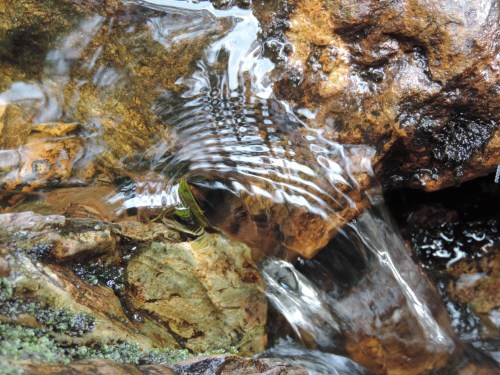
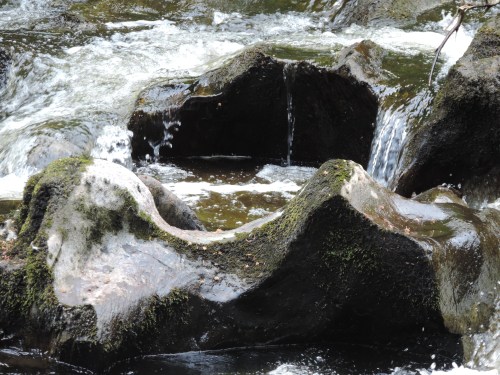
This photo of water flowing over rocks in a Highland stream transfixed me the first time I saw it, and it’s lost none of it power.
When you watch water pouring down over, around, and between rocks in a stream or a river, you can see how the water itself is shaped by the rocks and the earth which create its edges (the banks of the river). If you look carefully you can often see that there is an ongoing lengthy relationship between the water and the rocks. It’s not just that the rocks make obstacles which the water has to flow around. You can see that as the water flows over the rocks, it shapes them.
However, what you see in this photograph is an additional dimension. You don’t just see that the rocks are making the follow a particular path. You can see that the surface of the water itself is shaped. Those bands, or ridges, look waves spreading over the surface of the water, except you wouldn’t expect to see waves in a stream or river as it pours down a rocky hillside. Where do they come? Maybe it’s something to do with the rocks on the river bed, or the rocks within the river itself, but it looks like something different. It looks like this pattern, this shape, emerges from within the water itself. As if it looks this way because of some influence within the water.
So, this photo always makes me think of that. It makes me think of how each of us is shaped by external structures, and the environments in which we live – by which I mean the physical, social, and cultural environments at least. But how we are also shaped by our constantly evolving inner structures and environments……our memories, imaginings, thoughts and ideas, as well as our physical bodies and all the cells, tissues and organs which lie hidden inside.
Who we are, what we are like, what we look like to others, what our characteristics are, are all shaped, are all constantly being shaped, by an alchemical mix of the external and the internal, of the visible and the invisible.
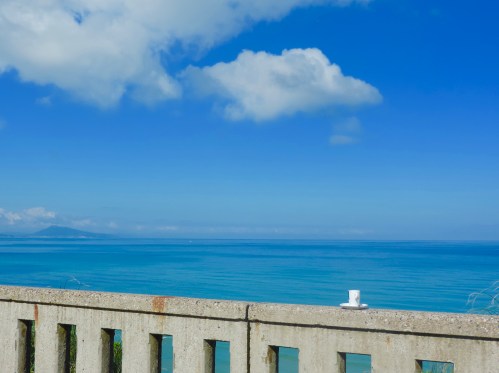
This is one of my all time favourite photos. I took it while having breakfast at a little cabin at the top of the hill on the edge of Biarritz. I realise that the concrete fence is not bonny! But that doesn’t take anything away from the picture for me. The rich, deep hues of blue in the sea, sky and even distant mountain are just gorgeous and I like the fluffy summer style of clouds floating by.
Hey, you might be saying, you’re going on about the fence, the sea, the sky, the mountain, even the clouds, but isn’t this a photo of a coffee cup?
Well, yes. You could say that. But, then you know my tendency to explore the contexts, the connections and the environment….how I am drawn to the “whole”. But, yes, it is a photo of an expresso, and that’s what I want to talk about today.
Even though these short coffees in Europe are called “expressos” they don’t necessarily imply a brief, speedy period of time. I noticed that when I first stopped for a coffee in Italy that the cafe had tall tables and no chairs. That was a surprise. Maybe that’s when I thought that an “expresso” wasn’t just fast to make, it was fast to drink. But that was a misunderstanding. When I went for breakfast with a group of Italian friends, they stood around the tables chatting, drinking their coffees, eating pastries or biscuits, and there was absolutely no sense of urgency or hurry.
Coffee time is a pause.
It’s often an in-between time….between waking up and engaging with the tasks of the day, for example. When I worked in Glasgow, I lived in Stirling, and traveled in the train for about an hour each way each day. I’d stop and enjoy a coffee once I arrived in Glasgow and before I caught my second train to the hospital, and, often, I’d stop and enjoy another one on the return journey. Those were times of pausing. Of stepping off the busy flow and slowing down to reflect, to read, to ponder. Coffee times were also times of sharing, of enjoying the company and chat. Not all coffee times are social times, but many of them are, and that’s important.
There’s a term in buddhism – “bardo” – it means a space. For example, there is a bardo between each in breath and each out breath, and another between each out breath and each in breath. There is even a bardo between each thought, but good luck catching any of those! I think a pause is a kind of bardo. A life bardo, breaking up a busy day, and helping us to re-centre, to re-focus, to re-connect and to re-store.
I was reading in an article in “Philosophie” magazine this morning. It was about rituals and one philosopher described his coffee ritual. He said he wakes up, drags his heavy feet and thick head through to the kitchen, pops a “dosette” into the coffee machine, presses the on button, and listens to the familiar sounds of the machine. That first coffee begins to re-connect his disconnected brain cells, but it also makes him cough. He has a second coffee, which settles his cough, then, the third coffee, he says, is “for pleasure”. Then he is ready to get on with the rest of the day. Wow! I think if I started every day with THREE expressos I’d FLY through the day!!
We all have our own rituals, our own habits, our own routines. This little coffee cup resting on the fence reminds me of that. It’s good to pause now and again, and in that bardo to take stock, to reflect, and to become aware of rituals, habits and routines. What are they, and what part do they play in my life?
How about you?
What comes to mind when you think of a pause, a bardo or a ritual?
In most countries the response to the Coronavirus pandemic has been to enact a lockdown. In France, it’s called “Confinement”. The same word used in English generally refers to imprisonment, but in Obstetrics it has another meaning related to the time between labour commencing and the baby arriving. Both of those situations come with quite a degree of stress!
Many people have found the restrictions tough but as long as they were in place then a kind of predictability began to emerge. In fact, each day could seem so similar to the previous day that sometimes it could be hard to work out exactly which day of the week it was. I’ve no doubt these lockdowns have produced their own particular stresses.
However, pretty much everywhere, the lockdown is ending (in France we have moved into “De-confinement”). The restrictions are being lifted in varied ways at different speeds. Because I live in France and would like to visit family in Scotland, I have to keep up with three sets of rules – those in France, those in the UK, and those specific to Scotland. Week by week that’s getting harder and more confusing. This period of lockdown easing has, in turn, its own, particular stresses. Not least because the rules keep changing now.
In addition to the stresses induced by trying to factor in different regulations in order to make future plans, I’m hearing an increasing number of people say that although they are now allowed to leave their home, they are too afraid to do so. On top of that, when you do venture out, what with all the perspex panels, instruction signs, brightly taped lines on the ground to stand behind or to follow, wearing masks, standing in long spaced-out queues (I don’t mean spaced-out in a drugged way!), and trying to maintain distance from everyone else…..well, it sure doesn’t feel like it used to do. It all takes some of the pleasure away. It all produces a sense of un-ease.
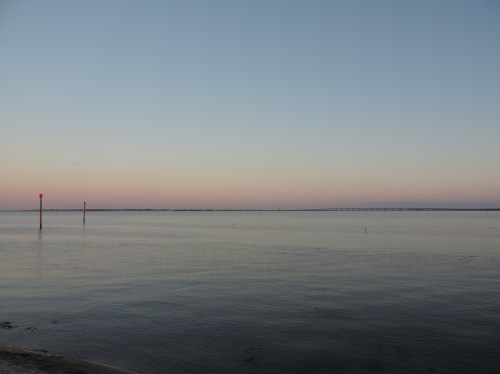
So, I thought today might be a good day to share a calming image. I’ve seen people sharing calming images on social media but I must say I don’t often find them very calming. I guess we all find different scenes calming. However, here’s one that works for me.
Take a wee while to yourself and gaze at this scene. Look at the wide and extensive calm water, stretching to every edge of the scene and beyond. See the red guide markers on the left, subtly guiding any boats to or from the shore. Look into the distance and see the long flat bridge, connecting the mainland on the left, to an island on the right (take that from me, you can’t see that you are standing on an island looking out at the sea from here) . Then notice the colours, the deep blue of the sky at the top of the scene fading into the pink from the last light of the sun which has just this moment set below the horizon. See the light blues in the sky just above the band of pink, and the similar light blues in the sea just in front of the bridge, and notice how the blues become darker and richer as the water reaches the shore just in front of you.
I find this scene wonderfully calming and peaceful. I hope you do too.
Do you have any photos on your phone, your pad, or your computer, which you can turn to, to absorb your attention in the beauty of this world we live in?
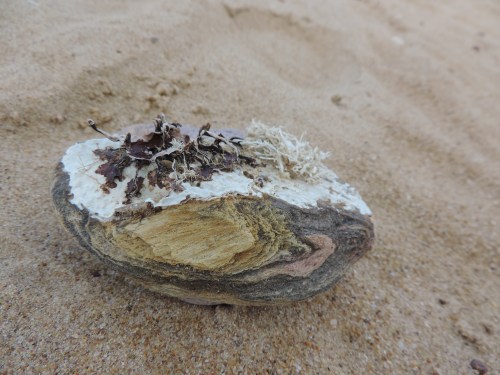
When I noticed this stone on the beach I was entranced. It looks like a whole small world. Look at the layers of minerals, their colours, their extent and shape. Look at the top of the stone with several species of lichen and/or seaweeds living there.
It makes me think of illustrations I saw when I was a child. Colour drawings of the Earth with a segment removed to show you the multiple layers all the way down to the core.
It also makes me think of the concept of the ecosystem, or even a biosphere….a complex of elements, some living, some non-living (which reminds me….I came across a quotation yesterday which said the opposite of “life” is not “death”, it’s “non-living”……must look that up!)
The idea of networks of connections and relationships between minerals, uni-cellular and multi-cellular organisms, air, water and sunlight co-creating the reality we live in…..I just love that.
It makes me think of the idea of viewing whatever we are looking at from different scales, because everything which exists, exists in nested layers of everything else……remember the old funny story about the teaching that the world floats on the back of a turtle? How the enquirer asked “And what does the turtle sit on?” The answer “Another turtle”. To which the enquirer asks “What does THAT turtle sit on?” The answer “Another turtle”. After a few minutes of this exchange continuing along the exact same question and response, the teacher finally responds to one of the “What does THAT turtle sit on?” with “It’s turtles all the way down, son. It’s turtles all the way down.”
On a more serious note, I found Lynn Margulis’s theory of “endo-symbiosis” hugely convincing. Briefly, she claimed that all multi-cellular organisms (that includes you and me) are made up an incredibly complex co-operating network of single cells, and that inside each of our cells are individual elements, like mitochondria, for example, which, way back in history were single celled creatures in their own right. She hypothesised that the evolutionary path of development was driven by collaboration and co-operation, with single celled organisms combining to live together at new levels. In other words all the different elements of a single cell came from smaller single “celled” creatures merging. Maybe that idea was a bit too challenging for some people, but it’s pretty undeniable that multi-cellular organisms like humans can actually be understood as whole worlds of vastly networked individual cells. It’s reckoned that only a tenth of the cells of your body are genetically “you”, the other ninety percent being bacteria and other unicellular organisms. Pretty mind boggling isn’t it? But it seems to be true all the same.
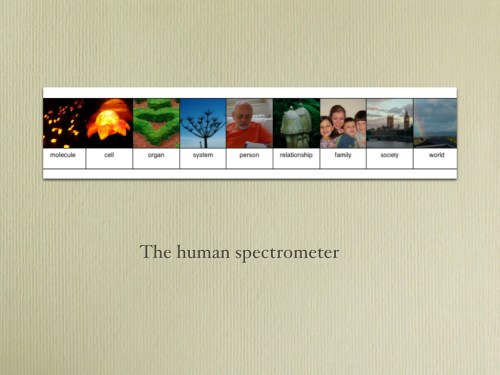
This idea of scale…..a long time ago I created a “human spectrometer” to help me discuss a patient’s issues with them at different levels of scale. Here it is
I’d start in the middle with the “person” because that’s where we met, person to person. Then I could move left zooming in on smaller and smaller parts of the person to consider the problems and their effects….perhaps in the “nervous system”, or the “digestive system”, then further “in” to disturbances in particular organs, “the heart”, or the “liver”, then further in yet to consider the role of cells, like white blood cells, or the cells of a specific organ, or, at an even smaller level the circulating levels of individual molecules, like hormones, antibodies, chemical messengers and so on.
I’d then return to the “person” and start moving right to consider the person within their significant relationships, within their family, within society, considering cultural, economic and work issues, or, finally within the “world”, by which I meant the environment.
I didn’t usually work through this whole thing methodically, step by step, but used it as an illustration to consider everything from pathology, to pathogenesis, to the impacts from and on the vast networks of life in which an individual lived.
I created a post about it back in 2007, so patients could explore the idea a bit more in their own homes.
It’s only now, many years later, after reading Iain McGilchrist’s “The Master and His Emissary“, that the left hemisphere zooms in to consider the parts, while the right zooms out to consider the connections, the relationships, the whole! Funny, how the universe works!
This notion of nested scales was also explored by Arthur Koestler who coined the term “holon” to describe the idea of multi-level hierarchies. You can read a bit more about that here.
Every one of us is a multitude. Check out Bob Dylan’s new release “I contain multitudes” for a very recent expression of this idea. In fact, as he sings it, maybe we are multitudes, plural.
The Scottish psychologist, Miller Mair, coined the term “community of selves” back in the 1970s. It remains a powerful metaphor for the complexity of an individual personality. That idea made a lot of sense to me, and helped me to understand not only my patients but also myself. We all have that experience of at very least tapping into different strands of our lives when we act within our different roles – parent, child, friend, neighbour, employee, professional, artist, consumer etc etc. We know all those roles are just a part of who we are but it can be very hard to untangle them, to see how they inter-connect.
The French philosopher, Deleuze, wrote about “multiplicities” as a way of understanding the complex universe, and described any particular instance as a “singularity of multiplicities”. I liked that idea the moment I read it. I happened upon his writings at the same time that I was exploring the new “complexity science”, and in particular the concept of the “complex adaptive system“, which fundamentally changed how I saw our lives and our world.
I once spoke to a “Chef de Service” at a Parisian Homeopathic Hospital and he described to me that he saw each patient as like a diamond, with multiple facets shining, each one different, but together all part of the same individual. He saw his therapeutic strategy as being based on addressing several of the most prominent of a patient’s “facets”. A rather poetic way to think of the same underlying issue.
What is the underlying issue?
Life is messy.
On the “inside” and the “outside”. I put those words in quote marks because I’m pretty sure that frequently there is no clear boundary between the two. I think wherever we look we can find multiple threads to follow. We can identify particular paths, storylines, themes, chains of cause and effect, which run through a lifetime.
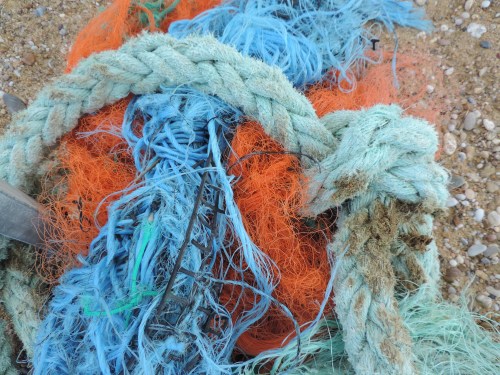
And, here’s the important point, brought back to the front of my mind by this photo today, all those paths, storylines, threads or whatever, are entangled. They are connected. They are inextricably interconnected, astonishingly woven together to create a unique, beautiful tapestry of a single life.
I’m not a fan of labelling a patient with several different concurrent diagnoses then sending them off to separate specialists to have each disease treated as if it exists in isolation. In Medicine this is referred to as “silo-ing“, a strange word which means separating out someone’s problems into separate baskets, boxes, or “silos”, then treating each one separately. Most of the evidence used in “Evidence Based Medicine” comes from trials where patients have been selected on the basis that they have only the single disease which is under study, and that they are receiving only the single drug which is being trialled. But the real world isn’t much like that. Much more common is the finding that an individual patient will have several different diagnoses active at the same time and that they will already be on a cocktail of drugs. Medicine is more messy than some people would have you believe.
So what? Is this a counsel of despair? Am I saying life is too complex and entangled to make any sense of it? No. Absolutely not.
What I find is that this complex entangled life is beautiful. That it manifests in the most unique, most varied, most astonishing individual narratives you could imagine.
What I find is that when you look for the connections between the parts, you get insights and understanding which you’d miss if you kept your attention only on single parts.
What I find is that it’s best to use your whole brain, not just half of it, as Iain McGilchrist, author of “The Master and His Emissary“, would say. It’s not enough to separate out the threads and elements and study them. You have to weave them back together to see the contexts, the contingencies and the connections. In other words, you need both your left hemisphere ability to see the threads, and your right hemisphere ability to weave them together into a whole.
What I find is that when you look at life this way, then you encounter the “émerveillement du quotidien” – that you find yourself wondering and marvelling every single day. You find diversity and uniqueness. You find infinite trails of connections. You find that curiosity is constantly stimulated and never ends. You find that you are humbled by how little you actually know. You find that you doubt predictions and develop a distaste for judging people.
You find that Life is astonishingly, endlessly, fascinating.
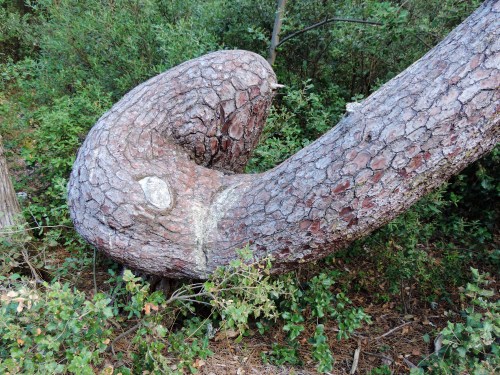
But when you look at a tree like this you realise something has happened, not once, not twice, but several times. This tree seems to have started growing pretty normally but then, for unknown reasons, has take a right angled turn to grow horizontally for a bit. Was that a storm? A strong gust of wind? An animal or a human who bent the young tree over like that? Then a little later, the tree keeps on the horizontal but takes another right angle turn. How do you explain that one? I can’t. But surely we’d agree both turns were significant. On both occasions the future path of the tree was changed enormously. Not long after this second swerve, it starts on an upward path again, as you might expect any tree to do. But we can’t explain why it happened then.
You know, I think life is often like this.
Here’s one of the most useful questions I’d ask a patient – “When did you last feel completely well?” I liked that question because over the course of weeks, months and years an illness changes. It can change so much that at the point of presentation it looks quite different from how it began. So, I didn’t ask “When did this [insert diagnosis here] start?” Or, “When did you get sick?” Those questions often missed the origins of the illness. Also, many times, people would present with more than one diagnosis. Human beings can’t be compartmentalised into neat separate diagnostic boxes without losing sight of them as human beings. Sometimes a story, or narrative if you prefer that word, would begin with a certain illness, but then others would emerge on top….either replacing the original one, or blending in somehow. It was, therefore, more revealing to ask “When did you last feel completely well?”
You’d be surprised how often that was a difficult question to answer. Often I needed to prompt and coax, sometimes going right back to early school days, before someone would say, yes, that’s when I last felt completely well.
Once they’d told me when they had been well, we’d then start to discuss two things. Firstly, what was happening in life around the time you began not feeling well, and, secondly, tell me about what you experienced when you first started to feel unwell. I don’t claim that the revelation of significant traumatic events, be they accidents, infections, emotional traumas or abuse, then enabled me to say it was this or that event which caused your illness. But pulling together these pieces of a person’s story frequently opened up a new level of understanding. And, actually, somewhat surprisingly for the patient, it often revealed just how amazingly they’d coped with significant traumas.
So when I look at an image like this tree, I’m immediately wondering what the story is……how did the tree develop in this particular way? What was going on when these dramatic twists and turns took place?
I’m not finished yet…….because the other thing this tree tells me is to consider the wider, fuller picture. It’s hard enough to unpick key events, but you need a longer view, a more holistic view, to make sense of the fuller life story.
Here’s what seems to have happened next…..
That upward movement we looked at a few moments ago continued until the tree managed to contact its neighbour. Then they bonded. They made a connection. And they grew upwards together for the rest of their lives (OK, I don’t actually know how much longer these trees lived so maybe it wasn’t for the rest of their lives, but we say that when we tell stories, don’t we?)
We still don’t know what happened in those early phases of life, but with this longer, fuller view, we can at least make sense of the final turn upwards. We can see what appears to be a seeking for a connection, a movement towards an-other. Or at least, our story-telling brains make it easy to make sense of what we are seeing by interpreting it this way.
I don’t think you ever fully know another person. I don’t think anyone can ever make complete sense of another person’s life. In fact, I’m not sure we can even do that for ourselves. But we can spot patterns. We can see shapes, and movements, and directions, and rhythms. And when we weave those together into a lifetime narrative they really can help us to make sense of our experiences.
One of my most favourite phrases in French is “L’Emerveillement du quotidien” – which translates as something like “the wonder of the everyday”, but actually there are other layers of meaning which I find hard to capture in English.
I suppose the thing I love about the word “wonder” is that has several connotations. It suggests a certain curiosity, a “wondering” what something is, or how it came about. But it also suggests a kind of awe, something amazing, astonishing, or, at very least attention-catching. The sense of “everyday” also has a couple of nuances. It means something common, as in something you might encounter any day, and it means something ordinary. So you immediately find yourself dealing with a paradox – how can the “ordinary” seem “extraordinary”? How does something “common” become both “particular” and “special”?
I’ve come to believe that there is always something extra-ordinary in the ordinary, and, after working with thousands of patients over four decades of clinical work, I’m convinced that every human being is “special”. Special not in the sense of above or superior, but in the sense of particular and unique. In fact, I think it a dehumanising act to reduce any person to “ordinary” or “common”. It’s a failure to really meet and get to know the individual.
So, although these terms seem somewhat paradoxical I find no conflict in them. I find that every single day I can have my attention captured and feel a sense of wonder and amazement develop inside me, just by living my “ordinary”, “normal”, “everyday” life.
I think there are two important principles to bring to this idea and practice – attention and imagination.
We humans have remarkable powers of unconscious and subconscious functioning. We can easily slip into auto-pilot. Have you ever had that experience of driving somewhere with you head full of thoughts to such an extent that on your arrival you have virtually no memory of the actual journey? This happens especially if your trip is one you have taken many times before. You navigate, without much conscious thought, from one familiar landmark to the next, through one well known intersection to another, but you might be hard pushed to describe any of the details of the journey. We are equally great at acquiring habits, and once we set those routines off, unless anything interrupts the expected flow, then we cruise through those activities, “without a second thought”, or, maybe more accurately, without a first one!
These are great powers and they enable us to get on with living without having to stop and make sense of life in every lived moment. But it comes at a price. We miss a lot. In fact, it comes at another, perhaps even greater price. We open ourselves up to being controlled. There are vast industries of advertising, propaganda, and persuasion designed to hustle us along towards somebody else’s desired goals without stopping to consider them.
So, how do challenge that? By slowing down and paying attention. OK, maybe not all the time, but more than we are in the habit of doing. The more often we slow down and pay attention to what is here and now, the more we notice. And, my contention is, the more we notice, the more we wonder.
Repeated experiences of wondering undermine the belief that there is nothing interesting or different about any individual, that all flowers are the same, that nothing changes, or that generalisations are more true than specificities. In fact, repeated experiences of wondering create the exact opposite. They affirm, every single day, that every person is unique, that every plant is unique, that no experience is ever really repeated, and that the truth is always found deeper than in a surface generalisation.
When I walked along the banks of this stream, which you can see in the photo at the start of this post, I noticed rocks and water. Everywhere I looked the rocks looked different, and I spent a long time mesmerised by the flow of the ever changing water.
Have another look at this particular shot. Don’t you find yourself starting to wonder? Starting to wonder about the shapes of the rocks? How smoothly they have been carved by the water. Don’t you start to wonder how each rock becomes this particular shape, and how the rock got to this position in the stream in the first place? It’s pretty easy to let a whole river of questions pour through your mind, and even without answers, those very questions start to stir a sense of amazement, of awe, of wonder.
The second element is imagination. We humans don’t just “see” the way a camera “sees”. We select, represent and interpret. We pick certain elements out of the immense flow of materials, energy and information which constantly course through our minds and bodies. We re-present those original flows and turn them into mental images, thoughts and ideas. And we interpret those representations, colouring and shading them with meanings which we draw from our memory banks and conjure up with our imagination.
I look at these particular rocks and I see a giant wide open mouth. I can imagine that some great monster fell, or was thrown or chased, into the water some time in the distant past. I can imagine that “once upon a time” something happened here, and there’s a story to be told to “explain” what we can see now. In Celtic traditions there is an abundance of such stories about the landscape. The mountains, rivers, forests, lochs, boulders, trees and ponds have stories attached to them, names given to them. Those stories and myths enrich the landscape, and add an extra, invisible layer to Life on Earth. Some people refer to this phenomenon as “enchantment” and I rather like that.
Here’s to a life of wonder and enchantment bursting up into our consciousness every single day.
Here’s to finding our inner heroes and discarding our inner zombies!
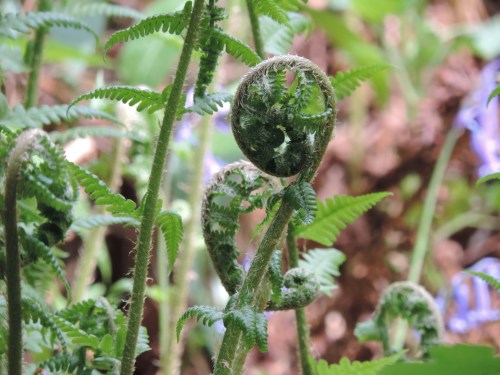
One of the most beautiful shapes in the universe is the spiral. From the spirals of galaxies to the double helix spiral of DNA, and so, from the largest scale to the smallest, there are spirals.
One of the commonest places to see them around you is where ferns grow. I love those spiral shapes you see as a fern unfurls.
Spirals make me think of the kind of path that life follows.
Clearly life does not follow a straight line. It doesn’t run directly and steadily from birth to death with no curves, pauses, deviations or ramblings.
And although there are many cycles in Nature and in our lives, the life story doesn’t follow a circular path either. Although sometimes it feels that way when you have one of those “How did I end up HERE again?” moments. When we don’t learn, when we try to solve our problems using the same solutions which brought those problems about in the first place, it often doesn’t go so well, or, at least, not so differently.
It seems to me that life is more spiral in character, and that, yes, we revisit unresolved issues, unhealed traumas, and unsolved problems repeatedly until we resolve them, solve them, until we heal. But each time around when we revisit something, when life throws up what seems like the same challenge yet again, it’s different. We are different. Because we change all the time. Every experience we have changes us, contributes to our memories, influences our choices and our actions, creates new behaviours, thoughts and habits. So when we hit that “How did I end up HERE again?” we are not exactly “HERE” again!
That always gives me hope.
We have a chance to respond differently this time, to make a different choice, and maybe set off along a brand new path…..another path with its own new spirals to come.
But here’s the thing about that fern in this photo – is it spiralling or un-spiralling? Is there even a word “un-spiralling”? I think instead of “unfurling” because that’s what it seems to be doing. It’s unfolding, opening up, stretching out, expanding. But, hey, I guess that’s a kind of un-spiralling…..something to learn from that I think!
Social distancing, physical distancing, isolation, “confinement”, lockdown. We’ve been going through an enormous period of physical separation from each other, and from the Earth.
Sure, there’s Zoom and WhatsApp, and FaceTime and all the rest, but we’ve been reduced, I think, by connecting through screens. These virtual meetings, avatars and asynchronous communications have got two sides, haven’t they? They open up channels for us and allow us to speak, to send messages back and forth, and so to have some sense of connection. But they add an extra layer between us, almost as if there is a mist, or a fog that we can’t quite see through.
I think part of the problem is that reality is physical and even the apparently invisible, un-measurable, Self, is embodied. Our feelings and our thoughts are embodied. Our everyday experience exists within physical reality.
Yet we’re being told that touch is dangerous. That we must keep a metre or two away from everybody else. In France you’re not supposed to kiss anyone on the cheek anymore, and in many countries you’re not supposed to shake hands…..and I don’t know about you but this knocking elbows or kicking each others ankles just doesn’t do it for me! We’re told that surfaces are dangerous. They need to be wiped, and washed, and sprayed and cleaned again and again and again. We’re told to wash our hands for longer and more frequently than most of us have ever done before…to remove all trace of whatever we might have touched.
Don’t get me wrong. I understand what this is all about. I know this virus can only spread through physical and/or close contact. But, all the same, these new habits and new rules have turned the sensation of touch into a fear of touch. And that doesn’t strike me as a good thing.
So, today, I want to remind you of that particular one of your five senses – touch.
Look at this tiny white feather. Don’t you just long to reach out, pick it up, stroke it gently, or stroke your skin gently with it? It is beautiful to look at, that’s for sure, but to touch it, to feel its almost weightless physical presence, makes it more real.
At the other end of the scale, look at this burr. What an amazing creation! What a way to spread around the world! It looks a little bit like those images we’ve seen of the coronavirus, and if you’ve ever brushed up against a burr like this you’ll know it catches onto to you pretty damn effectively. And no wonder…look carefully….every single one of those spikes has a sharply hooked arrowhead at the end of it. If you wanted to design something to easily fix onto whatever creature comes close to it, you couldn’t do much better than this. At first glance, of course, this mass of needles looks like a protection mechanism. It looks like a huge STAY AWAY signal. And if you touch it with your fingers, it really isn’t a pleasant experience. But it’s not designed to keep creatures away. It’s designed to connect, to attach, to hook on and stick.
Here’s my box of curiosities. You know the idea of a “cabinet of curiosities“? That always appealed to me. Those cabinets were, in some way, the precursor to museums, but they were more personal. I kept this box right next to my chair in my consulting room. Children, almost always less inhibited than adults, were fascinated by it, but, actually lots of the adults were too. In fact, the majority of objects in my “box of curiosities” are gifts from patients, colleagues and friends over many, many years. People who saw my box, often brought me something to add to it.
You’ll see there is a quite a variety of textures in there. There’s feather, leaf, and stone. There’s metal, shell and chestnut. There’s cord and there’s wood. Every single one of these objects begs to be picked up and handled. Yes, to be looked at, but mainly to be touched.
So why not take a little time to explore the sense of touch today? I think it connects us to reality in a completely unique way.
I think that the “call of the sea” is real. We are pulled towards the oceans. Are houses with seaviews the most expensive houses in any country? Why is that? Is it that the sea represents both freedom and adventure? When we look out across the water towards the horizon it is somehow incredibly appealing when all we can see is water and sky. We don’t need to glimpse any distant coastlines to feel drawn to the edges of our land.
It does seem as if the sea, itself, stirs our souls.
But I think there is another factor. The edge.
I am naturally drawn towards the edges. I love to walk along a beach, gazing at the far horizon, breathing in tune to the rhythm of the breaking waves. That constantly changing, dynamic, irregular, line which marks where the water meets the sand, and the sand meets the water.
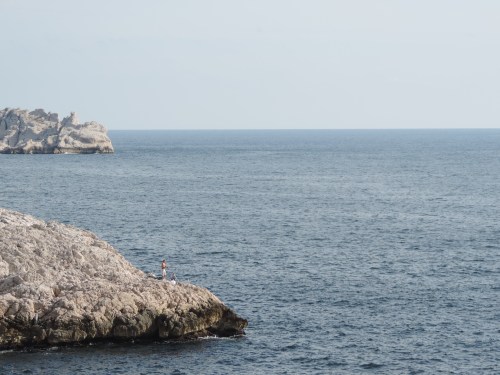
It’s the same with rocky outcrops. Just like the fisherman in the second photo there, we love to get to the edge (of course, he’s hoping to catch fish so if he doesn’t go to the edge, he’s not going to have much success!). But it’s not only the fishermen who like to stand, or sit, at the edge of a rock.
I wonder how much this instinctive attraction is due to a basic law of Nature – that all complex adaptive systems move towards “far from equilibrium” points? All living systems do. All ecosystems do. In fact, I think the concept of “steady state”, or “balance” misleads us. When I was taught about “homeostasis”, the idea that our “internal environment” has multiple checks and balances to maintain a constant inner state, I thought it made a lot of sense. I learned about all the feedback loops which kick in to ramp up or damp down activity in the body, to keep things ticking along in the “normal range”. But gradually I realised that was a bit simplistic.
The missing pieces included growth and adaptation, both of which are linked to creativity. That creativity manifests itself in “emergence” – the appearance of new behaviours and conditions which couldn’t have been predicted from the pre-existent ones. It manifests itself in novelty and difference. It manifests in growth, development, and maturity.
Once we start to understand that Life is based on a dynamic equilibrium – the kind of balance which never settles down – then we notice that everything tends to be drawn towards the edges.
It’s the same when we look at the activity of organs like the heart and the brain. The rhythm of the heart is constantly changing. You can measure the “heart rate variability”, and find that when there is next to none, the heart has become rigid, non-adaptive, and is about to fail. On the other hand, when you find that it’s chaotic, the heart is also about to fail. The sweet spot is the zone at the edge of both of those extremes. Same with the brain. When a seizure occurs the somewhat chaotic activity of the brain waves suddenly develop zones of constancy. It’s the imposition of rigid, regular wave patterns which seems to obliterate the underlying, normal, variable rhythms. The sweet spot, again, is in that zone at the edges of these two extremes – the zone between rigidity and chaos.
If we are going to learn from this pandemic we’re going to need new thinking, new ideas, different ways of living and organising ourselves. We aren’t going to learn if we try to “return to normal”.
The future is still to be invented, and we’re going to find it at the edge.
I welcome constructive criticism and suggestions. I will not, however, tolerate abuse, rudeness or negativity, whether it is directed at me or other people. It has no place here. ANYONE making nasty comments will be banned.




 Heroes Not Zombies