Feeds:
Posts
Comments

Archive for the ‘health’ Category

I’ve long thought that there is a dilemma at the core of the human being which comes from two apparently opposite needs. The need to belong, and the need to be an autonomous, unique, separate self.

How do we achieve that?

We are social creatures. We’ve evolved that way. We have the most sophisticated and complex neurology which allows us to do much more than create connections and relationships with others. It allows us to empathise, to get in tune with, others. It enables us to influence and be influenced by others.

This pandemic has shown us even more clearly than ever that we are social creatures. We need our relationships. We need our families, friends, colleagues.

From the moment we are born we need to create healthy, strong relationships with others…..without them, we would die.

It’s also pretty clear that we all share this one little planet, and that the air, the water and the nutrition that we all need exists in inter-connected cycles and ecosystems – all without borders.

But we are all unique and separate individuals. We each have a finely tuned immune system which recognises anything which is “not me”. We have well-developed personal boundaries and borders. And we are all actually unique. The universe has never created you before, never created anyone identical to you before, and never will in the future. As we weave the events, experiences and relationships of our lives into our personal biology, we develop a completely unique set of memories, beliefs, values, characteristics and behaviours. We are all different. We all have a unique narrative to share.

You might think what we need is a balance between these two needs – a balance between separateness and belonging. But balance doesn’t seem to be quite the right concept to me.

It seems that we need to be healthily separate and healthily connected, both a the same time. We need to see, acknowledge and respect the uniqueness of every human being we meet, AND we need to build bonds of commonality, as well as understanding the vast interwoven networks of co-dependency and co-creation without which none of us could exist.

I guess it’s back to my favourite “and not or” – we really, really need to pay attention to, and nurture, both of these needs – in ourselves and in others.
Read Full Post »

I graduated in Medicine from The University of Edinburgh back in 1978. During my medical education and training I was taught about the heart. I remember we were taught about the heart muscle, the system of electrical conduction which produced the rhythm of beats, about the heart valves and how to diagnose different valve problems according to the sounds we could hear when we listened through our stethoscopes. I learned how to administer and read an “ECG” – that series of spikes and waves you see on heart monitors and printed out on long strips of paper.

I didn’t learn that there was a neural network around the heart, nor what that might do. Back then if we thought about it all, the heart was a sophisticated pump for keeping the blood flowing around the body, and phrases like “heart felt”, “broken heart”, “having a heart to heart conversation”, and so on, were considered flowery or poetic metaphors.

I know better now.

We now know that there are sophisticated networks of nerve cells around all the hollow organs of the body, but especially around the heart and the gut. We also know that there is a LOT of communication between the heart and the brain, and that, contrary to what we used to believe about those connections, most of the flow of information is from the heart TO the brain, not the other way around.

We’ve also learned that the beating of the heart creates electromagnetic waves which radiate out around the whole body, and can even be detected outside the body. Those rhythmic waves seem to have a role to play in co-ordinating, or “integrating”, a wide range of functions of the whole body, and even connect with, influence and can be influenced by the waves radiating from other peoples’ hearts.

It turns out that those metaphors we use have a biological, neurological, physical basis in the person. We have a certain kind of “heart intelligence” which allows us to “know” and to “communicate” from one heart to another.

Isn’t that amazing?

Since I came to understand all that I’ve realised just how important it is for we humans to have a “heart focus” – to try to connect to others and communicate with others “from the heart”, not just from the rational brain.

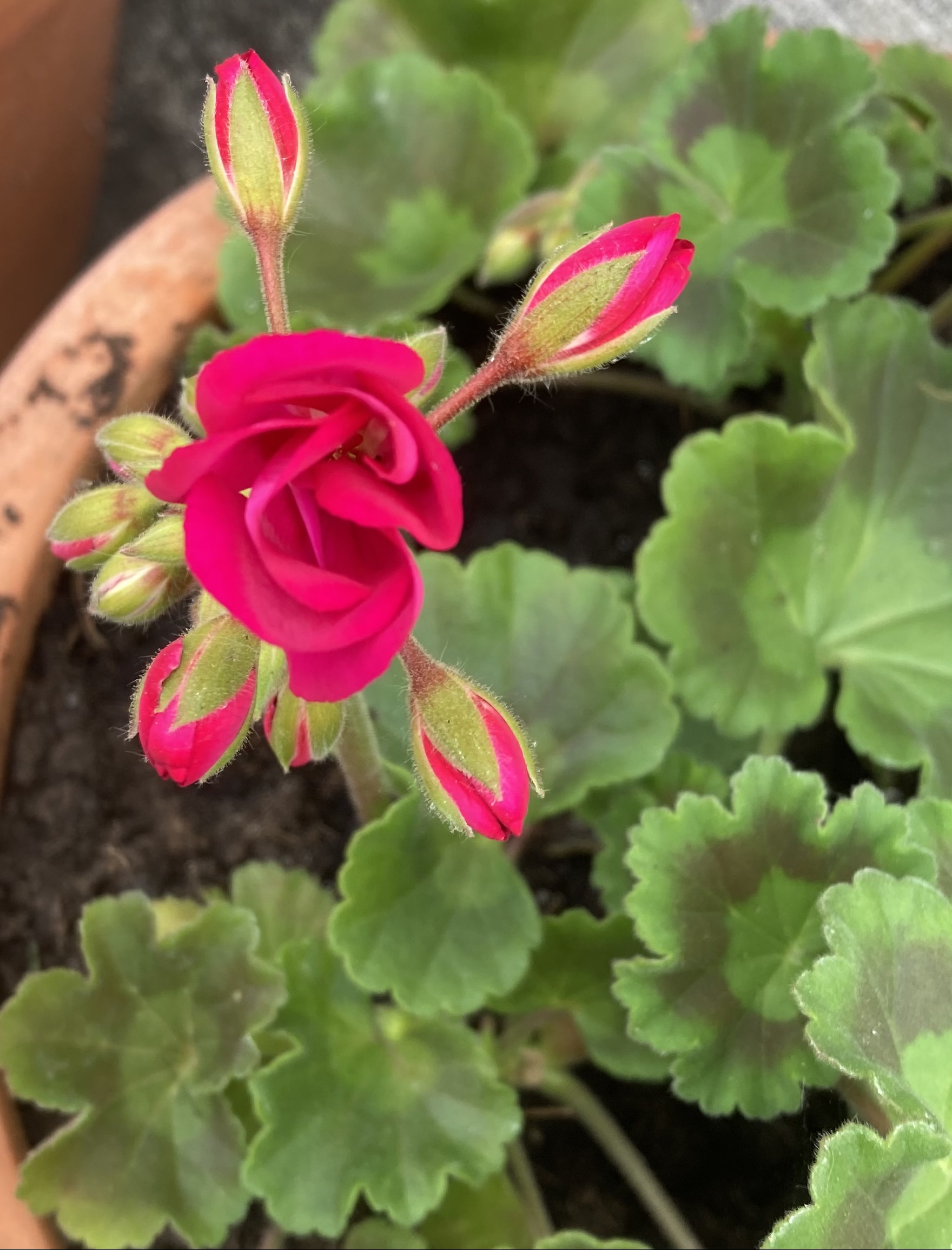
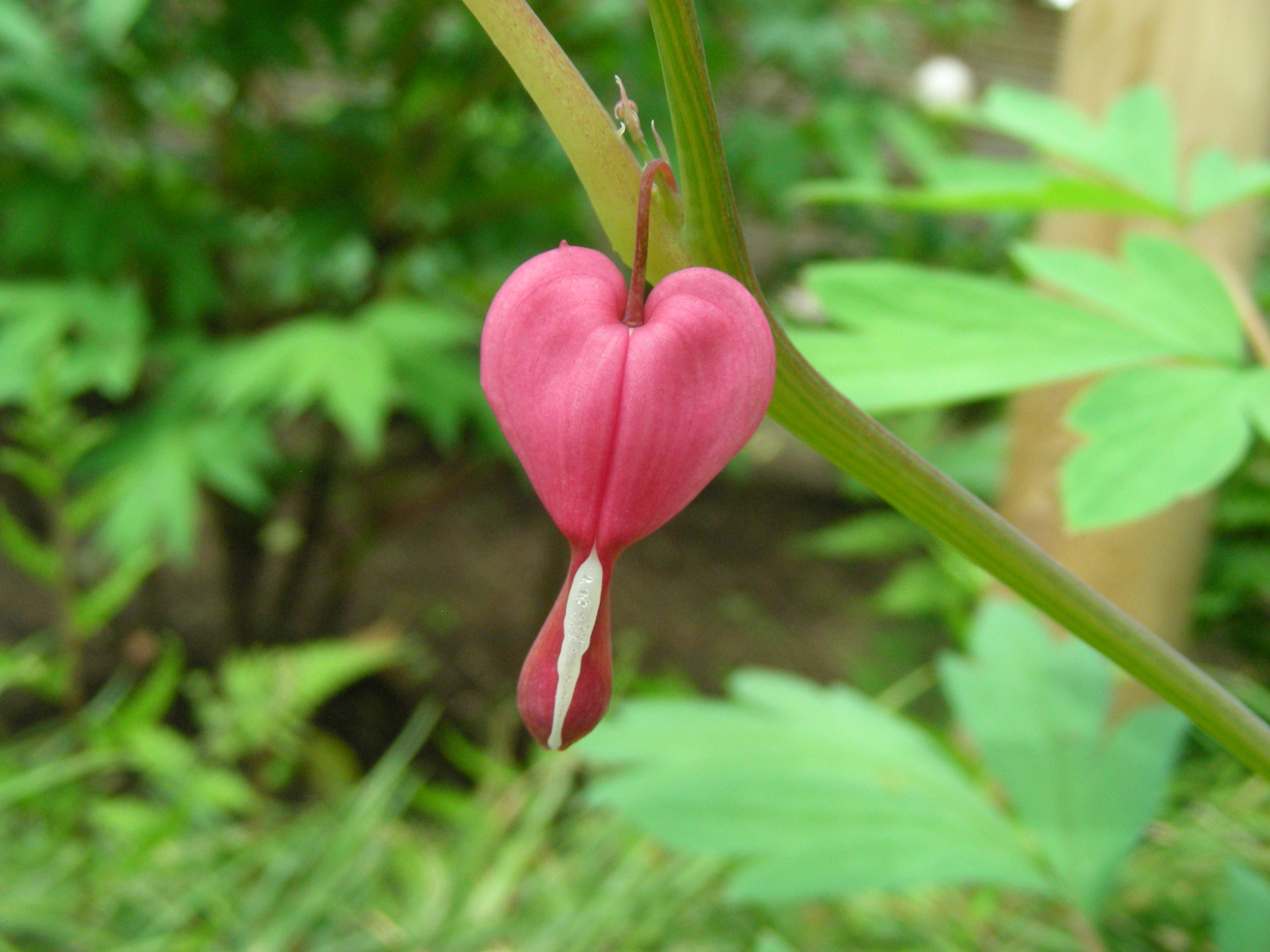
We all love to find heart shapes in Nature, don’t we? Like this little flower in today’s image. Or in the bark of a tree, the shape of a stone, or in a work of art. Why is that, do you think?

I think it speaks to the core importance of everything we think of when we use these heart metaphors in our language, in our poetry and in our songs.

After all, who thinks it’s a good idea for someone to act in a “heartless” way?

Not me!

Read Full Post »

Meditation in a huge variety of forms has become incredibly popular in recent years. “Mindfulness” seems to be marketed as the solution to almost everything, perhaps because it has contextualised the original Eastern teachings for a Western, twenty-first century audience, and removed the references to spirituality and belief.

However, I think there’s an equally ancient “classical” practice stretching right back to Greek philosophers. It’s the combination of slowing down and observing.

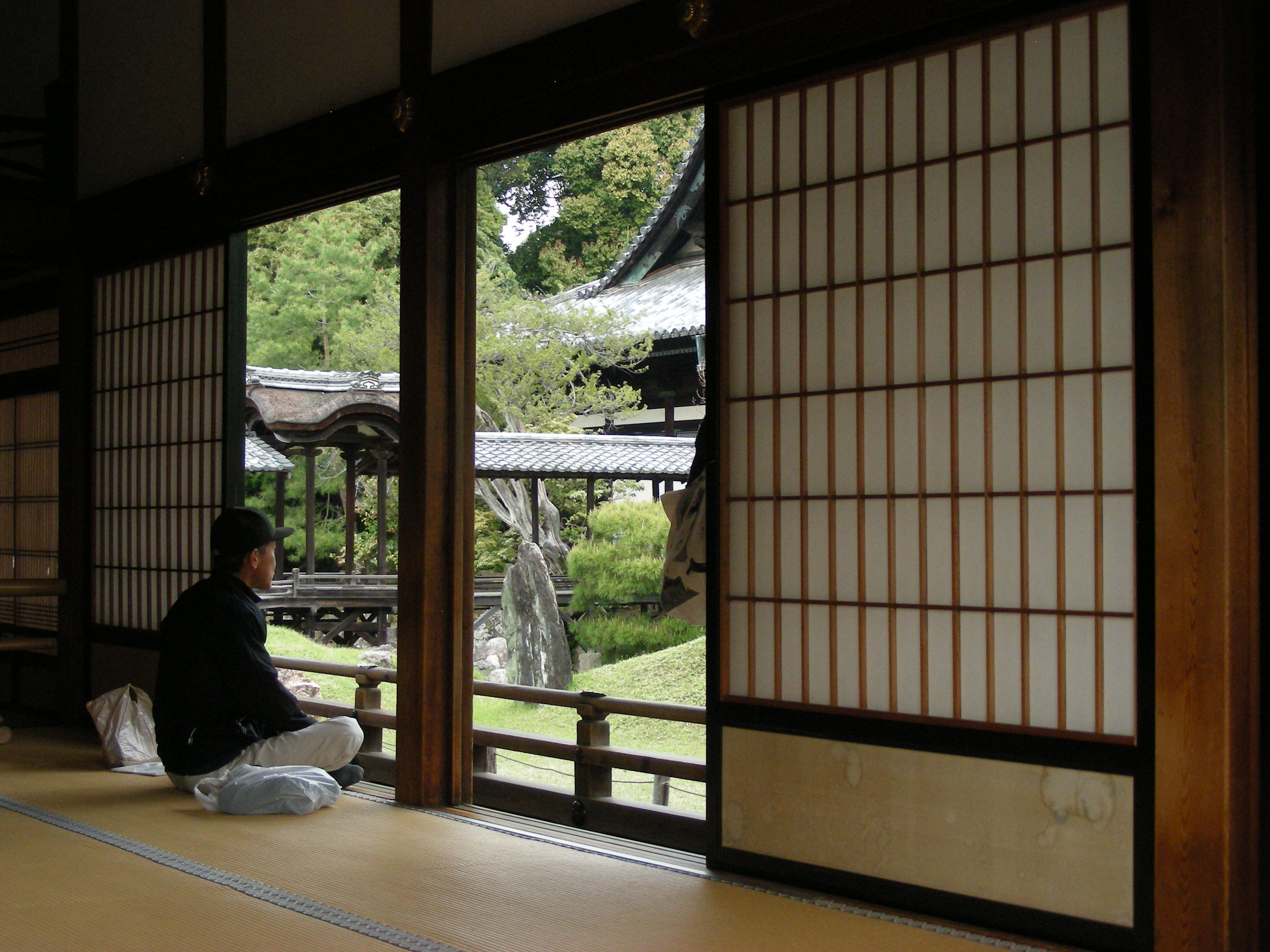
“Sitting and looking” is one of my favourite “activities”. Since I retired and moved from Scotland to South West France, I have spent many, many more hours outside than at any previous time in my life. Sometimes I’m outside to tend to the garden. I’ve discovered the delights of growing, harvesting and enjoying a wide range of fruits and vegetables, and I get a huge amount of joy from seeing the beauty of different trees, shrubs and flowers. But oftentimes I like to just sit on a chair in the garden and look.

I look up at the blue sky and watch a few buzzards soaring effortlessly on warm air currents swirling so high above me that the birds are just little specks, and their high pitched cries sound far away and near at one and the same time. I look up and see kestrels hovering on a single point in the air, their wings beating so fast I can’t see them, then watching them drop like a stone to the earth when they spot some prey far below them.

On cloudy days I get lost in the ever-changing tableau of characters which I can see in the clouds.

Throughout the year I see the seasonal changes in the long parallel lines of vines stretching from here to the horizon.

Sitting down makes me slow down. It allows me to pause, to take a few deep breaths (without even thinking about my breathing), and to become more present. It allows my awareness to open up and come alive, so that I notice what would otherwise pass me by.

It’s a great, life-enhancing, combination.

Sitting and looking.

I recommend it. (Health warning: too much sitting is bad for you health. Use it in moderation. Movement, walking and other forms of exercise are also necessary!)

Read Full Post »

My daughter, Amy Palko, who produces a knitting blog on youtube, entitled “The Meaningful Stitch” did a poetry advent in the month of December with one of her online friends from the knitting community, Jackie, of Cady Jax Knits. You can find their videos here

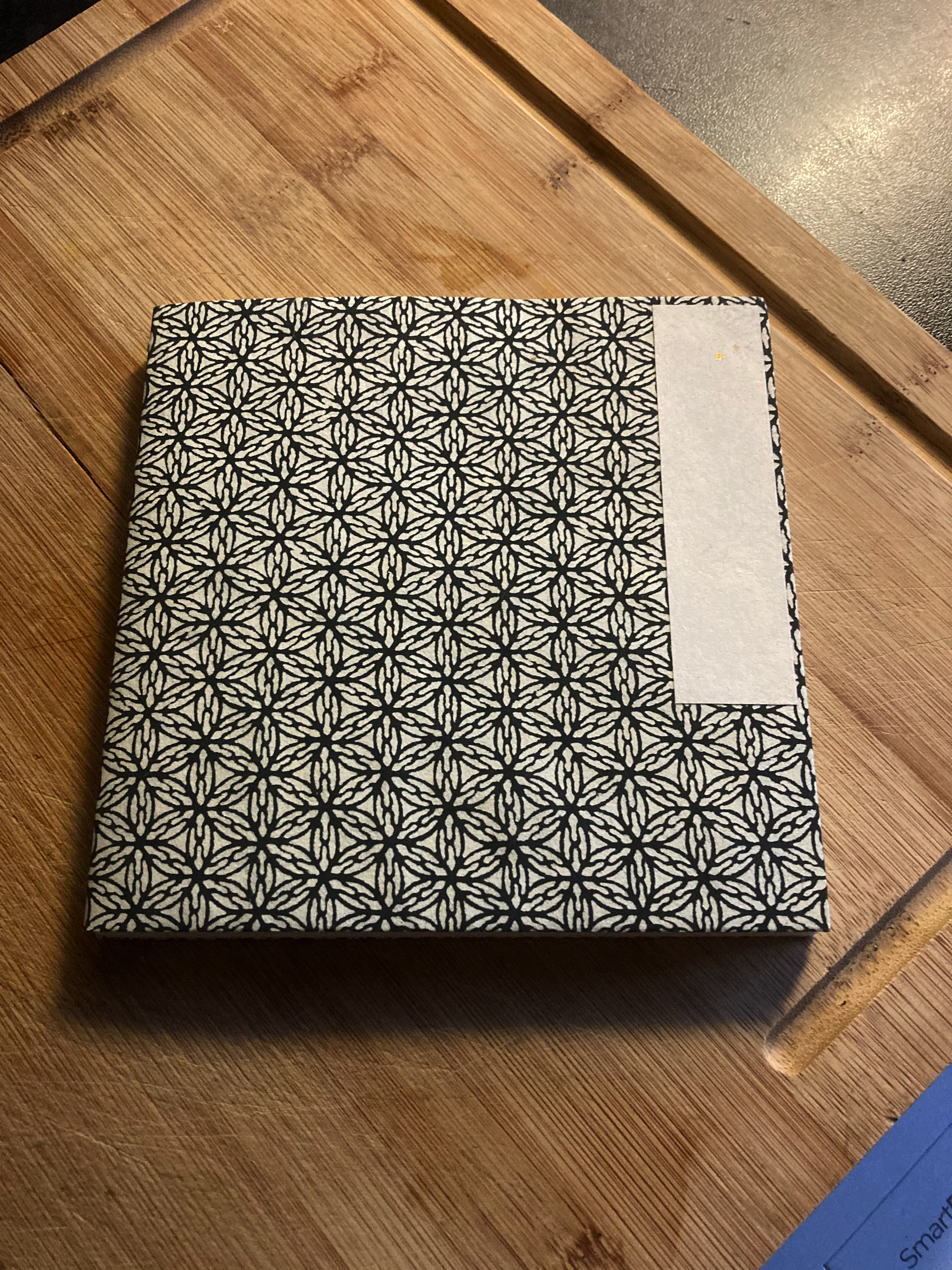
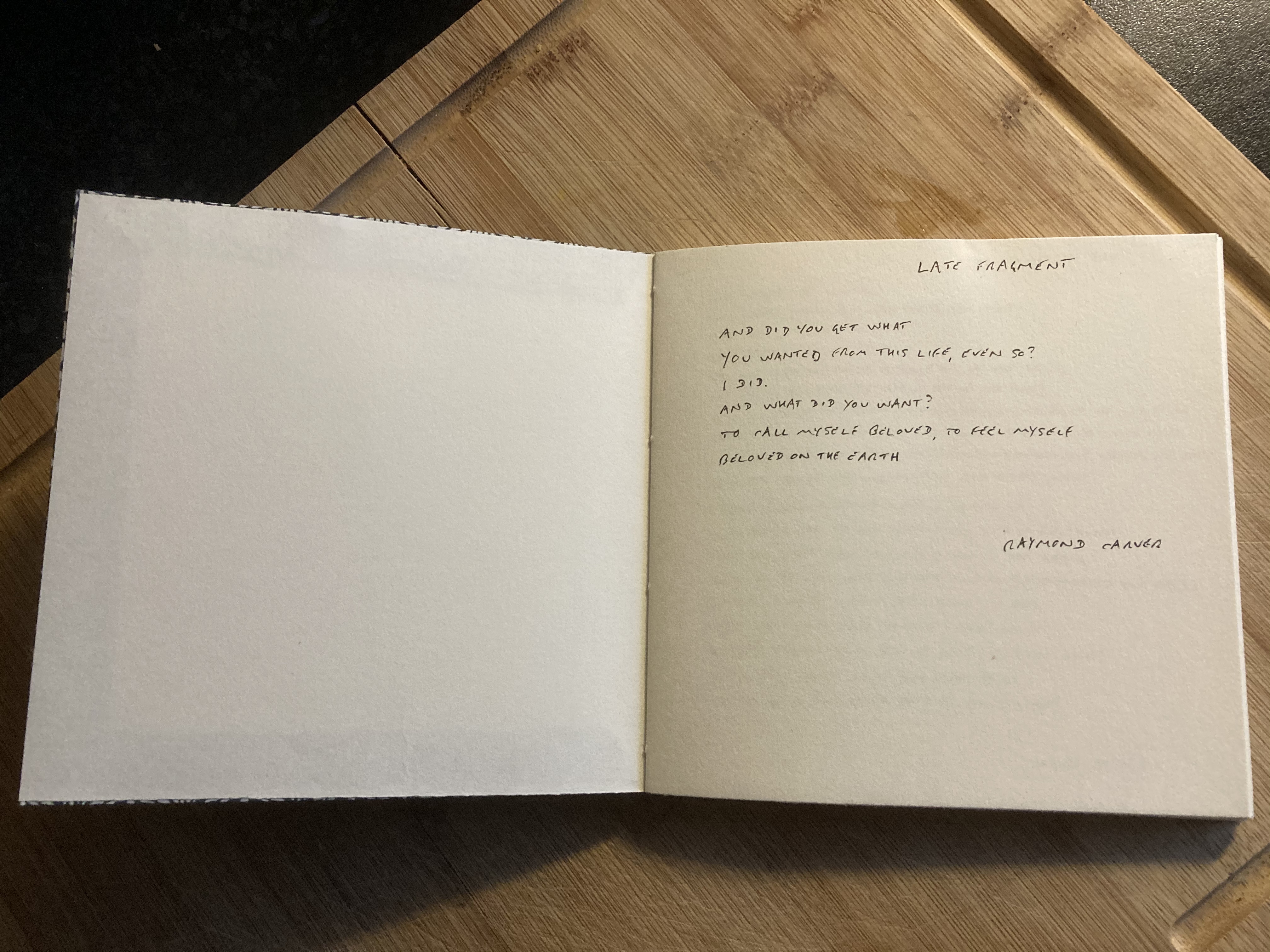
One of the things they discussed was creating a personal anthology of your favourite poems. I thought that was a great idea and got out this handmade notebook which my wife, Hilary, had created and given to me, and started writing some of my favourite poems in it.

I think it’s important to actually write the poems in, not to print them out from the internet and paste them in, though, if that would work better for you, then go ahead. I find that taking the time to hand write each poem enhances my experience of the poem itself.

I keep this notebook on my desk beside my computer and from time to time I read a poem or two, or I copy in another poem that I really love.

I really recommend this. It’s one of those practices which takes something meaningful and enjoyable – in this case poetry reading – and increases the time and attention you give to the poems you select. In the process you create a unique collection of exactly the “best” poems for you.

If you’ve read a few of my posts on this blog, I’m sure you’ll be aware of how Iain McGilchrist’s thesis on the differences between the left and right cerebral hemispheres. Well, if he’s right, which I think he is, then there is an imbalance for each of us, and for our wider societies, between the approaches, the world views, or the ways of engaging with reality, which each hemisphere offers us. We have become left brain dominant, and it would be much better to use our whole brain more, and re-set the balance, to put the right brain back in its rightful role as “The Master” and use the left brain “Emissary” to do what it does best. Since I came to understand that thesis, I’ve been more aware of trying to support and develop what the right hemisphere can bring to my life.

Well, there are many ways to do that, but I’ll just share three with you here.

The right brain loves novelty and finding connections, so as I practise curiosity and the sense of “émerveillement du quotidien” I’m building up the right hemisphere.

The second thing is music. The right brain relishes music – both creating music and listening to music. I play music a lot. Mostly I listen to music, but I also try to play a bit of piano and guitar from time to time. Music is very personal and what I like, you might not like, but I’ve recently discovered Paradise Radio, a commercial free, internet radio station from the US, and I love, love, love it. You can select between “main mix”, “mellow mix”, “rock mix” or “world mix”. Check it out.

The third thing I’ve identified is poetry. We activate our right hemispheres a lot when we read and write poetry. More so than we do when reading stories, or articles.

So, there are my three daily practices, which I hope lead to development of a more whole brain way of living……curiosity, music and poetry.

Read Full Post »

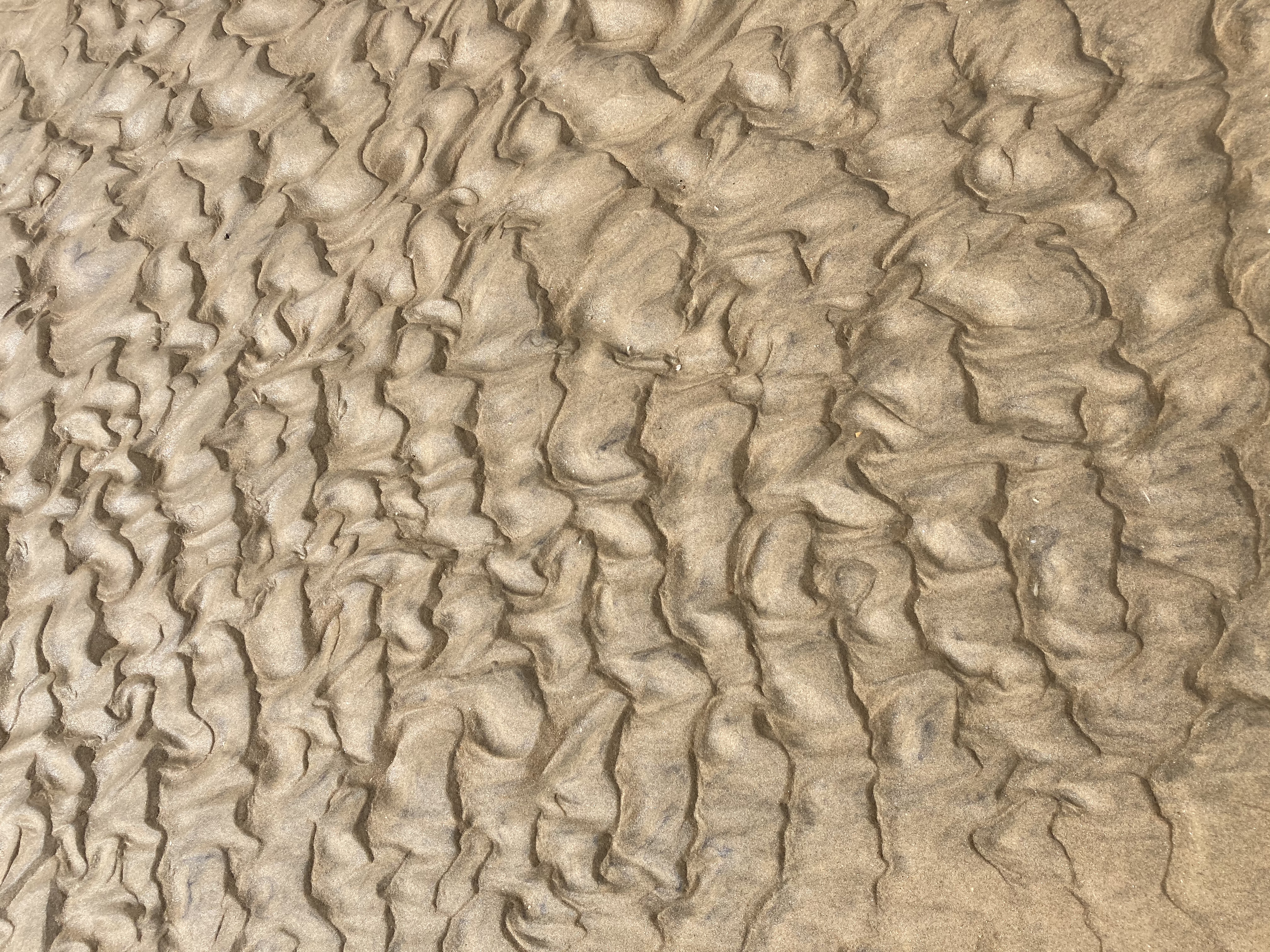
Look at this amazing pattern left on the sand by the action of the water after the tide has gone out again at the beach.

When you look at this you know immediately that the sand has been shaped by the water, although, to be honest, I don’t understand how water manages to make such intricate patterns like this on the sand. Maybe somebody does!

There are other striking patterns on the wet sand at the beach, some clearly made by plant material, seaweed I expect, and some obviously from the imprints of shells, some little worm-shaped piles caused by burrowing creatures throwing up the sand behind them, and often many footprints of birds which have run across the beach.

What impresses me most about all these patterns is that they are the traces left by some activities which occurred a little while ago. They are the evidence of the past imprinted on the present. That reminds me of how we are shaped by the events and experiences of our lives. Our encounters with others change us. Our experiences don’t just create memories, they set up patterns of chemical, electrical and cellular response in our bodies.

We can become aware of some of that in bodily changes, from tightenings of muscles, to changes in heart rate and breathing, to sweating and trembling, and so on, usually before we are even aware that we reacting to something.

I spent much of my career working with patients who had chronic, long-standing illnesses, and we could often make some sense of what was going on by teasing out the threads and themes which ran through their stories over many years. It certainly wasn’t always the case, but sometimes the actual disease and its precise location in the body was clearly related to the body’s responses to events or experiences long forgotten.

It’s pretty clear to me that just as the movement of the water shapes the sand in the way you can see in this photo, so do our experiences and relationships shape us. Realising that makes me want to be more aware of my own actions and words. It makes me want to choose to spread constructive, supportive and creative waves in the world. After all, whatever we do, whatever we say or write, has effects far beyond the limits we could imagine.

Read Full Post »

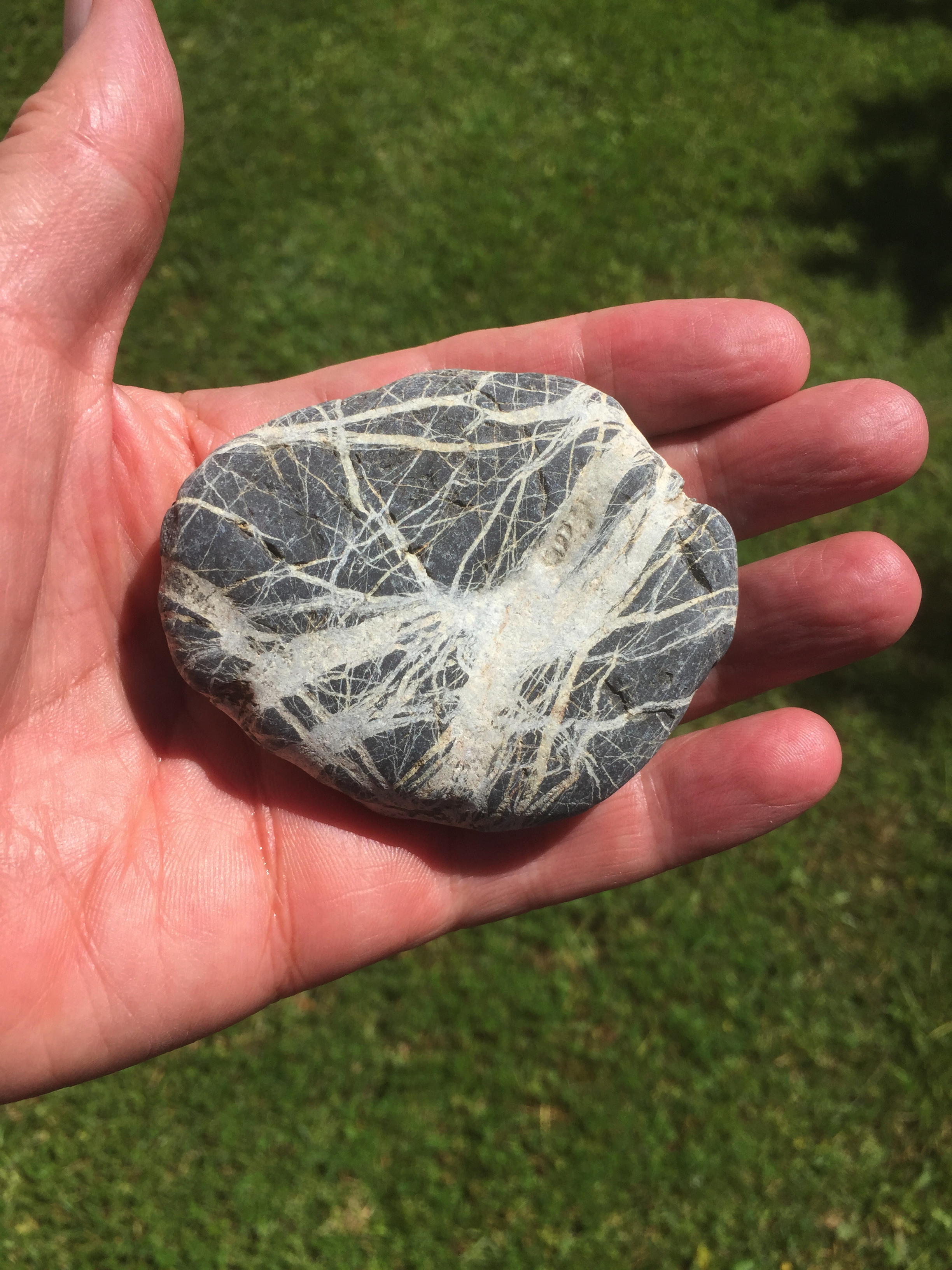
Sometimes you come across a stone that just demands to picked up, turned over, contemplated and brought home. That was the case with this one which I still have with me. I like it partly for its almost heart shaped form, but I like it most for the pattern you can see on it.

When I look at this, I see a number of lines of varying breadths and lengths, criss-crossing the surface and I think of each of them as a representation of a path, or a journey.

When I trained in Medicine, we were taught “how to take a history”. While I developed a bit of discomfort around the use of the verb “to take” there, I kept the concept of the history. In fact I’d tell people a large part of my work was about enabling people to tell their own personal history…..or their story. I used the idea of “story” a lot in my work. I’d ask people to tell me about their present experience in the light of past events and within the scope of their fears and hopes for the future. The traditional life story has a clear timeline, starting at birth and ending with the person’s death. Except, I quickly discovered, that in order to understand a person well I had to explore the family stories too….in other words to hear what happened before the patient was even born……as well as exploring the stories of many of the others (brothers, sisters, other relatives, friends and colleagues) whose stories intersected with the patient’s story.

So, I was quite surprised when I read a small article in “Philosophie” magazine about maps – they described how the French philosopher, Giles Deleuze said that our “subjectivity” was created from our movements, from our meetings, and from the relationships we had with other beings, other things, and other places. He said the map was an imprinting of all these movements, encounters and relationships which was laid down in our psyche, and so, when analysing ourselves we had to explore more as a geographer than as a historian.

Now, as you know, I’m a great “and not or” person, so I wouldn’t replace the work I did, or the way I make sense of my life with a geographical approach instead of an historical one, but I find that notion incredibly appealing.

What if, next time you are exploring your life, your experience, and your “self”, you make a map – a map of the journeys you’ve taken, the places you’ve gone, the experiences and encounters you had there, and the relationships with people, other living creatures, things and places which you’ve woven into your soul as you have lived?

What might that map look like?

It strikes me that adding this geographical approach to my life opens up new insights because it reveals and highlights the interactions, relationships, encounters and experiences of my life. The historical approach, of course, can reveal the characters, the events and the chronology of a life, but this shift of focus from my “story” to my “map” has, I think, loads of potential.

Read Full Post »

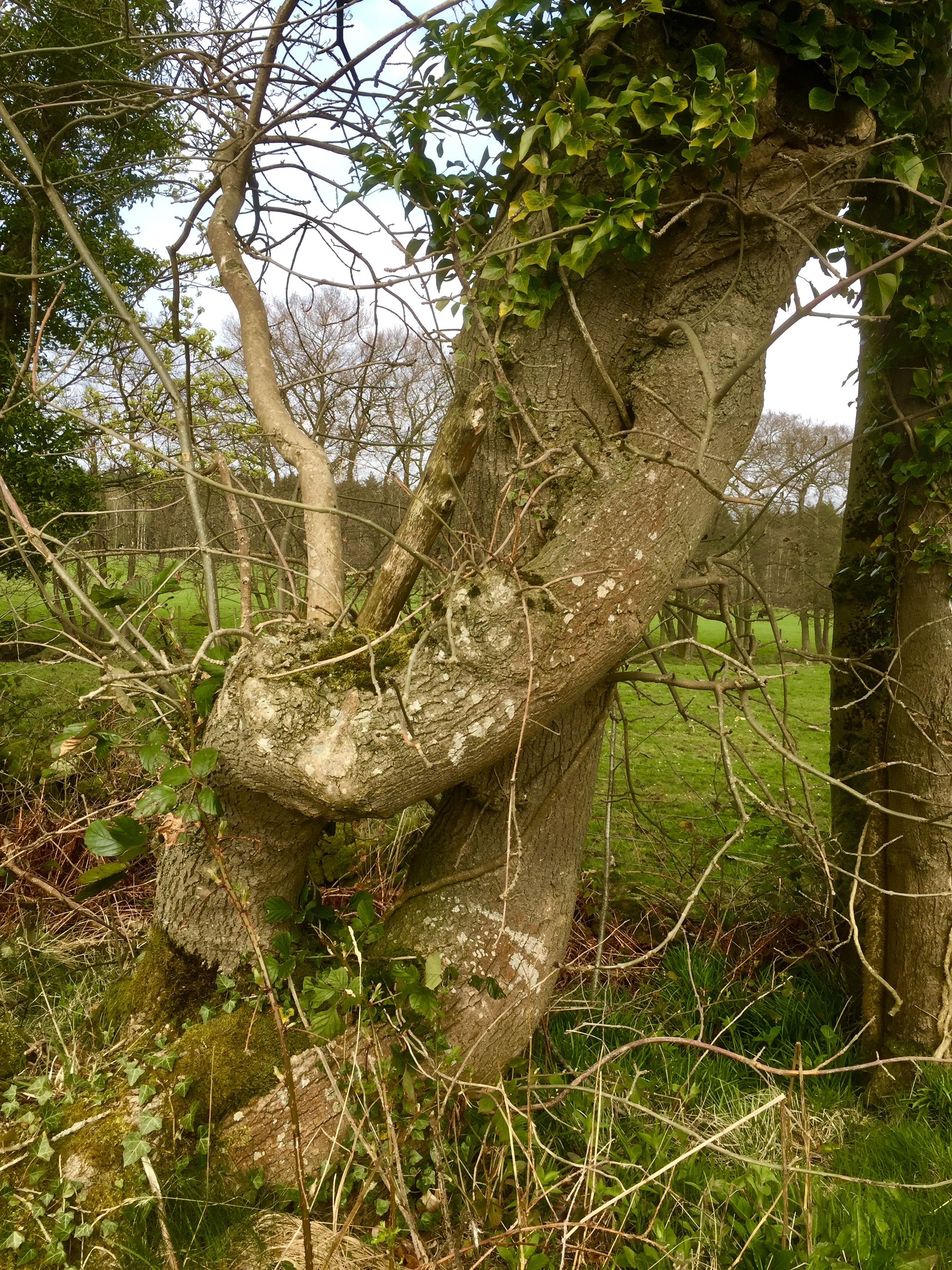
I reckon we pretty much expect trees to grow straight up, then branch a bit, then grow further, still straight up. But, actually, of course, this is seldom the case. Trees, even their main trunks often veer off this way and that, or bend in one direction, only to turn in a totally different one a few metres further on. I confess I don’t know what makes a tree take the twists and turns that it does.

Look at this one for example, not only has it swerved around an almost 90 degree angle but it seems to have entwined itself on the neighbouring tree. What do you think? These trees are lovers? They’ve entangled themselves in each other’s lives forever?

It looks that way to me.

So maybe some of the shape of this tree can be understood in relationship to the other tree. Now how often is that the case with we humans? Do we ever reveal our character in any other way than by responding to what we encounter and by acting in response to the others in our social world? Can you really understand anyone without understanding their place in a family, in a community, a society? Can you really understand anyone without seeing how they respond to others, without exploring the nature of their relationships? I don’t think so.

A belief in the uniqueness of every single human is at the core of my world view and my practice as a doctor. But I never attempt to understand a person solely in isolation. I can only get an idea of who they are by hearing the stories of their experiences and relationships, and by observing how they respond to others….including myself.

I’ve no doubt that all our interactions with others change us. I would not be who I am today without having been changed by all the doctor-patient relationships I experienced in my life. You could say patients made me who I am. Not only patients of course, you also have to take into account the others in my life, family, friends, colleagues, even those who challenged me, or disliked me.

Our lives are entangled.

That’s just how it is.

But we can make choices, and we choose both who and how. We can choose to pay attention to certain people, to care for them, to engage with them, to collaborate with them, or to compete with them. All of those choices weave our unique, personal web of inter-relationships. And that constantly evolving cloth forms the very tissue of our being…..or should I say of our “becoming”.

When I look at this photo today it leads me to contemplate the people in my life, those who are no longer present, those who I’m actively relating to, and those who played significant roles in fashioning my experiences and creating the memories I have. You could say, it leads me to consider the characters in my life story. Who they are, who they were, what experiences we had together and how we become entwined and entangled.

I am grateful to them all. We made each other who we are…..together.

Read Full Post »

One of the most beautiful things to see in any garden is the unfurling of the petals of a flower. That phase where the bud opens up and the gorgeous coloured petals unfurl themselves captures an essence of Life for me.

I see this and I think “becoming not being” – you’ll have noticed that phrase at the top of my blog? I wrote that as a subtitle because it is the most fundamental lens through which I see and understand the world.

The difference between those two words is movement…a particular kind of movement…..movement of change from one state to another.

Everything is in the process of becoming. It’s easy to see that in living organisms. The trillions of cells which make up the human body are in constant process of birth, growth, maturing and dying. They are replaced at different rates according to their type (blood cells living much shorter lives than bone cells for example), but none of them stay the same for the whole lifetime of the person.

When we look at an old school photo we might recognise ourselves, but when we compare that to one taken a decade later, then another and another, we see very, very images of the same person. All might be photographs of me, but all look utterly different.

This process of growth and development is a key characteristic of health for me. When I was working as a doctor, it was important for me to have a positive definition of health. I wanted to to help people to become healthy, and healthy, I think, is a positive state in its own right, not just an absence of symptoms or disease.

When I used to look out of my window in Central Scotland I could see the mountains, and the distinct shape of Ben Led always caught my eye. It amazed me that every day it looked different. Of course, I wasn’t close enough, or around for long enough, to see the physical structure or the surface of the mountain change (though change it did, over millennia). But my daily experience of the mountain was created more than rocks and earth. It was created by the light, the clouds, the sun, and the seasons. And all that changed all the time.

Nothing is fixed.

That’s my point.

Nothing can be understood in isolation from its environment, from its network of connections and relationships, or from its unique history and potential.

Stories….narratives….are always in the process of becoming….because stories weave together the past, the present and some possible futures, into one beautiful cloth. A dynamic cloth, which is always unfurling, always becoming, not being.

This image stirs all of this for me. I love how the “becoming not being” lens makes every day so much more alive!

Read Full Post »

Sometimes I think I don’t say it clearly enough, so I’m focusing on it today.

Here’s my core belief – I believe love is the strongest force in the universe. I believe that love, in all its manifestations, underpins the creation of Life, the existence of human beings, and the constant movement towards ever greater complexity through the creation of an infinite network of connections.

I believe that it is love manifests as attraction. From the blending together of energies and universal forces, to the binding together of subatomic elements to create atoms, the building up of atoms into molecules, and molecules into complex materials which combine to create living cells, to the desire of cells to live together and form mutually beneficial bonds so creating multi-cellular creatures, right up to the way we humans are fundamentally social creatures where none of us could exist in utter isolation.

That deep intense love a parent feels for their new baby from the moment they set eyes on each other. Without that love, no bond would form, and without the bonds of selfless care, that baby would die. With an abundance of love and care that baby can more than survive, they can develop, grow and excel in becoming the unique individual that only they can be.

I believe it is love for other creatures, other forms of life, for this little planet, Earth, in which we all live, which stokes our curiosity, opens our hearts, moves us towards each other and to towards new discoveries. It’s our love of knowledge and understanding which underpins everything from science to philosophy. It’s our love of beauty which underpins so much creativity and art.

I believe it is our love for justice which drives us to demand it.

As I look around the world in these pandemic times, of course I see lots of evidence of cruelty, unfairness and neglect. But I also see an outpouring of love, of people reaching out to each other, of people caring for each other, of people risking their very lives for each other.

I am attracted to those who have loving hearts and minds. I am repelled by those who are driven by hate and cruelty. But here’s the strange thing, from my experience of a lifetime of work as a doctor working with patients one to one I believe that love has the potential to heal even the most hardened, most hurt, most closed off hearts and minds.

So, let me say it clearly once more.

I believe love is the strongest force in the universe.

Read Full Post »

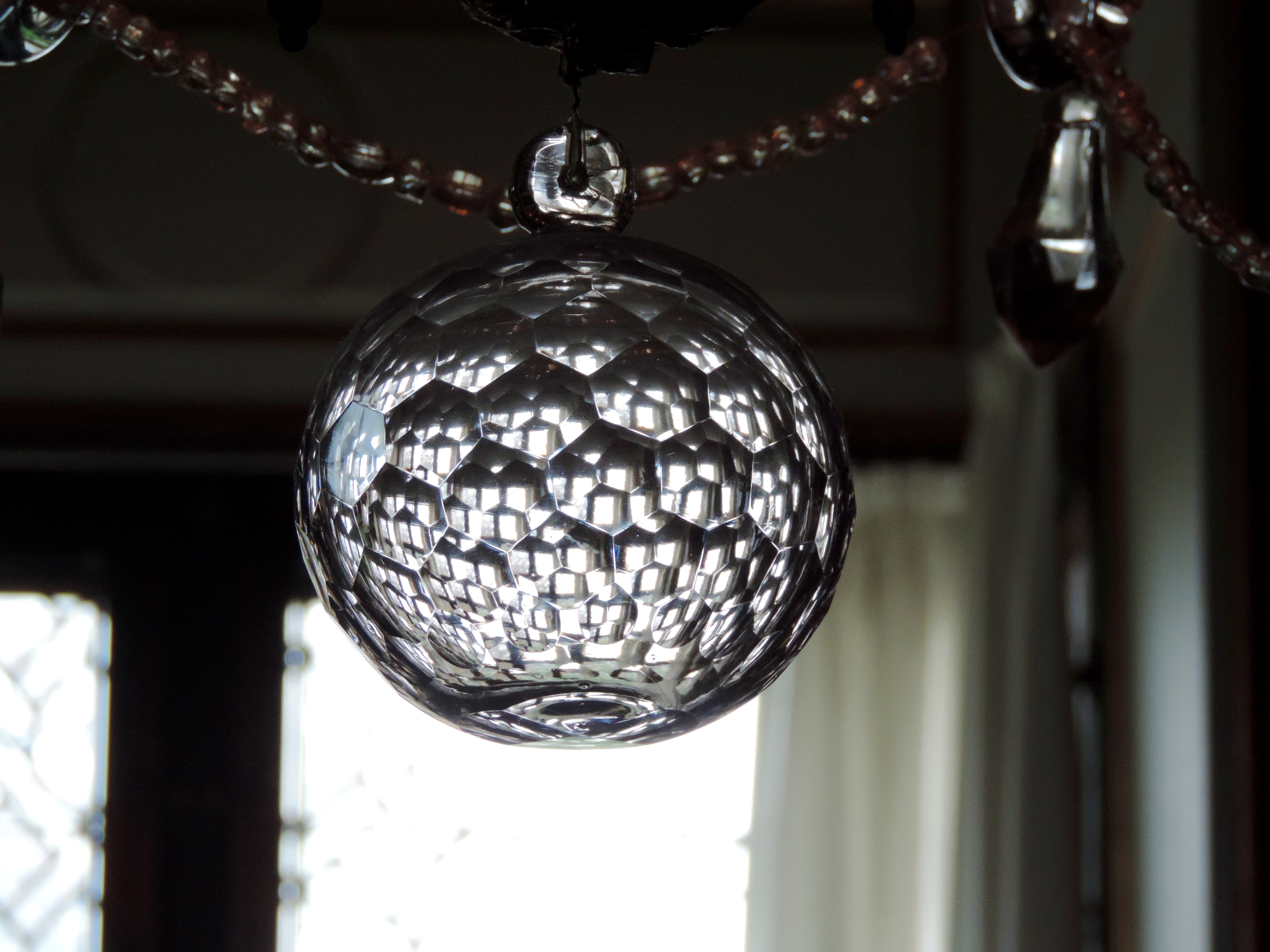
This cut crystal really hits the spot for me – firstly, I see it and I think it is really beautiful. The beauty of it delights me. Secondly, I’m amazed by it. The craftsmanship involved in imaging then fashioning a piece like this utterly astonishes me. Thirdly, it fascinates me. I gaze at it and look at the way the light travels through it. I see how each facet acts like a lens through which I can see the other facets, and how all the facets act as lenses on the window and the rest of the room.

I can have that blend of responses to many of the photos I have and I think that’s got a lot to do with my decisions about which to gather together into my “best photos” folder. Beauty, amazement, wonder and fascination. Altogether they bring me joy. And, without falling into the habit of ranking and creating hierarchies, I think joy is one of the most emotions we can have in our daily lives. Joy activates a whole set of physical and psychological changes in us. And, it just feels GOOD.

But this image does one more thing for me, the thing I really look for in my special collection of best of the best images – it inspires, stimulates thought, curiosity, wonder, and a potentially infinite web of threads of thought.

This idea of a multi-faceted interface gets me thinking about how we humans are like this. Whenever a patient told me their story, as we explored different themes, events and experiences, I’d see them shining like this – each aspect, each theme, each way of behaving, of experiencing, of engaging with the world glimmering like one of these facets. There are many selves within each of us. In 1977 the Scottish psychiatrist, Miller Mair, described a model of the “self” coining the term “community of self” – his idea was that none of us can be reduced to one simple set of characteristics, behaviours and qualities. Each of us exhibits a different self in different contexts – for example, there would be differences in how I was with patients, from how I was with my family, with colleagues and with friends. But that each of these selves were not separate, at least, if we were mentally healthy. Instead, they would all be integrated into one – into one community where they all interacted to give us the sensation of a unitary, or single, self. I liked that model. It opened up the possibilities of exploration of different aspects of a person, often contradictory or opposing aspects, while allowing every one them a place where they could be accepted.

This idea also makes me think of Indra’s Web – that beautiful idea of the universe consisting of an infinite be-jewelled web, where everything is connected, and every gleaming jewel reflects all the other jewels. I think that’s a great model for understanding the world in which we live.

It also makes me think of how we use multiple lenses through which to see, and understand, the world. In fact, if we reduce ourselves to seeing everything through just one small lens or window we find that we tumble into division and conflict with others who don’t share that single lens. But when we embrace the multiplicity of lenses through which we can see the world we can find points of connection with others.

That’s my final thought for today – not only are we all like this multifaceted cut crystal, but when one of our facets lights up in connection with one of someone else’s facets, then we don’t just make a connection, we can brighten each others lives.

I hope this lens, this shining small facet, here today, brightens your life today, and that you, too, feel the stirrings of joy, of wonder, of delight and of connection.

Read Full Post »

« Newer Posts - Older Posts »