Feeds:
Posts
Comments

Archive for the ‘health’ Category

A human being is a part of the whole, called by us, “Universe,” a part limited in time and space. He experiences himself, his thoughts and feelings as something separated from the rest — a kind of optical delusion of his consciousness.”

Albert Einstein

This is foam on a beach. As the waves break, turn white, and crash onto the sand, sometimes they make bubbles…..lots of them. If you look closely you’ll see all different sizes of bubbles and as they catch the sunlight they show us all the colours of the rainbow. They are like delicate, precious gems. However, like all bubbles, they don’t last very long. As you watch, they pop and disappear before your eyes, disappearing back into the rest of the surf, back into the great ocean which they never actually left.

Einstein says our sense of being separate is an optical illusion. We have these functions we call consciousness, ego and self…..what are they? Where can we find them? Where do they come from and where do they go to?

I am convinced that each of us is unique. I spent my working life meeting, getting to know and to understand, thousands of people, one person at a time. I never found any two people who were identical. I find it’s easy to judge people when you don’t know them. It’s easy to make loose assumptions about individuals when you only “know” them as members of a group or a category. But when you take time to listen without judging, when you actively build a relationship of care, I find that everybody has something amazing to tell. Everyone has the ability to astonish you. The hearts, the desires, the longings, the hurts and the struggles of others create utterly unique life stories, and remarkable people.

But I’ve never thought that we are separate. As you start to follow the threads in a person’s life story, it’s hard to find a starting point. In fact, we doctors are taught to explore a patient’s family, their social, work and personal relationships, as well as their particular body and mind. Holistic practice demands that we follow the threads in as many directions as we can. Frequently, patients would tell me they had never told anyone else what they had told me and that I must know them better now than anyone else does. Yet, I knew I spent only a few short hours over a number of months with them, so how could I really know them? I knew how I’ve never got to the point where I think I know and understand everything about myself, let alone about anyone else.

Well reality is like that. We encounter individuals on particular occasions. Like these bubbles in the foam we can see them, recognise their uniqueness, but they are never separate. We are all connected. We all emerge from the same ocean, from the same atmosphere, from the same ecosystems. We have all evolved from the same beginnings. As we live our lives, our short, transient lives, we build an infinite number of connections and relationships. Everything and everyone is always changing.

I think that’s the most amazing and thrilling aspect of life – that we have the ability to separate out, to see each bubble as it is, to know each person as they are, whilst at the very same time knowing that whatever it is, whoever they are, this appearance of separateness is a delusion.

Read Full Post »

I love spirals. I find them quite captivating. My attention is caught by them and I’m drawn close to contemplate them. I’m not sure what it is that makes them just so beautiful, but, to me, they are amongst the most beautiful shapes in the universe. You can see them around you in many places of course….in plants, especially climbers which use this method of finding places to hook onto, then pulling tight to hoist themselves upwards. But also in ferns, and in plants which throw out creepers and tendrils which stress across the ground. We humans often create spirals in our art. Maybe it’s because I’m Scot, because like most Scots I’ve been steeped in the traditional Celtic and Pictish complex knots, three armed spiral shapes which we call the triskele, and intertwined ribbons which swirl around each other. However, I suspect it’s not just those of us with Celtic backgrounds who like spirals.

One of the things I like best about the spiral is that it seems to me that a person’s life story often has that sort of trajectory. There are issues, problems, difficulties which we meet, attempt to address, or run away from, which just keep spiralling back again and again. In fact, human development too seems to have a spiral path.

I don’t think time flows in a straight line. It loops, and it spins, slows down, pauses, runs forward. The past and the future both have their part to play in my ability to make sense of the present. They don’t exist in three separate, sequential boxes, but rather, they loop, cycle and spiral together to create the intricate patterns of the tapestry of a life.

There’s a special thing about this photo. You have to look a bit more closely to see it. Right in the middle of the main spiral in this photo you can see the world clearly – it’s as if you are looking through a lens.

Isn’t that magical?

It reminds me that if I really do want to see the world clearly, then the lens of the spiral can be a pretty good way to do that. What do you see more clearly about your life, when you consider it through the lens of a spiral?

Read Full Post »

“Emerveillement” is one of my most favourite French words. It means wonder, amazement, marvel…..words like that. You get the idea? I am a “wonderer” – Curiosity may be one of my core features. I’m sure that helped me to be a good doctor. I found every single patient fascinating. Monday mornings for me were an opportunity to begin a new week of meeting new patients, hearing their stories, working with them to make sense of their illness and to understand both who they were and what they were experiencing.

But my sense of curiosity, of wonder, of “emerveillement” was never focused solely on human beings. Every day my mind fills with questions, I find myself astonished by something I see, hear, or read. New discoveries delight me. New knowledge thrills me. And perhaps nothing pleases me more than achieving a better understanding of something.

This photo is one I took during several visits I’ve made to Segovia over the last few years. Surely it’s Segovia’s most impressive feature! It’s an enormous aqueduct built by the Romans (yes, the Romans!) to bring water from the countryside into the heart of the town.

I mean, just look at it! Isn’t it astonishing? What a conception! What a feat of engineering! What a vast labour, heaving those stones, cutting them to the right size, putting them into the correct positions! The aqueduct didn’t have a pump. As far as I know, Romans didn’t have pumps…..well not machine ones anyway. No, instead they built this impressive structure so that water would flow continuously downhill along the length of the high channel. Seriously impressive! Human genius!

But there’s more….because not only is it an incredible solution to the problem of how to get clean water to the population in the town, but just look at it…..it’s beautiful. It’s a work of art.
Nowadays we would be more likely to cut a trench, lay some pipes and then cover them up. Not the Romans. They created a thing of beauty which was also a solution.

I can’t help but think we’ve gone too far down the road of “utilitarianism”, “short term thinking” and “profit taking” these days. How many of the water supply mechanisms made in the last century will still be functioning and looking beautiful two thousand years later.

The human genius is not just in finding solutions. It’s in creating beauty, and in seeing far enough forwards to make things which can last. We need a bit more of that.

Read Full Post »

I know that it is still too early for many of you to feel that we’ve reached a time of opening up. Here in France we are into yet another “confinement” and can only travel up to 10 km from home and there’s a curfew every night. But this is Spring here in the Charente and as I look around my garden I see “opening up” everywhere I look.
The trees and flowers have buds starting to unfurl. I see the green protective covers begin to peel back and show me hints of the glorious colours of the petals and blossoms which are about to emerge.


Life doesn’t progress along neat straight lines. It’s not “linear”, and it’s not exact. In fact, Life is so diverse that the changes around me occur at different rates all the time. The plants go through their various stages of seasonal cycles in their own time. The plum tree blossom has gone now, the cherry tree blossom is carpeting the grass every time there is a breeze, but the mulberry tree is only showing its first hints of the leaves to come. The Spring daffodils and tulips are all but past however the irises, the poppies and the tree paeonies are only about to reveal their beautiful flowers.


Wherever you live in the world there will be seasonal changes going on around you which are a bit different from the ones I see around me. Life is varied and diverse, and whilst all Life shares a tendency to “becoming” over “being”, the evidence is always contextual. It all depends on the circumstances and the local environment.
I think we humans are like this too. Yes, you can see broad, sweeping life stages in every individual, from birth to childhood, through adulthood and into mature, old age. But we don’t all develop at the same rate or in the same way. And we don’t progress mechanically as if we are working our way square by square around a board game.
We leap forward, retreat, hit setbacks, meet challenges, stumble across opportunities. We build support and networks of relationships. We connect, and we disconnect. There really are an infinity of paths and an infinite diversity of life stories. No two of us are identical.

But this “opening up” that I see in today’s image, is an essential part of being human. We don’t grow if we don’t open up.

For the second half of my career I worked in a specialist centre for people with chronic illnesses. When someone has suffered for a long time they are often in a state of closing down, of separating themselves out from the world, and of building more walls in the hope of some security and safety. They are often exhausted and lack the ability to take even small steps forward. For all those reasons, our hospital was built around a garden which was like a small, abundant, natural, cloister, where we could wander, sit, wonder and talk together……the patients and the staff. Time and time again we’d see how this enabled people to re-connect, to break out from the closed, separated, fearful places they had retreated into, and begin to notice the plants, the seasons, the birds, the fox and the squirrels, to begin to be heard, to begin to feel cared for.

This process of healing required a coming together of “opening up”. The opening of the hearts and minds of the carers, who paid attention, and listened without judgement. And the opening of the hearts and minds of the patients who could begin to feel safe, to feel hope, and begin to get in touch with Life’s flow of energy again.
Wherever we are in life, whatever stage we have reached, we all need to open up in order to grow. We need to find the right circumstances, the fertile ground, the caring, loving connections between ourselves and the rest of this world……other people, other creatures, “Gaia”, herself…..in order to flourish, in order to become fully what we can become.

Even in the midst of these difficult times if you look around you will see signs of opening up…..in hearts, minds, bodies…..in communities, relationships, in plants and other creatures.
I think it helps to look out for those signs of opening up. It gives us hope and courage, and without those, then what?

Read Full Post »


I think this is one of the most remarkable trees I ever saw. I don’t know what the story is here. I don’t know if the original trunk was damaged, became diseased, or was deliberately cut down by some people. But what you can see here is the remaining stump of the tree, surrounded by new growth on all sides. So it’s like a ring of trees around the original one. I can’t prove it but I bet these are not separate trees at all. As best I understand what happens in situations like this, all of this growth stems from the one plant. It is, in fact, one tree, with several trunks.
This image sparks off two trains of thought for me.

The first is about resilience. Living organisms have astonishing powers of resilience. Of course, they aren’t immortal, but when you do see recovery the shape and direction it takes can be pretty surprising. I saw that many times with patients. There were always those who didn’t just “become well again”, but who were so changed by the experience of their illness, that as they healed, they grew in completely different directions to the ones they had taken up to becoming sick. A few months, or years, further one, they were truly transformed. The impact of the illness might still show in some ways, but the changes in their personalities, choices, behaviours, ways of thinking and living, were so profound that it was hard to see they were, in fact, “the same person”.


The second is about identity. That phrase, “the same person”, is always one which gets me wondering about identity. I read an article online this morning about the Celts. It described the controversy which exists between academics about just how the Celts were, who they were, where they lived and where they came from. What amazed me about that piece was just how widespread the “Celtic” peoples appear to have been in the past, and whilst there is debate about whether the Western Celts moved East, or vice versa, and whether or not, the people we call “Celts” were all “really Celts” is something I find much less interesting. Rather than falling down the rabbit hole of identity and its origins, I found myself wishing again that people would accept how inter-related we all are….all we humans. These attempts to divide us up into neat categories and then challenge each other on whether or not we qualify to be a member are both harmful and sad.

Yes, it might be interesting to trace some of the threads which have intertwined to weave our individual tapestries of self, but can we give up on all this unhelpful categorisation and attempts to separate and divide? Can we see instead that every one of us has connections, past, present and future, which wind their way across all such artificial, imaginary boundaries, which we call “categories”?

Our connections, what we share now, what our ancestors shared before, what we will share in our common future, all matter so much more than all this putting everything and everyone into separate, labelled boxes.
After all every one of us is changing every moment of every day, and with enough time passing, those changes can take on the significance of transformations.

Read Full Post »

Every connection we make is a bond. Every relationship we have involves an interaction between ourselves and the other which changes both parties in the process.
In Saint Exupery’s “The Little Prince” he describes two key relationships, one which the Prince has with a rose, and one with a fox. In both cases he makes the point that creating the relationship changes how they see each other. In that process they become unique to each other, they start to care about each other, and, in fact, they become responsible for each other.


Lynne McTaggart writes in her book, “The Bond

An entirely new scientific story is emerging that challenges many of our Newtonian and Darwinian assumptions, including our most basic premise: the sense of things as separate entities in competition for survival. The latest evidence from quantum physics offers the extraordinary possibility that all of life exists in a dynamic relationship of co-operation.
All matter exists in a vast quantum web of connection, and a living thing at its most elemental is an energy system involved in a constant transfer of information with its environment.
The world essentially operates, not through the activity of individual things, but in the connection between them – in a sense, in the space between things.

We often have the tendency to think of a bond as a limitation, even something which imprisons us, as if each bond is a chain. But, I prefer to think of bonds as relationships, as connections which, at their best, are “integrative” – that is – mutually beneficial bonds between well differentiated parts. That, after all, is how the body works. Every single cell, every organ, every tissue and every system within the body exists in constant interaction with all the others. It functions because the basis of all these relationships is the creation of mutually beneficial bonds. And as I often think, what happens inside the body, happens outside the body. In other words, what we come to understand about the nature of reality by coming to understand ourselves helps us to understand the entirety of reality.

Carlo Rovelli, the nuclear physicist, advocates a relational understanding of the universe. He says

The world is not a collection of things, it is a collection of events. The difference between things and events is that things persist in time, events have a limited duration. A stone is a prototypical ‘thing’: we can ask ourselves where it will be tomorrow. The world is made up of networks of kisses, not stones.

Once we shift our awareness away from parts and separate entities towards relationships, connections, experiences and events, we find a whole other set of values develop.

Try it for yourself and see how it seems to you.

Read Full Post »

I took this photo in a steampunk themed cafe in Capetown a few years ago. There’s no doubting this is a work of art. There is a beauty in technology which we can admire in both some of the latest devices and machines we have available to us, and there’s also a certain beauty in old technologies, which are the source material for these steampunk creations.

But we humans have become almost hypnotised by the machine model of reality. Everywhere we go we see machines. We use the concepts of components, parts, processes with inputs and predictable outputs everywhere. The human body is often thought of as an elaborate, perhaps complicated, machine. But it isn’t.
If there is one big modern myth I’d like to counter it’s the myth of the machine. Life is NOT machine-like. Human beings are not like machines….no not even computers! Animals and plants are not like machines. Reality, in fact, is not machine-like.

Why not?
Because reality, Nature and Life are not assemblages of components. We are not made up of discrete parts which can just be replaced.

Reality, Nature and Life are non-linear and massively interconnected. Nothing exists in isolation and every movement, every behaviour, every birth, life and death makes changes which ripple through the entire world. Life is dynamic, never fixed. Life is emergent….it changes in ways which cannot be predicted at the individual level. Life is adaptive, constantly detecting and responding to changes in the environment and in the vast networks of relationships.

Reality, Nature and Life are inter-dependent. All that exists is implicated in the co-creation of all that exists.
Some scientists have defined life as possessing a quality of “auto-poiesis” – self-making capacity – all living creatures grow, mature, reproduce, replace cells, repair damage throughout their entire lives.
Others define life as having “self-moving capacity” – a stone can’t move itself, but a bacterium can, a bird can, a human can.

In fact, it’s still pretty amazing to look at Biology textbooks, check the index and see if you can find a definition of Life. Let me know if you find any! Similarly, textbooks of Medicine don’t seem to have even index entries, let alone whole chapters, about “health” – it isn’t even defined!

There are many other arguments to consider which make the case for just how UNLIKE machines reality, Nature and Life are. So, why do we persist? Thinking we can deal with reality as if it is a giant machine. Why do we persist in giving such attention to short term thinking and reductionist science? Because the longer the time scale, the less and less machine-like, reality appears.

In the last fifty years or so there have been great advances in our understanding of networks, of systems, and of “complex adaptive systems” in particular. We are waking up to the inter-dependent nature of this little planet we all share. My hope is that these insights will shift the balance and the machine-like model will be put back in the box where it deserves to be – the box marked “machine”. Let’s not put anything else in there!

Read Full Post »

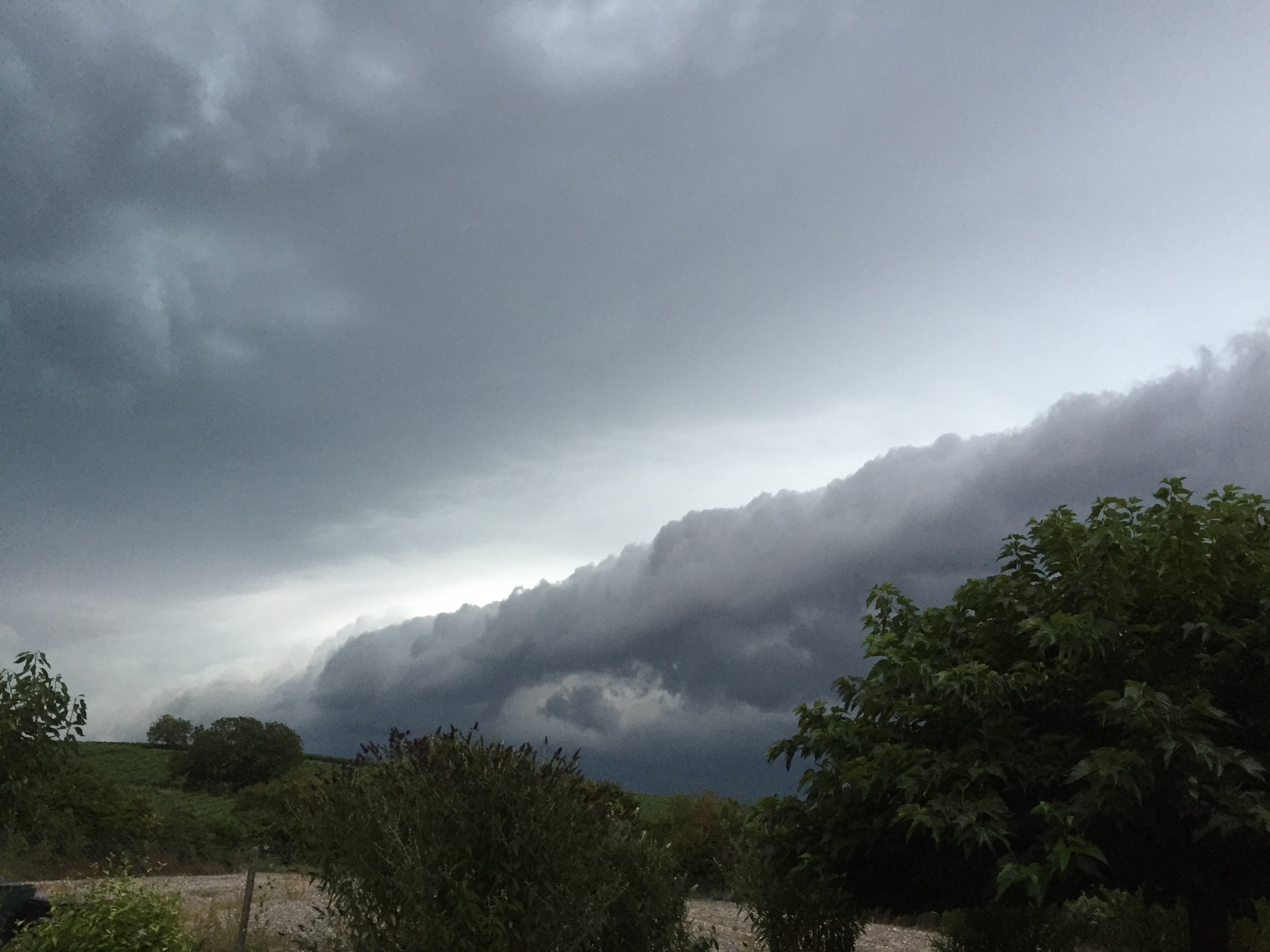
I took this photo five years ago, but I still find it one of the most dramatic images of a storm that I’ve ever taken. You can see the leading edge of the storm system making its way from the West, heading over the vineyards to where I live.

Of course, if you weren’t actually there you might think this is the back edge of the storm system which has passed over and is now receding. You’ll have to take it from me that that’s not what was happening.

What do we do when we see a storm coming? Brace ourselves? Batten down the hatches? Run away? Or just do nothing apart from feeling afraid?

I don’t mean only literally in the face of a weather event……I mean what do we do when we think we see the signs of a big challenge or problem looming over the horizon?

Our body’s nervous system sets off three possible responsible responses to threat – you’ve probably heard of the “fight or flight” response – well, in addition, there’s a “freeze” response. I always remember watching the news footage of the bombing of the Boston marathon. After the blast the first thing you hear is silence and then quickly after that screaming and shouting as people run in all directions. That first silence really grabbed me. That’s the freeze response. Part of our defence system (the parasympathetic nervous system) kicks in at that moment and basically shuts down a lot of activity so we can really pay attention, really become aware, then after that the adrenaline/sympathetic nervous system response is activated and we are set to fight or flee.

Of course our range of reactions and behaviours is incredibly varied and individual, but we all share these basic reactions as the information and energy flows through us.

What I’ve just described there is the “acute” response. It’s short term, time limited, often very brief and kicks in when there is a clear and imminent danger. But on a day to day basis our whole system responds to our thoughts, to the words and behaviours of others, and to both memories and imaginings with aspects of these systems playing a part in creating “chronic stress”. That chronic stress is pretty damaging, impairing our immune systems, creating chronic inflammation in our bodies, and undermining our mental well-being.

What can we do about it?

I always start with awareness. When I worked as a doctor, usually my first priority was to understand – to figure out what was going on, to make a diagnosis, to assess the situation. That usually involved an element of analysis, but you can’t analyse anything until you are aware of it, so the first response is to be present. In becoming present, you become aware. In fact, being present is a powerful therapeutic behaviour. It’s good for the patient and it’s good for the doctor, too.

I think the next step involves responding with intention. It’s one thing to become aware, and even to figure out what’s happening, but it doesn’t amount to much without an intention which shapes your next thoughts, ideas and behaviours. In Medicine, that intention is to care. If you care, if you give a damn, if you activate love and kindness, then the healing responses will fall into place.

I reckon it’s the same with life. I think a good place to start is with awareness and intention. If we aren’t present, if we aren’t aware, we’re on autopilot, “zombie” mode, and we are open to the manipulation of others, and to becoming stuck in habits created by rumination and pain. But if we do wake up, we have a chance to recognise what’s happening, to stand back a little, by taking a pause, or a few deep breaths, and then make a choice…..make a choice formed by our intentions.

What if our intentions are kindness, love, and understanding? What if our intentions are to feel joy, wonder, and connection? What if our intentions are to build “mutually beneficial bonds”? What if our intentions are what the French call “bienveillance”…….well-meaning, well-wishing?

What do you think the experience of seeing a looming storm would be like then?

Read Full Post »

The pine forest at the “Côte Sauvage” in the Charente Maritime, the “Foret des Cedres” in Provence, the deciduous forest around the Bracklinn Falls in Central Scotland, the maple forests around Kyoto……these are some of my most memorable forests. They delight me.

It’s many years since I learned about the Japanese practice of “forest bathing” – which simply means spending some time in a forest – well, actually, not so much just passing some time there, but immersing yourself in it, really engaging with it, listening to the sounds of birds calling, of the branches swaying in the wind, breathing deep the scents of pine, cedar, and other trees, watching the play of sunlight through the leaves as together they create whole performances of light and shade, of shape and shadow – you get the idea.

We have learned a lot about forest bathing in recent years. We’ve learned of the benefits it brings to everything from a sense of well-being to a boost in some of the chemicals and cells involved in our immune system, to a calming of the harmful chronic inflammatory activities inside our bodies which occur as a result of stress. It’s just GOOD for you! And that’s a sweet spot for me – finding what is BOTH good for me and just utterly enjoyable – health boosting and happiness boosting – result!

We’ve also learned a lot about the lives of trees and forests in recent years. We’ve learned that trees don’t live in isolation, that they are in constant communication with each other, sending out warnings when they are attacked or vulnerable, sharing nutrients, and supporting each other. They do this both by sending out chemicals through the air, and by an astonishingly complex network of root systems intertwined with microfibres of fungi creating what has been termed “the wood wide web”.

Here are some of the main books I’ve read which have taught me what I know about how trees and forest demonstrate inter-dependency, how they communicate with each other, and how they behave as one complex adaptive organism. “The Hidden Life of Trees“, by Peter Wohlleben, subtitled, “What they feel, how they communicate: discoveries from a secret world”; “Gossip from the Forest” by Sara Maitland, subtitled, “The tangled roots of our forests and fairytales”; “Braiding Sweetgrass” by Robin Wall Kimmerer, which blends “indigenous wisdom” with “science and teachings of plants”; and, the novel, “Overstory“, by Richard Powers. You can probably add your own favourites to that list, but if this is something you want to explore, you could do worse than start with any of those books.

This fairly new knowledge of forests is part of a much wider trend in science – the attempt to understand connections. I think this is a radical, and much needed, shift. The reductionist science of understanding parts has led to an explosion of knowledge, but too often, we fail to really understand the real world because we fail to see that every single part only exists as an embedded, inextricable element of the whole. The fabulous improvement in that approach mirrors a shift in the use of the left hemisphere of the brain which engages with the world by separating it into parts to analyse and categorise, towards the use of the right hemisphere with engages with the world as a whole, and focuses our attention on connections and relationships.

We are now looking much more at whole environments, whole webs of inter-relationships. We see such networks everywhere, from the activity of micro-organisms in our guts (the “microbiome”), to the “neural networks” within the brain, the inter-relationships of species within ecological “niches”, or “biomes”, and in world wide cycles of movement of water, gases, and other molecules.

One concept which is useful in all these areas is the one of the “connectome” – this is the activity of mapping out the interactions and relationships within whatever we are studying. In terms of the brain it can be helpful to imagine that every single thought has the “neural correlate” of a “connectome” of nerve cells. Apparently we have so many neurones in our brain, and each of them is so massively interconnected, that if you were to consider all the potential permutations of activity of little networks within the greater network, then that number would be greater than the number of atoms in the universe! Well, I don’t know how anyone works out something like that, but suffice it to say, the potential for our imagination, for our cognition, for our memory, for our ability to visualise, conceptualise, analyse, synthesise and create, is pretty damn close to infinite!

There’s something else interesting about all these “connectomes” – they are related to each other. Each one is nested into several others, and each one of them sets up resonances and harmonies with other ones. Perhaps that partly explains how we feel what other people feel, how we come to think what other people think, and, maybe even how our inner environments are affected by our external ones.

Amazing what a walk a forest can do for us, huh?

Read Full Post »

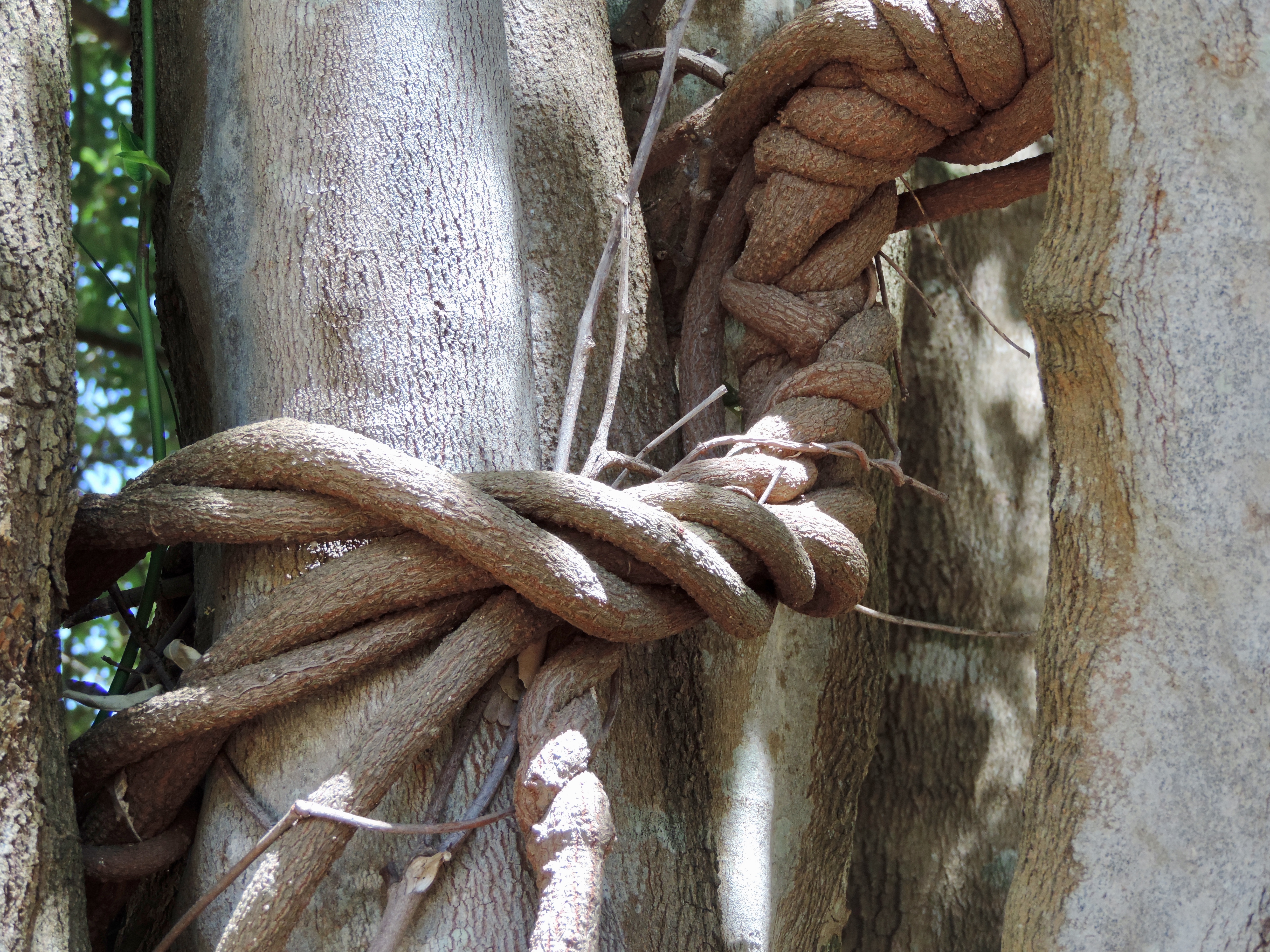
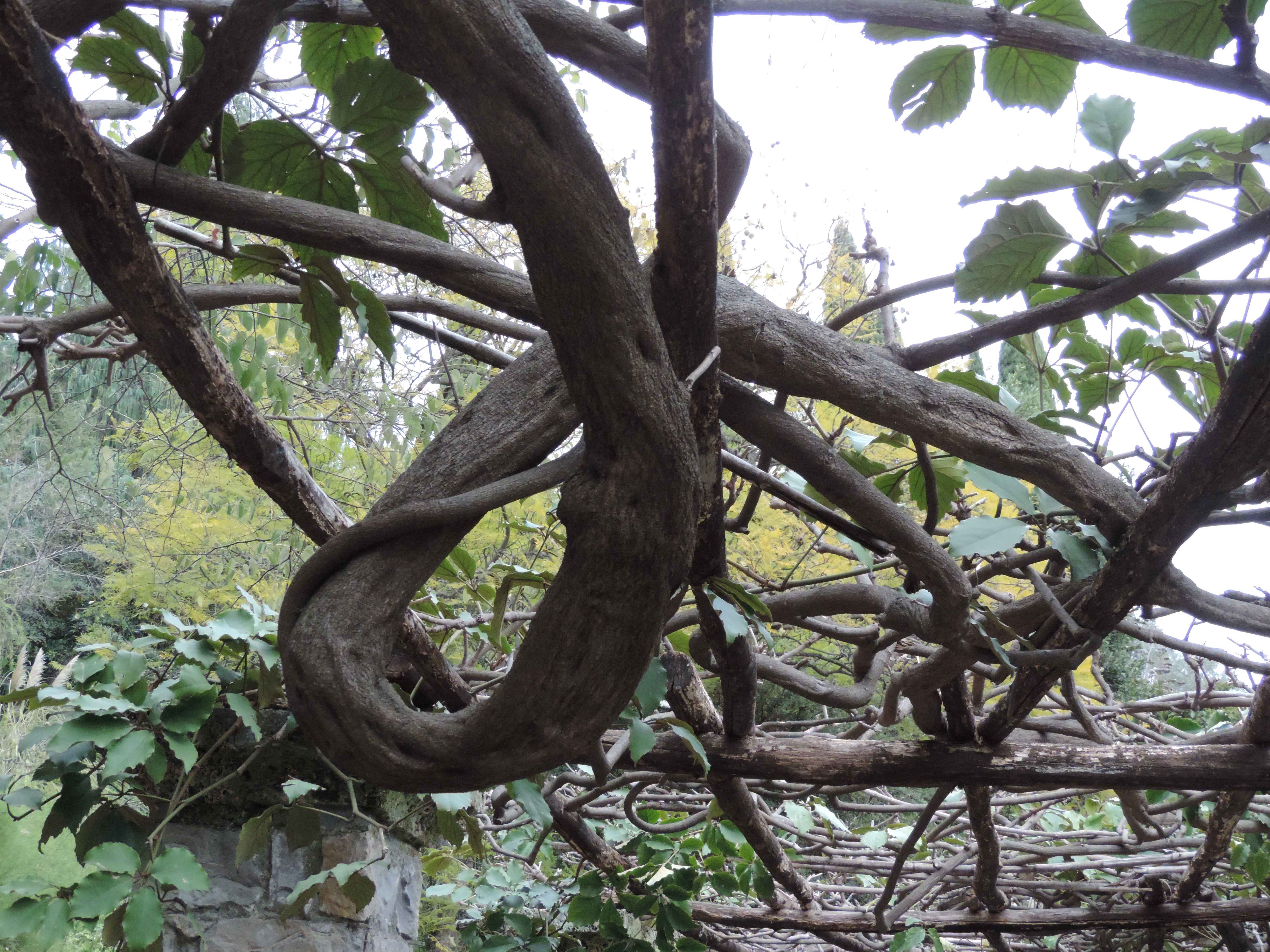
This isn’t the only plant I’ve seen which twists and turns a lot, but perhaps this is one of the most striking. I always find myself wondering two things when I look at an image like this one.

The first thing is just how amazingly complex the structure is. When this plant started as a single seed, nobody could have predicted the shape it would achieve today. Even more, at no point in this plant’s life could anyone predict with accuracy the detail of the directions it would take, the exact places where it would turn to the left, the right, head up, or head down. Its shape size and uniqueness at every point are unpredictable in the details. And that’s the same for us in our own lives.

Every individual patient who ever consulted with me had a unique, personal story to tell. Nobody could have predicted the detail of their story from the day of their birth. That truth remains the case day after day after day. What I mean is that whatever treatment I gave someone, the only way I could know whether or not it would help them, and, in particular, just how it would help them, was to have another consultation with them, days, weeks, or months further on and listen to them tell me their unique experience. Only the patient could tell me how helpful the treatment was. I think that, sadly, that’s a bit forgotten in a lot of modern medicine. We can’t know for certain what the outcomes are going to be for an individual patient, no matter what “evidence base” we are aware of.

Secondly, I look at this plant and I wonder about the events in its life. What happened, and when, to produce those particular dramatic significant turns of direction. When I consulted with patients I liked to ask “When were you last completely well?” Then we would explore the emergence of their illness and the contexts of their personal life in which the symptoms appeared. Asking that didn’t just help me make a diagnosis, it helped me and the patient to make sense of their illness and their life. The events of our life play a significant role in the emergence of the illnesses we suffer. But they play a significant role in our growth, our development of character and personality, and in our experiences of joy, love and satisfaction too.

Read Full Post »

« Newer Posts - Older Posts »