Feeds:
Posts
Comments

Archive for the ‘health’ Category

I’m listening to the audio version of Thomas Moore’s “Care of the Soul in Medicine”, and I can’t remember the last book I encountered with which I so comprehensively agree.

I’ve not used the word “soul” much in life, and the triad of “body, mind and spirit” or “body, mind and energy” have seemed more useful to me, but the way Thomas Moore describes soul, the more I’m beginning to wonder why I didn’t clock this at an earlier age. Here’s what he says about soul –

It is impossible to define precisely what the soul is. Definition is an intellectual enterprise anyway: the soul prefers to imagine. We know intuitively that soul has to do with genuineness and depth, as when we say certain music has soul or a remarkable person is soulful. When you look closely at the image of soulfulness, you see that it is tied to life in all its particulars—good food, satisfying conversation, genuine friends, and experiences that stay in the memory and touch the heart. Soul is revealed in attachment, love, and community, as well as in retreat on behalf of inner communing and intimacy.

Well, I understand that. Completely. And I agree with both the broad thrust, and the detailed statements within his book. Medicine is care of the soul, and without that, it degenerates into something both disturbing and unsatisfying. Why did we start to remove the subjects who experience health care, and replace them with the objects to be worked on? Why have we developed an obsession with what can be measured at the cost of losing the stories, no the souls, of those who are sick?

Thomas Moore quotes Albert Schweitzer a couple of times and I decided to read a little of his writings too.

“The greatest discovery of any generation is that human beings can alter their lives by altering the attitudes of their minds.”

Wow! That’s my job every day. That’s exactly what my colleagues at the Centre for Integrative Care, Glasgow Homeopathic Hospital, come to work to do every day – to help people to alter the attitudes of their minds, and so alter their lives.

“Constant kindness can accomplish much. As the sun makes ice melt, kindness causes misunderstanding, mistrust, and hostility to evaporate. ”

And there’s something we can’t be reminded of too often. I’m struck by the lack of kindness, the complete absence of empathy and compassion, in the communications of the critics of my discipline. I’ve often wondered what their vision is for health care….more people taking more drugs? It’s all too easy to react to their hostility with indignation and in so doing to lose touch with the only thing which can make it evaporate – kindness.

Let me be more kind. Let me aspire to be more kind every day.

I am proud of my colleagues. In little ways, small gestures of kindness towards their patients, a few words of greeting in the corridor to welcome them in, the passion with which they speak about their work, and their determination to do their absolute best every time, they affirm for me what doctors should be like.

I guess I’m lucky. I get to connect to people at a soul level every day.
 

Read Full Post »

So just what IS the vision of those who deliver our health services these days? Is this the message they’re giving us…….?

Listen carefully…….

Read Full Post »

Take a few moments and watch this short video clip (about 7 minutes).
It’s the last part of Sir Harry Burns, Scotland’s Chief Medical Officer’s excellent address to the NHS Scotland Conference 2011.
In this part of his talk, he eloquently makes a strong case for the central importance of compassion in health care.

You can see his whole talk, and download his powerpoint slides here

Read Full Post »

One of my most favourite environments is the traditional ryad in Morocco. One of THE loveliest hotels I’ve ever stayed in was in Marrakech. I especially like the internal courtyard, with a fountain, and in the one where I stayed, there were orange trees growing there. Every late afternoon, traditional musicians would sit and play in the courtyard and we’d drink mint tea while relaxing in the alcoves.

So, I was particularly taken by this piece on the Guardian’s website about doctors playing music to their patients in Turkey

“It’s complementary treatment. Without having to prescribe additional drugs, five to 10 minutes of a certain musical piece lowers the heart rate and blood pressure. “Medieval hospitals were built around a courtyard with a fountain. The sound of the water, the colours of glass windows, the intensity of the light, the types of flowers and plants – all of it was part of the complementary treatment of patients,” Sönmez explains. “We are thinking of changing the light in the intensive care unit to pink,” he adds with a smile. “Pink light has a soothing effect.”

Here’s my vote for re-learning what those medieval hospitals got right! Too often “progress” and “modernity” means rubbishing the past and losing so much valuable knowledge. Imagine how health care could be transformed by this kind of attention to both the environment and the arts, and not reducing our focus to a materialistic concept of the body.

Read Full Post »

I got thinking about sensations the other day. Patients talk to me every day about their sensations – pain, dizziness, nausea, itch, numbness and so on. The medical concept of such sensations is “symptoms”. Interestingly, not a single one of these symptoms are objective. Nobody can know them, experience them or measure them apart from the person who has them. But what are they? According to psychologists, sensations are the effects of sensory stimuli, and perceptions are our awareness, or understanding of them.

So, are sensations in the mind?

Well, that’s not where we tend to situate them. We situate them in the body. Pain is usually described as being felt in particular parts of the body. Pain in the leg, an itchy arm, a numb patch on the back of the hand….and so on. That suggests sensations are in the body, not the mind. But what about phantom limb pain? A sensation which is specifically located in a part of the body which no longer exists?

Where do doctors look for a problem when someone describes a sensation? The part of the body the sensation “belongs to”. If someone has chest pain, doctors go looking at the chest and its contents for an explanation of the pain. If they can’t find any abnormalities there, then the focus shifts to the mind – “it’s not in his chest, it’s in his head”. In other words, in the absence of physical pathology in that part of the body, the explanation given is a disorder of the mind.

Do you find this an adequate understanding?

I don’t.

It seems to me that sensations are phenomena of the person, and shouldn’t be attributed to either the body or the mind. They should be situated in a person’s story, because it’s the narratives we tell ourselves and others which create not only a sense of self, but all of our sensations too. Sensations may have locality, but that doesn’t make them the markers of pathology. They can be the expressions of meaning.

If you’re not sure what I’m on about here, check out this post. And if you’d like to read more about the idea of meanings behind sensations, you could start with the excellent “Why do People Get Ill?” or “Meaning-full Disease“.

Read Full Post »

One of my favourite lines from Bob Seeger is “I wish I didn’t know now what I didn’t know then”.

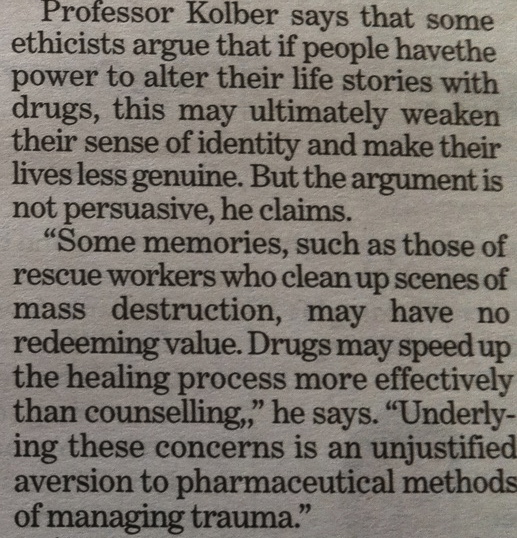
However, I was a little startled by a piece in the “i” newspaper last week about drugs which can wipe out memory. Here’s a jpeg of the bit of the article which really took me aback….


I don’t know about you, but as best I understand it our memories are a key part of the stories we tell ourselves and others to create both a sense of self, and to make sense of our lives.

Who’s to say that a painful memory has no value. A painful memory will probably always be a painful memory, but our responses to painful episodes can be the important foundations of who we become.

Before I go…..here’s the song in question (performed by Toby Keith)

Read Full Post »

I am frequently impressed with the writings of Ray Moynihan, and his article in this week’s BMJ is probably one of his best. It’s entitled “Surrogates Under Scrutiny” – not a title which immediately appealed to me because I mistakenly thought it would be an article about surrogate pregnancy. I was wrong! It refers to use of “surrogate” markers for health outcomes. I must confess I’ve never come across this use of the term before, but he relates it to The Institute Of Medicine’s report “Evaluation of Biomarkers and Surrogate Endpoints in Chronic Disease“.

This is, potentially, an enormously important article (or, at least, it’s a great introduction to an enormously important issue)

It’s a constant source of frustration to me that the reductionist, materialistic promotion of “evidence” in Medicine, seems to prioritise biomarkers, and to trivialise patient centred outcomes, or any attempt to capture the narratives of health and wellbeing. I now understand more clearly why.

It’s also a source of concern for me that human beings are consuming ever greater quantities of pharmaceuticals without any evidence that is producing greater health, wellbeing or happiness. Don’t get me wrong. Drugs can produce great changes in disease and, consequently, can open the opportunities for people to thrive, grow and experience better health. I wouldn’t like to see diabetics trying to get by without insulin for example. However, the limited view that only drugs can produce better health, strikes me as fundamentally naive. In fact, in many situations, the balance between potential harms and potential benefits has swung way far in the direction of harm. I now understand more clearly why we’re getting this wrong.

Let me just replicate for you here the closing paragraphs of Ray Moynihan’s article, because I don’t think I could put it better myself.

Shift from numbers to people

A major rethink of the role of surrogates in medicine is timely. Routinely approving and prescribing therapies on the basis of their effects on someone’s numbers, rather than their health, is increasingly seen as irresponsible and dangerous. And even when evidence suggests clinical benefits of popular “preventive” medicines for those at lower risks, a rational assessment reveals many people must be treated to prevent one adverse event, so most users gain no direct benefit despite years of treatment. The cost effectiveness of this approach is unsurprisingly in doubt. More disturbing still are the questions about whether some of the suggested clinical benefits are real or simply artefacts of sponsorship bias. The rigour of the evidence informed approach to medicine has in recent decades helped us all understand the limitations of relying on surrogates, and for one of its key architects—McMaster University professor Gordon Guyatt—this problem is both historical and cultural. He argues that central to putting American medicine on a scientific basis was the assumption that an understanding of biological mechanisms would translate into improved management of patients. And while medical students over a century later are still taught to focus on fixing a person’s biological numbers—whether it’s cholesterol or bone density—what is urgently required is a new approach that provides genuine improvement for the person. Understanding biological mechanisms and diagnosing by numbers has undoubtedly brought great benefits. Yet as the definitions of medical conditions relentlessly expand via that porous relationship between the science and business of healthcare, this fragmented reductionist approach is conferring multiple medical labels on vast swathes of healthy people, who are then treated with preventive drugs that won’t help most of them and may hurt many. The magic of numbers may help corporate profits and professional pride, but at what cost to the health of ordinary people who mistake a numerical benefit for a genuine one? Surely it’s time to ask if there might be a healthier new model for medicine based on far less harmful and costly ways to try to reduce human suffering.

Read Full Post »

This week’s BMJ carries an editorial and a paper about the definition of health. The current  most widely known definition is that of WHO – a state of “complete physical, mental and social wellbeing”.
The claim is that this sets the bar too high and excludes most people from health most of the time – it’s both the word “complete” and the range across physical mental and social that seems to be problematic.
I find myself agreeing with the discomfort about the WHO definition and long ago explored an alternative – you can read how I got to my working definition here.
My working definition was that health involved three capacities – adaptability, creativity and engagement. I still find that definition useful, but in recent months I’ve been using perhaps a somewhat simpler one – Vitality and Resilience.
I do think a healthy person has good vitality. Everyone seems to grasp that straight away. It hardly needs definition. However, you can consider good vitality as containing the concepts and/or experiences of, good energy, wellbeing, or having a strong “vital force”.
Without good vitality it’s hard to be resilient.
Resilience contains both the idea of coping and that of the linked phenomena of self-defence, self-repair and self-regulation.
The paper in the BMJ proposes “adaptability and self-management” as the criteria for health. I can see where they are going with this, and don’t disagree with the adaptability part, but I find “self-management” to be pretty weak. I very much prefer creativity and engagement! I think a healthy person grows and develops. A heathy person is well connected to their environment and to others. It’s a lot more than “homeostasis”.
Frankly, I’m still pretty amazed you can’t find an entry for “health” in standard textbooks of clinical medicine and that medical education doesn’t seem to teach future or current doctors how to define health, how to assess it, or how to enable patients to increase it. Medicine in the 21st century  seems stuck on the old 16th century concept of the “lesion” and has it’s eye firmly on disease, not health.
Why is this important?
Well, lots of reasons really, but not least because we are pursuing the “management” of more and more chronic diseases. We don’t have a good understanding of why people get ill, we don’t have a good understanding of how people get better, and we’re only in the foothills of knowledge about health.
Until we start to train our focus and resources on health we’ll chase disease after disease, and continue to have greater and greater proportions of our populations consuming more and more drugs. That’s a path which is not affordable, and isn’t producing healthier people.


Read Full Post »

Maxwell Maltz, a plastic surgeon who lived and worked in the US, studied the relationships between self-image, self-esteem and personal growth. He wrote “Psycho-cybernetics” in 1960 [ISBN 978-0-671-70075-1]. He uses a distinct language and set of concepts, which seems very 1960s to me, but the underlying understanding of human behaviour, the connections between the mind and the body, and the ways people can be helped to grow, strike me as being very true. I particularly like his emphasis on the importance of imagination and how we use it to create a self-image, and in so doing, how that sets our embodied mind (not a term he uses) off to get on with delivering according to the interpretation of reality we give it.

I like the last chapter of “Psycho-cybernetics” especially, where he says –

…the body itself is equipped to maintain itself in health; to cure itself of disease……in the final analysis that is the only sort of “cure” there is.

I’m still amazed how little this is understood. So many people, health professionals included, are caught up in the delusion of pathology and drugs. Health is not absence of pathology. Drugs don’t “cure”……they just manage disease. If there’s any healing going on, it’s the natural processes of the body which are responsible. The best drugs can do is modify disease, and in so doing modify illness, whilst we hope healing takes place in the background.

It might be an old concept to think about healing energies, but I like the way Maltz puts it –

This élan vital, life force, or adaptation energy – call it whatever you will – manifests itself in many ways. The energy which heals a wound is the same energy which keeps all our other body organs functioning……whatever works to make more of this life force available to us; whatever opens to us a greater influx of “life stuff”; whatever helps us utilize it better – literally helps us “all over”

I think, and I hope this is the way Medicine will develop – by understanding better just how people get better, and by studying the methods and techniques we can use to genuinely stimulate and support healing. It’s not the dominant paradigm yet, but I’m going to bet it will be!

Read Full Post »

I am he as you as you are he as you are me and we are all together.

We’re still in the midst of a highly atomistic society, as Mary Midgley describes so clearly in books like “Science and Poetry” and “The Myths We Live By”. The thrust of human thought has been to separate, divide and reduce. Consequently there’s a popular conception that we are all separate – that there is a “me” inside my head. We have a sense that each of us are as separate as billiard balls. We might bump into each other, impact on each other, but we don’t spill over into each other.

But it’s all changing. There’s a new paradigm, a new way of thinking on the block, and it’s gaining ground fast.

That new paradigm is the irreducibility of reality, the importance of understanding connections, interactions, complexity. There’s a shift in focus from separate entities to between-ness.

“The Empathic Brain” by Christian Keysers [1932594515] gives an interesting insight into how the discovery of mirror neurons has shown us just how wrong the idea of completely separate, skull-bound minds is. Keysers is one of the pioneer researchers working on the discovery and understanding of mirror neurons.

Here are just two points from his book which might change the way you think about the mind, the self and your relationships.

Firstly, Keysers and others have shown that mirror neurons are involved in producing a phenomenon where the pre-motor strip in our brain becomes active in specific ways. When we see someone carrying out an action, our brain prepares to make our bodies carry out the same action. This might even follow through into the action itself. Have you ever noticed how two people well connected in conversation often mirror each others postures or body movements? Little things like touching one ear, or scratching their nose, where one person does it, and the other immediately mimics the same action. If you ask the people concerned about it, it’s likely they’re not even aware that it’s happening. It’s not that the one thinks “Oh she’s scratching the tip of her nose, I think I’ll scratch mine”!

Secondly, an area of the brain known as the “insula” becomes activated when we empathically respond to another’s emotion. This explains why some people can become quite overwhelmed by another’s emotion. In fact we’re not all the same in this regard. The insula of the most highly empathic people becomes much more active than that of the less  empathic. Again this isn’t something we consciously, rationally choose. The activation of the insula by others’ emotions doesn’t seem to be under our control.

Here are a couple of passages from “The Empathic Brain” –

Imagining actions also increases brain activity in the premotor regions involved in executing similar actions……Thus, during both observation and imagination, our brain uses the premotor cortex to mentally re-enact an action without actually moving the body.


If we interpret the actions of other individuals through our own motor programs, our own motor programs will have a very strong impact on our perception of other individuals.


Empathic people activate their insula very strongly and may be overwhelmed by the vicarious emotions that movies trigger in them. Other people activate their insula only weakly, needing much stronger stimuli to trigger their own feelings.


Through shared circuits, the people around us, their actions and their emotions, permeate into many areas of our brain that were formerly the safe harbours of our identity: our motor system and our feelings. The border between individuals becomes permeable, and the social world and the private world intermix. Emotions and actions are contagious. Invisible strings of shared circuits tie our minds together, creating the fabric of an organic system that goes beyond the individual.

The concepts of the mind as embodied and extended  seem very helpful to me. This work on mirror neurons, interestingly, touches on both of these.


Read Full Post »

« Newer Posts - Older Posts »