Feeds:
Posts
Comments

Archive for the ‘health’ Category

ripples in the sand, originally uploaded by bobsee.

Then the long trail of her footprints, stretching back towards the sea, became slowly indistinct as each one filled with water and edged in upon itself; and in a matter of minutes, as darkness began to fall, the shape of the foot was lost at every place until the last vestiges of her presence were washed away, the earth closing over as though no one had passed by.

Sebastian Faulks. Human Traces

Read Full Post »

Human Traces by Sebastian Faulks (ISBN 978-0-099-45826-5) is a novel of ideas. Set in the late 19th, early 20th century it tells the story of two young men who become idealistic doctors, determined to work together to understand mental illnesses so that they can cure them. In addition, they hope that in understanding the interface between the body and the mind they will understand what it is to be human.

I found it really absorbing. Much of the discussion was around subjects which are very familiar to me – consciousness, the relationship between the body and the mind, the debate about whether mental illnesses have neurological bases or not, and the still young area of evolutionary biology. However, as a doctor, the book has additional relevance. After all, my experience is also one of idealism and hope; the belief that doctoring will be about curing, and the gradual erosion of that to aim at managing diseases instead of curing them (that last is a painful loss – for sure, doctors have cures for many acute diseases now, but the burden of illness is chronic disease and, sadly, we seem a long way off from finding genuine cures for those)

Sebastian Faulks floats an incredibly interesting hypothesis about the hearing of voices, having one of the characters, Thomas, propose that this was a facility that all human beings possessed but which has since been lost by most of us. He cites the literary evidence of Man’s relationship to God/gods where the earlier stories show people hearing voices which they obeyed – they experienced the daily reality of their gods; and later stories showing that people no longer reliably heard those voices and had to throw lots, examine entrails, find unusual characters (prophets) who could still hear the voices, in order to know what the gods wanted. He links this idea to the emerging concept of evolution and natural selection by proposing that the hearing of voices was linked to the development of consciousness and the loss of the voices was related to the development of self-awareness through the acquistion of language. If you are not familiar with any of these ideas this novel is a great place to introduce yourself to this area of thought.

However, this 609 page novel did not engage me emotionally……..until page 595. From page 595 to the very last word of the novel, it hit me like a sledgehammer. I didn’t just cry. I sobbed. I was totally unprepared for it. This is quite honestly one of the most powerful pieces of writing I’ve read. Maybe it hit me so hard because it touched so many issues which lie in the core of my being – what is it to be a doctor? what use am I to others? how do we get a sense of self and how does it feel to lose that to an illness like dementia? what does it mean to become invisible? and, ultimately, what trace do I leave on this Earth?

There are a number of phrases and passages which have stimulated a whole lot of things for me, and I’ll return to post about some of them separately.

Thought provoking, educational, well-written, and, ultimately, powerfully emotional.

Highly recommended.

Read Full Post »

I read a great post on the SlowDownNow.org blog. In it Christopher Richards describes his experience of being looked after by a doctor who took his time, then his experience of trying to find a new doctor after this first one had retired.

I’m pretty sure we’re losing something really important with our current round of NHS reform. And its something related to speed. Sure you need fast, effective treatment when you are acutely unwell, but the surgeon or physician who is tending you still needs to take his or her time and not rush things or the job just won’t get done properly. However, the big demand in health care these days is chronic disease and here we really have been looking for quick fixes at the expense of taking our time to listen, to understand and to enable patients to adapt, to grow and to enlarge their lives in the presence of their diseases.

An American sociology professor, Arthur Frank, wrote “The Wounded Storyteller” (ISBN 0-226-25993-5) to describe his study of how patients talk about their illnesses. He identified three major “genre” of narrative – the “restitution” one – which is the quick fix approach to health care (“A bit of me’s broken. If you could just fix it or replace then I’ll be on my way”). This is appropriate in much urgent and acute medicine but is really of no use in chronic illness or in enabling patients to become genuinely healthy. He proposes that doctors should help their patients to create new narratives – “quest narratives” based on the principles of Joseph Campbell’s work on the structure of myths and legends (otherwise known as Hero stories).

That very process entails a shift from the quick, the immediate, the partial to the slow, the lasting and the whole.

I wrote here about countering Getting Things Done with Dolce Far Niente, and here about finding the spaces where you can relax, and here about becoming aware of the gaps in our experience.

What ways do you slow down?

Does slowing down improve your quality of life? Give you time to reflect, re-charge, and to grow?

Read Full Post »

The Guardian today has an article about a research paper published back in May in the British Journal of Psychiatry. There are more and more attempts to control the future in our society. Predictive statistical models are increasingly being used by everyone from supermarkets (to “target” their marketing to you on the basis of what they think you might like to buy), to social work (to give special help to young mothers who they think might give birth to children who will become criminals), to the criminal justice system (to try and predict re-offender probability), to (my main area of interest) health care (where the experience of groups is used to determine what interventions an individual should or should not recieve – so called “Evidence Based Medicine”).

The paper discussed in today’s Guardian shows that the margin for error between the group studies and individual outcomes is so great that –

When applied to individuals the margins of error are so high as to render any results meaningless.

Almost every day I have a discussion with patients about risks and choices. I always emphasise that the statistical predictions are based on groups and averages and that there is absolutely no way of knowing to what extent they are relevant to this individual.

We are all different. Nobody, but nobody, can tell an individual what their future holds and to pretend they can on the basis of statistical modelling which isn’t up to the job is potentially very harmful.

This heroes not zombies site is about encouraging people to become aware, to think, and to develop their uniqueness. We need to celebrate individuality and difference more and we need to understand that people matter more than statistics – especially in social work, justice systems and health!

Read Full Post »

rainbow over castle, originally uploaded by bobsee.

What’s the significance of a rainbow? Is there a pot of gold at the end of it? In this case it looks like the pot of gold must be in Stirling Castle!
The rainbow is a hopeful symbol isn’t it? This beautiful one which I saw on wednesday made me think of the two states I often see as a doctor – hopelessness and hopefulness.
Some doctors tell people how long they’ve got to live. Usually these are people with cancer. But these prognoses are just based on statistics. For this individual who sits with me today I have no way of telling how they’re life will progress let alone of telling when they’re going to die. More than once I’ve told patients that having a disease doesn’t give you knowledge of when you’re going to die.
Pretty much in every condition a doctor will see someone who gets worse, someone who doesn’t get better and someone who does. The proportions of people in each of these categories changes with different diseases. But there are ALWAYS people who defy expectations. Look at Stephen Hawking. He has Motor Neurone Disease and most people with this disease die within a couple of years of diagnosis. Stephen Hawking has had this disease over 40 years now.
Patients with any disease have a choice about how to live their lives. They can choose to give up in despair, or they can choose to hope. A doctor’s job includes helping patients to choose hope – realistic hope, not crazy hope!

Read Full Post »

rrr.jpg

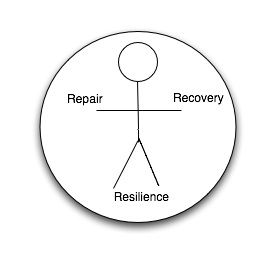
Here’s a diagram I drew last night.

This works for me as a symbol of what health care should do.

In the middle we see the symbolic representation of a person. All health care should be focussed on the individual. It’s this person with me today who needs my attention. It’s this person in their uniqueness who needs to be understood and cared for. It’s the whole of this person who is with me today (not just the bit of them that’s not working!)

There are three Rs –

  1. Repair
  2. Recovery
  3. Resilience

Most treatments are directed at repair. Dilating constricted airways, reversing spasm of arteries, killing infecting organisms etc. But we only become well again by recovering from an illness. If we have an infection then an appropriate antibiotic might kill the bacteriae but it’s our body’s processes of healing and recovering which restore our tissues and our whole beings to health. The processes of recovery are not so well understood and very few medical interventions claim to stimulate or enhance recovery, but we see reports like this which show that the patients’ emotional state influences recovery for example and some research has shown that the physical environment in which a patient is nursed influences recovery. In other words, recovery is not about just dealing with the disease, recovery is about addressing the whole person in the context of their environments.

Finally, after recovery, can we do anything to reduce the chances of this person falling ill this way again? Can we increase their resilience? So much of preventitive health these days is a technical fix – drugs – drugs to lower blood pressure and cholesterol for example – but the best way to be healthy and to stay healthy is to be more resilient – and that involves not just the physical body but the whole person in the context of their life. Not so much is understood about resilience and very, very little exists in health care to specifically address and enhance an individual’s resilience.

Wasn’t it Benjamin Franklin who said

God heals and the doctor takes the fees

Well, that’s not good enough any more. We need more research to understand the processes of recovery and resilience and we need to ask the question of health care – how does this intervention address the patient’s needs for Repair, Recovery AND Resilience? And if the intervention ONLY addresses repair, then what else are we going to do to address both Recovery and Resilience? Because without addressing these needs we are fighting a continually losing battle of repeated repairs.

When the NHS was created in the UK, the Labour government genuinely believed that providing health care for all would so improve the health of the nation that the costs of the service would fall year by year. It never happened. Quite the reverse. Why? Because they created a National Repair Service, not a National Health Service. (well, that’s part of the reason, another part is that health is a much more complex phenomenon than can be addressed by a health care service – poverty, housing, sanitation, education and work and so on are HUGE influences on health experience too)

There’s one final element to this little drawing. The circle around the person. This represents understanding that we need to address a whole individual within the context of their life, and also represents that a person needs cared for by a circle of carers. Health including recovery and resilience is influenced by that complex network of individuals – professionals, friends and relatives who surround the person.

Fundamentally, though, the circle represents CARE – nobody really gets better unless someone cares for them. All health care should be delivered by people who CARE.

Read Full Post »

I’ve just started reading Sebastian Faulks’ Human Traces. On page 21 this sentence struck me

Do we already possess all we need to stop feeling the world as the sound of footsteps and the ache of our backs and to look up – to the woods and the hills and the oceans that stretch out in their immensity, just waiting to be seen?

I’m in the habit of drawing simple little diagrams to explain things to patients. I draw one which is just a circle. I say “This circle represents your life”. Then I draw a much, much smaller circle inside the first one and I say “When we have chronic pain, or sadness, or breathlessness, or stiffness, or whatever, our life becomes much smaller. Maybe we can’t go out so much. Maybe we can’t face other people. Maybe everything loses its joy. It’s necessary to do this to survive sometimes. We all need to feel safe before we can grow. If the treatment I’m going to give you works it’ll reduce your symptoms and stimlate your body’s natural healing processes and so let you begin to look up and start to see that you can move outside of this constricted, safe zone, and as you do, your world will start to get bigger and more enjoyable again. Then we’ll know you are getting well.”

We don’t grow with our heads down. We grow when we look “to the woods and the hills and the oceans that stretch out in their immensity”

These are the hills I see from my bedroom window

Read Full Post »

Orthopaedic surgeons at St Louis University School of Medicine were a bit puzzled when their clinical tests on patients post hip surgery indicated they were recovering well but the patients own reports didn’t confirm that. What they did was ran a parallel questionnaire which amongst other things asked about emotional well-being. The two sets of results didn’t correlate

“What we found was surprising – the clinical test found good-to-excellent results, while the self-test taken by the same patients showed significantly worse recovery.”

Now, to you and me that might not be a surprise but, strangely, to these surgeons it was a shock. You know why? The surgeons see themselves as technical fixers. In this case they were fixing hips and they were assessing how well the new hips worked. But they are being confronted with the fact that the hips in question are inside people and people are a lot more complex than just the bits of their bodies.

You can’t but applaud this conclusion from Berton Moed MD

“The number one issue is recognition – we need to acknowledge that there’s more going on with patients than what current clinical tests tell us,” he says.

But wait, his suggestions for what do about this problem is worryingly medicalised –

“Do we need to look at other interventions besides fixing their hip? I think we might have to,” he says. “That could include bringing in social workers and psychologists to work with the patients in the areas that surgeons, who often are super subspecialists, may not be able to deal with.”

OK, I’ll let the “super” and “sub” bit connected to the “specialists” go for the moment but do we really need social workers and psychologists to help patients recover? Because surgeons don’t know how to address a patient’s issues and feelings?

Please, let’s recognise that people are always more than the sum of their parts and that every health care intervention should take into consideration the whole person, not just the wonky bit! Recovery, true recovery, from an operation is a complex phenomenon. If we don’t recognise this we are in danger of wasting a lot of time and good effort only doing half a job. Every surgeon and every nurse on a surgical ward should be able to address and care for the human needs of the patients in their care.

By the way, just what is a “super subspecialist”? Someone who only has the skills to deal with bits of people?

Read Full Post »

Morag Wilson, a 32 year Dietetics Manager in the NHS committed suicide by stabbing herself with a kitchen knife then throwing herself from a bridge 100 feet above the Manchester ship canal. The coroner said she was driven to this sad end by the pressures of her job. Specifically, Agenda for Change had produced very disparate outcomes for dieticians in her region and resulted in widespread resentment amongst staff. The coroner said this

“I find it extremely sad that a young woman with such a lot going for her, very dedicated to her work, has been reduced to despair by the pressure upon her at work,” he said. “When people introduce these rules and systems perhaps a bit more thought as to what effect they will have on people would be helpful.”

The NHS should be a people focussed organisation – focussed on the patients and those who deliver the health care. Targets, budgets, managerial processes, should all be measured against the impacts they will have on people. Please, can we have a health service that cares, that really cares about people?

Read Full Post »

BBC news reports today that Loyd Grossman has attacked government for failing to take patients’ nutrition seriously. In response, the Department of Health “spokesperson” (why are these people always anonymous?) says

A Department of Health spokesperson said: “Hospital food has improved greatly over the past few years.

Wow! It has??!! Well I work in an NHS hospital and I can’t say I’ve seen any improvement in hospital food, so that got me wondering…….improved how? What has improved? The food has improved? I popped across to the Audit Scotland site and found a report on catering in NHS hospitals in Scotland dated last November.

They found that NHS spending on food and beverages (that’s not the catering costs including staff pay and so on, it’s just the cost of the food and beverages) rose from £2.23 per person per day in 2001/2002 to £2.34 in 2005/2006 (and they point out that’s less than the rate of inflation over that period) But that’s an average! The hospital where I work actually spends less than two pounds per patient per day on food and beverages. (about £1.60 actually)

OK, so it’s not rocket science, but what do you reckon? You think the DOH spokesperson is right? The food has improved “greatly” in recent years but they’re actually spending less on it?

How can we expect sick people to get better if we don’t feed them well? Surely a sick person needs even better nutrition than a healthy person does? Here’s my question to anyone in the DOH “What’s your daily spend on food and beverages for your family?” Then compare that to what a hospital patient is given and ask yourself if there’s a problem here.

Read Full Post »

« Newer Posts - Older Posts »