Feeds:
Posts
Comments

Archive for the ‘life’ Category

Maybe clover?

Sometimes I describe myself as “insatiably curious”. I suppose I have an instinct for what’s different, unique or unusual. And I find all of those things every day.

I’ve no idea what this is in this photo I took. It was pretty small but the colour made it stand out in the grass. Now that I can see it more clearly in this photo it’s even more beautiful, even more curious, than it was when I was taking the picture.

Amazing! Isn’t life just full of such uniqueness and diversity?

Read Full Post »

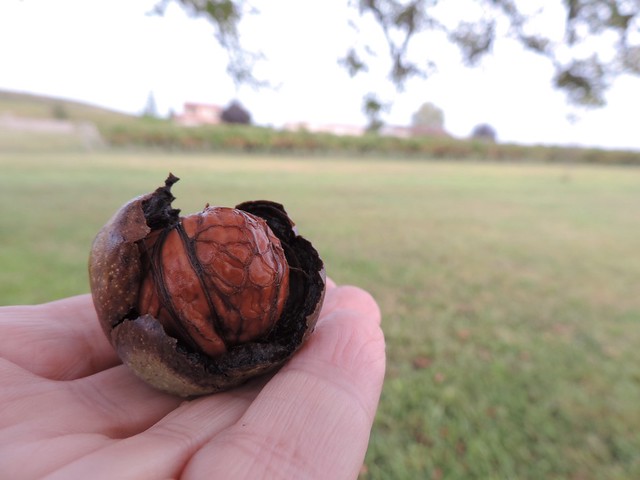
Walnut in hand

There are a couple of walnut trees outside, each one abundant with nuts just now. I picked one of the nuts up from the dozens carpeting the ground.

Look!

Isn’t it amazing? This incredible dark brown walnut emerging from its shell. Look at the patterns on its surface. See how those patterns are echoed in the lines of my skin?

And, slightly disturbingly, doesn’t it look a little like a small brain?


Read Full Post »

Autumn rain

This is a beautiful season here in the Charente. After a heavy shower of rain (it’s impressive when rain falls with a certain determination or significance) I saw the raindrops on these gorgeous autumnal leaves.

I love the Japanese cultural reverence of transience which they celebrate  every Spring with the cherry blossom, but this combination of raindrops on autumn leaves seems to me to capture the essence of the dynamic changes we experience continuously in our lives……changes upon changes.

Read Full Post »

On youtube you can find a series of beautiful short videos in a series titled “Nature is speaking”. Each is narrated by a famous actor. Do go and check them out.

Here’s my favourite, with the truly magical voice of Kevin Spacey…….


Read Full Post »

In the A to Z of Becoming, second part, N stands for NEST.

photo

photo

photo


Although we normally associate nesting with birds, like this little one building his unusual upside down nest with its entrance from below, we also use the concept of nesting in our own lives.

In one way, our nest is our home. We all need a sense of home, and each of us will personalise our living space to create our own familiar nest. Have you thought about your home that way? What’s your nest like? How’s it doing? Have you made it the kind of nest you want to live in? Is there anything you’d like to change or modify to make it a more comfortable nest, make it more YOUR nest?

It’s interesting to look at the three photos above. They remind us that it takes time to build a nest. We don’t often walk straight in to a house and it’s instantly our home. It takes time, effort and choices to make it home. They also remind us that all nests are unique. There’s no single “right way” to build a nest. What’s important, is not only that it does the job of providing us with shelter, but that it feels like our home.

We use the concept of nesting in another way too, I think. Nesting involves some snuggling down, or, in old Scots’, to “coorie doon”. I’ve a friend who talks about the need for the occasional “Club Duvet Day”…..you get the idea. Sometimes we need to create a pause which involves making a small, comfortable space and settling into it for a bit.

So, what do you think?

Is there anything you could be doing to make your nest more the way you’d like it to be?

Or do you have the need this week to “coorie doon” for a wee while, to create a wee nest and settle into it – for rest, for restoration, for recovery?

Read Full Post »

I’m always interested in research which demonstrates ways in which we can support natural healing – after all, there isn’t any other kind of healing, is there?

Here’s an interesting study using writing practice

49 healthy adults aged 64 to 97 years wrote about either upsetting events or daily activities for 20 minutes, three days in a row. After a time lag of two weeks, to make sure any initial negative feelings stirred up by recalling upsetting events had passed, all the subjects had a biopsy on the arm, and photographs over the next 21 days tracked its healing. On the 11th day, 76 percent of the group that did expressive writing had fully healed as compared with 42 percent of the control group.

This particular exercise – writing about an important or upsetting event for 20 minutes each day for three days in a row – has been around for quite some time. James Pennebaker pioneered it, and has studied the effects of writing on health extensively. He says

People who are able to construct a story, to build some kind of narrative over the course of their writing seem to benefit more than those who don’t,” Pennebaker says. “In other words, if on the first day of writing, people’s stories are not very structured or coherent, but over the three or four days they are able to come up with a more structured story, they seem to benefit the most

What’s particularly interesting here is how the creation of story goes along with changing perspectives and understanding better what’s been happening.

Pennebaker’s research developed a computer-based, text analysis program to analyze word counts in different categories, such as emotion words (e.g. happy, sad, angry, joyful), cognitive words (e.g. realize, understand, think), self-reference words (e.g. I, we) and an additional 70 categories. Much to the surprise of the researchers, the change in emotion words didn’t correspond to improved health. The more powerful predictor of improved health was the use of cognitive words–that is, individuals who showed an overall increase in the use of causal words (e.g. because, reason) and insight words (e.g. realize, know, understand) showed improved health.

So it’s not just about telling a story, changing perspective or increasing understanding, it’s about improving immune function and both physical and mental health.

Read Full Post »

rain drops

Little drops of water shining so brilliantly on a leaf are not just like gemstones, they are like little lenses.

It’s  good couple of decades since I read “Lens of Perception“, but I remember being very taken with the author’s metaphor of the lens. We can only experience the world from our unique, subjective viewpoint, and our perception is continuously influenced by not only our personal make up and characteristics, but by our stories – created from our past experiences, memories, beliefs and values and by our imagination (so full of fears, anxieties, hopes, dreams and expectations).

It’s good to become aware of those lenses we wear all the time – we see the whole of Life through them.

Read Full Post »

White Berry path

October is the month of fruition in my twelve monthly themes.

I think that sometimes we think of fruition as an end point…..after months of planning and work, now the results can be seen…..now the project comes to fruition.

But there’s another way to think of fruition when we don’t take a rigid linear view. The seasons are cyclical and autumn isn’t an end any more than spring is a beginning. There is something about fruition which is, at one and the same time, an emergence of all that has gone before, and the jumping off point into a fantastic increase in connections…..as the beech nuts fall from the tree, the beginnings of new beech trees are picked up and carried off by creatures or by wind.


Beech at the edge

So what is coming together for you this month….and where might it take you next?

Read Full Post »

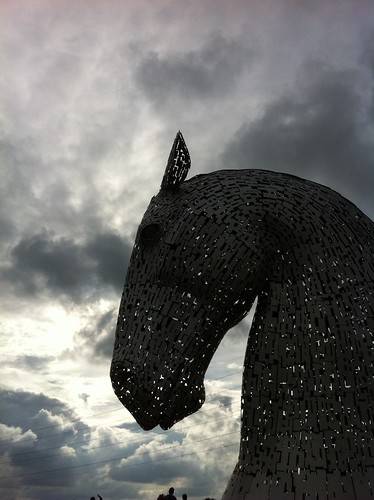
One kelpie

The kelpies

A fairly recent development just off the Stirling/Edinburgh motorway is the installation of these “kelpies”. I visited them at the weekend for the first time. They’ve been installed in a newly created park area which has lots of common space for roller-blading, cycling, walking, feeding ducks at the duck pond, a children’s adventure playground and so on, but everyone comes to walk around, and be amazed by, the kelpies themselves. I visited on a Sunday which is probably a more busy day but there were hundreds and hundreds of people there.

Kelpies are part of the myths of Scotland – I suspect most people aren’t that particularly familiar with them, but I wonder how many go home and read a bit about them. Wikipedia is a good starting point (but it does strangely include paintings which depict kelpies as naked females, when, in folklore in Scotland, the kelpie was invariably male)

I loved that so many people were walking, sharing time with family or friends, and gaining such sheer pleasure from this open air art. What a fabulous combination of art, community and healthy activity. Made me wonder if we don’t pay enough attention to the way art in particular can be a central focus of influence on our quality of life.


Read Full Post »

In the A to Z of Becoming, second part, M is for ‘make’.
I like the verb ‘make’ because its essence is creativity. To make something is to create something. But it’s broader than that somehow because it includes the wider sense of taking an action, of ‘making something happen’.


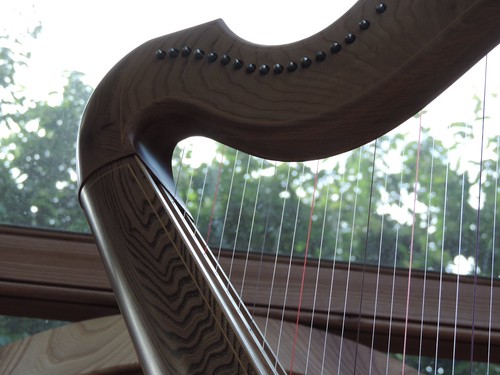
Harp strings

Maybe you could make some music this week? Play an instrument, sing a song…..I’ve recently purchased a new guitar (I got my last guitar when I was 13, and haven’t played it for almost 40 years) – and I can’t tell you just how much FUN it is to rediscover the chords, the notes, the ways of creating a rhythm.

Maybe you are good with your hands and you could make something in the sense of building or constructing something.

Maybe you could make a change – decide what you’d like to do differently and actually start doing it.

Maybe you could make a meal, or at least a cup of tea…..

Maybe you could make a difference in someone’s life with a simple gesture, or an act of kindness……..go on, make someone’s day!

The joy of making lies in doing it consciously, doing it with both intention and awareness. That’s what makes all the difference.


Read Full Post »

« Newer Posts - Older Posts »