Feeds:
Posts
Comments

Archive for the ‘life’ Category

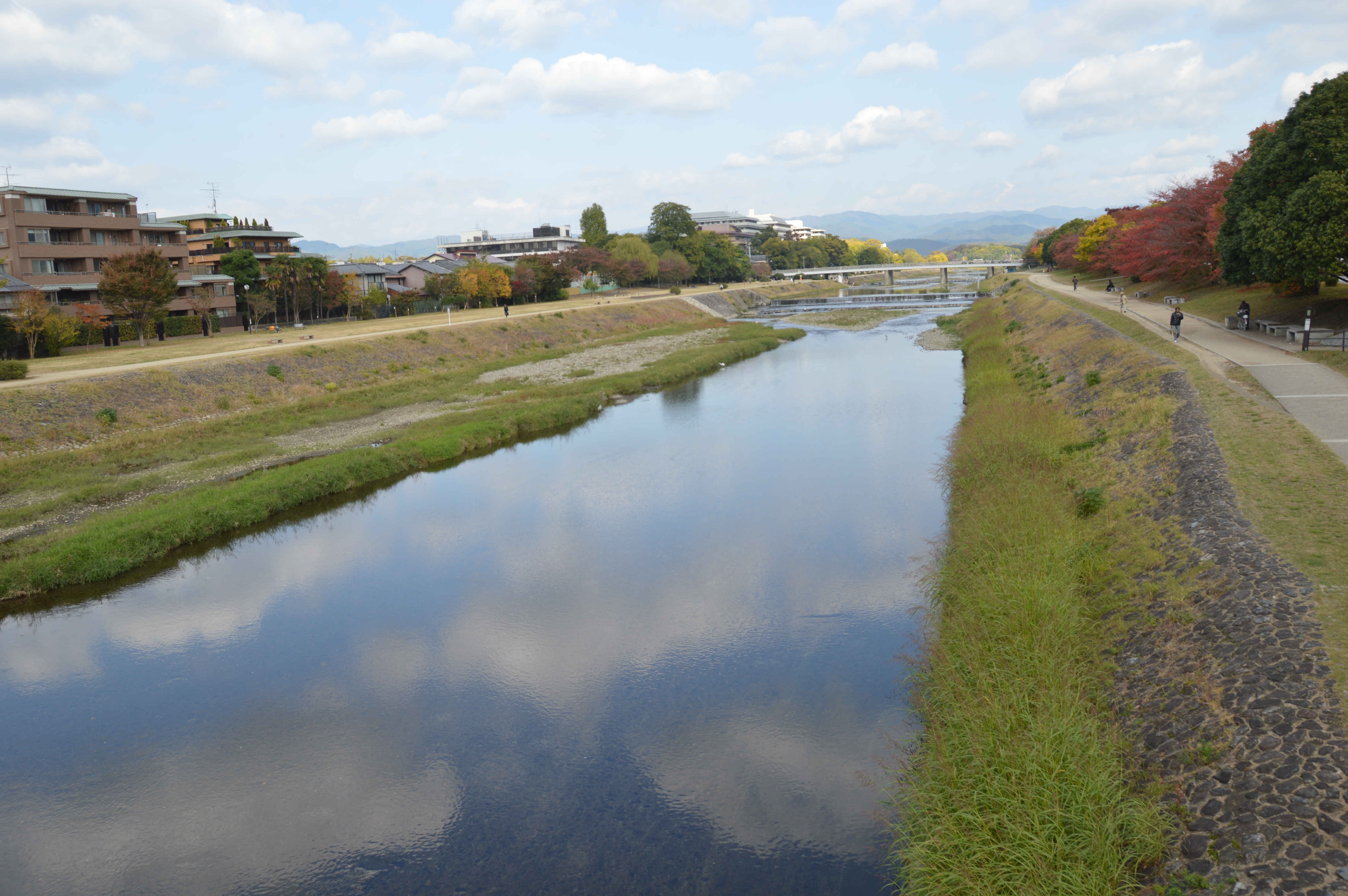
This is the Kamo River which flows through Kyoto. I took this shot because I liked the colours of the trees on the bank, and the reflection in the river of the clouds floating on a blue sky. I still like it for those reasons. However, I’ve found that, in the many years since I took this photo, that I’ve returned to it over and over again. I’ve used it to illustrate what I think are some of the most fundamental lessons of the universe.

On one bank you see trees, and a pathway running between the trees and the river. The trees are diverse. They are different species, different shapes, and different colours. For me they represent diversity and a “natural” habitat. You could argue they represent “wildness” – that universal force which continuously strives for growth, difference and diversity. It’s a “multiplicity”, not a “mono-culture”.

On the other bank you see houses, hotels and offices. This is the built environment. It is planned, constructed and ordered. Yes, I agree, the buildings are not all the same, and there is a saving grace in the Kyoto architecture. In some parts of other cities the buildings really are “cookie cutter” in their shape and construction. Let’s say this represents a second universal force – that which organises and builds.

Thomas Berry, in his “The Great Work”, describes these two forces beautifully and points out that an excess of “wildness” produces destruction, chaos and disorder….things can fall apart, whilst an excess of “discipline” produces too tight limits, narrow boundaries and a level of organisation which makes life impossible. I see this story represented in this photo.

Right down the middle of these two forces we see a calm, harmonious, “integrated”, flowing river. This is the “sweet spot”, that place where the interplay of these two great forces produces both Life and beauty. In this photo, there is even a bridge connecting the two. The bridge is a connector, and it’s through the creation of “mutually beneficial bonds between well differentiated parts” that we experience “integration”, harmony and growth.

You can think of a life journey sailing down this river, sometimes veering off towards more organisation, and sometimes off to the other bank to find diversity and wildness. As we navigate our way between these two opposites, we experience a full life, a rich life, a life of depth, meaning and purpose, a life of beauty and joy.

The final thing I’d say about the universal lesson I see in this photo is that it encourages us to appreciate the “whole”, not to judge one bank as “good” and the other as “bad”. After all, if we only had one bank, we wouldn’t have a river……we wouldn’t have a life.
Read Full Post »

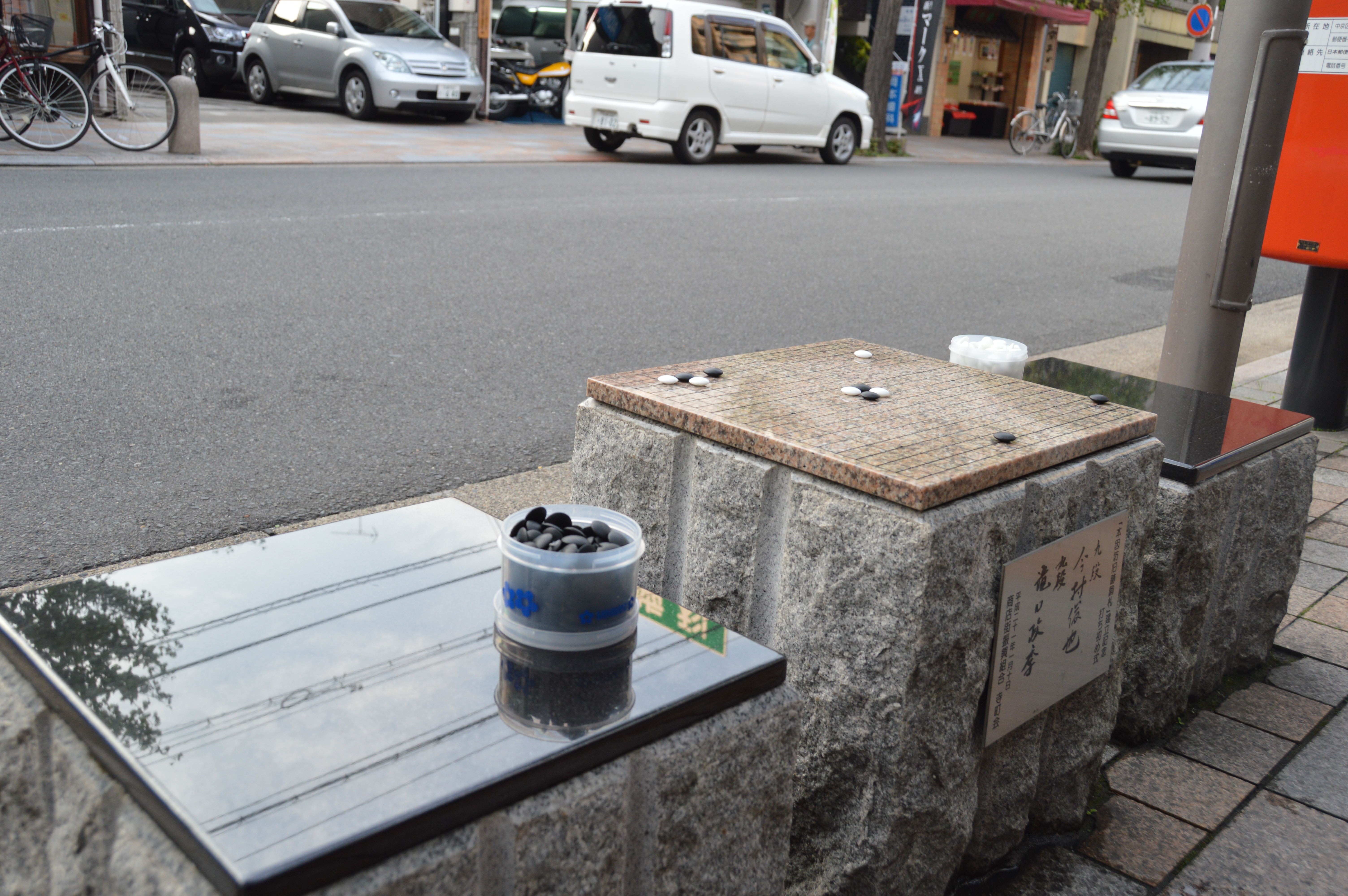
One day I was walking the streets of Kyoto and I saw this…….a game of Go, set up at the side of the road, for anyone to play. I don’t play Go but I thought it was amazing to see this. I suppose I’ve seen public chess boards and outsized chess pieces in other places, but this seemed a first to me.

Board games are very popular in France, where they are called “jeux de sociétié”(which would translate into “society games”) and sales of board games have apparently taken off spectacularly here. Card games are also very popular in France, although it’s a long time since I’ve seen a group of old men sitting at a cafe playing cards (I expect that will come back though)

There has also been a tremendous growth of interest in chess this last year, although, as I understand it, that is being put down, largely, to the extremely popular, fabulous, Netflix series, “The Queen’s Gambit” (if you haven’t seen that yet, I highly, highly, recommend it)

I also read recently that a study has shown that young boys who play video games are registering lower degrees of anxiety and psychological stress during the pandemic. Nice to read a more positive report about gaming.

So, maybe this pandemic has turned out to be an opportunity for us to rediscover the value of play in our lives – whether that be board games, card games, video games, or simply the unexpected benefit of young parents finding more time to play with their children. I know a lot of concern and emphasis has been on the difficulties associated with home schooling but I also know that many young parents now working from home are finding that their quality of relationships with their children has increased, at least in part due to the fact that commuting has diminished so much and spending that “found time” playing with the kids is such a delight to many.

So, how about you? Have you been playing more over the course of this last year? Did you take up chess? Are you enjoying your new “play times” with your children?

We shouldn’t underestimate the value of play.

Read Full Post »

One day, as I was walking to the railway station to go to work, I saw this little guy apparently checking out surfing! Ok, I know, it’s actually the stick from an ice lolly but, hey, to a snail, maybe that looks like a surf board? I paused to take a photo, smiled, then continued on my way to work. But this photo still makes me smile every time I look at it.

It reminds me of two of the most important things in life – slowing down and playing.

I emigrated from Scotland to France when I retired in 2014, and I now live in the Charente. This region of South West France has a snail as part of its logo. There is a strong culture here of slowing down, staying calm, and enjoying the everyday. Slowing down is what I had to do to take this photo. I was on my way to work, and for most of us, that’s something we do somewhat hurriedly. After all, I had a train to catch. However, stopping for a moment, getting my camera out of my bag and taking the photo, pulled me right out of my head full of “to do” lists and schedules, right back into the here and now. That’s what slowing down does. It gives us the opportunity to be present, and to savour the moment. It gives us the opportunity to pay attention to reality, right here and right now, instead of surfing across the face of life with our head in the clouds. It also prompts you to reflect and consider. I find that when I pause, or slow down, and notice what is around me, that whatever I’ve noticed lingers for a bit. It affects my mood for a bit. It stimulates a line of thought that I carry forward…..on that particular day, into the train, where I got out my notebook and jotted down some thoughts about the “slow movement” – “slow cities”, “slow food“, “slow medicine“.

The second thing is that this is just fun. It’s amusing to think of a snail taking up surfing. It’s about play. The neuroscientist, Panskepp, describes seven fundamental emotions we can find in many living creatures (including humans!). The three “negative” ones, are the ones we are all probably familiar with – Rage, Fear and Panic. Interestingly, though, he names four “positive” ones – Seeking, Care, Lust and Play. (read this interview with him in the “Journal of Play” – yes, there really is such a thing!) Play turns out to be a really important driving force, stimulating curiosity, experimentation, imagination and creativity.

You only need to spend a few minutes with a toddler to see how important play is. They press every button (yes, including your buttons!), as they explore what each object can do, and what they can do with each object. As they get a little older you see children totally absorbed in imaginary worlds….whether playing with toys, with found objects, or with other children. Give a child a piece of paper and some crayons or paint and they don’t stop to wonder if their art skills are up to the challenge of creating something, they just start to draw and to splash the colours around. How much do children like dressing up? Building spacecraft, houses, vehicles from cardboard boxes (thank you Amazon)? Play is absolutely fundamental. Pansepp has studied this in depth, and much of his work has been on the way animals play. He’s gone a long way to help us understand the importance of play and thank goodness for that, because otherwise we are likely to dismiss it as “childish”. It isn’t.

So, here’s my recommendation for this week – follow the surfing snail’s example – slow down and play a little!

Read Full Post »

This pandemic is giving us a really clear experience of living within limits. We experience that as a series of constraints. It’s frustrating and uncomfortable. We want to be free, don’t we? Free to do whatever we want, whenever we want, without a care in the world.

Wouldn’t that be bliss?

But, wait, isn’t that kind of naive? Because there is no such thing as living without limits. We are never free to do absolutely anything we could imagine or desire. That’s a fantasy. Or even a delusion.

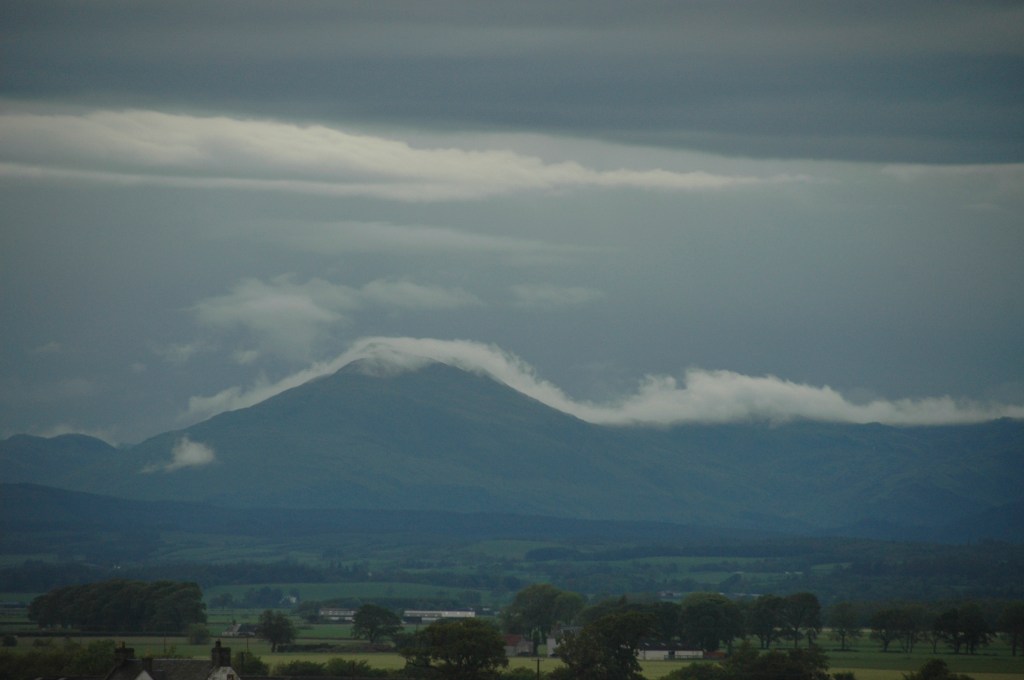
I found myself thinking that as I looked at this old photo of a thin layer of cloud hugging the contours of Ben Ledi.

I have just read “Ou suis-je?” by Bruno Latour where he describes some of the limits we live. One of those is what scientists call “the critical zone” – which is the space in which Life can exist. It’s an astonishingly narrow space. You can probe down into the Earth about ten kilometres and you’re down to rock where nothing lived, and you can soar up into Space about ten kilometres and beyond that the atmosphere becomes so thin nothing can live there.

The actual numbers aren’t that important. What is amazing is that all of Life exists within a very, very narrow zone. I don’t know if you’ve seen a photo of the Earth from Space which captures the thinness of the atmosphere. Let me find it for you.

There you are.

Well that’s the image which came to my mind as I looked at my photo of Ben Ledi.

We all live within these very narrow limits. We share, with every other living organism, this astonishingly thin “critical zone”.

The fact that living with limitations has become such an intense experience for so many during the pandemic has woken us up. We live in One interconnected world, a world of precious and limited resources. Now we have to learn to change the way we live – to change away from consumption and destruction to sustainability and creativity.

The pandemic has also shone a strong light on inequality showing us, perhaps more clearly than ever, that too many people are struggling to live with financial and social limitations which make them most vulnerable to serious illness and death.

So maybe now is a good time to think about the reality of living with limits and start to make the changes which increase the chances of better lives for more of us, rather than keeping our eyes closed and hoping for the impossible.

Read Full Post »

When I look at this photo I think “This is what life feels like, and this is what life really is”.

What I mean is this – look at those bubbles (I’m going to guess that when you looked at this photo the first thing you noticed were the bubbles). Each one looks perfect, and perfectly separate from the rest. Each bubble is distinct, different in size, different in location, different in the exact way it reflects the light, and also, although you can’t see this in a still photo, each moving along its own distinct, and different path (there are hints of that in the flows of water currents which you can see creating that marbling effect between the bubbles).

We feel like this. Separate, distinct, different. We feel, and we are, unique. There are no two of us with identical characteristics, identical stories, living in exactly the same time and place having exactly the same experiences. We have a membrane which seems to separate us from the rest of the world. On the outside, that membrane is our skin. On the inside it’s mucous membranes lining our lungs, our digestive system and our urinogenital system. Inside, and within, that, is our immune system, a distributed network of cells and chemicals which recognise “foreign” substances and protect us from their potential harm.

But actually, we are not separate. Those membranes are porous. They are not impermeable. And that’s for a very important reason. They enable us to connect. They enable us to interact with others and with the rest of the planet. They enable us to ingest nutrients, inhale oxygen, expel waste materials and exhale carbon dioxide, amongst many other exchange processes. So, to see them as simple barriers or borders is wrong. They do distinguish what is “me” from what is “not me”, but they enable my life by enabling these, and multiple other connections and flows.

Look again at these bubbles. Where do they come from and where do they go? They emerge from the water itself, and they dissolve back into the water they emerged from. So do we. We emerge within the rest of this “natural” world, come into existence for a brief period of time, then we dissolve back into the great web of being from which we came. In the part between birth and death, that part we call life, we don’t disconnect from that great web. We live in communion with it. We live as part of it, not apart from it.

Life is flow – flow of molecules and chemicals, flow of energy, flow of information. Our existence is a delicate but distinct dynamic interplay of those flows, creating the appearance of separateness and difference, but never disconnecting from, or existing apart from, the whole.

Our lives are distinct and beautiful, but they are not separate.

Read Full Post »

Why do we open up? Why do we “unfurl”? As I wrote the other day, my word of the year is “épanouissement” – which means to flourish, to blossom, to fulfil – we follow that path by uncurling, unfolding, unfurling, just like these ferns. And why do we do that? Because, just like these ferns suggest – it enables us to connect.

Opening up, vastly increases our chances of making meaningful, healthy, nourishing connections. Closing down does the opposite.

There are times we need to enfold ourselves, to close down, curl up like a hedgehog for defence, but actually, much, much more, we need to do the opposite. Because without making connections we die.

We do not exist in isolation. Even if it feels like we are being asked to do exactly that during this pandemic, what we’ve discovered is that it isn’t possible. None of us can live without the vast world wide web of others…..without whom we wouldn’t have shelter, food, water, comfort or care. It’s the natural state of affairs – connectedness. And connections aren’t worth much unless they act as channels of exchange – of materials, energies and information.

When I look at this photo, I don’t just see two ferns unfurling, opening up, but I see two ferns touching gently, almost as if they are having their first kiss.

Isn’t this what we need to grow in our world? Not grow our consumption of “stuff”, nor grow our production of waste. We don’t need to grow our destruction of ecosystems. We’ve been doing that all too well. It’s time to change course, isn’t it? To grow our connections, our “integrated” connections – the ones which enable mutually beneficial relationships to thrive. We need to grow our capacity for care and creativity. We need to grow our passion for love, tolerance and acceptance. And to do all that we need to open both our minds and our hearts.

Read Full Post »

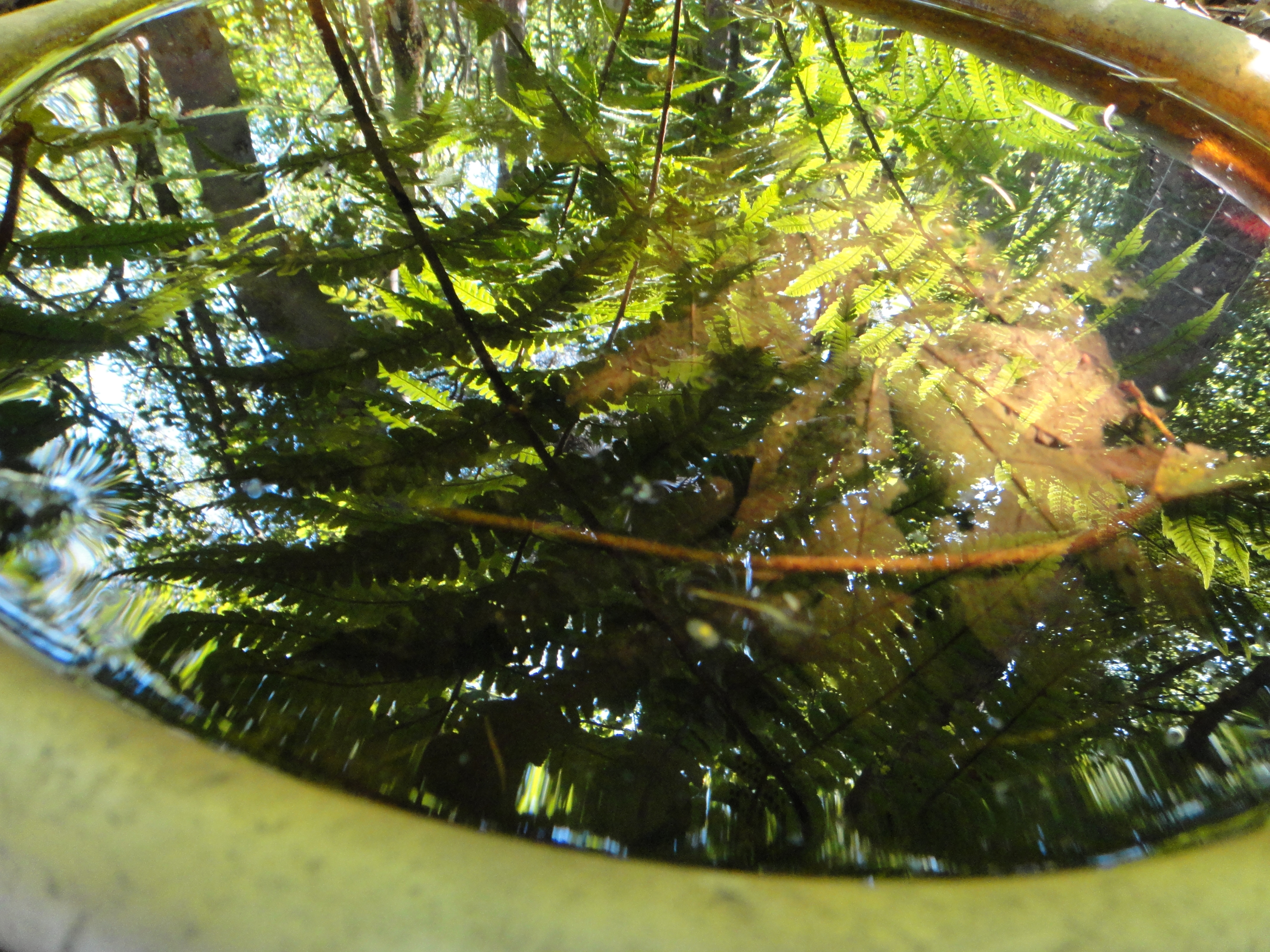
I have a fascination for reflections. I love to gaze into pools, ponds and fountains where the water is fairly still and you can see the world around you reflected on the surface. So, this is one of my favourite photos. I found this old stone basin full of water just sitting abandoned in a forest. I don’t know if the forest makes the image more magical for you, but it does for me.

As I gaze at this simple bowl of water I see the reflections of the trees and ferns which surround it, but I also immediately see fallen leaves lying below the surface….in other words I can both the living leaves and the dead leaves at the same time. That superposition strikes me as both interesting and beautiful. It’s as if I can see a snapshot of the past and the present in exactly the same moment, as if time itself collapses. Then I also notice the ripples on the surface of the water…..the water’s surface has its own shape. It’s not the same as a sheet of mirror glass. It’s moving, changing, dynamic. I’m sure if I had a microscope and sampled some of the water I’d find whole families of creatures in here, but with the naked eye, I see only the plant life and the water itself.

An image of Galadriel in Lord of the Rings gazing into her magical pool comes to my mind, and that layer of fantasy, of fiction, of story, just enriches the experience of the encounter.

I see green life everywhere and stand amazed at the abundance and diversity. I see the water itself as filled with life, filled with history and filled with potential……a memory bank, a lens and a crystal ball all rolled into one.

You know, I think one of the best ways to enrich our daily experiences is to see the connections, the threads, the traces, the reflections, echos, and to follow them for a bit. That way I don’t see a simple “object” but I encounter another aspect of manifest reality, a changing, particular, and unique aspect which involves me, the “subject” who is having the encounter. But that old “object”/”subject” split doesn’t satisfy me any more. It now seems that there really isn’t a clear division between objects and subjects in this universe. Rather that there are an infinite number of layers of connection, some of which appear as “objects” and others of which appear as “subjects”.

There really is nothing which exists in isolation.

Prove it to yourself by exploring some connections for yourself. Notice the threads, the roots, the knots, the intersections, the reflections……..I bet you find it an enriching, enchanting experience.

Read Full Post »

My word for 2021 is a French word – épanouissement. Translated into English it has various connotations but basically it means “blossoming” or “opening up”. It’s also used in psychology to refer to the development of the personality, or the self – it means “fulfilment”, or, more specifically, “self-fulfilment”. It can also be used in the description of someone’s face, as when their face “lightens up”. You get the idea?

This peony which I saw in Ueno gardens in Tokyo many years ago captures this notion for me by somehow conveying motion within a still image. Because the beautiful petals are unfolding and opening up in a spiral manner, this looks a bit like one of those little windmills you might have played with as a child. As a physical pattern this spiralling, whether in an opening up, or a closing up, speaks to us of movement. It’s not as static as some other geometric patterns appear.

That element of motion conveyed by this flower’s petals is, I think, an essential part of the whole concept of “épanouissement” – in other words, it’s always a work in progress. It’s not a goal, at least not as an end point, or an “outcome”. It’s a ongoing, growing, developing, evolving, ever-changing phenomenon. And that’s exactly what I think the development of the Self is like.

We are not fixed entities with identities held in aspic. We are not separate, not unconnected, not static. Rather we emerge from within the vast web of Life, never leaving that web, but developing a coherent sense of Self within it, a sense of Self which never stands still, and which, ultimately ebbs back into the great web itself.

Here’s the exciting extra part that you and I can access – consciousness. We have Will and we can make choices. We are “agents”. We are the “co-creators” of reality. We can do that consciously, and deliberately, or we can drift, reacting rather than responding to every change and signal which comes our way. When we wake up, become more aware, then we can choose how to respond, moment by moment, day by day, year by year.

So, here we are, still in the throws of this pandemic, but we have not stopped changing. The thing is – we are now more aware of our inter-connectedness, our inter-dependence, not just with other human beings across the entire planet with all of Life, all of Nature, all of The Earth, as active, living members of Gaia.

So what does that mean for our “épanouissement”? For our “unfolding”, our “self-fulfilment”, our “flourishing”? How are we going to blossom now?

Those are some of the questions that float around in my head these days. These feel to me to be some of the most important questions for me to answer now. This pandemic has challenged our values, our aspirations and our modes of living. How do we want to evolve all three of those? Our values; our aspirations; our modes of living.

Read Full Post »

Taking pictures is one of my favourite ways of improving the quality of my life.

I’ve taken photographs, on and off, at different stages of my life, and I’ve used several cameras over the years. Nowadays, most of us have a perfectly decent camera on our mobile phones. What do I mean by a perfectly decent camera? One that we have easy access to, are likely to use, and which can create images of a quality which we find pleasing. I know that “serious photographers” and professionals have different standards and needs and will have much more expensive, technologically developed equipment which will meet those needs for them. However, I’ve never had a really expensive camera and as well as several albums of prints, I’ve got a library of tens of thousands of digital images I’ve taken over the years.

Here’s why I like to “think take a picture” on an ordinary day –

  • First of all, having the intention to take a photograph today heightens my awareness of the here and now. It improves my ability to notice what is around me. Whether I am carrying a camera, or my smartphone, in my pocket, having the thought “take a picture”, puts me “on the lookout”. It just helps me to notice what might otherwise pass me by.
  • Second, taking a photo requires me to frame a shot. It involves paying attention to composition – to the elements, colours, shapes, and their inter-relationships. That “framing the shot” adds to my simple “noticing”. It engages me with my surroundings. I look this way and that, focusing in on this then that, re-framing, re-focusing, until I find an image which pleases me. Then I might look at the photo I’ve just taken, and revise it by picking out, selecting, or re-framing to make another image.
  • Third, as you can probably tell, from the second point, taking photos slows me down. It’s too easy to whiz through life on auto-pilot, never stopping to actually be present. Taking photos helps me to counter that. It literally slows me down and draws me into the immediate here and now. There’s an enormous benefit from slowing down and many ways to do it, but taking photos is one of the ways for me.
  • Fourth, when I review photos on my computer later, I see things I never saw at the time. I notice elements, juxtapositions, aspects of the scene, that I just didn’t see as I took the photo. This enhances my pleasure further – it’s a second bite of the cherry. It doubles, or more, the delight, the wonder, the awe, or whatever comes up for me as I look at the image.
  • Fifth, my images are my main source of inspiration and reflection. You’ll have noticed that my posts here all have one of my photos in them. More than that, every single post starts with one of my photos. I do that for two reasons – because I like to share the joy my photos bring, and because I don’t know what I’m going to write until I select the photo. It’s the photo which is the creative spark. It’s the image which sets off my memories, thoughts and imaginings. It’s the picture which is my creative muse. My inspiration.

Read Full Post »

This pandemic with its lockdowns (or “confinement” as we call it in France) has been, and continues to be, tough for a lot of people for many reasons. It’s the biggest global disruption of our way of life that most of us have ever experienced. So many “normal”, “everyday” and “routine” activities and experiences disappeared over an incredibly short period of time. Apart from the disruptions of work, family and social life, we’ve seen an end to “mass” everything – no crowds of spectators at sporting events, no theatre or cinema audiences, no music concerts, no festivals…..well, I’m sure you can add to that list.

However, there have been two positive developments which I’ve read that many people have experienced – one inner, and one outer which enhances the inner. Pardon? Let me explain.

With the shrinking of our horizons, physical and social, many of us have been spending more time in contemplation – yes, maybe deliberate meditation or other such exercise, but, also a more general reflection. A kind of reassessment and revaluing. It’s given us the time and space to become more aware of our habits and routines and ask if we want to re-establish them when the time comes (when the pandemic is over).

What patterns of behaviour, what modes of living, what activities have been disrupted that I don’t want to re-establish? That I want to let go off.

What new patterns, rituals, activities do I want to create instead? What new ways of living do I want to begin?

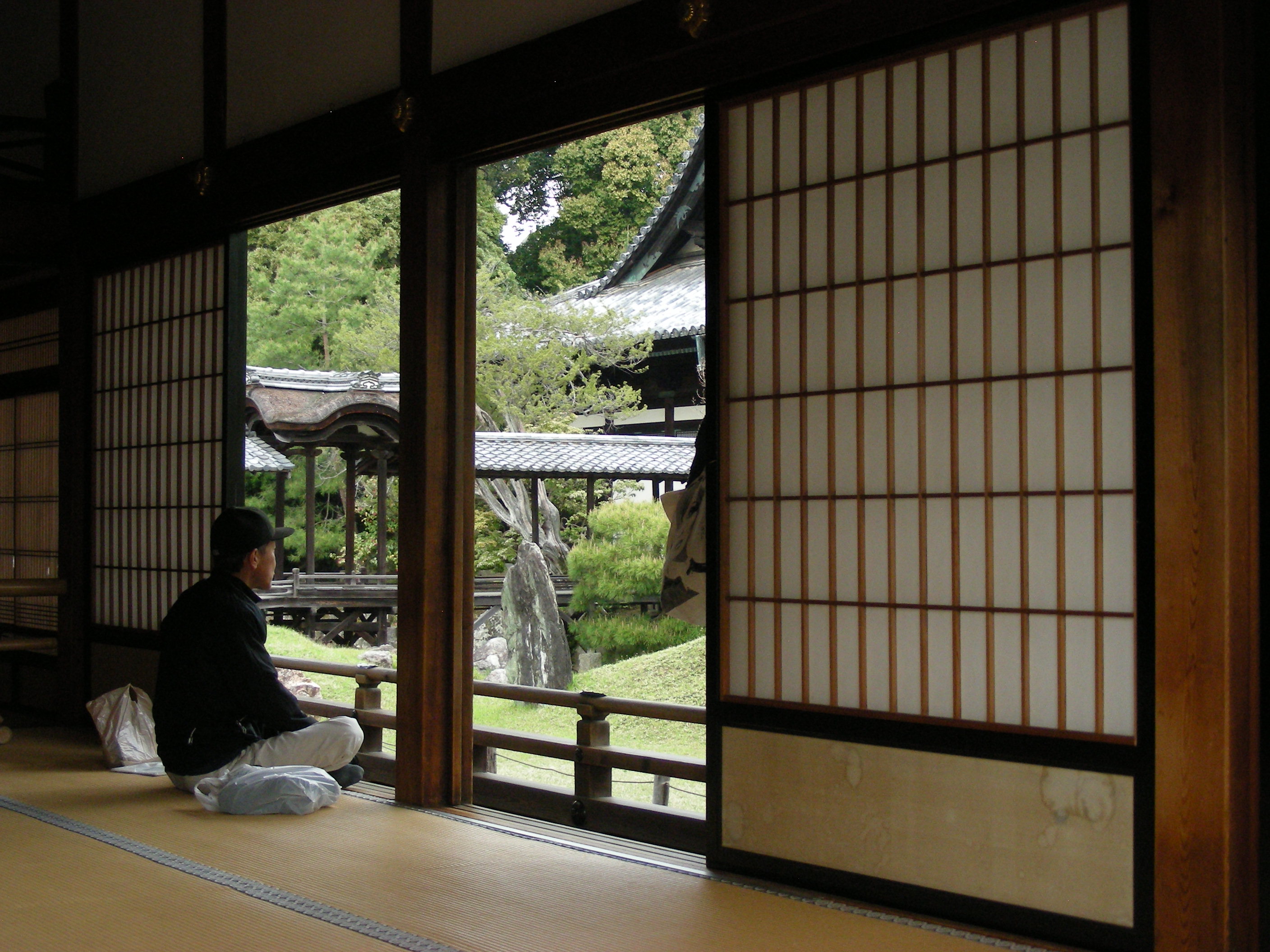
This un-asked for, and, frankly, pretty unwelcome, pause, is a real opportunity for both awareness and change. You don’t need to have a meditation space, like the man in this photo, to do that, but maybe there’s something inspiring in this image anyway? Maybe it would be good to create, if possible, a place, a space, which we find is conducive to contemplation and reflection? Or maybe we can do that wherever we are?

That’s the inner – this is an opportunity to develop our inner selves – to pay some more attention to our physical and mental health and our lifestyles. To become aware of our habits of thought and feeling and ask ourselves if we want to develop along different paths now.

The second is about what we call “Nature”. You know, I’m a bit uncomfortable about talking about “Nature” as if Nature is a thing, and more than that, as if “it” is a “thing” “out there”. We are part of Nature, not apart from Nature. But then, we’ve sort of forgotten that, as a species, and maybe that’s one of the problems which has brought us to this pandemic. So, maybe this is a great time to reconnect, to re-engage, to re-orientate ourselves with regard to the “natural world”.

I’ve found that noticing the cycles of the flowers, the vegetables, and the trees, has become something I am much more aware of now. I’ve found that I’ve noticed many more species of birds in the garden. I’ve noticed that when I’ve had the chance a walk in vineyards, in amongst some trees, or along a sandy beach on the Atlantic coast, then I feel a huge boost. That shouldn’t be a surprise. I’ve written before about the recognised benefits of spending time in the natural world – to the extent that some people now talk about “Nature Therapy“.

There is something truly life enhancing about becoming more aware and more engaged with “the natural world” and from “forest bathing” to spending time in open spaces we know that such activities boost the chemicals in our bodies and minds which influence our immune system, our moods and our thought patterns.

So, connecting better to the “outer” enhances the “inner”.

Again, you don’t need a beautiful Japanese garden like the one in this photo, (although, isn’t that gorgeous?) – but I recommend taking advantage of this time and space to develop your inner self, and your connected self, by grabbing or creating every opportunity you can get to do so.

Contemplation and Engagement with the Natural World.

Read Full Post »

« Newer Posts - Older Posts »