Feeds:
Posts
Comments

Archive for the ‘narrative’ Category

illuminate

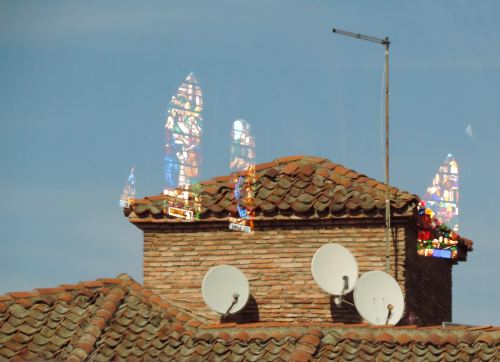
I stepped out through the back door of the cathedral in Segovia and onto a large paved terrace surrounded by stone lions. When I turned to look back to the tall arched doorway I noticed that the plain glass doors which hung in the doorway perfectly reflected the buildings across the street. I took a photo.

When I loaded up the photo later I noticed that there were some strange lights above and on the roofs and when I zoomed in I saw more clearly that behind the reflection of the tiles and the satellite dishes some of the cathedral’s stained glass windows shone through the glass door.

That got me thinking……

Here in this one photo is an interesting idea. For centuries the church has created the images and the stories to tell people what the world is like, what life is like, and how they should live. With captivating art and gripping stories it presented a particular view of the world. More than that, really, because in presenting that view and spreading it so widely, it created a reality for the people who lived in it.

But look at those satellite dishes.

Who is creating the images and the stories now? Who is telling people what the world is like? What life is like? And how they should live?

Who is presenting a view, and spreading it so widely, that it’s creating the reality for those who live in it?

With the rapid development in communications technology, with powerful mobile phones, connected computers, the internet, social media, memes, images and videos which “go viral”, some writers say we have created a whole new layer of the environment in which we live – the “noosphere” (the sphere of human thought). The truth is we’ve always had a noosphere. We’ve always lived, we humans, within this environment of human thought.

There are the image creators and the story tellers who fashion the patterns in this environment, and in so doing, they influence many others.

We have a choice. We can be the image creators and the story tellers, or we can be passive consumers. If we choose to be passive consumers, whose world, whose idea of the world, are we choosing to live in?

If we choose to be the image creators and the story tellers, what images shall we share? What stories shall we tell?

Read Full Post »

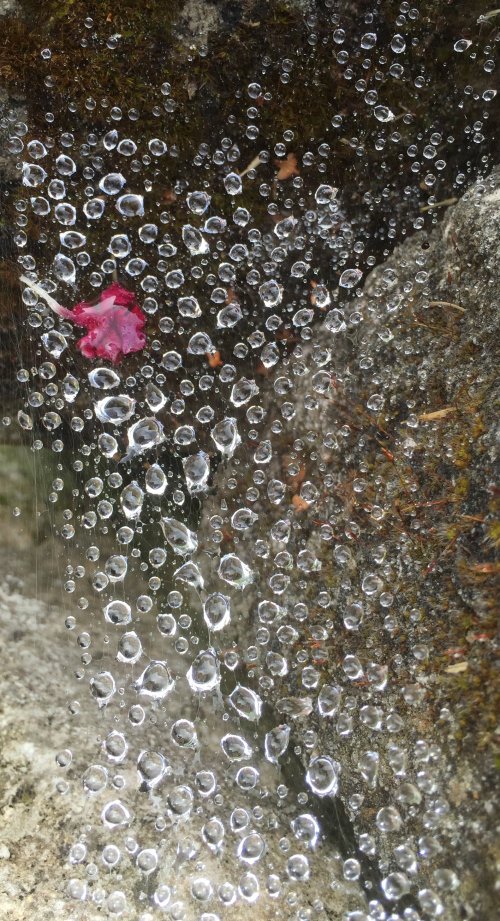
petal web

Thomas Berry and Brian Swimme who developed the new story of the universe talk about three core values which seem to be embedded in evolution. It’s a really interesting and different take on evolution. The story we have heard most over the last hundred years or so is one of a random, harsh, competitive universe full of “stuff” or materials which somehow have stuck together to make ever more complex objects which can each be studied and understood in isolation from each other.

That story never resonated with me and it can be argued it has more to do with the dominant politico-economic model of capitalism and “the market” than it has with science.

The three values Berry and Swimme articulate are differentiation, subjectivity and communion. Their claim is that take away any one of these three and the whole universe as we know it collapses. Brian Swimme also claims that we can use these three values to check if our actions are in harmony with the evolutionary direction and activity of the universe. In other words they can be considered as fundamental values which help us to assess and judge our behaviour and that of others (including politicians and economists).

Differentiation.  The universe started differentiating from its earliest moments. We don’t look around and see a homogenous mush – we see clusters, or “objects”. But the universe doesn’t just produce what Swimme calls “articulated constellations of energy”. It produces UNIQUE articulated constellations of energy. No two galaxies, no two stars, no two creatures are identical. Producing uniqueness turns out to be a key universal value.

Subjectivity. Everything has an inside. Even the simplest atoms are self-organising, self-maintaining phenomena. The particles within the atom are held together and organised by the atom itself. This self-organisation reaches its most complex in human beings. We are all “autopoietic” – we are “self-making” creatures. We self-defend, self-organise and self-maintain. Yet this interior “self” remains unknowable. We can’t see it, can’t define it, can’t pin it down. This interiority is what enables us to see every object as a subject.

Communion. Thomas Berry used the word “communion” to describe the relationships which exist everywhere. Nothing exists in isolation. Everything is connected to other things. We all live in a vast web of relationships.

This all leads to Berry and Swimme describing the universe as an “communion of subjects”, or as a “communion of differentiated subjects”.

Try this idea out for yourself. What does the world look like through this lens? What sense do you make of life which part of a “communion of subjects”?

When considering any political policy, any scientific description, any choices you might make, what happens when you set them in the context of  the three values of “differentiation, subjectivity and communion”?

For me, I experience a shift from fear to curiosity, from senselessness to meaningfulness, from isolation to belonging…..how about you?

Read Full Post »

two

In the Spring of 1784, Armand Marie Jacques de Chastenet, marquis of Puységur, discovered that Victor Race, one of the peasants who worked on the marquis’ land, had pneumonia. The marquis had become interested in the work of Mesmer and “animal magnetism” so decided to see if he could help Victor back to health using this new method.

Victor fell into a trance and began to speak. But to the astonishment of his master, he didn’t speak in his usual patois, but in perfect learned French instead. Not only that but he talked about subjects that an illiterate peasant couldn’t have known about.

What happened next is even more astonishing. The marquis and Victor became a therapeutic couple. The marquis would ask an ill person about their symptoms….he’d “take the history of the patient”, and, in trance, Victor would pronounce the diagnosis and prescribe treatments.

Neither of these men were able to carry out the acts of healing by themselves, but together, they could.

This was one of the first recorded episodes of “lay mediumship” in Western civilisation.

I think that’s a remarkable story and I know of other instances from within my own lifetime where such astonishing collaborations occurred.

But even setting aside the somewhat “supernatural” aspect of these tales, isn’t there something like this going on in every therapeutic act? Isn’t every therapeutic act a collaboration between the patient and the therapist. Without each other they can’t achieve healing, but together, they have the chance to become something unique and greater than either of them. Together they can gain a greater understanding, and together they can find answers they couldn’t find alone.

I think we forget that in modern medicine, thinking that the doctor can do it all by him, or her, self. Thinking that one person has all the answers, ready made, so to speak.

There can be some of the most astonishing examples of magic happening when two people form a bond and work together for a common purpose.

Read Full Post »

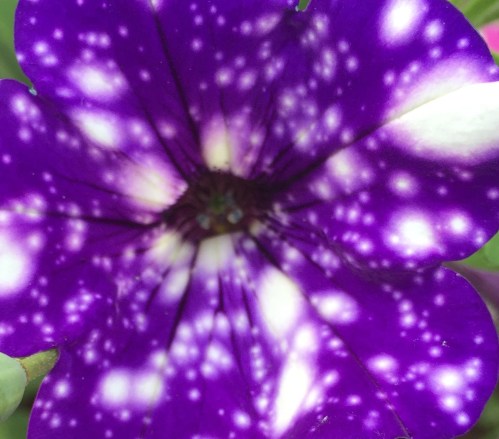
night sky flower.jpg

I’ve just finished reading Andrea Wulf’s “The Invention of Nature” which is her biography of Alexander von Humboldt. I thoroughly recommend it. It’s a big read but a great one. I must confess I’m one of the apparently many who has never heard of Humboldt but am I glad I know something about him now.

One of the most amazing things about Humboldt is how he saw, described and wrote about Nature as a complete interconnected web, and he did this at the end of the 18th, and beginning of the 19th centuries. What an insight! What a vision! What an understanding! His enthusiasm for Nature and his insatiable curiosity are infectious, even now. But it’s his underlying fundamental insight which thrills me most. He describes ecology before the word was even invented. He sees the damage caused by short term economic greed and, more than that, he describes the environmental consequences of these short sighted actions. He demonstrates how the interconnected web of Nature means that these simple minded grabs for wealth will produce long term, far reaching negative consequences for many.

Seeing our world and everything in it as intimately, inextricably interconnected is the basis of holistic science. This is a science of wonder, exploration and discovery. He uses the best scientific instruments of the time to measure whatever he can measure, but he does something which scientists today so often fail to do. He uses the measurements to discover the connections. He puts things together rather than dividing them up. He sees nothing as existing in isolation. In other words he uses reductionist methods in a holistic way.

Reading about him is one of the clearest examples ever of integration. The two halves of his brain both worked brilliantly together. He pursued the new and climbed the highest mountains to see the world as a whole (right cerebral hemisphere). He measured, analysed and categorised (left cerebral hemisphere). Then he put it altogether in a vast web of contexts (right cerebral hemisphere again). What a great demonstration of using the whole brain. Of course I’m simplifying here. I’m sure he didn’t use his brain in such a linear fashion, but, still, I think it’s magnificent.

I thought about him again as I looked at this wonderful flower (see the image above). It’s called “Night sky”. Isn’t it stunning? Doesn’t it immediately show you how the human brain both discovers and creates connections?

That we can see the starry heavens in the soft purple petals of an earthy flower…….


Here’s a short video clip of Andrea Wulf talking about her book –

Read Full Post »

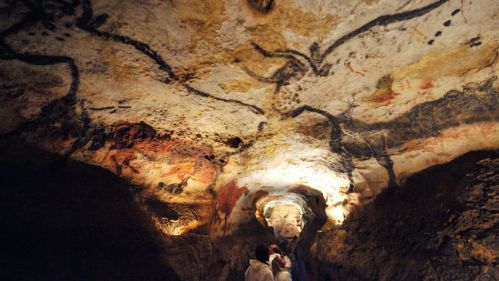
FRANCE CAVE DRAWINGS

Part of Lascaux famed cave drawings are photographed in southwest France, during a rare visit, Friday, July 25, 2008. Clusters of black fungus have been spreading over the drawings said scientists in 2007. The stains were the latest biological threat to the Lascaux cave drawings, which were discovered in 1940 and are considered one of the finest examples of prehistoric art. Carbon-dating suggests the murals of bulls, felines and other images were created between 15,000 and 17,500 years ago in the caves near Montignac, in the Dordogne region. In 1963, after green algae and other damage appeared, the caves were closed to the public. Only scientists and a few others are allowed to enter at certain times. (AP Photo/Pierre Andrieu, Pool)

I recently visited the Lascaux caves which are about a three hour drive from where I’m living now. I’d heard of them but I hadn’t realised they were as close as this.

You’ll see from that photo above, which isn’t mine, that the incredible wall art in the caves was deteriorating quickly due to the effects of fungi and carbon dioxide brought in by visiting tourists, so the government closed the caves to preserve them and did something astonishing.

They built an exact replica of part of the cave network, faithful down to 5mm, using teams of artists to recreate the artwork using the same kinds of pigments used by the original artists on artificial cave walls.

The caves were discovered in 1940 when a group of boys were exploring a forest. A storm had blown down some trees and one of the fallen trees had opened up a hole in the ground under its roots. Their dog disappeared down the hole so they went after it, quickly realising it was a tunnel into caves. After retrieving their dog, they went back home and got lamps, returning to squeeze along the dark tunnel until it opened up into a cave. Can you imagine how astonished they were when the light from their flames lit up the huge paintings of bulls, bison, cows, horses and deer which covered the walls and ceiling of the cave?

There was a lot more down there than what the boys found in the first cave. The paintings are thought to have been created up to 18,000 years ago and had remained, perfectly preserved, once the cave network was sealed off by the forest.

Lots of questions immediately spring to mind – how did they manage to paint such life-like depictions of animals under the ground in the darkness using just small lamps for light? They covered not only the walls but the ceilings. How did they get up there? They used the contours of the cave walls to make their paintings seem three dimensional. How did they have the imagination and the skill to do that? And WHY? Why did they put so much time and effort into the creation of this fabulous art?

It didn’t take long before the effects of thousands of visitors started to degrade the art work so the government sealed it off and created Lascaux 2, a replica. If you click through on that link you’ll go to an interactive tour of the re-creation.

So, I went down the stone steps with a couple of dozen other visitors and a guide. In the ante-room after the great doors were pulled closed, our eyes adjusted to the low level of light and the guide talked us through the story of the discovery of the Lascaux caves and the creation of Lascaux 2. Then he opened the far doors and we all squeezed down a narrow passageway between rough walls of rock. The passageway opened up into the Hall of the Bulls, so called because of the four, almost life size paintings of bulls which completely cover the ceiling of the cave.

He switched off the lights and lit a cigarette lighter. As the small, single flame cast its faint light up onto the walls and ceiling you could swear the animals were moving. It was quite cold down there and without artificial light it would be pitch dark.

We spend the best part of an hour exploring the cave and hearing about the different paintings.

So, you’re thinking. You just visited a replica? How did that feel?

You know what? It was magical. I thought it might be a bit Disney-like, but it wasn’t. You know what it was like? It was like standing in the middle of an art installation. That’s exactly what the replica is. It’s a work of art designed to communicate to you something of the experience of the artists. And that’s what this replica represents, isn’t it? A work of art. Created by unknown artists almost 18,000 years ago….

So there it is…one work of art, touching the viewer, stirring some kind of feelings which the artists had after they’d been inspired in a similar way by other artists, long gone, who left these astonishing creations.

Here’s my final thought. Isn’t it just wonderful that we humans create art? Not for a sum of money, fame, or some utility, but to…..what? Interpret our world? Interact with our world? Make sense of our world? Express ourselves, just because we can?


Read Full Post »

tree wall

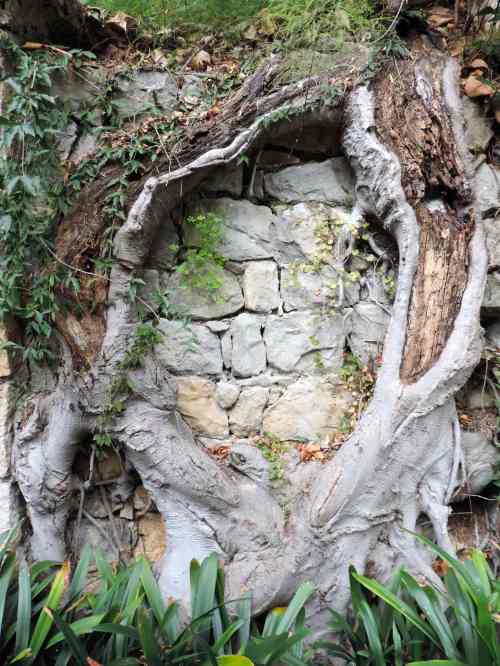
I didn’t see any white rabbits, but, like Alice, I stumbled across this.

What is this? A wall with a tree growing in a strange, separated way over it? Why would a tree grow that way?

A portal deep in the woods? A portal which someone has walled over? Why would they do that?

There’s a story here.

How would you like to tell it?

Let me help you to get started. Once upon a time……..

Read Full Post »

last leaf

There’s a growing body of evidence that using your brain is good for your brain. Who’d have thought it?!

There’s also a growing body of evidence that what is good for your brain is good for you. The old mind-body duality is breaking down in the light of neuroscientific findings about the connections between the brain, the rest of the nervous system, and the rest of the body.

Using your brain is one of the key themes of this blog. I believe it’s just too easy to drift through life in zombie mode, influenced by others, manipulated by others, controlled by others. And yet, I also believe it very, very possible to make our own choices, to become “self-directed”, conscious creators of our own, unique stories and, hence, lives.

One of the most commonly promoted ways to use our brains is “mindfulness“. A sort of clumsy word which describes a certain state of awareness.

You can practice “mindfulness” by learning certain meditation techniques, and/or, you can do what Ellen Langer says, and “seek novelty”. 

I find that choosing to be aware, stoking the natural curiosity for the day, seeking “l’émerveillement du quotidien” is one of the easiest, and most delightful ways, to achieve this – this is the main way I try to be “mindful”.

There are two related techniques which help me to live this way. They both date way back thousands of years but both work just as well here and now.

Here are two photos to illustrate the techniques.

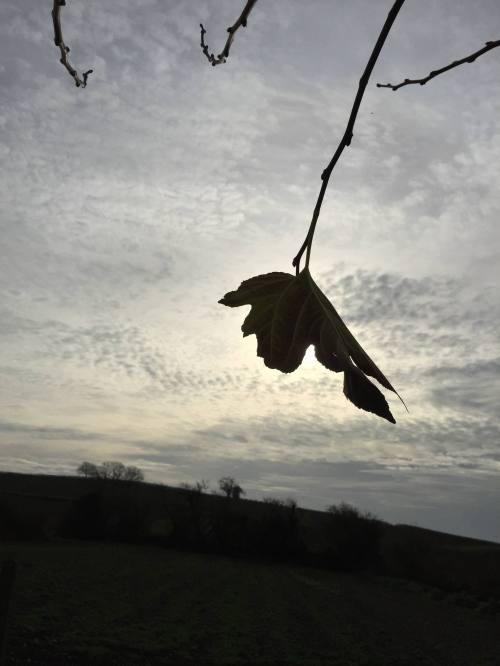
The first one is the one at the start of this post. It’s “the last leaf”. There’s a mulberry tree in my garden here in France and this is my second season of raking up and gathering the leaves as they fall. The first year I arrived here I wasn’t prepared for this phenomenon. This tree really sheds a LOT of leaves. I confess, I found that clearing up the leaves was a bit of a burden. But this year? This second season for me? I’ve loved it. Pretty much every other day I’d take the rake and gather up the leaves into huge canvas bags and every other week I’d make a trip to the “déchetterie” (“the tip”, we’d say in English). I enjoyed taking my time, rummaging through the different shapes, sizes and colours of the leaves. I enjoyed seeing the green grass again once the leaves were gathered, but quickly, of course, the grass would recreate a “wabi sabi” appearance with just two or three newly fallen leaves adding interest and attracting attention.

As more and more of the tree shed its leaves I decided I’d like to photograph the “last leaf”. That’s my first image in this post. And that’s the first technique – “live today as if this is the last” – that’s not as morbid as it first sounds…..due to the constancy of change, every day is unique, and the truth is, you will never have a chance to live this day, exactly like this, ever again. So it might be a good idea to savour it. To notice what you can, to hear what you can hear, touch what you can touch, smell what you can smell, take your time to taste and savour the food you are eating.

Because this will be your last opportunity to do so.

Here’s the next image –
first leaf

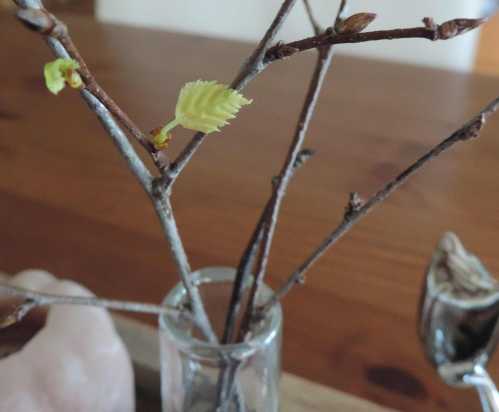
We have twin birch trees in this garden, and when the wind blows in the autumn, they shed, not only leaves, but lots of small twigs and branches. Yep, most of these head to the “déchetterie” too, but Hilary picked some up, finding their shapes pleasing and used a couple as a table decoration. There was a little water in the bottom of one of the vases she used, and look what happened! A few days later, there was a new leaf!

So, here’s the second image, “the first leaf”, and the second technique, “live today as if it’s the first”.

That’s true too. Due to the uniqueness of every day, of every experience, of every moment, whatever you encounter today, you encounter for the first time. Sometimes that’s not so obvious. Our habits and our routines deaden our awareness and we become oblivious to the small changes which can make a big difference.

You have never lived this very day before. So why not approach it with the sense of wonder, curiosity and amazement which you did so naturally as a child? (This is “l’émerveillement du quotidien” – the wonder of the every day)

I mean look at that little twig! It’s grown a leaf! A perfect, bright green, little leaf! Isn’t that amazing? I wondered a wee while ago about how difficult it was to know whether a seed was dead or alive, but I didn’t wonder about these (apparently discarded) twigs. They were dead as far as I knew. But add a little water, and, hey presto! Life magically emerges!

If you don’t stumble across something new, something for the first time, today, you’re just not looking.

So, there you go, two photos, two ancient techniques, “last and first”, and a step in the right direction from “zombie to hero“!

Read Full Post »
IMG_3419

Elizabeth Gilbert’s book, “Big Magic”, is about “creative living”. What is that?

…when I refer to “creative living”….I’m talking about a life that is driven more strongly by curiosity than by fear.

Well, I think that really is a key – we are so driven by fear, and fear is used as such a tool to control whole populations these days. To be driven by curiosity rather than fear strikes me as likely to completely alter our view of the world.

Take health care for example. So much health care is generated by fear – fear of dying, fear of getting cancer, fear of getting this disease, or that disease. It creates a whole ethos and it’s sure not a positive one. What if we underpinned our healthcare with curiosity instead? What if we consciously sought out experiences which were nourishing, nurturing, stimulating, life enhancing? Would that lead to healthier lives instead of lives of avoidance?

I do believe a creative life is a richer life. Here’s what Elizabeth Gilbert says –

A creative life is an amplified life. It’s a bigger life, a happier life, an expanded life, and a hell of a lot more interesting life.

That reminded me of a book I read a long time ago – Robert Solomon’s “Joy of Philosophy” – where he juxtaposes a “thin” life with a “passionate” one. His use of the metaphors of thin vs thick throughout that book struck me as original and clear. Who wants a “thin life”?

Elizabeth goes on to explain in a little more depth what she means by “creative living” –

The universe buries strange jewels deep within us all, and then stands back to see if we can find them. The hunt to uncover those jewels – that’s creative living.

Ooh, I love that. What a lovely metaphor! We really do all have unique and wonderful treasures buried within us. In fact, I don’t think it is possible to fully mine the depths of any individual human being, but what jewels lie there waiting to be discovered when we take the time to explore!

The courage to go on that hunt in the first place – that’s what separates a mundane existence from a more enchanted one.

Yep, it might take courage, but what else are you going to do with all that fear that is thrown at you in this world?

And who wants a “mundane existence”?

Read Full Post »

One of the new experiences I’ve had this summer (my first summer living in the Charente region of France) is with barn owls.

Not long after I moved here, a barn owl flew out from a neighbour’s barn and up onto a light on my house, then quickly flew back home again. I saw the owl a few times, mostly as a blur of white as it flew from somewhere above my front door at night. One time as I was chatting to a friend of mine, the owl came out, flew three times around the mulberry tree, keeping its eyes on us, then flew back to the barn.

Do you know about the noise the barn owls make at night – its a hissing noise, not a hoot. Barn owls don’t hoot. Well for a couple of months in the summer I heard a lot of hissing from the dovecots in our house.
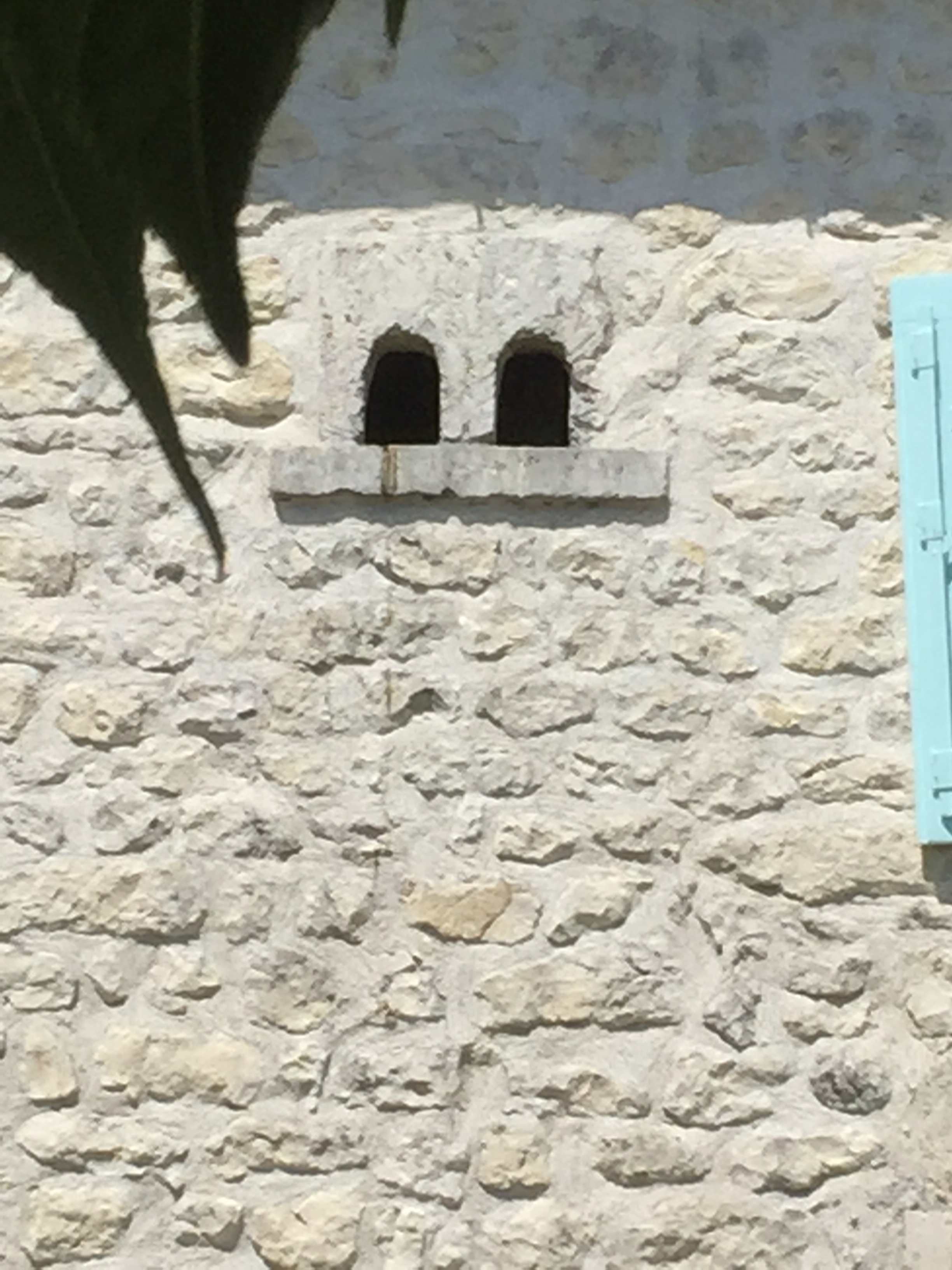
Can you see those two little holes in the wall next to the third from the left upstairs window?
front of house
You can see them better close up
dovecots in wall
Well that’s where the noise was coming from and that’s where the barn owls have a nest.
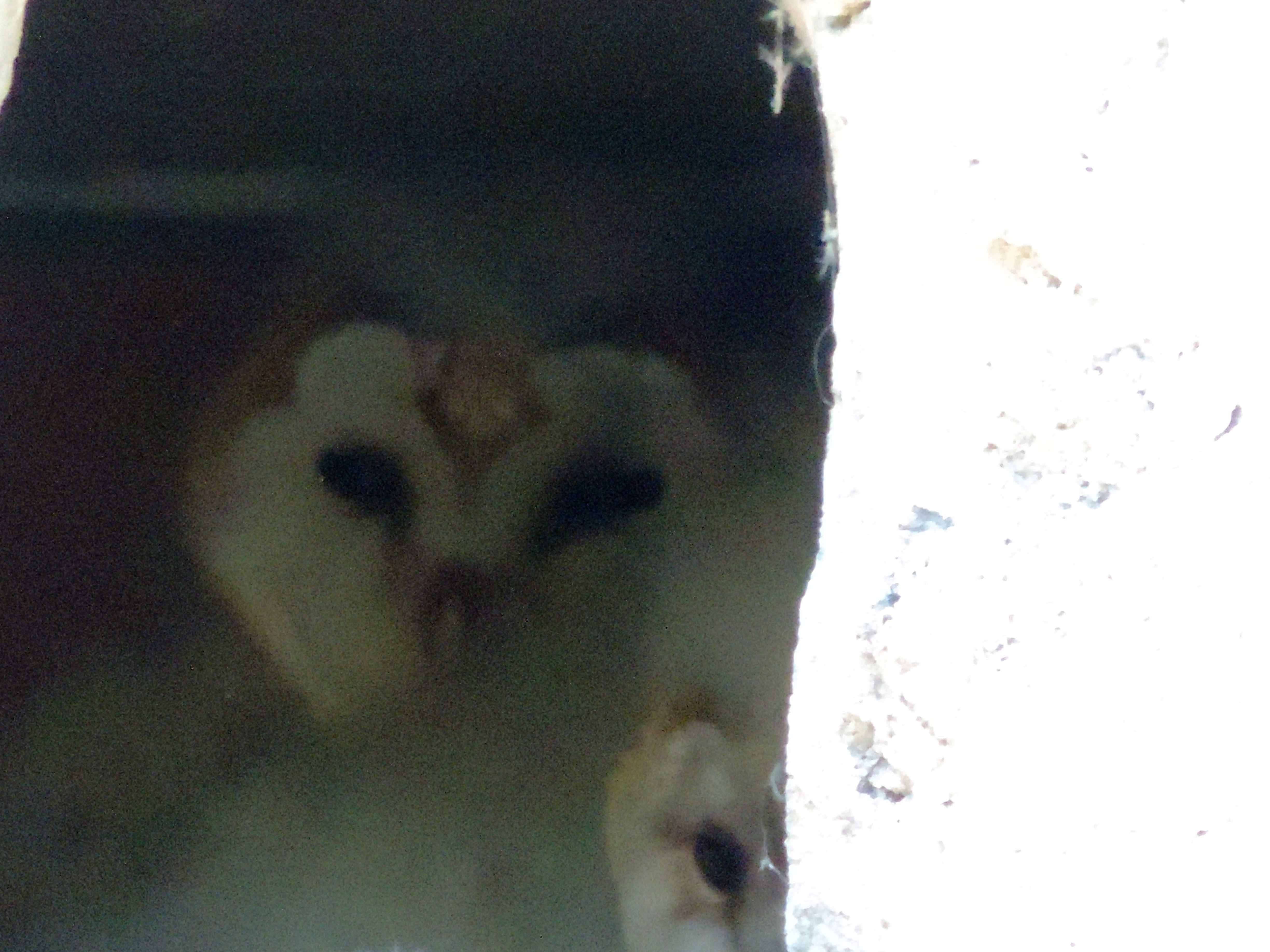
I haven’t managed to see any owls actually fly into or out of the holes but after a few days I stood back in the garden and when I looked really carefully I could see owls. I used my little camera with the zoom lens, set the zoom to max, ratcheted up the ISO setting to the darkest conditions and stood very very patiently for ages until I got some pics of the owlets in the nest –
two owlets in nest
Well that was all very exciting and I sent an email to Marie-Pierre, Hilary’s friend who knows a lot about birds and she said they were definitely barn owls and we should watch out for one getting thrown out because that happened a lot and when it did you should put it back in the nest or up in a tree so it doesn’t get caught by cats or foxes.
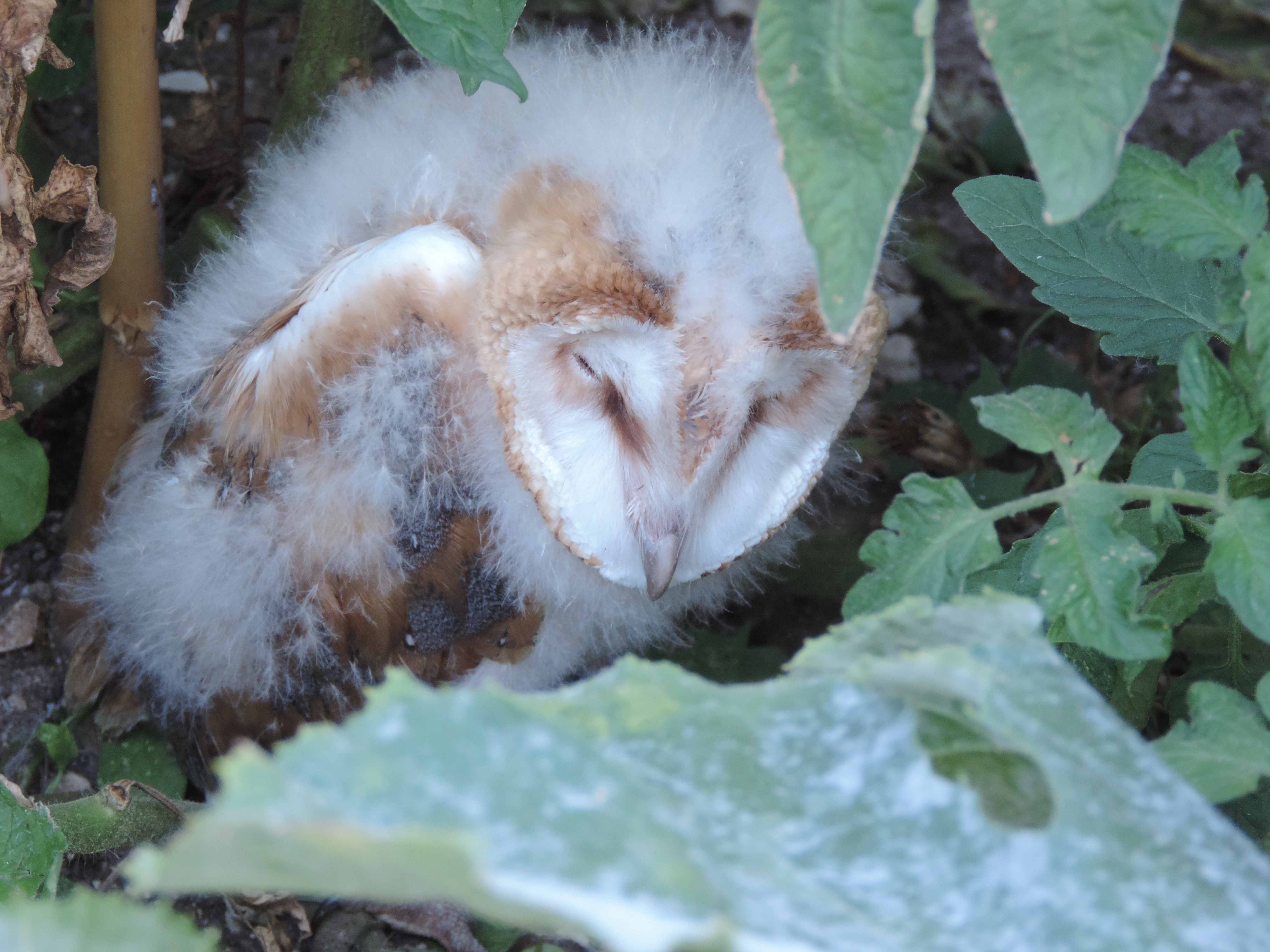
A couple of days later we found an owlet hiding under the tomato plants in the veggie plot –
owlet in veggies
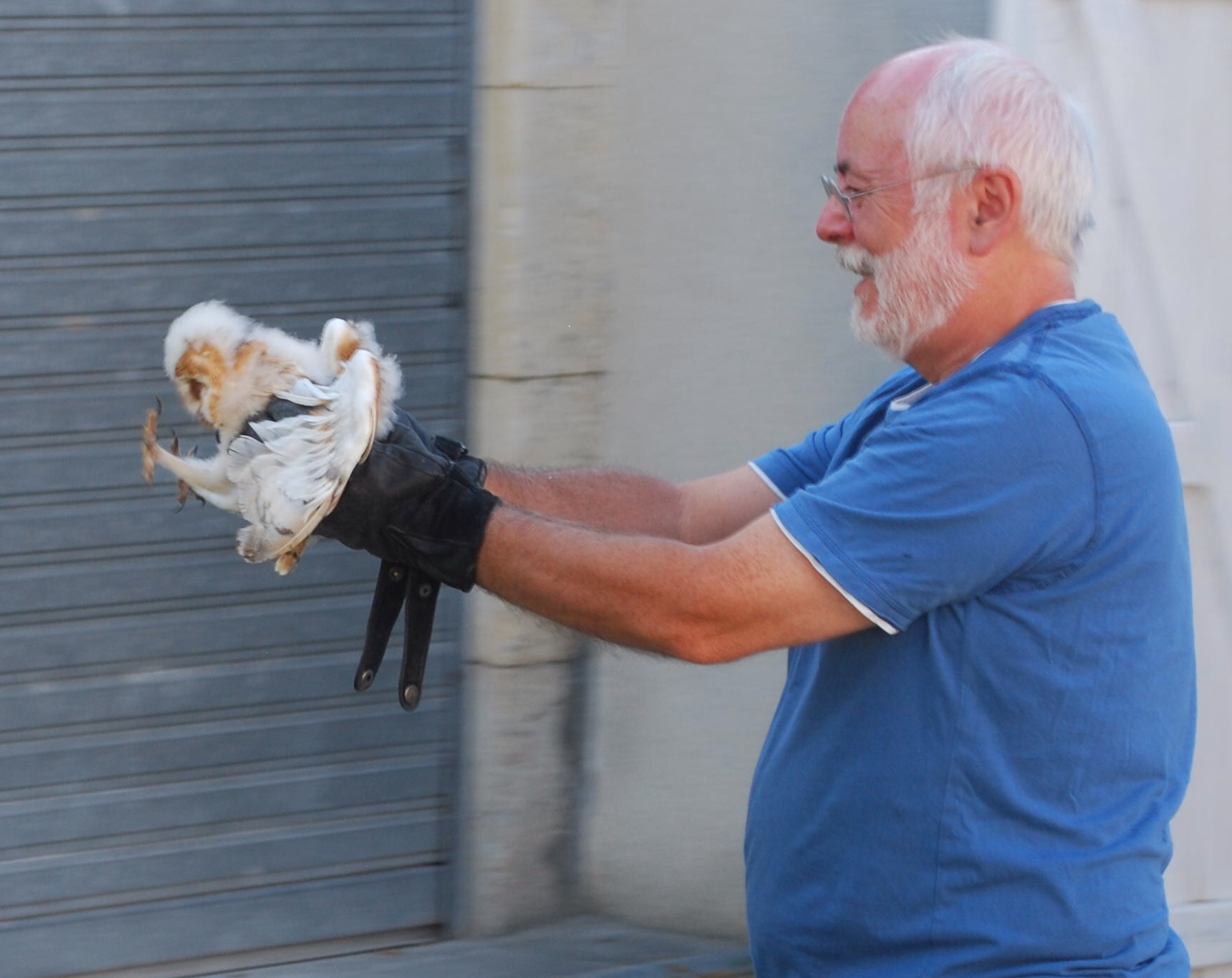
Well the nest is too high for me and I didn’t think I could reach it with a step ladder so I put it in the mulberry tree – there’s a photo of me carrying it!
me carrying owlet
Next day it was gone and no sign of feathers or anything so we reckoned it had either been carried back to the nest or it had flown.
However the following day we found it hiding between a stone trough and the wall of the house – and it didn’t look great. I put it back in the tree and went off to the supermarket to get it some chicken pieces but by the time I came back it was back behind the trough again.
A wee while later (it was pouring rain all that day) it staggered out onto the path and fell over so I picked it up and put it in a shoe box and put that in the shed – it didn’t look like it had long to go and a couple of hours later it was still and had passed away.
I found that very upsetting. Really sad and tearful. But then that’s Nature I guess and I read about barn owls and the young don’t have a lot of luck! Often one gets thrown out the nest then the parents don’t feed it any more and once they learn to fly they are chased off to find their own territory but most don’t make it dying from starvation cos they don’t hunt well enough, or killed by cats, foxes or cars!
Yikes!
The next day, I couldn’t believe it – another baby owl behind the trough! Oh no! So this time I put the step ladders on a plank and took the owlet up the steps with me and pushed him over the ledge into the dovecot.
He, or she, didn’t fall out again!
It’s been a bit of an emotional roller coaster and a big learning for me. I handled the second owl much more easily than the first and looks like I might have made a better decision with it. However, why do they get thrown out in the first place? Is it because they aren’t right somehow and the mother is protecting the others with limited food supplies?
Who knows!?
Well the hissing continued for a few weeks, then at around the time I expected the little ones to fly off, the family decanted across to my neighbour’s barn, but they came back to the garden every night to hunt, play and hiss.
I went to Scotland for a week, and when I came back the garden was silent again at night. I guess the young ones have “dispersed” – off to find their own territories and take their chances in life.
I felt a bit sad that they’d gone, but it’s good that they have. It’s the natural flow of Life.
I wonder if the adults will come and nest here again next year. Well, if they do, then I’m a bit more experienced, and I’ve bought a taller ladder, so I’m ready for any wee ones which tumble out into the garden.

Read Full Post »

DSCN4463

What if we built a health care system starting by ensuring that every patient gets enough time with the doctor, nurse or therapist for them to be seen, heard and treated as an individual?

Jacques Lacan said that the greatest gift we can give someone is to listen fully without judgement or interpretation.

What if we gave that gift to every patient, every time?

Also, so that every time a patient met a doctor, nurse or therapist, they didn’t have to start to tell their story all over again, but rather, the story could be deepened and extended enabling understanding to increase and a relationship to be built, what if we also built a health care system based around continuity of care?

If we started from there, what might that lead to…..?

Individualised care, enough time with every patient, continuity of care…..what would you add next?

Read Full Post »

« Newer Posts - Older Posts »