Feeds:
Posts
Comments

Archive for the ‘narrative’ Category

pleiades

Which of the constellations in the night sky do you recognise? I wonder if one of them is the seven sisters – “Pleiades”.

I read the following in Gary Lachman’s “A Secret History of Consciousness”

In a fascinating chapter of Cities of Dreams, Gooch sets forth the evidence that this undistinguished group, made up of fourth-magnitude stars—not particularly brilliant—was not only known to our ancient ancestors, but appears in the mythology of many disparate peoples, and in exactly or nearly exactly the same context. For example, for the ancient Greeks, the story went like this: Orion the hunter came upon six sisters and their mother one day in a wood. Burning with lust, he chased the sisters through the wood for five years, whereupon Zeus took pity on the girls and changed both them and Orion into stars, hence the constellations of Orion and the Seven Sisters. Strangely, a very similar myth exists among the Aborigines of Australia. Wurrunna the hunter was out in search of game, when he too came upon a group of seven girls. He grabbed two of them and took them as wives on the spot. However, the trees in the forest took pity on the girls and suddenly grew to a tremendous height; the five free sisters climbed to the sky, as did the other two, thus escaping Wurrunna……..The Pleiades are always known as the Seven Sisters, and they are always hunted. Likewise, they always escape, either through magical means or through the intervention of a god………The Pleiades also have the unchallenged distinction of being the only constellation noted and named by every culture on the planet, past or present.
What do you think of that?
The night sky has always fascinated me. I love the way we humans connect up the individual stars with invisible lines to create constellations, which we then don’t just name, but tell stories about…..stories which help us make sense of the Life and this World. But how did this happen? How did we end up with such similar clustering of stars and such similar stories attached to these clusters (or constellations)? I find that especially fascinating when there are these close similarities in the stories of such disparate and disconnected cultures.

Read Full Post »

I reckon we often think about time as a line. We stand at a point on the line and we call that point the present. Everything from the start of the line up to that point is the past. It’s behind us. And everything from that point to the end of the line is the future. It’s ahead of us. In fact, I’ve used just this idea many times in the consulting room.

It’s neat.

But it’s not a good model of reality!

Time in many ways is a more cumulative process. We grow, not by leaving the past behind us. Every moment emerges from the accumulated past. The past is always within us, always present. It’s probably more like the rings of a tree. Each day grows out of all the other days.


Emerging branch


Henri Bergson puts it this way, in his “Creative Evolution”

……the past grows without ceasing, so also there is no limit to its preservation. Memory, as we have tried to prove, 1 is not a faculty of putting away recollections in a drawer, or of inscribing them in a register. There is no register, no drawer ; there is not even, properly speaking, a faculty, for a faculty works intermittently, when it will or when it can, whilst the piling up of the past upon the past goes on without relaxation……..the past is preserved by itself, automatically……The cerebral mechanism is arranged just so as to drive back into the unconscious almost the whole of this past, and to admit beyond the threshold only that which can cast light on the present situation or further the action now being prepared—in short, only that which can give useful work.
He is saying that we select elements of the past (memories) which might be useful to us in the present. He’s describing something ideal there, explaining something about the mind, but it is really more complex than that, isn’t it? Quite often, it seems, some memory is evoked seemingly against our will, and without it being at all clear that its becoming conscious in a helpful way. But in those moments, in those experiences, we have the opportunities to learn a lot about ourselves.
To what extent do we operate on a kind autopilot ( a major theme of this heroes not zombies site ), with the past memories, habits, loops, paths, somehow running our whole lives?
Not that we can act without these influences. Here’s Bergson again…
it is with our entire past, including the original bent of our soul, that we desire, will and act
Just to put this in context, when he refers to our entire past, he includes what we brought into this world when we were born, not just our accumulated experiences of this life. One common fascinating aspect of that view is our common experience of behaviours and traits which we see in our children or ourselves which seem identical to those of certain predecessors….a father, grandmother, great grandparent, or some other relative who was never alive at the same time as this child.
We don’t have to operate only on autopilot of course. We can develop our understanding of ourselves, become more aware of our present moment, of our choices and why we are making them, and create some small spaces (the neuroscientist’s “necessary distance”) between what comes up and what we do……we can learn to respond rather than react, and in so doing grasp that opportunity to become the active author of our own story.
To become heroes, not zombies.

Read Full Post »

I’m a bit of sceptic about putting collated data ahead of individual experience when it comes to finding what is best for this patient today.

So, I was very taken by this sentence from a Japanese doctor’s journal. This is a surgeon who has been the only doctor on a small Japanese island since 1978.

Initially, the locals were wary of this strange young doctor coming to their island. How would he win their trust? Show them some graphs of randomised controlled trials and run night classes on calculating odds ratios?

Nope.

I would have no choice but to wait and to rely on the power of positive results to build a relationship of trust here

This is what you call believing reality…..when time and again the lived experience steadily builds your confidence.

Read Full Post »

paris park

Sometimes I think there are two kinds of people (that’s nonsense of course because there are as many “kinds” as there are people!). The two kinds I’d like to consider here are those who value stories, and those who value data.

I am still astonished when I remember the conversation I had with a young junior doctor who told me they were being taught “Don’t listen to the patient, they lie all the time. Only the results tell the truth” That is a data teacher talking, and, frankly, I think it’s scary to think such an attitude exists in doctors, especially doctors who are teaching young doctors. (by the way, do you remember a character called “Data“?)

What I love is the story. Every person I meet tells me a new story. It’s in the narrative that I can make sense of their suffering. It’s in the narrative that I can see the connections between the mind, the body and the spirit.

We all use narrative, not only to understand each other, but to make sense of our own lives.

When I first started to explore the use of narrative in medicine, I think the very first article I read was by Rita Charon. Here’s a passage from her book, Narrative Medicine.

What I am trying to convey is the kind of listening that will not only register facts and information but will, between the lines of listening, recognize what the teller is revealing about the self. Conventional medical care has not considered this kind of listening to be its responsibility. Except for some psychiatrists and psychoanalysts, health care professionals cannot give the time or get the training needed to listen for stories. Without knowing what is salient to an illness and what is not, many doctors and nurses fear that such listening will trap them for hours hearing information that is unrelated to disease. Listening to it, they think, will only distract them from the task at hand— to deal with the insomnia or to treat the abdominal pain. Unfortunately, sickness does not travel in straight lines, and we who care for sick people have to be equipped for circuitous journeys if we want to be of help. Although many health care professionals worry that they do not have the time to listen for stories, many of us who have incorporated listening into practice find that time invested early is recouped quickly. Indeed, the first few visits with a patient may take more time than in conventional practice, but time is saved shortly down the road by having developed a more robust clinical alliance from the start. The serious consequences of not being able to do this kind of narratively sophisticated listening is that patients’ symptoms get dismissed, their non-medical concerns get ignored, and treatable disease gets missed. More compellingly, only this kind of narrative listening will hear the connections among body, mind, and self, and disease recognition and treatment cannot proceed, we are beginning to believe, without simultaneous attention to all three.

I think that’s so right. The shame and weakness of the UK NHS is how it is constructed around routine encounters between doctors and patients which last less than ten minutes. What on earth can you understand about a patient in ten minutes? How do you make a diagnosis? No wonder doctors send patients off for X Rays, scans of this, scans of that, and blood tests so much nowadays. But what worries me most about our current model of care, is how prioritising data, results in just what Rita Charon says “patients’ symptoms get dismissed, their non-medical concerns get ignored, and treatable disease gets missed.”

Jennifer Percy, writing in The Atlantic, says

The language of science was unsatisfying to me. “The most incomprehensible thing about the universe is that it’s comprehensible,” Einstein said. But I don’t think human relationships are ever fully comprehensible. They can clarify for small, beautiful moments, but then they change. Unlike a scientific experiment with rigorous, controlled parameters, our lives are boundless and shifting. And there’s never an end to the story. We need more than science—we need storytelling to capture that kind of complexity, that kind of incomprehensibility.

It’s not just human relationships which are never fully comprehensible, it’s human beings. Can we really apply “rigorous, controlled parameters”, to lives which are “boundless and shifting”?

We do need storytelling to capture the complexity. And we do need to understand that these stories never end.

Read Full Post »

No, there’s no question mark at the end of that title. I’m not asking a question. I’m thinking about all the little everyday experiences which make life special

melon and ham

In the summer this year, in a little bookshop in the heart of France, I stumbled across a beautiful, inspirational book called “Le Sel de la Vie”, by Françoise Héritier. Then a couple of weeks ago, in my favourite independent little bookshop in Scotland, The Watermill, I stumbled across an English translation of the same book. I had no idea it had been translated and its just as engaging and inspiring in translation as it was in the original French. One of the strange things about translation is that “le sel” is “salt”, so the literal translation of the title would be “The salt of life”. However, to grasp the true essence of the original text it’s been translated as “The Sweetness of Life”. How interesting! Salt or sweet? Both work for me, and when combined (like in my delicious starter above) it can be even more special.

This little book is like no other book I’ve ever read. The author wrote it in response to a colleague’s postcard from his holiday on the Isle of Skye. He described the holiday as “stolen” and that got her thinking about how we spend our time and how he was stealing his own life by failing to be in touch with all the daily little experiences which made life so special, so sweet……

Given my recent post on the one sentence, I was really struck by this part of her introduction

So what follows here is an enumeration, an ordinary list in one long sentence……

I can’t really quote you any of the book because whenever I start it, I can’t stop it! She writes, in one long flowing list, using a free association method, listing sensations, experiences, memories which she considered to be everyday special. Does “everyday special” strike you as odd? I think this is such a key element to living a great life – to be constantly in touch with the “everyday special”. Believe me, if you can’t find the special in the everyday, you’re not awake!

OK, difficult though it is to stop, here’s a wee sample

….phone calls made for no reason, handwritten letters, family meals (well, some of them), meals with friends, a beer at the bar, a glass of red or white wine, coffee in the sun, a siesta in the shade, eating oysters at the seaside or cherries straight off the tree…..

You get the idea?

I think if you dip into this little book and read a line or two before setting off into the day each morning, you’ll heighten your “everyday special” awareness. It’s almost like a different kind of meditation. But the other thing which this book inspires is to start your own list (in fact, the English language version has a few blank lined pages at the end to encourage you to do just that)

Go on, try it…..

Read Full Post »

the people we love, the place where we live.

That’s a quote from David Suzuki’s book, “The Sacred Balance”. It comes just after this paragraph –

Although we know who we are, where we come from, what we are for, we give that knowledge no weight; our culture tends to deny or conceal that insight, and so we are left alienated and afraid, believing the truth to be ‘objective’ instead of embodied (my italics). A world that is raw material, resources, dead matter to be made into things, has nothing sacred in it. So we cut down the sacred grove, lay it waste and declare that it does not matter, because it is only matter. Just so the slavers of an earlier century declared their merchandise to be incapable of ‘proper human feeling’. Just so generations of experimental animals have been sacrificed in the name of research. Pesticides poisoning the lakes and rivers, fish disappearing from the oceans, rain forests going up in smoke – this is the world we have spoken so powerfully into existence, and we will continue to live in it unless we change our tune, tell a different story.

What a powerful piece of writing!

Aren’t there so many important points in that one paragraph? How we fail to recognise the embodied nature of reality, and instead create the delusion of ‘objects’ and ‘objectivity’. And how from that one delusion we create a whole story of separateness and objectification which colours our relationships to others, to Nature, and, ultimately, to ourselves.

We DO know very well what matters most to us – and that is the people we love, and the place where we live.

Shall we just act from that knowledge? Test our choices against that truth?

How would life look then? What story would we be telling……a love story?

Read Full Post »

I read a fabulous book whilst on holiday in France recently – “Ni hasard, ni nécessité” by Marc Halévy. I’ll probably write a few posts inspired by it. Here’s the first –

Marc Halévy refers to the three meanings of the word “sens” in the French language.

The first is sensation, or senses – what we experience subjectively. This is such a great way to be present – to pay attention to, to become aware of, or mindful of, the sensations you are experiencing in the here and now. What colours, what light and patterns can you see? What sounds do you hear? What scents can you smell? What tastes linger on your tongue? What does your body sense?

The second is meaning – “what sense do you make of……..?” We are meaning seeking creatures. We are always wondering why, and what does this mean? Why me? Why this happening now in my life?

The third is direction – “where am I going?” “where will this lead?” “what’s the point, or purpose or direction of my life?” We like to be able to see an overarching narrative in our lives. We like to see how we’ve got to where we’ve got to and where that might lead if we carry on down this road.

I love this unpacking of that one word “sens” – the sensations, the meaning and the direction of my life.

In fact, sticking with French for a moment, it’s not far from “le sens” to “l’essentiel” – as Saint Exupéry said “l’essentiel est invisible pour les yeux”

What is most important to us, what is essential in fact, is what is invisible – and the sensations, the meaning and the direction in our lives are all invisible. They aren’t material. They can’t be measured. But they create “le sens de la vie”.

Read Full Post »

diversity in the autumn garden

It’s common for us to experience loss, break down, destruction and disintegration.
In the middle of it, it can become hard to see the wood for the trees, and it can feel like this falling apart is not just inevitable but permanent.

As the leaves fall from the trees in the autumn, the bare branches of the winter woodland give the appearance of life being over for those trees.

Human beings know they don’t live forever, and although some have a belief in reincarnation, or lives of different forms from this life, nobody expects they are not going to experience loss, degeneration and death.

If the course of Life could be summarised as destruction and decline, then what kind of Life would that be? Is that really what we believe? That the direction of Life, the direction of the Universe even, is towards destruction and disintegration? Having begun with a Big Bang, are we heading for the final whimper (as T S Eliot wrote?)

But look again at the photo above. What do you see? Death and destruction? Loss and endings? Life and growth? Change and diversity?

The old mechanical, materialist view of the world teaches the idea that we try hard to resist destruction. “Entropy” is the term used to describe the inevitable run down of a system. But this view is more relevant to machines (which are “closed” systems), than it is to Nature (which is full of interconnected “open” systems).

Prigogine coined the term “dissipative structures” to better describe the reality of Nature and living organisms. He found that complex adaptive systems used dissipation to renew themselves, and in this renewal they grew, developed and adapted to changes in their environment. Indeed, Varela and others coined the term “autopoiesis” (self-making capacity) to describe the essential characteristic of a living system.

All living systems, ourselves included, are continuously breaking down existing structures and elements in order to create ourselves anew – in order to not just adapt, but to flourish. Not a single cell in our bodies lives as long as we live. In fact cells live between a few days and few months on average. It’s not the material, or the “stuff” of which we are made which makes us who we are. In that sense, we are much more like a river than we are like a machine.

I find this idea thrilling. Partly because I work every day with people who are experiencing loss and breakdown, people whose lives are falling apart. When a loved one dies, when your relationship or your job ends, when disease appears suddenly, or slowly in your life, it can all become quite overwhelming and it can be hard to see how any good can come of this experience. But here’s the key point, such continual change, such cycles of breaking down and destruction are not just inevitable but they are a necessary part of growth and renewal. These special times are times of renewal.

Spring time (not quite managing to appear yet here in the UK) is a good time to reflect on this. I’ve mentioned before how the Japanese celebrate transience through the cherry blossom festivals.

Renewal occurs through adaptation. As our lives change, if we take the time to become more aware, and we learn not to cling to current forms, we can see that in the midst of dissipation we discover the vast potential for creativity and growth. Just think of the universe story for a moment. Is it one of era after era of decline and destruction? No. It’s one of ever increasing diversity and complexity. It’s a story of cycles of joining together, breaking apart and forming new connections. It’s a story reflected in every single living being. Here’s the miraculous truth. The universe is not a closed machine heading day by day towards destruction. It’s a vast interconnected web of open systems producing the most elaborate, most complex and most amazing phenomena day after day after day.

snowdrops closeup

Read Full Post »

Each of us lives out a story, a dynamic narrative whose only consistency is that we somehow show up in each of the scenes. While the plots line may be unknown to us, there is one. Creating a Life. James Hollis

We know ourselves and others through the stories we tell. We create meaning and gain an understanding of the events and experiences of our lives by creating a narrative. And isn’t that quote so true? Doesn’t it sometimes seem as if the only constant in our life story is that we show up in each of the scenes. All of life, the world we live in and experience, is woven into these stories, which always, in some way, contain ourselves.

But what about this idea of a plot? Because doesn’t it happen to all of us that from time to time we lost the plot? In fact, don’t many people never seem to have a grasp of the plot? Well, an interesting factor in the creation of the plot comes from thinking about Fate.

What is fate?

The narrower the frame of consciousness, the greater the personal chronicle plays out as fate…what is denied inwardly, will come to us as Fate. Creating a Life. James Hollis

Of course, we have the hand we are dealt too, as part of Fate. Sir Harry Burns, the Chief Medical Officer of Scotland, in discussing the problems of ill health in Scotland points the discovery that a grandfather’s experience can alter his genes and so pass on influences that way through his children and even their children too. We can’t understand a person, or their plot, without seeing who they are within more than their own personal lifetime. We have to consider their genetic, familial, cultural and societal contexts and influences, most of which may shape the unconscious more than they shape the conscious. Living a zombie life, on automatic pilot, will be experienced as a life dominated by Fate, but waking up, becoming conscious, examining our own lives, gives us the chance to become the heroes of our own personal stories.

Plot is partly unearthed, and partly created.

Read Full Post »

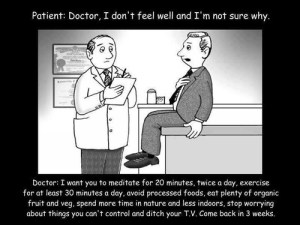
I saw this cartoon the other day and there was immediately something about it that bothered me….
IMG_0354

……what was it?

The advice from the doctor….well, I say all of those things. Not exactly as said here, but pretty close. I suspect any doctor giving advice about health probably covers a selection of these points nowadays. Maybe some would talk about “5 a day” instead of “plenty of organic fruit and veg”, and some would mention stopping smoking and drinking in moderation, but it really covers the common advice.

So, what’s the problem?

Well, the problem is you can imagine from this cartoon that this advice has become like a standard prescription. A modern panacea. Doesn’t matter who the person is, or what they are complaining about, here’s the same advice.

Who is this man in the grey suit? When he says he doesn’t feel well, what exactly does he feel? And what really are his concerns? Why has he come to the doctor as this particular point? In other words, who is he, what kind of life does he lead, and how does his illness experience fit into his life story? (There’s a clue that he is seeking a meaning when he says “I’m not sure why”

What’s missing?

The person – because we aren’t hearing the story.

Here’s the text of a post I wrote on this blog four years ago about the importance of story (the importance of story, you’ll see, is a main theme of this blog)

The people who come to see us bring us their stories. They hope they tell them well enough so that we understand the truth of their lives. They hope we know how to interpret their stories correctly. We have to remember that what we hear is their story.

Robert Coles in “The Call of Stories”.

Stories have always fascinated me. I love them. Every day when I sit in my consulting room patients tell me the most amazing, fascinating and unique stories. As a medical student I was taught how to “take a history” – I hate that phrase actually – who’s doing the “taking” and what exactly are they “taking” and from whom? Doesn’t seem right to me at all. Instead I prefer teaching medical students how to listen to patients’ stories. However, the point is that this is the beginning of all diagnosis. To a certain extent listening to the patient’s story is a diminished art. There’s an over-reliance on technology and a lot of doctors just don’t seem to be able to make a diagnosis without a test these days. Diagnosis is a form of understanding. It’s a process of trying to make sense of somebody’s experience.

If stories are so important in clinical practice, then how can I learn to handle them better I wondered? There is a developing area of medicine known as “narrative-based practice”, with associated “narrative-based research” methodologies, but materially-orientated, reductionist scientists look down on narrative. They prefer data. So, when I started to study narrative (which, technically is the story AND the way that story is told), I couldn’t find much work from a scientific perspective. I had to turn to the humanities.

One of the books which I really love in this area of study is “On Stories” by Richard Kearney (ISBN 9-780415-247986). Not only is it a fabulous exploration of the place of story in human life, but it’s written completely beautifully. Richard Kearney is a philosopher but he’s also a magnificent writer. This one book taught me more about the importance of story than any other.

Telling stories is as basic to human beings as eating. More so, in fact, for while food makes us live, stories are what make our lives worth living.

This sets stories at the heart of human existence – not optional, but essential.

Aristotle says in “Poetics” that storytelling is what gives us a shareable world.

The key word there is “shareable”. It’s through the use of story that we communicate our subjective experience and its through the sharing of subjective experience that we connect, and identify with others.

Without this transition from nature to narrative, from time suffered to time enacted and enunciated, it is debatable whether a merely biological life could ever be considered a truly human one.

Beautifully expressed. Sets narrative at the heart of what it means to be human and stands it against those who would take a materialistic view of life which they claim can be reduced to data sets and DNA.

Every life is in search of a narrative. We all seek, willy-nilly, to introduce some kind of concord into the everyday discord.

This is one of my favourite lines in the whole book. This is exactly the power of story – it enables us to “get a handle on” life, to bring some kind of order out of chaos.

What does Richard Kearney mean by story then? Well, I’ll finish this post with two more quotes from his book which make it very clear and very simple.

When someone asks you who you are, you tell your story. That is, you recount your present condition in the light of past memories and future anticipations.

This shows that story collapses time, bringing the past and the future into the present. Story telling requires memory, imagination and expression.

Every story requires –

a teller, a tale, something told about, and a recipient of the tale.

Nice and simple, but what profundity lies in there. For every story, there is a unique human being doing the telling, there is the story itself and its subject matter, and, very importantly there’s the recipient – the listener or the reader. Story is, as Aristotle said, a way of creating a shareable world. That’s the greatest potential of blogs, I reckon. By sharing our stories we create a shared world. Yes, sure, stories can divide as well as connect, but without stories, there is no potential for connection, no potential for compassion and no potential for the creation of a meaning-full, and better world.

Read Full Post »

« Newer Posts - Older Posts »