Feeds:
Posts
Comments

Archive for the ‘narrative’ Category

The Scottish Storytelling Centre in Edinburgh hosted the International Storytelling Festival last week and I participated in a series of workshops entitled “Stories and Cures”. What a fantastic, stimulating, rich experience with a diverse range of nationalities and disciplines taking part. Right at the start of the week I heard something I’d never heard before.

Back in the 18th and early 19th centuries throughout Europe when a person wished to consult with a doctor, there was a practice of letter writing. Someone would write a letter to the doctor whose advised they wished to receive. The letters were typically the person’s story, in their own words, describing what they were experiencing and the contexts of those experiences. In other words, the letters weren’t just lists of symptoms, and certainly weren’t tables of figures or readings, but, rather, they were highly personal, unique life stories.

The doctor would then write back, commenting on parts of the person’s story and giving a range of advice , often touching on issues of morals, hygiene or spiritual life. This was the beginning of a conversation which might be followed up with further exchanges of letters and/or with meeting up for face to face consultations.

Joanna Geyer-Kordesch, whose research as a Professor of the History of Medicine was the basis for this series, has read hundreds of such letters in English, German and French.

I didn’t know such a practice had ever existed.

Just think for a moment how different this practice was from our current doctor-patient relationships.

First of all, the record of the person’s illness is now created and held by the doctor. The stories have been turned into case notes and typically it would be extremely difficult to gain any understanding of who the person is if you were to read these notes. Doctors notes (I don’t think they usually could be stretched to be considered as stories) are mainly lists of symptoms, physical findings and results of investigations, then diagnostic labels based on pathology. The advice recorded certainly isn’t in the form of a conversation or exchange with the patients. In fact advice is more likely to have been replaced by a list of drugs prescribed.

What are the consequences of this change?

There has been a shift in power – from the person to the doctor, or the institution. This shift in power is so great that the words recorded are much more likely to be the doctor’s words and his or her interpretations of the person’s experience, rather than any record at all of the story the person has told (it’s not like that where I work because we have a tradition of writing down the patient’s actual words as much as we can – however, it’s still the doctor making and holding the record, not the person whose life it is)

There has been a shift in focus – from the person to the pathology. As Eric Cassell so beautifully describes in his “The Healer’s Art”, and “The Nature of Suffering”, illness is what the person goes to the doctor with and disease is what he comes home with.

It seems to me we’ve lost sight of the human being in the process. By reducing someone to a mere physical body to measured and imaged, we have dehumanised Medicine. The PERSON has been lost. How do we get the PERSON back into the centre of the stage? How do we get the individual’s agenda back at the heart of the medical engagement? How do we regain the truth of the uniqueness of every single human being and move away from the mass production processes of reducing people to diseases, diseases to “managed”, rather that people to be healed?

A good starting place would be to enable people to tell their stories – in their words, in their order of priority, in their own style – to reveal not just their sensations and experiences, but also their choices, their values and their beliefs (and what about the creation of the record? How and where would you create the record of your illness and your healing?)

Maybe valuing each individual’s story would begin to let us re-humanise Medicine?
Read Full Post »

Every day at work I’m focused on trying to understand another person. Every patient who comes to our hospital is seeking, amongst other things, an explanation.

If someone has been given a diagnosis of, say, Multiple Sclerosis, amongst the many questions they are likely to have, are “What does this mean?”, “What does it mean to me, and to my life?”, “How has it come about?”, “Why me?”, “What is this illness and what things are going to make it better, or worse?”

We all have many other questions too, but these questions are amongst the ones to do with explanation.

It’s perhaps even worse when a clear diagnostic label hasn’t been given. When someone suffers chronic pain, chronic fatigue or chronic low mood but “all the tests are normal”. What then? What’s going on?

Explanation involves getting to know someone. If we limit the explanation to a tissue level e.g. “arthritis”, or to an organ level e.g. “angina”, then we stop before we explain this illness in this particular person’s life. And if we want to help the person, not just the “arthritis” or the “angina”, then we’re going to have to take into account the uniqueness of this person’s experience of this particular illness.

A major way we can do that is through story.

It’s through the telling of a story that we gain our insights, and our explanations. For me, two of the questions I want to answer with every patient are “what kind of world does this person live in?” and “what are their coping strategies?”

The kind of world we live in is fashioned by our beliefs, our values and our circumstances (our contexts or environments, physical, relational, cultural), and the way we try to adapt to the changes in our lives are manifest in our default and learned strategies.

In an article entitled, “What do we know when we know a Person?”, Dan McAdams points out that the explainer, or the observer is also important  –

One must be able to describe the phenomenon before one can explain it. Astute social scientists know, however, that what one chooses to describe and how one describes it are infiuenced by the kinds of explanations one is presuming one will make. Thus, describing persons is never objective, is driven by theory which shapes both the observations that are made and the categories that are used to describe the observations, and therefore is, like explanation itself, essentially an interpretation.

In other words, my world view and my coping strategies will influence what I see, what I hear and what sense I make of the patients who consult me. I’ll return to that issue in another post, but Dan McAdams article starts with an interesting conceptual framework for what we know about another person.

Individual differences in personality may be described at three different levels. Level I consists of those broad, decontextualized, and relatively nonconditional constructs called “traits,”…….At Level II (called “personal concerns”), personality descriptions invoke personal strivings, life tasks, defense mechanisms, coping strategies, domain-specific skills and values, and a wide assortment of other motivational, developmental, or strategic constructs that are contextualized in time, place, or role……..Level III presents frameworks and constructs that may be uniquely relevant to adulthood only, and perhaps only within modern societies that put a premium on the individuation of the self…..Thus, in contemporary Western societies, a full description of personality commonly requires a consideration of the extent to which a human life ex- presses unity and purpose, which are the hallmarks of identity. Identity in adulthood is an inner story of the self that integrates the reconstructed past, perceived present, and anticipated future to provide a life with unity, purpose, and meaning.

You can read the full article by Dan McAdams here.

So, how do we get to know someone? Partly it involves knowing ourselves, being aware of our own way of seeing and experiencing the world, knowing what we pay attention to, what we are fascinated by, disinterested in, what we believe and what we value.

And, partly, it involves a focus on the telling of a story – one which “integrates the reconstructed past, perceived present, and anticipated future to provide a life with unity, purpose, and meaning”.

That’s a good start, I reckon.

Read Full Post »

One of the main themes of this blog, and probably a core theme of my daily work as a holistic, integrative doctor, is the place of narrative in our lives.

I recently mentioned in another post that working with patients’ narratives was a part of what I and my colleagues do every day at the Centre for Integrative Care in Glasgow. A couple of readers have asked me to say more about that and I thought I’d pull together some thoughts into this post.

One of the first books I read which impressed me about the importance of stories in medical work, was Arthur Frank’s “The Wounded Storyteller”. In this book, which is the product of years of research, Frank claims that there are two very common types of story patients present to clinicians – “restitution” stories, and “chaos” stories. He proposed that we can think of these as two primary “genres” of story. The former is probably the commonest in biomedicine healthcare. It can be captured with the phrase “I’m broke, please fix me”. It’s an approach to illness and health which considers that disease is a dysfunction or lesion somewhere and that if the bit that’s wonky could just be fixed then all would be well. The latter is also very common, especially when there are a multitude of symptoms and the person has  become lost in the illness.

Frank proposes that a clinician’s job is to help patients turn these stories into “quest stories” – based on the principles of Joseph Campbell’s hero narrative.

The integrative journey from stuckness or chaos to flow and coherence emerges out of this creation of a new narrative.

Another reason to work with narratives is the human need for myth creation. We are meaning seeking creatures, and the myths, or universal stories, as Karen Campbell calls them, shape our lives. So it makes sense to understand which myths we’ve incorporated into our stories.

Shifting from the materialistic, reductionist myth to a soulful, heart-focused, holistic one, allows the creation of a much more positive story, one which brings hope, and which opens up the possibilities of a different future path.

A key component of the creation of a future with a more clear set of potentials is choice. William Glasser’s Choice Theory, turns our narratives on their heads, and focuses us on the verbs we use to describe our experience. What emerges is a much more autonomous, more powerful story – a shift from passivity to activity, from victim to autonomous individual, from zombie to hero.

But it’s not just the verbs in our stories which are important. It’s the metaphors too. The amazing work of Lakoff and Johnson demonstrates the embodied nature of metaphor, and in so doing gives us the opportunity to pick up on the metaphors we are using, including the bodily locations of our diseases or disorders, and gain a profound understanding of the meaning of our illness experiences.

I hope for stories of improvement as I work with patients, but the stories which excite me the most, are the ones of transformation. Yet again, this week, I’ve heard several such stories. That makes it a complete thrill and delight to be able to practice Medicine this way.

Read Full Post »

I’m a great fan of stories. In fact, I think we understand ourselves and others by using narrative, and the central way in which I work as a doctor is to hear people’s stories, and help them to change them from stories of being stuck or in chaos, to stories of flow, and flourishing and growth.

I’m also a great fan of fiction and the importance of the imagination. I vividly remember Ian McEwan writing this, about this day, ten years ago…

If the hijackers had been able to imagine themselves into the thoughts and feelings of the passengers, they would have been unable to proceed. It is hard to be cruel once you permit yourself to enter the mind of your victim. Imagining what it is like to be someone other than yourself is at the core of our humanity. It is the essence of compassion, and it is the beginning of morality.

So, this recent article in the Guardian caught my eye, “Reading fiction improves empathy, study finds”. There are a number of studies described in this article, and it’s introduced me to something called “the pyschology of fiction”, and, specifically to the work of Keith Oatley. If I wasn’t so insatiably curious I wouldn’t keep finding these amazing new worlds to explore! One of the studies described in the article compared the effects of reading Harry Potter with the effects of reading Twighlight. They used a new measure – “Twilight/Harry Potter Narrative Collective Assimilation Scale”! Don’t you love that? Look at this conclusion from that research –

“The current research suggests that books give readers more than an opportunity to tune out and submerge themselves in fantasy worlds. Books provide the opportunity for social connection and the blissful calm that comes from becoming a part of something larger than oneself for a precious, fleeting moment,” Gabriel and Young write. “My study definitely points to reading fulfilling a fundamental need – the need for social connection,”

and read this fascinating comment by Keith Oatley

“I think the reason fiction but not non-fiction has the effect of improving empathy is because fiction is primarily about selves interacting with other selves in the social world,” said Oatley. “The subject matter of fiction is constantly about why she did this, or if that’s the case what should he do now, and so on. With fiction we enter into a world in which this way of thinking predominates. We can think about it in terms of the psychological concept of expertise. If I read fiction, this kind of social thinking is what I get better at. If I read genetics or astronomy, I get more expert at genetics or astronomy. In fiction, also, we are able to understand characters’ actions from their interior point of view, by entering into their situations and minds, rather than the more exterior view of them that we usually have. And it turns out that psychologically there is a big difference between these two points of view. We usually take the exterior view of others, but that’s too limited.”

Spot on. He really nails the importance and value of fiction as a tool for building empathy. We reduce the place of the Humanities in our education system at our peril!

Read Full Post »

One of my favourite lines from Bob Seeger is “I wish I didn’t know now what I didn’t know then”.

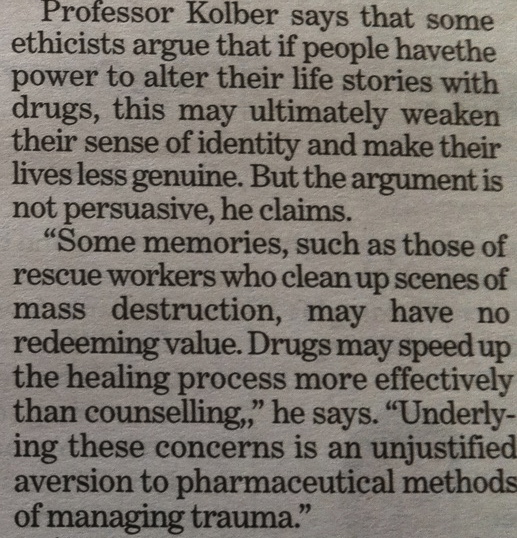
However, I was a little startled by a piece in the “i” newspaper last week about drugs which can wipe out memory. Here’s a jpeg of the bit of the article which really took me aback….


I don’t know about you, but as best I understand it our memories are a key part of the stories we tell ourselves and others to create both a sense of self, and to make sense of our lives.

Who’s to say that a painful memory has no value. A painful memory will probably always be a painful memory, but our responses to painful episodes can be the important foundations of who we become.

Before I go…..here’s the song in question (performed by Toby Keith)

Read Full Post »

In a consultation recently, the question of what makes an experience or a relationship meaningful came up. Whether or not something feels meaningful is something we seem to know intuitively. We don’t usually sit down, consider the details, weigh them up, then reach a calculated conclusion. But what makes an experience or a relationship a “meaningful” one?

I think there are at least two dimensions to this.

How does this experience, or relationship, fit in to my story?

A story, or a narrative, has a beginning, a middle and an end (actually, I’m increasingly doubtful about this concept of an “end”!). Let’s say then, that in constructing the story of my life, I consider the present as it emerges from the past and lies in the context of the possible futures. We do create a sense of who we are by telling ourselves and others a story – the story of my life. This is one of the two dimensions of meaning. How does this experience fit into my story? Is it strongly embedded? Is it complexly and multiply connected? How does it relate to all that has gone before, and how might it influence the scope of the possible futures? We tend to feel something is “meaningful” when we can make sense of it within our story, and when it is deeply connected to so much of our story.

Secondly, we tend to feel something is meaningful when it makes a big impact. This feels like a second dimension of meaning. The power, the strength, the depth even, of the impact. You could say this is “significance” or you could simply call it “impact”. Of course, it’s likely that the strength of an impact will have an influence on the extent to which it becomes an important part of our story.

Maybe the less meaningful experiences, are covered by a line, or a few words in our story. A paragraph at most. And maybe the more meaningful ones gain an entire chapter, or even volume, of their own?

Read Full Post »

I recently stumbled over Arthur Frank’s “The Renewal of Generosity” (ISBN 978-0226260174). Many years ago I read and was hugely impressed by his “The Wounded Storyteller”. It’s a great small book which is an important contribution to the struggle to create a better way of practising medicine in the 21st century. Doctors and patients are increasingly demoralised by the reduction of health care to technical procedures and the delivery of products (what Dan Siegel describes as “diagnose and drug” in his analysis of contemporary psychiatry). The everyday, subjective experiences of both patients and doctors are dismissed as irrelevant in the pursuit of measurement, targets and throughputs. Isn’t it some kind of indictment of our current health care that he can say this on page one –

My conviction is that at the start of the 21st century the foremost task of responding to illness and disability is not devising new treatments, though I’m grateful this work will proceed. Our challenge is to increase the generosity with which we offer the medical skill that has been attained.

That’s the word which really struck me – generosity. I think a lot about compassion and its central place in good health care, but I’ve not really considered the work generosity. It’s such a good word. Somehow it not only encompasses compassion but it contains within it a sense of enlarging life – my own life, and the lives of others to whom I am generous. It’s a welcoming, loving, life growing word. It’s a good word to bear in mind when considering “how to live”, how to find happiness and how to create well-being.

His key theme in this book is to weave together the teachings of ancient Stoicism (a much misrepresented classical philosophy I believe), with the case for dialogue. He primarily draws on the writings of the Stoics, of Levinas and Bakhtin.

The practice of medicine is a relationship between two people. What are we to call these two people? As a doctor, I’m fairly comfortable with the term, “patient”, but it bothers me that it seems to imply something passive, expecting the ill person to just be treated, and that contains the seeds of objectification – treating people not as people, seeing them as instances of disease, instead of persons who suffer. I hate the word “client”. It’s laden with commercialism and contractualism for me. However, Frank pulls a different set of words out of the bag and they hit me between the eyes –

The renewal of generosity will be hastened if participants in medical relationships think of themselves not (at least not only) as patients and professionals, much less as consumers and providers, but as guests and hosts.

Guests and hosts! He elaborates and explains, but I won’t share that here. Just think about this idea for a moment. I’ve never encountered it anywhere else. Wonderful.

I love so much of what he has to say about the importance of dialogue –

Dialogue suggests that the world is co-experienced by two of more people. Each one’s perspective is necessarily partial, and each needs to gain a more adequate sense of the world by sharing perspectives.

I wrote about that from a neuroscience perspective recently here.

The enlarging of perspective, or, in the other words, the attempt to see a more full picture demands dialogue. It prevents us from dismissing others through judgement and classification.

…no final, finalising discourse that defines anything once and forever. No last word can be said about this you, whose horizons of possibility remain open.

“whose horizons of possibility remain open”……how often do we forget that? How often do we squash hope with the illusion of certainty? How often do we practice as if we know exactly what a treatment will bring about for the person undergoing it? Having open horizons of possibility is a characteristic of healthy living.

We have other good reasons for dialogue apart from sharing our perspectives to gain a fuller picture. We use dialogue to value the other.

…the moral demand of dialogue is that each grant equal authority to the other’s voice……it’s being willing to allow their voice to count as much as yours

[doctors] are taught monological medicine: the doctor is the one cognitive subject in the consulting room, and the patient is an object for that cognition.

Identification with others requires giving up monologue.

The other element which we have to consider when we focus on dialogue is the other part of the doctor-patient (or host-guest) relationship – the carer. I think our system of medicine dismisses this almost entirely. The focus on “randomised controlled trials” is a focus on the statistics of groups. Once a drug or treatment is “proven” it seems to be irrelevant who delivers it, or how. Yet that’s not our experience when we are ill. Who the doctors and nurses are is important to us. How they talk, how they listen, how they treat and care for us. The idea that its the treatment which is important and the not the person administering it seems inhuman to me.

We can keep the question before us: what do they think about how I am imagining them? and we can believe that what they think matters.

We should honour patients’ stories, not dismiss them as “subjective” or “anecdotes”. They matter.

Finally,

…the person who we see ourselves revealed to be is seen most fully in others’ responses to us

Isn’t that so true? What have you seen of yourself in others responses to you today?

Read Full Post »

In “The Wounded Storyteller” (ISBN 0-226-25993-5) Arthur Frank describes his study of how patients talk about their illnesses, where he identified three major “genre” of narrative which we use to talk about illness – the “restitution story”, the “chaos story” and the “quest story”. I thought that was such an interesting insight and such a wonderful ideal to aim for.

Most patients tell the restitution type of story. It goes along the lines of “I’m broken, please fix me”. Our whole health care system seems created around this idea. Patients present their broken bits for fixing, the fixing is the outcome or target to be delivered cost-effectively, doctors are seen as the fixers and the process of health care is experienced as a passive one by the patient.

The chaos story is also very common. Frequently we become overwhelmed by not only the illness, but also the diagnosis and the treatments. In a chaos story a patient is lost in an ocean of suffering, confusion and distress. As they tell their story it comes tumbling out in all its complexity and it can be very hard to see the person who is suffering from the vast intense collection of symptoms and problems. Indeed, even the storytellers can’t find themselves any more in the middle of this terrible experience.

Frank proposes a beautiful alternative genre of story to tell – the “quest story”. A quest story has certain clear elements and they are the ones you find in “hero stories” in all cultures around the world. The “hero”, he proposes, is the patient. Their quest is health. The adventure is the illness. As the patient encounters various investigations, diagnoses, symptoms and treatments, they are experienced as challenges which need to be met in order to gain “boons”. It’s the gaining of these boons which grows the hero into the person who can attain the goal of the quest. (Think of the traditional tale of the prince who wants to marry the princess but first is told he needs to slay the dragon, overcome the wicked witch, and so on, before he can become the man worthy of the princess’ hand in marriage).

One of the best examples of this is Lance Armstrong‘s autobiographical “It’s not about the Bike” (ISBN 978-0224060875). Lance is a professional cyclist who was a great sprinter but when he tried the Tour de France he found he didn’t have the stamina for it. He developed testicular cancer with widespread metastases and was given only a slim chance of survival. He underwent surgery and chemotherapy successfully, became depressed by the whole experience, then got back on his bike. A year later he entered the Tour de France and won it. He went on to win it eight times in a row – more than any man has ever done before. In his book he says if he’d had to choose between cancer and winning the Tour, he’d choose cancer every time. That shocked me when I read it. He went on to explain, cancer and dealing with it made him the man who could win the Tour de France. That’s a quest story! (let me be clear – he’s not advocating cancer as a good thing, something to be welcomed, or worse, sought – he’s telling the story of how dealing with a serious illness can actually grow us, ultimately changing our lives for the better)

The challenge, I think, is to find a way to live, which is a quest story in it’s own right……to become heroes, not zombies.

Read Full Post »

BBC Radio 4 broadcast a really interesting programme this week entitled Metaphor for Healing. I don’t think you’ll be able to listen to it (unless it’s still on the BBC iPlayer) but they’ve put up a good page about it on the bbc website. There’s obviously a link between issues of metaphor and those of visualisation. In fact, in some ways metaphors are tools for visualisation aren’t they? The programme talked a bit about Jan Alcoe, who used visualisation to both cope with both her disease and her treatment. It’s not hard to think that every patient should have a session about this before undergoing chemo and radiotherapy. I’ve read a lot about visualisation in cancer settings before so although her story is a particularly impressive one, it didn’t tell me anything really new. However, the rest of the programme was about the conscious use of metaphor in consultations, and I’ve not heard that discussed so clearly before.

Dr Grahame Brown, a musculo-skeletal specialist at the Royal Orthopaedic Hospital in Birmingham, claims he is able to save hundreds of patients from the need to have spinal surgery every year simply by “reframing the negative metaphors that have been unwittingly used by their doctors that can lead to a destructive and self-fulfilling cycle”. Many of the patients he sees have been referred for surgery after becoming convinced their spine is ‘crumbling’ or that they have ‘degenerating’ disc disease, when in fact they have a prolapsed disc or other normal wear and tear that is common in most people. Yet anxious patients latch on to these suggestions and become convinced that things are only going to get worse.

Now this really is fascinating. By becoming aware of the metaphors used by the patient (typically those given to them by other doctors) which make it harder for a patient to break free from chronic pain, then giving them different metaphors, he helps them change the way they think about, perceive, and, ultimately, experience their pain. He claims that this can have such a dramatic, quick effect, that many escape not only the need for surgery, but also escape from their pain.

It’s an impressive outcome.

There is specific mention of two techniques, or approaches, based on metaphor, used by people in this programme – the Human Givens method, which is a fascinating counseling technique, and the Clean Language approach, which is based on a technique developed by a practitioner inspired by “Metaphors we live by” written by Lakoff and Johnson, one of the books which have changed the way I think about the world. Fascinating to see these ideas turn into practice.

Read Full Post »

Human beings are sense-making creatures. We continuously process all the information we can gather from our environments – internal and external – and try to put the information together somehow. I think we use two particular sets of skills to do this, and they’re related.

The first skill is pattern spotting.

What do we think when we look up and see this?

oak

We pick out the colours, the shapes and the contexts of what we see, and we name it – sunlight behind oak leaves, casting overlapping shadows.

This happens so quickly and effortlessly that we don’t even pause to wonder about it. In fact, we’re seeing patterns everywhere, all the time. It’s a fundamental skill needed for understanding.

The other skill we use is storytelling, or narrative. We “join the dots”, or “put things together” by creating narratives. By creating stories we make sense of the patterns we see. Personal sense. When you look at this oak tree for example, you’ll perhaps become aware of certain feelings, and maybe those feelings related to previous experiences involving oak trees. As a species we create stories about trees, and, specifically, about oak trees, so maybe some of those stories will come to mind and your experience of looking at this tree will be enriched by that.

Well, here’s an interesting study which explores how we might enhance these core skills. The first sentence of the report caught my attention –

Reading a book by Franz Kafka –– or watching a film by director David Lynch –– could make you smarter.

Pardon?

Well, according to the psychologists who conducted this study –

exposure to the surrealism in, say, Kafka’s “The Country Doctor” or Lynch’s “Blue Velvet” enhances the cognitive mechanisms that oversee implicit learning functions

It appears that reading a text, or watching a movie which is challenging to understand because it doesn’t appear to make sense, enhances our skills in making sense! I suppose it’s a bit like going to the gym (I wouldn’t know….never been!) and practising using your muscles so that they then work more efficiently and with greater strength.

Well, the questions which arise about what do they mean by “smarter” are answered by the specifics of the study. What they actually showed was that after reading Kafka, or watching a David Lynch movie, a person’s ability to spot patterns was enhanced.

Interesting. Actually, I spend most of every day trying to spot patterns, listening to stories, and trying to make sense of what I’m seeing and hearing. You could say that’s my job. But how interesting, even from the perspective of training doctors. Maybe we should be encouraging doctors and medical students to encounter surrealism, to read Kafka and watch David Lynch. Maybe that would help them to become more skilled doctors. The practice of medicine isn’t all about learning facts after all.

Read Full Post »

« Newer Posts - Older Posts »