Feeds:
Posts
Comments

Archive for the ‘narrative’ Category

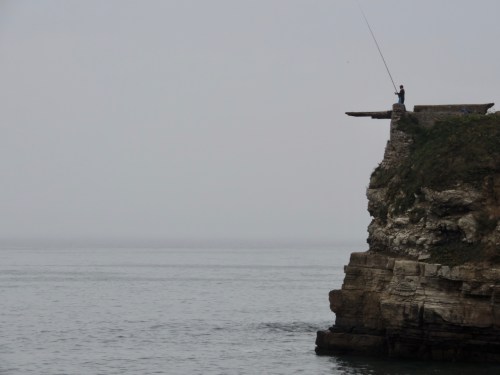
I took this photo in Gijon, Spain a while back. I’ve returned to look at it many, many times.

There’s something hear which captures my attention and provokes my thoughts.

I’ve always been struck by two things in this image. The first is the solitary nature of the fisherman. It reminds me how we humans are constantly addressing two apparent opposites. We are highly social creatures. We need relationships. We need to connect. We want to share. On the other hand, every one of us is unique. Every one of us experiences this universe from the position of the subjective self. There’s no alternative to that. We need to know that we exist, that we are seen and heard, that we can exert our will and make a difference in the world. We all need some time alone. Alone with our thoughts, our memories, our sensations and experiences. And, yes, it’s also great to share.

The other thing is the distance between this fisherman and the water (and therefore the fish!). It looks a LONG way down. I can’t see his fishing line but I can see that the rod he is using seems huge. There does seem to be a man-made ledge at the top of this cliff so I’m guessing it’s a good place to fish. And as I’ve never fished in my life, I know nothing about fishing, but I’m going to guess that a good place to fish is where you catch fish. There would be little point in standing there dangling a line into the sea far below if you never caught a fish, would there? (Or maybe there would. Sometimes I wonder if the main pleasure from fishing comes from the solitude, not from catching anything. But maybe some of you do go fishing and you can tell me)

As I look at this image again today, well into our third week of lockdown in the midst of this pandemic, I see a third thing – hope.

Hope?

Yep, hope.

Here is a man, a solitary man, standing far above the source of what he hopes for (fish?), but with sufficient hope to actually stand there.

I think that’s one of the things we need at this point – hope.

I hope for an end to this pandemic and its deaths and confinements.

I hope for a re-evaluation of the world we live in.

I hope we carry forward our new-found admiration and respect for all the people in under-valued jobs who keep our societies going – the health workers, the carers, the cleaners, the food producers, the transporters, the cashiers, the shelf-stackers, the teachers, the people who keep the water flowing, the lights on, the heating working, the researchers and innovators……has this list got an end? I’m sure you are already thinking of other workers whose importance to us all is suddenly coming to the fore.

I hope we shift our focus and our energy away from competition and control towards co-operation and helping.

I hope we learn from this experience.

I hope that what we learn leads us to make different choices.

I hope we take forward this valuing of human beings and relationships and build it into our new societies.

What do you hope for?

Let’s begin to imagine what kind of world we want to build together in the light of what we know now.

(My list of hopes is by no means complete. I only hope I can inspire you to start to make your own list)

Read Full Post »

What colour is the sea?

Blue?

Like the sky?

Green?

Like grass?

White?

Like clouds?

What colour is the sand?

Yellow?

Like lemons?

Grey?

Like stone?

Blue?

Like the sky?

Here’s one thing I’ve found….the more I pay attention to the particular, the more I see (or hear, or smell, or taste, or feel)

We use our left cerebral hemispheres to focus on parts or aspects, label them, categorise them….which is all useful of course, but if we leave it at that we stop seeing reality as it really is.

We need to reintegrate that information into the right cerebral hemisphere to see its contexts, its connections and relationships to everything else. Only then do we experience the particular, the uniqueness of all that is real.

I found that in my work with patients. It was never enough to apply the diagnostic label and think of the patient as just an example of that – whether that be a “diabetic”, an “asthmatic”, or whatever. I had to pay attention to the specifics, to this particular patient’s unique story. Only then could I experience the reality of who they were and understand what they were experiencing.

So, here’s something to try today. Slow down and take your time to pay attention. Explore, as much as possible without labelling. Or, actually, it’s pretty tough not to label, so once you apply the label, just say to yourself, ok, this is an apple (or whatever it is you are exploring), but then, what colours do I see, what textures do I feel, what scents do I smell, what sounds do I hear as I interact with it (turning it over in your hand, running your fingertips over its surface, biting into it…..only if you are exploring something edible of course!)

You get the idea?

Pick anything you like. An object, a song, a view, a flavour, a scent, a sensation. Slow down, pay attention, notice the labels which pop into your head, then continue to explore.

Allow yourself to experience the diversity of the unique.

Read Full Post »

There’s no doubt this is a very challenging time for very many people. This pandemic is shining a bright light on many problems which we’ve collectively tolerated or ignored.

For me, perhaps THE most impressive feature of this crisis is how human beings are connecting and caring about each other. I know, you might think that’s an odd thing to say when we are all being told to “self-isolate” and practice “social distancing”, (I don’t like either of these phrases, preferring “physical distancing” for the latter, and “sheltering” for the former) but you’ll have seen people on balconies singing, shouting to each other, clapping to salute the health care workers. You’ll have seen people offering their talents and creativity online with free lessons, concerts, publications. You’ll have seen hundreds of thousands of people volunteering to make sure neighbours are safe and nourished. You’ll have seen health care workers, drivers, emergency workers, people who work in the food production and supply chain, and many, many others giving 100% to keep others safe, to heal, to nourish, to support.

You’ll have seen that scientists and researchers around the world are publishing and sharing their work freely and widely without barriers between nations and peoples. We human beings are absolutely brilliant at learning from each other.

We all live on the shoulders of giants.

There is an outpouring of love, of care, and of compassion. Maybe more on a global scale than I’ve seen at any other time in my life.

I’m not naive. I know there’s a lot of evil, cruelty, injustice and selfishness too. But I just want to a take a moment today to celebrate our human ability to make connections, to care, to love, to learn from each other, and to collaborate.

I hope we build the next phase of our lives together on those principles.

Read Full Post »

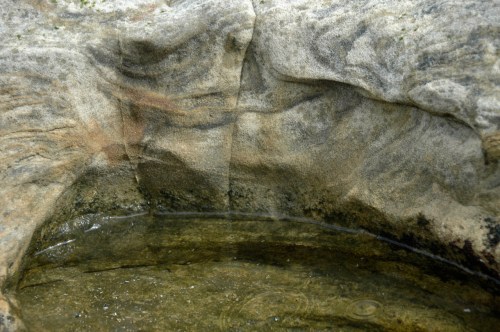
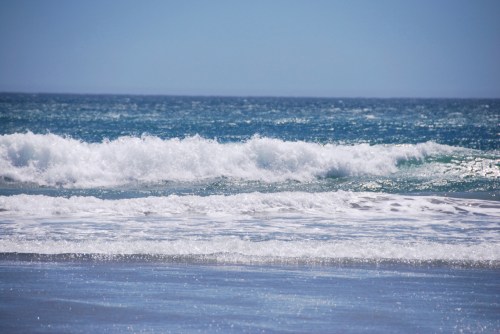
When I look at this the first thing I think is “how beautiful”. It’s like a work of art, isn’t it?

Look at the sweeping lines, the layers, the smooth surfaces and the ripples in both the water and the stone.

The next thing I think is how similar AND different the water and the stone are…..those colours, surfaces and lines, but the stone which changes over millennia while the water changes over seconds.

The third thing I think is how the universe began, fourteen billion years ago or so, first with only a couple of different atoms, then a few more as the creative and destructive furnaces of the stars kicked into action, and how every single element we’ve found on this planet was created, atom by atom, in those vast clouds of stars millions of light years away. Then over millions of years how the Earth was fashioned into the incredible substances, structures, materials.

It astonishes me.

The fourth think I think when I contemplate this image is how all the water, all the rocks, all the air which moves around as winds across the face of the Earth and the Sea, all the heat of the Sun which beats down upon us, makes this one, precious place for us all to live.

One of my favourite books of all time is Thomas Berry’s “The Great Work”.

Read Full Post »

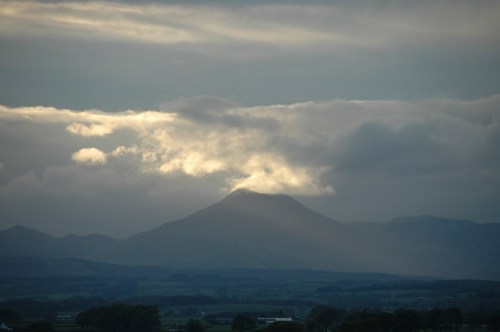
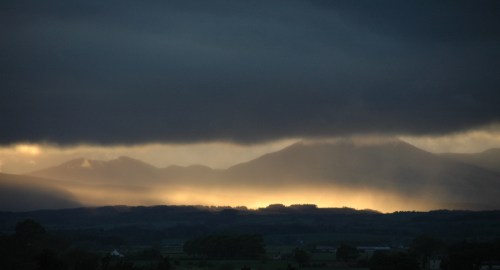
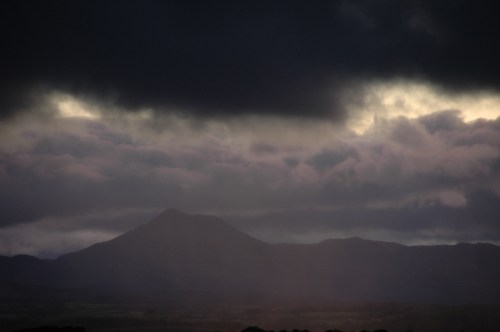
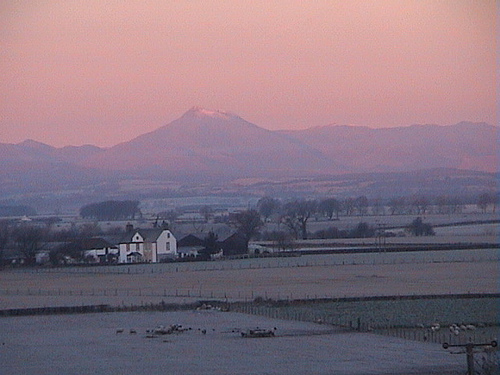
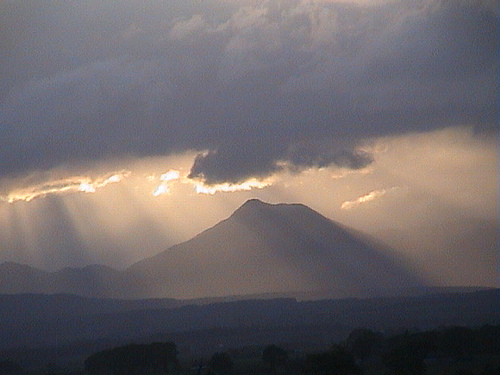
When I lived in Cambusbarron in Scotland I looked out of the window each day and saw Ben Ledi. I quickly realised that this mountain looked different every day, so I started taking photos of it. I took a LOT of photos.

I was constantly amazed how my usual experience was not of looking at the same scene every day, but seeing a different scene.

I know, maybe you are thinking, but it’s the same mountain. It’s just the clouds and the light which is changing….

But the mountain doesn’t exist by itself. It exists in a place and a time. I can’t see the mountain disconnected from the world in which it exists. That wouldn’t be real, would it?

I think the world is like this.

Absolutely everything is connected. Absolutely everything exists in webs of contexts and environments.

It changes moment by moment. Everything we see, hear, smell, touch and taste changes constantly as the streams of molecules, energies and information flow through, influencing, creating, disrupting.

So, today is always new.

This moment is always new.

We humans are good at doing something called “abstracting”. We isolate a part of what we are experiencing and consider it as if it is separate, disconnected, un-attached. We call these abstractions “things” or “objects”. Or we call them “outcomes” or “results”.

But we have to return our abstractions to reality eventually and then we seem them as less isolated, less fixed, less separate than we thought.

I never felt I could understand a patient by isolating their disease from their life. I never felt I could understand someone’s illness if I considered only the changes in certain cells, organs or tissues.

When we tell our stories, part of what we are doing is describing some connections…..some sequences, some consequences. We describe events, experiences and emotions, and together they combine to make every day, every moment, every place and every relationship, unique.

What did you notice today?

Was there something familiar which you experienced differently today?

Read Full Post »

With all the “social distancing” that is going on, and being urged upon us, I thought it might help to remember this line from Saint Exupery’s “The Little Prince” –

The important things in life you cannot see with your eyes, only with your heart.

I don’t really like the term “social distancing” because I think we need each other now more than ever.

What’s important during this pandemic is to reduce the time you spend in the same physical space as other people. The more physical contacts you have, the more chance you will catch this virus and spread it to other people. A French official put it well the other day when he said – don’t think how can I avoid catching this, think how can I avoid spreading it to everyone else?

I think that’s a useful flip because people spread this virus without having any symptoms, and while, chances are if YOU get this virus then it won’t be serious, for about one in every five people it will be. Reducing your physical contacts now is the most caring thing you can do.

But that does NOT mean to minimise your relationships.

More than ever this is a good time to tell the people you love, that you love them.

Now more than ever this is a good time to share…..to share thoughts, to share feelings, to share our stories.

We humans are perhaps THE most social of all creatures. We die without social contact. So let’s pay attention to that and increase our communications. Phone more, text more, FaceTime, or Skype more, blog more, instagram more, WhatsApp more…….whatever means you have at  your fingertips use them now.

Have you seen any of the video clips online of Italians or Spaniards on their balconies? Singing, cheering, banging pots and pans…….all saying “we are here, and we are in this together”.

As we minimise our physical contacts for now, let’s over-compensate for that, by increasing our “invisible” ones, the ones we can see only with our hearts.


Read Full Post »

I took this photo recently when visiting the Caumont gallery in Aix en Provence (before France closed down!).

I was attracted to the light shapes on the wall of the building opposite. The one on the right looks like a cocktail glass, but the other two are vaguely like kanji – which, given that the gallery had a special show of Japanese prints, is highly likely!

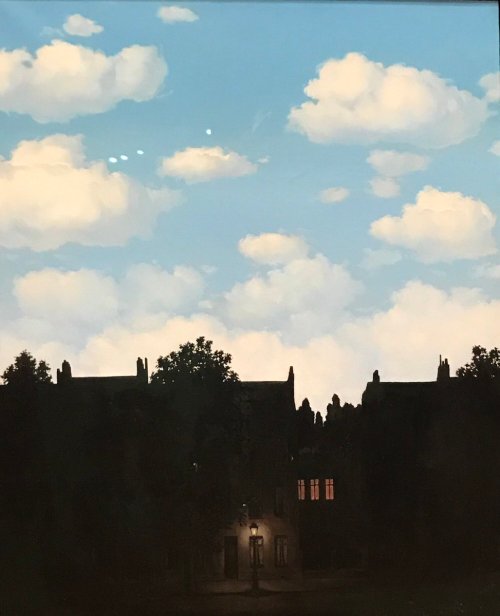
When I look at the photo now I’m reminded of two things – a famous painting by Magritte

And, a photo I took in the New Carlsberg Museum in Copenhagen of ancient biblical scripts written in Aramaic and found in Palmyra.

The room with the scripts showed the letters projected across the images on the walls as a soundtrack played of someone speaking words in Aramaic from the book of Genesis. That was one of those moments where the hairs on my arms stood up on end and my eyes got watery.

I have long since had a love of words. I have hundreds of books. I read all the time, often several books at once. I love stories and I am insatiably curious. When I qualified as a doctor I bought a complete set of Encyclopaedia Britannica with my first month’s salary. I know wikipedia might have surpassed that now but I can still get the thrill of serendipity by leafing through its pages and falling down a knowledge rabbit hole. At work I looked forward to every Monday morning because I knew it was the start of a week where patients would come and tell me their stories. Every single one of them unique.

I taught in Japan at one point and tried to learn a little Japanese. I didn’t get very far but I am still enthralled by their three alphabets – yes THREE! I chose to emigrate from Scotland to France when I retired to have the experience of living in another language and I’ve got a little collection of favourite French words for which I can’t find any direct English translations, or where the English translation feel somewhat inadequate. I love that. (Emerveillement would be my first example!) I’ve also been trying to teach myself Spanish over this last year, just because I’ve discovered Spain since moving to South West France, and have had a number of fabulous road trips there (I’m using the Duolingo app).

Words, and stories.

I’m also quite an avid reader of poetry, and I recently heard a fantastic interview with the American poet laureate, Tracy K Smith, on Ezra Klein’s podcast. Highly recommended!

With more and more of us having to put our normal lives on hold and stay at home I think this is a great opportunity to explore more books, more poems, more stories, words and art. Are you finding that too?

Read Full Post »

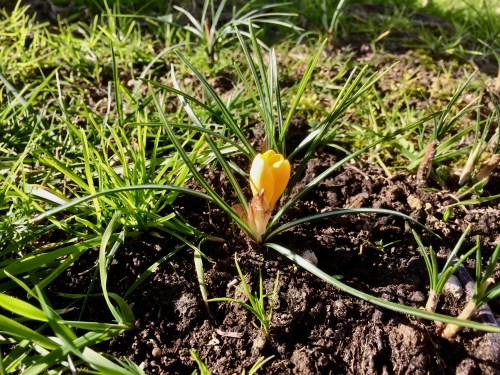
Here they come! The first little crocus flowers.

It’s the middle of January, and here in the Charente we have blue skies and a bitingly cold wind blowing from the North East (the literal opposite direction from the prevailing winds which come from the South West).

Every year in late autumn I poke some more holes in the grass around the mulberry tree and plant some crocus bulbs. Last time I planted about fifty of them. I’ve lost count of how many I’ve planted in the last five years. We have an image in mind of a carpet of yellow, purple and white crocus flowers covering the ground at the foot of the tree, but, so far, it’s never looked remotely like that, so I just keep adding a few more every year.

Did you know that there is no scientific way to tell if a seed is dead or alive? No way to know which have the potential to burst out of their shells and make their way through the soil towards the Sun. Any botanists out there can correct me, but I suspect the same applies to bulbs. There’s no way of knowing which will produce full-blown flowers, and there certainly is no way of knowing which of them will appear first.

That means that every single year the sight of the first crocus is a surprise and a delight. It’s like making a discovery. Even if I know it’s me who planted the bulbs there. That delight doesn’t go away with the appearance of the first flower either. Every single new plant brings an equal measure of delight. It’s the gift that goes on giving!

This is one of the occasions where I am struck by how we humans can welcome and embrace uncertainty. We’d like to think we can control things. We’d like to think we can predict things. And there are certainly cases where we can, but more often than not, we can’t. I worked as a General Practitioner for four decades of my life, and the core skill of a GP is to be able to handle uncertainty.

In the Primary Care setting, a GP (Family Doctor), tends to be one of the first to be consulted when a patient becomes unwell and can’t manage their illness by themselves. In my training I was taught this meant I’d see a lot of patients with “undifferentiated illness” – because in the earliest stages of illness things can be pretty vague. There might be a bit of a fever, or just a symptom or two….feeling tired, or achey, of slightly nauseous. In these early hours or days there might not be much to find amiss on a physical exam, or at least, not much to find which is distinctive of any specific disease. A few days, or even hours, later, it can be glaringly obvious! Which is why GPs learn to assess the severity of a patient’s symptoms, the over all level of their health, and the need for any urgency. We learn to review the situation as quickly and frequently as appropriate. We also learn that the future is not predictable at the level of the individual patient. We can have a good knowledge of the likely progress of certain pathologies, but we can’t predict the future path of an individual’s illness. Same thing goes for any treatment. Whether or not a certain treatment is so-called “evidence based”, only the unfolding story of this particular patient in the days and weeks ahead will reveal the course of the illness and the appropriateness of the treatment.

I can see that you might read that and despair, thinking, surely the doctor can do better than that? Surely they can predict the future with certainty. Well, nope, they can’t. What that means is that the uniqueness of the individual can never be set aside. The particularity of the person can never be replaced by the categorisation of their illness by diagnosis, or by the likely effectiveness of any treatment. At all the times, the GP has to make a judgement, based on knowledge and experience, use that judgement to decide what to do, then, crucially, follow up.

That’s why I don’t think it’s a good idea to chop the delivery of health care into little pieces. Dealing with the whole person has got a time dimension to it. We need to know how things are progressing, and make another judgement, another decision, in the light of the changes.

So, I might have started writing this thinking about a little yellow crocus popping up, by I find my train of thought exploring uncertainty, unpredictably and the Practice of Medicine, (who saw that coming?!)

Where that takes me to is – I think there are at least three crucial elements to good Medical Practice –

  1. Time – sufficient time for the patient and the doctor to get a good understanding of what’s going on
  2. Continuity of care – follow through of every event into an emerging story over hours, days or weeks
  3. Open minds – never closing down the thought processes by ticking a box, or issuing a prescription, knowing that the future, in all individual circumstances is uncertain.

I’ll leave you with one of the “new”, newly emergent, crocus flowers, by which I mean one of the new variety I planted last year which has just popped up to say hello!

Read Full Post »

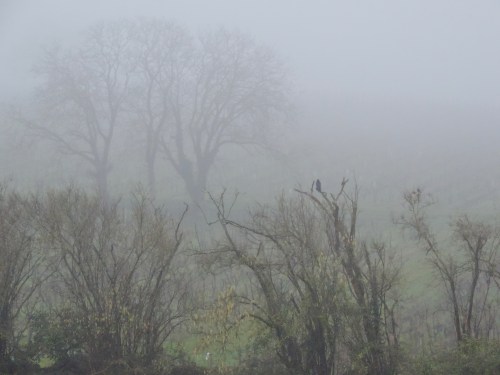
I don’t deny there is a beauty in fog.

But when I looked out the window this morning and saw that the vineyard covered hillside had disappeared, the word “obscured” popped into my head.

Fog “obscures”. It prevents us from seeing the world so clearly. It draws the horizon closer, sets a nearer limit to our perception.

Well, with that in mind, I spotted an article in Wired magazine……”To fight disinformation we need to weaponise the truth

Through social media, mainstream media and mass media, we are being manipulated on a daily basis. We are bombarded with propaganda and advertising, trying to get us to think what someone else wants us to think, to buy what someone else wants us to buy, to believe what someone else wants us to believe, to vote they way someone else wants us to vote.

When I started this blog over a decade ago I chose the title “Heroes not Zombies” because I had an idea that we tend to drift through life on autopilot, but that if we wake up, become aware, and claim the authorship of our own stories, then we become the heroes of our own stories. But, of course, it’s not just that we drift along on autopilot, it’s that we allow others to sit in the driving seat.

So, here, in that Wired article, is a wake up call, but also a kind of education. The author explains how we are being manipulated.

Cybersecurity researcher Ben Nimmo describes Russia’s approach in terms of the “4Ds”: dismiss critics, distort facts, distract from other issues, dismay the audiences. And indeed Russia has been leading the way in using disinformation-based warfare against other nations. But others are now joining them.

The article is worth reading but I thought I’d summarise the 4 “Ds” here. Just so they are nice and clear. Just so that I don’t forget them.

  • DISMISS critics
  • DISTORT facts
  • DISTRACT from other issues
  • DISMAY audiences

So, as you browse through your timelines on your social media accounts today, or read the headlines on the front pages of the newspapers, or watch the news on TV, why not write these four words down on a post-it and see what the messages you are reading look like in the light of the 4Ds?

Read Full Post »

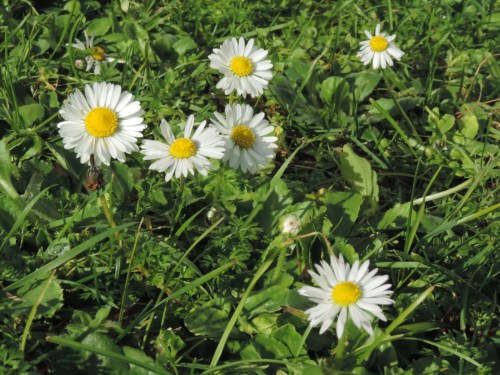
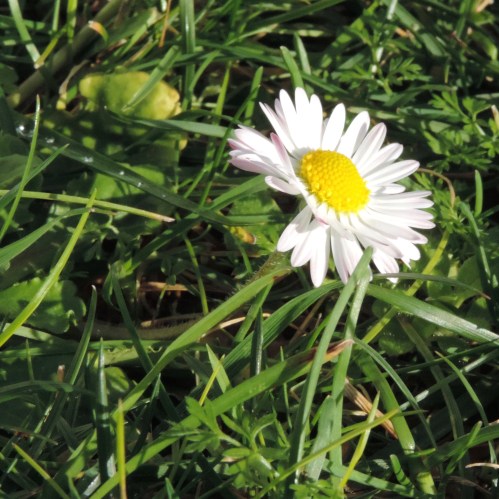
It’s almost the end of the year and a few days I go something caught my eye when I walked out into the garden here in the Charente – daisies!

I don’t know why, but I’ve always associated daisies with the summer, and I don’t remember ever seeing them flower around the time of the winter solstice, but, who knows? Maybe they do! Perhaps if you’ve more botanical knowledge than I have you’ll be able to enlighten me. However, what I’m saying is this is the first time in my life that I’ve been aware of daisies flowering in the winter time.

So what, you might ask?

Well, here’s why this interests me……

I find that when I notice something different, something new to me, that it slows me down, draws me into the here and now, makes me more present. I felt compelled to turn around, get my camera, then go back out and take some photos of these daisies. I enjoy getting down in the grass to take a close up of the small flowers which grow there, and for a few moments, as I frame and focus, I lose myself in this action. Lose myself in the sense of interrupting the almost chaotic nature of the endless flow of thoughts which seem to occupy my busy brain, and focus for a bit, on looking, on discovering, on photographing these little flowers.

So, there’s the first thing. They take me to another place, to another pace.

Second, as is often the case when I slow down, notice, savour and become absorbed by something, I find a sense of wellbeing, of joy, and of transcendence occurring. I feel nurtured by that.

Third, I start to think about what I know about this family of plants – the daisy family – what I know about them is that they have been used by humans, for hundreds of years, to treat injuries. They have a reputation for stimulating and encouraging repair and recovery. Bellis perennis (this common lawn daisy), Chamomilla, Calendula, Echinacea, Millefolium, Arnica, are all members of what we now call the Asteraceae (the daisy family). And they are all members of Nature’s Pharmacy of healing plants, used particularly in the treatment of injuries. There’s an interesting quality which many of the flowers share which relates to this repair-ability they seem to have – when you walk across the grass, standing on daisies as you go, if you stop and look back, it’s hard to see which ones you stepped on – they have great resilience, great ability to withstand and recover from trauma. Isn’t that interesting?

Fourth, and this is because of what I’ve learned over the years about these little plants, as I wander around the garden, crouching down to take the photos, I start to wonder about resilience. How resilience, which incorporates both an ability to withstand trauma, and an ability to recover from it, is much neglected in Medicine. Even in the treatment of injuries, I wasn’t taught much at Medical School about resilience or how to stimulate and nurture it. But isn’t this an essential part of all healing? This poorly understood phenomenon of self-defence, self-regulation and self-repair. I know now it’s a common feature of all “complex adaptive systems“. But that’s not something taught at Medical School either…..

Fifthly, and, if you are familiar with my thought from other posts on this site you’ll see this one coming, I feel humbled. I feel humbled by the astonishing phenomenon of the lives of these pretty flowers. I feel humbled by the realisation of the limits and partial nature of all human knowledge, and, certainly my own! I feel humbled to be in touch with the natural phenomenon of resilience, and ponder what I can do, what we can do together, to stimulate and support the resilience of ourselves, our loved ones, of other living creatures, of ecosystems, of Nature, of our planet Earth.

Read Full Post »

« Newer Posts - Older Posts »