Feeds:
Posts
Comments

Archive for the ‘perception’ Category

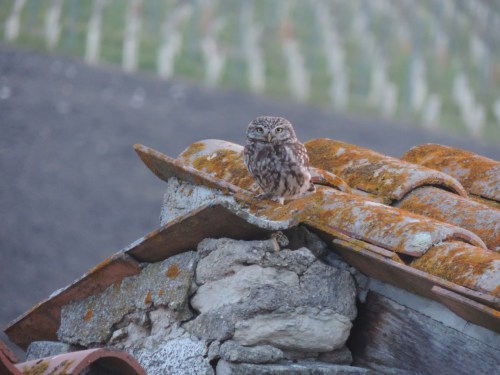
This year a new bird has taken up residence in a neighbour’s barn. He’s a “Little Owl”, and, yes, that’s his common name. His scientific name is “Athene noctua”. The “Athene” part goes right back to the belief that this owl had a special connection with Athena, and the “noctua” part comes from the Latin for “Minerva”, who was the Roman equivalent of Athena. As such, this little creature has long been held to represent wisdom and knowledge…..pretty much just what we need more of in our world.

I’ve watched him come and go and the other day there noticed he wasn’t alone. Seems he and his mate have a nest up high behind the roof beams at the back of the barn. He’s a pretty wary creature though so it’s been hard to get a decent photo. However, yesterday, looking out of the window of my study, I could see him sitting on a nearby roof. I slowly raised my camera to my eye, taking care not to make any sudden movements which might attract his attention, even though I was inside my house, and he was outside on the roof. I zoomed in, focused, and pressed the button. I can’t say I really clearly saw what I was getting a picture of, but when I uploaded it to my computer I realised he had totally clocked me.

He is looking directly at me!

How does one living creature possess that knowledge? How do we know that we are being looked at? I bet you’ve had an experience where you are sitting reading a book or having a coffee and, suddenly, you become aware that someone is looking your way. You look up, catch their eyes, and they either hold their gaze, or, more commonly, quickly look away.  I’ve often wondered how that works. What are we picking up? It’s not about casting our eyes around the world and just noticing someone else’s direction of gaze. We seem to be able to detect something, and it also seems this is a talent which is not exclusive to human beings.

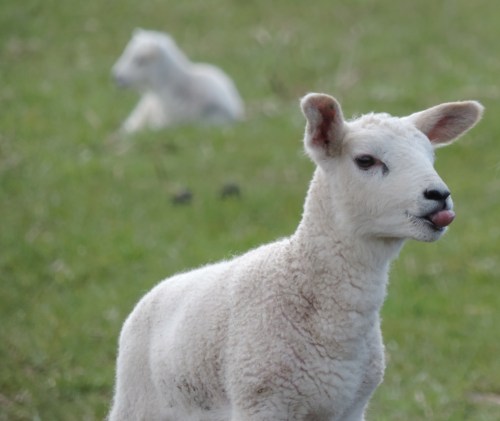
This isn’t the first time I’ve had this experience with an animal. Here’s a photo I took one Spring day when the first lambs were in the fields.

Tell me this little one hadn’t clocked me!


Read Full Post »

Quite a lot of people, me included, are saying this pandemic is throwing a light on certain things – how fragile our systems of health care and social care, how poor the safety nets are, how interconnected the world is, how the instincts to collaborate and connect are so strong in human beings, how much we humans move around the Earth……[add you own here]

But today I stumbled across some old photos of reflections and I realised that the reflections are a different sort of light.

A direct light brightens and maybe even makes more clear the object it is shining on. That’s useful. Though it immediately brings to my mind that question I have about Scandi-noir crime drama – why does the (usually female) detective always go down into the basement or the abandoned warehouse at night, all alone, with just a torch to light up little bits of the room? Well, I suspect I know the answer to that one already.

Reflections are different.

They turn things upside down.

They give us an unusual and different take on reality, which lets us see beyond what the light is illuminating.

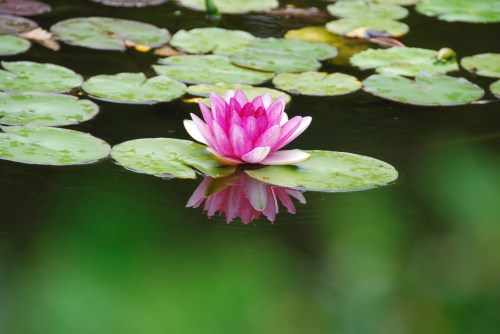
Look at this one, for example –

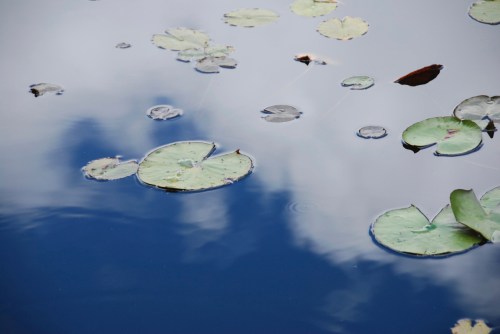
lily leaves on a still pond which is reflecting the blue sky and some clouds.

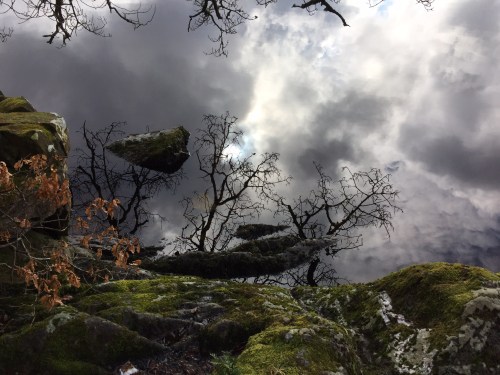
Or this one –

the edge of a Scottish loch where the still water is reflecting the clouds

Or, this one –

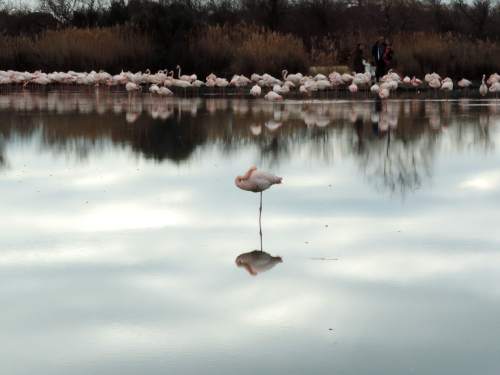
the solitary flamingo doubled by the water’s surface

In all these cases the reflection does something special I think.

It literally turns something upside down which immediately makes us look more carefully.

It changes our perspective whilst keeping our default one. In other words, it increases our perception and understanding by doubling our perspectives.

It shows us connections we were happy to ignore as long as we focused solely on the central subject. It connects the sky to the water, the water in the clouds to the water in the loch, for example, reminding us of these cycles and links and interconnections which are the most fundamental characteristic of Nature.

It increases our experience of beauty. Each of these photos could have been beautiful without the reflections, but I think that including the reflections make them exponentially more beautiful.

All of which brings me to my main thought today – shining a light on something helps us to understand it, promotes analysis and clarifies what has been obscure or forgotten. Reflecting adds in something completely different – it promotes our perception and understanding by changing our perspective, highlighting the connections, and increasing our senses of wonder and delight.

“And not or” is my moto – analyse and reflect. Actually, as I write that sentence I’m reminded of Iain McGilchrist’s Divided Brain thesis and how the left cerebral hemisphere is great for zooming in, analysing and cataloguing, while the right seeks out the connections, the specific and the unique.


Read Full Post »

Markings.

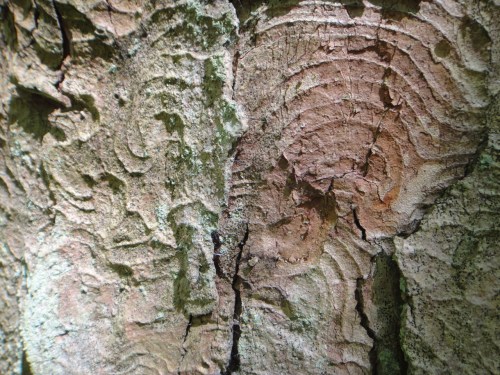
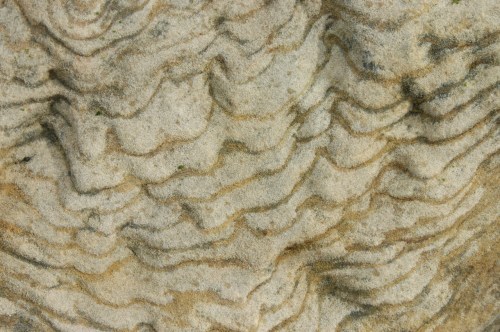
I find patterns utterly fascinating….wherever they are. Look at this blend of textures and colours on the surface of a tree. Isn’t it beautiful? It’s as if some artist has been doodling or a sculptor has been running his or her fingers through wet clay.

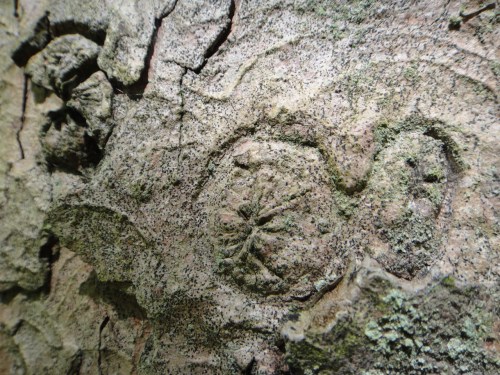
Here’s another one.

This one looks like an infinity loop to me.

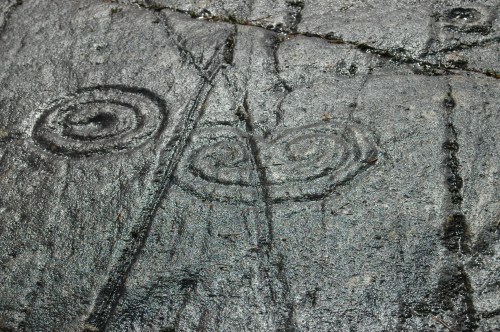
It reminds me of some of the cup and ring markings on the rocks in the Kilmartin Valley in Scotland. Here’s a photo I took of one of them.

The cup and ring markings in Kilmartin are really impressive and challenging. As best I know absolutely no-one has managed to explain them. Are they maps? Are the signatures? Are they messages from one person or tribe to another? Are they symbols, and if so, of what? Or are they doodles?

We humans have a particular kind of creativity. We imagine, we play and we make marks. I love all of that. But then I look around me and I see that making marks is embedded in all kinds of natural phenomena. It’s as if the whole Universe just loves to make marks.

We live an a creative universe.

Creativity runs through us the way our blood runs through us, the way our breath runs through us, the way we are infused by the streams of materials, energies and information which run through us, the way our spirit runs through us.

We react and we act. We engage and we respond. Catabolism and anabolism (biological terms related to our metabolism….how we break down materials which we consume and fashion them into the things we need to live) are at the core of our being.

Just by living, we create, but isn’t it such a thrill when we create consciously?

Isn’t it such a delight when we stumble across the works of creation?


Read Full Post »

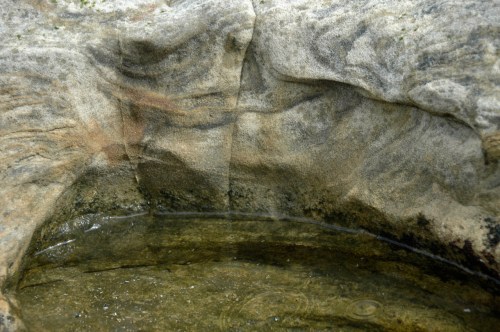
When I look at this the first thing I think is “how beautiful”. It’s like a work of art, isn’t it?

Look at the sweeping lines, the layers, the smooth surfaces and the ripples in both the water and the stone.

The next thing I think is how similar AND different the water and the stone are…..those colours, surfaces and lines, but the stone which changes over millennia while the water changes over seconds.

The third thing I think is how the universe began, fourteen billion years ago or so, first with only a couple of different atoms, then a few more as the creative and destructive furnaces of the stars kicked into action, and how every single element we’ve found on this planet was created, atom by atom, in those vast clouds of stars millions of light years away. Then over millions of years how the Earth was fashioned into the incredible substances, structures, materials.

It astonishes me.

The fourth think I think when I contemplate this image is how all the water, all the rocks, all the air which moves around as winds across the face of the Earth and the Sea, all the heat of the Sun which beats down upon us, makes this one, precious place for us all to live.

One of my favourite books of all time is Thomas Berry’s “The Great Work”.

Read Full Post »

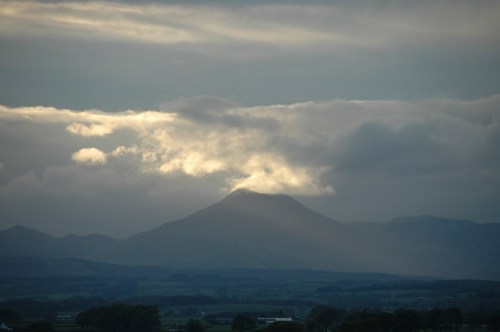
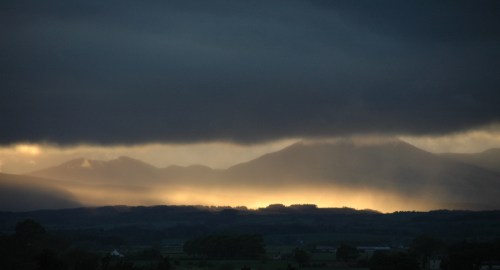
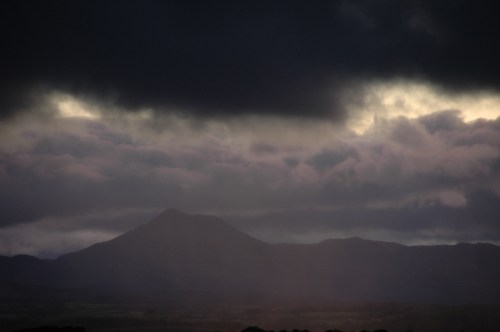
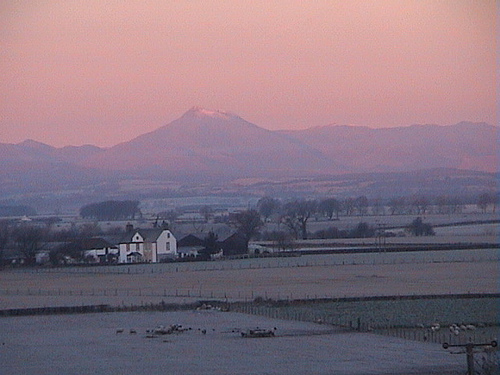
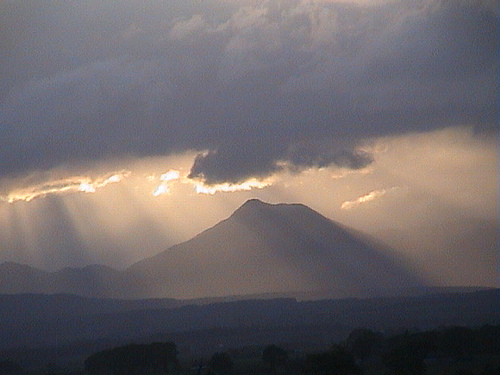
When I lived in Cambusbarron in Scotland I looked out of the window each day and saw Ben Ledi. I quickly realised that this mountain looked different every day, so I started taking photos of it. I took a LOT of photos.

I was constantly amazed how my usual experience was not of looking at the same scene every day, but seeing a different scene.

I know, maybe you are thinking, but it’s the same mountain. It’s just the clouds and the light which is changing….

But the mountain doesn’t exist by itself. It exists in a place and a time. I can’t see the mountain disconnected from the world in which it exists. That wouldn’t be real, would it?

I think the world is like this.

Absolutely everything is connected. Absolutely everything exists in webs of contexts and environments.

It changes moment by moment. Everything we see, hear, smell, touch and taste changes constantly as the streams of molecules, energies and information flow through, influencing, creating, disrupting.

So, today is always new.

This moment is always new.

We humans are good at doing something called “abstracting”. We isolate a part of what we are experiencing and consider it as if it is separate, disconnected, un-attached. We call these abstractions “things” or “objects”. Or we call them “outcomes” or “results”.

But we have to return our abstractions to reality eventually and then we seem them as less isolated, less fixed, less separate than we thought.

I never felt I could understand a patient by isolating their disease from their life. I never felt I could understand someone’s illness if I considered only the changes in certain cells, organs or tissues.

When we tell our stories, part of what we are doing is describing some connections…..some sequences, some consequences. We describe events, experiences and emotions, and together they combine to make every day, every moment, every place and every relationship, unique.

What did you notice today?

Was there something familiar which you experienced differently today?

Read Full Post »

You know these seeds which helicopter down from the trees? Strangely one-winged and decidedly “wonky” looking?

Well, maybe humans wanting to make something which would be carried on the wind wouldn’t design it like this, but, hey, Nature’s designs are the best!

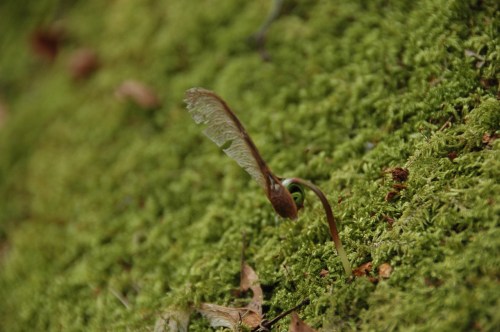
So, sometime, maybe last autumn, this little seed spirals its way from a tree, who knows which tree, and tumbles and flies and skips and zigzags its way through the air, to land here, on the forest floor. Then, a few months later, who knows how it knows, it wakes up, yawns and starts to stretch, feeling that Spring is around the corner.

And look at it now!

Out of the pod uncoils a long stem, probing down through the moss to find nutrients, and begin to grow itself into a tree!

I mean, do you ever stop and consider something like this?

Have you any idea how it happens?

We can’t even tell if an individual seed is alive or not, is viable or not, until it wakes up and begins to develop. Isn’t that incredible? That we can’t even tell if it alive or dead? Nobody can.

Then how do the cells start to divide and “differentiate”? That means start to develop into the different cells which will produce all the different parts of the tree.

One of my most favourite and most memorable lecturers at Edinburgh University was the Professor of Anatomy, Professor Romanes. He used to start a lecture with a box of coloured chalks and one of those giant rotating blackboards which gave you one screen after another. By the time he finished he’d produced what were no less than works of art showing each different kind of cell, each different kind of tissue, in a different colour. We were transfixed.

He gave a series of lectures on embryology taking us through the various stages of development of a foetus from a fertilised egg cell to a ready to be born baby. I remember thinking at the time, and those thoughts are still with me, “how on earth does that happen?”

I mean, how on earth does a single fertilised cell divide and multiply and differentiate to produce all the organs, all the tissues, all the parts of a human body, and every one of them in the “right” place?

It utterly amazed me.

It still does.


Read Full Post »

This is a photo I took while travelling to the north of Scotland a few years ago.

Both the dark foreground of the land and the foreboding rain-filled clouds in the sky could make a scene like this oppressive.

If both what’s right at our feet and right above our heads is gloomy and threatening it’s hard to stay positive and calm.

But look! That’s not all there is to this scene. There’s the crack in the clouds, the long strip of bright silvery light with sunbeams pouring down onto the water and making it glow. The water surface dazzles like the Sun itself.

Beyond the light a whole palette of colours emerge in the sky, shade after shade of blue.

In a bright blue sky, none of this would be visible.

In a completely overcast sky, none of this would be visible.

This is life, this is the world we live in.

There is always foreboding and darkness, and there is always hope and light.

The incredible thing is, they are often here at exactly the same time and place.

Read Full Post »

We humans are great at spotting patterns. We join things up, put features together, make connections to create and see forms, structures and behaviours. We’ve done it for centuries, gazing up into the night sky and joining the dots with invisible lines to make constellations which we can find, follow and associate with time and place. We’ve used that skill to navigate, to know when to sow and when to harvest, to find our place in this world and to wonder and dream about the infinite universe.

There’s one particular kind of pattern that we are really, really good at spotting – a face.

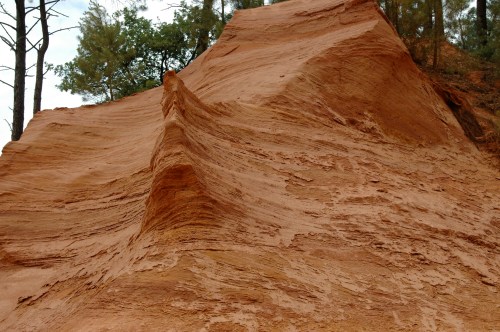
We have a whole area of the brain dedicated to spotting and recognising faces. We see them……even where there aren’t any human beings! Like in the ochre forest outside Roussillon in the South of France. As I wandered around it, I saw faces everywhere. Do you see them too?

Read Full Post »

Coronavirus, epidemic, pandemic, deaths, school closures, travel bans, hospitals overloaded, patients in the corridors, floods, fires, plagues of locusts, hurricanes, tornados, earthquakes, snowstorms, climate change, immigration, deportation, walls, cancer…….

It’s not hard to make a list of threats, to find things to be afraid of.

Every headline screams – be afraid, be very afraid!

“Prepare for the worst and hope for the best”

Sounds good advice, huh? Said this way around the first thing to do is focus on the worst, then once you’ve done that you might get around to dragging up a bit of hope. Said the other way around you hope first, but what you do, what actions you take, are determined by imagining the worst.

Is this a good way to live?

Imagining the worst every day? Feeling fear every day? Feeling anxiety every day?

Maybe not, huh, but isn’t it just common sense? Isn’t it just “sensible”?

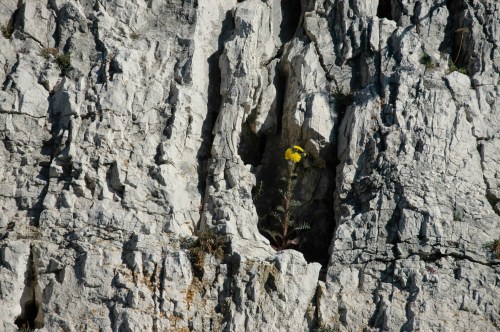
One day I was out walking along the Mediterranean coast and I looked up at this immense grey rocky cliff and a patch of yellow caught my eye. I zoomed in with my telephoto lens and took this photo. Wow! Look at this single, beautiful yellow flower. I was about to write “delicate, little flower” there but stopped myself because “delicate”?? I don’t think so. How did that little seed, blown there by the wind, or dropped by a bird, find enough to sustain it, enough to keep it alive, enough to make it burst out of its shell and stand tall and reach for the yellow sun and spread its petals to say to the world “Here I am” “I am alive”.

People die without hope. I’ve seen it. Many times.

If my mind is flooded with daily fears, if my thoughts swim in an ocean of dread, what kind of day is it going to be today? What kind of life will I experience? And what if this is “my one wild and precious life“? Is this how I want to spend it?

What’s the alternative?

Denial? Delusion? Escapism? I suppose so…..but I think there are better options –

“Hope for the best, and adapt”

If we start the day with hope, make our plans based on hope, then we set off positively. If obstacles appear, accidents happen, luck runs out, then we can adapt. I used to commute from Stirling to Glasgow on the train every day to go to work. I never set off thinking “maybe I won’t get there”. I never went to Queen Street Station after work thinking “maybe I won’t get home”. I never planned for the worst, then got round to trying to hope all the dreadful things wouldn’t happen.

Well, I didn’t always get there, and I didn’t always get home. One day the G8 Summit was held in Gleneagles. The authorities closed Stirling down. No trains. No buses. Motorways blocked. I didn’t get to work that day. One day at work it started to snow. It snowed and it snowed and it snowed. By the time I finished work there were no trains leaving Glasgow. The buses were all full, then there were no more buses because the motorway was blocked. I found a hotel room using my smartphone, stayed the night, and next morning, stopped off in Marks and Spencer for a new shirt on my way to work.

Many, many times, trains were cancelled or ran late. Many times the train would stop in the middle of the countryside for half an hour, or an hour, or sometimes, even longer. The journey wasn’t always as straightforward as it should have been. But I still never set off thinking “maybe I won’t get there”.

So that’s one way……

“Hope for the best, and adapt”

Here’s another –

“Look for the good and adapt”

This isn’t quite the same because it isn’t based on a starting point of hope. It starts with an intention. An intention to seek, to be curious, to be on the look out for what delights, and what amazes. To find “L’émerveillement du quotidien“. Because it’s always there. There will always be beauty to discover, music to excite or delight, scents and flavours to savour, textures to relish. There will always be acts of kindness, acts of courage and acts of love. You can see that all the time. In how many terrorist attacks do we see the cruelty of one person, followed by the courage, kindness and love of many, many others.

What if every day I look for the good, and when obstacles, accidents, infections, bad luck come my way, I find a way to adapt?

I look at that flower, flourishing (because that’s what flowers do, isn’t it, they flourish?) in what looks like barren adversity, and I think, well, that’s amazing, that’s beautiful, that’s life.


Read Full Post »
I’m writing a book just now about “and not or”.

“And not or” is a concept I’ve been exploring for some time and I thought it was time to start writing down some of my discoveries more systematically because I thought that would help me to think and, hopefully, take my understanding to a new level. Well, I’m in the midst of all that and, so far, what I can is…..I’m really enjoying it! Hey, that strikes me as a pretty good reason to write….to enjoy it. When I say I enjoy it, I don’t just mean it is pleasurable. I mean I feel it adds value to my life and helps me to make more sense of it. It’s fulfilling.

I’ve also been browsing through some old digital photo libraries of mine and re-discovering images I haven’t thought about for years. I think that because I’m so immersed in the “and not or” idea of my book that I’ve developed a different perspective from the one I had when I took these photos, so now I contemplate them through that new lens. I think this particular image is a good example of that.

What do I see when I look at this photo?

I see two hills. One is dark and the other light. I immediately think of the yin yang symbol, with its dark half and its light half. Isn’t that pleasing? To see BOTH the dark and the light hills in the same scene?

I see the reflections of the two hills in the astonishingly calm surface of the loch. Clear, clear reflections, one dark and one light. Isn’t it delightful to see the objects and their reflections in the same scene? I think of the connections between the conscious and unconscious parts of our minds. How what lies below our consciousness, emerges into consciousness as a kind of reflection, at night, in dreams, and in the waking hours, in our emotions and thoughts.

I see within the reflections two boats. A black boat with a light cabin in the middle of the reflected dark hill, and a white boat in the reflected image of the light hill. Each boat has its own beautiful mirror image beneath it in the water. This symmetry of reflections reminds me of the fractal nature of the universe, with patterns and images cascading through time and space.

I see brightly lit sky and heavy rain-laden clouds above the loch, and I see the dark shoreline, grassy, and mossy and earthy, in the foreground. I love this spread of earth, water, air and light and this one image.

I see the activities of humans, the little boats, some for fishing, some for pleasure, and the machinery on the raft in the middle of the loch. And towering over these little boats and equipment, are the magnificent, rocky hills, standing like quiet giants, watching what lies at their feet.

This is like a kind of meditation for me. As I explore this AND that AND these AND those and see the connections, the reflections, the symmetries and patterns, my mind and my heart slow down to match the pace and the rhythm of the scene.

I hope you get a similar experience.

Read Full Post »

« Newer Posts - Older Posts »