Feeds:
Posts
Comments

Archive for the ‘perception’ Category

illuminate

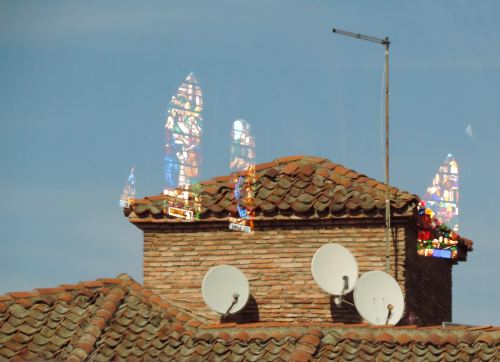
I stepped out through the back door of the cathedral in Segovia and onto a large paved terrace surrounded by stone lions. When I turned to look back to the tall arched doorway I noticed that the plain glass doors which hung in the doorway perfectly reflected the buildings across the street. I took a photo.

When I loaded up the photo later I noticed that there were some strange lights above and on the roofs and when I zoomed in I saw more clearly that behind the reflection of the tiles and the satellite dishes some of the cathedral’s stained glass windows shone through the glass door.

That got me thinking……

Here in this one photo is an interesting idea. For centuries the church has created the images and the stories to tell people what the world is like, what life is like, and how they should live. With captivating art and gripping stories it presented a particular view of the world. More than that, really, because in presenting that view and spreading it so widely, it created a reality for the people who lived in it.

But look at those satellite dishes.

Who is creating the images and the stories now? Who is telling people what the world is like? What life is like? And how they should live?

Who is presenting a view, and spreading it so widely, that it’s creating the reality for those who live in it?

With the rapid development in communications technology, with powerful mobile phones, connected computers, the internet, social media, memes, images and videos which “go viral”, some writers say we have created a whole new layer of the environment in which we live – the “noosphere” (the sphere of human thought). The truth is we’ve always had a noosphere. We’ve always lived, we humans, within this environment of human thought.

There are the image creators and the story tellers who fashion the patterns in this environment, and in so doing, they influence many others.

We have a choice. We can be the image creators and the story tellers, or we can be passive consumers. If we choose to be passive consumers, whose world, whose idea of the world, are we choosing to live in?

If we choose to be the image creators and the story tellers, what images shall we share? What stories shall we tell?

Read Full Post »

diversity potager

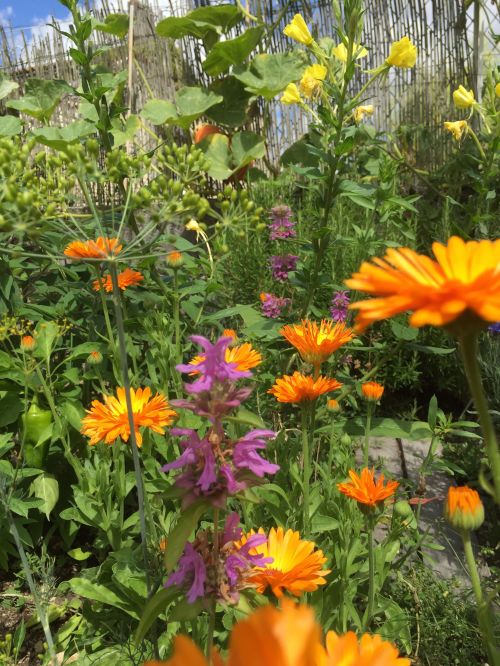
Here’s a small corner of our potager. I took the photo because the beauty of the abundant diversity caught my eye.

When I look at it now I realise that different people will see different things when they look at this.

Some might see competition – survival of the fittest – as each plant fights all the others for the most sun, the most water, the best nutrients from the soil. When the world looks like that its full of fighting, of winners and losers, of the pursuit of self-interest. In such a world is there ultimately one winner? One species of plant which beats all the rest and eliminates them from the competition?

Some might see chaos – unruly, disorder, no control. Does such a world need to be tamed? Does it need to be ruled, ordered and managed to produce….to produce “outcomes” – and what will those outcomes be? Who determines them? Who measures? Who manages? Who controls?

Some might see beauty and diversity – as I do – each plant expressing its uniqueness to the full, flourishing amongst the others. When the world looks like this, it looks like a community. It looks like a living, growing, healthy being. Gaia. Nature.

I see uniqueness here.

I see flourishing here.

I see community here.

I see beauty here.

What do you see?

Read Full Post »

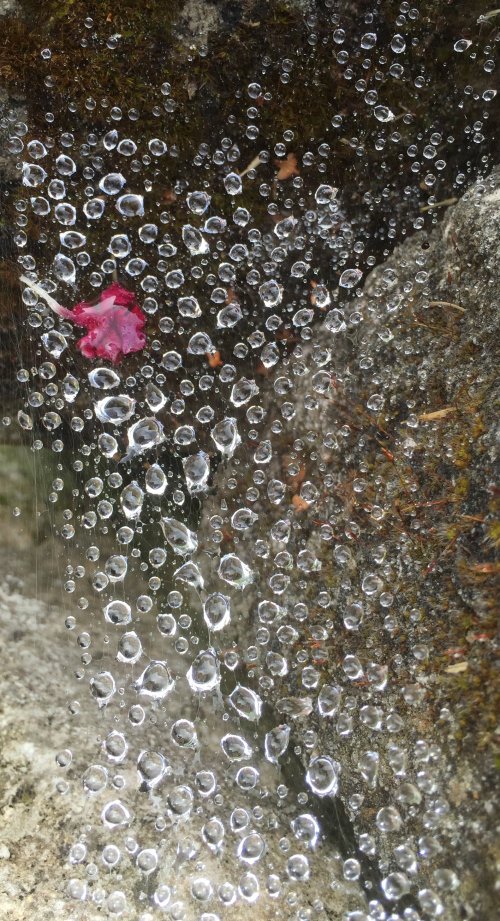
petal web

Thomas Berry and Brian Swimme who developed the new story of the universe talk about three core values which seem to be embedded in evolution. It’s a really interesting and different take on evolution. The story we have heard most over the last hundred years or so is one of a random, harsh, competitive universe full of “stuff” or materials which somehow have stuck together to make ever more complex objects which can each be studied and understood in isolation from each other.

That story never resonated with me and it can be argued it has more to do with the dominant politico-economic model of capitalism and “the market” than it has with science.

The three values Berry and Swimme articulate are differentiation, subjectivity and communion. Their claim is that take away any one of these three and the whole universe as we know it collapses. Brian Swimme also claims that we can use these three values to check if our actions are in harmony with the evolutionary direction and activity of the universe. In other words they can be considered as fundamental values which help us to assess and judge our behaviour and that of others (including politicians and economists).

Differentiation.  The universe started differentiating from its earliest moments. We don’t look around and see a homogenous mush – we see clusters, or “objects”. But the universe doesn’t just produce what Swimme calls “articulated constellations of energy”. It produces UNIQUE articulated constellations of energy. No two galaxies, no two stars, no two creatures are identical. Producing uniqueness turns out to be a key universal value.

Subjectivity. Everything has an inside. Even the simplest atoms are self-organising, self-maintaining phenomena. The particles within the atom are held together and organised by the atom itself. This self-organisation reaches its most complex in human beings. We are all “autopoietic” – we are “self-making” creatures. We self-defend, self-organise and self-maintain. Yet this interior “self” remains unknowable. We can’t see it, can’t define it, can’t pin it down. This interiority is what enables us to see every object as a subject.

Communion. Thomas Berry used the word “communion” to describe the relationships which exist everywhere. Nothing exists in isolation. Everything is connected to other things. We all live in a vast web of relationships.

This all leads to Berry and Swimme describing the universe as an “communion of subjects”, or as a “communion of differentiated subjects”.

Try this idea out for yourself. What does the world look like through this lens? What sense do you make of life which part of a “communion of subjects”?

When considering any political policy, any scientific description, any choices you might make, what happens when you set them in the context of  the three values of “differentiation, subjectivity and communion”?

For me, I experience a shift from fear to curiosity, from senselessness to meaningfulness, from isolation to belonging…..how about you?

Read Full Post »

redstart close.jpg

This morning I woke up to the news that the referendum vote on the UK’s membership of the EU had been won by the Leave campaign.

I immediately felt sad, not least because I see this as a victory for the forces of xenophobia and misinformation. I’m a great proponent for diversity, for the celebration of uniqueness and for integration (the definition of which is “the creation of mutually beneficial relationships between well differentiated parts”).

But I found something else happened too. I tumbled into anxious feelings of uncertainty. Question after question flooded my brain.

Will I have to give up living in France? Will I need a residency permit and visas to visit other European countries instead of having the right to live here and to drive across the borders into Italy, Spain, Belgium or wherever I else I want to visit freely? What will happen to the currency exchange? To the value of my pension? What about my children and my grandchildren? Will they now lose the right to travel, study and live in this richly diverse continent?

Oh, the questions kept coming, and the answers are unknowable.

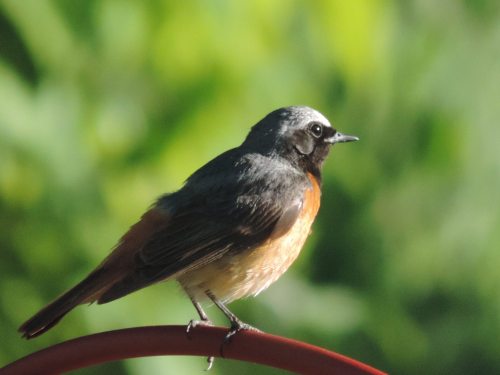
Then I looked outside and there he was again. The redstart. I’ve written before about my experience of a particular redstart in this garden but since yesterday he’s been perching on a chair right outside my front door and whistling loudly. He’s never done that before and it got me wondering.

What’s he trying to tell me?

Is he in trouble? I even went and looked where his nest is but couldn’t see anything wrong. He can’t be hungry. There’s an abundance of food around just now. He looks healthy and vigorous. Nope, I couldn’t figure it out.

Then I thought, well maybe he just likes it there. On the back of that chair.

Or maybe he’s just enjoying being close and asking for some attention.

Well, you know what he did? He called me right back into the here and now. The worries, the unsolved problems which might not even ever exist, all faded away. I just enjoyed looking at him, listening to his song, and taking his photograph.

Attention to the present and the particular does that for us. It makes today, this moment, more real, more vivid, and more enjoyable.

Thank you, Mr Redstart.

Read Full Post »

ceramic plate.jpg

I came across this medieval ceramic plate in a museum recently. Here’s what I thought.

How beautiful!

How unique!

Look at the two birds and how together they almost seem to create third bird in the middle, looking out at me!

What a delightful scene! Two birds kissing. Or one bird feeding another.

What a great example of integration – the creation of harmonious bonds between individuals.

I still think all of that.

But something else struck me as I uploaded this photo to share with you……maybe some people will look at this and see it as two birds fighting? Maybe they’ll see it as conflict and competition, not bonding and dancing?

Then I realised that everything we encounter has an element of the Rorscharch Ink Blot test to it – what we see in it is what we bring to it.

If that’s true, then we can experience more love by bringing more love to the table.

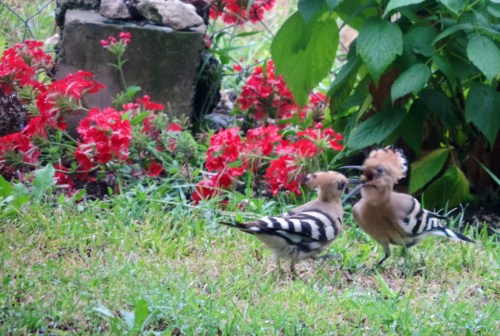
Here’s one of the reasons I immediately saw an image of bonding –

hoopoes feeding.jpg

This is a picture of one Hoopoe feeding another in my garden last year.

Read Full Post »

mermaid sleeping

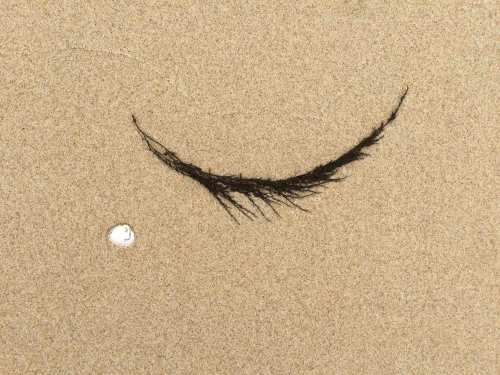
As I walked along the beach I stumbled across this mermaid sleeping…

The man who has no imagination has no wings. Muhammad Ali


Everything you can imagine is real. Pablo Picasso

The world of reality has its limits; the world of imagination is boundless. Jean-Jacques Rousseau


Read Full Post »

pink

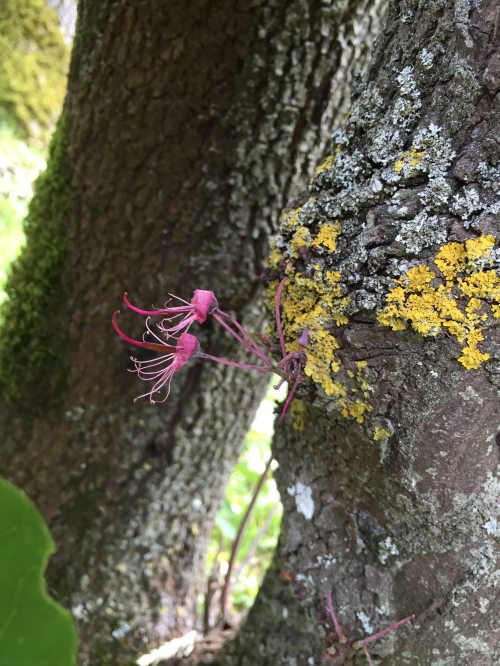
As I walked between the trees at the side of the Charente in Jarnac this caught my eye.

I don’t think it was only the pink and yellow colours together which grabbed me. It was the surprise at seeing this delicate flower growing right out of the trunk of the tree. Now, I’m not a botanist, just someone who is insatiably curious, so I don’t know what this flowering plant is. But I’m pretty sure it isn’t a usual part of the tree it’s growing from. There weren’t any other flowers like this further up the tree.

As usual, an image like this sparks a few trains of thought.

How do we notice what we notice?

Difference.

Isn’t it usually difference which catches our attention?

One of the commonest kinds of difference which we notice is movement. By definition, motion is difference. It’s a change of place in time. It’s the flight of the barn owl from my house to my neighbour’s barn. It’s bats flying round and round the garden at dusk. It’s the sudden appearance of light and shadows as the sun appears from behind a cloud.

Another common difference to catch our attention is sound. Any sudden new sound. The wailing of a siren in a city street, the alarm call of a blackbird which has just spotted a cat, the distant church bells striking noon. The sounds we don’t hear are those which are constant. We only notice them when they stop.

What’s new is different too. We’ve got two cerebral hemispheres, and the right one, in particular, is wired to seek out whatever is new. The left might seek the familiar, but the right is attracted to novelty.

So maybe that’s another reason I noticed this strange and beautiful pink flower growing out of the tree trunk. I’d never seen anything exactly like it before.

Not least because I don’t know what this flower is, I don’t know what the nature of the relationship is between the flower and the tree. Is it parasitical? Is the flower gaining something from the tree, but not contributing anything? Or is it commensal, with both the flower and the tree benefitting from the relationship?

One of the keys to creative development and growth is integration. Integration can be defined as “the creation of mutually beneficial relationships between well differentiated parts”. In other words, it’s when there is a bond, a good, healthy, mutually supportive bond, between two very different organisms or objects.

I’d like to think this image represents that. It certainly increases my awareness of such an idea.

Integration isn’t just about the relationship of course. It’s about the well differentiated parts as well. And that brings me back to the idea of difference.

When we are surrounded by attempts to force us into pre-determined moulds, by monocultures of chain stores and pressures to conform, it can be hard to express our differences in a positive way. There’s so much fear these days of “the other”, of strangers, immigrants, of other races, other genders…….

How different might the world be if we pursued integration instead…..by not only tolerating, but celebrating difference, and finding ways to create mutually beneficial relationships between them?

Might be beautiful. Might be surprising. Might be attention grabbing.

Read Full Post »

pink tulip

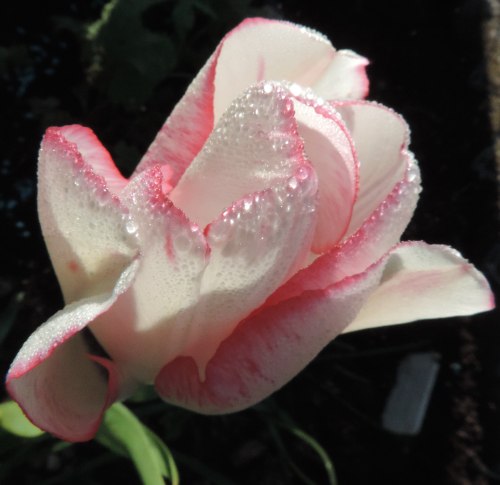
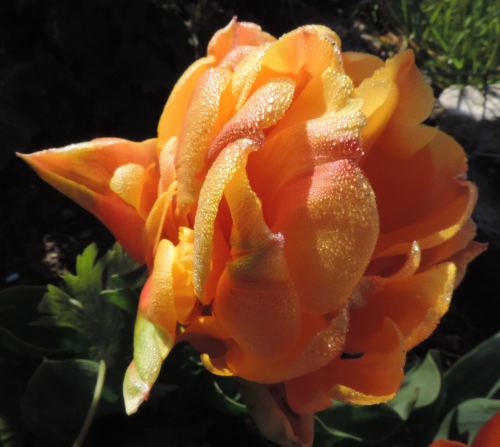
In the morning, when the sun encourages the flowers to open their petals, and the heavy dew begins to evaporate, there’s a moment where everything just comes together.

orange tulip

Beauty….hard to capture with words, but impossible to miss when you go looking for it….

Read Full Post »

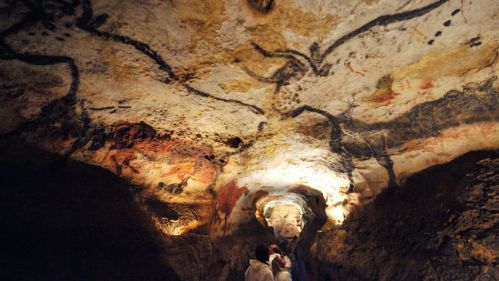
FRANCE CAVE DRAWINGS

Part of Lascaux famed cave drawings are photographed in southwest France, during a rare visit, Friday, July 25, 2008. Clusters of black fungus have been spreading over the drawings said scientists in 2007. The stains were the latest biological threat to the Lascaux cave drawings, which were discovered in 1940 and are considered one of the finest examples of prehistoric art. Carbon-dating suggests the murals of bulls, felines and other images were created between 15,000 and 17,500 years ago in the caves near Montignac, in the Dordogne region. In 1963, after green algae and other damage appeared, the caves were closed to the public. Only scientists and a few others are allowed to enter at certain times. (AP Photo/Pierre Andrieu, Pool)

I recently visited the Lascaux caves which are about a three hour drive from where I’m living now. I’d heard of them but I hadn’t realised they were as close as this.

You’ll see from that photo above, which isn’t mine, that the incredible wall art in the caves was deteriorating quickly due to the effects of fungi and carbon dioxide brought in by visiting tourists, so the government closed the caves to preserve them and did something astonishing.

They built an exact replica of part of the cave network, faithful down to 5mm, using teams of artists to recreate the artwork using the same kinds of pigments used by the original artists on artificial cave walls.

The caves were discovered in 1940 when a group of boys were exploring a forest. A storm had blown down some trees and one of the fallen trees had opened up a hole in the ground under its roots. Their dog disappeared down the hole so they went after it, quickly realising it was a tunnel into caves. After retrieving their dog, they went back home and got lamps, returning to squeeze along the dark tunnel until it opened up into a cave. Can you imagine how astonished they were when the light from their flames lit up the huge paintings of bulls, bison, cows, horses and deer which covered the walls and ceiling of the cave?

There was a lot more down there than what the boys found in the first cave. The paintings are thought to have been created up to 18,000 years ago and had remained, perfectly preserved, once the cave network was sealed off by the forest.

Lots of questions immediately spring to mind – how did they manage to paint such life-like depictions of animals under the ground in the darkness using just small lamps for light? They covered not only the walls but the ceilings. How did they get up there? They used the contours of the cave walls to make their paintings seem three dimensional. How did they have the imagination and the skill to do that? And WHY? Why did they put so much time and effort into the creation of this fabulous art?

It didn’t take long before the effects of thousands of visitors started to degrade the art work so the government sealed it off and created Lascaux 2, a replica. If you click through on that link you’ll go to an interactive tour of the re-creation.

So, I went down the stone steps with a couple of dozen other visitors and a guide. In the ante-room after the great doors were pulled closed, our eyes adjusted to the low level of light and the guide talked us through the story of the discovery of the Lascaux caves and the creation of Lascaux 2. Then he opened the far doors and we all squeezed down a narrow passageway between rough walls of rock. The passageway opened up into the Hall of the Bulls, so called because of the four, almost life size paintings of bulls which completely cover the ceiling of the cave.

He switched off the lights and lit a cigarette lighter. As the small, single flame cast its faint light up onto the walls and ceiling you could swear the animals were moving. It was quite cold down there and without artificial light it would be pitch dark.

We spend the best part of an hour exploring the cave and hearing about the different paintings.

So, you’re thinking. You just visited a replica? How did that feel?

You know what? It was magical. I thought it might be a bit Disney-like, but it wasn’t. You know what it was like? It was like standing in the middle of an art installation. That’s exactly what the replica is. It’s a work of art designed to communicate to you something of the experience of the artists. And that’s what this replica represents, isn’t it? A work of art. Created by unknown artists almost 18,000 years ago….

So there it is…one work of art, touching the viewer, stirring some kind of feelings which the artists had after they’d been inspired in a similar way by other artists, long gone, who left these astonishing creations.

Here’s my final thought. Isn’t it just wonderful that we humans create art? Not for a sum of money, fame, or some utility, but to…..what? Interpret our world? Interact with our world? Make sense of our world? Express ourselves, just because we can?


Read Full Post »
mulberry

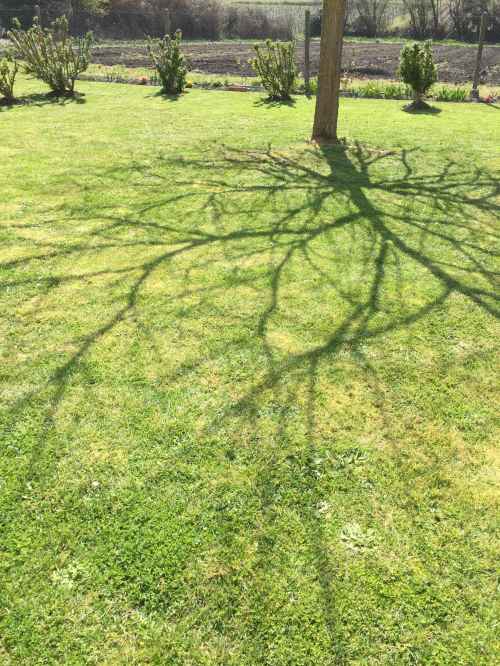
The other day I was sitting outside enjoying some Spring sunshine when I noticed the strong shadows of the mulberry tree.

It struck me that the pattern of the branches was probably very similar to that of the root system under the soil. “As above, so below”, as the old saying goes….

I also enjoyed just looking at the patterns. There is something very beautiful about this branching pattern we see everywhere in Nature, isn’t there?

Then I realised I’d focused on the shadows rather than on the branches of the tree itself, and that brought back to mind Plato’s Allegory of the Cave. Do you know it? Here’s a link for you to explore it further. Or watch this video from the fabulous “School of Life” –


The prisoner who is dragged out into the light comes to know the shadows are re-presentations of reality, but I’ve often thought it’s a shame that when he returned to the cave, he couldn’t see the shadows any more. Shadows, after all, can be both beautiful and quite enlightening!


Read Full Post »

« Newer Posts - Older Posts »