Feeds:
Posts
Comments

Archive for the ‘perception’ Category

As I wandered today I wondered……don’t we all perceive the world differently? If our stories, our personal stories, shape our selves, which is how it seems to me, then our experiences will frame our present reality. We experience today in the light of our past experiences and our imagined futures. Stories all have this movement….from the past, to the present, to the future – a beginning, a middle and an end I suppose.
So one of the most powerful ways in which memories and dreams can create our present is how they frame our perception and our interpretation of today’s experiences.

through the round window

What frames are you aware of? Which memories, which dreams or fears, create the frames of your present?

The other thing I wondered about today was about the uniqueness of our individual perspectives. We can only experience the world as a subject, as this subject, living this life. So, how does the world look from your unique, subjective perspective?

room with a view

(this is a view from the tatami mats, across the strips of carpet, towards the Japanese garden – this is a view from where I was kneeling)

Finally, how can we share these ways of seeing? How can we develop our inter-subjective experience? One way, for me, is through the sharing of our stories. You can share your experience by telling me it. I can share mine, by telling you…..or by showing you what I caught with my camera…..(I’m sure you can think of other ways too)

Read Full Post »

Once you learn that most of the activity of the brain goes on without either conscious awareness, or with conscious awareness only kicking after the initial response, you begin to doubt that all our choices are conscious ones…..or rational ones. In fact, the brain stem and the limbic system are the key centres for our survival responses, our drives, our avoidances, and our emotional processing. How often do we behave in ways which really can’t be understood from the premise of consciously choosing once presented with the facts? Is that how human beings function? Would that even be the best way for human beings to function? (consciously and rationally, whilst discarding other ways of perceiving, processing our experience and responding). What do you think once you learn that there is an enormous neural network around the hollow organs of the body, the heart, and the gut especially, which we might well use to figure things out….where we might process and produce what we call “gut reactions”, or “heart felt” beliefs?

I’ve stumbled on two very different texts in this area in the last couple of days. Isn’t that weird, actually? It’s that old “coincidence” thing again…..never quite got to a point of really figuring out how those “coincidences” come about, or what they mean.

A few days ago, I read about a report for the WWF called “common cause“. The report, written by Tom Crompton. Essentially it argues that if we look at the research evidence, it would seem that human beings don’t make decisions using rational thought very much. Here’s a paragraph from the Summary –

There is mounting evidence from a range of studies in cognitive science that the dominant ‘Enlightenment model’ of human decision-making is extremely incomplete. According to this model we imagine ourselves, when faced with a decision, to be capable of dispassionately assessing the facts, foreseeing probable outcomes of different responses, and then selecting and pursuing an optimal course of action. As a result, many approaches to campaigning on bigger-than-self problems still adhere to the conviction that ‘if only people really knew’ the true nature or full scale of the problems which we confront, then they would be galvanised into demanding more proportionate action in response. But this understanding of how people reach decisions is very incomplete. There is mounting evidence that facts play only a partial role in shaping people’s judgment. Emotion is often far more important [see Section 1.3]. It is increasingly apparent that our collective decisions are based importantly upon a set of factors that often lie beyond conscious awareness, and which are informed in important part by emotion – in particular, dominant cultural values, which are tied to emotion. It seems that individuals are often predisposed to reject information when accepting it would challenge their identity and values.

That’s got me thinking about the importance of understanding our values (and/or our “virtues”) again.

Then, this morning, I read a post about some interesting TED videos, and the first one was this, by Dan Airley. He makes the case that we suffer from “cognitive illusions” just as much, if not more than, we suffer from “optical illusions”. (It’s about how we make decisions. It’s VERY entertaining, and thought provoking, and it’s just 17 minutes long. Take the time to watch it)


Read Full Post »

Can you see him?

hidden

Can you see him now?

hidden

Read Full Post »

lavender

This large trailer of lavender was parked on the Cours in Aix, and the scent was strong well down the street. Scents embed memories deeply into our minds. What scents stimulate the strongest memories for you?

Read Full Post »

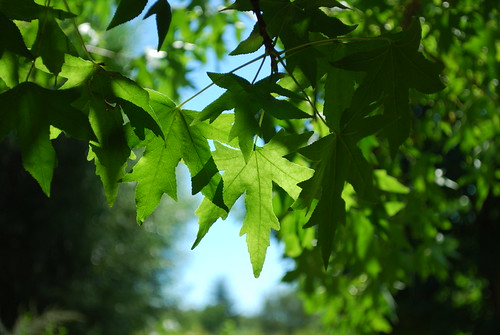
sunlit leaves

sunlit leaves

I love the sight of sunlight through leaves.

Look at these three photos. I think they illustrate a really important lesson for all of us. They illustrate the paradox of difference and sameness. If you’re a botanist, you might look at these three photos and seek to classify them as three different trees. What “families” do they belong to? What are their “names”? But if you just look, you’ll see that whilst each tree has its own characteristics, each leaf is different.

We’re all different too. I think that’s something to celebrate. I despair at the kind of thinking which stops at the level of classification into types, diagnoses, statistics. We need to be able to think beyond that, to see beyond that, to be curious about, fascinated by difference, and to love uniqueness.

Read Full Post »

Remember the X-files?

Well, the question about there being a truth “out there” is an interesting one. Out where, exactly? I’ve stumbled across an interesting couple of phrases recently which are getting me thinking about the nature of reality and how we experience it.

Our experience of the world helps to mould our brains, and our brains help to mould our experience of the world.

Iain McGilchrist, in The Master and His Emissary, uses a lovely word – “reverberative” – to capture the idea of reality being a dynamic interactive relationship between the subject and the object.

….right-hemisphere qualities of being a betweenness: a reverberative, “re-sonant”, “respons-ible” relationship, in which each party is altered by the other and by the relationship between the two..”

So, even if there is an “out there” it can only be known in the acting experiencing, a two-way, constantly changing experience.

Everything that we know can be known only from an individual point of view, or under one or another aspect of its existence, never in totality or perfection. Equally what we come to know consists not of things, but of relationships, each apparently separate entity qualifying the others to which it is related.

“…what we come to know consists not of things” – now that’s a thought-provoking phrase.

Then I came across an article by Professor Richard Conn Henry, from the Department of Physics and Astronomy at John Hopkins University. His article, published in Nature, is titled “The Mental Universe”, with the summary “The only reality is mind and observations, but observations are not of things. To see the universe as it really is, we must abandon our tendency to conceptualise observations as things”.

He quotes the physicists Sir James Jeans….

..the stream of knowledge is heading towards a non-mechanical reality; the Universe begins to look more like a great thought than like a great machine. Mind no longer appears to be an accidental intruder into the realm of matter….we ought rather hail it as the creator and governor of the realm of matter.

and Sir Arthur Eddington

It is difficult for the matter-of-fact physicist to accept the view that the substratum of everything is of mental character.

But, says Professor Henry, that’s exactly what quantum physics is showing us. In this article he says “The Universe is entirely mental…and we must learn to perceive it as such”, concluding with the following words –

The Universe is immaterial – mental and spiritual. Live, and enjoy

I have a feeling materialistic scientism is in its last days!

Read Full Post »

sunlit

Ok, try this today…..notice the light.

Just let some light catch your attention and stop for a moment and wonder. How does it look? How does the world reveal the light to you? How does the light make you feel?

Read Full Post »

I read this fascinating fact in Scientific American recently –

Of the virtually unlimited information available in the world around us, the equivalent of 10 billion bits per second arrives on the retina at the back of the eye. Because the optic nerve attached to the retina has only a million output connections, just six million bits per second can leave the retina, and only 10,000 bits per second make it to the visual cortex. After processing, visual information feeds into the brain regions responsible for forming our conscious perception. Surprisingly, the amount of information constituting that conscious perception is less than 100 bits per second.

Wow! The first part of that whole story is startling enough, and one we don’t routinely consider. There is a vast amount of information surrounding us, but we can only pick up the limited amounts which our sensory organs are capable of handling. For example, we don’t see the same spectrum of colours as other creatures – a flower won’t appear to a bee, the way it does to a human! But, then when you consider the rest of this story, look at just how much “data loss” occurs between what the sensory organ can detect and what we can consciously appreciate!

Funnily enough, I’d just recently read the following in “The Renewal of Generosity” by Arthur Frank (ISBN 978-0226260174) –

Dialogue suggests that the world is co-experienced by two of more people. Each one’s perspective is necessarily partial, and each needs to gain a more adequate sense of the world by sharing perspectives.

Wouldn’t it make more sense to respect each others’ perspectives and enter into dialogue, than to assume that our personal (limited) view is THE right one? (I’m just thinking of the way the politicians are acting in this current election month in the UK)

Read Full Post »

Look at the colour of this water. It’s an amazing colour isn’t it?

water green from reflected leaves

Why is it that colour? It’s the effect of all the leaves on the trees of the forest through which the stream is flowing. On another day, in another season, this very water (well, actually, this very stream, not this very water!), looks an entirely different colour. In fact, a few hours earlier, or a few hours later, it looks completely different.

This got me thinking. Not just thinking how beautiful it is. It is stunningly beautiful. But how change is a such a constant, and, how whatever we see is the result of many factors, and how everything needs to be understood in it’s context, and how nothing can be reduced to some simple set of data, or simple description, without, in fact, obscuring its reality.

Maybe it’s just the way my mind works, but it also got me thinking about the interactions between the environment and the elements of the environment. I’ve just taken out a subscription to a new journal titled Ecopsychology. I’ve never come across this term before, but its the area of study which looks at the interactions between behaviour and the environment. I love it when I come across these whole new fields of human exploration and knowledge.

Read Full Post »

I took a walk at the weekend. Up through the Birks of Aberfeldy. Robert Burns wrote a poem about this place. Here he is –

Burns writing The Birks

He wrote well before me, in an earlier time and an earlier season.

I went to the Birks to find leaves. I love the colours of autumn. Come and have a look at some of the amazing golds, and reds, and silvers, and yellows, and greens, and bronzes I found…..

yellow splash

autumn bridge

higher turns first

silver forest

silver birch

forest

But what I really like most about this time of year is how you can see change happening right before your eyes. It’s true, change is always with us. Life is dynamic. Nothing can be reduced to a fixed, final and complete understanding. There’s always more to see, more to learn. There are always new ways to explore, growth and change to pursue and enjoy.

leaves turning

red tinge

shadow leaf

There’s always wonder.

There’s always hope.

Read Full Post »

« Newer Posts - Older Posts »