Feeds:
Posts
Comments

Archive for the ‘philosophy’ Category

Stone circles, dolmens, single standing stones, cairns and burial mounds…….I have a fascination for all of these objects. There are a lot of them in Scotland (like this one at Lundin Farm) and there are a lot in France.

I was born, grew up in, lived and worked in Scotland. I emigrated after I retired from the NHS in 2014. I now live in the Charente, near the town of Cognac….a small town with a big reputation, not least due to the spirits made and exported around the world from here.

I had an intention to come and live in France for a long, long time. I wanted to live at least a part of my life in a different culture, a culture fashioned in a different language. I feel this move has widened and deepened my experience of life. But I don’t feel I’ve lost my Scottishness. It’s fascinating to live that weave of two languages, and two cultures. It really does give me the sense of an enriched, enhanced life.

I think we humans all share the same small planet. We all breathe the same air, drink water from the same water cycles, eat food grown in the same biosphere. Frontiers are artificially drawn lines on the globe. We all came from the same nomadic first tribes. We are all descended from the same first humans. When I come across these ancient neolithic structures I feel connected…..connected vertically back down a family tree to the past, and horizontally around me to everyone, and everything, else currently sharing planet Earth with me.

There’s an old classical spiritual exercise about standing back from your immediate surroundings. You can think of it in the same way as looking at the world once you’ve climbed a hill. You can think of it in the same way as those images from space which show our blue and green planet spinning slowly. When you look “from on high” then you get a different perspective. You see something whole. You see something inter-connected. You see the flows of clouds in the atmosphere, the flows of water in the oceans, and you realise you are a small, but unique, individual in a much greater whole.

Well, I think something similar happens when you encounter a stone circle. I’ve often had the sensation that I feel different inside the circle from what I do on the outside. I don’t mean that in any spooky way, but I just mean that the action of stepping inside one of these ancient structures, created surely with immense effort by men and women with rudimentary tools, lets you have a different perspective. You can feel connected, not just to multiple generations of ancestors, but to those deep currents which run through every human being – the desire to create, to interact with what is around you, to make something new, something special, to make a work of art, a work of the spirit, a work of quality.

We human beings don’t just survive. We change the world as we live in it. We create the world as we live in it. We discover and we make meaning. We create experiences, and the opportunities to have experiences, for ourselves and for others.

What kind of world are we creating now? What experiences are we making for ourselves and for others? What opportunities to enhance and enlarge life are we making and seizing?

Read Full Post »

I reckon one of the most important lessons I’ve learned in life is the importance of context. There’s a huge tendency to “abstract” elements from reality – to take things to pieces and examine the pieces; to reduce the whole to a selection of parts; to consider only a single episode or moment in a life story; to pull a single thread from the entire matrix and try to follow just that; to measure what can be measured and disregard the rest. This tendency to “abstraction” is coupled with a tendency to “generalise”, so all is labelled, categorised and filed away; to give precedence to the “average”, the “norm” and the “typical”, over the “individual”, the “specific” and the “unique”.

Our left hemisphere is the champion of all that. Abstraction, labelling, categorisation and generalisation are at the heart of the way it engages with the world. All that can be useful. It can help us to “get a grip”, to “grasp” things, to make predictions and exert some control over the future (at least in small ways for short periods of time).

But it isn’t enough.

Throughout my decades of work as a doctor I interacted with people one-to-one, one after the other, always encountering a unique human being in a specific situation with a particular life story. I never saw two identical people in two identical situations with two identical life stories.

To make a diagnosis, to achieve a better level of understanding, and to establish a personal bond with each patient demanded that I brought my right hemisphere into play. I had to seek the connections, make connections, discern the meaning from the contexts, the contingencies and the uncover the unique, singular story. Only by doing that could I understand this person, in this situation, at this point in their life.

I got thinking about all that again this morning as a I looked at this photo. I mean, at first glance it’s a photo of someone in traditional Japanese dress. At second glance they are standing in front of a statue of Hume, the Scottish philosopher, dressed as a classical Greek scholar. Well, there’s a combination you don’t see every day! I have seen lots of people in traditional Japanese dress, but mainly when I’ve been visiting Kyoto. Not in Scotland. I’ve walked down the High Street in Edinburgh countless times past this statue of Hume

Only once did I see someone wearing a kimono, standing having their photo taken next to it.

So it’s the context of these two figures which makes this photo what it is. Either character by him or herself might tell a different story. But seeing them together here is a sort of “satori” – a “kick in the eye” – it makes me stop, take note, and reflect.

It inspires me to reflect about the importance of contexts and connections, of juxtapositions and synchronicities. And it inspires me to reflect on the two great traditions of philosophy and thought – the Eastern, Taoist/Confucian/Shinto/Buddhist with the Western, Enlightenment/Rationalist/Greek and Roman.

That’s an incredibly rich source of inspiration!

Follow your own special way through the thought chains and connections which unfurl, unravel, and open up before you when you look at this.

Read Full Post »

Did you ever come across an ancient Chinese philosophical concept, “Li”? I’m no scholar of Chinese philosophy but the sense I make of this idea is that there are invisible patterns, structures and forces throughout the universe which shape the forms that we see. (If you understand this better than me, and you think I’m mis-representing “li” please explain in the comments section)

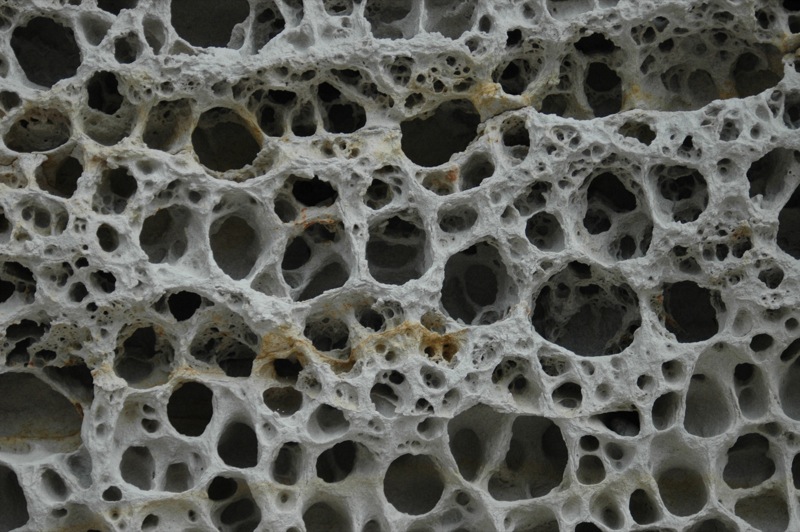
It does seem to me that there are certain patterns in Nature which seem pretty widespread. This one which is a “honeycomb” pattern in rock in the West of Scotland is one of these, and, for me, it’s one of the most fundamental.

It’s a bit like a web, or a net, and really it’s simply connections and points of connections. The connections are the thin almost thread like pieces and the points of connection are where two or more of these pieces meet. This is the basis of all networks – we call the points of connection, “nodes”, and the lines represent the ways in which nodes influence each other.

Simple nodes receive information, energy or materials from other nodes, and pass them on. More complex nodes do some processing, so that the exact information, energy or materials which it receives, leave it in somewhat different form.

One of the places we see this structure is in our brains – we have billions (yes, billions) of special cells in our brain. We call them “neurones” and their main purpose is to transfer information from one place to another. The neurones all meet up with other neurones at specialised junction points called “synapses”. Every single neurone is connected this way to several thousand (yes, several thousand) other neurones. You can imagine pretty easily that the permutations of firing, communicating neurones, neuronal pathways and neural networks in the brain might not be infinite, but it’s so gobsmackingly (is that a word?) large that we literally can’t actually envision it in its totality. I’m sure I once read someone say that the number of whole brain states, determined by which neurones are firing is greater than the number of visible stars in the universe. Well, don’t know if that’s quite right, but it sure gives you a way of imagining the immensity of it.

Another place we see this structure is in the human body. Think of each of your several billion cells as a node, and once you realise that every single one of those cells lives in constant relationship with all the others (either directly or indirectly, cos that’s the way a network works) then you get a good understanding of why we need to think of our health and wellbeing holistically. None of our parts live in isolation. In fact all our cells, all our tissues and all our organs, are continuously, dynamically relating to others by establishing and maintaining “integrative” relationships – that is “Mutually beneficial bonds between well differentiated parts”. There’s a key point to see here – the most fundamental kind of relationship in the universe is collaborative, integrative and co-operative.

Yes, competition exists. Of course it does. But we have been duped into believing that competition is THE key relationship in the universe…….THE driver of evolution. It’s important and it’s real, but by itself competition could not produce evolution, could not produce Life, cannot describe reality. We need relationships which are essentially integrative, fundamentally well-meaning, mutually supportive, collaborative, to do that.

I don’t know about you, but I think we could all benefit from this simple shift of understanding – we need to put “collaborative, integrative, co-operative” relationships at the heart of our decision making.

Read Full Post »

I’m pretty keen on taking photos of webs, especially on a misty morning or after it’s been raining.

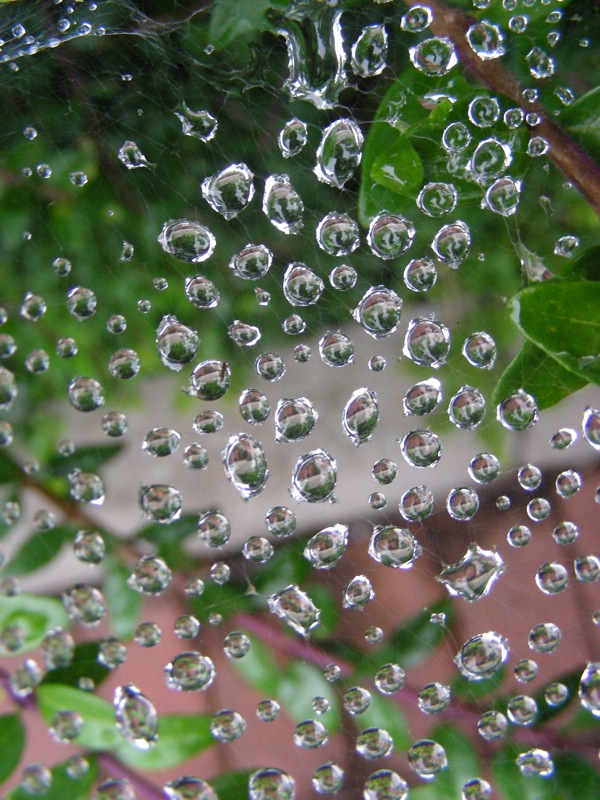
This is one of my most favourite photos of a web. Actually you can hardly see the strands of the web itself, which makes it even more interesting……it’s like the underlying structure which gives shape to the whole image is invisible, or almost so. And I think life is like that. There are underlying structures, forms and shaping forces to everything, but mostly that’s all invisible!

What we see most in this photo is a myriad of water droplets – each one of them acting as a prism or a lens. Look closely at any of them and you can see that they are showing you an upside down image of the surrounding world. Isn’t that fascinating as well as beautiful?

Because what that makes me think is how each of us is like one of these droplets. Each of us has our own unique perspective upon the world. Every single one of us sees and experiences the world from our individual and different subjective point of view.

But we are all connected. And we are all living in the same world. So most of what we see in any of these little lenses is the same. We live shared lives. We experience shared phenomena.

That takes me back to my favourite – “and not or” – we are at the one and the same time having unique, individual experiences, AND shared, common, connected ones.

It’s not a matter of choice.

If we forget either one of these apparent polarities then we fail to grasp reality. Reality is a vast, inter-connected, largely invisible web of unique, individual events and experiences, constantly changing, constantly interacting, always astonishing and, utterly beautiful.

Read Full Post »

There’s a tradition around Kyoto of climbing the hill to the Fushimi Inari temple in January. There are the most amazing Tori gates there….thousands of them winding through a forest on top of a hill. It’s one of the most spectacular places I’ve ever visited. The tradition related to the start of the year is about wishing for a “good harvest” or, in more modern times, wishing for good luck and well being I suppose.

The reason I return to these photos and think of Fushimi Inari every January is because of the gates – because January is the month of the threshold, of the gate, of the place where we step forwards into the New Year looking ahead with some hope and good wishes, and looking back at the old year just gone, remembering some of our main experiences. In fact “January” gets its name for the God “Janus”, the one with two faces, one looking forwards and the other looking back.

But there’s an additional reason I return to these particular photos in January – because the Inari shrine with its long winding passageways of Tori gates isn’t just about look forward and back. It is utterly, wonderfully, beautiful just as it is. In other words, as you walk through these gorgeous bright orange tunnels of gates, with glimpses of bamboo and forest all around you, you become completely entranced by the present – by the here and the now.

So there you have it – January – really a wonderful month to take the time to reflect on the year just ended, to look ahead with hope and wonder to the year ahead, and to remind yourself of the “émerveillement du quotidien” – the every day wonder of this one, unique, and special day which is unfurling before you right here, right now.

Read Full Post »

It’s many years since I was walking around Aix en Provence and came across this ball lying against the kerb. I could have just walked by. After all, what’s so remarkable about a ball just lying in the street? But I didn’t. I crouched down at the side of the pavement and took this photo.

The ball is the centre of attention. I know about the “rule of thirds” in relation to picture composition but I decided this time to make the ball sit pretty much in the middle of the shot. But it’s not just a picture of a ball. It’s a ball in a totally empty street……which really gives the impression of an abandoned ball. I don’t know if the ball had been abandoned or if some kid had just left it outside their house while they had their lunch, but in this particular framing this image still captures a real sense of abandoned play for me.

At this point in our pandemic (it’s January 1st 2021 as I write this) a street like this looks like the “new normal”. I’ve been seeing streets like this for about nine months now. So, now that I return to this old photo it has a new, topical relevance.

But I want to return to the ball itself today, because what is the purpose of ball like this, other than to be something to play with?

I know we are going to have to develop new behaviours, make different choices, change our lives in the face of this pandemic, but I’m going to suggest to you today that one of the behaviours we could do with a bit more of is “play”. I don’t mean that in a trivial way. In fact, I think play is greatly under-rated. Babies and children learn and develop most of their key, lifetime skills, through play – they explore, they press what they can press, push what they can push – I saw a little video of my smallest grandchild opening his first ever Xmas present. He’s not a year old yet. But he immediately spun whatever would turn, pushed whatever buttons would go down, popped a ball into a hole……he just constantly tried out everything. It’s this kind of play we need to cultivate I think and that is going to require –

Wonder – if you can keep in touch with a sense of wonder, not only will every day have something in it to delight you, but you’ll remain curious, you’ll keep wanting to explore. We will find new ways of living through our capacity to wonder. Lose the sense of wonder, lose the ability to invent new ways to live, lose the ability to make sense of this world.

Humility – getting down to a child’s level is a way of having a “beginners mind” – a way of countering any arrogance of knowing it all. We never know it all. That’s just not possible. Unless we retain a sense of humility and acknowledge that we can always learn from our experiences then we just aren’t going to progress. One of the things that frustrates me most about this pandemic is what seems like a systemic inability of politicians to admit they didn’t get things right, to acknowledge that they could have made different choices. Without the ability to do that, they can’t make better choices next time around.

Joy – how much do you let joy guide your actions and choices? Researchers into the neuroscience of emotions, and many philosophers over hundreds of years have shown us that joy is one of the most powerful emotions and drivers in the human psyche. You can see that easily in children. If it’s not bringing them joy, they soon let you know! And, yes, I know, joy is not the only emotion, and can’t be your only guide. I’m just suggesting that there’s a benefit in becoming a bit more aware of brings you joy, understanding why that is, and then feeding that into your decision making.

Imagination – I sometimes think this our superpower. We are literally the co-creators of our daily lived experience and there is no way we could do that without excercising our imaginations. We can’t think ahead without it. We can’t experience what anyone else is experiencing without it. We wouldn’t have memories without it. We couldn’t create without it.

I’ll leave this post with those four things. I think these are four things related to “play” and I think we are going to need them all in spades as 2021 unfurls……

  • Wonder
  • Humility
  • Joy
  • Imagination

Read Full Post »

In my two previous posts I’ve considered how our experience is altered by the frames through which we live – through which we perceive and engage with daily reality. These frames, psychologically, are fashioned out of our beliefs, our values, our habits and our memories.

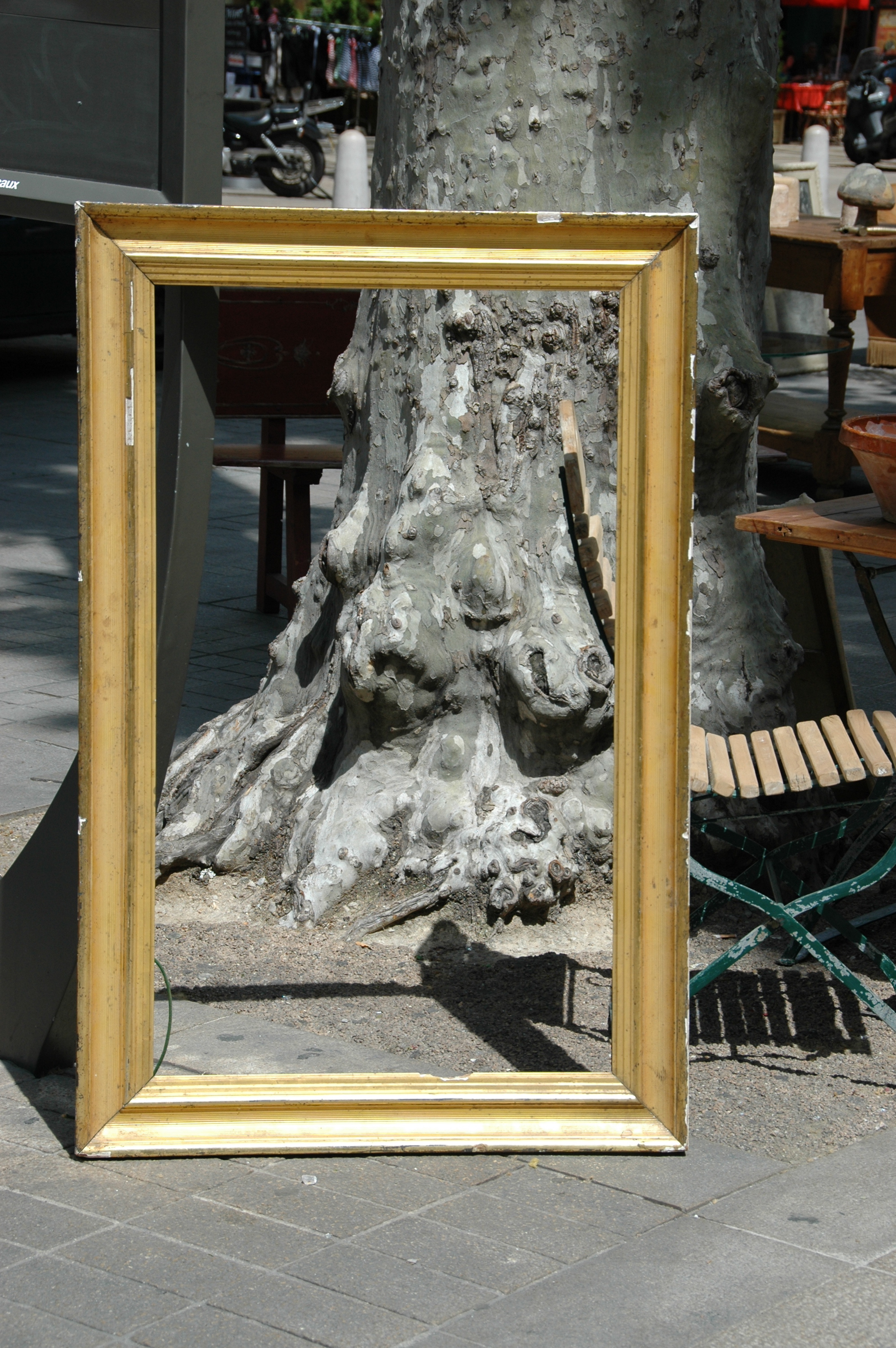
This photo is of a picture frame at a stall in an antiques market in the middle of Aix en Provence. What always strikes me first when I see this photo is how the frame is the dominant source of colour in the image. I’ve actually looked at this and wondered if it was a black and white photo with only the picture frame coloured later on, but it isn’t. I haven’t edited or changed anything from the original shot. When you look more carefully you can see plenty of colour to the right hand side of the image. Still, that contrast between the golden frame and the pretty monochrome pavement, tree and the left hand side of the background really, really makes the frame stand out.

So, I got to thinking a bit more about this idea of the frame, fashioned from our beliefs, values, habits and memories, and how that plays such a role in our lived reality. The first thing that came to mind was the way in which our two cerebral hemispheres engage with the world differently. The left focuses in on parts and details, emphasises objects, measurements, and data. The right is more focused on the whole, on the connections, relationships, the “between-ness” of everything, and on the particular, the unique and the specific. Along with that goes a predilection for mechanisms and machines with the left hemisphere and a predilection for nature and human beings with the right. At least, that’s one way of summarising some of what Iain McGilchrist describes in “The Master and His Emissary”.

The question then is which hemisphere are we in the habit of using most? And I think, again agreeing with McGilchrist, that there is no doubt the left hemisphere approach to the world has become the dominant one. We live in a world where we give priority to data, measurements, objects, control and grasping, to machines and computers, to industrialisation and automation. But this pandemic has shown us the importance of understanding how everything connects, of the importance of the human, and the unique, of our need for care and for each other. So, maybe one way we need to move forward into 2021 is by building the strengths and powers of the right hemisphere “frame” of values, beliefs, and habits. Maybe our way forward is going to require more imagination, more flexibility, more adaptability than the dominant “frame” the left hemisphere has provided for us?

The next thing that comes up for me is about our shared values, beliefs and habits – our structural ones which have produced modern day capitalism, our exploitative relationship to “Nature” which we see as something outside of us, something to be dominated. What if we tackled those two issues together?

What if we explored a different kind of economics and politics which would reduce inequality, reduce exploitation and injustice? What if shifted from having money as our god to Nature as our god? To see Nature as something we are a part of, not apart from. To see Nature as a source of infinite wonder, of an enormous resource, not to be consumed but to learn from? What would the world look like through that frame? How would that change our values, beliefs and habits?

Well, that’s what I want to explore in the months ahead. I want to learn more, understand more, and share more about the real world, the real world seen through the frame of connectedness, uniqueness, diversity, equality, kindness and wonder.

How about you? What values, beliefs and habits do you think dominate the frames through which you engage with the world? And which of those do you think are shared with others? Is there anything there you’d like to change?

In fact, more than that, what if you were to imagine your “golden frame”? Your ideal, your dream, frame? The way you’d most like to engage with the world and the shared beliefs, values and habits which you’d like to spread most widely? What would that look like?

Read Full Post »

Yesterday I wrote about the difference between viewing a garden from the perspective of inside a building, to that of viewing it as you walk around the garden itself.

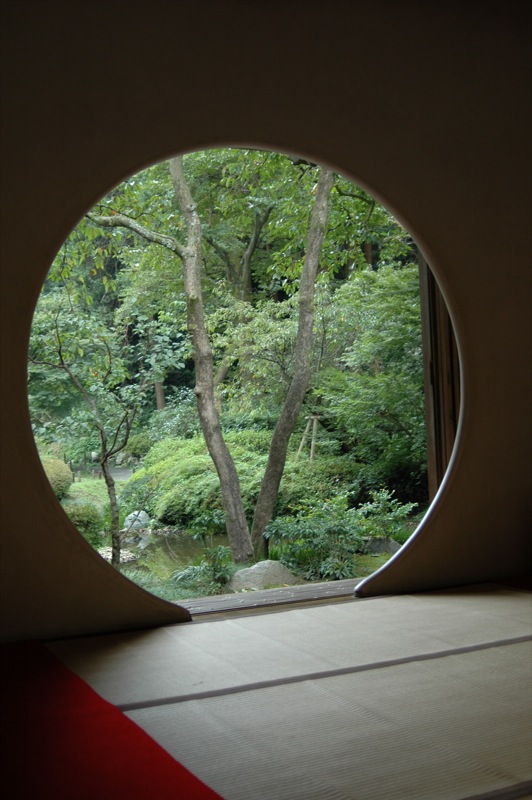
The photo I used for the first perspective showed a traditional rectangular shaped doorway, all straight lines and 90 degree angles between them. So I thought I’d contrast that today with this photo, taken at a different temple, but again showing a garden viewed from the perspective of inside the building.

This time it’s a round window. Now, before I say anything more what do you feel as you look at this image? Isn’t there something particularly attractive about the round frame, instead of the rectangular one? Isn’t it somehow less aggressive, less harsh? Even if you didn’t think the other window frame really had those qualities before you looked at this one.

But there’s something else about this frame…..the circle is not complete. There is a section missing at the floor level. This is, as I understand it, another characteristic of Japanese design aesthetics. The idea is that if you leave something “less than perfect” or “incomplete” then it does two things – it stimulates the observer to use their imagination to “complete” the shape, and it contains a kind of latent dynamic quality – it is in the process of “becoming”. It isn’t “fixed” or “dead”.

All that makes me wonder about the kinds of frames we use to engage with everyday life. Because there is no doubt that our values, beliefs, memories and habits all exert powerful effects on what we notice, what impact those observations and experiences have upon us, and what sense we make of them.

Do you agree?

If so, I think that’s why it’s good to stop now and again, to reflect and to try to become more aware of just what values, beliefs, memories and habits we access most frequently. One simple way to do that is Julia Cameron’s “Morning Pages” exercise. It’s just writing non-stop, stream of consciousness writing to fill three pages of a notebook every morning. My experience of this is that it works best when you don’t re-read what you’ve written until some time later – say at least a month or so – so, here’s my proposal – are you up for doing “Morning Pages” every day of January? Then reading over what you’ve written once we reach February?

Read Full Post »

I’ve read before that one of the major differences between Japanese and English garden design is that in Japan the emphasis is on what the garden looks like from inside the house, whereas in England the garden is designed from the perspective of the observer actually in the garden.

I think that’s probably an over-simplification and as with pretty much all generalisations it should be taken with a pinch of salt.

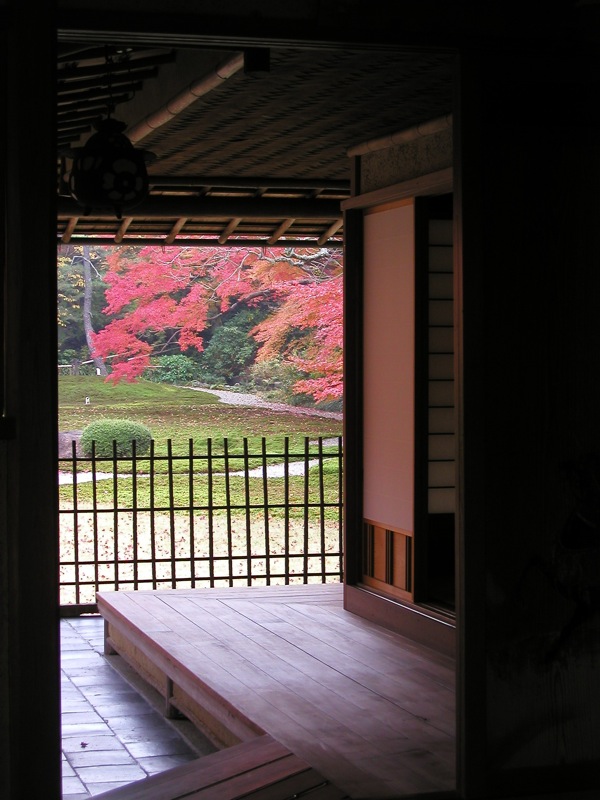
However, here’s an example of a Japanese garden. I took this photo form the interior of a temple, and you can see that the garden pulls your attention towards it. Not only does the window seem to create a frame for a beautiful picture, but the wooden flooring leads you out of the room towards the fence inviting you to enter the garden…..but only to the edge.

Maybe that’s partly where this idea comes from that the aesthetic in Japan is to create the experience for the observer standing just a little bit outside of the garden.

But, now, look at this next photo, which I took during the same visit to the same garden.

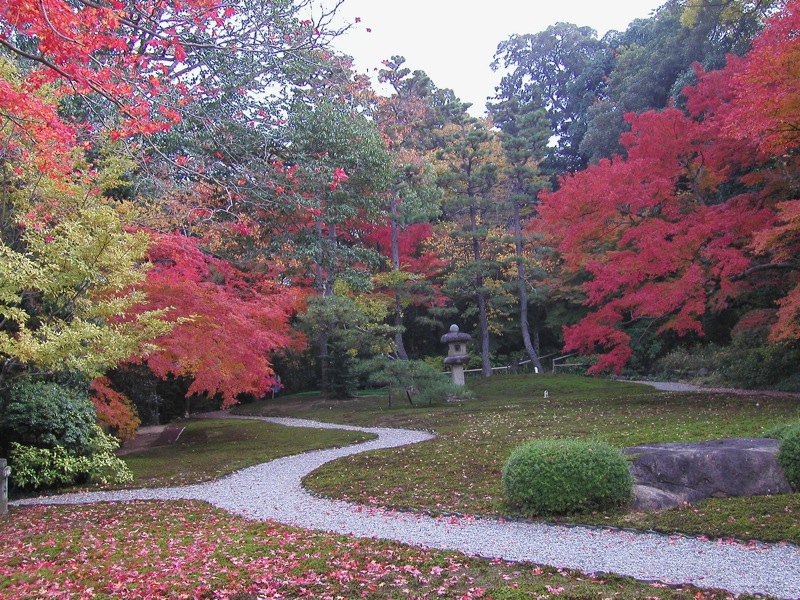
This isn’t a garden just to be looked at from the outside. Look at these winding paths, the stone lantern, the opening between the trees, the well trimmed low shrub, the grey rocks. This is all absolutely begging you to get out onto that path and experience this garden as it unfolds around you! This is a garden to be experienced from the inside of the garden itself.

How do I reconcile these two views and these, at face value, conflicting sets of design value?

And not or“.

Here’s some of the true genius of Japanese aesthetics, in my humble opinion…….a resolution of polarities to create something greater than either of the poles can achieve by themselves.

This is a garden created to be beautiful and inviting from inside the temple, AND to be beautiful and inviting once you are in the garden itself. Both of these experiences are so memorable, and dovetailing the two perspectives into one takes the entire visit to a whole other level.

I find this incredibly inspiring. It inspires me to connect to, to seek out, and to create, beauty. It inspires me to break down the artificial boundaries between perspectives – to bring the view from outside the garden into the view from within the garden. It inspires me to create curiosity and intrigue as well…..because don’t you just want to walk along that path and have a closer look at those rocks, that shrub, that stone lantern? Don’t you just want to walk along that path and “bathe” in that gorgeous forest of colour? Don’t you just know in your bones that this is the kind of thing which is “good for you”, which will nourish your soul, stimulate your body and your mind, enrich your life?

Read Full Post »

When I looked up and saw these black and white clouds I immediately thought of the yin yang symbol….that brilliant representation of wholeness, the union of opposites, and the permanency of change.

I think those are three of the most significant principles I return to again and again to make sense of the world, of life, of other people and of me.

Wholeness because all reduction, every move to separate and isolate, every attempt to disconnect, to abstract, to re-present, is fraught with the potential for delusion. There are no separate, isolated, disconnected phenomena in Nature. All our abstractions and re-presentations which we carry out with our left hemispheres are a step away from reality. Which is not to say they aren’t useful. They are. But you can’t rest there. You have to re-contextualise, to hand back the analysis to the right hemisphere to understand what you are looking at as only an aspect of the whole.

The union of opposites because we humans, Nature, Life and the Universe are full of opposites….dark and light, heat and cold, attraction and repulsion, organisation and disintegration. In fact it seems that there is no universe without opposites. We are tempted to construct the myths of competition and conflict from that fact, but we must not miss the deeper understanding – that all of existence emerges from the integration of opposites, not from the elimination of one pole by another, not from the unchallenged dominance of one over another.

The permanency of change because that’s the nature of reality. There is nothing fixed, nothing which is not in the process of growing, or adapting or degenerating, whether we see that as three Gods, or as the natural cycles of the biosphere and of the seasons.

So when I look again at these clouds, these beautiful black and white clouds, I am captured by their beauty and entranced by the teaching they can give me.

Read more about this in my book, “And not Or”. You can get it from Blurb at https://www.blurb.co.uk/b/10155078-and-not-or

There’s also a Kindle version – https://amzn.to/2UozjIw – if you are in the UK. If you are not in the UK, go to your local Amazon site and search for “Leckridge” – you’ll find it quickly that way (let me know if you don’t!)

Read Full Post »

« Newer Posts - Older Posts »