Feeds:
Posts
Comments

Archive for the ‘philosophy’ Category

I love the places where different elements meet. There’s a magic there. Here are three I saw recently.

Where sun, air, clouds and rain meet the sea…..

rainatsea.jpg

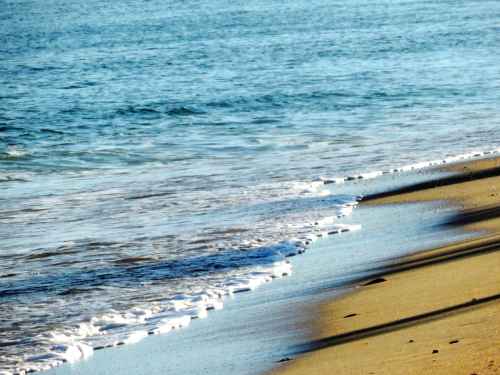
Where the sea meets the land…..

seasand

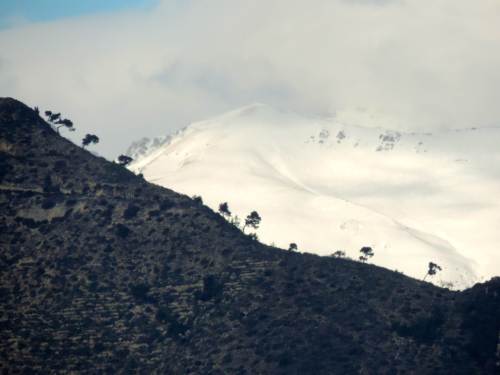
and where the snow meets the forest and the clouds meet the mountains…

snowline

Iain McGilchrist, in his Master and His Emissary, describes how our right cerebral hemisphere has an approach to the world which focuses on “betweenness”. I think looking out for, and noticing, the meeting points, these boundaries, margins and connections in the world is a great way of activating your right hemisphere.

It’s a good way of just enjoying the sheer beauty of the world too!

Read Full Post »

Have you ever visited the Musée d’Orsay in Paris?

No?

Put it on your list.

It’s one of my favourite places in the world. It was originally a railway station and has been turned into an art gallery on the banks of the Seine. It’s an astonishing building. Quite incredible that anyone would construct a railway station to look like this, but also, quite brilliantly transformed into a gallery.

When I go I like to go straight from the main entrance, down through the sculpture gallery right to the far end of the building where you can find an escalator that takes you up to the fifth floor where there is a fabulous collection of the work of the Impressionists.

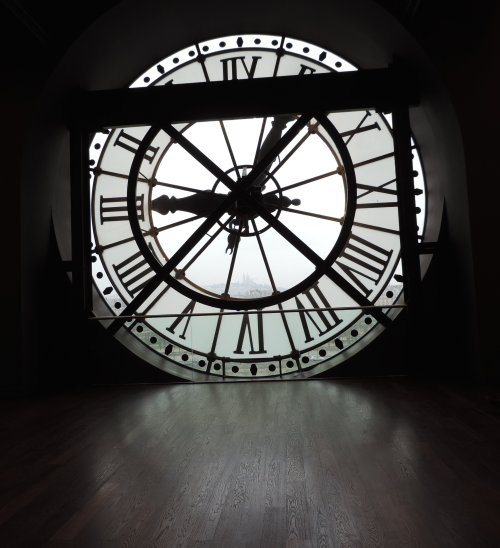
Before you get to their work though you pass through the room with the clock in it.

That’s the one I want to share with you today.

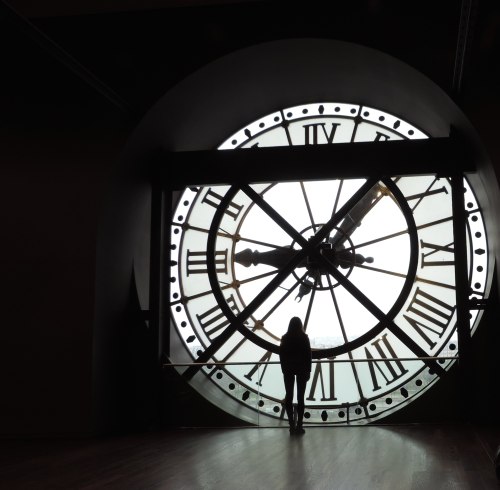
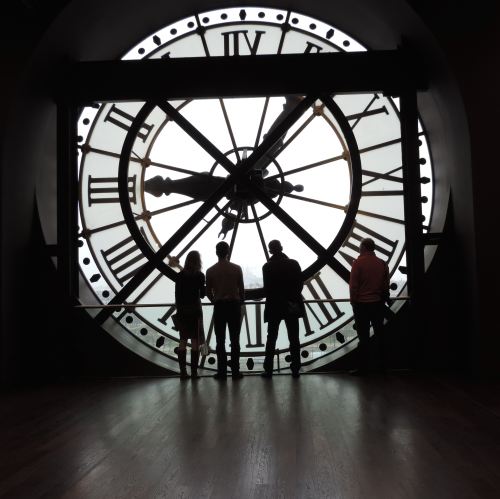
Here are three photos I took –

one

group

seeing beyond

These all stimulate my thoughts about time and how we relate to it. They conjure up my thoughts about “taking time” – in other words, slowing up, savouring, taking the time to fully experience the here and now, but also, taken in sequence, these three images provoke the following thoughts –

Firstly, how good and necessary it is to spend some time by yourself. Remember Julia Cameron’s “Artist’s Way”? I often told people about her exercise of making an “artist’s date” – actually scheduling into your diary a piece of time – it might be an hour, half a day, a day – and there are only two rules to apply to that piece of time – you have to spend it alone (no sharing!) – and you have to spend it doing something you enjoy (no chores!). You should then schedule in a regular series of these dates at a frequency you can manage – daily, weekly, forthnightly….whatever. Whether or not you are an artist, I think this is a very, very valuable exercise to try.

Secondly, how good and necessary it is to spend some time with others. There is something truly magical about sharing an experience with someone else – whether that be a visit to a gallery, listening to song, watching a movie, having a meal – we are social creatures, we human beings and sharing experiences with others makes our heart sing.

Thirdly, when we lose ourselves in something….a view, a book, a creative act……we experience “FLOW” – what Czikszentmihalyi wrote about in his study of happiness. It’s that time when we are “in the zone” and time “stands still”. Just gazing through this clock to Montmartre is an entrancing experience.

Isn’t strange that time doesn’t pass at a constant speed? Despite what clocks seem to tell us?

Read Full Post »

last leaf

There’s a growing body of evidence that using your brain is good for your brain. Who’d have thought it?!

There’s also a growing body of evidence that what is good for your brain is good for you. The old mind-body duality is breaking down in the light of neuroscientific findings about the connections between the brain, the rest of the nervous system, and the rest of the body.

Using your brain is one of the key themes of this blog. I believe it’s just too easy to drift through life in zombie mode, influenced by others, manipulated by others, controlled by others. And yet, I also believe it very, very possible to make our own choices, to become “self-directed”, conscious creators of our own, unique stories and, hence, lives.

One of the most commonly promoted ways to use our brains is “mindfulness“. A sort of clumsy word which describes a certain state of awareness.

You can practice “mindfulness” by learning certain meditation techniques, and/or, you can do what Ellen Langer says, and “seek novelty”. 

I find that choosing to be aware, stoking the natural curiosity for the day, seeking “l’émerveillement du quotidien” is one of the easiest, and most delightful ways, to achieve this – this is the main way I try to be “mindful”.

There are two related techniques which help me to live this way. They both date way back thousands of years but both work just as well here and now.

Here are two photos to illustrate the techniques.

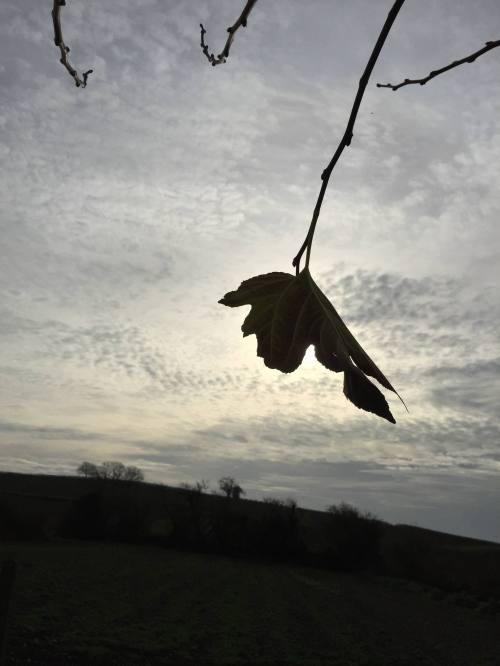
The first one is the one at the start of this post. It’s “the last leaf”. There’s a mulberry tree in my garden here in France and this is my second season of raking up and gathering the leaves as they fall. The first year I arrived here I wasn’t prepared for this phenomenon. This tree really sheds a LOT of leaves. I confess, I found that clearing up the leaves was a bit of a burden. But this year? This second season for me? I’ve loved it. Pretty much every other day I’d take the rake and gather up the leaves into huge canvas bags and every other week I’d make a trip to the “déchetterie” (“the tip”, we’d say in English). I enjoyed taking my time, rummaging through the different shapes, sizes and colours of the leaves. I enjoyed seeing the green grass again once the leaves were gathered, but quickly, of course, the grass would recreate a “wabi sabi” appearance with just two or three newly fallen leaves adding interest and attracting attention.

As more and more of the tree shed its leaves I decided I’d like to photograph the “last leaf”. That’s my first image in this post. And that’s the first technique – “live today as if this is the last” – that’s not as morbid as it first sounds…..due to the constancy of change, every day is unique, and the truth is, you will never have a chance to live this day, exactly like this, ever again. So it might be a good idea to savour it. To notice what you can, to hear what you can hear, touch what you can touch, smell what you can smell, take your time to taste and savour the food you are eating.

Because this will be your last opportunity to do so.

Here’s the next image –
first leaf

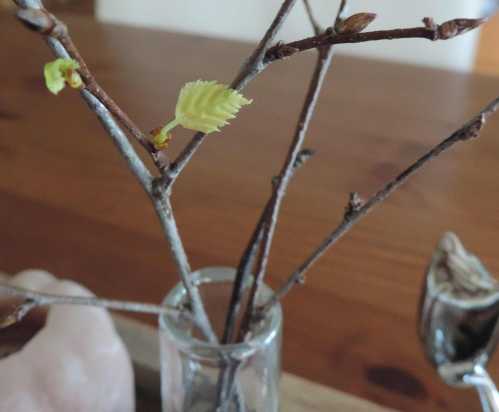
We have twin birch trees in this garden, and when the wind blows in the autumn, they shed, not only leaves, but lots of small twigs and branches. Yep, most of these head to the “déchetterie” too, but Hilary picked some up, finding their shapes pleasing and used a couple as a table decoration. There was a little water in the bottom of one of the vases she used, and look what happened! A few days later, there was a new leaf!

So, here’s the second image, “the first leaf”, and the second technique, “live today as if it’s the first”.

That’s true too. Due to the uniqueness of every day, of every experience, of every moment, whatever you encounter today, you encounter for the first time. Sometimes that’s not so obvious. Our habits and our routines deaden our awareness and we become oblivious to the small changes which can make a big difference.

You have never lived this very day before. So why not approach it with the sense of wonder, curiosity and amazement which you did so naturally as a child? (This is “l’émerveillement du quotidien” – the wonder of the every day)

I mean look at that little twig! It’s grown a leaf! A perfect, bright green, little leaf! Isn’t that amazing? I wondered a wee while ago about how difficult it was to know whether a seed was dead or alive, but I didn’t wonder about these (apparently discarded) twigs. They were dead as far as I knew. But add a little water, and, hey presto! Life magically emerges!

If you don’t stumble across something new, something for the first time, today, you’re just not looking.

So, there you go, two photos, two ancient techniques, “last and first”, and a step in the right direction from “zombie to hero“!

Read Full Post »
changing weather

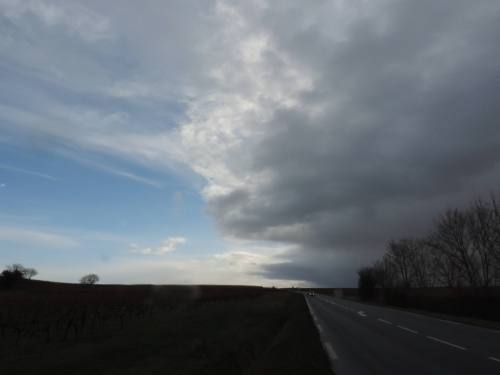
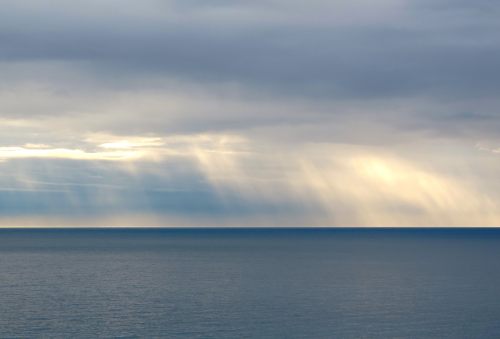
I stopped to take this photo partly because the drama of the dark rain cloud half filling the sky caught my eye, but also because I instantly thought about the yin yang symbol – half dark, half light, capturing the essence of constant change.

But when I look at it now what springs to mind is the old question about a glass of water – is it half full, or half empty? And what does that say about the way you see the world?

So, what do you see here? A brightening sky of spreading blue? Or a darkening sky of spreading grey?

Whichever it is, of course, this too shall pass – the blue will be covered with rain clouds again, and the rain clouds will pass on by to reveal the blue.

But I do wonder, how our world view influences our view of the world…..and how that affects not just what we notice, but how we interpret what we notice?

Read Full Post »

paris

Returning from Scotland to France the other day, I flew over Paris and captured this view.

The first thing which catches your attention is probably the sunlit River Seine, around which the city has grown. It sparkles and shines and reminds me that Paris is known as the “city of light”.

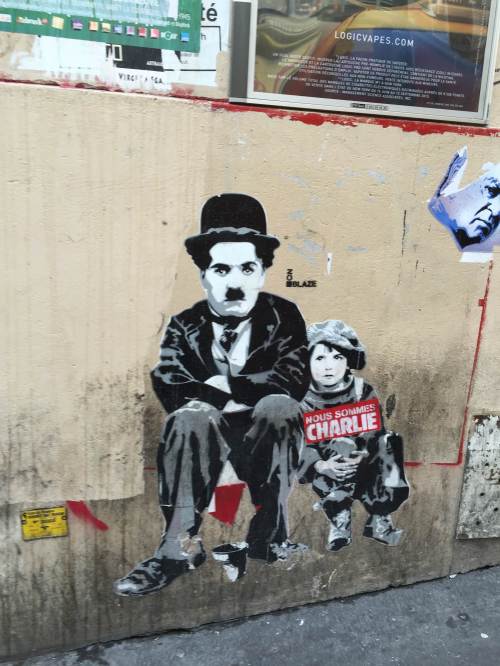
But what comes to mind when people mention Paris now, in the light of 2015? At the start of 2015, we heard about the terrorist attacks on the cartoonists at Charlie Hebdo, and on the Jewish supermarket. Then we saw the huge expression of solidarity spreading far beyond Paris into the rest of France and the rest of the world with thousands upon thousands of people coming out into the streets and declaring “Je suis Charlie”.

je suis charlie

At the other end of 2015 came the massacres of mainly young people enjoying music, drink, food and each others company as the terrorists struck again in this same city. And, again, there was a reaction across the world, as people flew the tricolour, changed their profile pictures, sang La Marseillaise, and declared their solidarity with the people of Paris.

These attacks have been interpreted as an attack on what Paris “stands for” in the world, as an attack on “French values”……and so as an attack on both pleasure and delight in Life, and on “freedom, equality and brotherhood”.

Of course, these events are complex and can’t be reduced to such apparently simple interpretations.

How do we choose a life of joy instead of a life of fear? How do we say “yes” to the world, instead of “no”? I don’t think we know all the answers, but when seen from above, this sparkling city still seems to shine as some kind of beacon.

Paris is still a “city of light”.

Then I looked again at this photo, and I zoomed in so I could see the Eiffel Tower. The truth is it’s not to easy to see the Eiffel Tower in a clear blue sky any more. Most days it seems to be dulled or obscured by pollution in the atmosphere, so isn’t it interesting that the global climate change conference took place in Paris just before 2015 ended?

Wow! We have a lot of work to do, to make this world a better place for us all to live in together. A lot needs to change as we switch from consumption and waste to resilience and sustainability, as we choose to shift our attention from fear to love.

But let me return again to this image, because, instead of reducing it to its parts, I find it simply beautiful. Isn’t Paris also known as a place where artists gathered? Isn’t it one of the great symbolic cities of creativity and imagination?

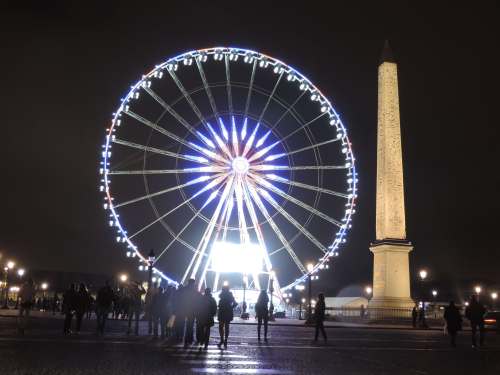
Here’s my hope then for 2016. That we can each enrich our lives this year with love, imagination and the joy of living. That this can be a year when we nurture and sustain the beauty of the light in our world – that burdens are lightened, days are brightened and that we become more enlightened.

paris by night

shining lights


Read Full Post »

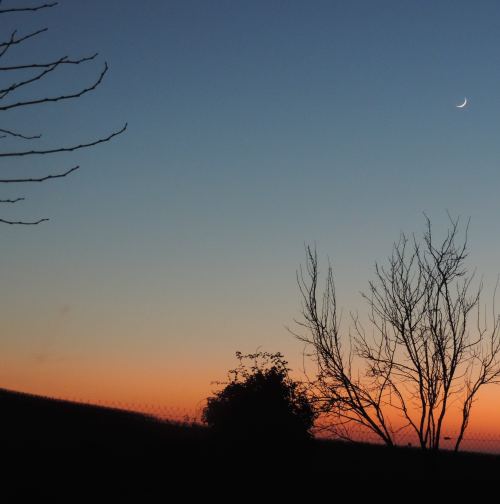
two lights.jpg

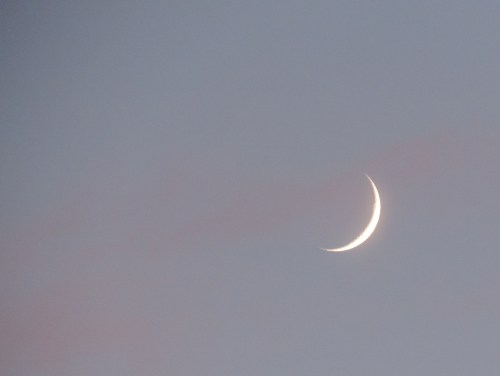
Just after the sun set I saw this moment – where the moonlight meets the twilight. Knowing, of course, that these are both the light of the same sun.

I watched a fascinating and moving documentary on French TV on Sunday. It was about a French family, a father, mother, teenage son and two younger daughters sailing a boat up the east coast of Canada to Greenland and as far north as they could go.

The further north they sailed the less they encountered towns and villages, but when they did stop, they’d be welcomed by local Inuit people. Although they couldn’t speak to each other in a common language, their interactions were friendly and curious. There were lots of smiles and a welcoming into homes to share some food.

I was reminded of holidays in Brittany many, many years ago, where our little son, probably only about 5 years old at the time, would spend all day playing on the beach with another child who was there. The children didn’t speak the same language but they had fun for hours. When we asked him what the little girl’s name was he replied “I don’t know” with an expression which suggested he didn’t even understand the need to ask the question.

It’s been my experience as I’ve travelled in other countries that strangers are helpful and friendly. There is some fundamental affinity between human beings.

I know all that can go very wrong very quickly however. A few days ago I was reading one of Montaigne’s essays (On coaches), where he described the reports of the “New World” which were just becoming known at the time (he lived in the 16th century). The tales he told were of the Spanish greeting the native peoples of Mexico and other “New World” countries, presenting themselves as peaceful and friendly, then deceiving and tricking them….slaughtering, capturing and torturing them. Demanding gold from them. The descriptions of the violence are as awful as anything you’d see in “Game of Thrones”! Montaigne was shocked by it –

Who ever set the utility of commerce and trading at such a price? So many cities razed, so many nations exterminated, so many millions of people put to the sword and the richest and most beautiful part of the world turned upside down for the traffic in pearls and pepper!

He mused about how things could have been so different –

What an amelioration for the entire globe, if the first examples of our conduct that were offered over there had called those peoples to the admiration and imitation of virtue and had set up between them and us a brotherly fellowship and understanding?

In other words, what if the explorers had presented the best of themselves instead of the worst? What if they had behaved in such ways that the native peoples had admired them and wanted to imitate them instead of fearing them? What if the whole goal of the exploration had been an increase in “brotherly fellowship and understanding” instead of exploitation and theft?

Makes you wonder, huh?


These tales of violence seem both far away and disturbingly close. We certainly haven’t evolved to a better way. There are still wars of religion, torture, exploitation and even domestic violence. However, I do think there is a glimmer at least of hope because there is something I can do. And that you can do. Every day.

We can tune in to our natural human attraction for other humans and approach them with our best selves rather than our worst. I can, and you can, meet others with a desire to “increase brotherly fellowship and understanding” (that’d be sisterly too by the way!!)

Can’t we?

Read Full Post »

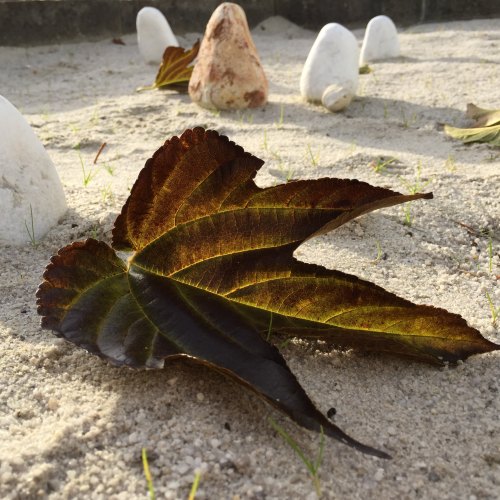
leaf and stone

I have a large mulberry tree in my garden and at this time of year, every morning there is a small carpet of leaves on the ground waiting for me to come and gather them up.

There is also a sandpit in this garden. Someone, sometime, presumably created it for children to play in, and my littlest grandchildren played in it in the summer time. For the rest of the year I arrange, and re-arrange some stones we bought in a local store and rake the sand from to time, almost like a Japanese garden but on a much smaller, more amateur scale! My landlord, when he saw what I’d done asked if I’d arranged a “petit menhir” – a small circle of standing stones. I hadn’t thought of them like that but circles of standing stones are in my genetic memory so the idea has stuck.

Some of the mulberry leaves fall into the circle of the stones and when I got down to the sand-level I managed to take this photo.

I love the contrast of the transient, seasonal leaves and the apparently unchanging stones on the sand.

I say “apparently unchanging” because I know that everything is constantly changing, but some at such a slow rate that a single human lifetime is not enough to spot the difference.


Read Full Post »

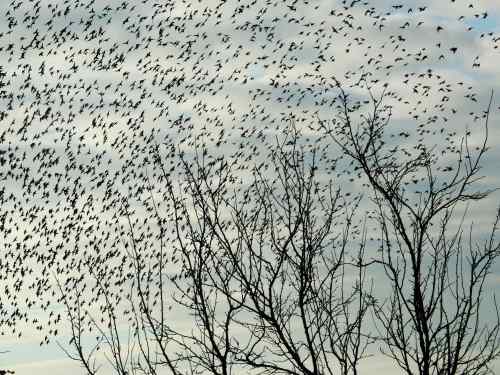
starlings

In his essay, “On Experience”, Montaigne wrote

Nor is there anything more remarkable in Socrates than the fact that in his old age he finds time to take lessons in dancing and playing instruments, and considers it well spent.

Socrates? In his old age? Dancing and playing music?! Well, I never…..

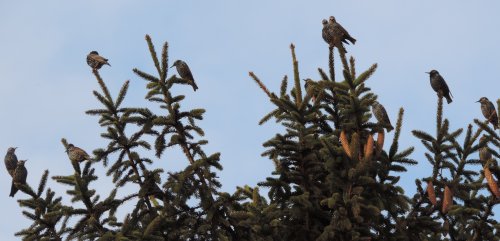
I thought about that the other day when I saw the starlings gathering again in the trees at the top of vineyard. They gather in their dozens, then their hundreds, and then, I suspect (because I haven’t tried to count them), in their thousands. As they settle into the trees they begin a great commotion, all singing and whistling and shouting it seems at the same time. They can keep this up for several minutes and so far I haven’t been able to figure out whether or not they are singing together or just all singing at the same time.

No matter really, because all of a sudden the whole flock falls completely silent – not a cheep! The silence is always, and I mean always, followed by flight. Suddenly they take off as one and fly away from the trees.

Then you can see something quite remarkable. The flock will divide into sub-groups and be joined by yet others you hadn’t even noticed coming. They will swoop down onto the vines, or soar high into the sky. I have no idea how you predict which way they are going to fly next and I can’t see that they all follow a single leader.

They really do seem to fly as one great organism.

I don’t know why they gather and behave like this. I fancy they just like singing and dancing. A bit like Socrates did, it seems…..

When they fly directly overhead the sound of their wings beating the air can take your breath away.

I’m sure they enjoy what they are doing even more than I enjoy watching them, but they affirm for me somehow how one of the best things to do in life is to enjoy living, to celebrate your music and your movement and your ability to join with, and flourish with, others…..

starlings in the tree

Read Full Post »

IMG_4143

I’m lucky to live in a place where I can see a lot of sky. I don’t think I’d like to live somewhere where I could only catch glimpses of it.

I notice the sky. A lot. I notice it when I open the shutters in the morning. This morning there was a pinkish orange/peachy glow from the rising sun. Now the sky is blue again. I find I only need to gaze up for a few moments and I see something which catches my attention – a high trail of white from a jet hurrying from the south to the north (or vice versa); a single bird hovering so high above the ground I can’t begin to understand how it can spot its prey in the vineyard; some clouds gathering, floating on by, changing shape every second.

Clouds catch our attention a lot, don’t they? Well, not so much when they are uniformly grey and stretching from one horizon to the next, but especially when they form shapes.

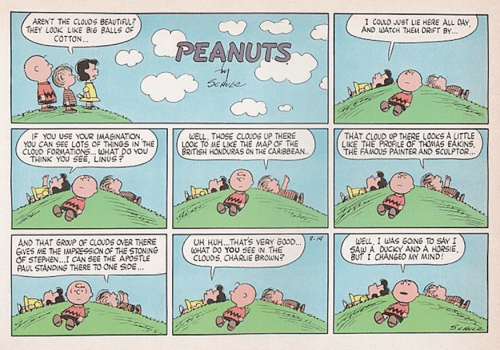
Actually I can’t tell you how often one particular Peanuts strip comes to my mind when I start to think about the shapes which clouds make! Wait, I’ll have a look…..oh, yes, here it is!!

peanuts clouds

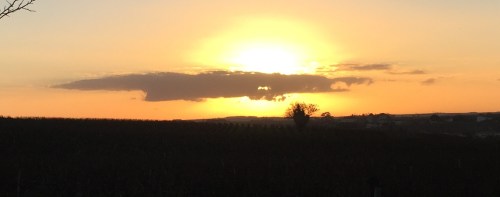
What do you see when you look at the cloud I photographed yesterday and posted at the beginning of this piece?

Do you see a dragon? A crocodile? What?

Two things spring to my mind when I start to reflect on our ability to see recognisable patterns in clouds – patterns which we can name – the first is about imagination and how it is always active and always busy creating the reality we experience. It’s not something we switch on and off. We use it all the time to see….to see the physical world, to make sense of it, to interpret it, to make and recognise symbols and be inspired.

The second is about the astonishing pattern-making/pattern-recognising power of the human mind. It’s such an integral part of who we are that we aren’t even aware that we are doing it. But we are. All the time. Seeing not just the patterns of the physical world around us, but the hints, suggestions and representations which are unique to each one of us.


Read Full Post »

DSCN4682

Marilynne Robinson in her new book, “The Givenness of Things”, says

Suppression tends to obscure evidence of its own failures, since fear is as likely to inspire ingenuity and stealth as it is compliance

Just before I read that I was reflecting on how much attempted power and control there is in our world.

We see it in the way fear is used – to control behaviour and to suppress diversity and difference.

But no living creatures can be controlled. You’ll have encountered the phrase “as difficult as herding cats” before, but maybe there is no creature harder to control than a human being.

You can suppress human beings, manipulate them, enslave them, make life difficult for them, but you can’t control them. There isn’t an empire in the history of the world which hasn’t disappeared. I heard Ursula Le Guin accepting a reward recently and she said whilst it was difficult to imagine living under a different regime from the current capitalist one, there was once a time when people believed in the divine right of kings and it didn’t look then as if that could change. She was making a plea for writers of imagination to help us to imagine a better system.

Can we use our fears to inspire our ingenuity rather than the pursuit of power?

Especially since control over Nature or over others is always such a transient delusion.

Read Full Post »

« Newer Posts - Older Posts »