Feeds:
Posts
Comments

Archive for the ‘philosophy’ Category

sun over the vines

Montaigne writes about life –

I enjoy it twice as much as others, for the measure of enjoyment depends on the greater or lesser attention that we lend it. Especially at this moment, when I perceive that mine is so brief in time, I try to increase it in weight; I try to arrest the speed of its flight by the speed with which I grasp it, and to compensate for the haste of its ebb by my vigor in using it. The shorter my possession of life, the deeper and fuller I must make it.

The first thing which struck me when I read this paragraph was “….depends on the greater or lesser attention that we lend it.” I’ve thought for a long time that attention is a great magnifier. Whatever we pay attention to gets bigger, more intense, or more significant, it seems to me. That’s what attracted me to the work of the positive psychologists such as Seligman. It seems to me that the more attention we give to a fear, the greater the fear becomes, so is it not better to give more attention to strengths, hopes and potentials and make them bigger instead?!

The second thing which struck me was his use of the terms “weight”, “speed” and “vigor”. In each and every one of these instances he is making the case for an intensity of engagement. This reminded me of the work of the philosopher, Robert Solomon, whose book, The Joy of Philosophy, is subtitled “Thinking Thin versus the Passionate Life”, and of Liz Gilbert, in her “Big Magic” where she talks of the “amplified life”.

Montaigne precedes this passage with a musing on the phrase “pass the time”, and here he is arguing that we shouldn’t just let time pass, we should embrace life fully and so experience it more intensely than we do when time is just drifting by.

The third thing which struck me was “The shorter my possession of life, the deeper and fuller I must make it”. He wrote this when he was older (it’s from the essay “On Experience” which is the last one in the third of the three volumes of the “Essais”). How often do you hear people who have had an accident or serious illness, say, in the full awareness of their mortality, that they now intend to live life more fully? Such crises are often described as “wake up calls”. This is the same idea, isn’t it?

So, what is Montaigne saying here that I’d like to take on board today?

That I want to live today with awareness, with passion and with intensity. I want to fully experience the one and only chance to live today.

That’ll do!

Read Full Post »

waterwheel

Here’s a couple of thoughts – is the scientific method the way to be sure of things? And, is there only one scientific method?

What provoked those thoughts? An article in the Guardian citing research about jihadists

What kind of person becomes a jihadi terrorist? Specifically, what kind of educated person? The overwhelming majority of graduates recruited into Islamist terrorism studied engineering, science and medicine. Almost none are social science or arts graduates, according to research. The insight could have important implications.

Almost half (48.5%) of jihadis recruited in the Middle East and north Africa had a higher education of some sort, according to a 2007 analysis by Diego Gambetta that is cited in Immunising the Mind, a new paper published by the British Council; of these 44% had degrees in engineering. Among western-recruited jihadis that figure rose to 59%.

The author of the paper, Martin Rose, describes what he terms the “engineering mindset” which, he claims, makes science and engineering graduates more susceptible to jihadist indoctrination.

The culture of science teaching, says Rose, resolves all too easily into a right and wrong, correct and incorrect binary. This damages the ability of science and engineering students to develop the skills of critical examination.

……three specific traits that characterise the “engineering mindset”: first, it asks “why argue when there is one best solution?”; second, it asserts “if only people were rational, remedies would be simple”; and third, it appeals to those with an underlying craving for a lost order, which lies at the heart of both salafi and jihadi ideology.

It does seem that the jihadists see the world in a binary way – black and white, right and wrong etc – “That is perhaps why, in Isis-controlled territory, university courses in archaeology, fine art, law, philosophy, political science and sports have been eliminated, along with drama and the reading of novels.”

This claim that a training in science and engineering leads to seeing the world in binary ways and assertions of certainty is totally contrary to what I just read in “Sapiens” by Yuval Noah Harari. He describes a number of revolutions in human development – the agricultural revolution, the cognitive revolution and finally, the scientific revolution. Of the scientific revolution he says

The Scientific Revolution has not been a revolution of knowledge. It has been above all a revolution of ignorance. The great discovery that launched the Scientific Revolution was the discovery that humans do not know the answers to their most important questions…….modern people came to admit that they did not know the answers to some very important questions, they found it necessary to look for completely new knowledge.

This seems to suggest that scientists might be best placed to say “I don’t know”, rather than to make claims about the possession of “THE TRUTH”.

Isn’t a good scientist always unsure? Does a good scientist ever claim they have the complete, final, definitive knowledge or understanding of anything?

Well that’s what I thought about science until I oversaw a science student’s notebook one day. The scientific method described there was of “Observation; description; explanation; prediction; control”. That shocked me when I read it but suddenly a particular approach to science made sense to me. I hadn’t taken on board that the ultimate goal of science was control. I thought it was explanation – possible explanations!

But a little further on in “Sapiens” Yuval Noah Harari writes

In 1620 Francis Bacon published a scientific manifesto titled The New Instrument. In it he argued that ‘knowledge is power’. The real test of ‘knowledge’ is not whether it is true, but whether it empowers us. Scientists usually assume that no theory is 100 per cent correct. Consequently, truth is a poor test for knowledge. The real test is utility. A theory that enables us to do new things constitutes knowledge

Aha!

Back to Bacon again! The sometimes claimed “father of the scientific method”. I never warmed to him with his desire to dominate Nature and human beings.

So also there are two kinds of empires, as rewards to those that resolve them. The one over nature, the other over men; for the proper and chief end of the true natural philosophy is to command and sway over natural beings; as bodies, medicines, mechanical works, and infinite other things

So maybe here’s the link – its a particular type of “scientific method” which is a quest for certainty in order to wield power.

Maybe it’s time for us to invest more in the humanities if that’s what is required to produce critical thinkers who can live with the reality of uncertainty.

Rose suggests that the British Council, the organisation funded by the UK to spread British cultural influence around the world, should involve itself in education reform, to “humanise” the teaching of scientific and technical subjects. A broader-based education would give vulnerable students the intellectual tools to develop an open-minded, interrogatory outlook – and to question authority, whether scientific, political, religious or scientific.

And maybe it’s time to promote a different scientific method – one based on wonder, curiosity, and the humble belief that we never know everything about anything.

But then, “que sais-je?”

Read Full Post »
simple web

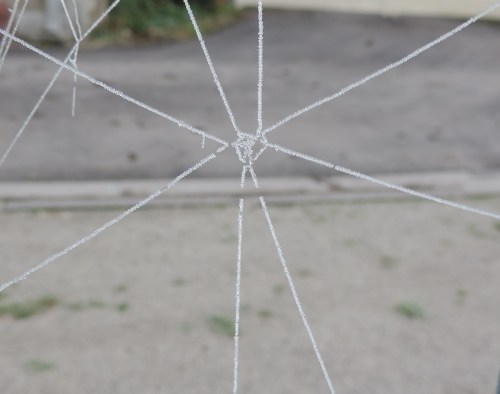
I’ve seen some amazingly complex and elaborate spider webs in my time, but look at this one I stumbled across early one morning recently.

I reckon this has been spun by a truly Charentaise spider. One of the commonest phrases people use in the neck of the woods is “soyons zen” (“let’s stay zen” – meaning keep calm, take it easy, relax…..you get the drift!). The creature which is one of the emblems of this region is a snail, and a small town near me (Segonzac) is one of the “Citta Slow” network.

cagouille

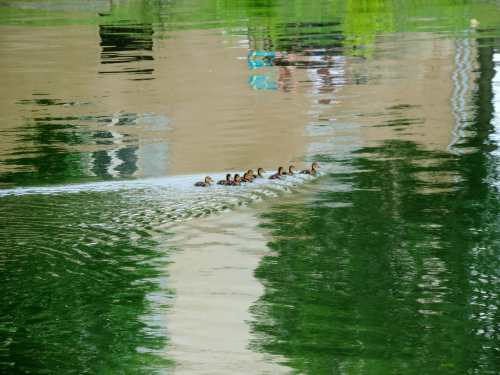
People say the River Charente flows slowly and calmly. It’s not in a rush. It doesn’t get all white spray and choppy (at least not as it flows through Cognac), and the way that river lives becomes yet another potent emblem of the Charentaise way of life.

duck family

So what struck me about this web was its bare, sparse, simplicity. And it’s that simplicity which appeals to me so much. I find a real beauty in it. Yes, I admire, and can easily be in awe of, the complex and the elaborate, but simplicity just hits the mark so directly and powerfully, don’t you think?

I know, some of you might be thinking “that spider’s not going to catch many flies with that web!” and I thought that too, but then I got to thinking, who says spiders never make webs just for the sheer fun of it? Who says spiders only have one reason to spin a web? And how does whoever says that, know?

Maybe some webs are spun to catch morning dew.

Maybe some are spun to be beautiful.

Maybe some are just spun because a spider is just being, sorry…… becoming, a spider!

Read Full Post »

between

I’m not a fan of labels and categories.

I don’t like putting things into boxes with rigid edges.

I find life is so complex, rich and varied that to default to “two value thinking” (categorising experiences or phenomena as either “this” or “that”) diminishes rather than enhances.

I like what Iain McGilchrist refers to as the “between-ness” of things. He says that’s the essence of the right cerebral hemisphere’s approach to the world.

Focusing on the between does at least two things I find. It heightens my awareness of change, because all I see, hear, taste, feel, think about, is constantly becoming. Secondly, it focuses me on relationships and connections. To look for the between involves considering between what, and so, not only what is being connected, but on the very quality and nature of the connections and relationships themselves.

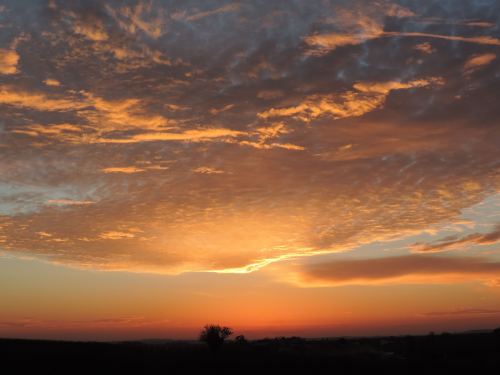
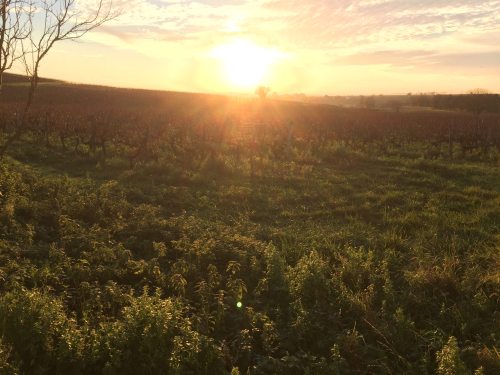
The moments just after the sun sinks below the horizon are a fantastic opportunity to immerse yourself in the between. If day is when the sun is in the sky, and night is when it is below the horizon and the light has gone, then these moments, one of which is in the photo here, are somewhere in between day and night.

Try it for yourself and see what it feels like. Experience the between!

Read Full Post »

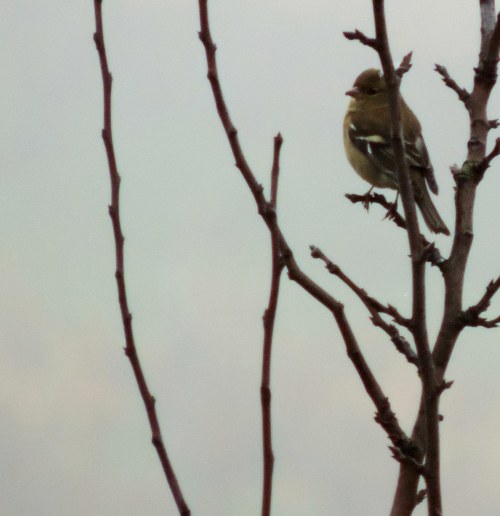
birdwatch

Montaigne wrote

There is nothing that should be recommended so much to youth as activity and vigilance. Our life is nothing but movement…

When I read this I automatically reframed it into a more modern language and something which fitted better with the themes which are important to me – actions and awareness.

I also thought immediately of the birds in the garden. How they seem to be busy all the time and also, continuously “vigilant” or aware.

If I was to single out two characteristics which make the difference between zombie mode and hero mode in our lives it would be these two –

Activity

In some ways you could argue that we are what we do. When writing stories we create and reveal character by describing the choices they make. William Glasser developed a whole therapeutic approach based on making people more aware of the choices they are making all the time – because we do choose all the time. It’s just that for a lot of the time the choices happen automatically as part of habits, routines or manipulation. That’s the zombie way in my view.

The auto-pilot way. We’re not experiencing our human-ness to the full when we live that way. But we are active all the time. Even if that activity is simply sitting and breathing.

If you’d like to explore this in more depth, then search for my posts in the “a to z of becoming” series on this site where I reflect on 52 different verbs, each of which is an action we can take to further our “becoming”.

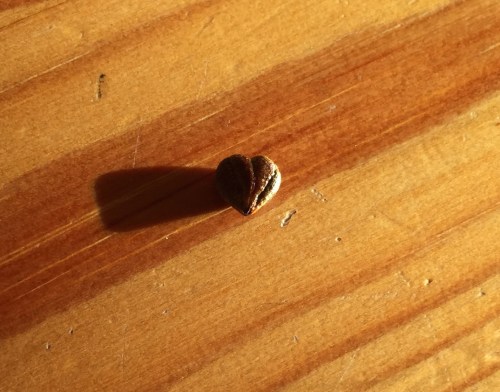
Life is difficult to define. I mean from a scientific or biological perspective. You can see that in the difficulty we have knowing whether or not a seed is alive. But amongst the most successful attempts to define life there is always some mention of action – of respiration, or metabolism. Or as Maturana and Varela said – of “self-making” – they even came up with a new word for that – “autopoiesis”.

If life is significantly about the activities we are undertaking, then might it not be better to be aware? To reflect and consider so that we can choose? Even if we choose to continue doing what we were doing anyway?

That leads to the second characteristic –

Awareness

People talk a lot about mindfulness these days, but that word is really just another word for awareness. To be “mindful” is to be aware.

Awareness is partly about paying attention. It’s about focus. Where are we directing our attention? What is catching our attention?

And it’s partly about reflection, because as we reflect on what has just occurred or what we have experienced we heighten our awareness and deepen our understanding of ourselves and our lives.

As Ellen Langer says, mindfulness is the opposite of mindlessness. Why would you choose the latter?

So, maybe there’s something to learn from the birds – and from Montaigne – that “activity and vigilance” are to be recommended!


Read Full Post »

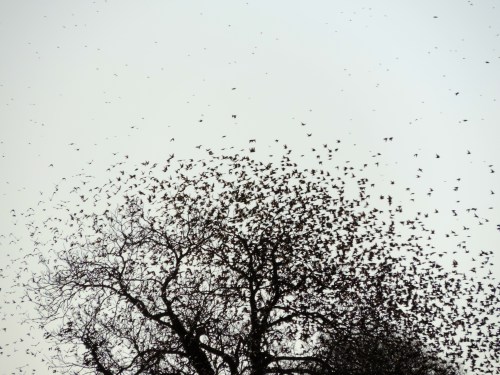
DSCN4747

Look at this tree. Those aren’t leaves, they’re birds! Hundreds of them, thousands maybe.

I’ve never seen such a large flock of birds near me before. Maybe you haven’t either. What do you think your response would be? Would you think of Alfred Hitchcock?

Not me!

I didn’t think of that for a moment.

I was fascinated, entranced, drawn outside with phone and camera to do my best to record something of this phenomenon.

Here’s what I put together from my short video clips and some photos.

Later, while reading Montaigne, I read

He who fears he will suffer, already suffers from his fear.

It got me thinking about the stance we take towards the world, about our default attitude. Because isn’t there so much fear around? In fact, it seems to me that fear is often used deliberately as a weapon of control.

What’s the greatest fear?

Some say it’s the fear of death. That this “existential fear” is the foundation of all other fears. For example, as a comedian I heard once said “I don’t have a fear of flying. I have a fear of crashing!” People who fear the dark, fear what dangers might be hidden in the darkness. People who fear dogs, fear that the dogs will attack them. People who fear illnesses, fear suffering and death.

Montaigne says if you spend your life fearing suffering, you’ll be suffering throughout your life. Yet so much of the health advice offered to people is based on trying to avoid death (the greatest fear).

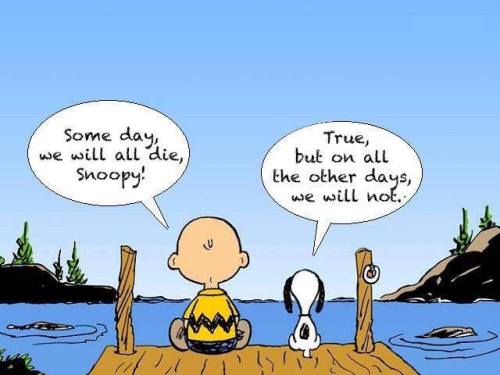
12072632_978160722251727_1794598302913905177_n

If fear is our default, we don’t just suffer, we live in a shrinking world, fearing difference, the “other” and change.

What’s the alternative?

6d36c2e75bc308b00db209125c854c06

Dread one day at a time??!!

Nope.

The great thing about alternatives to fear is that there are so many of them.

There’s courage. Courage is the determination to go ahead even when you are feeling fear. That’s something I’ve been practising since coming to live in France. When you start to live in another country with a different language, not only are customs and habits different but at first you’ve no idea how to ask the simplest things. So a trip to a post office, or the local Mairie, or the garage can be quite intimidating. Until you summon up your courage, and just go. And, in my experience here, each and every time I discover there has been absolutely nothing to be afraid of. People are friendly and they want to help. (Then next time you go the fear has diminished, or even gone away entirely)

There’s wonder. Wonder and curiosity. That’s the response I had when I saw all the birds. That’s the attitude I hope to take into every day – l’émerveillement du quotidien.

There’s love. Love comes with a desire to make connections and with an intention to care, or at very least, not to harm – and that applies in relation to plants and animals as much as to other human beings. How often does it seem to be that when your intention is a loving one, that you meet the same response? When I was a GP, my partners and I built a new clinic and the reception was an open one – no glass or metal barriers between the patients and the staff. We were warned that we’d be vulnerable to being attacked. It never happened. Not even remotely.

Fear closes.

It closes us off from the world and from life.

The opposite is whatever opens – courage, wonder, curiosity, love…..add your own favourites at the end of this sentence!

I prefer the opposites for what they bring in themselves, but I resist fear for another reason. I don’t want to be controlled. Heroes not zombies anyone?


Read Full Post »

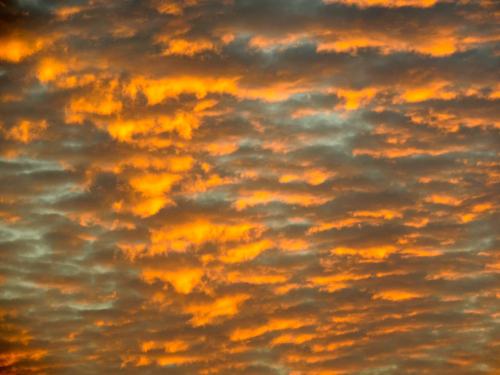
orange clouds

Montaigne wrote –

Except for old age, which is an indubitable sign of the approach of death, in all other ailments I see few signs of the future on which to base our divination.

When I read this I immediately remembered a conversation I had with a patient one day. She’d just told me that her husband had been diagnosed with cancer and had been told he had six months to live. I asked her how she felt about that.

“I’m angry”.

That’s not such an uncommon response when people hear such bad news, but I don’t take anything for granted so I asked her to say why she felt angry.

“How come he gets to know how long he’s got, and I don’t get to know how long I’ve got?!”

Well, that surprised me! I hadn’t heard a response like that before.

So I took some time to explain that having a particular disease did not bestow any certainty about the future. Prognosis is a tricky a practice. When speaking statistically about groups or “cohorts” in studies we can say one thing, but when speaking about an individual, it’s actually much, much harder.

The diversity of human experience undermines predictions every day. I think that was one of the best lessons I learned as a doctor. Beware of false certainties!

Read Full Post »

tree

Just by being alive we affect those around us.

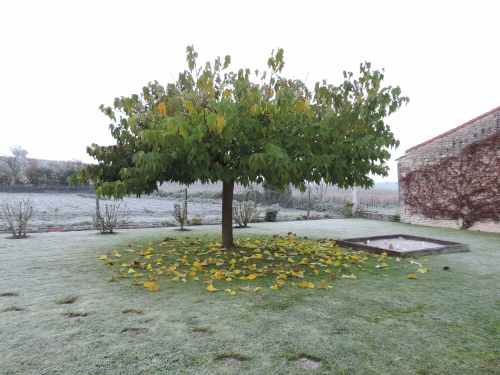
When I woke up the other day and saw the frost on the grass, and how, under the mulberry tree, in addition to it dropping an attractive circle of yellow leaves, the grass was unfrosted. I don’t know if that is because the leaves on the branches create an invisible zone of warmer air preventing the frost from forming, or whether its warmth from the activity of the roots under the soil, but it’s striking isn’t it?

It made me think how just by living we affect the world we live in. What we breathe in, what we breathe out, what we eat, what we excrete, and all the actions we take.

I reckon even our thoughts start to ripple out into the universe. Our thoughts affect our the metabolism of our bodies, our immune and inflammatory systems (our defences), what we say to others, and our actions. In all these ways the environment around us changes. Maybe just a little, maybe quite a lot.

None of us live in a vacuum or a bubble. The world is different today because you are living in it. Guess it’s worth taking some time to reflect and wonder what kind of ripples we are sending out, what shadows we cast.

The COP21 conference in Paris comes up next week. A good time to consider how our choices and our lifestyles affect the rest of the world…..

Read Full Post »

IMG_3968

Montaigne had strong views about health and doctors. He disparaged those who claimed to be better able to tell him what was good for him than he was.

He trusted his self-knowledge more than what others said or wrote about such matters, saying, for example, “I would rather be an authority on myself than on Cicero”. That strikes me as an admirable goal – to become an authority on yourself – to know yourself!

He said of medicines – “If it is a pleasant medicine, take it; it is always that much present gain. I shall never balk at the name or the colour, if it is delicious and appetizing. Pleasure is one of the principal kinds of profit.”

He said of “advice”, or rules for living prescribed by a doctor, “The disease pinches us on one side, the rule on the other. Since there is a risk of making a mistake let us risk it rather in pursuit of pleasure.”

One of my teachers said “Your patient’s life shouldn’t be harder for them when they leave your consulting room, than it was when they came in.” That struck me as wise advice. Montaigne would have agreed!

His issues on this subject weren’t just about doctors and medicines however. He was concerned about people telling others how to live. He gives examples of the diverse lifestyles of shepherds and fishermen and asks if it is sensible to give such different people exactly the same advice.

That’s an issue which troubled me throughout my career. Over the years we’d hear that fat was bad for you, fat was good for you; milk was good for you, milk was bad for you; hormone replacement therapy should be offered to all women, hormone replacement therapy should be avoided at all costs…..and so on.

As advice moves from how to recover from, or “manage” an illness, to prevention, the whole situation becomes infinitely worse.

Is there really any point in living a life of avoidance as a core principle? Avoid this, avoid that, don’t eat this, don’t drink that, don’t do this, don’t do that…..Montaigne quotes the sixth century poet, Maximianus, to back up his stance.

Obliged to wean our souls from things on which they thrive,

We give up living, just to keep alive.

“We give up living, just to keep alive”. Wow! That’s the heart of it. Surely there’s a seed of something wonderful in that one line?

Life’s for living. Death avoidance has a 100% failure rate…..eventually!


Read Full Post »

dawn frost

The other morning the sky turned pink as the sun was getting up out of bed and it cast a delicate rosy hue to the frosted grass.

The pink had faded away within minutes and the frost was gone by the end of the morning.

Transience is held in high regard in the Japanese aesthetic of “wabi sabi”. I’ve written a few times about the phenomenon of the annual cherry blossom festivals in Japan, but that’s just one of the most prominent expressions of this admired quality.

What is it about transience that makes something so special? Isn’t our instinct to want to hold on? To grasp at whatever pleases us? To try to resist change?

Well, there’s no doubt we have those qualities, but just as all human life is filled with paradoxes and opposites, we have this attraction to transience too.

I knew instantly that the pink in the sky would be gone within minutes. And I was pretty sure the frost wouldn’t last all day either! But that drew me right in to being fully present. And that’s what I think this quality of transience does for us. It heightens the experience of now.

The pre-socratics used to say start every day knowing that whatever you experience today will be for the first time ever, and knowing also that whatever you experience today will be for the last time ever. Every moment is unique. Every day is special. No two experiences are exactly the same.

So whatever you encounter today, savour it, relish it, enjoy it to the full.

Read Full Post »

« Newer Posts - Older Posts »